Agentic AI vs Generative AI: What They Are and Which One You Need
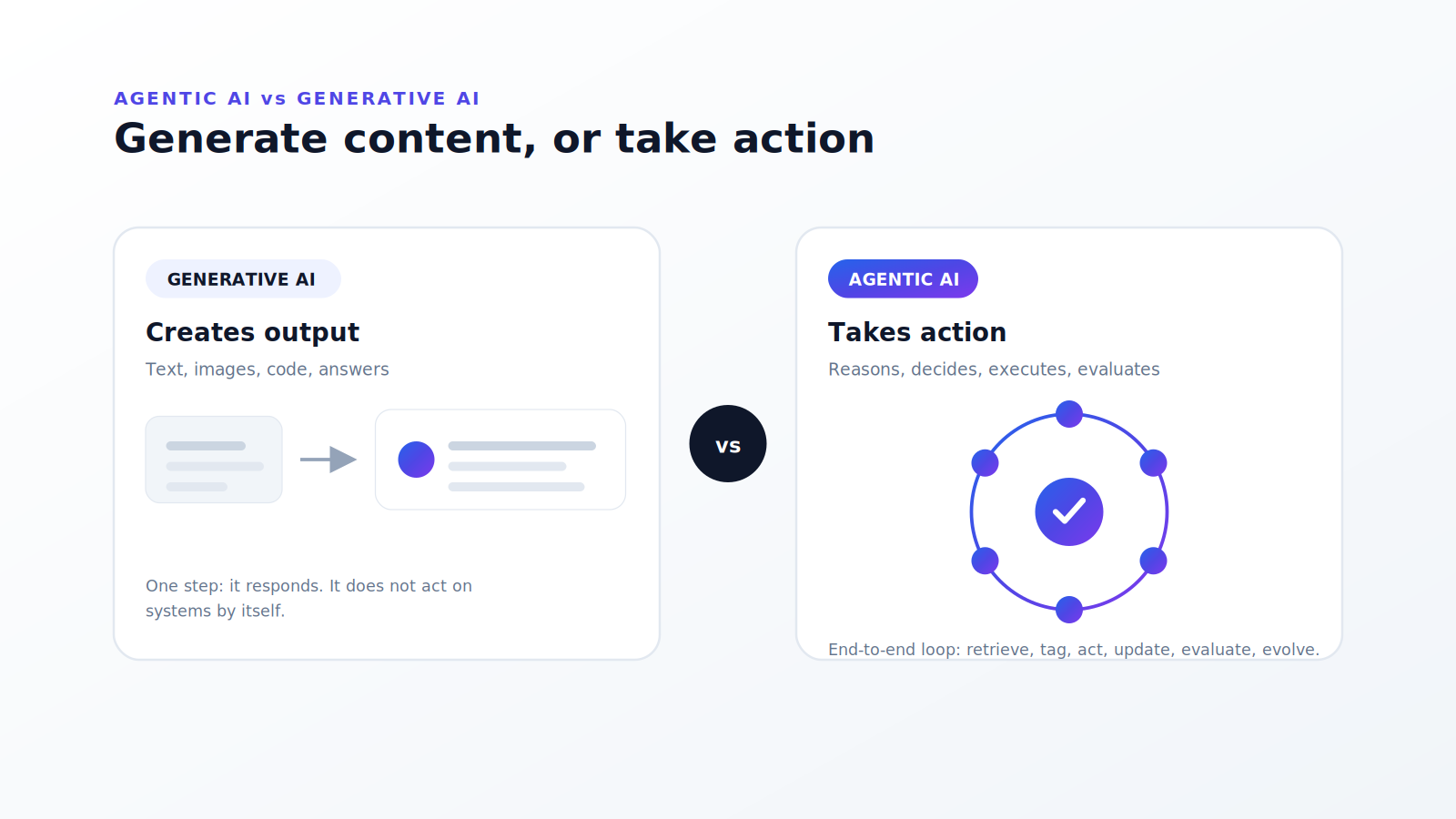
Here's the short answer. Generative AI creates content — text, images, code, an answer to a question. Agentic AI takes action — it reasons through a goal, makes decisions, and executes steps across your systems to get something done. The agentic ai vs generative ai distinction comes down to one word: doing. Generative AI produces an output; agentic AI produces an outcome. This guide gives you the straight definitions, the real difference, how the two relate, and how to tell which one your use case actually needs.
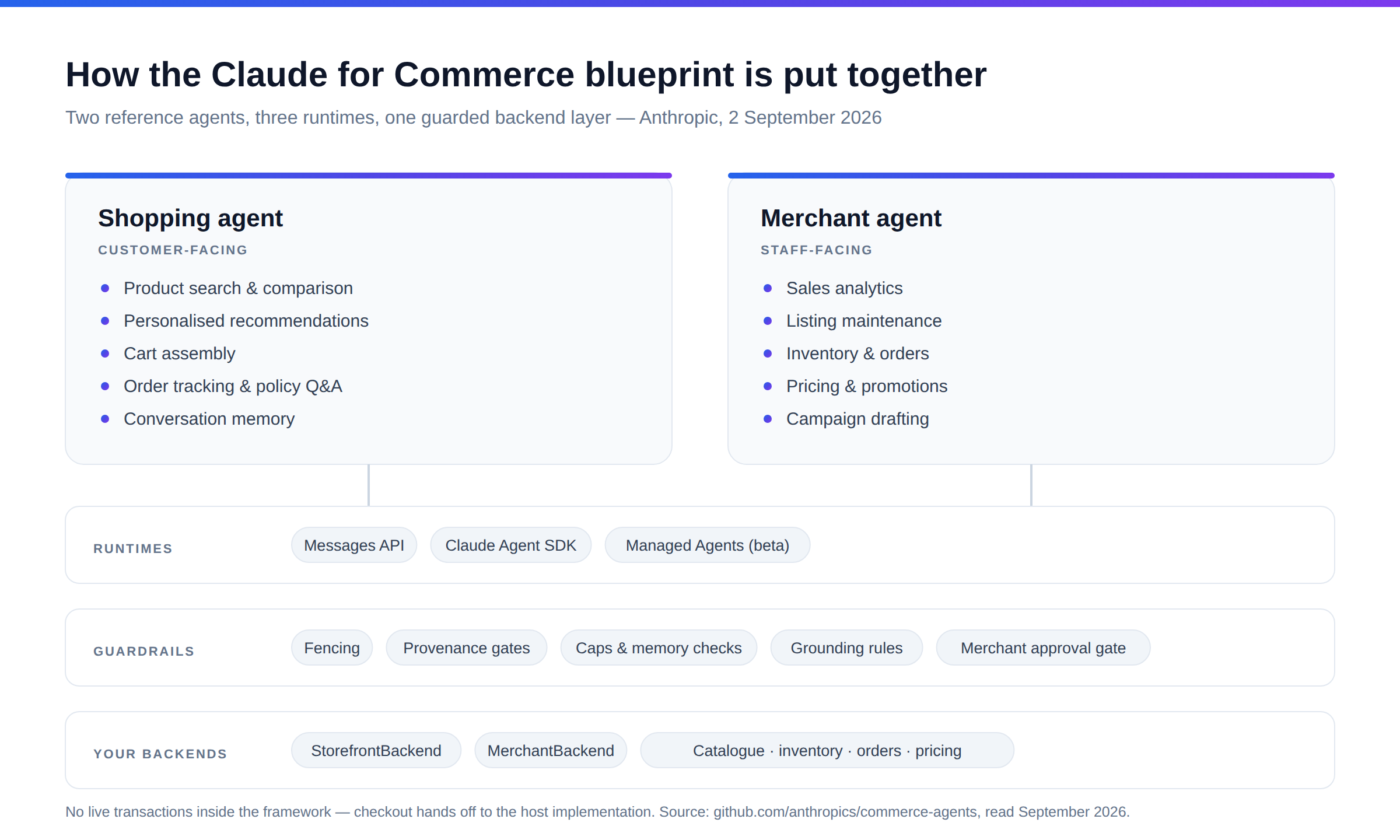
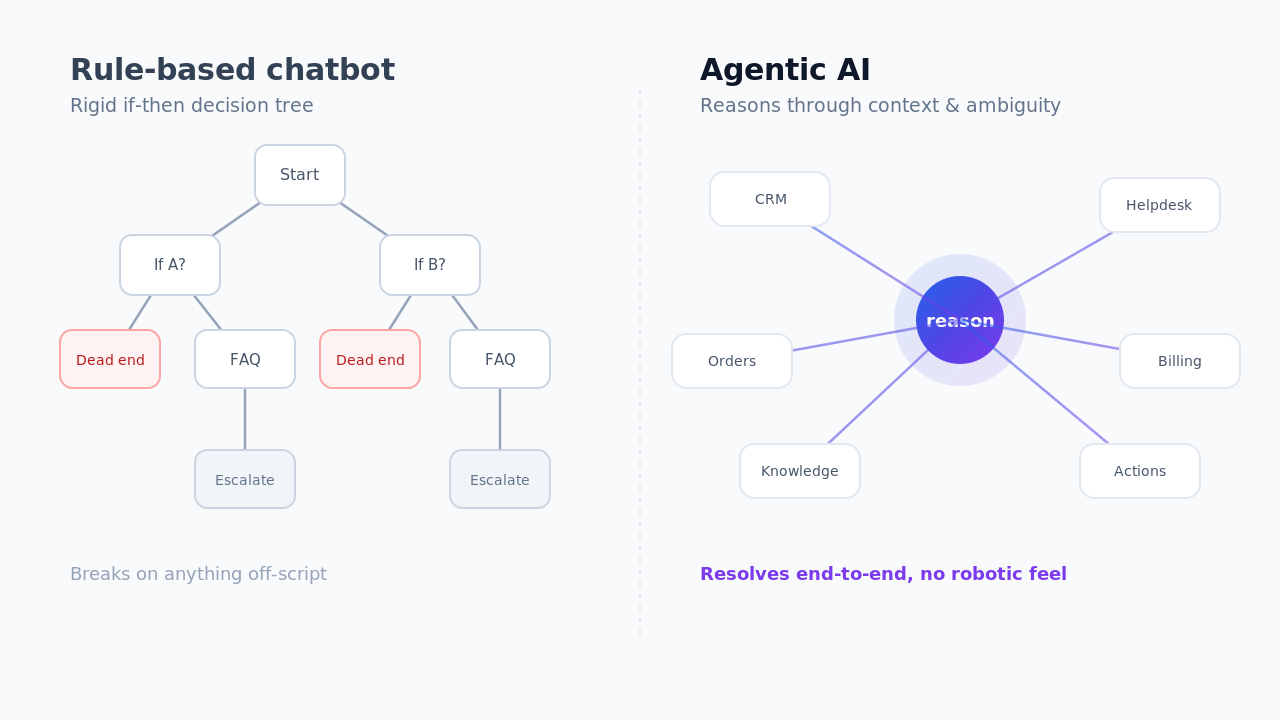
The market has matured past the "add a chatbot" era — see the evolution of conversational AI for how it got here. Real customer service automation now runs on multi-agent, agentic AI that reasons through a case, takes actions in your systems, and escalates cleanly when it should. The upside is real, but so is the risk of confusing the two. Let's fix that.
What is generative AI?
Generative AI is a class of models that generate new content in response to a prompt. Trained on large datasets, these models predict and produce text, images, audio, or code that resembles what a human might create. When you ask a chatbot a question and it writes a fluent answer, that's generative AI at work — it retrieved patterns from its training and generated a response.
Generative AI is powerful and genuinely useful: drafting replies, summarizing a thread, translating a message, suggesting an article. But notice its boundary. It generates and then stops. On its own, generative AI doesn't decide what to do next, take an action in another system, or verify that a job is finished. It answers; it doesn't act.
What is agentic AI?
Agentic AI is AI built to accomplish goals autonomously. An agentic system reasons about a task, breaks it into steps, chooses tools, calls other systems, checks its own work, and adapts when reality changes — all in pursuit of an outcome you defined. The key capability, the thing that makes it "agentic," is the ability to do: to take real actions, not just describe them.
Concrete agentic ai examples: an agent that reads a refund request, checks the order in your commerce platform, confirms the policy, issues the refund, updates the ticket, and notifies the customer — end to end. Where generative AI would draft the refund email, agentic AI actually processes the refund. Modern agentic systems are usually built as a multi-agent platform where specialized agents coordinate, because real work rarely fits one prompt.
Agentic AI vs generative AI: how they differ
The difference between agentic AI and generative AI is action versus output. Generative AI is fundamentally a content technology — its unit of work is a generated artifact. Agentic AI is fundamentally an operational technology — its unit of work is a completed task.
That single shift changes everything downstream. Generative AI is stateless and reactive: prompt in, content out, no memory of a larger goal. Agentic AI is goal-directed and stateful: it holds an objective, plans, acts, observes the result, and loops until the objective is met or it decides to escalate. Generative AI needs a human to carry its output somewhere and do something with it. Agentic AI closes that loop itself. One writes the answer; the other resolves the case.
How agentic AI and generative AI relate
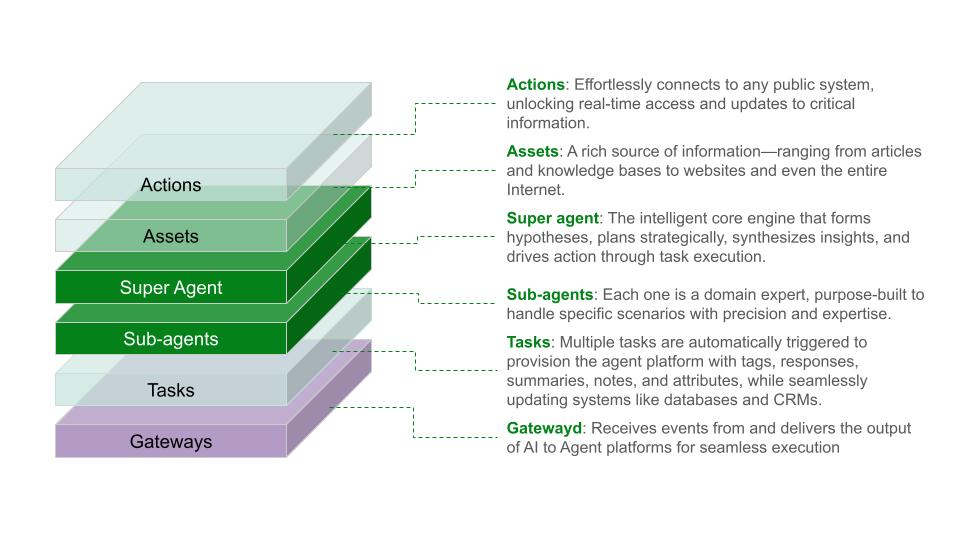
They aren't rivals — they're layers. This is the most common point of confusion, so to answer the question directly: agentic AI usually contains generative AI, but it is not the same thing. A generative model is often the "language brain" inside an agentic system — the part that understands the customer, drafts a reply, or interprets a document. Agentic AI wraps that brain in the machinery that makes it useful: planning, memory, tool use, system integrations, evaluation, and guardrails.
Put simply, generative AI is a component; agentic AI is an architecture. You can have generative AI without any agentic behavior (a chatbot that only answers). You cannot have a genuinely agentic system without some generative capability underneath. The AI operational layer is what turns a capable generative model into a system that reliably gets work done in your business.
A useful analogy: generative AI is the engine, agentic AI is the whole car. An engine is impressive on its own, but it doesn't take you anywhere until it's connected to a transmission, wheels, steering, and brakes — the parts that turn raw power into controlled movement toward a destination. Agentic AI is that assembly. It takes the generative model's raw language capability and adds the direction (a goal), the controls (tools and integrations), and the safety systems (evaluation and guardrails) needed to actually arrive somewhere. This is also why "should I use generative or agentic AI?" is often the wrong question. The better question is how much of the car you need: if you only want to draft text, the engine alone is fine; if you need to get work delivered, you need the vehicle around it.
What each means for customer service and sales
This is where the distinction stops being academic and starts showing up in your numbers. A customer service or sales interaction is not a single question — it's a chain of steps. Answering the question is only the first one.
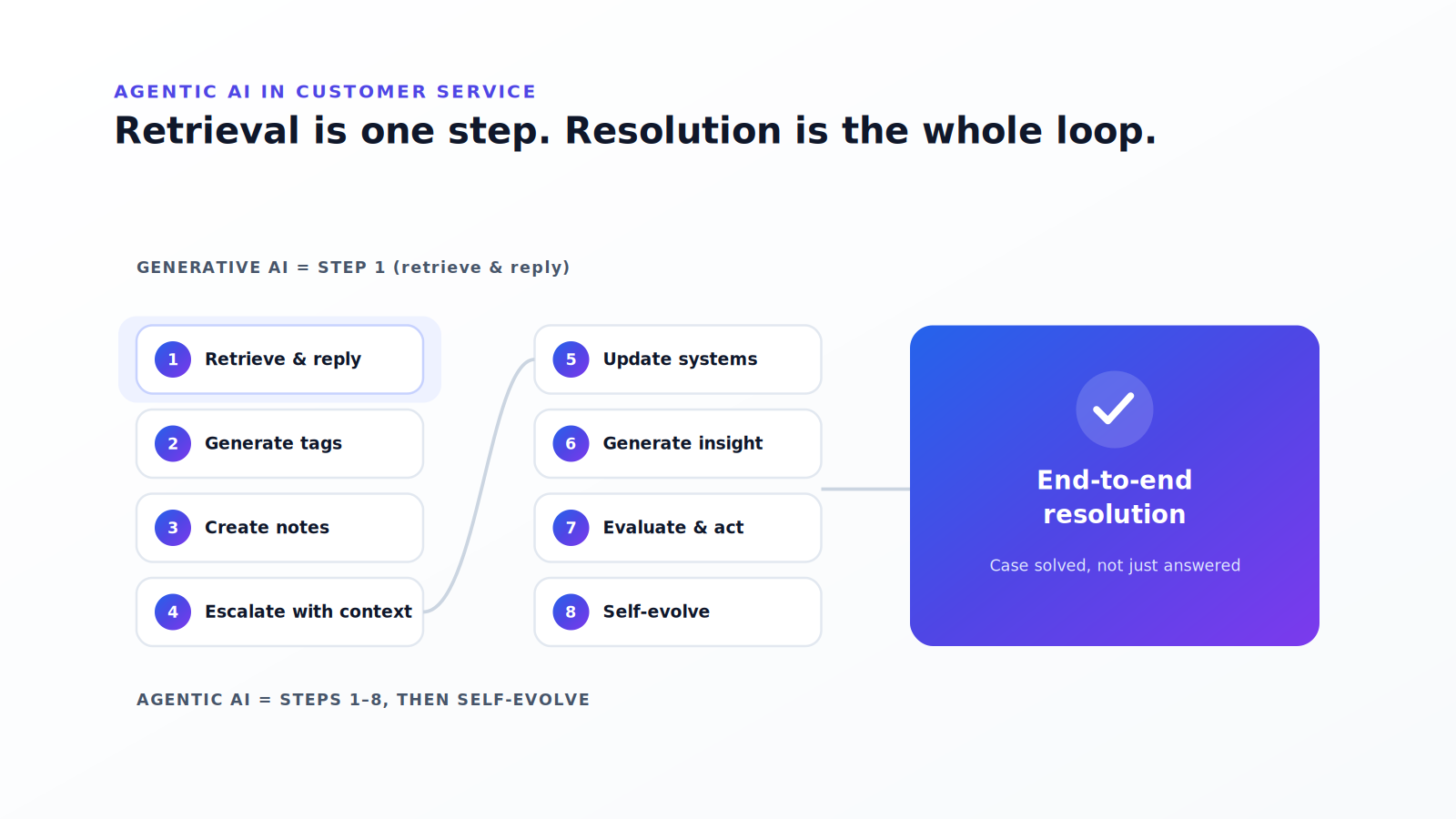
Generative AI, on its own, handles information retrieval and reply — one step in a much longer process. Genuine agentic AI for customer service handles the whole chain: it retrieves and replies, generates the right tags, creates internal notes, escalates with full context when a human is needed, updates the systems of record (the CRM, the order, the subscription), generates insight from what it sees, evaluates and takes the next action, and then self-evolves as patterns change. That's the difference between deflecting a ticket and resolving it.
The business consequence is concrete. Retrieval-only automation caps out at deflection — it answers, the customer still has to do the work, and CSAT quietly suffers. End-to-end agentic automation drives real resolution rate, higher CSAT, and lower cost per case, because the case is actually finished. Our AI customer service benchmark by industry shows how far apart "answered" and "resolved" really are — often 20–40 points. On the sales side the same logic holds: generative AI can suggest a response, but agentic AI can qualify the lead, recommend the right product, update the opportunity, and move the deal forward. And because the system runs on a deep insight engine and continuous optimization, it doesn't just act once — it learns which actions work and improves.
Which one fits you?
There's no universal winner; there's a right fit for your use case. If all you need is content — draft copy, a summary, a first-line answer — generative AI may be plenty. If you need work completed without a human doing every step, you need agentic AI. Weigh the choice across four areas.
Capability needed. Start from the job. Does success mean "produce a good answer," or does it mean "the ticket is closed, the record is updated, and the customer is satisfied"? If actions across systems are part of "done," only agentic AI can deliver it. Generative AI will leave the last mile to your team.
Cost and budget. Generative AI is generally cheaper to run per call and simpler to adopt. Agentic AI does more per interaction and can cost more to stand up — but the honest comparison is cost per resolution, not cost per message, because agentic AI removes downstream human handling. See how the math works in our cost per ticket breakdown.
Reliability. This one cuts toward caution. A system that only generates text is easier to constrain, guarantee, and evaluate. An agentic system that takes real actions is more powerful and inherently harder to control — more moving parts, more ways to go wrong. That's exactly why the platform matters: reliable, no-hallucination behavior, strong guardrails, clean escalation, and rigorous evaluation are what make agentic AI safe to trust with real operations. Don't adopt agentic capability without them. It also helps to know the shape of the risk: agents are often strongest on hard, novel cases and least consistent on the routine ones, which is the central problem facing commerce agents.
Performance target. If your goal is ambitious — high resolution rates, measurable CSAT gains, real cost reduction — agentic AI has the stronger ceiling, because it finishes work rather than handing it off. If your target is modest and content-shaped, generative AI clears the bar at lower complexity.
Key takeaways
Generative AI creates; agentic AI acts. They relate as component to architecture — agentic systems typically use generative models inside a larger loop that plans, integrates, evaluates, and executes. In customer service and sales, generative AI covers one step (retrieve and reply) while agentic AI covers the end-to-end path to resolution. Choose based on your use case and four factors: the capability the job actually needs, your cost and budget, the reliability you can guarantee, and the performance target you're chasing. When "done" means real work completed — not just a good answer — agentic AI is the fit.
Want to see end-to-end resolution in action? Watch agentic AI resolve real tickets across your stack, not just answer them. Book a free demo →
Frequently asked questions
What is the difference between agentic AI and generative AI?
Generative AI creates content — text, images, code, or answers — in response to a prompt, then stops. Agentic AI pursues a goal: it reasons, plans, takes actions across systems, checks its work, and adapts until the task is done. The core difference is action. Generative AI produces an output; agentic AI produces a completed outcome.
Is agentic AI generative AI?
No, but they overlap. Agentic AI usually contains a generative model as its language and reasoning core, then wraps it in planning, memory, tool use, integrations, and guardrails so it can act. So generative AI is a component, and agentic AI is the larger architecture built around it. You can have generative AI alone, but not agentic AI without generative capability.
What is an example of agentic AI?
A customer support agent that reads a refund request, verifies the order in your commerce system, checks the policy, issues the refund, updates the ticket, and notifies the customer — end to end, without a human doing each step. Generative AI would draft the email; agentic AI actually completes the refund and updates every system involved.
When should you use agentic AI vs generative AI?
Use generative AI when the job is to produce content — a draft, a summary, a first-line answer. Use agentic AI when the job is to complete work across systems without a human carrying every step. If success means "the case is resolved and records are updated," you need agentic AI. If it means "give me a good answer," generative AI may be enough.
Which is better for customer service, agentic AI or generative AI?
For genuine resolution, agentic AI. Generative AI handles information retrieval and reply — one step — while agentic AI also tags, notes, escalates, updates systems, generates insight, takes action, and self-evolves, which is what actually closes a case. Generative-only tools tend to deflect rather than resolve, which can raise volume and lower CSAT over time.
Is agentic AI more expensive than generative AI?
Per interaction, agentic AI often costs more and takes more to deploy, because it does more than generate text. But the right comparison is cost per resolution, not cost per message: agentic AI removes downstream human handling, so a higher per-interaction cost can still mean a much lower total cost per solved case. Compare loaded cost per resolution, not sticker price.
Does agentic AI still hallucinate like generative AI?
Any system using a generative model can hallucinate, so the safeguards matter more in agentic systems because they take real actions. Well-built agentic platforms reduce this with grounding in your data, strict guardrails, verification and evaluation steps, and clean escalation to humans. Reliability engineering — not the model alone — is what makes agentic AI safe for real operations.
Can generative AI and agentic AI work together?
Yes — that's the norm. Most production agentic systems use generative AI for language understanding and drafting, then add planning, tool use, and integrations to act on that output. Think of generative AI as the brain and agentic AI as the body and nervous system that let it get real work done in your business.