The Evolution of Conversational AI: From Expert Systems to Agentic AI
Conversational AI has moved through four stages: expert systems built on knowledge bases and similarity retrieval, intent and entity engines wired together with rules, generative AI with RAG, and now agentic AI that reasons and acts. The last two arrived close enough together that they're best read as one era — the shift from systems that match to systems that understand. Knowing which stage a conversational AI platform actually belongs to is the fastest way to predict how it will behave when your real traffic hits it.
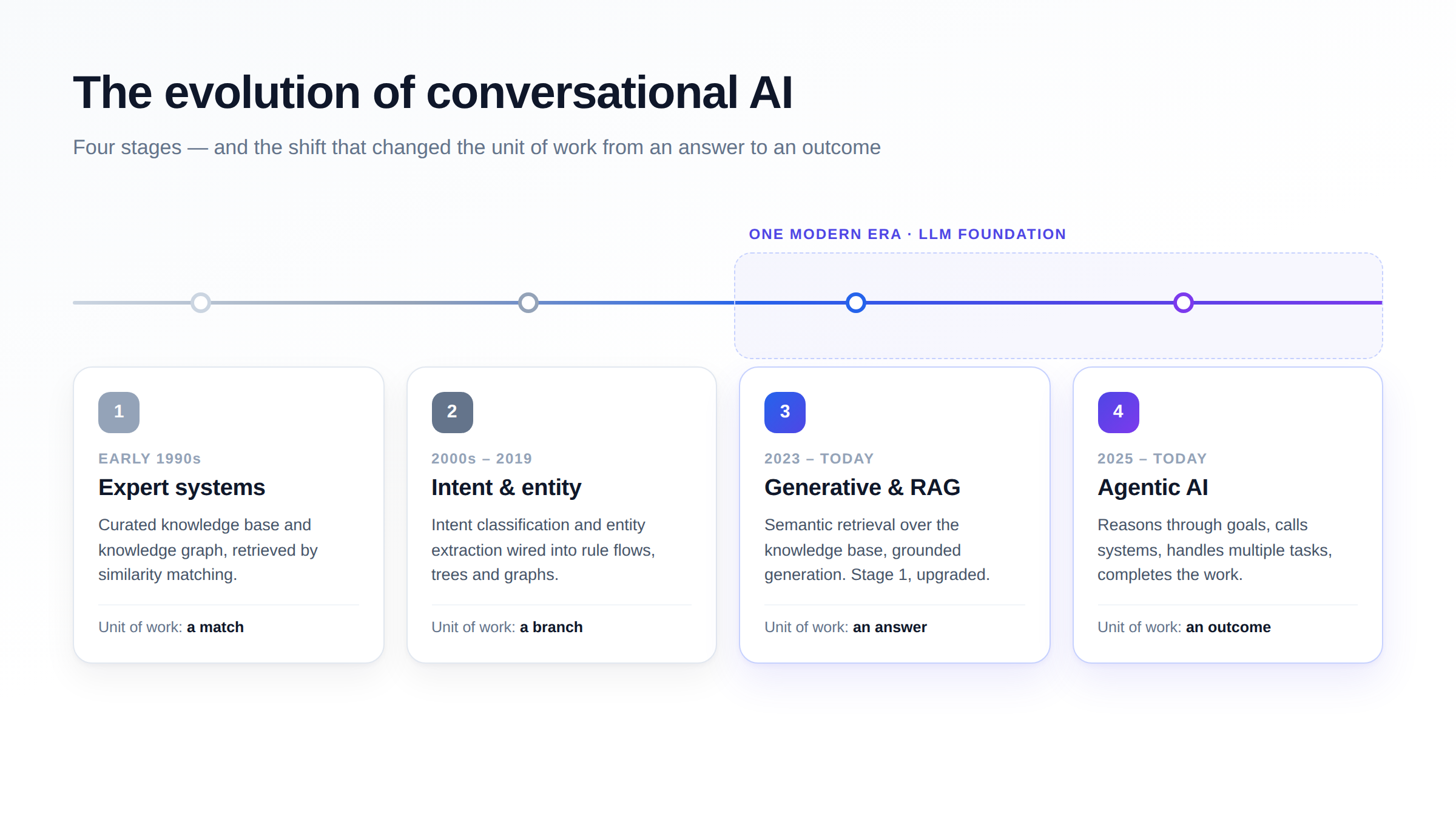
Every stage solved the previous stage's failure. Every stage also carried its own ceiling. That pattern is the useful part of this history, because the ceilings are still visible in products being sold today.
What is conversational AI?
Conversational AI is any system that holds a natural-language exchange with a person and does something useful with it. That definition is deliberately broad, because the category spans a 1990s decision-tree help system and a 2026 multi-agent platform that issues refunds. Both are "conversational AI." They share almost no architecture.
This is why buying is hard. The label describes an interface, not a capability. The four stages below describe the capability.
Stage 1: Expert systems and knowledge retrieval (early 1990s)
The first conversational systems were expert systems: a curated knowledge base, sometimes structured as a knowledge graph, with a retrieval layer that matched an incoming question to the closest stored answer by similarity.
The logic was transparent. A human wrote the knowledge, a human curated the structure, and the machine found the nearest match. When the question resembled something in the base, the answer was correct and auditable — you could point at the exact record that produced it.
The ceiling was coverage. Anything outside the curated knowledge returned nothing useful, and keeping the base current was permanent manual labor. Similarity matching also had no notion of meaning: a question phrased differently from the stored entry simply missed.
Worth noting, because it matters for Stage 3 — this architecture never actually went away. Knowledge-base retrieval still sits underneath a great many support systems in production right now.
Stage 2: Intent and entity (early 2000s to 2019)
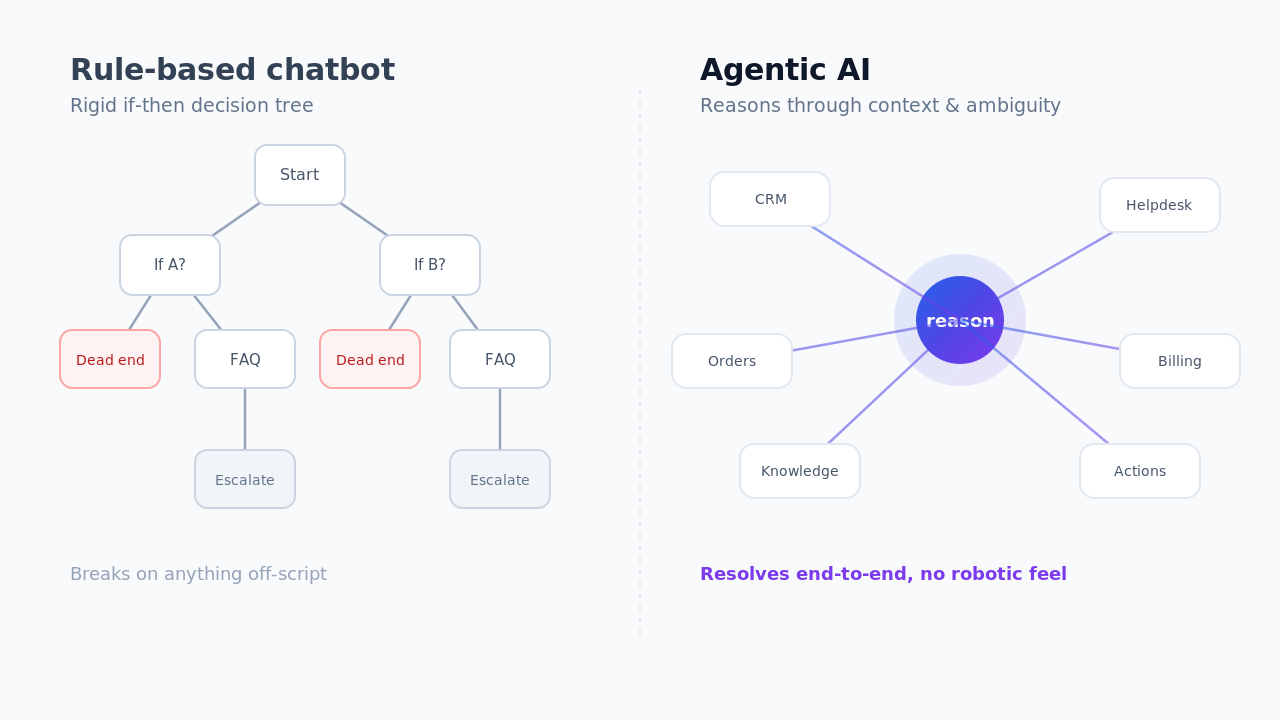
The second stage replaced similarity matching with classification. Instead of finding the nearest stored answer, the system predicted the user's intent from a fixed set, extracted entities (the order number, the date, the product), and then followed a path — a flow, a decision tree, or in more advanced systems a graph — assembled by hand.
Intent detection was the whole ballgame. Get the intent right and the rest of the machinery executed cleanly. This was genuinely the best available engineering for its time: classifiers were reliable enough to be useful, and rule graphs made behavior predictable and testable, which operations teams valued.
Its weakness showed up under real traffic. Intents are a closed set, and customers are an open one. A message carrying two intents, an unusual phrasing, a mid-conversation change of subject, or a genuine edge case would land on the wrong branch — and once on the wrong branch, the rule graph followed it confidently to a dead end. Coverage required more intents, more rules, more branches, and every addition raised the maintenance cost and the chance of collision. It was, in the honest phrasing, fragile in front of real and complex traffic. Most "the bot didn't understand me" frustration people still carry dates from this stage. We've written more on why traditional chatbots break where agentic AI doesn't.
Stage 3: Generative AI and RAG (2023 to today)
Large language models changed the input problem. A generative system doesn't classify an utterance into a fixed bucket — it reads it. Phrasing, typos, compound questions and context stopped being failure modes.
Pair that with retrieval-augmented generation, and the shape becomes clear: retrieve the relevant passages from your knowledge, then have the model compose a grounded answer. Which is to say — and this is the honest framing — Stage 3 is an upgrade of Stage 1, not a departure from it. It's the expert system reborn: the same knowledge base and the same retrieval instinct, but with semantic search replacing similarity matching and fluent generation replacing the canned record.
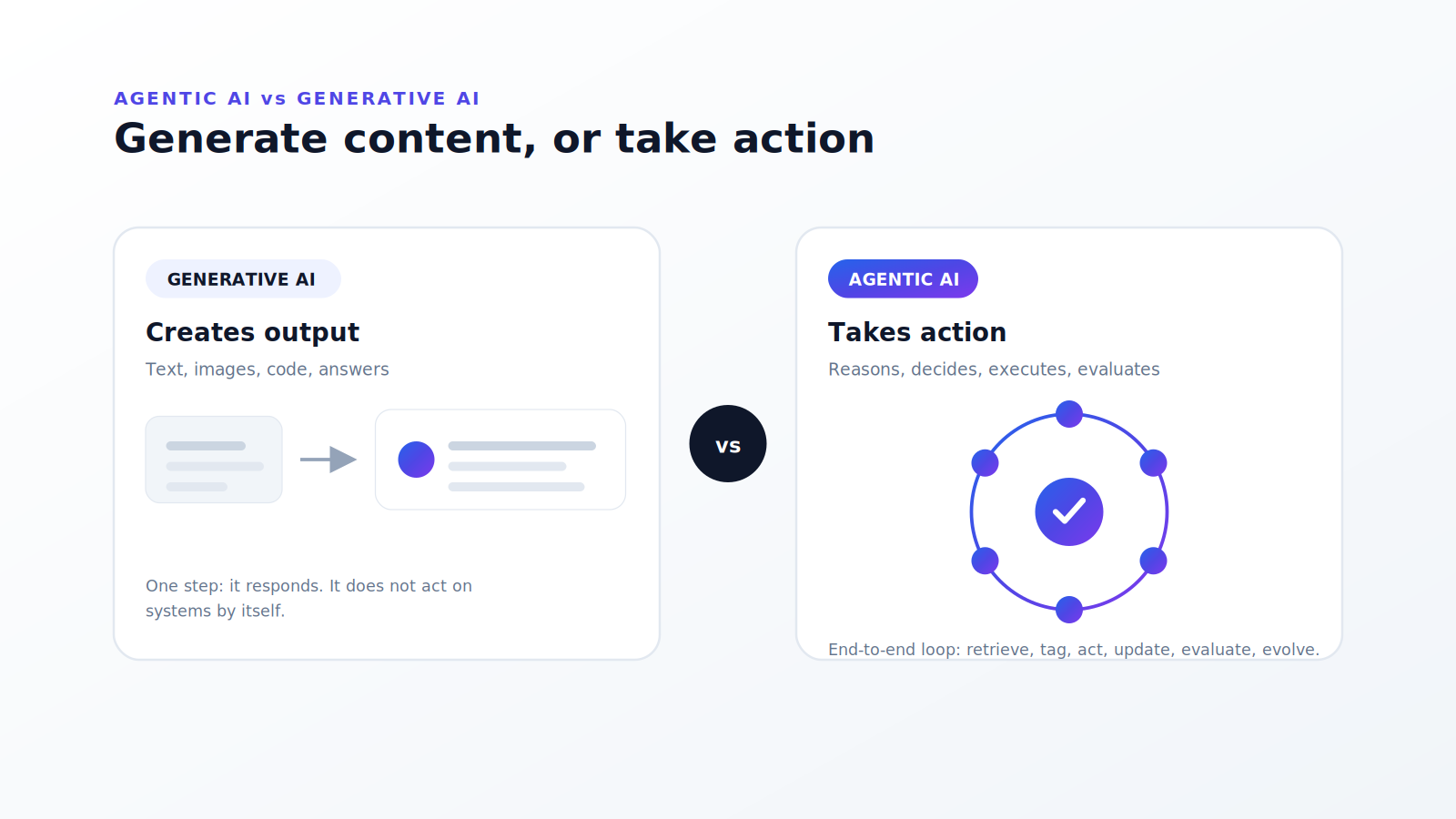
That upgrade is substantial. Coverage widened enormously, maintenance dropped, and answers became readable. But look at what the unit of work still is: an answer. A RAG system retrieves and replies. It does not check the order, issue the refund, update the CRM, or confirm the job is done. It deflects the ticket rather than resolving the case — and a deflected ticket often comes back.
Stage 4: Agentic AI (2025 to today)
The fourth stage changes the unit of work from an answer to an outcome. An agentic system reasons about a goal, decomposes it into steps, calls tools and systems, handles several tasks in one conversation, checks its own work, and escalates when it should.
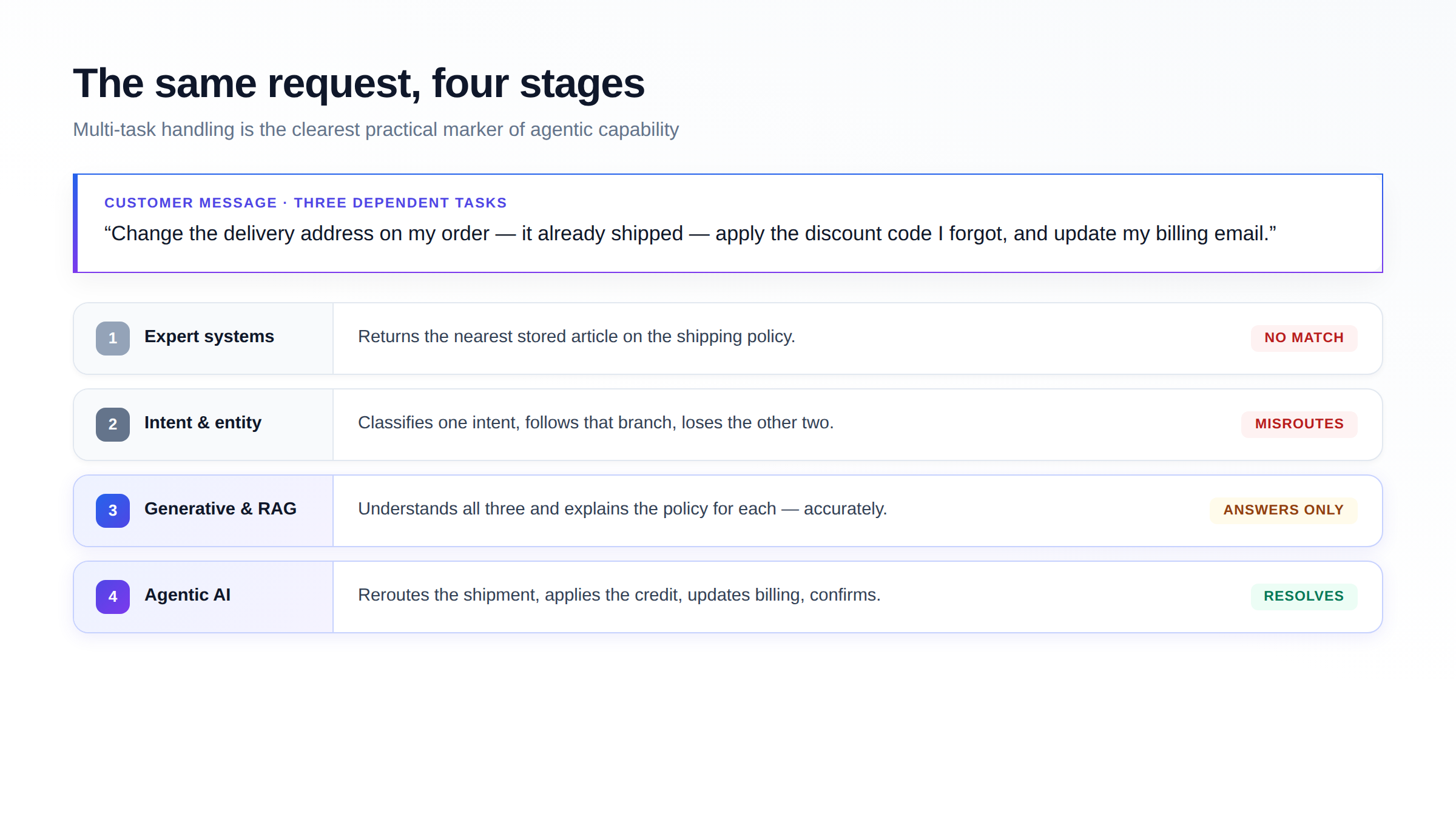
This is what lets a system resolve a case rather than describe a resolution. A customer asking to change a delivery address on a shipped order, apply a discount code retroactively, and update their billing email has issued three tasks in one message — with dependencies between them. Stage 2 would misroute it. Stage 3 would explain the policy for all three. Stage 4 executes them.
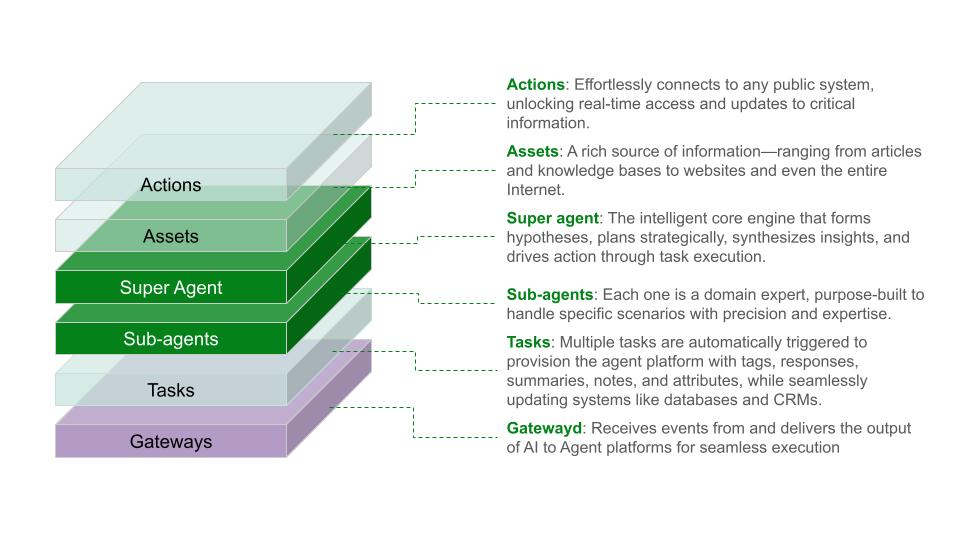
Doing that reliably takes more than a better model. It takes multi-agent architecture so specialized agents handle specialized work, real integrations into the systems where the work lives, and the reliability engineering — grounding, guardrails, evaluation, clean human escalation — that makes autonomous action safe. This is the layer AgentMesh™ implements inside Aissist's AI Operational Layer.
Why stages 3 and 4 are really one era
Stages 1 and 2 are separated by a genuine technological break, and so are 2 and 3. Stages 3 and 4 are not. They run on the same foundation models, arrived barely two years apart, and most Stage 4 systems contain a Stage 3 system inside them — generation and retrieval are how an agent understands the request and drafts the reply.
So read them as one modern era with a decisive internal split: does the system answer, or does it act? That question separates a RAG chatbot from an agentic platform far more sharply than any release date. It's the same distinction we draw in agentic AI vs generative AI.
What this means when evaluating a conversational AI platform
Vendors across all four stages describe themselves in Stage 4 language. Three questions cut through it:
What happens on a request with no stored answer? A Stage 1 or 3 system retrieves the nearest thing or says it can't help. A Stage 4 system reasons toward a path or escalates cleanly with context attached.
Can it complete two dependent tasks in one conversation? Multi-task handling is the clearest practical marker of agentic capability. Stage 2 misroutes it, Stage 3 narrates it.
Is the metric deflection or resolution? Deflection counts conversations that didn't reach a human. Resolution counts problems that ended. A Stage 3 product usually reports the first because that's what it can do. Compare on resolution rate and cost per resolution — our 2026 benchmark normalizes vendors on exactly that basis.
Key takeaways
Conversational AI evolved from curated expert systems, through brittle intent-and-entity rule graphs, to LLM-based retrieval and now agentic execution. Stage 3 is best understood as the expert system upgraded — semantic retrieval and fluent generation over the same knowledge-base instinct — which is why it still answers rather than acts. Stage 4 is the real break, because it changes the unit of work from a reply to a completed outcome. When you evaluate a conversational AI platform, ignore the category label and test the behavior: unknown requests, multi-task conversations, and whether the number reported is deflection or resolution.
Curious which stage your current stack is actually in? See agentic AI resolve real cases end-to-end across the tools you already run. Book a free demo →
Frequently asked questions
What is conversational AI?
Conversational AI is any system that exchanges natural language with a person and acts on it. The term covers a wide architectural range — from 1990s knowledge-base retrieval to modern agentic platforms that take action across business systems. Because it describes the interface rather than the capability, two products called "conversational AI" can behave completely differently on the same request.
What are the stages in the evolution of conversational AI?
Four. Expert systems with knowledge bases and similarity retrieval from the early 1990s; intent-and-entity classification wired into rule flows from the early 2000s to 2019; generative AI with retrieval-augmented generation from 2023; and agentic AI that reasons and takes action from 2025. The last two share a technology foundation and are often treated as a single modern era.
What is the difference between conversational AI and agentic AI?
Conversational AI is the broad category — anything that talks with a user. Agentic AI is the newest stage within it, defined by acting rather than answering. An agentic system reasons through a goal, calls tools and systems, handles multiple tasks, and completes work. Most conversational AI in production today still stops at generating a reply.
Is RAG the same as agentic AI?
No. Retrieval-augmented generation retrieves relevant knowledge and generates a grounded answer — its output is a reply. Agentic AI may use RAG internally for understanding and drafting, then adds planning, tool use, system integration and verification to complete a task. RAG answers the question; an agent resolves the case.
Why did intent-based chatbots fail?
Because intents are a fixed set and customer messages are not. Anything outside the trained intent list — unusual phrasing, two requests in one message, a mid-conversation topic change — got misclassified, and the rule graph then followed that wrong branch to a dead end. Expanding coverage meant more intents and rules, which raised maintenance cost and collision risk.
Are expert systems still used in customer service?
Yes. Knowledge-base retrieval remains widely deployed, and it's also the conceptual ancestor of modern RAG — semantic search and generation layered over the same curated-knowledge foundation. The architecture didn't disappear; it got substantially better inputs and outputs.
How do I tell which stage a conversational AI platform belongs to?
Test three behaviors. Give it a request with no stored answer and see whether it reasons or stalls. Give it two dependent tasks in one message and see whether it completes both. Then ask whether the vendor reports deflection or resolution — deflection usually signals a system that answers rather than acts.
Does agentic AI replace conversational AI?
No — it's the current stage of it. Agentic systems still hold the conversation, and typically use generative models to understand and reply. What changes is what happens after understanding: instead of ending at a good answer, the system carries the task through your systems to completion.