The Evolution of the Knowledge Base: From Knowledge Graphs to Skills and Sub-Agents
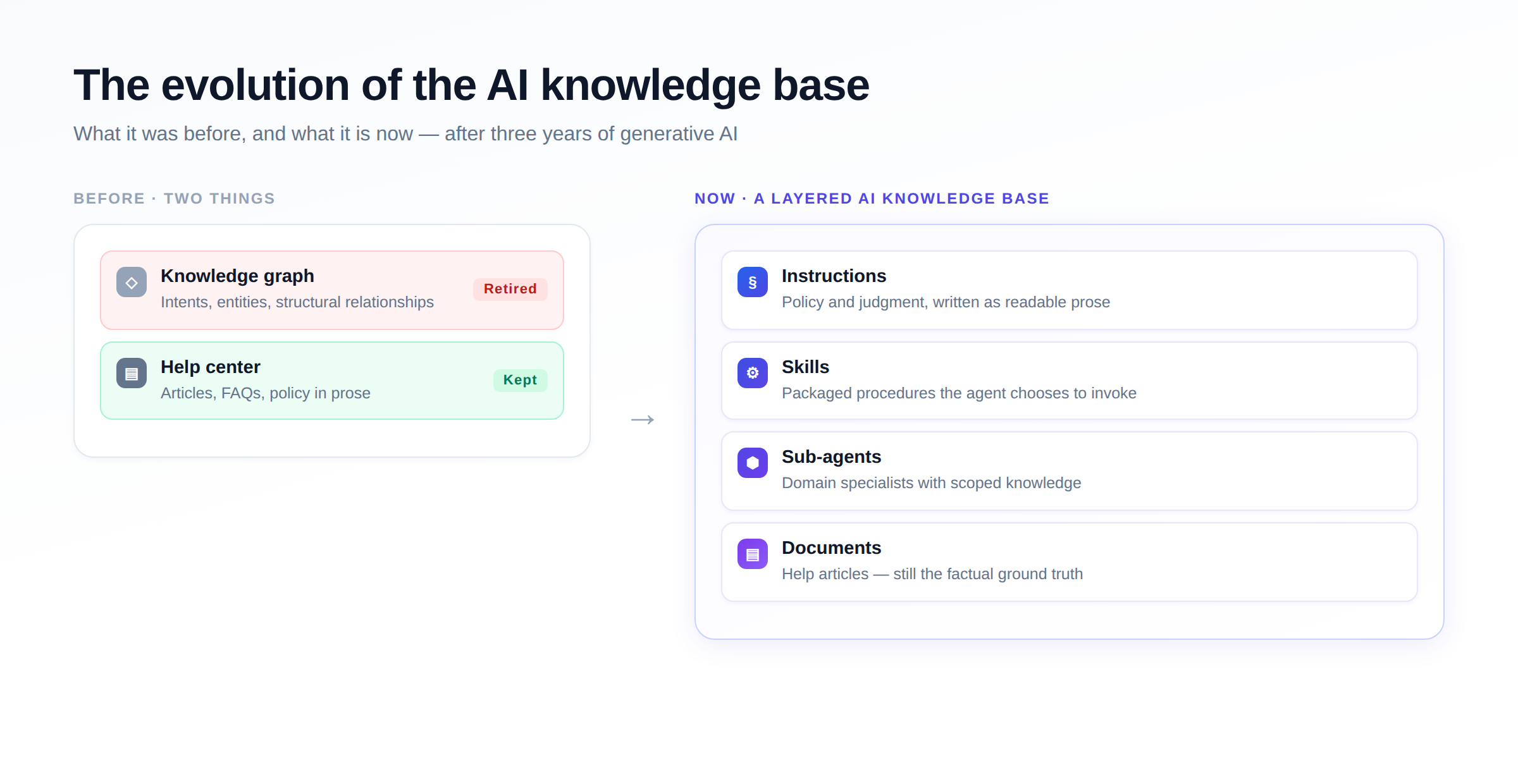
The evolution of the knowledge base is the clearest example of how much generative AI changed the plumbing underneath customer service. For twenty years, "knowledge base" meant two different things at once: a knowledge graph of intents, entities and structured relationships that told a bot what a customer meant, and a help center of articles and FAQs that told a customer what to do. In the three years since generative AI arrived, one of those survived and one didn't. The help articles are as useful as ever. The knowledge graph has been quietly retired — and what replaced it isn't a better graph. It's instructions, skills and sub-agents. If you're building an AI knowledge base today, that distinction decides most of your work.
What is a knowledge base?
A knowledge base is the organized body of information a system or a person draws on to answer questions and complete tasks. In customer service it has traditionally covered two distinct assets: the customer-facing help center, and the machine-facing structure that let software interpret a request.
Those two were always different things doing different jobs. Conflating them is why so many teams now say "we have a knowledge base" and get very different results from their AI.
The two things "knowledge base" used to mean
1. The knowledge graph — structural knowledge
The machine-facing half. A map of intents (what the customer wants: track_order, request_refund), entities (the order number, the SKU, the date), and the relationships between them. Sometimes a genuine graph, sometimes a taxonomy with a flow attached.
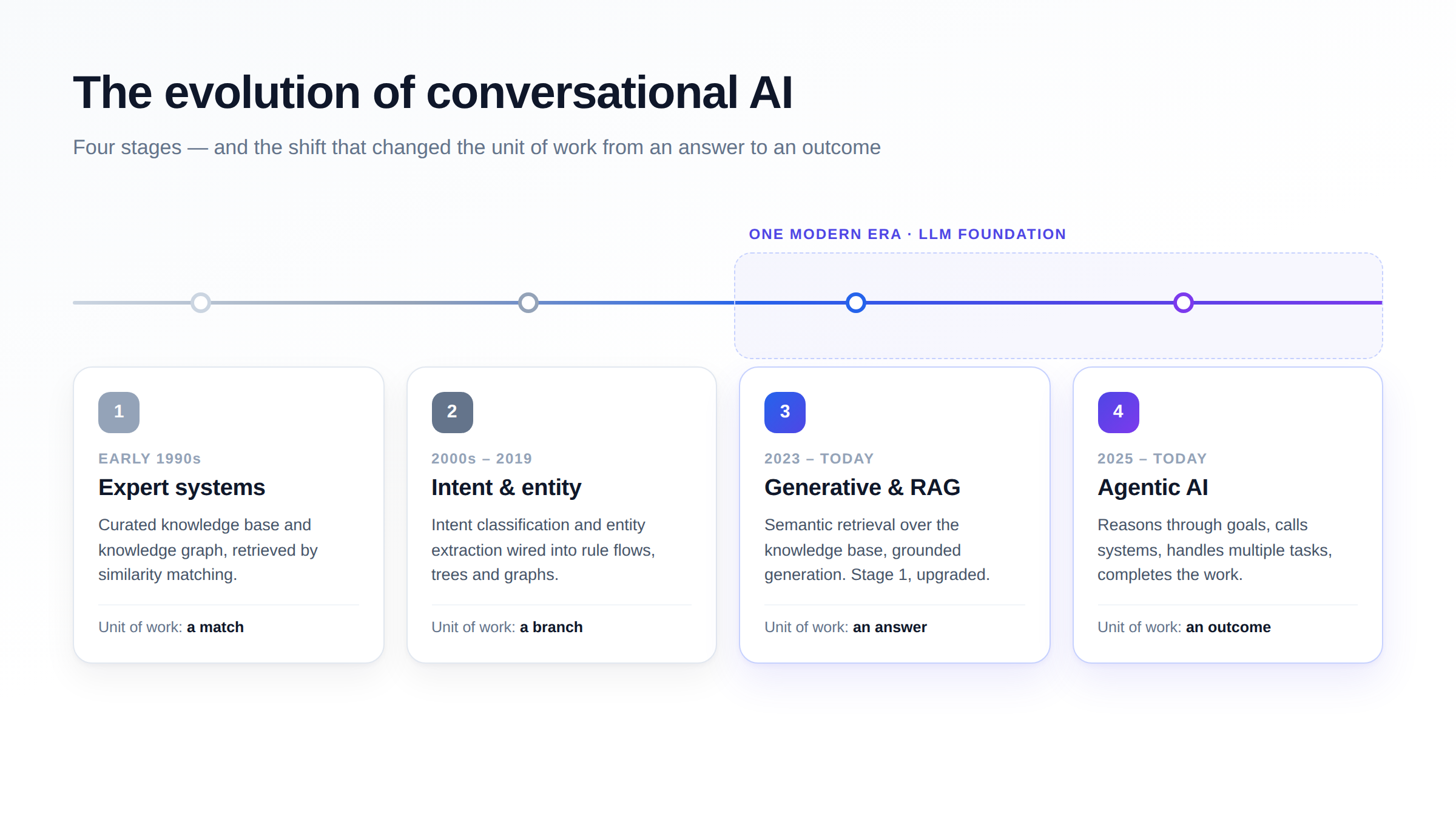
Its purpose was interpretation. Language models didn't exist to read a message, so the graph gave software a finite structure to map messages onto. Curating it — defining intents, labeling training utterances, drawing the branches — was a substantial, permanent job. This is the architecture we covered as Stage 2 in the evolution of conversational AI.
2. The help center — articles and FAQs
The human-facing half. Written guidance: how returns work, what the warranty covers, how to reset a password. Written by support and content teams, read by customers, and increasingly by agents looking something up.
Its purpose was explanation. It carried facts and policy in prose.
How the knowledge base evolved in three years
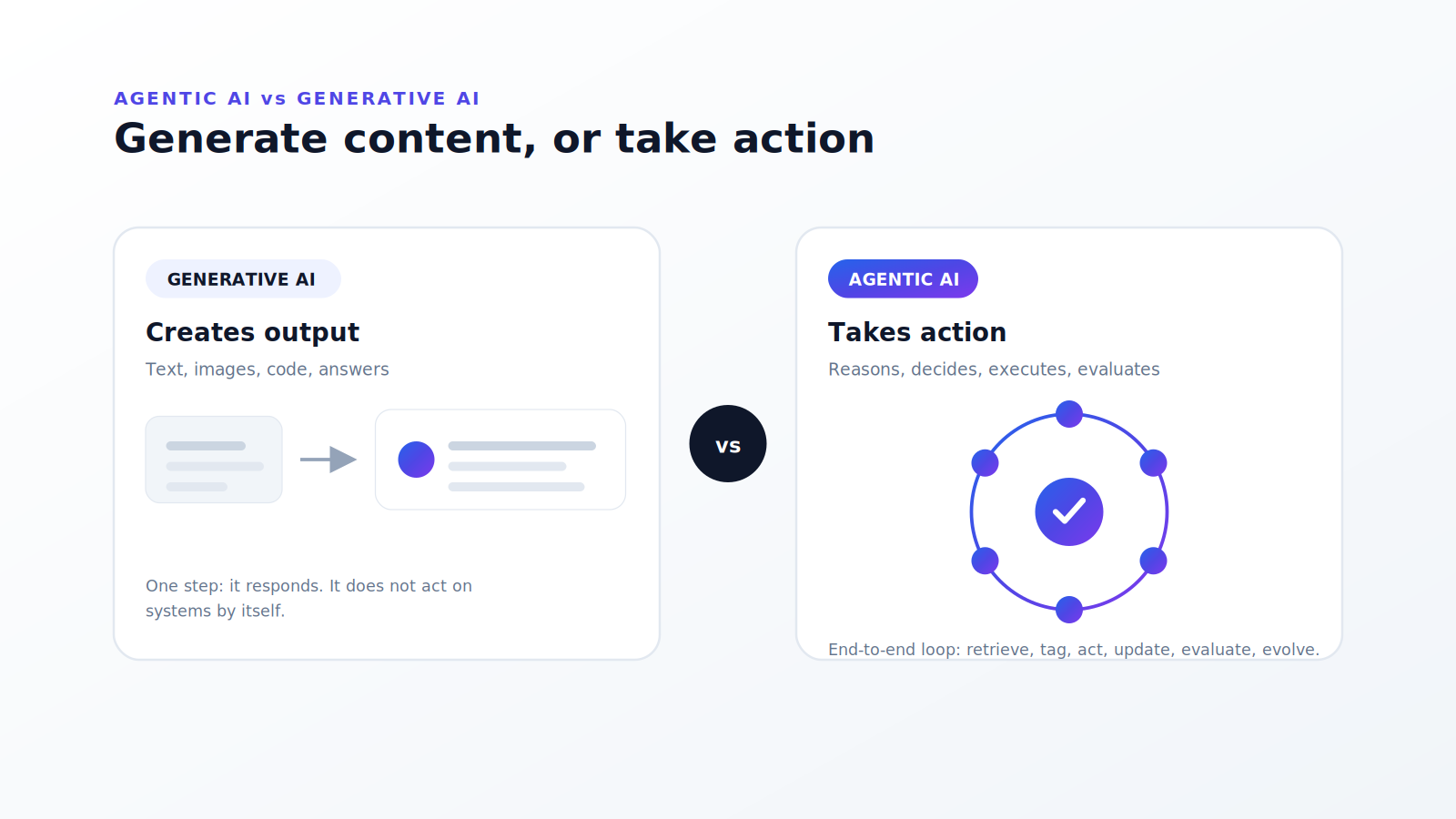
Generative models can read. That single capability removed the reason the knowledge graph existed.
An LLM doesn't need a message mapped onto a finite intent set to understand it — it reads the message directly, including phrasing the graph was never trained on, two requests in one sentence, and context from earlier in the thread. The interpretation layer that took quarters to build and never stopped needing maintenance became redundant almost overnight.
The help articles, by contrast, got more valuable. Their content — the actual facts and policies — is exactly what a model needs to stay grounded and stop making things up. The prose that was written for humans turned out to be excellent machine input.
So the knowledge graph didn't lose to a better graph. It lost because its entire job — turning language into structure — got absorbed by the model.
Why the knowledge graph got retired
Three reasons, in order of how much they mattered:
It solved a problem that no longer exists. Intent classification was a workaround for machines that couldn't read. Once they could, maintaining a parallel structure to describe meaning became pure overhead.
It capped resolution. Intents are a closed set; customer requests are an open one. Every real-world message outside the taxonomy routed wrong, and the fix — more intents, more branches — increased collisions and maintenance cost. Coverage and maintainability pulled against each other permanently.
It encoded the wrong layer. A graph describes what a message means. It says almost nothing about what to do — the policy, the judgment, the exceptions. That knowledge lived in rule conditions scattered across branches, where it was nearly impossible to read or audit as a coherent whole.
A caveat worth stating plainly: knowledge graphs are not dead as a technology. They remain genuinely useful for enterprise data modeling, search, and relationship-heavy domains. What's retired is their role as the interpretation layer for conversational AI.
What replaced it: the modern AI knowledge base
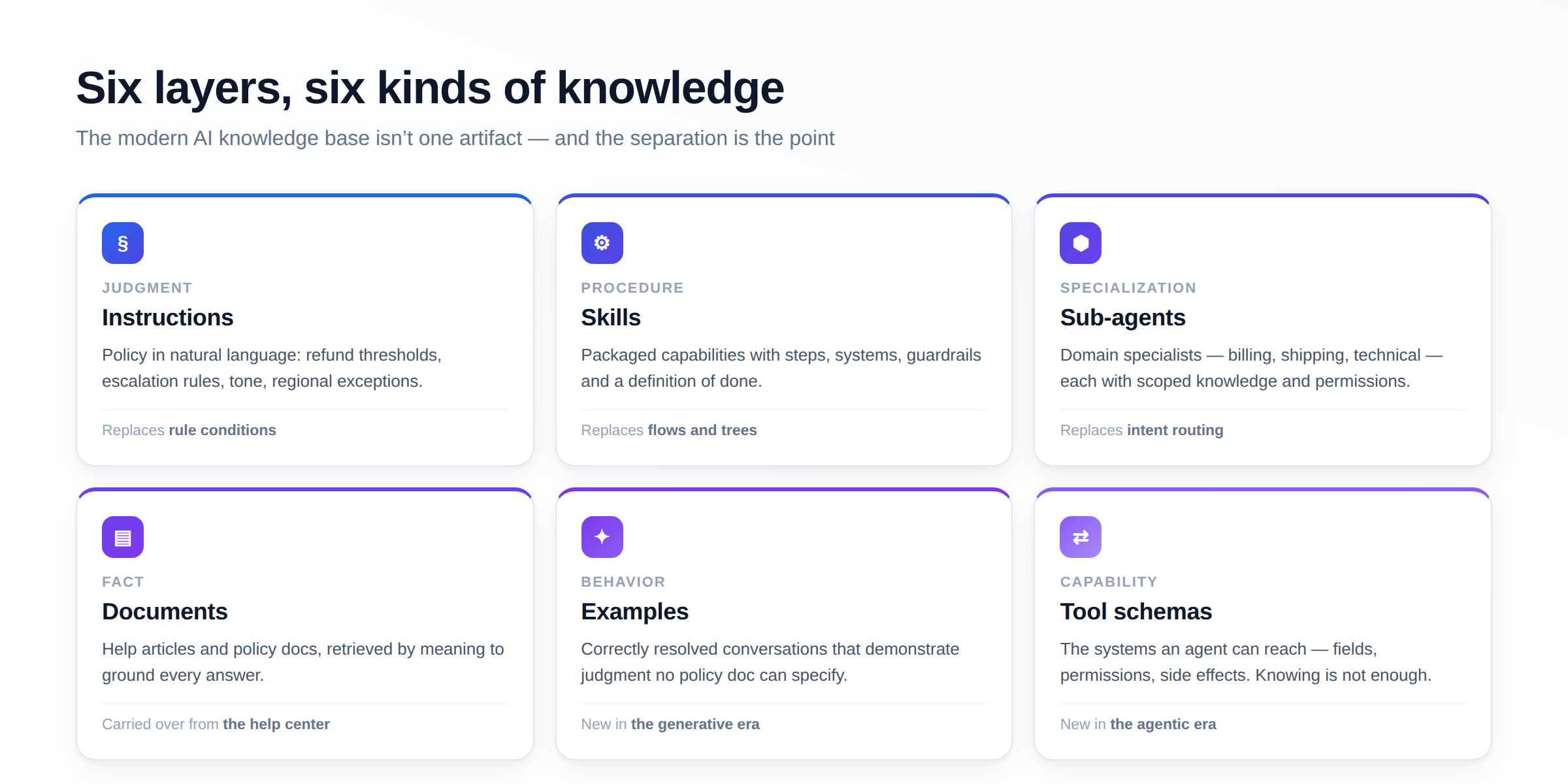
The new knowledge base is not one artifact. It's several, each carrying a different kind of knowledge, and the split is the point.
Instructions — the operational knowledge
Instructions are natural-language policy and procedure written for the agent. When to issue a refund without approval and when to escalate. How to verify identity. What never to promise. Which exceptions apply in which region. The tone to hold when a customer is angry.
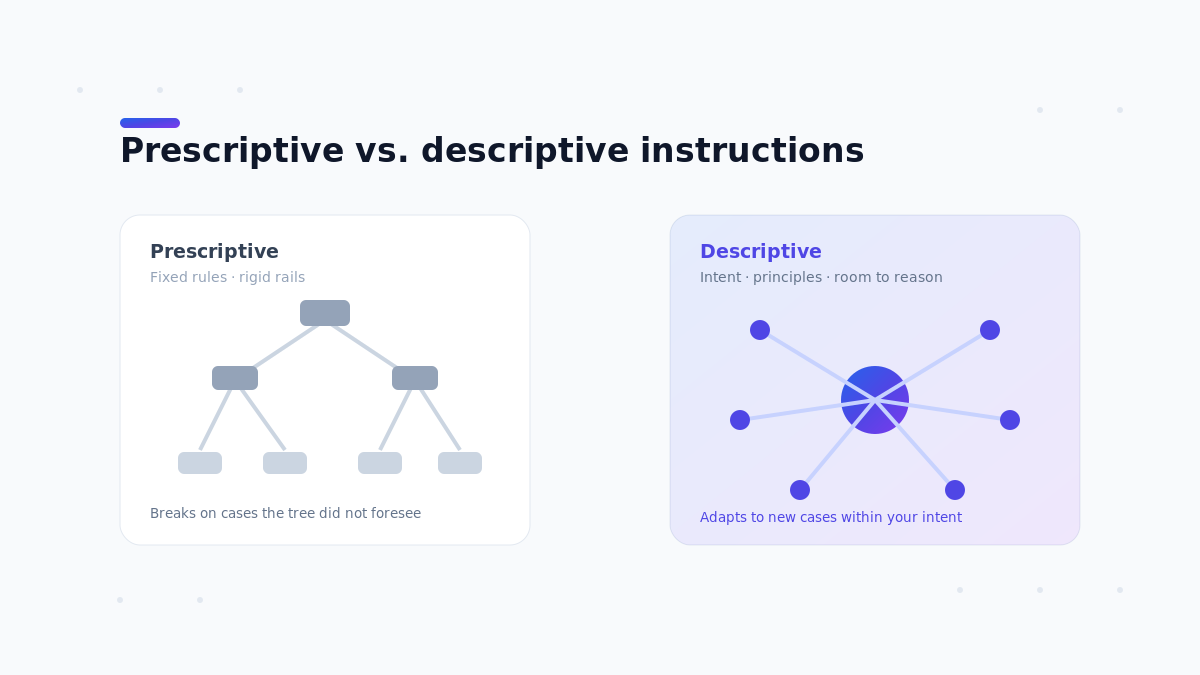
This is the knowledge that used to be buried in rule conditions across a hundred branches — now written as readable prose in one place. Two consequences follow. First, it's auditable: a manager can read the policy the AI is operating under and tell whether it's right. Second, it's editable by the people who own the policy — support leads and ops managers, not engineers. Changing a refund threshold becomes editing a sentence rather than filing a ticket. Writing them well is its own skill; we cover it in how to write good instructions for generative AI.
Skills — the procedural knowledge
A skill is a packaged, repeatable procedure the agent can invoke: the steps involved, the systems it touches, the inputs required, the guardrails around it, and the definition of done. "Process a return." "Verify identity." "Apply a retroactive discount." "Reroute a shipment."
The difference from a flow is who's in control. A flow was a fixed path the system was dragged along. A skill is a capability the agent chooses to use, when its reasoning says it's needed — and it can chain several in one conversation, in an order nobody scripted in advance. That's what allows a single message containing three dependent requests to actually get resolved rather than misrouted.
Sub-agents — the specialized knowledge
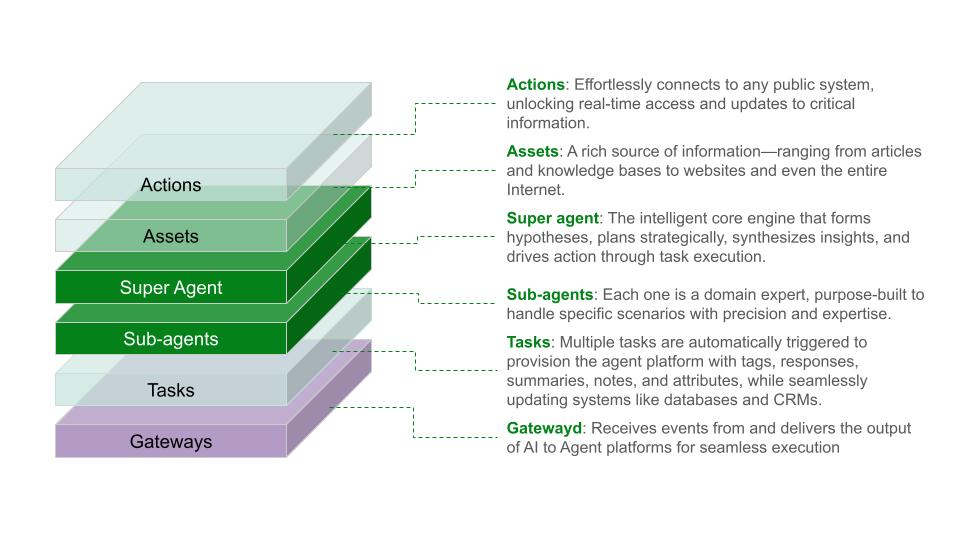
Rather than one model holding everything, work is partitioned across specialized agents: a billing agent, a shipping agent, a technical support agent, a sales agent. Each carries its own instructions, its own skills, and its own permissions, coordinated by an orchestrating layer that routes and delegates.
This is knowledge organized by responsibility rather than by topic, and it's the direct structural replacement for intent routing. It also scales in the opposite direction from a graph: adding a domain means adding an agent with its own scoped knowledge, not adding two hundred intents that collide with the existing taxonomy. This is the architecture behind AgentMesh™ and the broader multi-agent platform.
Documents — still the factual ground truth
Help articles, policy docs, product specs, past tickets. This is the part that carried straight over from the old world, with one change: it's retrieved by meaning rather than matched by keyword, and used to ground generation instead of being served verbatim.
Its job is narrower now and more important. Documents supply facts. Instructions supply judgment. Keeping those separate is what stops an agent from treating a stale help article as a binding policy.
Examples — the behavioral knowledge
Genuinely new, and easy to overlook. Past conversations that were resolved correctly function as knowledge: they demonstrate tone, escalation timing, and judgment in a way no policy document captures. A good escalation is easier to show than to specify.
Tool and system schemas — the capability knowledge
What an agent can do is part of what it knows. The definitions of the systems it can reach — the fields, the permissions, the side effects of each call — are as much a part of the modern knowledge base as any article, because an agent that can't act on a fact can only tell the customer about it.
Help articles didn't die — their job changed
Worth being explicit, because this is where teams over-correct. Help articles remain one of the highest-leverage assets in support. What changed:
They no longer have to be exhaustive, because the model can compose an answer from several sources rather than needing one article per question phrasing. They no longer have to be phrased the way customers search, because retrieval is semantic. And they're no longer the only thing you maintain — they're one input among several.
The failure mode to avoid: treating your help center as your entire AI knowledge base. It contains facts, not judgment. An AI grounded only in help articles can explain your return policy accurately and still have no idea when it's allowed to make an exception.
What this means for maintaining a knowledge base
The maintenance job changed shape. Curating intents and labeling utterances is gone. In its place:
Write policy, not branches. The highest-value work is now writing clear operational instructions and keeping them current as policy changes.
Separate facts from judgment. Keep documents factual and instructions decisional. Blending them produces an agent that can't tell what's binding.
Feed failures back. Escalations and misfires are the best signal you have about what the knowledge base is missing — a gap in instruction, a missing skill, or an ambiguous document. Systems built for continuous improvement close that loop deliberately rather than waiting for a quarterly audit.
Audit what the AI is actually operating under. With prose instructions this is finally possible. Read them the way you'd read a new hire's training doc.
Key takeaways
The evolution of the knowledge base runs in one direction. It used to mean a knowledge graph of intents and entities plus a help center of articles. Generative AI retired the graph — not by replacing it with a better one, but by absorbing its job, since a model that reads doesn't need language pre-mapped into structure. Help articles survived and matter more, as factual grounding. What actually replaced the graph is a layered AI knowledge base: instructions carrying policy and judgment, skills carrying procedure, sub-agents carrying specialization, documents carrying fact, examples carrying behavior, and tool schemas carrying capability. The maintenance work shifted from labeling utterances to writing clear policy — a job that belongs to operators rather than engineers.
Want to see what an AI knowledge base looks like in production? Watch agentic AI resolve real cases using your existing help content and your policies. Book a free demo →
Frequently asked questions
What is an AI knowledge base?
An AI knowledge base is the full set of knowledge an AI agent draws on to resolve requests. It goes beyond documents to include instructions (policy and judgment written in natural language), skills (packaged procedures the agent can invoke), sub-agents (domain specialists with their own scoped knowledge), examples of correctly resolved cases, and the schemas of the systems the agent can act in.
Is a knowledge base the same as a help center?
No. A help center is customer-facing content — articles and FAQs explaining how things work. A knowledge base is broader: it includes that content plus the machine-facing knowledge a system needs to interpret requests and act on them. Many teams use the terms interchangeably, which is why "we have a knowledge base" predicts so little about how well their AI performs.
Are knowledge graphs still used in customer service AI?
Rarely as the interpretation layer. Their original job — mapping language onto a fixed set of intents and entities — was made redundant by models that read language directly. Knowledge graphs remain genuinely useful for enterprise data modeling, search, and relationship-heavy domains, but maintaining one to classify support messages is now largely overhead.
What are instructions in an AI knowledge base?
Instructions are natural-language policy and procedure written for the agent: when to refund without approval, how to verify identity, what never to promise, which regional exceptions apply, what tone to hold. They replace the logic that used to be scattered across rule conditions and decision-tree branches, and because they're prose, the people who own the policy can read and edit them directly.
What is the difference between skills and flows?
A flow is a fixed path the system is dragged along, defined in advance. A skill is a capability the agent chooses to invoke when its reasoning determines it's needed — with defined steps, systems, guardrails and a definition of done. The practical difference is that an agent can chain several skills in one conversation, in an order nobody scripted, which is what makes multi-task requests resolvable.
What are sub-agents?
Sub-agents are specialized AI agents that each own a domain — billing, shipping, technical support, sales — carrying their own instructions, skills and permissions, coordinated by an orchestration layer. They're the structural replacement for intent routing, and they scale better: adding a domain means adding one scoped agent rather than adding intents that collide with an existing taxonomy.
Do I still need help articles if I have an AI agent?
Yes. Help articles are the factual grounding that keeps an agent accurate instead of inventing answers. What changed is that they no longer need to be exhaustive or phrased the way customers search, because retrieval is semantic and the model can compose from multiple sources. They supply facts — but not judgment, which is what instructions are for.
How do I build an AI knowledge base?
Start with the documents you already have — help articles and policy docs supply the facts. Then write instructions capturing the judgment your team applies but has never written down: thresholds, exceptions, escalation rules, tone. Define skills for the procedures that involve acting in other systems. Partition into sub-agents once one domain's knowledge gets large enough to interfere with another's. Then feed escalations and failures back in continuously.