The 11 Best G2 Alternatives in 2026
The best G2 alternatives in 2026 are TrustRadius, Gartner Peer Insights, PeerSpot, SourceForge, SoftwareSuggest, Clutch, Trustpilot and Crozdesk — plus Capterra, GetApp and Software Advice, with one large caveat. G2 bought those last three from Gartner in February 2026, so three of the platforms every other comparison page still lists as independent options are now owned by the company you are trying to find an alternative to. This guide compares all eleven on verified vendor prices, review verification and audience fit, and covers two questions nobody else answers: what replaces G2 Buyer Intent, and where G2 Track went.
Reviewed by Alex Gomez, Sr. Analyst. Disclosure: this guide is published by Aissist.io. We build agentic AI for customer service and sales — we are not a software review site, and we hold no affiliate or referral relationship with any platform listed here. Vendor prices, review counts and audience figures were read from live pages on 20–21 August 2026.
TL;DR: Start with the fact that reshapes this entire category. G2 acquired Capterra, GetApp and Software Advice from Gartner in February 2026 — so three of the platforms every other "G2 alternatives" list still recommends as independent options are now owned by G2. Here is what is actually left.
- Best genuinely independent alternative: TrustRadius
- Best free listing for enterprise vendors: Gartner Peer Insights
- Best for SMB click volume (now G2-owned): Capterra
- Best for phone-qualified leads (now G2-owned): Software Advice
- Best for European SMB discovery (now G2-owned): GetApp
- Best for cloud-marketplace reach: PeerSpot
- Best for developer and IT-ops audiences: SourceForge
- Best published fixed-price listing: SoftwareSuggest
- Best low-cost verified profile: Clutch
- Best for a Google-visible star rating: Trustpilot
- Best small-budget test: Crozdesk via Revleads
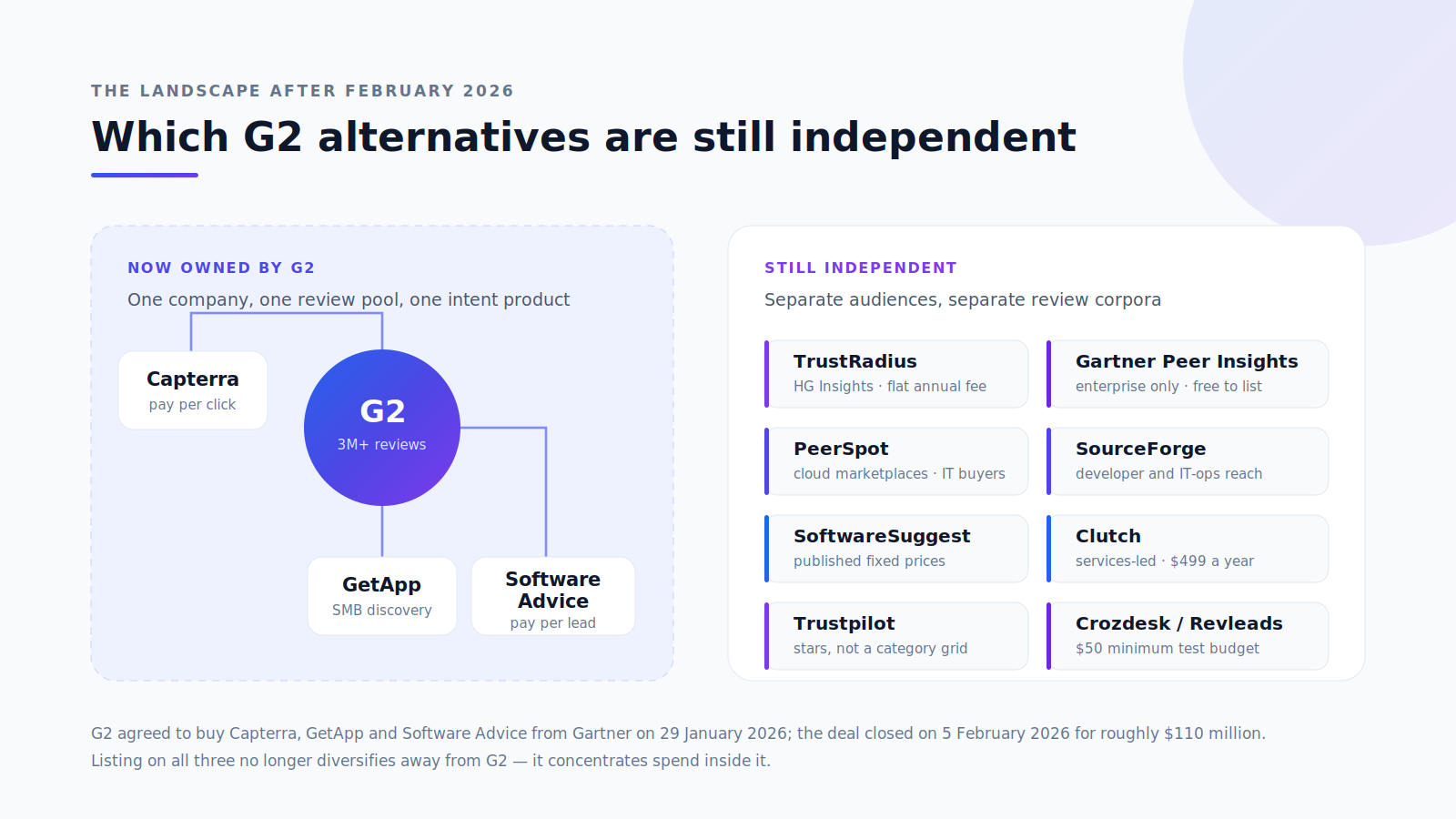
The buying trap in this category is diversification theatre: paying to list on G2, Capterra, GetApp and Software Advice looks like four channels and is now one company, one review pool, and one buyer-intent product.
How we compared these software review sites
We scored each platform out of 5 on six criteria for a maximum of 30, excluding anything under 65% (20 of 30). Vendor prices, review counts and audience figures were read from live pages on 20–21 August 2026. Where a platform publishes no price, this article says "not published" — it does not repeat a third-party estimate as if it were a vendor figure, and where a credible reported figure exists it is labelled as reported.
The six criteria:
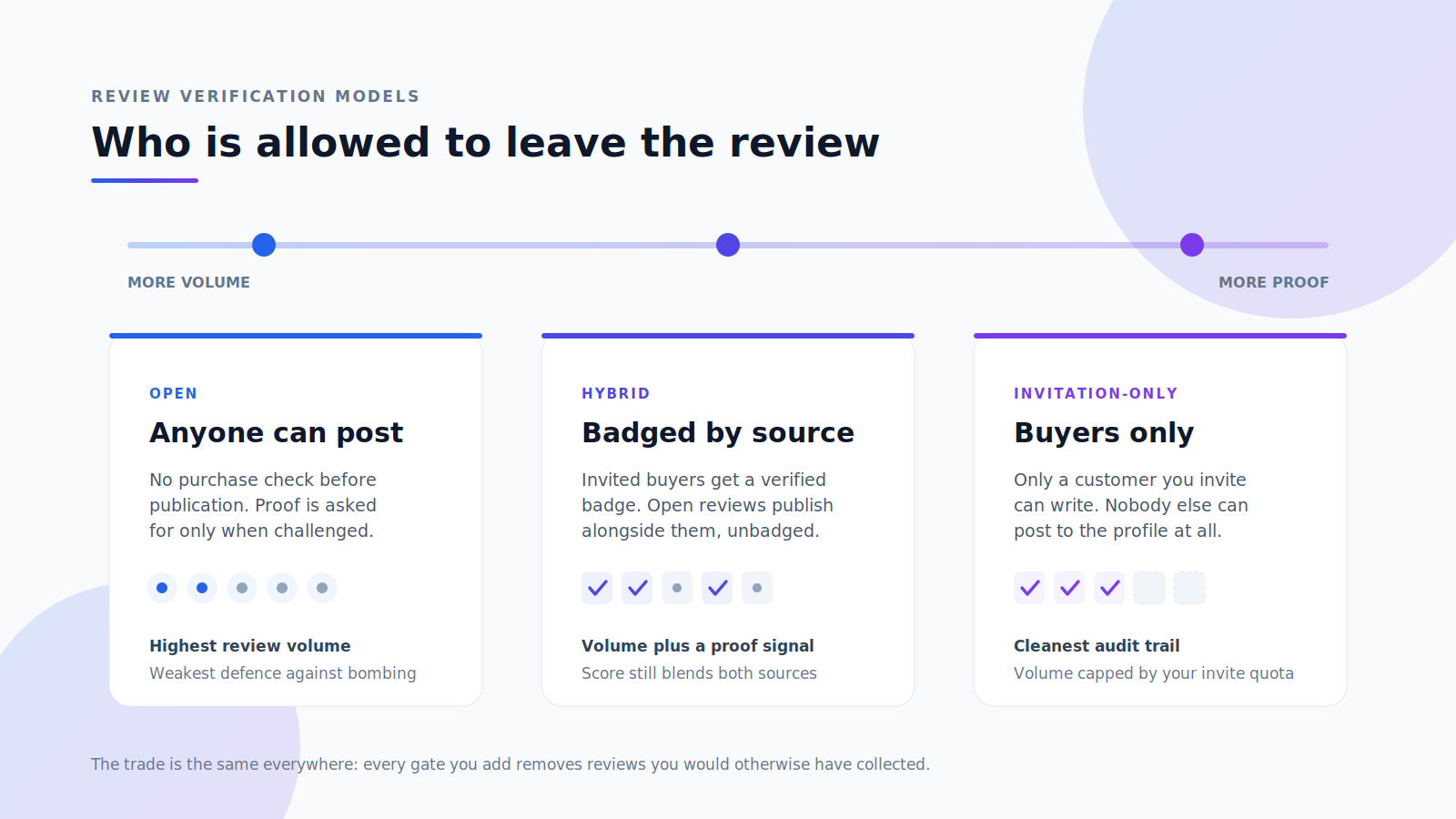
- Independence from G2. After February 2026 this is a real variable, not a philosophical one.
- Review corpus and verification. Total reviews, how reviewers are authenticated, whether incentives are permitted and disclosed, and whether AI-written reviews are allowed.
- Price transparency. Whether a vendor can budget without a sales call, and what the billing unit is.
- Buyer reach and audience fit. Annual buyers, SMB versus enterprise skew, and geography.
- Intent and lead capability. Whether the platform sells buyer-intent signals or qualified leads, and how they are packaged.
- Syndication and AI visibility. Whether reviews can be reused on your own site, whether they generate rich snippets, and whether the platform is doing anything deliberate about AI answer engines.
Two things disqualify a platform: no published review-verification policy, and a review corpus so thin relative to its catalogue that most listings carry no meaningful social proof.
The bias disclosure, plainly: this is Aissist.io's blog. We build agentic AI for customer service and sales. We are not a software review site, we hold no affiliate or referral relationship with any platform below, and we have no stake in which one you choose. G2 appears in this article as the baseline being compared, not as a competitor we benefit from criticising.
Two numbers frame why any of this matters. TrustRadius's 2026 B2B Buying Disconnect report, based on 1,862 buyers surveyed in January 2026, found 74% of B2B technology buyers use reviews to inform purchasing decisions while only 13% used analyst reports — down 63% since 2022. And G2's own 2026 Buyer Behavior Report found 38% of buyers name review sites as the top source shaping their shortlist, just ahead of AI chatbots at 37%. Review presence is not optional. Where you buy it is the open question.
The acquisition that broke every other list
On 29 January 2026, G2 announced it was acquiring Capterra, Software Advice and GetApp from Gartner. The deal closed on 5 February 2026 for approximately $110 million, a figure disclosed in Gartner's FY2025 Form 10-K rather than by either party at announcement. The three properties now trade as G2 Digital Markets.
G2's own framing: the combined entity reaches "200+ million annual software buyers," holds "nearly 6 million verified customer reviews," and promises "up to 3x more Buyer Intent signals." Godard Abel, G2's co-founder and CEO, called it "a transformational moment for G2, and, more importantly, the global B2B software industry."
Three consequences a vendor should act on:
Listing on all four is no longer diversification. It is concentration inside one company, drawing on one shared review pool. Capterra, GetApp and Software Advice have shared a single 2.5-million-review corpus for years; that corpus now sits under the same roof as G2's three million.
G2 Buyer Intent got materially wider. Since 3 June 2026 it aggregates signals across all four properties, with G2 reporting up to 2x more signals and a 36% increase in accounts identified as in-market. If you already buy G2 intent, you got an upgrade. If you were shopping for an alternative, the gap widened.
Gartner now routes buyers away from its former properties. Gartner's old Digital Markets vendor page is a redirect notice sending small businesses to G2 Digital Markets and large enterprises to Magic Quadrant and BuySmart. Gartner Peer Insights is now Gartner's only review property, and it is enterprise-only by rule.
The 11 G2 alternatives at a glance
| Platform | Best for | Owner | Verification | Vendor billing model | Entry price | Sells buyer intent? |
|---|---|---|---|---|---|---|
| G2 (baseline) | Broadest category coverage | Independent | Business email, LinkedIn or personal Gmail; AI reviews permitted | Tiers + intent add-on | $2,999 first year | Yes, across 4 properties |
| TrustRadius | The genuinely independent option | HG Insights | LinkedIn or work email only; depth-vetted | Flat annual fee per product | Was $30,000/product/year; no longer published | Yes |
| Gartner Peer Insights | Enterprise reach at zero listing cost | Gartner | Corporate email matching employer + confirmed profile | Free | $0 | No |
| Capterra | SMB click volume | G2 | 30+ human moderators, 20+ checks; incentives allowed | Pay per click | Not published | Via G2 |
| Software Advice | Phone-qualified leads | G2 | Human moderation of identity, not content | Pay per lead | Not published | Via G2 |
| GetApp | European SMB discovery | G2 | Shared pipeline with Capterra | Pay per click / lead | Not published | Via G2 |
| PeerSpot | Cloud-marketplace reach | Independent | LinkedIn or company email; 100% human moderated | Quote only | Not published | Yes |
| SourceForge | Developer and IT-ops audiences | Slashdot Media | Not published | 5 tiers, quote only | Not published | Yes, at Amplify tier |
| SoftwareSuggest | Published fixed-price listings | Independent | Not published | Fixed package price | $4,000 / 6 months | No |
| Clutch | Low-cost verified profile | Independent | Identity and work history confirmed | Flat annual fee | $499/year | No |
| Trustpilot | A Google-visible star rating | Independent (LSE: TRST) | Open — anyone can post | Per domain, 12-month term | $99/month | No |
| Crozdesk / Revleads | A small-budget test | Black & White Zebra | Not published | Self-serve PPC | $50 minimum, $6 default CPC | Yes |
Read the owner column first. Four of the twelve rows above are the same company.
Who each one is built for
| Platform | Audience | Scale (vendor-published) | Review verification strictness | Syndication and rich snippets | Notable constraint |
|---|---|---|---|---|---|
| G2 | SMB through enterprise, global | 3M+ reviews, 200,000+ products, 2,000+ categories, 100M+ buyers | Medium — personal Gmail accepted, AI reviews permitted | 6 widgets, but only the Star Rating widget emits schema | Market Presence axis scored partly on PPC spend and web traffic |
| TrustRadius | Mid-market and enterprise, US-centric | 12M annual buyers, 400+ categories, 400+ word average review | High — LinkedIn or work email only, depth-vetted | Content licensing product; schema not published | Total review count not published |
| Gartner Peer Insights | Enterprise only — reviewers must be at $50M+ revenue firms | 880,000+ ratings (760,000+ on a second Gartner page), 840+ markets, 28,600+ vendors | Highest — corporate email must match stated employer | Quote reviews free; widget guide now redirects | No intent product at all |
| Capterra | SMB, strong international footprint | 2.5M+ reviews, 50M+ users yearly (vendor-published) | Medium-high — 30+ moderators, 20+ checks per review | No first-party widget with schema documented | No published pricing at any level |
| Software Advice | SMB and lower mid-market, US, 150 industries | 2.5M+ shared reviews, 1M+ businesses helped | Medium — identity verified, content explicitly not fact-checked | Shared syndication across sister sites | Lead quality is entirely the vendor's risk |
| GetApp | SMB, strongest European skew of the three | 2.5M+ shared reviews, 45,000+ solutions, 1,000+ categories | Medium — same shared pipeline | Shared syndication | No verification page, no methodology page, no about page |
| PeerSpot | Enterprise IT, infrastructure, security | 86,000+ in-depth reviews, 864,000–910,000 professionals | High — LinkedIn or company email, 100% human moderated | Sole review provider inside Google Cloud Marketplace | Vendors need 50+ employees and 10+ enterprise customers to list |
| SourceForge | Developers, sysadmins, IT ops, global | 20M+ monthly visitors, 122,100+ business titles | Not published | Cross-property placement, LinkedIn retargeting | Download-driven traffic overstates enterprise buying intent |
| SoftwareSuggest | SMB and mid-market, India and South Asia skew | 50,000+ listings, 1,500+ categories, 10M+ annual buyers, ~40,000 verified reviews | Not published | Not published | Under one review per listed product on average |
| Clutch | SMB and mid-market services buyers, global | 350,000+ providers, 12M+ annual users, $2B in projects | High — identity and work history confirmed | Not published | Free tier removes your website link from directory pages |
| Trustpilot | B2C and ecommerce first; B2B as a trust layer | 301M active reviews, ~556,000 businesses reviewed in 2024 | Low — open, no purchase gate | Google Seller Ratings partner, widgets emit review schema | No software category taxonomy or comparison grids at all |
| Crozdesk | SMB to mid-market, European heritage | 51,698 products, 384 categories, 821 expert reviews | Not published | Distributes across Revleads publisher network | Vendor brand deprecated — vendor.crozdesk.com redirects to Revleads |
The 11 best G2 alternatives, reviewed
First, what you are actually replacing: G2
G2 is a B2B software review marketplace and buyer-intent data platform where verified users rate business software, and where vendors buy profiles, category placement and account-level intent signals to reach in-market buyers.
Verification: Sign-in via business email, LinkedIn or personal Gmail — the Gmail path is materially looser than TrustRadius or Gartner Peer Insights. An optional product screenshot is held privately to corroborate usage. Every review is human-moderated before publication, and reseller reviewers get a Business Partner label and are excluded from scoring. AI-generated reviews are permitted under G2's published guidelines. · Deploys onto: Salesforce, HubSpot, Marketo, 6sense, Demandbase, LinkedIn, ZoomInfo and Chili Piper for intent delivery. · Audience: SMB through enterprise with no vertical skew, plus meaningful EMEA growth.
Scale: 3 million-plus reviews, 200,000-plus products, 175,000-plus vendors and 2,000-plus categories, reaching 100 million-plus global buyers (vendor-published, 2025 Year in Review).
Syndication: Six embeddable widgets, five of which display actual review text — but only the Star Rating widget carries Product Review schema, so most of what you embed produces no rich snippet. Separate partner syndication pushes reviews into Microsoft AppSource, AWS, SAP, CDW and ADP.
Cost: Free tier at $0 with a basic profile and three users. Starter $299/month or $2,999 for the first year. Professional and Enterprise are quote only. Buyer Intent is a paid add-on available on Professional and Enterprise, with 30 seats per vendor (FY26 pricing guide). As a reported figure rather than a published one, procurement platform Vendr lists a median annual contract value of $28,000 across its verified G2 deals, with Enterprise ranging from roughly $21,300 to $28,300 and reaching $95,000-plus with add-ons.
Pros:
- The largest verified review corpus in the category at 3 million-plus — and after February 2026, ownership of the second-largest as well.
- The only platform selling cross-property intent covering four discovery sites at once, with G2 reporting a 36% lift in accounts identified as in-market since the June 2026 expansion.
- Publishes an itemised price for its entry paid tier, which Capterra, GetApp, Software Advice and Gartner Peer Insights do not do at any level.
Cons:
- Market Presence — half of the Grid's horizontal axis — is scored partly on PPC spend, web traffic and employee headcount using third-party data, so a better-funded vendor can outrank a better-liked one regardless of review sentiment.
- Reviewers may authenticate with a personal Gmail account and AI-written reviews are explicitly permitted, neither of which is true of TrustRadius or Gartner Peer Insights.
- Only one of six widgets emits schema markup, so the four widgets that actually display review text deliver no SEO benefit to your own site.
Our take: G2 is the default for a reason — the corpus, the category taxonomy and the intent product are all category-leading, and after the acquisition its reach is genuinely hard to replicate. Do not treat it as a complete strategy if your buyers are enterprise IT, if you need reviews inside a cloud marketplace, or if a Grid position determined partly by ad spend is a problem for how you compete.
1. TrustRadius — best genuinely independent alternative
TrustRadius is an independent B2B technology review platform, owned by HG Insights, that publishes long-form individually vetted reviews from verified enterprise and mid-market practitioners and sells vendors a flat-fee customer-voice programme plus downstream intent data.
Verification: The strictest of the large platforms alongside Gartner Peer Insights. Registration is via LinkedIn or work email only — there is no personal-email path. Every profile is authenticated by a moderation team, and reviews are vetted for authenticity, depth and detail, with thin submissions returned to the reviewer for more. Average review length is 400-plus words. · Deploys onto: CRM via embedded lead capture; combined with HG Insights technographic install-base data. · Audience: the clearest mid-market and enterprise skew here; 12 million annual technology buyers across 400-plus categories.
Syndication: Content licensing is a named product line for reusing customer voice across your own channels with embedded lead capture. Schema markup and rich-snippet support are not published. TrustRadius also ships a GEO Monitoring Dashboard tracking AI share of voice and product visibility in AI-generated answers — the only first-party product of its kind among these eleven.
Cost: This changed days before publication. TrustRadius's Customer Voice Package carried a published price of $30,000 per product per year with multi-year discounts. On 5 August 2026 HG Insights rebranded the vendor product as HG Customer Voice, and the old pricing URL now redirects to a page that publishes no price at all (checked 21 August 2026). Treat $30,000 as the last known list price, not a current quote. Intent-Driven Leads, Downstream Intent, Premium Content and GEO Monitoring were already quote only. Vendr reports an average contract value of $32,000 across 59 purchases, with a range of $24,900 to $62,896 and average negotiated savings of 21%.
Pros:
- A known list price of $30,000 per product per year, published until the August 2026 rebrand — still the most useful public anchor for what an independent review-site programme costs, even though the figure is no longer on the page.
- LinkedIn-or-work-email-only registration plus depth vetting, producing 400-plus word reviews that read like practitioner accounts rather than survey responses.
- Genuinely independent of G2 after February 2026 — which, if the point of this exercise is diversification, is the whole argument.
Cons:
- Total review count is not published anywhere, so a vendor cannot size the corpus against G2's 3 million or Capterra's 2.5 million before committing tens of thousands of dollars.
- 12 million annual buyers is roughly a quarter of Capterra's 50 million and an eighth of G2's 100 million-plus, at ten times G2's published entry price.
- The "no pay-to-play" positioning sits awkwardly with ownership by HG Insights, an intent-data company that monetises the same buyer behaviour the review platform observes.
Our take: If you sell to mid-market or enterprise buyers and want a review presence that is not owned by G2, TrustRadius is the answer, and its known list price gives you a defensible anchor going into the negotiation. Do not buy it as a volume play — you are paying for depth and independence, not reach.
2. Gartner Peer Insights — best free listing for enterprise vendors
Gartner Peer Insights is a free, Gartner-moderated enterprise IT review platform where verified technology decision-makers at large organisations rate software and services, feeding Gartner's Voice of the Customer reports and appearing alongside Magic Quadrant research.
Verification: The strictest here. A reviewer must supply a corporate email address matching their stated employer and hold a confirmed profile on gartner.com or a credible external site such as LinkedIn. A human moderation team then assesses context, quality and relevance, taking three to ten business days, and approved reviews must include written comments explaining the ratings. · Deploys onto: nothing — it is a destination. · Audience: enterprise only by rule. Voice of the Customer eligibility counts only reviews from companies with revenue above $50 million.
Syndication: Thin. Vendors may quote reviews in marketing free of charge and create deep links to their overview page, but no schema markup or rich-snippet support is documented and the review widget's user guide now redirects to the Peer Insights homepage. Full content reuse runs through paid Gartner reprints.
Cost: Free. No listing fee, no pay-per-click, no pay-per-lead. Vendors get enterprise-wide portal access with no user limit, a dedicated programme manager, complimentary Gartner review sourcing and the right to quote reviews externally. The only money involved is review incentives: Gartner funds $1,250 for new vendors in the first six months as fifty $25 gift cards, and vendor-funded incentives are capped — though note that two live Gartner pages state contradictory caps of $5,000 and $10,000 per market per year, which is worth clarifying with your programme manager rather than assuming.
Pros:
- Genuinely free to list, with unlimited portal users, a free Gartner-run review sourcing service and $1,250 in starter incentive funding — an unusual combination in a category where the cheapest paid alternative is $499 a year.
- Strictest verification of the eleven: corporate email matching stated employer, plus a confirmed profile, plus human moderation.
- Reviews surface inside interactive Magic Quadrants and feed Voice of the Customer, putting review effort directly into Gartner's analyst-facing research — which no other platform here can offer.
Cons:
- Sells no buyer-intent data at all. Vendors get reputation, not pipeline, so it cannot substitute for G2 Buyer Intent or TrustRadius Downstream Intent under any configuration.
- Excludes the SMB market by rule, and Gartner's own vendor page now redirects small businesses to G2 Digital Markets.
- Thinnest syndication here — no schema, no rich snippets, a widget guide that redirects to a homepage, and contradictory numbers on its own pages for both incentive caps and total review count (760,000-plus versus 880,000-plus).
Our take: If you sell to enterprises, there is no argument for not listing — it costs nothing and the analyst adjacency is unique. Do not expect it to produce leads; treat it as a credibility asset that a procurement committee will check, not a demand channel.
3. Capterra — best for SMB click volume (now owned by G2)
Capterra is a software discovery directory and pay-per-click advertising marketplace where small and mid-sized business buyers compare products by category and reviews, and where vendors bid for sponsored placement to generate clicks.
Verification: The most specific moderation mechanics published by anyone here — 30-plus human quality-assurance moderators applying 20-plus control checks per review, with identity confirmed through manual checks and third-party enrichment, plus technology checks for generative-AI and plagiarised content. Suspicious reviews trigger a demand for further evidence of software use, and failure means permanent removal. Incentives are explicitly allowed as "a nominal incentive for their time and effort," given regardless of rating. There is no LinkedIn or work-email requirement. · Owner: G2, since 5 February 2026. · Audience: SMB, with a strong localised international footprint across Australian, Indian, French and Spanish properties.
Syndication: Reviews propagate free across Capterra, GetApp and Software Advice from one shared pool. No first-party embeddable widget with schema markup is documented on a live Capterra page — every "Capterra reviews widget" in search results is a third-party scraper product.
Cost: Free listing plus pay-per-click sponsored profiles. The official PPC service description confirms budget-capped CPC billing with monthly spend limits, but states no minimum bid and no minimum monthly spend, and there is no pricing page — capterra.com/vendors/pricing returns a 404. Third-party analysis reports a $2.00 minimum bid, a $500 monthly floor and typical $2–$10 clicks; we could not verify either figure on Capterra's own live document, so treat it as reported, not confirmed.
Pros:
- Publishes the most detailed moderation mechanics of any platform here — 30-plus human moderators and 20-plus checks per review, named on a live page.
- 2.5 million-plus reviews and 50 million-plus annual users by its own count, roughly four times TrustRadius's stated annual buyer reach.
- One review collection effort propagates across three properties at no extra cost.
Cons:
- Zero published vendor pricing. No pricing page exists and the official PPC service description contains no bid minimum, no spend minimum and no rate card, so a vendor cannot budget without a sales call.
- Incentivised reviews are permitted as standard and there is no LinkedIn or work-email requirement, so verification rests on moderator judgment plus enrichment vendors.
- Its own former parent now routes enterprise buyers away from it — Gartner's redirect page sends large enterprises to Magic Quadrant instead — which confirms the SMB ceiling as published policy.
Our take: Capterra remains the highest-volume SMB discovery surface in the category and the moderation is better documented than most. Do not buy it as a hedge against G2 — since February 2026 that is the same invoice going to the same company.
4. Software Advice — best for phone-qualified leads (now owned by G2)
Software Advice is a human-advisor software matching service and review directory that phone- or chat-qualifies small and mid-sized business buyers and sells them to vendors as BANT-verified pay-per-lead prospects.
Verification: All reviews are manually examined by a team for reviewer identity and conflicts of interest, with technology checks for generative AI and plagiarism. The published FAQ is unusually candid about the limit: moderators verify who submitted a review, and explicitly do not fact-check the opinions. Incentives are allowed and disclosed with an icon on the published review, must be offered regardless of rating, and gift cards are auto-fulfilled only on publication. · Owner: G2, since 5 February 2026. · Audience: SMB and lower mid-market, US-centric, with the heaviest vertical skew of the three sister sites across 150 named industries — strongest in healthcare, construction, legal and field services.
Syndication: Reviews syndicate to Capterra and GetApp and to third-party sites via the shared reviews-sharing applications. No first-party widget with schema markup is documented.
Cost: Pay per lead, not pay per click — the distinguishing model in this group. Leads are BANT-verified by a human qualification team and delivered with enriched prospecting data. No prices are published, and we found no credible published cost-per-lead figure specific to Software Advice; generic B2B industry bands quoted elsewhere are not its figures.
Pros:
- The only platform here that delivers human-qualified BANT leads rather than clicks or anonymous intent — a materially different purchase with a different risk profile.
- A free one-to-one advisor consultation returns three to five shortlisted options in about fifteen minutes, the shortest buyer time-to-shortlist in this article.
- 150-industry coverage makes it the strongest option here for vertical SaaS with a narrow ideal customer profile.
Cons:
- Pay-per-lead pricing is entirely undisclosed, with no published cost per lead, no published qualification pass rate and no published refund policy — so lead quality risk sits entirely with the vendor.
- Its own FAQ confirms moderators do not fact-check review content, only reviewer identity, so review substance is unverified by policy.
- It sells the same underlying 2.5-million-review corpus as Capterra and GetApp, so paying all three means paying three times for one review asset.
Our take: For vertical SaaS selling into healthcare, construction or legal, phone-qualified leads from a category advisor are a genuinely different channel from a review listing, and worth testing on its own merits. Do not buy it expecting an independent second opinion on your G2 presence — it is the same company and the same reviews.
5. GetApp — best for European SMB discovery (now owned by G2)
GetApp is a software discovery directory for small and mid-sized business buyers that surfaces business applications by category with user reviews, monetised through vendor listings and sponsored placement sold via G2 Digital Markets.
Verification: The same shared moderation pipeline as Capterra and Software Advice — human moderation, identity checks via enrichment, generative-AI and plagiarism detection, incentives permitted with disclosure. GetApp publishes no separate verification page of its own. · Owner: G2, since 5 February 2026; the legal operator remains Nubera eBusiness S.L., the Barcelona entity named in the acquisition. · Audience: SMB with the strongest European skew of the three sister properties.
Syndication: Reviews syndicate automatically across the three sister sites. No documented first-party widget or schema markup.
Cost: Free listing plus paid programmes sold centrally by G2 Digital Markets — Engaged Buyers (pay per click), Qualified Leads (phone and chat-qualified pay per lead) and Brand Building profiles. No prices published anywhere.
Pros:
- Publishes concrete catalogue figures on a live page — 45,000-plus solutions across 1,000-plus software types — which Capterra and Software Advice do not.
- Shares the full 2.5 million-plus review pool, so one collection effort appears on three properties.
- A distinct European and multilingual footprint reaching buyers G2.com alone does not.
Cons:
- It is now the third of three sibling sites drawing on one identical review corpus, so listing here adds distribution but not independent social proof or a distinct reviewer population.
- No vendor pricing published at any level and no GetApp-specific vendor portal — everything routes through g2digitalmarkets.com.
- The lowest brand transparency of the eleven: no methodology page, no verification page, and getapp.com/about-us returns a 404.
Our take: GetApp is worth having if European SMB buyers matter to you and the incremental cost of adding it to a Digital Markets package is small. Do not evaluate it as a standalone alternative to G2 — it is a distribution surface for a review corpus G2 now owns.
6. PeerSpot — best for cloud-marketplace reach
PeerSpot, formerly IT Central Station, is an enterprise technology peer review and buying-intelligence platform that publishes long-form validated reviews from verified IT practitioners for enterprise infrastructure, security and software buyers.
Verification: LinkedIn or company-email registration is required, and PeerSpot states plainly that this "enables us to prevent vendors or other non-users from posting fake reviews." Every post is human-moderated before publication, taking up to three business days. Some reviews come from paid interviews, and PeerSpot discloses per review that the reviewer "may have been offered a gift card as a thank you for participating" — a level of per-review provenance disclosure nobody else here matches. · Audience: enterprise IT, infrastructure and cybersecurity, with a category mix of firewalls, storage, cloud and ITSM.
Scale: 86,000-plus in-depth reviews and 80,000-plus side-by-side comparisons. Community size is stated as 864,000 professionals on the vendor page and 910,000 on the buyer homepage — the two official pages disagree, which is worth noting when a vendor quotes you either figure.
Syndication: The differentiator. PeerSpot claims to be the only validated review provider to AWS Marketplace and the sole provider of customer reviews inside Google Cloud Marketplace. It also claims 32 million operational LLM citations across AI platforms (vendor-published).
Cost: Not published. Products named are Review Capture, PeerContent, peerspot.ai, Sponsored Comparisons and Customer Videos, all quote only. PeerSpot states on its FAQ that it does not accept banner advertising and that there is "no pay to play."
Pros:
- Sole review provider inside Google Cloud Marketplace and a validated provider to AWS Marketplace — a distribution position no other platform in this article holds.
- 100% human moderation with a public authentication policy and per-review disclosure of how each review was obtained.
- Long-form interview-style reviews that are materially deeper than survey-format reviews on the SMB directories.
Cons:
- No published pricing at any tier, so every engagement starts as a sales conversation.
- A hard listing gate: vendors need 50-plus employees and 10-plus enterprise customers to be listed at all, which excludes most early-stage SaaS.
- Its own two official pages publish conflicting community sizes, and total product count and traffic are unpublished — a documentation-quality problem a buyer can spot in thirty seconds.
Our take: If you sell infrastructure or security software and transact through AWS or Google Cloud Marketplace, PeerSpot's marketplace position is worth more than its review count. Do not approach it as an early-stage vendor — you will not clear the listing threshold.
7. SourceForge — best for developer and IT-ops audiences
SourceForge is a software discovery, review, comparison and download directory operated by Slashdot Media that helps business and open-source software buyers find and evaluate tools, and sells vendors category placement, click traffic and buyer-intent reporting.
Verification: Not published. Profiles carry verified user reviews and verified-vendor badges, but no detailed verification methodology exists on a live page — the weakest disclosure of any platform in this article. · Audience: broad SMB to mid-market, heavily technical, global, spanning SourceForge and its sibling Slashdot. · Scale: over 20 million monthly visitors, 122,100-plus business software titles, 500,000-plus open-source projects, and more than 2.6 million software downloads a day (vendor-published). Total review count is not published.
Syndication: Cross-property placement across SourceForge and Slashdot, plus third-party retargeting and LinkedIn. No documented schema or rich-snippet support.
Buyer intent: Yes, and it is a headline feature. Signals include company details, industries, job titles and seniority levels, delivered via API, Slack or email with CRM and ABM integration plus display and LinkedIn retargeting. Intent sits in the Amplify tier and above.
Cost: Free listing plus five named paid tiers — Plus, Premium, Amplify, Precision ABM and Enterprise. The pricing page states that packages are "based on budget" with channel mix set by tier. No dollar figures, no CPC and no per-lead rate are published.
Pros:
- The largest self-reported audience of any platform here at 20 million monthly visitors and more than 2.6 million downloads a day.
- The broadest catalogue at 122,100-plus business software titles.
- Intent data is delivered operationally through API, Slack, CRM and ABM and paired with retargeting, rather than sitting in a dashboard you have to remember to check.
Cons:
- Zero price transparency across all five tiers, with no published CPC or cost per lead.
- No published total review count and no published review-verification methodology, so review credibility cannot be audited at all.
- Download-driven, open-source-weighted traffic means raw visitor numbers materially overstate enterprise buying intent.
Our take: For developer tools, infrastructure software and anything an engineer evaluates by downloading it, SourceForge reaches an audience the B2B directories mostly miss. Do not treat its traffic figure as comparable to a review site's buyer count — a download is not a shortlist.
8. SoftwareSuggest — best published fixed-price listing
SoftwareSuggest is a business software discovery and review directory, headquartered in India, that lets buyers compare, review and get free consultations across 1,500-plus categories, and sells vendors premium listings, pay-per-click and marketing-qualified leads.
Verification: Not published. Reviews are labelled verified but the method is not documented on the about or homepage. · Audience: SMB and mid-market with a pronounced India and South Asia geographic skew, evidenced by rupee pricing and a category mix weighted toward Indian verticals. · Scale: 50,000-plus listed software products, 1,500-plus categories, 10 million-plus active yearly buyers, and approximately 40,000 verified reviews.
Syndication: Not published. No documented schema or rich-snippet support.
Cost: The most transparent vendor pricing in this article, published in full:
- Basic — $4,000 per 6 months, including a $1,000 PPC credit, premium listing and ad-free profile.
- Gold — $9,000 per 6 months, including $2,500 PPC and $2,500 MQL credits, a product review and a CXO interview.
- Platinum — $15,000 per 12 months, including $5,000 PPC and $5,000 MQL credits, leader-matrix consultation and guest posts.
One caveat printed on the page itself: "CPC & CPL will be defined at the time of sign-up."
Pros:
- Publishes exact dollar prices for all three tiers on a live page — only Clutch, TrustRadius and Trustpilot come close, and none of them publish a full ladder.
- The entry point is materially cheaper than G2's paid tier over a comparable period.
- PPC and MQL credits are bundled into the tier price, so a portion of the spend comes back as media rather than being pure listing fee.
Cons:
- Approximately 40,000 verified reviews across 50,000-plus listed products — under one review per product on average, so most listings carry effectively no social proof.
- CPC and CPL are only defined at sign-up, so the effective cost per lead is unknowable before you contract.
- No buyer-intent product at all, and the India-weighted audience limits usefulness for vendors selling primarily into North America or EMEA.
Our take: If you sell into India or South Asia, or you simply want a listing budget you can approve without a procurement cycle, SoftwareSuggest is the most legible option in this article. Do not expect the review corpus to do heavy lifting — the ratio of reviews to listings is the weakest here.
9. Clutch — best low-cost verified profile
Clutch is a B2B services and solutions marketplace that publishes verified client reviews of agencies, development firms, consultancies and some software providers, helping buyers shortlist partners and helping providers win qualified inbound.
Verification: Clutch's content operations team confirms reviewers' proof of identity and work history, and contacts reviewers by email to request more information where detail is insufficient. Reviews that do not represent an authentic business relationship are not published, and Clutch notes its average review runs to hundreds of words. · Audience: SMB and mid-market services buyers first — agencies, development shops and consultancies — with software a secondary category, and heavy global representation of offshore and nearshore firms. · Scale: 350,000-plus providers listed, 12 million-plus annual users, and $2 billion in global service projects flowing through the platform annually.
Syndication: Not published. No documented schema or rich-snippet support.
Cost: Published in full. Basic is free, giving basic company info and analytics, limited case studies, no verification badge, competitors displayed on your profile and no website link from directory pages. Verified is $499 per year, adding the verification badge, higher visibility, competitor removal from your profile, website links, unlimited case studies, custom directory URLs, 365-day performance data and a dedicated support rep. Advertiser is quote only.
Pros:
- At $499 a year, the Verified tier is an order of magnitude cheaper than any other paid listing in this article.
- Identity- and employment-verified reviews under a published verification standard, at a price point where most competitors publish nothing at all.
- 350,000-plus providers means genuinely deep category coverage, and the free tier is usable for basic listing presence.
Cons:
- The free tier is deliberately handicapped — no website link from directory pages and competitors shown on your own profile — which functions as a paywall on basic utility rather than a genuine free option.
- No buyer-intent product, so it cannot substitute for G2 Buyer Intent in any configuration.
- Services-first: a pure software vendor sits in a minority category on a services marketplace, and neither total reviews nor monthly traffic is published.
Our take: For a services-led software company — implementation-heavy products, anything sold alongside professional services — $499 a year for a verified profile is close to free relative to what it replaces. Do not expect it to reach a software buyer researching a category; that traffic goes to G2 and Capterra.
10. Trustpilot — best for a Google-visible star rating
Trustpilot is an open consumer review platform where any customer can review any business by domain, used by B2B software vendors mainly as a source of Google-visible star ratings and on-site trust widgets rather than as a software comparison marketplace.
Verification: Open, and the loosest here. Anyone can leave a review without proof of purchase; invited reviews are labelled and organic ones are not gated. Trustpilot's Trust Report 2025 states that all submissions are assessed by automated detection systems against millions of data points, and that 4.5 million fake reviews were removed in 2024 — 7% of everything posted — with 90% caught automatically. · Audience: overwhelmingly B2C and ecommerce. For B2B software it is a supplementary trust layer, not a discovery channel. · Scale: 301 million active reviews and approximately 556,000 businesses reviewed during 2024.
Syndication: The strongest area. Trustpilot is a Google Seller Ratings partner and its widgets emit review structured data, which is the mainstream path to star rich snippets on your own site.
Cost: Published in full, on a 12-month commitment. Free at $0. Starter from $99/month per domain with 100 invitations. Plus from $319/month per domain with 300 invitations and up to three domains. Premium from $799/month per domain with 1,000 invitations. Enterprise is quoted. Note the billing unit is per domain, and pricing scales on invitation volume rather than category placement or leads.
Pros:
- Fully transparent published pricing from $0 to $799 a month with exact feature counts at each tier.
- By far the largest review corpus of any platform in this article at 301 million active reviews.
- Publishes an annual transparency report with hard fraud numbers, a level of disclosure none of the B2B review sites match.
Cons:
- No proof-of-purchase gate, so B2B buyers weight Trustpilot reviews far less heavily than G2 or PeerSpot reviews when evaluating software.
- No software category taxonomy, no comparison grids and no alternatives pages, so it captures none of the category-level discovery traffic G2 monetises.
- Zero buyer-intent data, and per-domain pricing on a mandatory annual term multiplies cost for multi-product or multi-region vendors.
Our take: Trustpilot earns a place on this list for exactly one job — putting stars next to your brand in Google results and on your own pricing page. Do not buy it expecting category discovery; if your buyers search "best CRM software," Trustpilot has no surface that answers them. We cover its consumer-side competitors separately in our guide to the best Trustpilot alternatives.
11. Crozdesk (via Revleads) — best small-budget test
Crozdesk is a business software search, comparison and awards directory, owned by Black & White Zebra, whose vendor-facing lead generation is now sold through the Revleads platform on pay-per-click and pay-per-lead terms.
Verification: Not published. The site distinguishes expert software reviews from community reviews but documents no verification methodology. · Audience: SMB to mid-market horizontal B2B SaaS with European and UK heritage. · Scale: 51,698 software products across 384 categories — but only 821 expert software reviews, a ratio worth pausing on.
Syndication: Revleads distributes campaigns across Black & White Zebra's owned sites plus a network of third-party publishers, so a Crozdesk-sourced campaign reaches beyond crozdesk.com. No documented schema support.
Cost: Free listing plus self-serve paid campaigns via Revleads, with published rate parameters rather than packages: a $50 minimum budget, a $10,000,000 maximum, a $6 default CPC, a $1,990 maximum CPC bid, and a $1,000 minimum for listicle campaigns. Note a conflict in Revleads' own material — the campaign form accepts $50, while the Revleads support FAQ states the minimum monthly PPC budget is $1,000. Confirm which applies before planning around the lower figure. No named tiers and no cost-per-lead rate card.
Pros:
- The lowest barrier to entry of any paid channel here — a $50 minimum on the campaign form against $4,000-plus almost everywhere else, though the support FAQ quotes $1,000 as the monthly PPC minimum.
- Self-serve bidding with a published default CPC, so cost per click is knowable before you sign anything.
- Free listings automatically qualify for buyer guides, market assessments and awards programmes at no cost.
Cons:
- The Crozdesk brand is effectively deprecated on the vendor side — vendor.crozdesk.com redirects to Revleads, and Black & White Zebra's own platform launch announcement does not mention Crozdesk at all, leaving the brand's forward status ambiguous.
- Only 821 expert reviews across 51,698 listed products, so the great majority of listings are directory entries rather than reviewed products.
- The published weekly visit figure is network-wide across Revleads publishers, not Crozdesk-specific, so the site's own audience remains unsized.
Our take: Crozdesk is the cheapest way to find out whether paid directory traffic converts for your category at all, and even the higher $1,000 figure is a fraction of a $2,999 G2 commitment. Do not build a channel on it — treat it as a test that tells you whether to spend properly elsewhere.
What a software review presence actually costs
Take a concrete case: a mid-market B2B SaaS company with a $40,000 annual budget for software discovery channels, one product, selling to North American mid-market buyers. Here is what that budget buys on each platform, using prices published as of 21 August 2026.
| Platform | Billing model | Published annual cost | What $40,000 buys | Cost visible before a sales call? |
|---|---|---|---|---|
| Gartner Peer Insights | Free | $0 | Full listing, unlimited users, free review sourcing, $1,250 in Gartner-funded incentives | Yes |
| Crozdesk / Revleads | Self-serve PPC, $6 default CPC | $50 minimum | ~6,700 clicks at the default CPC | Yes |
| Clutch | Flat annual | $499 | Verified badge, website links, unlimited case studies | Yes |
| Trustpilot | Per domain, annual term | $1,188–$9,588 | Starter to Premium, 100–1,000 invitations/month, one domain | Yes |
| G2 | Tiered, entry published | $2,999 first year (Starter) | Upgraded profile, review collection, badge licences, 3 users. Professional and Enterprise quote only | Entry tier only |
| SoftwareSuggest | Fixed package | $8,000 (two Basic terms) | Premium listing plus $2,000 in PPC credits | Yes |
| TrustRadius / HG Customer Voice | Flat annual per product | $30,000 last published, now quote only | Review sourcing, campaign strategy, embedded lead capture, content licensing | No longer |
| Capterra | Pay per click | Not published | Unknowable without a quote | No |
| Software Advice | Pay per lead | Not published | Unknowable without a quote | No |
| PeerSpot | Quote only | Not published | Unknowable without a quote | No |
| SourceForge | 5 tiers, quote only | Not published | Unknowable without a quote | No |
Five of eleven platforms publish nothing at all. That is the single most important structural fact about this market: you cannot build a channel-mix spreadsheet from public information, which is precisely how marketplace pricing stays high.
Hidden costs to price in before you sign:
- Review-sourcing labour. Every platform requires you to ask your own customers. G2's Enterprise tier includes a $1,000 gift-card credit and Gartner funds $1,250 in starter incentives, but on most platforms the incentive budget and the campaign effort are yours.
- Incentive rules differ, and they are legally consequential. Gartner caps gift cards at $25 each to stay within the FTC's nominal-value guidance and prohibits them for government employees entirely. Capterra and Software Advice permit incentives with disclosure. Getting this wrong is an FTC exposure, not a policy violation.
- Badge licensing. Some report badges and category placements are separate licences from the listing itself.
- The intent add-on. G2 Buyer Intent is available only on Professional and Enterprise, both quote-only. Budgeting $2,999 for Starter and expecting intent data is the most common misreading of G2's price list.
- Multi-product multiplication. TrustRadius bills per product per year. A three-product portfolio is $90,000 at list, not $30,000.
- Contract terms. Trustpilot requires a 12-month commitment. SoftwareSuggest sells in six- and twelve-month blocks. Vendr's data suggests G2 contracts are negotiable — it reports an average 21% saving on TrustRadius deals — so list price is a starting position, not a price.
How to choose the right G2 alternative
Eight rules that resolve most of this without a spreadsheet.
If your goal was to diversify away from G2, then TrustRadius, Gartner Peer Insights and PeerSpot are your real options, because Capterra, GetApp and Software Advice became G2 properties in February 2026 and now share its review pool and intent product.
If you sell to enterprises, then list on Gartner Peer Insights first, because it costs nothing, applies the strictest reviewer verification in the category, and feeds Voice of the Customer research that procurement committees actually read.
If you sell to SMBs, then Capterra and GetApp still carry the volume, because 50 million-plus annual users is reach no independent alternative matches — just do not count it as diversification.
If you need pipeline rather than reputation, then look at Software Advice's pay-per-lead model or G2 Buyer Intent, because Gartner Peer Insights sells no intent data at all and Clutch, SoftwareSuggest and Trustpilot sell none either.
If you sell infrastructure or security through AWS or Google Cloud Marketplace, then PeerSpot is close to mandatory, because it is the sole review provider inside Google Cloud Marketplace and a validated provider to AWS.
If your budget needs approving before a sales call, then start with Gartner Peer Insights, Clutch, SoftwareSuggest or Crozdesk, because since TrustRadius stopped publishing a price in August 2026 they are the only ones left with a number you can put in a spreadsheet.
- If you are pre-revenue or under 50 employees, then skip PeerSpot and TrustRadius, because PeerSpot's listing gate requires 50-plus employees and 10-plus enterprise customers, and a five-figure annual commitment is hard to justify below a certain ACV.
If AI answer engines are where your buyers now start, then prioritise review depth over review count, because long-form reviews on TrustRadius and PeerSpot give a model more to quote than a five-star rating with no text — and G2's own research found review volume explains under 2% of the variance in AI citations.
G2 Buyer Intent alternatives, specifically
A large share of people searching for G2 alternatives are not looking for a review site at all — they want the intent data without the listing. Three platforms answer that, and they work differently from review-site intent.
Bombora sells co-op-sourced content-consumption intent. Its data comes from a declared cooperative of 5,000-plus B2B sites processing 15.8 billion interactions a month across nearly 4.7 million domains, resolved to 2.8 million businesses across a 21,600-topic taxonomy. Company Surge flags accounts researching above their own baseline. The difference from review-site intent: Bombora sees the whole B2B web but never sees your product page or a competitor comparison — it is broader and earlier-stage. Pricing is quote only; Bombora maintains a pricing page that publishes no figures.
6sense is a layer above the others. It aggregates third-party intent from Bombora, G2, TrustRadius, TechTarget and PeerSpot alongside its own keyword-level search intent in 40-plus languages, and outputs predictive buying-stage scores. The difference: it does not replace review-site intent, it consumes it. Pricing is quote only across three named bundles with no published figures, and data credits meter contact unlocks.
Demandbase bundles account-level intent into a full ABM platform with advertising activation. It is the only one of the three that publishes its pricing structure — a platform fee plus a flat fee per user — without publishing figures. Note that its intent product pages at the obvious URLs returned 404s when we checked on 21 August 2026.
TrustRadius Downstream Intent deserves a mention here as the closest direct substitute for G2 Buyer Intent: it identifies in-market accounts researching a vendor and its competitors, and since the HG Insights acquisition it is combined with technographic install-base data.
The practical conclusion: none of these publishes a price, all of them require a demo, and the honest framing is that no B2B intent provider publishes a cost per lead. G2's own case study with impact.com reports a cost-per-lead reduction from $120 to $53 — a first-party figure on a G2-published page, not an industry benchmark.
Nadia Davis, Vice President of Marketing at CaliberMind, described the evaluation problem this way in a G2-published case study: "It's really hard to define awareness… maybe impressions, maybe not. But when you see competitor evaluation — that's something you should be paying attention to." Her colleague Nic Zangre, VP of Revenue Architecture and Solutions, added: "We were able to uncover accounts that weren't even in the CRM." Both quotes come from a case study G2 published about its own product, so read them as customer reasoning rather than independent validation — but the underlying distinction, between awareness signals and competitor-evaluation signals, is the right one to test any intent vendor against.
What happened to G2 Track
If you arrived here looking for G2 Track alternatives, the product moved. G2 Track, the SaaS spend-management tool, was acquired by BetterCloud in March 2024 and is no longer a G2 product. Searches for "G2 Track" still register meaningful volume, and almost no ranking page mentions this.
If you need SaaS spend and licence management today, the category to search is SaaS management platforms — BetterCloud, Zluri, Torii and Productiv are the names that come up — not software review sites. It is a different product category that happened to share a brand.
What software review sites are, and how they actually make money
A B2B software review site does three jobs at once, and the tension between them explains most of what buyers and vendors find frustrating about the category.
The first job is hosting reviews. That is an editorial and moderation function, and it is genuinely expensive — Capterra runs 30-plus human moderators applying 20-plus checks per review, and Gartner Peer Insights takes three to ten business days per submission.
The second job is helping buyers shortlist. Category pages, comparison grids, filters and quadrant charts. This is the part buyers value and the part that produces the traffic.
The third job is selling that traffic to vendors. Every platform monetises the same audience the first two jobs attract, and the model it picks determines who carries the risk:
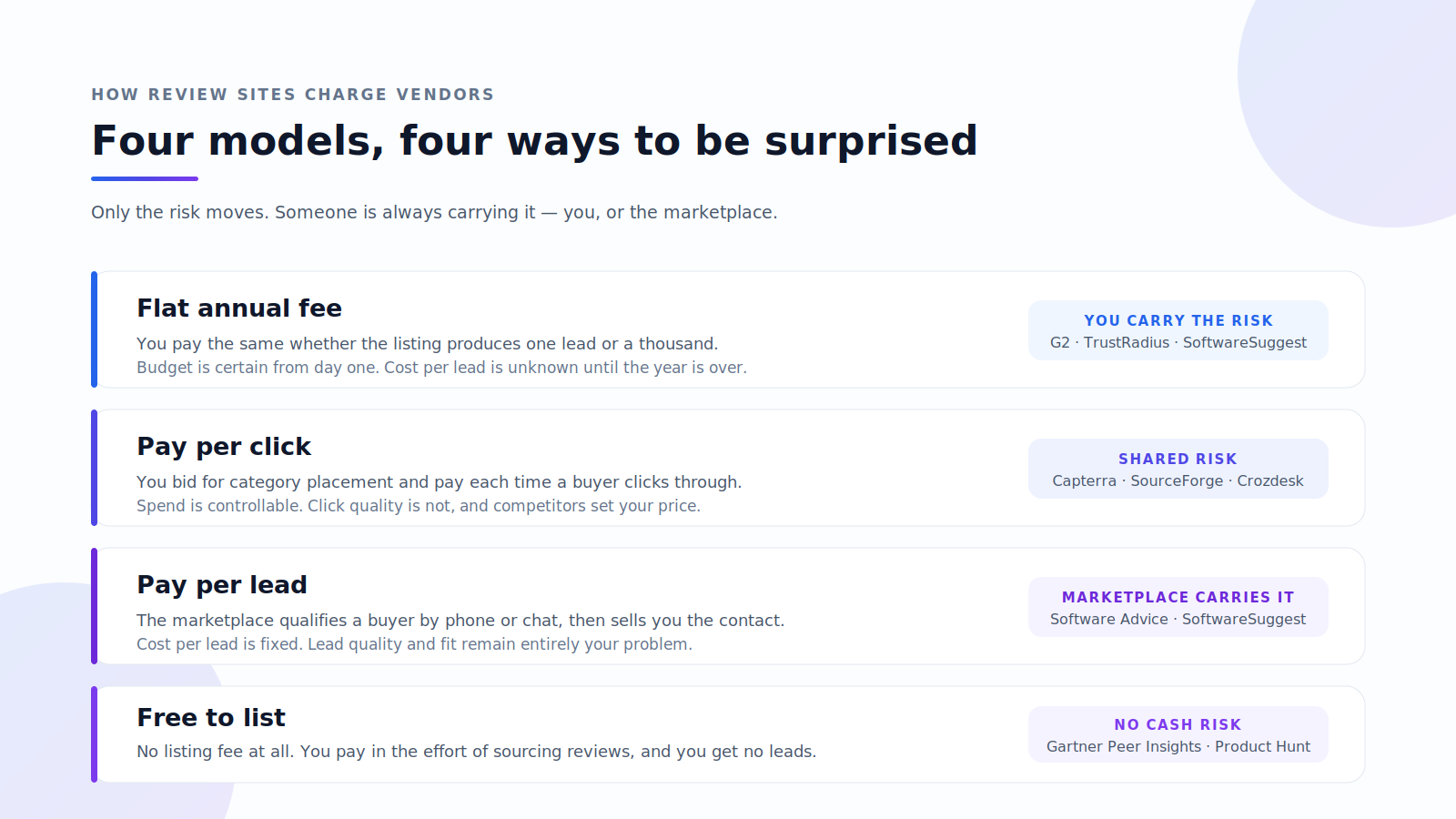
- Flat annual fee — G2 Starter at $2,999, TrustRadius at a last-published $30,000, SoftwareSuggest at $4,000 per six months. You carry all the risk: the price is the same whether the listing produces one lead or a thousand.
- Pay per click — Capterra, SourceForge, Crozdesk. Risk is shared. Spend is controllable, click quality is not, and competitors' bids set your price.
- Pay per lead — Software Advice, and SoftwareSuggest's MQL credits. The marketplace carries qualification risk and you carry fit risk.
- Free — Gartner Peer Insights, and the free tiers everywhere else. No cash risk, no leads, and you pay in sourcing effort.
The uncomfortable structural point is that the ranking logic and the revenue model are not independent. G2's Grid places products on two axes, and Market Presence — half the horizontal axis — is scored partly on employee headcount, revenue estimates, search authority, web traffic and PPC spend, using third-party data from sources like ZoomInfo and Crunchbase. A well-funded vendor with mediocre reviews can outrank a beloved smaller one on that axis. That is documented in G2's own published methodology, not an accusation — but a buyer reading a Grid should know that half of it is not about satisfaction.
How reviewers get verified, and why it varies so much
The strictness ladder runs roughly like this, from tightest to loosest:
- Gartner Peer Insights — corporate email matching stated employer, plus a confirmed gartner.com or LinkedIn profile, plus human moderation.
- TrustRadius and PeerSpot — LinkedIn or work email only, no personal-email path, plus depth vetting or full human moderation.
- Clutch — identity and work history confirmed, with follow-up email requests where detail is thin.
- Capterra, GetApp, Software Advice — human moderation plus enrichment-service identity checks, incentives permitted, no work-email requirement.
- G2 — business email, LinkedIn or personal Gmail, human moderation, AI-generated reviews permitted.
- Trustpilot — open to anyone, with automated fraud detection after the fact.
- SourceForge, SoftwareSuggest, Crozdesk — no published methodology at all.
Two details in that list deserve more attention than they get. Software Advice's own FAQ states that moderators verify who submitted a review but explicitly do not fact-check the opinions. And G2 permits AI-generated reviews — a defensible position given how many people now draft with AI, but one worth knowing when you weigh a five-star paragraph.
Where AI answer engines fit, honestly
This is where the category's marketing has run ahead of the evidence, so it is worth being precise.
The demand shift is real. G2's April 2026 research, surveying 1,076 B2B decision-makers, found 51% of buyers now start research with AI chatbots more often than Google, up from 29% a year earlier, and 69% chose a different vendor because of chatbot guidance. TrustRadius found 63% used AI somewhere in the purchase journey — but also that 94% of AI-using buyers fact-check the responses.
What is much less clear is whether listing on a review site is how you get cited. The only quantified figure available — 22.4% share of influence for software-related queries — is published by G2 about G2. That same study's regression found a 10% increase in a product's G2 reviews correlated with roughly a 2% increase in AI citations, at an R² of 0.009, meaning review volume explains under 2% of the variance in citations. Meanwhile Semrush's independent study of 230,000 prompts and over 100 million citations across ChatGPT Search, Google AI Mode and Perplexity surfaced Reddit, Wikipedia, LinkedIn and YouTube as the top-cited domains, with no software review site appearing in its published rankings.
The honest reading: buyers are demonstrably using AI to research software, and review sites are demonstrably not the dominant thing AI cites. Treat any vendor's AI-visibility claim about its own platform with the scepticism you would apply to its SEO claims, and weight review depth — which gives a model something to quote — over review count.
The part no review site sells you
One thing worth stating plainly, because no marketplace has an incentive to: your reviews are a lagging indicator of how you actually treat customers. G2 Digital Markets' 2026 Software Buying Trends survey of 3,385 global decision-makers found that only one in three organisations adopt new software without disruption or regret, and that 61% hit implementation disruption in the past 18 months. Those experiences become reviews within a quarter or two, on whichever platform you happen to be paying for.
If a meaningful share of your negative reviews cite slow support responses or unresolved tickets, listing on a second marketplace does not fix it — it just distributes the problem more widely. Response time and resolution rate are the two variables that move review sentiment most reliably, and both are operational. Our 2026 AI customer service benchmark sets out what resolution rates and CSAT look like across sectors, and our cost benchmark of AI service covers what resolving a ticket actually costs — useful if you want to know whether the support operation is the constraint before you increase the listing budget.
Frequently asked questions
What is the best alternative to G2?
TrustRadius, now sold as HG Customer Voice, is the strongest genuinely independent alternative for mid-market and enterprise vendors; its last published price was $30,000 per product per year, though HG Insights stopped publishing a figure after rebranding the product in August 2026. Gartner Peer Insights is the best free option for enterprise vendors. PeerSpot is the best choice for infrastructure and security vendors selling through AWS or Google Cloud Marketplace. Capterra still carries the most SMB volume, but G2 has owned it since February 2026.
Is Capterra still owned by Gartner?
No. G2 announced it was acquiring Capterra, Software Advice and GetApp from Gartner on 29 January 2026, and the deal closed on 5 February 2026 for approximately $110 million. The three now operate as G2 Digital Markets. Gartner retained Gartner Peer Insights, which is now its only review property.
Are G2 and Capterra the same company?
Since February 2026, yes. G2 owns Capterra, GetApp and Software Advice, which have long shared a single review pool of 2.5 million-plus reviews. G2's own review corpus of 3 million-plus sits alongside them, and G2 Buyer Intent has aggregated signals across all four properties since 3 June 2026. Listing on all four is not diversification.
How much does it cost to list on G2?
G2 publishes a free tier at $0 and a Starter tier at $299 per month, or $2,999 for the first year. Professional and Enterprise are quote only, and Buyer Intent is a paid add-on available on those two tiers. Procurement platform Vendr reports a median annual contract value of $28,000 across its verified G2 deals, with Enterprise typically between $21,300 and $28,300 and reaching $95,000-plus with add-ons.
Which software review site is free for vendors?
Gartner Peer Insights is genuinely free — no listing fee, no pay-per-click, no pay-per-lead, unlimited portal users, a free Gartner-run review sourcing service and $1,250 in Gartner-funded starter incentives. It sells no buyer-intent data, so it delivers reputation rather than pipeline. Most other platforms offer a free listing tier with meaningful restrictions; Clutch's free tier, for example, removes your website link from directory pages.
What are the alternatives to G2 Buyer Intent?
Bombora sells co-op-sourced content-consumption intent across 5,000-plus B2B sites. 6sense aggregates intent from Bombora, G2, TrustRadius, TechTarget and PeerSpot into predictive buying-stage scores. Demandbase bundles account intent into a full ABM platform with advertising activation. TrustRadius Downstream Intent is the closest direct substitute. None of the four publishes a price.
What happened to G2 Track?
G2 Track, the SaaS spend-management product, was acquired by BetterCloud in March 2024 and is no longer a G2 product. If you need SaaS spend and licence management, the category to search is SaaS management platforms — BetterCloud, Zluri, Torii and Productiv — rather than software review sites.
Which software review site do enterprise buyers actually use?
Gartner Peer Insights is the most enterprise-restricted by design: Voice of the Customer eligibility counts only reviews from companies with revenue above $50 million, and Gartner's own vendor page routes small businesses elsewhere. TrustRadius and PeerSpot also skew mid-market and enterprise, with longer, more technical reviews. Capterra, GetApp and Software Advice are SMB-weighted.
Do AI assistants like ChatGPT cite software review sites?
Less than the review sites suggest. The only quantified figure — 22.4% share of influence for software queries — is published by G2 about G2, and that same study found review volume explains under 2% of the variance in AI citations. Semrush's independent study of 230,000 prompts found Reddit, Wikipedia, LinkedIn and YouTube among the most-cited domains, with no software review site in its published rankings.
Is it worth listing on multiple software review sites?
It depends on whether they are actually different. After February 2026, G2, Capterra, GetApp and Software Advice are one company sharing one review corpus, so listing on all four multiplies cost more than reach. Genuine diversification means pairing G2 with an independent platform whose audience differs — Gartner Peer Insights for enterprise, PeerSpot for cloud marketplaces, SourceForge for developers.
Changelog
- August 2026 — First publication. All vendor prices, review counts and audience figures read from live pages on 20–21 August 2026. Reflects G2's acquisition of Capterra, GetApp and Software Advice (closed 5 February 2026), the expansion of G2 Buyer Intent across four properties (3 June 2026), HG Insights' acquisition of TrustRadius (June 2025), and Crozdesk's migration to Revleads (March 2025). Next scheduled review: January 2027.