The 12 Best Trustpilot Alternatives in 2026
The best Trustpilot alternatives in 2026 are REVIEWS.io, Google Business Profile, Feefo, Judge.me, Yotpo, Okendo, Loox, Bazaarvoice, Shopper Approved, Birdeye, Podium and Stamped. Which one is right depends on a single question most comparison pages skip: do you need company reviews, product reviews, or reviews on other people's websites? This guide compares all twelve on verified prices, verification models and real G2 scores — and normalises the billing unit, because the same business can pay $180 a year on one platform and $19,176 on another for identical review volume.
Reviewed by Alex Gomez, Sr. Analyst. Disclosure: this guide is published by Aissist.io. We build agentic AI for customer service and sales — we do not sell a review platform, and we hold no affiliate or referral relationship with any company listed here. Prices were read from vendor pricing pages on 20–21 August 2026; G2 and Capterra ratings were read in August 2026.
TL;DR: Here is the short version, one platform per job.
- Best like-for-like replacement for company reviews: REVIEWS.io
- Best free option with the biggest audience: Google Business Profile
- Best invitation-only verification for regulated industries: Feefo
- Best hard cost ceiling at any volume: Judge.me
- Best for Shopify brands that also want loyalty: Yotpo
- Best for getting reviews onto retailer product pages: Okendo
- Best for photo and video reviews on a free plan: Loox
- Best enterprise retail syndication: Bazaarvoice
- Best for Google Seller Ratings on paid search: Shopper Approved
- Best for multi-location reputation across many sites: Birdeye
- Best SMS-first collection for local services: Podium
- Best for pairing reviews with loyalty and lifecycle email: Stamped
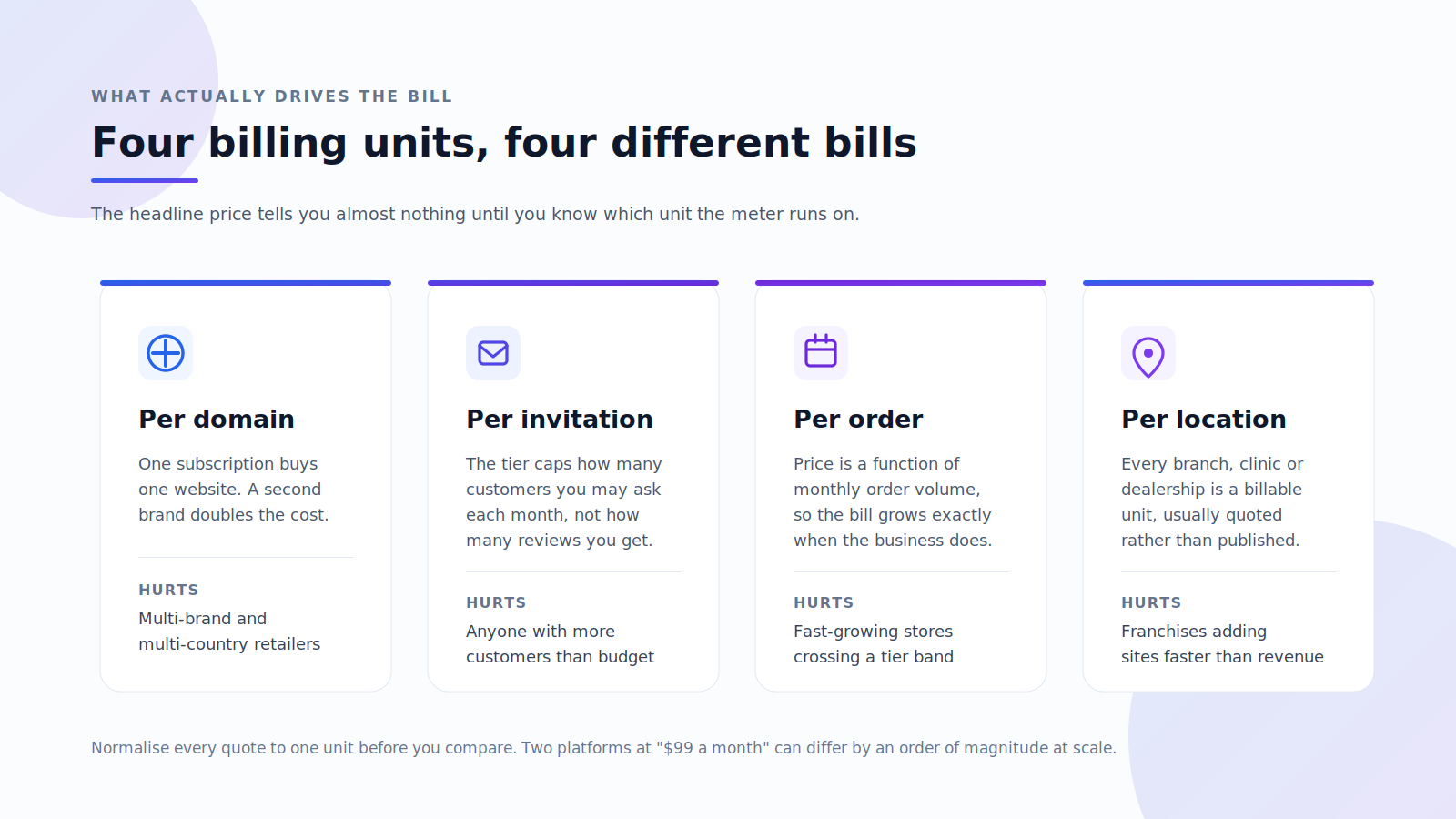
The buying trap in this category is comparing headline prices without normalising the billing unit: Trustpilot charges per domain and caps monthly invitations, Yotpo and Okendo charge by order volume, and Birdeye charges per location — so two platforms both advertising "from $99 a month" can differ by an order of magnitude on the same business.
How we compared these Trustpilot alternatives
We scored every platform out of 5 on six criteria, for a maximum of 30, and excluded anything scoring under 65% (20 of 30). Prices were read directly from each vendor's live pricing page on 20–21 August 2026, and third-party ratings from G2 and Capterra were read in August 2026. Where a vendor publishes no price, this article says "not published" rather than repeating a figure from a directory — several directory listings we checked were materially out of date.
The six criteria:
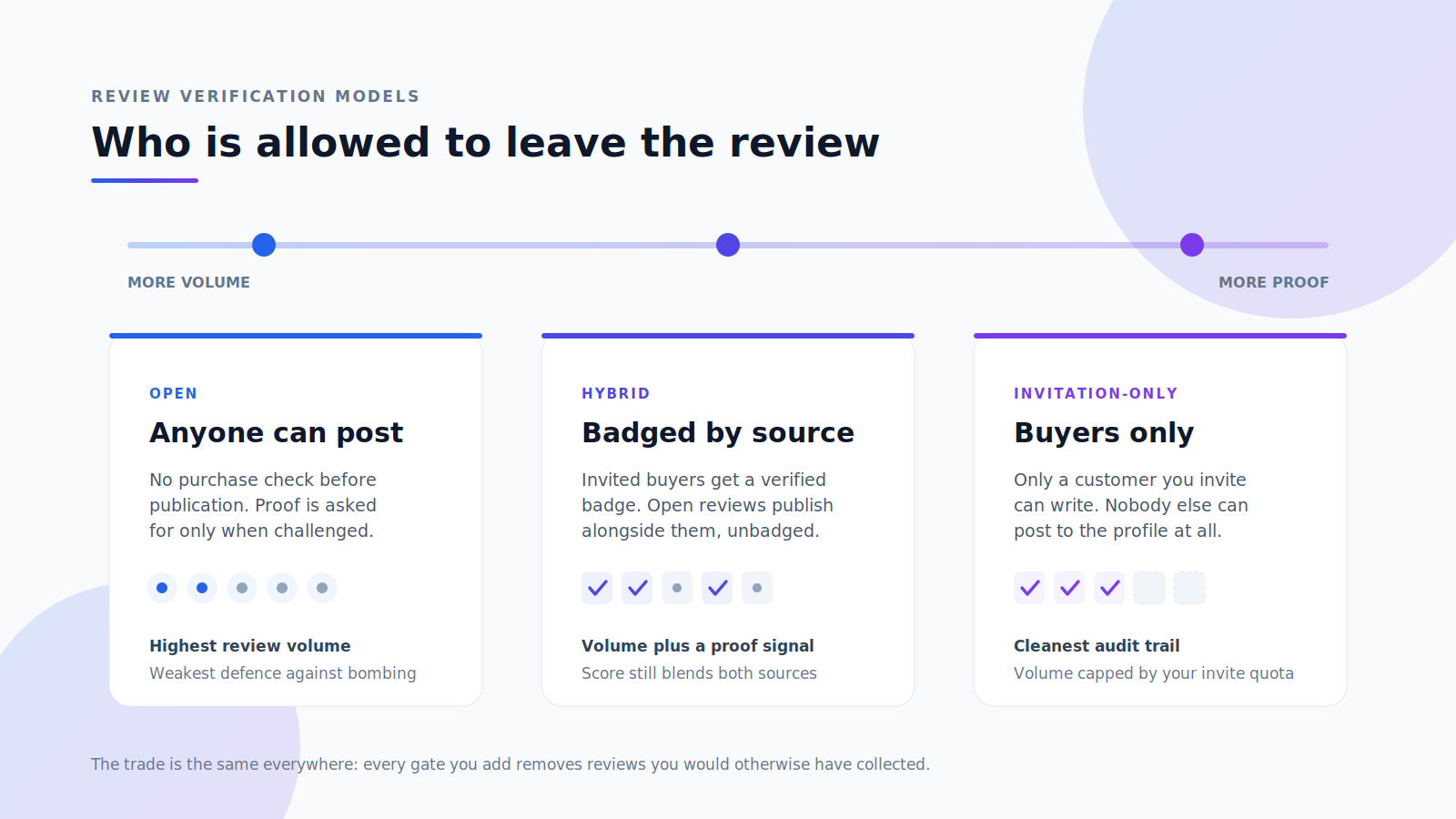
- Verification model. Who is allowed to post, whether purchase is checked before or after publication, and whether unverified reviews count toward the score.
- Distribution and SEO reach. Google Seller Ratings eligibility, Google Shopping product ratings, rich snippets, and syndication to retailer product pages.
- Price transparency and cost at scale. Whether real numbers are published, what the billing unit is, and what happens to the bill when the business doubles.
- Collection channel coverage. Email, SMS, WhatsApp, QR, on-site and in-app.
- Third-party evidence. G2 and Capterra scores weighted by review count, so a 5.0 from 16 reviewers does not outrank a 4.7 from 4,205.
- Stack fit and time to live. Whether it runs on your cart or helpdesk, and how quickly a first review lands.
Two things disqualify a platform: no published verification policy at all, and a review corpus so thin that the rating carries no signal.
We will declare the bias up front — this is Aissist.io's blog. We build agentic AI for customer service and sales, we do not sell a review platform, and we hold no affiliate or referral relationship with any of the twelve companies below. Nothing here is ranked to sell you something we make. The ordering follows the rubric scores, and the "best for" labels are deliberately non-overlapping so no two platforms compete for the same job.
One more framing note. Reviews are not a marketing garnish in 2026. BrightLocal's Local Consumer Review Survey 2026 found that 97% of consumers read reviews, 41% always do, and 68% now require a minimum four-star rating before they will consider a business — up from 55% a year earlier. The same survey found 74% will only consider reviews written in the last three months, which makes rate of collection, not lifetime review count, the metric that actually matters.
The 12 Trustpilot alternatives at a glance
| Platform | Best for | Verification model | Billing unit | Entry price | Deploys onto existing stack | G2 rating (n), Aug 2026 |
|---|---|---|---|---|---|---|
| Trustpilot (baseline) | Brand-level trust at scale | Open — anyone can post | Per domain, 12-month term | $99/mo (free tier: 50 invites) | Yes | 3.4 (263) |
| REVIEWS.io | Like-for-like company review replacement | Hybrid — open reviews prompt a proof request | Per domain, by invite volume | $29/mo (free tier: 25 invites) | Yes | 4.8 (653) |
| Google Business Profile | Free reach at the moment of local intent | Open — no purchase check at all | None — free | $0 | Partial | 4.6 (393) |
| Feefo | Invitation-only proof in regulated industries | Closed — invited customers only | Flat tier, by invite volume | $200/mo US, £149/mo UK | Yes | 4.6 (155) |
| Judge.me | A hard cost ceiling at any volume | Hybrid — web reviews never get the badge | Flat SaaS | $0 free, $15/mo paid | Yes | Not rated (0) |
| Yotpo | Shopify brands that also want loyalty | Verified-buyer led | Monthly order volume | $15/mo (free to 50 orders) | Yes | 4.3 (265) |
| Okendo | Reviews on retailer product pages | Hybrid — store reviews gated to buyers | Monthly order volume | $19/mo (free to 50 orders) | Yes | 4.7 (436) |
| Loox | Photo and video reviews on a free plan | Hybrid — five distinct badge states | Monthly orders + overage | $0 free, $49.99/mo paid | Shopify only | 4.9 (30) |
| Bazaarvoice | Enterprise retail syndication | Verified-purchase plus human moderation | Annual enterprise contract | Not published | Yes | 4.2 (809) |
| Shopper Approved | Google Seller Ratings on paid search | Verified-purchase, invited only | Per bundle, per site | $119–$382/mo | Yes | 4.7 (238) |
| Birdeye | Multi-location reputation across many sites | Invited from your own customer records | Per location | Not published | Yes | 4.7 (4,205) |
| Podium | SMS-first collection for local services | Invited from your own customer records | Not published | Not published | Yes | 4.5 (2,110) |
| Stamped | Reviews plus loyalty and lifecycle email | Invited post-purchase | Monthly order volume, per module | $199/mo | Yes | 4.6 (27) |
The billing unit column is the one to read first. It is the difference between a bill that stays flat as you grow and one that triples when you cross a threshold you did not know existed.
Who each one is built for
| Platform | Best-fit team | Channels the platform collects on | Where it runs | Time to first live review | Notable compliance and distribution |
|---|---|---|---|---|---|
| Trustpilot | SMB to enterprise; services, travel, fintech | Email, API invitation links | Shopify, WooCommerce, Magento, Salesforce, HubSpot, Zendesk | Same day on a cart integration | Google Review Partner; Seller Ratings, Shopping ratings, Bing Merchant Reviews |
| REVIEWS.io | SMB and mid-market ecommerce | Email, SMS, smart links, on-site, surveys, video | Shopify, BigCommerce, Magento, WooCommerce, Klaviyo, Gorgias | Self-serve, 14-day trial | Google Seller Ratings, rich snippets, Google Shopping |
| Google Business Profile | SMB and multi-location local services | Share link, QR, NFC | Google Search and Maps only | Minutes to create, days to verify | No syndication; no on-site rich snippets from GBP content |
| Feefo | UK and EU mid-market; finance, insurance, auto, travel | Email, SMS, WhatsApp, in-mail (SMS and WhatsApp are paid add-ons) | 600+ platforms via Integration Hub, Shopify app | Not published | Google-accepted feed for Seller Ratings and Shopping stars |
| Judge.me | SMB and price-sensitive mid-market | Email, on-site, SMS links, QR, Shopify Orders page | Shopify, WooCommerce, BigCommerce, Squarespace | Self-serve, 15-day trial on paid | Rich snippets free; Google Shopping and Meta/TikTok on paid |
| Yotpo | SMB to mid-market Shopify D2C | Email, SMS, on-site forms | Shopify, BigCommerce, WooCommerce, Adobe Commerce, Klaviyo | Self-serve, free tier immediate | Rich snippets and Shopping from Starter; Seller Ratings only at $119/mo Pro; syndicates to Walmart, Macy's, Target |
| Okendo | SMB to mid-market Shopify D2C | Email, on-site smart capture, Shopify Customer Accounts | Shopify only, plus Klaviyo, Attentive, Gorgias | Self-serve, 14-day trial | Google Product Ratings, Seller Ratings, schema; syndicates via Bazaarvoice to 1,900+ retail sites |
| Loox | SMB and lower mid-market Shopify | Email, on-site widgets, referral prompts | Shopify only | Self-serve, 14-day trial on paid | Rich snippets and Shop app free; Google, Meta, TikTok on paid |
| Bazaarvoice | Enterprise CPG, electronics, beauty, big-box | Email, SMS, multi-product forms, sampling | Shopify, Salesforce Commerce, Adobe Commerce, SAP, BigCommerce, TikTok Shop | Weeks to months, services-led | 2,300+ retailers, 13,000+ brands, 2.3B monthly shoppers; Authentic Discovery API for AI search |
| Shopper Approved | SMB to mid-market ecommerce and lead-gen | Checkout survey, post-fulfilment email, video | Vendor installs the script for you | Install is done for you; Google stars 4–6 weeks after threshold | One of two named Google and Bing Review Partners for store and product reviews |
| Birdeye | Mid-market to enterprise multi-location | Email, SMS, webchat, QR, mobile kiosk | CRM, PMS and POS systems | Not published | Monitors 200+ review sites; no product-level SEO |
| Podium | SMB local and services businesses | SMS-first, email, webchat, mobile app | HubSpot, Salesforce, QuickBooks, Shopify | Not published | Google and Facebook only |
| Stamped | Mid-market ecommerce wanting a bundle | Email with in-mail forms, on-site, video | Shopify, WooCommerce, Klaviyo, Omnisend, Zendesk | Not published | Certified Google Partner; syndicates to Walmart and Target via Bazaarvoice |
Two of these twelve are not really Trustpilot replacements at all, and it is worth saying so before the reviews start. Birdeye and Podium are local reputation platforms — they push reviews onto Google and Facebook and monitor what appears elsewhere. They do nothing for product-level ecommerce SEO. If you came here because Trustpilot's per-domain bill is painful on a Shopify store, they will not solve your problem; if you came here because you run 40 dental clinics, they are the only two entries that will.
The 12 best Trustpilot alternatives, reviewed
First, what you are actually replacing: Trustpilot
Trustpilot is an open consumer review platform, listed on the London Stock Exchange, whose primary job is collecting and publishing company and service reviews on a public trustpilot.com profile, deployed as a hosted profile plus embeddable widgets and cart integrations.
Verification: Open. Anyone may post without an invitation, and Trustpilot's reviewer guidelines state an experience "doesn't necessarily mean a purchase — it's broader than that." Invited reviews get a Verified label; organic reviews sit alongside them and count toward the same score. · Deploys onto: your existing stack, no replacement required. · Channels: automated email invitations in 16 languages, reminder emails, API invitation links. Native SMS and QR are not published. · Review types: company and service reviews as the core product, with Product Reviews as a separate module.
Distribution: Official Google Review Partner feeding Google Seller Ratings, Google Shopping product star ratings, organic rich snippets and Bing Merchant Reviews for Microsoft Ads (vendor-published).
Scale: 361 million-plus reviews across 1.3 million-plus businesses as of FY25 (company results, 13 January 2026). Trustpilot's own Trust Report 2025 states it removed 4.5 million fake reviews in 2024, equal to 7% of everything posted that year, with 90% caught automatically (vendor-published transparency report).
G2: 3.4 (263), read August 2026 · Capterra: 4.5 (1,205) · Cost: free tier at $0 with 50 automated invitations per month and one user. Starter from $99/month per domain, billed annually, 100 invitations. Plus from $319/month per domain, 300 invitations, up to three domains. Premium from $799/month per domain, 1,000 invitations, with unlimited domains permitted but each domain priced separately. All paid plans carry a 12-month commitment (read from Trustpilot's plans page, 20 August 2026).
Pros:
- The largest consumer-facing review footprint of any platform in this article, so a Trustpilot profile carries recognition none of the others match.
- A genuinely usable free tier including 50 automated invitations a month, which most competitors do not offer at all.
- One Google Review Partner feed covering Seller Ratings, Shopping stars and Bing Merchant Reviews together.
Cons:
- Open posting means competitors, non-customers and disgruntled third parties can publish without proof of purchase; verification is retroactive, not a gate.
- Per-domain pricing on a mandatory 12-month term multiplies for multi-brand and multi-country retailers, and the $99 Starter tier is capped at one domain.
- Its G2 score of 3.4 from 263 reviews is the lowest in this comparison, and the gap between that and its 4.5 on Capterra is worth understanding before you renew.
Our take: Trustpilot is not a bad product, and for a single-domain service business that wants brand-level trust it is still the strongest name on the list. Do not stay on it if you sell products rather than a service, run more than one domain, or need proof of purchase before a review publishes.
1. REVIEWS.io — best for replacing Trustpilot one-for-one on company reviews
REVIEWS.io is a UK-founded ecommerce review platform whose primary job is collecting company reviews, product reviews, photo and video content, surveys and NPS in one subscription, deployed as a cart app or JavaScript snippet with a public company profile and on-site widgets.
Verification: Hybrid with an explicit two-state badge. Invited reviews after a transaction carry a Verified Buyer banner. Customers may also write directly on a company profile; those publish as unverified and trigger an automated request for proof of purchase, after which the review is switched to verified. Merchants can turn open reviews off entirely — the single most useful control Trustpilot does not offer. · Deploys onto: Shopify, BigCommerce, Magento, WooCommerce, Klaviyo, Gorgias. · Channels: email, SMS, dynamic links, a review collector landing page, on-site widgets, Review Booster for past customers, photo and video capture, and post-purchase surveys. · Review types: company and product reviews in one platform, plus video UGC and Q&A.
Distribution: Google Seller Ratings, Google rich snippets and Google Shopping product ratings, listed as plan features (vendor-published).
G2: 4.8 (653), read August 2026 — the highest score in this article backed by a meaningful sample · Capterra: 4.2 (10) · Cost: free tier with 25 invites. Essentials 300 invites, Start-Up 1,500 invites plus 100 SMS, Grow 5,000 invites plus 100 SMS and 100 survey replies, Plus 10,000 invites. Pricing is calculated per domain and the pricing page geo-localises, so verify the currency for your market; via the Shopify App Store on 20 August 2026 the US-denominated entry plans read Free, Launch $19/month and Launch Plus $45/month.
Pros:
- Best-rated platform here on G2 at 4.8 across 653 reviews, a sample large enough to mean something.
- Company reviews, product reviews, video, surveys and NPS in one subscription, where Trustpilot splits service and product reviews into separate modules and Feefo meters surveys by tier.
- A free tier plus a sub-$50 paid entry point, materially cheaper than Trustpilot's $99 and Feefo's $200 floors.
Cons:
- Open reviews are permitted by default on company profiles, so the verification guarantee is weaker than Feefo's closed model unless you switch them off.
- SMS is metered at 100 messages a month even on the Grow tier, so high-volume SMS collection triggers overages.
- Consumer brand recognition sits far below Trustpilot and Google, which matters if the reason you collect reviews is that shoppers go looking for them by name.
Our take: For most businesses leaving Trustpilot for cost or moderation reasons, REVIEWS.io is the closest thing to a straight swap, and the ability to disable open reviews addresses the complaint that drives most of those exits. Do not choose it if brand recognition on the review destination itself is the point of the exercise.
2. Google Business Profile — best for free reach at the moment of local intent
Google Business Profile is Google's free local listing product whose primary job is publishing a business's information and consumer reviews directly inside Google Search and Google Maps, deployed by claiming and verifying a listing rather than installing software.
Verification: Fully open, and the weakest of the twelve. Any signed-in Google account can review any business with no purchase, invitation or transaction check. Google verifies the business, not the reviewer, and enforcement is post-hoc content moderation. Review gating and incentivised reviews are prohibited by policy. · Deploys onto: nothing — it is a destination, not a layer. · Channels: a shareable review link, QR code, NFC and print. No native email or SMS automation, which is why an entire tooling category exists to bolt that on. · Review types: company and location reviews only.
Distribution: None outward. Reviews appear natively in Search, Maps and the local pack. Google Business Profile reviews do not produce third-party rich-snippet stars on your own website and are separate from Google Seller Ratings, which come from Google Customer Reviews or a licensed review partner — a distinction that trips up a lot of buyers.
G2: 4.6 (393), read August 2026 — note G2 lists it under its former name, Google My Business · Capterra: no listing exists for the product itself · Cost: $0. There is no paid tier. Cost appears only in whatever third-party tool you add to automate collection.
Pros:
- Zero cost, zero contract, and the largest audience of any option — BrightLocal's 2026 survey puts Google at 71% of consumers for reading local business reviews.
- Reviews surface at the exact moment of local search intent, with no widget to install.
- Highest G2 score of the free and near-free options at 4.6 from 393 reviews.
Cons:
- No purchase verification whatsoever. An analysis of over 73 million reviews by The Transparency Company found nearly 14% of reviews in home services, legal and medical to be highly suspicious or likely fake.
- No automated collection at all: no email or SMS invites, no drip logic, no CRM triggers.
- No product-level reviews, no retailer syndication and no on-site rich-snippet stars from Google Business Profile content, so it cannot support an ecommerce product page strategy.
Our take: Google Business Profile is not optional for any business with a physical or local presence, and it is free, so the only real question is what you pair it with. Do not treat it as a Trustpilot replacement if you sell products online — it answers a different question entirely.
3. Feefo — best for invitation-only proof in regulated industries
Feefo is a UK-based closed review platform whose primary job is collecting service and product feedback exclusively from confirmed transacting customers, deployed via integrations that pass order data to Feefo plus on-site widgets and a public merchant profile.
Verification: Invitation-only, and the strictest here. Feefo states that only people invited to leave feedback can write a review, so businesses can ensure "only genuine customers who have purchased your products or services are invited." No unsolicited public posting is possible. · Deploys onto: an Integration Hub connecting to 600-plus platforms, plus API, webhooks and a Shopify app. · Channels: email, SMS, WhatsApp — the only platform here publishing a native WhatsApp channel — and in-mail reviews. SMS and WhatsApp are paid add-ons rather than base features. · Review types: product and service reviews, plus NPS and custom surveys.
Distribution: Google-accepted feed powering Google Seller Ratings and Google Shopping stars, plus organic rich snippets via schema. Review Network syndication is a Bespoke-tier add-on (vendor-published).
G2: 4.6 (155), read August 2026 · Capterra: 3.8 (5) · Cost: UK Essential £149/month plus VAT with 200 email invitations, Enhanced £299/month plus VAT with 500 invitations. US Essential $200/month, Enhanced $400/month at the same invitation volumes. Bespoke is quoted. No free tier and no free trial (read 20 August 2026).
Pros:
- The only genuinely closed model here, which is the cleanest defence against review bombing and the strongest compliance posture on paper under both the FTC rule and the UK DMCC Act.
- Native WhatsApp review collection, which none of the other eleven publish.
- A Google-accepted feed whose acceptance is explicitly justified by the verification model rather than asserted.
Cons:
- The most expensive entry point in this article at £149 or $200 a month, with no free tier, no free trial and only 200 invitations included.
- Closed collection caps review volume at your invitation quota, and SMS, WhatsApp and syndication are all metered add-ons on top of the base fee.
- On 26 March 2026 the UK Competition and Markets Authority opened a consumer protection enforcement case against Feefo Limited, investigating whether one-star reviews moderated by Feefo were not published on Auto Trader's platform and were not counted toward star ratings. Evidence gathering runs to September 2026 and no finding has been made — the CMA states it should not be assumed that Feefo has infringed consumer protection law. It is a live matter a buyer should know about, not a verdict.
Our take: If an auditable proof-of-transaction trail is worth more to you than raw review volume — insurance, lending, travel, anything where a regulator might ask — Feefo's model is the one built for that. Do not pick it if you need thousands of reviews quickly or if a $200 monthly floor with no trial is more than the problem is worth.
4. Judge.me — best for a hard cost ceiling at any volume
Judge.me is a low-cost ecommerce review app whose primary job is collecting and displaying unlimited product and store reviews with photo and video, deployed as an app on Shopify, WooCommerce, BigCommerce and Squarespace with embeddable widgets.
Verification: Hybrid, and unusually explicit about it. A Verified Buyer badge is applied only when the reviewer matches an order in the connected store's order list. Visitors may leave reviews without trackable purchase history — Judge.me calls these web reviews and states they "will never receive a Verified Buyer badge." Merchants cannot self-apply the badge. · Deploys onto: Shopify, WooCommerce, BigCommerce, Squarespace, plus 130-plus integrations on the paid plan. · Channels: automated email with reminders, on-site forms and popups, SMS links, QR codes, and submission from the Shopify Orders page. · Review types: product reviews and store-wide reviews.
Distribution: Google rich snippets on the free plan; Google Shopping product reviews, Meta and TikTok Shop sync on the paid plan (vendor-published).
G2: no usable listing — a search for Judge.me on G2 returns no product page with reviews, so there is effectively no G2 presence to evaluate · Capterra: 5.0 (21) · Shopify App Store: 4.9 from 43,800 reviews, the largest merchant sample of any app here · Cost: free plan at $0 with unlimited product and store reviews, unlimited photo and video, rich snippets and 24/7 support. Awesome at $15/month adds AI features, Google Shopping, Meta and TikTok sync, referrals and every integration. Judge.me states plainly that "$15 per month is the most you can ever pay us."
Pros:
- A $15 monthly ceiling regardless of order volume or review count — by far the most predictable economics in this article, and the only entry where growth cannot increase the bill.
- The free plan includes unlimited reviews, unlimited photo and video, and Google rich snippets, with no authenticity restrictions applied to free accounts.
- Publishes SMS links and QR codes as collection channels, which Okendo, Loox and Stamped do not.
Cons:
- Open web reviews from non-purchasers are permitted and enabled by default, so out of the box the authenticity model is closer to Trustpilot's than to Feefo's.
- Google Shopping syndication, all integrations and the AI features are locked behind the paid plan; the free plan is rich-snippets-only for SEO.
- Effectively no G2 presence at all, and 21 Capterra reviews is a thin sample, so due diligence has little to read outside the Shopify App Store.
Our take: For a store where the review budget genuinely needs to be a rounding error, Judge.me is hard to argue against, and the price ceiling removes the most common unpleasant surprise in this category. Do not pick it if you need a recognisable public review destination or if unbadged reviews from non-customers are the exact thing you are trying to escape.
5. Yotpo — best for Shopify brands that also want loyalty
Yotpo Reviews is the reviews and visual UGC module of Yotpo's ecommerce retention suite, whose primary job is collecting verified-buyer product and site reviews with photos, videos and Q&A on product detail pages, deployed as a cart app with on-site display widgets.
Verification: Verified-purchase led. Requests are triggered from order data so reviews carry verified-buyer status, with AI moderation applied. On-site submissions from non-purchasers publish without the badge. · Deploys onto: Shopify and Shopify Plus, BigCommerce, WooCommerce, Adobe Commerce, Klaviyo, Meta, TikTok Shop. · Channels: email with in-mail review forms, SMS, and on-site collection including two-in-one requests that capture product and site reviews in a single send. · Review types: product and site reviews, visual UGC and Q&A.
Distribution: Google rich snippets and Google Shopping Ads from the Starter tier; Google Seller Rating is gated to the $119/month Pro tier. Also syndicates to Walmart, Macy's and Target, plus TikTok Shop and Meta (vendor-published).
G2: 4.3 (265) for the whole Yotpo platform, read August 2026 · Capterra: 4.5 (377) · Shopify App Store: 4.8 (4,396) · Cost: free to 50 monthly orders. Starter $15/month with pricing that changes by order volume. Pro $119/month adding Seller Rating, custom questions and AI summaries. Above that, quoted (Shopify App Store listing, read 20 August 2026).
Pros:
- The deepest Shopify-native footprint here, evidenced by 4,396 Shopify App Store reviews at 4.8.
- A free tier to 50 monthly orders and a $15 paid entry point, the cheapest volume-priced entry in this article.
- Bundles into Yotpo Loyalty and Subscriptions, so a review can trigger loyalty points without a second vendor.
Cons:
- Google Seller Rating is withheld until the $119 Pro tier, so the cheap plans cannot drive star ratings on Google Ads — the single most common reason a brand buys a review tool in the first place.
- Pricing is order-volume based and quoted opaquely above Pro, and third-party directories still list an entry price an order of magnitude above the Shopify listing.
- In August 2025 Yotpo laid off roughly 200 employees and moved to sell off its email marketing and customer messaging divisions, refocusing on loyalty and reviews — so the all-in-one premise it was bought for has narrowed.
Our take: If your reviews and your loyalty programme should share a customer record, Yotpo removes a whole integration problem, and the Shopify install is as easy as this category gets. Do not pick it if Google Seller Ratings are the goal and $119 a month is above your budget — you would be paying for a tier you only want one feature from.
6. Okendo — best for getting reviews onto retailer product pages
Okendo is a Shopify-native customer marketing platform whose primary job is collecting and displaying product reviews, UGC and ratings alongside loyalty, referrals, quizzes and surveys, deployed as a Shopify app with on-site widgets and automated review-request emails.
Verification: Hybrid, weighted to verified purchase. Review requests fire from order data, and the site review module is gated — Okendo's documentation states it "will show for customers who are a verified buyer via a review request." A Write a Review path bypasses that gate, and AI moderation rules are applied to submissions. · Deploys onto: Shopify only, plus Klaviyo, Attentive, Gorgias, Postscript, Meta, TikTok and Bazaarvoice. · Channels: automated triggered email, on-site smart capture forms and the Shopify Customer Accounts extension. SMS and QR are not published. · Review types: product reviews and site reviews.
Distribution: This is the reason to pick it. Google Product Ratings into Shopping and Product Listing Ads, Google Seller Ratings on paid search, rich snippets via automated schema, and syndication through Bazaarvoice to over 1,900 global retail sites including Target, Walmart and Sephora (vendor-published), plus TikTok Shop and the Shop app.
G2: 4.7 (436), read August 2026 · Capterra: 4.9 (233) · Shopify App Store: 4.9 (1,321) · Cost: billed on monthly order volume in bands. Free to 50 orders a month. Via the Shopify App Store on 21 August 2026: Essential $19/month, Growth $119/month, Power $299/month, each with a 14-day trial. Platform and bundle subscriptions normally require annual terms.
Pros:
- Retail syndication through Bazaarvoice to 1,900-plus retail sites, a distribution path Judge.me, Loox and REVIEWS.io do not offer at any price.
- Google Product Ratings, Google Seller Ratings and schema rich snippets all covered from one app, with no feature gated to a premium tier.
- Strong and consistent third-party validation: 4.7 from 436 on G2 and 4.9 from 233 on Capterra.
Cons:
- Order-volume pricing means growth is expensive, and the first step is early: Essential at $19 covers only 200 orders a month, so crossing 200 moves you to Growth at $119 — a 6.3x jump for the same feature set — and crossing 1,500 moves you to Power at $299.
- Shopify only. There is no WooCommerce, BigCommerce or Magento path.
- The pricing page does not display tier prices until you enter an order volume, so the Shopify App Store listing is the only place to read them plainly.
Our take: If you sell through Target, Walmart or Sephora as well as your own store, Okendo puts your reviews on their product pages, and that is worth more than any on-site widget. Do not pick it if you are not on Shopify, or if you expect to cross an order band soon and cannot absorb the step change.
7. Loox — best for photo and video reviews on a free plan
Loox is a Shopify-exclusive visual reviews app whose primary job is collecting photo and video product reviews and displaying them in on-site widgets, built specifically for Shopify stores and compatible with every theme.
Verification: Hybrid with the most granular labelling in this article. Reviews from customers who purchased carry "collected from a verified customer who purchased this item." Loox exposes five distinct states: verified purchase, marked as verified by the store owner, unverified, rewarded and incentivized — so a shopper can see exactly what produced each review. · Deploys onto: Shopify only, plus Klaviyo, Omnisend, LoyaltyLion and Google Ads. · Channels: review request emails with reminders, on-site widgets, and post-purchase referral prompts. · Review types: product reviews plus store reviews, with store reviews available on every plan including free.
Distribution: Google rich snippets and schema on the free plan, plus Shop app syndication; Google, Meta and TikTok syndication on paid (vendor-published).
G2: 4.9 (30), read August 2026 · Capterra: 4.9 (16) · Shopify App Store: 4.9 (9,028) · Cost: Beginner free up to 500 orders a month including review request emails, 17-plus widgets and rich snippets. Convert $49.99/month with 300 orders included and $50 per additional 300 orders, adding video, AI features, referrals and syndication. Unlimited $299.99/month (Shopify App Store listing, read 21 August 2026). Note that G2's Loox pricing page still lists an obsolete tier structure — use the Shopify listing.
Pros:
- A free plan covering up to 500 orders a month with rich snippets and 17-plus widgets, a far higher free ceiling than Okendo's 50 orders or Yotpo's 50.
- The most honest review labelling here — separate public badges for rewarded and incentivized reviews, which is exactly what the FTC rule is aimed at.
- Store reviews are included on every plan, including free, where several competitors gate them.
Cons:
- Shopify only, with no WooCommerce, BigCommerce or Magento path at all.
- The Convert overage model bites quickly: 1,500 orders a month costs $49.99 plus $200 in overage, which is $249.99 — within touching distance of the $299.99 Unlimited plan.
- Video reviews and all syndication beyond the Shop app require a paid plan, so the generous free tier is photo-and-snippets only.
Our take: For a visual-first Shopify brand under 500 orders a month, Loox gives away more than anyone else in this article and labels its reviews more honestly than most. Do not pick it if you are scaling through the 1,000–1,500 order range, where the overage maths turns against you before the Unlimited plan makes sense.
8. Bazaarvoice — best for enterprise retail syndication
Bazaarvoice is an enterprise UGC platform, owned by Marlin Equity Partners, whose primary job is collecting product ratings, reviews and visual UGC and syndicating them across a retailer network onto both brand and retailer product pages, deployed through enterprise implementation with managed moderation services.
Verification: Verified-purchase led plus heavy managed moderation — machine learning combined with 250-plus human moderators across 38 languages (vendor-published). Product sampling programmes are included, with sampled reviewers disclosed as such. · Deploys onto: Shopify, Salesforce Commerce Cloud, Adobe Commerce, SAP, BigCommerce, TikTok Shop, plus direct feeds to 2,300-plus retailers. · Channels: email, which Bazaarvoice says accounts for up to 70% of review volume (vendor-published), SMS, multi-product submission forms and sampling. · Review types: product reviews first, plus Q&A and visual UGC. Company and service reviews are not the proposition.
Distribution: The reason it exists. Syndicates to 2,300-plus global retailers, within a network of 13,000-plus brands and retailers reaching 2.3 billion monthly shoppers (vendor-published; the 2,300 retailers are counted inside the 13,000 figure, not additional to it). In April 2026 it launched an Authentic Discovery API to expose reviews to AI search and shopping agents, and added TikTok Shop syndication in March 2026.
G2: 4.2 (809), read August 2026 — the largest G2 sample in this article · Capterra: 4.3 (32) · Cost: not published. The pricing page lists tier names only, with no figures. No figure has appeared on a Bazaarvoice property since a July 2018 announcement that Open Network access starts "as low as $7,000 per brand per year" — a price now eight years old and not restated since. Real deals are bespoke annual contracts scaled by SKU count, syndication reach and implementation services. No free tier.
Pros:
- Retail syndication reach nothing else here approaches — 2,300-plus retailers inside a 13,000-plus brand-and-retailer network reaching 2.3 billion monthly shoppers.
- The largest verified third-party review sample in this comparison at 809 G2 reviews, with Capterra reviewers specifically praising syndication.
- Moved first on AI discoverability with the Authentic Discovery API, which matters as 45% of consumers now report using ChatGPT or similar AI tools to read reviews, up from 6% a year earlier.
Cons:
- No current published pricing of any kind — the last figure Bazaarvoice put in public was an Open Network floor in 2018 — so every evaluation starts with a sales call and an implementation quote.
- Capterra reviewers report that back-end setup and maintenance is clumsy and that reporting frequently requires support tickets to resolve filter issues.
- No self-serve path, no free tier and no free trial, and it is a product review platform rather than a company review platform — so it is not a Trustpilot replacement for a service business.
Our take: If your reviews need to appear on Target's and Walmart's product pages rather than only your own, Bazaarvoice is the category standard and has been for years. Do not evaluate it as an SMB — there is no version of this product that fits a business without an implementation budget.
9. Shopper Approved — best for Google Seller Ratings on paid search
Shopper Approved is an ecommerce review and trust-signal platform whose primary job is collecting merchant and product reviews at checkout and syndicating them into Google and Bing search, ads and Shopping, deployed via a website script installed by the vendor's own team.
Verification: Verified-purchase, invitation only. Reviews are collected from actual buyers at checkout and after fulfilment, which is what Google's store ratings pipeline requires. · Deploys onto: any website, with the vendor performing the installation. · Channels: checkout survey and post-fulfilment email, plus video reviews. SMS and WhatsApp are not published. · Review types: store and seller ratings, product reviews, video reviews and Q&A, kept explicitly separate.
Distribution: The strongest single-purpose distribution story here. Shopper Approved describes itself as one of only two Google and Bing Review Partners for both store and product reviews, and — unusually — publishes the actual threshold: 100 post-fulfilment store reviews with high-quality comments in the same country within 24 months, rated 3.5 stars or above, then four to six weeks for stars to appear (vendor-published, with Google's own criteria cited). Aggregate corpus: over 100 million reviews from more than 10,000 online stores (vendor-published).
G2: 4.7 (238), read August 2026 · Capterra: 4.9 (132) · Cost: $119–$382 per month per bundle, quoted per site, available as bundles or à la carte. A 15-day free trial with no credit card, and reviews collected during the trial are kept permanently even if you do not continue. Integration, setup and support are performed free by the vendor's US-based installation team (read 21 August 2026).
Pros:
- Publishes an actual price range on an official page, which Birdeye, Podium and Bazaarvoice do not.
- Documents the exact Google store-ratings threshold and timeline rather than making a vague SEO claim — you can tell before signing whether you will qualify.
- Reviews collected during the free trial are yours permanently, which removes the usual risk of a trial being wasted effort.
Cons:
- The dedicated pricing page shows no tiers at all; the only published figures come from an FAQ answer, and what moves a buyer from $119 to $382 is not disclosed.
- No free tier — the 15-day trial is the only zero-cost path.
- Integration coverage with ecommerce and marketing stacks is not published on its main pages, so stack fit is hard to verify before a sales conversation.
Our take: If the business case for reviews is written in paid-search click-through rate, Shopper Approved is built for precisely that and tells you the qualification rules up front. Do not pick it if you want on-site UGC merchandising — photo galleries and social proof widgets are not what this tool is for.
10. Birdeye — best for multi-location reputation across many sites
Birdeye is an AI-powered reputation and customer experience platform whose primary job is generating, monitoring and responding to reviews across 200-plus review sites for multi-location businesses, deployed as a SaaS dashboard with per-location workspaces, email and SMS automation and website widgets.
Verification: Invitation-based, sourced from the business's own customer records. Reviews are posted to third-party public sites where those sites' rules govern what survives. Birdeye does not host a closed verified-purchase corpus of its own. · Deploys onto: CRM, PMS and POS systems. Ecommerce integrations are not published. · Channels: email, SMS, webchat, QR codes and a mobile kiosk. · Review types: company and location reviews, with genuine multi-location reputation management as the core product — Birdeye publishes results for brands at 1,700 and 167 locations.
Distribution: Different in kind from the ecommerce tools. Reviews are pushed to public review sites rather than to Google Shopping feeds, with "every rating and review, from every site, in one place" across 200-plus sites. Google Seller Ratings, Google Shopping product ratings and ecommerce rich snippets are not published capabilities.
G2: 4.7 (4,205), read August 2026 — the deepest evidence base in this article by a wide margin · Capterra: 4.7 (705) · Cost: not published. The pricing page carries no figures. Billing is stated as per location rather than per seat, with quote bands at 1–3, 4–9, 10–39, 40–249, 250–999 and 1,000-plus locations.
Pros:
- Monitors and manages 200-plus review sites in one inbox, the broadest third-party coverage here.
- 4,205 G2 reviews at 4.7 and 705 Capterra reviews at 4.7 — an evidence base an order of magnitude deeper than most of this list.
- Publishes QR-code and mobile-kiosk capture, which the ecommerce-first tools do not offer at all.
Cons:
- No published pricing anywhere; every buyer goes through a sales form keyed to location count.
- Wrong tool for product reviews — no Google Shopping product ratings and no product-level rich-snippet capability is published.
- Capterra's aggregate flags a difficult contract termination process, with users describing cancellation as challenging under strict terms.
Our take: For a franchise, dental group, dealership network or clinic chain, Birdeye is the most complete answer in this article and the review volume behind its rating is unusually convincing. Do not consider it if you sell products online — you would be buying a location tool for a catalogue problem.
11. Podium — best for SMS-first collection in local services
Podium is an AI-driven lead conversion and messaging platform for local businesses whose primary job is generating and replying to Google and Facebook reviews via automated text invitations, deployed as a SaaS inbox and mobile app with per-location phone numbers.
Verification: Invitation-based from the business's own contact records. Reviews land on Google and Facebook under those platforms' rules; there is no Podium-hosted verified corpus. · Deploys onto: HubSpot, Salesforce, QuickBooks and Shopify. · Channels: SMS as the primary channel, plus email, webchat and a mobile app. · Review types: company and location reviews only. No product reviews.
Distribution: Google and Facebook only. No Google Seller Ratings, no Shopping product ratings and no ecommerce rich snippets are published.
G2: 4.5 (2,110), read August 2026 · Capterra: 4.3 (526) · Cost: not published. Both the pricing page and the get-pricing page show zero figures and the feature comparison table renders empty; Capterra confirms there is no free trial and no free version.
Pros:
- SMS-first review invitations with an AI reputation specialist that drafts both the invitation and the reply, which suits trades and services where email open rates are poor.
- A substantial evidence base at 2,110 G2 reviews and 526 Capterra reviews.
- Named CRM integrations including Salesforce, HubSpot and QuickBooks, useful when the customer record already lives in a CRM rather than a cart.
Cons:
- No pricing published anywhere on the official site, no free version and no free trial — the highest-friction evaluation in this article.
- Among the negative reviews on Capterra, high and inflexible pricing appears as a theme in 78% and software glitches in 74%, and every negative review that mentions cancellation describes it as difficult. Note the denominator: these are shares of negative reviews, not of all 526.
- Review destinations are limited to Google and Facebook, far narrower than Birdeye's 200-plus sites, and it does nothing for product-level SEO.
Our take: Podium earns its place for one specific job — getting a plumber, dealership or clinic to a steady flow of Google reviews by text, without asking staff to learn a new system. Do not sign without pushing hard on contract length and cancellation terms, because that is where its own reviewers concentrate their complaints.
12. Stamped — best for pairing reviews with loyalty and lifecycle email
Stamped is an ecommerce reviews, loyalty and lifecycle marketing platform whose primary job is collecting product and site reviews through in-email submission forms and pushing them to Google and retail syndication partners, deployed as a hosted app across Shopify, WooCommerce and other carts.
Verification: Post-purchase invitation model, with review requests sent automatically based on timing and delivery rules. Stamped does not publish an explicit verification-badge policy, which is a gap relative to Loox and Judge.me. · Deploys onto: Shopify, WooCommerce, Klaviyo, Omnisend, Zendesk, Zapier, Google, Meta, Bazaarvoice and the Shop app. · Channels: email with in-mail review forms accepting text, photo and video without leaving the inbox, plus on-site widgets and video testimonials. · Review types: product and site reviews, plus loyalty, rewards, referrals, gift cards and surveys.
Distribution: Certified Google Partner covering Google Shopping and Google Ads, with Google Seller Ratings documented separately, plus retail syndication to Walmart and Target via Bazaarvoice and bidirectional Shop app sync (vendor-published).
G2: 4.6 (27), read August 2026 · Capterra: 4.6 (37) · Cost: billed on monthly order volume, per module. No free tier. Reviews $199/month, Loyalty $299/month, Lifecycle $499/month, with 20% off a three-module bundle. Additional domains are $100/month each beyond the two included. Monthly subscriptions require no contract (read 20 August 2026). Note that Capterra still lists a $19/month starting price, which contradicts the live vendor page.
Pros:
- Certified Google Partner status covering Shopping product ratings and Seller Ratings, plus Bazaarvoice retail syndication to Walmart and Target.
- In-email review submission accepting text, photo and video without the customer leaving their inbox, which removes the single biggest drop-off point in review collection.
- Monthly plans carry no contract, so you can upgrade, downgrade or cancel at any time — the opposite of Trustpilot's mandatory 12-month term.
Cons:
- No free tier, and a reviews-only entry price of $199/month is roughly 13 times Judge.me's ceiling and ten times Okendo's entry.
- Multi-domain brands pay $100/month per additional domain beyond two, which recreates exactly the per-domain problem people leave Trustpilot to escape.
- Thin third-party validation at 27 G2 and 37 Capterra reviews, and Capterra's summary flags WooCommerce integration reliability issues for some users.
Our take: Stamped makes sense when reviews, loyalty and lifecycle email should share one customer record and one vendor relationship, and the no-contract monthly terms are a real advantage over the annual commitments elsewhere. Do not buy the reviews module on its own — at $199 a month against Okendo at $19 and Judge.me at $15, the bundle is the only version of this that pencils.
What these platforms actually cost: a worked example
Take a concrete business: a direct-to-consumer brand doing 1,500 orders a month across two domains, inviting roughly 800 customers a month to review, wanting Google Seller Ratings on paid search. Here is what a year costs on each platform, using published prices read on 20–21 August 2026.
| Platform | How the meter runs | Monthly at this scale | Annual | Gets Google Seller Ratings? |
|---|---|---|---|---|
| Judge.me | Flat, uncapped | $15 | $180 | Google Shopping yes; Seller Ratings not stated |
| Okendo | Growth band, 201–1,500 orders | $119 (single domain) | $1,428 | Yes |
| Yotpo | Pro tier required for Seller Ratings | $119 | $1,428 | Yes, at Pro only |
| Loox | $49.99 + $50 per extra 300 orders | $249.99 | $2,999.88 | Not stated |
| REVIEWS.io | Per domain, 1,500-invite tier | ~$99 × 2 domains | ~$2,376 | Yes |
| Shopper Approved | Per bundle, per site | $119–$382 | $1,428–$4,584 | Yes, at 100 reviews / 3.5 stars |
| Trustpilot | Per domain, 1,000 invites | $799 × 2 domains | $19,176 | Yes |
| Feefo | 500-invite tier, still short of 800 | $400+ add-ons | $4,800+ | Yes |
| Stamped | Reviews module + 2nd domain free (2 included) | $199 | $2,388 | Yes |
| Bazaarvoice | Annual enterprise contract | Not published | Not published | Yes |
| Birdeye / Podium | Per location — wrong shape for this business | Not published | Not published | No |
The spread between Judge.me at $180 a year and Trustpilot at $19,176 for the same 1,500 orders is not a quality gap. It is a billing-unit gap. Trustpilot's cost here is driven by two variables that have nothing to do with how many reviews you actually collect: the number of domains, and the monthly invitation cap you have to buy your way past.
Hidden costs to price in before you sign:
- Contract length. Trustpilot's paid tiers require a 12-month commitment. Stamped and Judge.me are month-to-month. Okendo's platform bundles normally require annual terms.
- Metered channels. SMS is capped at 100 messages a month on REVIEWS.io's $299 tier. Feefo charges for SMS and WhatsApp as add-ons on top of the base fee, and syndication is Bespoke-tier only.
- Feature gates that defeat the purpose. Yotpo's Seller Rating sits at $119 when the entry tier is $15. Judge.me's Google Shopping sits behind the $15 plan. Buying the cheap tier and discovering the one feature you needed is not in it is the most common mistake in this category.
- Per-domain multipliers. Trustpilot, REVIEWS.io and Stamped all charge per domain in some form. A multi-brand group should model this before comparing headline prices at all.
- Migration is mostly one-way. Reviews collected on a third-party platform generally do not transfer to a competitor, because the reviews belong to the platform's public profile, not to you. Budget for rebuilding the corpus from zero, and start collecting on the new platform before you cancel the old one.
How to choose the right Trustpilot alternative
Eight rules that resolve most of this decision without a spreadsheet.
If you sell products rather than a service, then choose a product review platform — Okendo, Yotpo, Judge.me or Loox — because company-level star ratings do nothing for a product detail page, and product ratings are what Google Shopping and retailer pages consume.
If you run more than one domain or brand, then price the per-domain multiplier before anything else, because Trustpilot, REVIEWS.io and Stamped all bill per domain in some form, and a three-brand group can pay triple for identical functionality.
If a regulator could ask you to prove a review came from a real customer, then choose Feefo's invitation-only model, because it is the only platform here where an unverified party cannot post at all, and a closed collection log is the evidence a compliance review will ask for.
If your business case is written in paid-search click-through, then choose Shopper Approved or a platform with published Seller Ratings support, because Google requires 100 post-fulfilment store reviews at 3.5 stars or above in the same country within 24 months before stars appear, and not every platform's feed qualifies.
If you sell through Target, Walmart, Sephora or similar, then choose Bazaarvoice or Okendo, because they are the only two here that syndicate your reviews onto retailer product pages, where a growing share of the purchase decision actually happens.
If you operate physical locations rather than a website, then choose Birdeye or Podium and claim your Google Business Profile, because the ecommerce tools have no concept of a location and Google is where 71% of consumers read local reviews.
If your order volume is about to double, then model the tier bands, not the entry price, because order-volume pricing is designed to grow with you: Okendo steps from $19 to $119 at just 200 orders a month and to $299 at 1,500, and Loox adds $50 per extra 300 orders.
If you mainly want the bill to stop being a surprise, then choose Judge.me, because it is the only platform in this article with a published hard ceiling — $15 a month, whatever happens to your volume.
One practitioner framing worth borrowing. James Bertram, Digital Marketing Manager at Abbott Lyon, described the switch decision this way: "We used Stamped.io before, which was a nice app, but they weren't a Google partner. I had previous experience with REVIEWS.io — the price was cheaper, the offering was better, and there's more that can be done with the platform." Note that this appears on REVIEWS.io's own blog, so treat it as a customer's stated reasoning rather than an independent benchmark. The reasoning is the useful part: partner status first, price second, breadth third — in that order, because partner status is the thing you cannot work around.
What review platforms actually do, and why the model matters
A review platform does three separable jobs, and most buying mistakes come from assuming one product does all three.
The first job is collection — getting a customer to write something at all. This is a deliverability and timing problem, and it is why the channel list matters: email still carries the majority of review volume (Bazaarvoice puts it at up to 70%), but SMS roughly doubles response rates for local services, and an in-email form that does not require a click removes the largest single drop-off point.
The second job is verification — deciding who is allowed to write, and whether that gets checked before or after publication. This is the axis nobody compares properly, and it is the real reason businesses leave Trustpilot. An open platform maximises volume and accepts that non-customers can post. A closed platform maximises defensibility and accepts a lower ceiling. A hybrid platform tries to have both and labels the difference. There is no correct answer, only a trade you should make deliberately.
The third job is distribution — putting the review somewhere it changes a decision. That might be your own product page via schema markup, Google Ads via Seller Ratings, Google Shopping via product ratings, a retailer's product page via syndication, or increasingly an AI assistant's answer. These are separate pipes with separate eligibility rules, and a platform that feeds one does not necessarily feed the others.
Why verification stopped being optional
The regulatory floor moved. The FTC's Rule on the Use of Consumer Reviews and Testimonials took effect on 21 October 2024, banning fake and AI-generated reviews, undisclosed insider reviews, and the suppression of negative reviews. Civil penalties run to $53,088 per violation under the FTC's inflation-adjusted schedule.
The UK went further. The Digital Markets, Competition and Consumers Act brought fake-review provisions into force on 6 April 2025, banning not only fake reviews but publishing reviews "in a misleading way" — which explicitly includes suppressing negative ones — and giving the CMA power to fine up to 10% of global turnover without going to court. In March 2026 the CMA opened its first formal enforcement cases under that Act specifically concerning reviews, and one of them concerns a review platform's moderation practices rather than a merchant's.
Against that backdrop, "how does this platform decide what publishes" is a due-diligence question, not a feature question.
Reviews are downstream of your support operation
One thing worth saying plainly, because no review platform will tell you: collection tooling changes the rate at which experiences become reviews, not the experiences themselves. BrightLocal's 2026 survey found 77% of consumers are less likely to use a business after reading negative reviews, and 74% only consider reviews from the last three months — which means a persistent service problem shows up in your rating within a quarter no matter which platform you send invitations from.
If a meaningful share of your negative reviews cite slow replies or unresolved tickets, the fix is upstream of the review tool. Response time and first-contact resolution are the two variables that move review sentiment most reliably, and they are operational, not promotional. Our ecommerce customer service benchmark and the wider 2026 AI customer service benchmark cover what resolution rates and CSAT levels look like across sectors, if you want to know whether your support operation is the constraint before you spend on a review platform.
Where AI answer engines fit
The distribution question is changing shape. BrightLocal's 2026 survey found 45% of consumers now use ChatGPT or similar AI tools to read reviews — up from 6% the previous year — while Google's share fell from 83% to 71%. That does not make Google unimportant, but it does mean review content is increasingly being read by a model summarising a category rather than a person scrolling a profile.
Practically, that rewards two things: structured, machine-readable review data on your own pages, and presence on platforms whose content is being indexed for AI answers. Bazaarvoice's Authentic Discovery API, launched April 2026, is the first explicit product move in that direction. Expect more, and treat any vendor's AI-visibility claims about their own platform with the same scepticism you would apply to their SEO claims.
If you sell software rather than consumer products, the equivalent question runs through B2B review sites instead — we cover that in our companion guide to the best G2 alternatives.
Frequently asked questions
What is the best Trustpilot alternative?
There is no single best one — it depends on what you sell. REVIEWS.io is the closest like-for-like replacement for company reviews and scores highest here on G2 at 4.8 from 653 reviews. Okendo and Yotpo are better for product reviews on an ecommerce store. Birdeye is better for multi-location businesses. Google Business Profile is the best free option for anyone local.
Is there a free alternative to Trustpilot?
Yes, several. Google Business Profile is completely free with no paid tier and reaches the largest audience of any option. Judge.me offers a free plan with unlimited product and store reviews plus Google rich snippets. Loox's free plan covers up to 500 orders a month. Yotpo and Okendo are free up to 50 monthly orders, and REVIEWS.io's free tier includes 25 invitations. Trustpilot itself has a free tier with 50 automated invitations a month.
How much does Trustpilot cost compared to alternatives?
Trustpilot's published plans run from $99 a month per domain for Starter with 100 invitations, to $319 for Plus, to $799 for Premium with 1,000 invitations — all on a 12-month commitment. Judge.me caps at $15 a month flat, Okendo starts at $19, Yotpo at $15, and REVIEWS.io in the $19–$29 range. Feefo is the most expensive entry at $200 a month in the US with no free trial. Prices read 20–21 August 2026.
Can I transfer my Trustpilot reviews to another platform?
Generally no. Reviews written on Trustpilot belong to the Trustpilot profile and cannot be migrated to a competitor's public profile, because the review is attached to that platform's hosted page. Some platforms offer an import function for reviews you already display on your own site, and REVIEWS.io's Review Booster can re-invite past customers to rebuild a corpus. Plan to run both platforms in parallel for a quarter rather than switching cold.
Why do businesses leave Trustpilot?
Three reasons recur. Cost, because pricing is per domain on an annual commitment and scales with invitation volume rather than results. Moderation, because Trustpilot's open model lets non-customers post and verification happens only after a review is challenged. And fit, because Trustpilot collects company reviews while an ecommerce brand usually needs product reviews on product pages.
What is the difference between Trustpilot and Google reviews?
Trustpilot is a third-party platform you pay to collect and display reviews, with a public profile page and widgets for your own site. Google reviews are free and appear directly in Google Search and Maps at the moment of search. Neither verifies purchase before publication. The practical difference is that Google reviews reach more people but cannot be automated or displayed as product ratings, while Trustpilot can be automated and feeds Google Seller Ratings.
Which review platform is best for Shopify stores?
For most Shopify stores it comes down to four. Judge.me if predictable cost matters most, at $15 a month uncapped. Loox if photo and video reviews are the point, with a free plan to 500 orders. Okendo if you also sell through retailers, because it syndicates via Bazaarvoice to 1,900-plus retail sites. Yotpo if you want reviews and a loyalty programme from the same vendor.
Which platforms give you Google Seller Ratings?
Google Seller Ratings require a licensed review partner feed, 100 post-fulfilment store reviews with comments in the same country within 24 months, and a rating of 3.5 stars or above. Trustpilot, REVIEWS.io, Feefo, Okendo, Shopper Approved and Stamped all publish Seller Ratings support. Yotpo gates it to the $119 Pro tier. Google Business Profile reviews do not produce Seller Ratings — that is a separate pipeline.
Are invitation-only review platforms better than open ones?
They are more defensible, not automatically better. An invitation-only platform like Feefo means no non-customer can post, which is the cleanest position under the FTC rule and the UK DMCC Act. The trade is volume: your review count is capped by your invitation quota and your response rate. Open platforms collect more reviews and accept that some come from people who never bought anything.
Do review platforms actually help SEO?
Indirectly, through three mechanisms rather than rankings directly. Review schema on your own pages can produce star rich snippets in organic results, which lifts click-through rate. Seller Ratings put stars on paid search ads. And fresh review content on category and product pages adds indexable text. None of this is a ranking factor on its own — the click-through improvement is the measurable part.
Changelog
- August 2026 — First publication. All prices read from vendor pricing pages 20–21 August 2026; G2 and Capterra ratings read August 2026. Added the CMA enforcement case opened against Feefo on 26 March 2026, Yotpo's August 2025 restructuring, and Bazaarvoice's April 2026 Authentic Discovery API. Next scheduled review: January 2027.