5 Best Intercom Fin Alternatives & Competitors for 2026
The best Intercom Fin alternatives in 2026 are Aissist.io, Lorikeet, Maven AGI, Decagon, and Sierra. Fin is one of the most mature AI agents on the market — a transparent $0.99 per resolution and a deep G2 review base — but teams still look for alternatives when the per-resolution bill climbs, when they need deeper agentic workflows, or when they want a cheaper way to automate tier-1. This guide compares the five strongest competitors on the five things that decide the purchase: technology (agentic vs generative), G2 rating, market fit, cost, and performance — with sources for every number. For adjacent shortlists, see our Sierra AI alternatives and Decagon AI alternatives guides.
Compiled by Alex Gomez, Sr. Analyst, read on 24 August 2026. Disclosure: this guide is published by Aissist.io, which sells an agentic AI layer that competes with every product listed here — including the one we rank first. We hold no affiliate, referral or paid placement relationship with any vendor on this page, and no vendor reviewed it before publication. Figures about other vendors are sourced to that vendor's own published material where one exists; where none exists we say so rather than estimate. Our own figures are self-reported and marked as such.
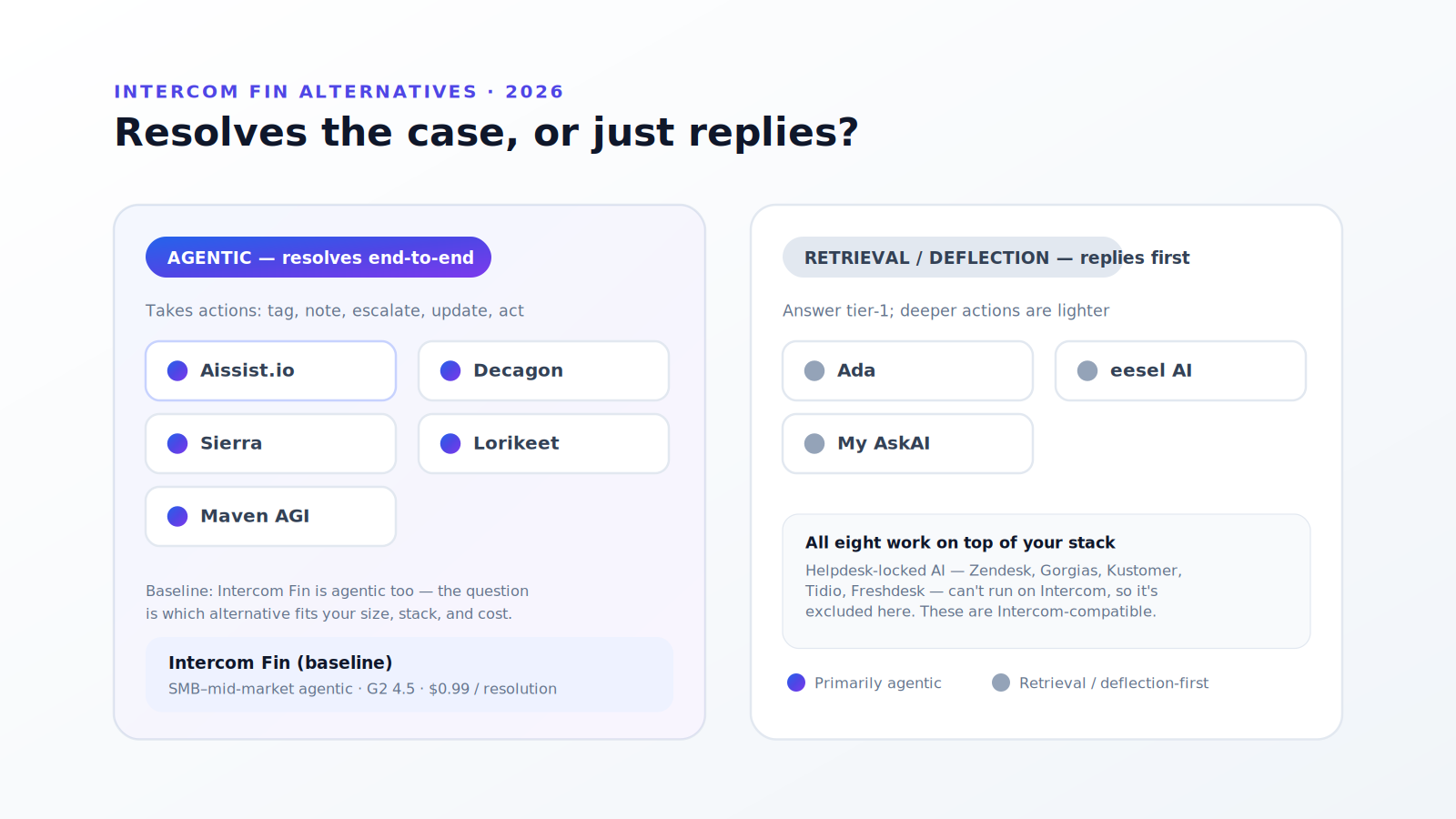
What we excluded — and why it matters
One rule shaped this list: every tool here is helpdesk-agnostic and works on top of Intercom. We deliberately left out the AI agents built into rival help desks — Zendesk AI, Gorgias AI, Kustomer AI, and Freshdesk Freddy. Those agents only run inside their own platform; they cannot operate on Intercom. So if you're staying on Intercom and want to replace or augment Fin, a helpdesk-native AI from a competitor simply isn't an option — you'd have to migrate your whole help desk to get it. Every alternative below is different: each is a standalone AI agent layer that plugs into Intercom (and usually Zendesk, Freshdesk, Salesforce, and your internal systems too), so you can swap or supplement Fin without leaving Intercom.
Why teams look for an Intercom Fin alternative
Fin is a strong product, so the reasons to shop are specific. Cost at volume is the most common: $0.99 per resolution is transparent and fair, but it scales linearly, and high-volume teams can find a lower effective cost per resolution elsewhere. Agentic depth is the second: Fin resolves well, but teams with complex, multi-system or regulated workflows (refunds, account changes, identity checks) sometimes want a deeper agent like Lorikeet, Maven AGI, or Aissist.io. Resolution reality is the third: Intercom cites a 76% average resolution rate, but independent testing often puts production numbers closer to 45–55%, so buyers pilot alternatives to see what actually resolves on their tickets.
How we compared these Intercom Fin competitors
Every tool below is scored on the five pillars that decide an agentic-AI purchase in 2026:
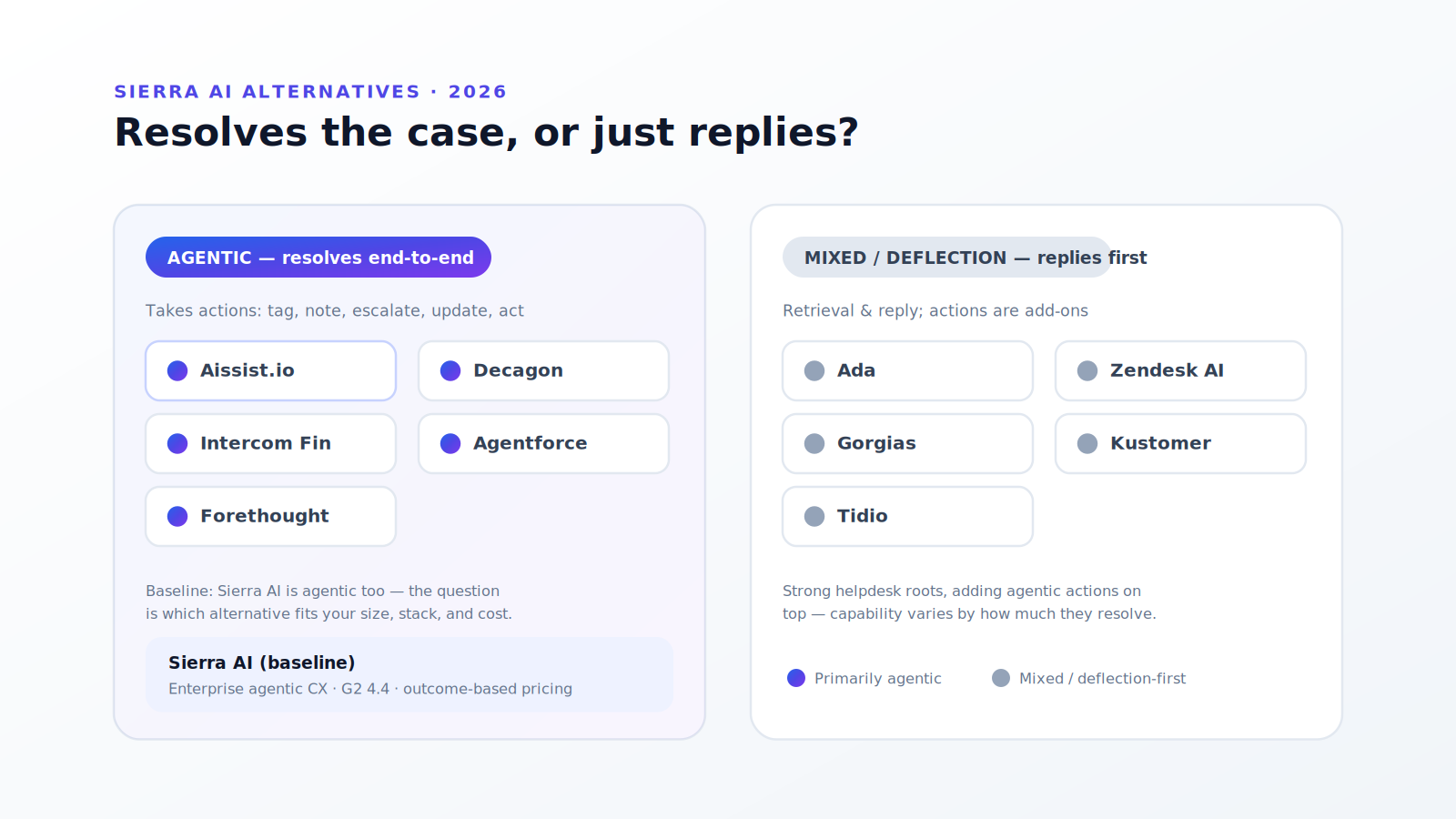
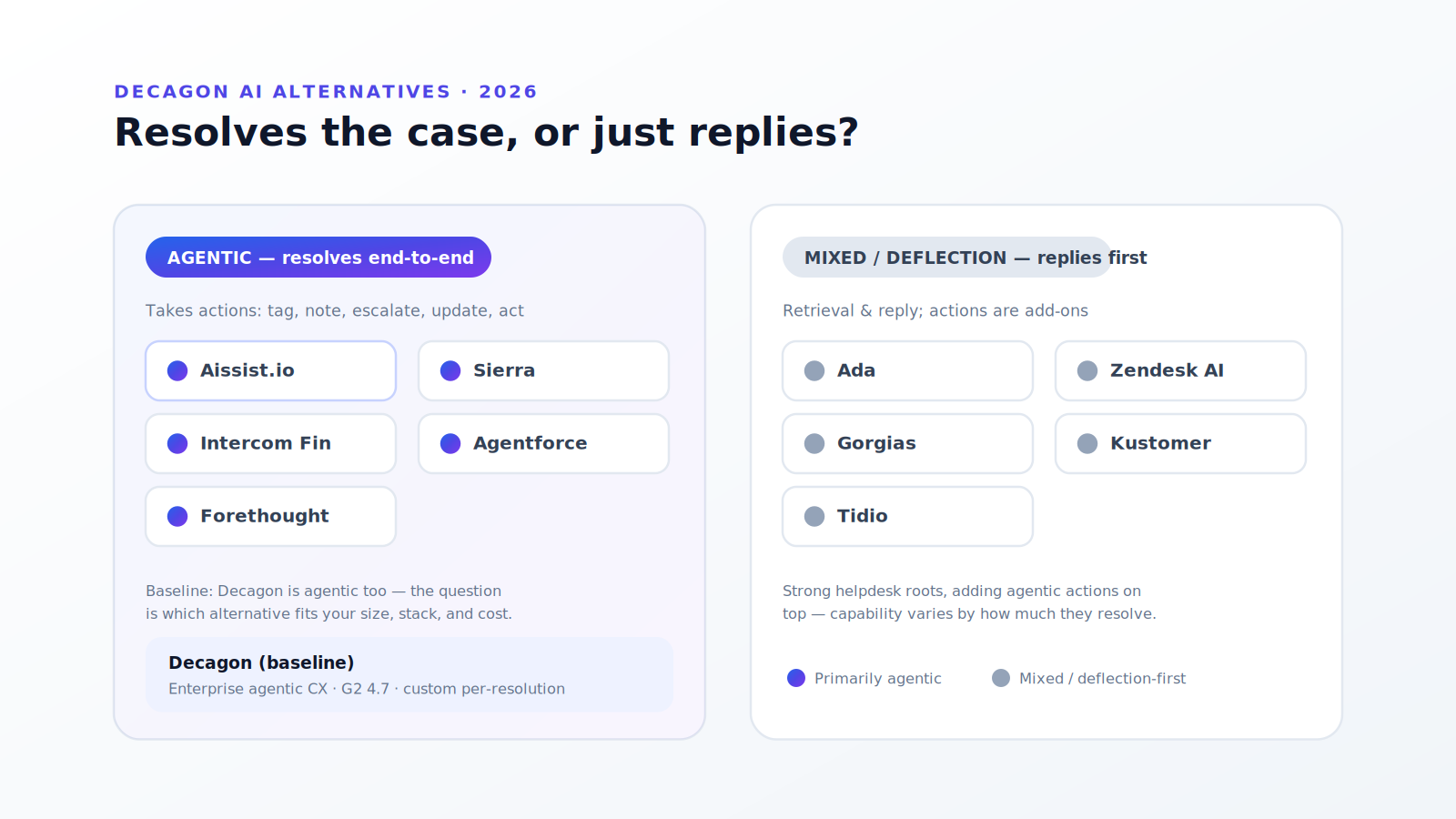
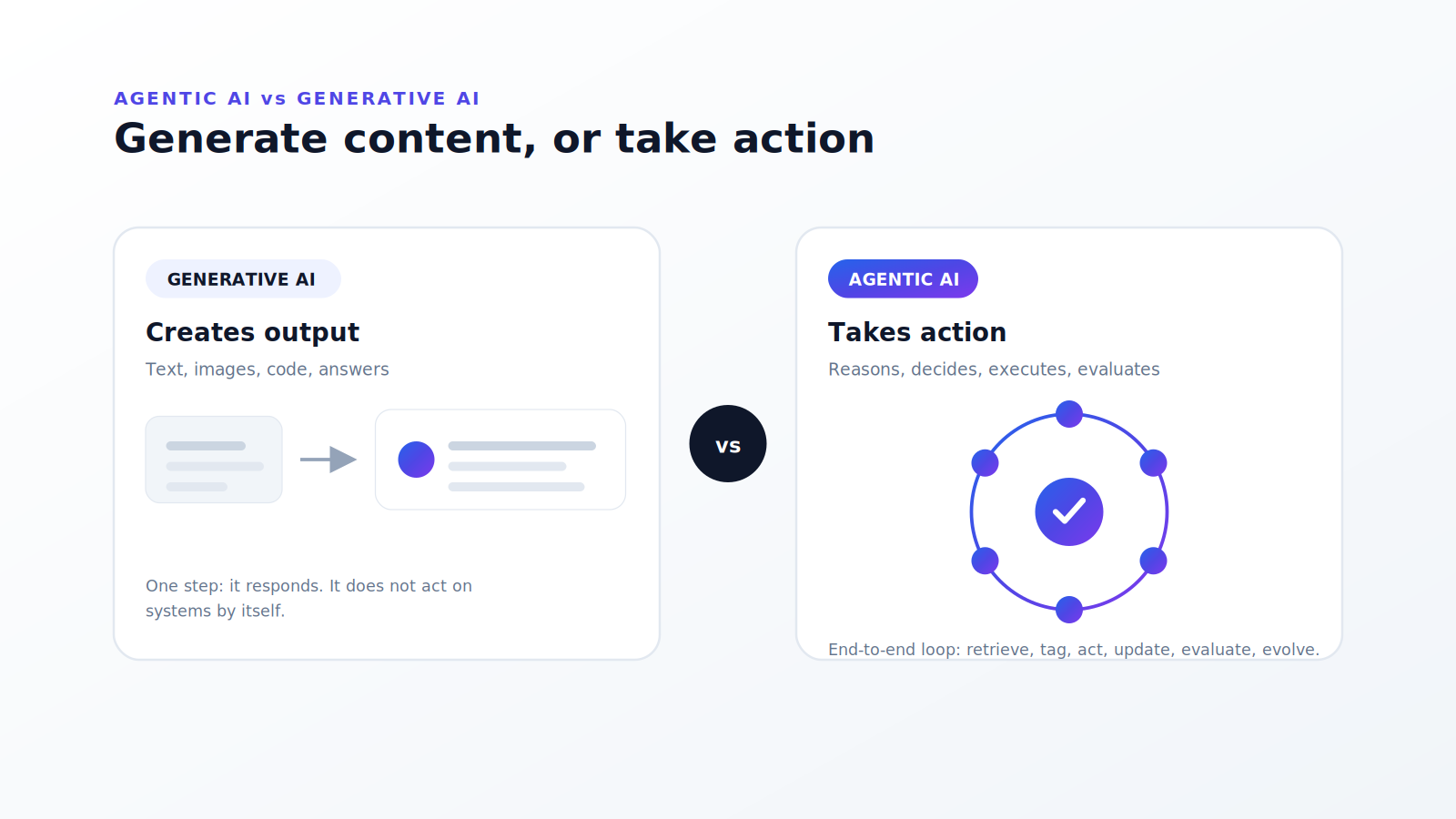
- Technology — agentic or generative. Does the AI resolve end-to-end (take actions, update systems, complete the task) or mostly deflect (retrieve and reply)? If that distinction is new, our explainer on agentic AI vs generative AI breaks it down — it's the difference between finishing a case and answering a question.
- G2 rating. Each product's overall G2 score and review count, captured August 2026. We flag vendors with a thin or missing review base.
- Market fit. The company size, region, and use case each tool is genuinely built for.
- Cost. The pricing model and real figures where published, benchmarked against our AI agent pricing benchmark, which normalizes 18 vendors to effective cost per resolved conversation.
- Performance. Published resolution / CSAT / deflection figures, with the source and whether it's vendor-claimed or independent. Treat vendor best-case numbers with care: our AI customer service benchmark by industry shows claimed rates of 65–86% routinely compress to 40–70% in production.
Intercom Fin alternatives compared at a glance
| Platform | Technology | G2 rating | Cost model | Best fit |
|---|---|---|---|---|
| Intercom Fin (baseline) | Agentic | 4.5 (3,901) | $0.99 / resolution | SMB–mid-market SaaS |
| Aissist.io | Agentic | 4.9 (45) | Up to $0.60 / resolution | Mid-market (+ SMB), layer on your stack |
| Lorikeet | Agentic | No G2 reviews | $1,500–$4,000 / mo, pay-per-resolution | Complex / regulated CX |
| Maven AGI | Agentic | 4.8 (19) | Custom / quote-only | Enterprise |
| Decagon | Agentic | 4.7 (28) | Per-resolution, custom | High-volume enterprise |
| Sierra | Agentic | 4.4 (77) | Outcome-based, custom | Large enterprise CX |
Pricing figures without a public source are third-party procurement estimates — confirm current numbers with each vendor.
The 5 best Intercom Fin alternatives and competitors
1. Aissist.io — best agentic layer for your existing stack
Aissist.io is an AI Operational Layer that resolves support and sales end-to-end and layers onto the help desk you already run — including Intercom, Zendesk, Salesforce, and Front — instead of replacing it. Its AgentMesh™ multi-agent workforce tags, notes, escalates, updates systems, and takes action, while Pulse™ and Evolve™ surface insight and keep improving it. Technology: genuinely agentic, built on multi-agent reasoning with governance and human escalation. G2: 4.9 (45, as of 7 October 2026) — the highest score on this list. Cost: up to $0.60 per resolution on the published pricing page, with a free tier — below Fin's $0.99. Performance: 83% average resolution and 4.8/5 CSAT on automated support (vendor-published). Best fit: mid-market teams (and up-market SMBs) that want deeper agentic resolution than Fin at a lower per-resolution cost, without a migration. Pros: works on Intercom, no rip-and-replace, transparent low pricing. Cons: younger brand with a smaller review base and lighter UI customization than the big suites.
2. Lorikeet — best for complex, regulated resolution
Lorikeet (founded by ex-Stripe and Google leaders) is an "AI concierge" built to resolve complex, high-stakes cases end-to-end using a graph/SOP-driven agent, integrating with Intercom, Zendesk, Front, HubSpot, and internal systems. Technology: strongly agentic — it follows your SOPs, calls internal APIs, and executes real workflows (reschedules, refunds, delivery changes) across chat, email, SMS, WhatsApp, and voice. G2: no populated reviews yet — treat social proof as case-study-based, not G2-verified. Cost: published pay-per-resolution — $1,500/mo (<5,000 tickets) to $4,000/mo (5,000–20,000), enterprise custom (lorikeetcx.ai/pricing). Performance: vendor-claimed 99% accuracy and 97% faster resolution at one client (vendor-reported, single client). Best fit: mid-market to enterprise in fintech, healthtech, travel, and other regulated/complex CX. Pros: deepest genuine workflow execution for hard cases. Cons: highest entry cost, no free tier, thin third-party validation.
3. Maven AGI — best enterprise agentic newcomer
Maven AGI (from ex-Google and HubSpot leaders) is an enterprise AI agent platform whose autonomous agents reason over your environment and take secure, multi-step actions, with 50+ integrations including Intercom, Zendesk, Freshdesk, and Salesforce. Technology: strongly agentic — explicitly beyond deflection. G2: 4.8 (19) — top-tier sentiment on a smaller base, with recent G2 recognition in mid-market AI support. Cost: custom, quote-only enterprise pricing with no public rate card. Performance: vendor-claimed up to 93% autonomous resolution, with a TripAdvisor case study near 90% (vendor-reported). Best fit: mid-market to enterprise across financial services, healthcare, telecom, and travel. Pros: enterprise-grade agentic depth and integration breadth. Cons: opaque, demo-only pricing and a real implementation lift; not SMB-friendly.
4. Decagon — enterprise agentic heavyweight
Decagon is an enterprise agentic-AI platform (valued at $4.5B in January 2026) whose agents resolve across chat, email, voice, and SMS using natural-language "Agent Operating Procedures" plus a hallucination-screening supervisor model. Technology: agentic. G2: 4.7 (28). Cost: custom per-conversation or per-resolution, with no public rate card; procurement aggregator Vendr put the median contract at $432,750/year on a 20 August 2026 read (Vendr does not publish its sample size). Performance: ~80% average deflection with named-customer case studies (vendor-reported). Best fit: high-volume enterprises (fintech, consumer tech). Pros: top-rated AI quality and strong guardrails. Cons: enterprise-only pricing and a thin public review base. See our full Decagon AI alternatives guide.
5. Sierra — marquee enterprise agentic platform
Sierra, from Bret Taylor and Clay Bavor, is an enterprise agentic platform whose agents resolve across chat, voice, and messaging by taking end-to-end actions. Technology: agentic. G2: 4.4 (77). Cost: outcome-based, custom contracts with no public rate card; reported commitments start around six figures plus implementation. Performance: Sierra cites ~70% containment and CSAT above 4.5/5 (vendor-reported). Best fit: large enterprises wanting a marquee agentic vendor. Pros: elite team, strong end-to-end action orientation. Cons: pricing opacity and cost; enterprise-only. See our Sierra AI alternatives guide.
How to choose the right Intercom Fin alternative
An honest point
Before the two lenses below, one honest caveat: the most natively integrated option is usually the platform's own AI — here, Intercom's own Fin. It lives inside Intercom, needs no extra connector, and is the simplest path if you prefer one platform, one vendor, and one console to manage. For some teams that single-vendor simplicity is the deciding factor, and that's a legitimate choice. But native does not mean most capable or best-performing — and the built-in option usually charges a premium for the convenience (Fin's $0.99 per resolution is transparent, but not the lowest here). Every agent below competes on resolution rate and cost per resolution, and several beat Fin on price, depth, or both. Weigh simplicity against capability, performance, and price before you default to native.
Beyond that, two decisions do most of the work: which tools fit your situation, and which delivers the best return on the money. Take them in that order — fit narrows the field, ROI picks the winner.
Choose the market-technology fit
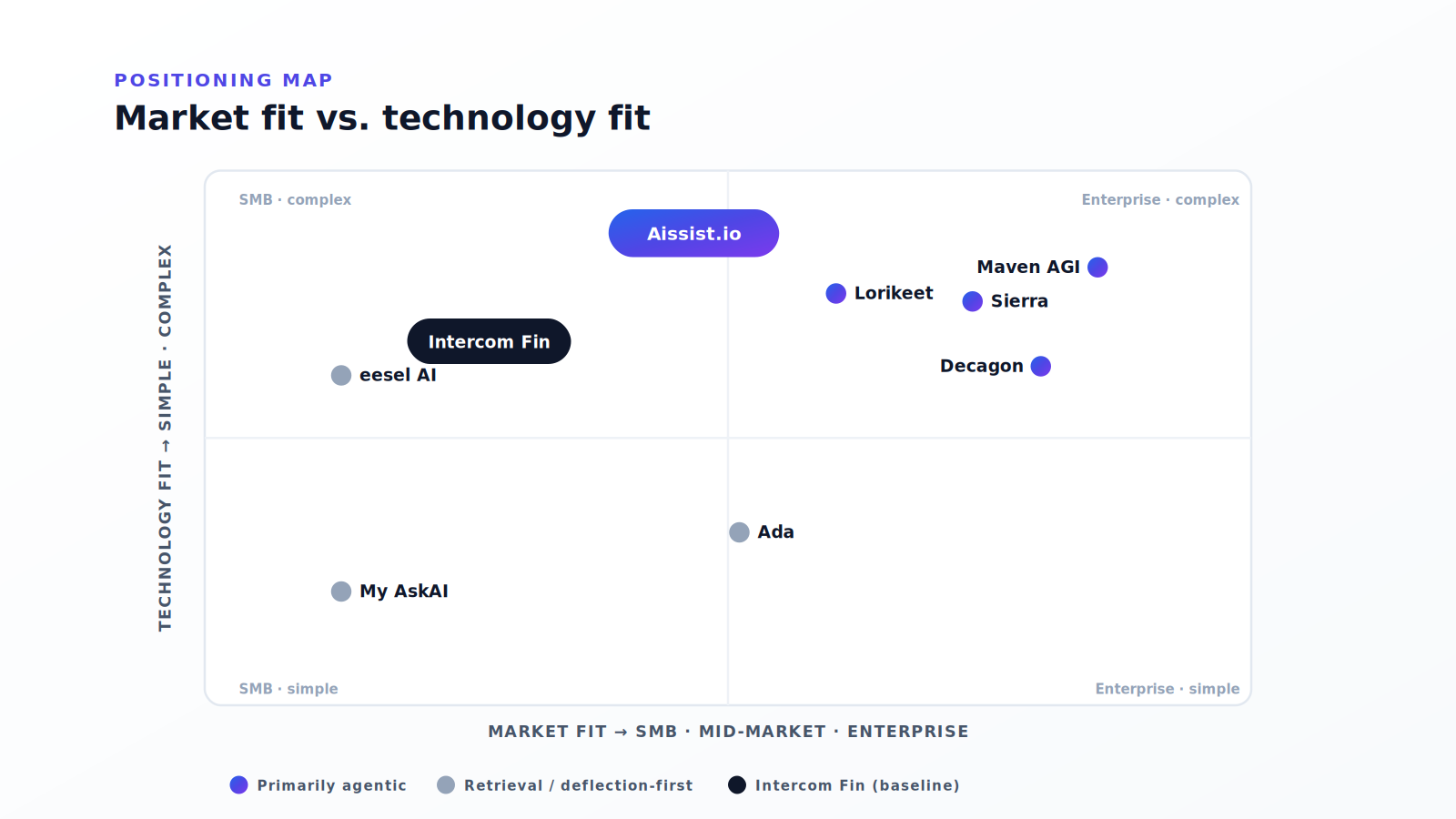
Two fits decide the shortlist, and they're the axes of the map above: market fit and technology fit. Market fit is more than which size bracket a tool targets or what it costs — it's the service, quality, and reliability behind the product: onboarding and support depth, how governed and hallucination-resistant the AI is, how cleanly it escalates, and whether the vendor can stand behind it in production. A cheap tool with strong benchmark numbers but thin support and shaky reliability is a poor fit for a team that needs dependable service. By segment, mid-market teams are best served by Aissist.io and Lorikeet, and large enterprises by Maven AGI, Decagon, and Sierra — but weigh the service and reliability behind each, not just the label.
Technology fit is use-case fit: how complex is the work you need done? For simple use cases — tier-1 FAQs and deflection — a heavy agentic platform is overkill; a lighter retrieval-based tool resolves them at a fraction of the cost. For complex use cases — multi-system workflows, refunds, account changes, regulated processes — a simple deflection bot won't be sufficient; you need a genuinely agentic tool like Lorikeet, Maven AGI, or Aissist.io that takes end-to-end action. The vertical axis maps that: the higher up, the more your use case justifies deeper technology. Every option here works on Intercom, so you can add or swap the agent without leaving your help desk. Match the tool's complexity to your use case — no more, no less.
Choose on the ROI
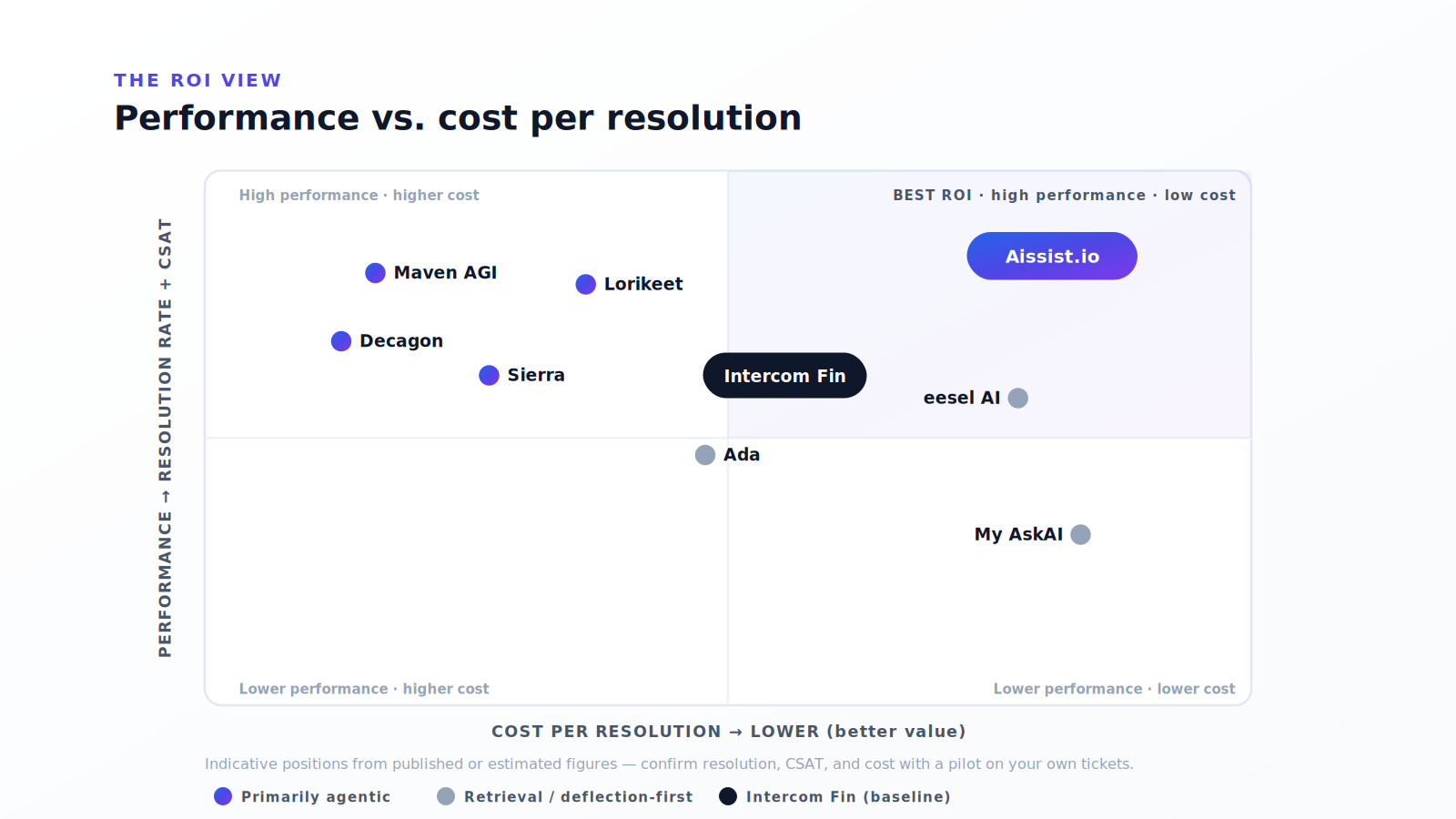
Once you have a fit shortlist, decide on return on investment, which comes down to two dimensions: performance (resolution rate and CSAT) and cost (per resolution). The sweet spot is the top-right of the chart above — high resolution and CSAT at a low cost per resolution. Enterprise platforms like Maven AGI, Decagon, and Sierra deliver high performance but at high, custom cost; Aissist.io aims for strong resolution at low, transparent pricing below Fin's $0.99. Two cautions: judge cost per resolution, not per seat or per message, and treat vendor-claimed resolution and CSAT numbers as best-case — our AI customer service benchmark shows they often compress in production. Run a short pilot on your own tickets, measure resolution and CSAT against a real cost per resolution, and hold each tool to the agentic standard — does it finish the work, or just answer?
Weighing a Intercom Fin alternative? See agentic, end-to-end resolution on your own tickets — no migration, transparent per-resolution pricing. Book a free demo →
Key takeaways
There's no single best Intercom Fin alternative — there's a best one for your size, stack, and budget, and every tool on this list works on top of Intercom, unlike the helpdesk-locked AI in Zendesk, Gorgias, Kustomer, and Freshdesk. For complex or regulated workflows, look at Lorikeet and Maven AGI; for enterprise scale, Decagon and Sierra; and for deeper agentic resolution at a transparent, low cost on your existing stack, Aissist.io. Compare on all five pillars — technology, G2, market fit, cost, and performance — shortlist two or three, pilot on real tickets, and decide on resolution rate and true cost per resolution. To benchmark an agentic pilot on your Intercom stack, book a demo.
Frequently asked questions
What are the best Intercom Fin alternatives in 2026?
The strongest Intercom Fin alternatives are Aissist.io, Lorikeet, Maven AGI, Decagon, and Sierra. All five are helpdesk-agnostic AI agents that work on top of Intercom. For deeper agentic resolution, look at Aissist.io, Lorikeet, and Maven AGI; for enterprise scale, Decagon and Sierra.
Can I use Zendesk AI, Gorgias, or Freshdesk Freddy on Intercom?
No. The AI agents built into rival help desks — Zendesk AI, Gorgias AI, Kustomer AI, and Freshdesk Freddy — only run inside their own platform, so they cannot operate on Intercom. To automate on Intercom you need either Fin or a helpdesk-agnostic agent (like the five in this guide) that layers on top of Intercom without a migration.
How much does Intercom Fin cost?
Intercom Fin is priced at $0.99 per resolution — a transparent, outcome-based model with a 50-outcome monthly minimum, plus separate charges for Intercom's help desk seats if you use them. It's one of the clearer pricing models in the category, but because it scales linearly with volume, high-volume teams often compare the effective cost per resolution against lower-priced agents like Aissist.io.
Is there a cheaper alternative to Intercom Fin?
Yes. Aissist.io publishes up to $0.60 per resolution, with a free tier, which targets a lower effective cost per resolution than Fin's $0.99 while adding deeper agentic action-taking. Maven AGI, Decagon and Sierra are quote-only, so ask each for a cost per resolution on your own volume before comparing them with Fin.
Is Intercom Fin agentic or generative?
Fin is increasingly agentic. With Procedures and actions it executes multi-step workflows and takes end-to-end actions, and Intercom bills on resolved outcomes rather than generated replies. It still relies on a generative model for language understanding, like every agent on this list, but it sits in the agentic camp rather than pure retrieval-and-deflect.
What resolution rate does Intercom Fin actually achieve?
Intercom reports a 76% average resolution rate (March 2026), with many customers above 85% — vendor-defined figures on Intercom's own measure of resolution. Lower counter-numbers in the 45–55% range are widely repeated, but they trace back to companies selling Fin alternatives rather than to any independent test, and none discloses a methodology, so we do not cite them. No neutral audit of Fin exists. Resolution depends heavily on knowledge-base quality and ticket mix, so pilot any tool — Fin or an alternative — on your own tickets before deciding.
Which Intercom Fin alternative is best for complex workflows?
Lorikeet and Maven AGI are built for complex, multi-system resolution — following SOPs, calling internal APIs, and executing real transactions like refunds and account changes — and Aissist.io offers similar agentic depth on your existing stack. For regulated industries where accuracy matters most, Lorikeet is purpose-built; for enterprise breadth, Maven AGI; for a lower-cost agentic layer, Aissist.io.
Do these alternatives require leaving Intercom?
No — that's the point of this list. Every tool here is a standalone AI agent layer that integrates with Intercom (and usually Zendesk, Freshdesk, Salesforce, and your internal systems), so you can add or replace Fin without migrating your help desk. That's exactly why the helpdesk-native AI agents from Zendesk, Gorgias, Kustomer, and Freshdesk are excluded — they can't run on Intercom.