9 Best Ada CX Alternatives & Competitors for 2026
The best Ada CX alternatives in 2026 are Aissist.io, Sierra, Decagon, Intercom Fin, Salesforce Agentforce, Forethought, Zendesk AI, Gorgias, and Kustomer. Ada is a mature customer-service automation platform — now marketed as an "agentic customer experience" suite — but it grew up as a deflection engine, prices on custom per-resolution contracts with no public rate card, and integration is the most common complaint in its own review base — 9 mentions of integration challenges across its G2 reviews, with Capterra reviewers calling setup "time consuming" (read 20 August 2026; see our Ada CX review for the full breakdown). If you want agentic resolution at a different size, price, or level of transparency, this guide compares the nine strongest competitors on the five things that decide the purchase: technology (agentic vs generative), G2 rating, market fit, cost, and performance — with sources for every number. For adjacent shortlists, see our Decagon AI alternatives and Sierra AI alternatives guides.
Compiled by Alex Gomez, Sr. Analyst. Last updated 13 October 2026. Disclosure: this guide is published by Aissist.io, which sells an agentic AI layer that competes with every product listed here — including the one we rank first. We hold no affiliate, referral or paid placement relationship with any vendor on this page, and no vendor reviewed it before publication. Figures about other vendors are sourced to that vendor's own published material where one exists; where none exists we say so rather than estimate. Our own figures are self-reported and marked as such.
What changed since the last update. Two ownership changes now sit inside this list. Salesforce completed its acquisition of Fin, the company formerly called Intercom, on 10 September 2026 — so Salesforce now owns two of the nine alternatives below, Fin and Agentforce. And Zendesk, which completed its Forethought acquisition in March, has sold Forethought AI agents as an add-on since 4 June 2026. A new table below sets out billing, published resolution and ownership for every vendor.
Why teams look for an Ada CX alternative
Ada (Toronto; established 2016) is a genuinely capable platform — well-rated on G2 (4.6 from ~173 reviews) with broad channel coverage and named enterprise customers across financial services, gaming, and ecommerce. Teams still evaluate alternatives for three consistent reasons. Cost and transparency lead: Ada prices custom, per-resolution, with no public rate card — third-party estimates put spend at roughly $1–$3.50 per resolution and median contracts near $70K/year, and buyers dislike negotiating blind. Resolution depth is second: Ada's heritage is deflection, and while it's adding agentic actions, teams with complex refund, account, or regulated workflows often want a tool built agentic-first. Integration and control is third: integration challenges are the single most-cited complaint in Ada's own review base (9 mentions on G2, alongside usability issues at 10), and Capterra reviewers describe setup as "time consuming" and adding channels as "complex, requiring significant time" — read 20 August 2026, and set out in full in our Ada CX review. Worth holding against the other side of the same review base, where "easy setup" is a top praise cluster.
How we compared these Ada CX competitors
Every tool below is scored on the five pillars that decide an agentic-AI purchase in 2026:
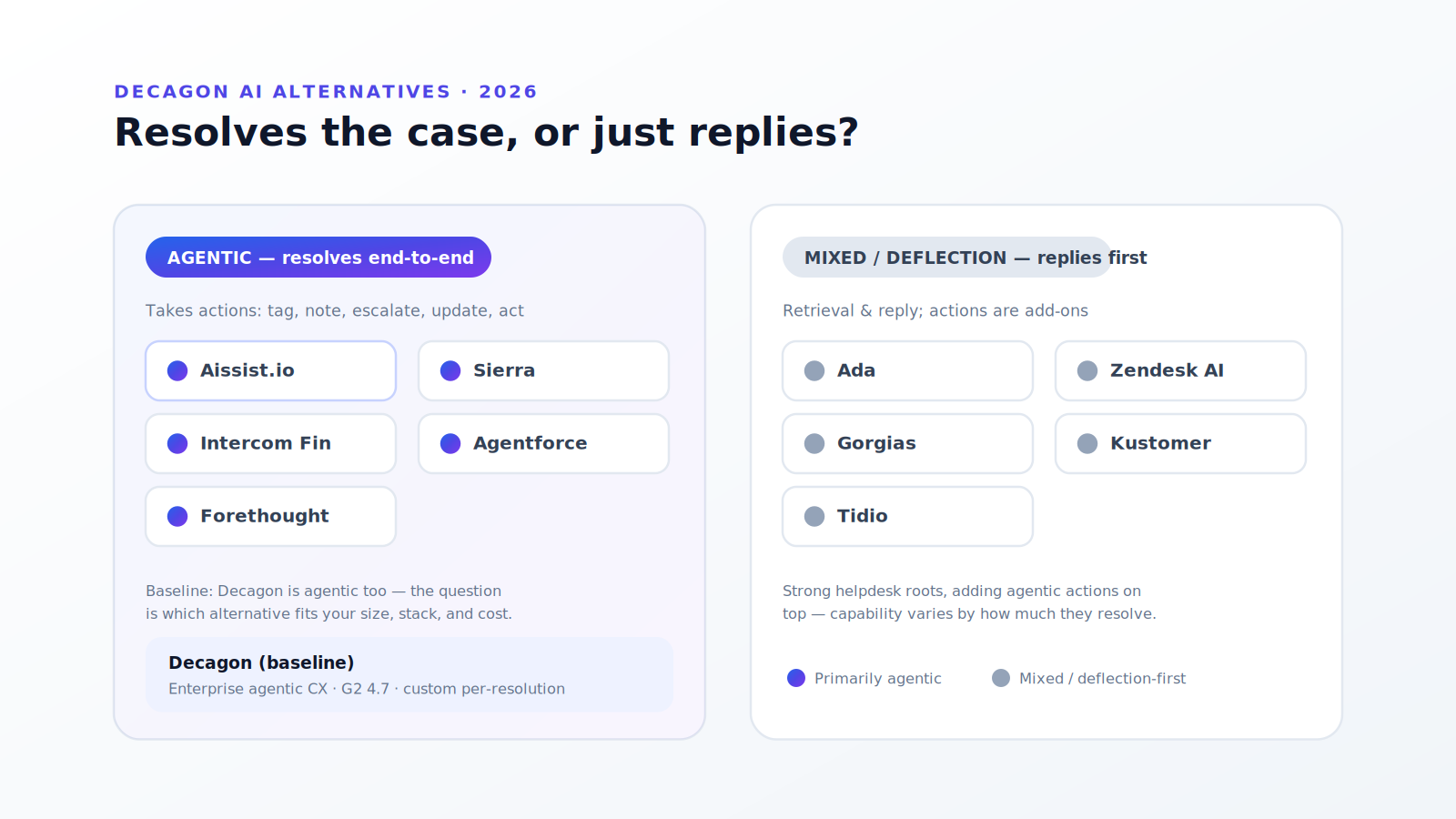
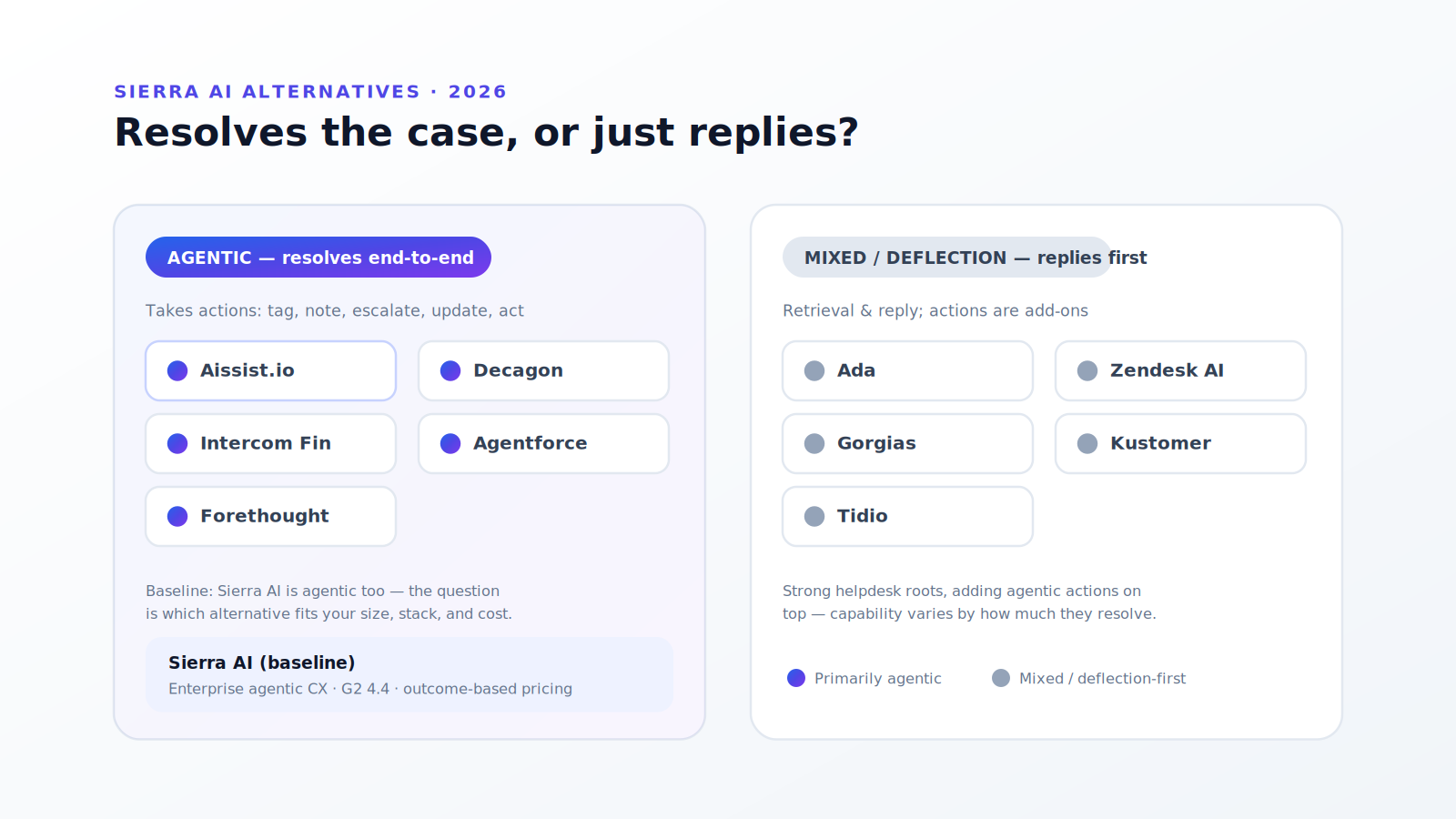
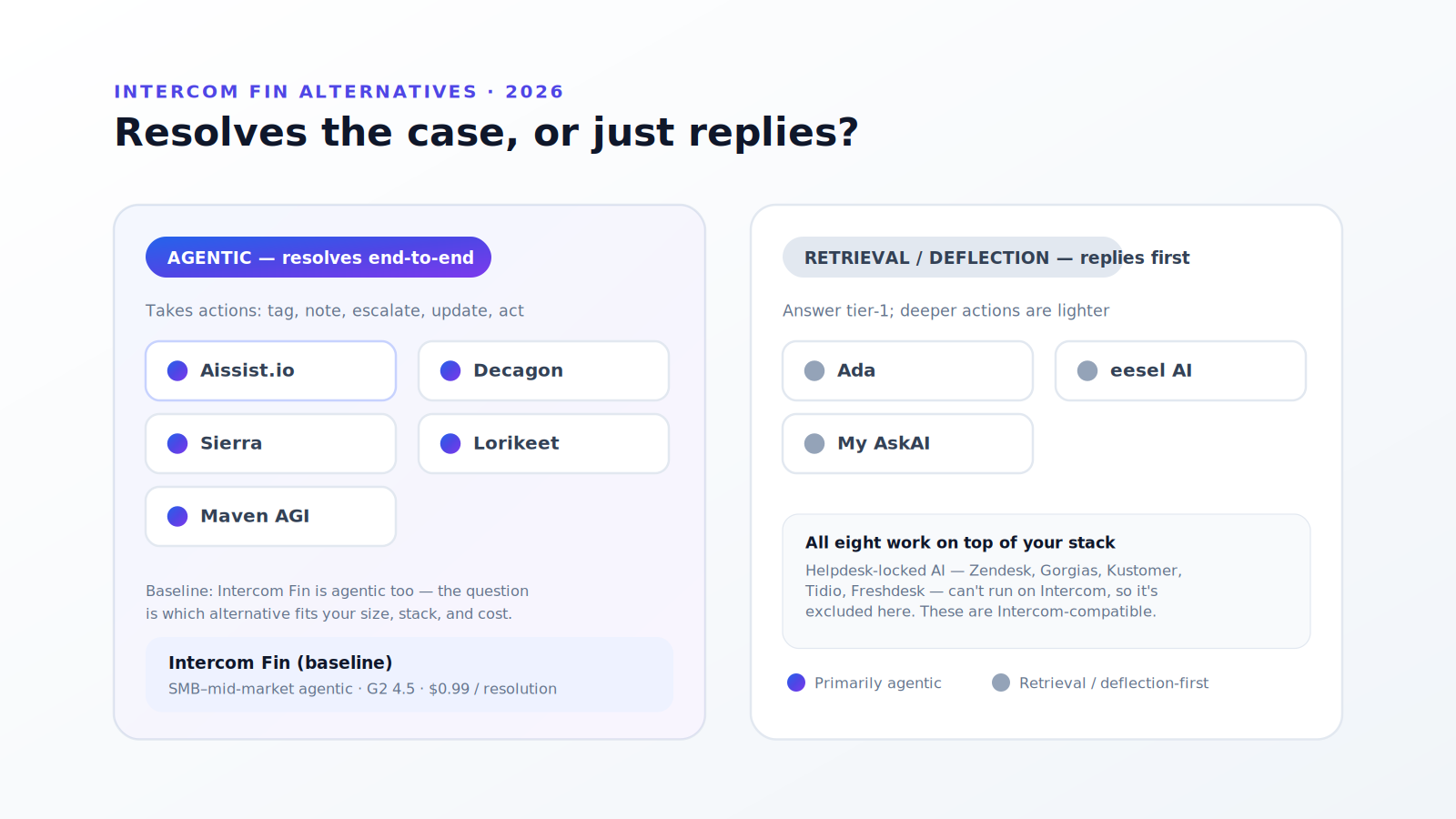
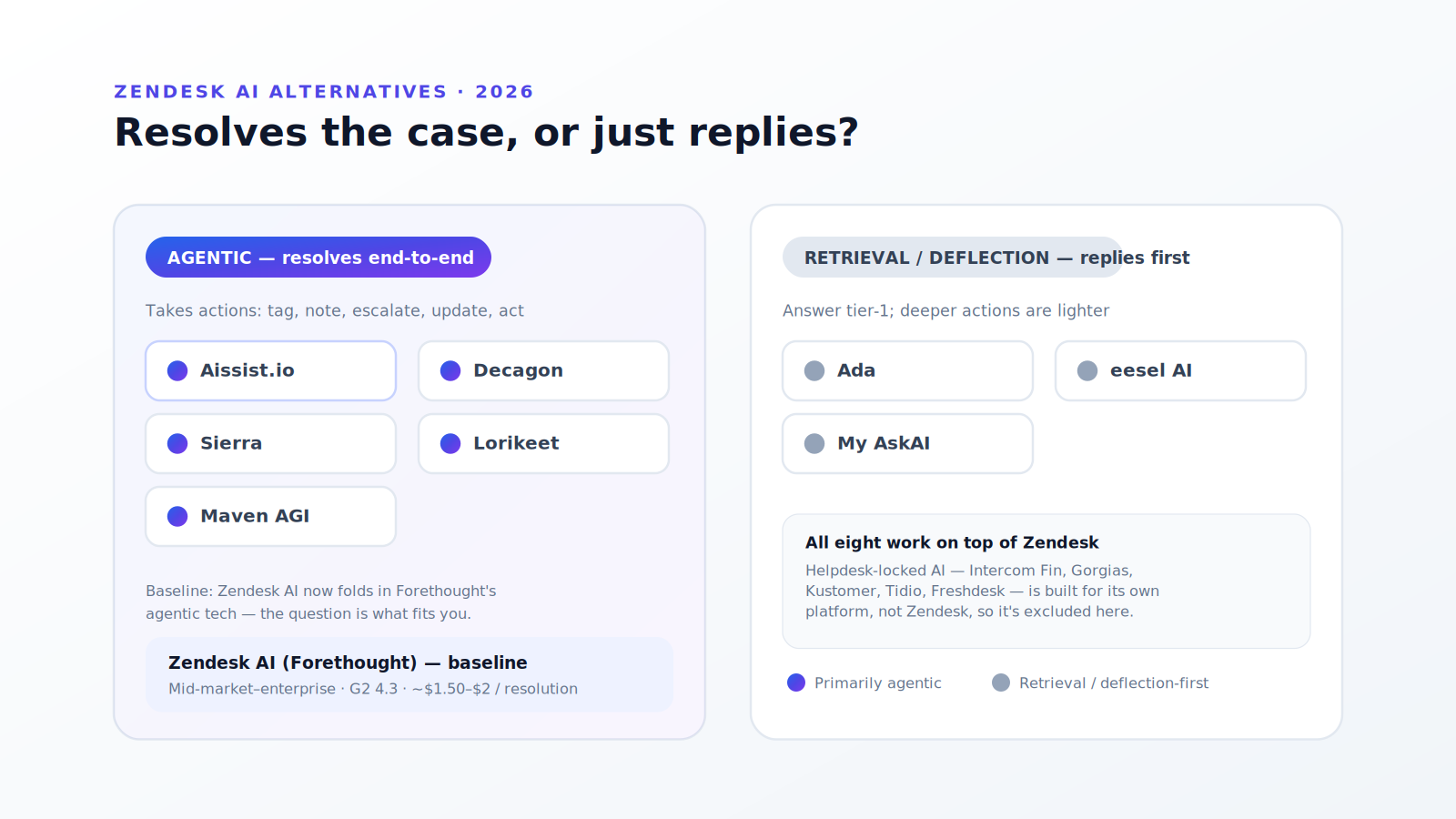
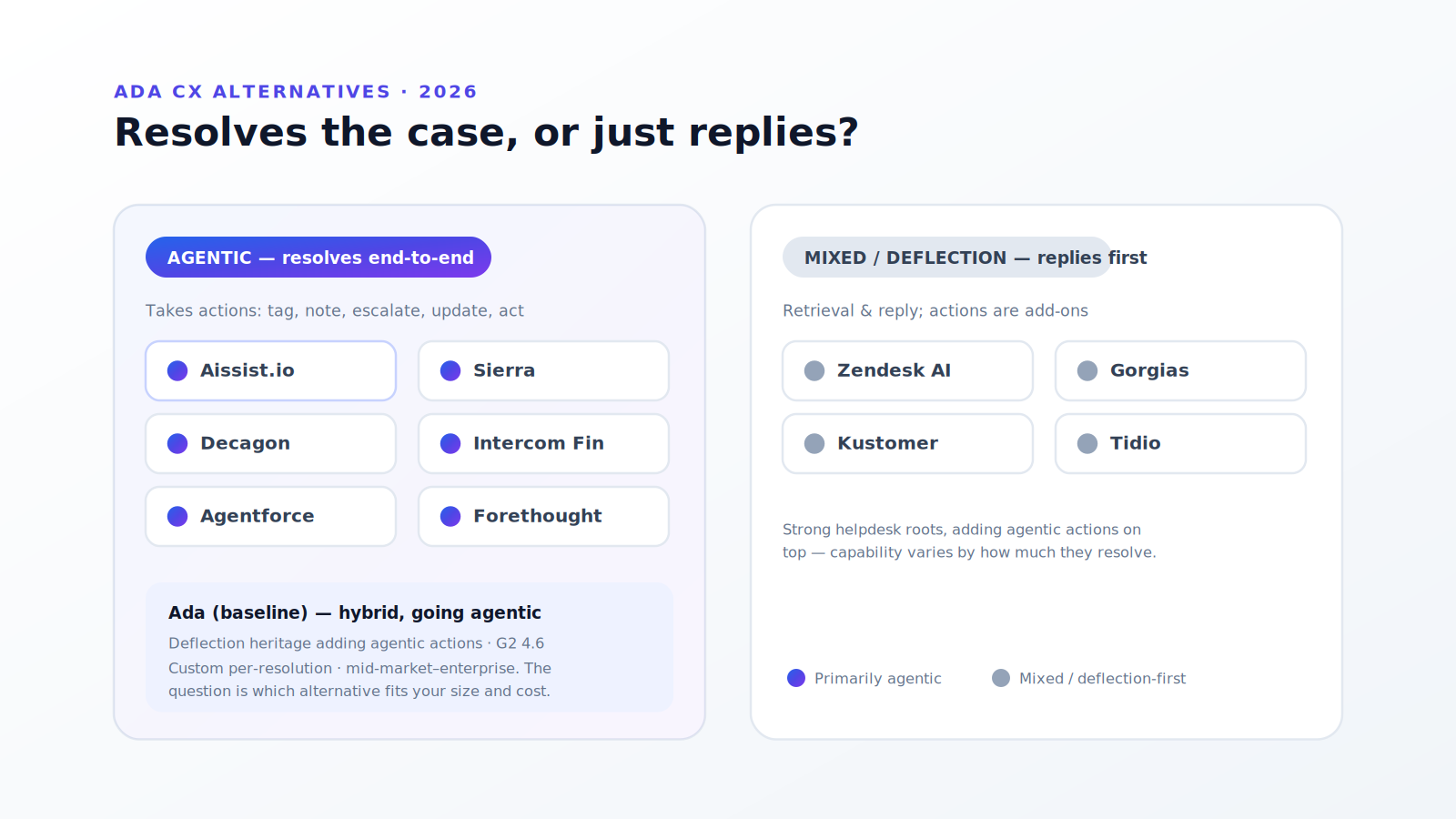
- Technology — agentic or generative. Does the AI resolve end-to-end (take actions, update systems, complete the task) or mostly deflect (retrieve and reply)? If that distinction is new, our explainer on agentic AI vs generative AI breaks it down — it's the difference between finishing a case and answering a question.
- G2 rating. Each product's overall G2 score and review count, captured August 2026. For suites, we note when the score reflects the whole platform rather than the AI agent alone.
- Market fit. The company size, region, and use case each tool is genuinely built for.
- Cost. The pricing model and real figures where published, benchmarked against our AI agent pricing benchmark, which normalizes 18 vendors to effective cost per resolved conversation.
- Performance. Published resolution / CSAT / deflection figures, with the source and whether it's vendor-claimed or independent. Treat vendor best-case numbers with care: our AI customer service benchmark by industry shows claimed rates of 65–86% routinely compress to 40–70% in production.
Ada CX alternatives compared at a glance
| Platform | Technology | G2 rating | Cost model | Best fit |
|---|---|---|---|---|
| Ada (baseline) | Hybrid | 4.6 (173) | Per-resolution, custom | Mid-market–enterprise |
| Aissist.io | Agentic | 4.9 (45) | Up to $0.60 / resolution | Mid-market (+ SMB), layer on your stack |
| Sierra | Agentic | 4.4 (77) | Outcome-based, custom | Large enterprise CX |
| Decagon | Agentic | 4.7 (28) | Per-resolution, custom | High-volume enterprise |
| Intercom Fin | Agentic | 4.5 (3,901) | $0.99 / resolution | SMB–mid-market SaaS |
| Salesforce Agentforce | Agentic | 4.3 (1,202) | $2 / conversation | Enterprises on Salesforce |
| Forethought | Agentic | 4.3 (166) | Custom / quote | Mid-market–enterprise (now Zendesk) |
| Zendesk AI | Mixed | 4.3 (7,031)* | No published rate (reported ~$1.50–$2 / resolution) + seats | Existing Zendesk suites |
| Gorgias | Mixed | 4.6 (567) | ~$0.90–$1 / resolution + tiers | Ecommerce / Shopify |
| Kustomer | Mixed | 4.4 (565) | No public rate card (Vendr: ~$89–$149/seat) | High-volume B2C |
*Zendesk's score is the suite rating, not an AI-agent-specific score. Pricing figures without a public source are third-party procurement estimates — confirm current numbers with each vendor. G2 figures were captured in August 2026, except Aissist.io's, read on 7 October 2026.
Pricing model, AI resolution and ownership (October 2026)
For AI agents, the billing unit and the resolution rate decide the real cost, and ownership decides how much the roadmap is yours to rely on. This table sets the three side by side. "Not published" means we found no average resolution figure from the vendor as of 13 October 2026; single customer case studies are noted but are not averages. Every figure here is vendor-claimed unless marked otherwise.
| Vendor | What it actually does | Pricing model and billing unit | Published AI resolution rate | Ownership as of October 2026 |
|---|---|---|---|---|
| Ada (baseline) | AI agent for messaging, voice and email, run through Playbooks and a reasoning engine | Custom contracts priced per resolution; no public rate card | 84% automated resolution claimed, though its own pages also say 80% and 83%; no methodology published | Independent, venture-backed; last raised a $130M Series C in May 2021 |
| Aissist.io | AI Operational Layer that resolves support and sales on top of your existing help desk | Usage-based, up to $0.60 per resolution | 83% average resolution (self-reported) | Independent; publisher of this guide |
| Sierra | Enterprise AI agents across chat, voice and messaging | Outcome-based custom contracts; escalated cases generally not charged | Not published as an average (one case study: nearly 70% containment at WeightWatchers) | Independent; raised $950M in May 2026 at a valuation it describes as over $15B |
| Decagon | Enterprise AI agents across chat, email, voice and SMS | Custom, per resolution; no public rate card | Not published as an average (case studies: 70% resolution at Chime, 80% deflection at Duolingo) | Independent; valued at $4.5B in January 2026 |
| Intercom Fin | AI agent on Fin's own help desk, or on top of Zendesk and Salesforce | $0.99 per resolution | 76% average, repeated by Salesforce across 30,000+ customers on 10 September 2026 | Salesforce — acquisition completed 10 September 2026 |
| Salesforce Agentforce | Agents native to Salesforce CRM and Data Cloud | $2 per conversation, or Flex Credits at $500 per 100,000 actions, on top of Salesforce licences | About 76% on Salesforce's own support (Salesforce measuring itself) | Salesforce, publicly listed (NYSE: CRM) |
| Forethought | Agentic Solve, Triage and Assist across chat, email, voice and Slack | Custom quote; a Zendesk add-on since 4 June 2026 | Not published | Zendesk — acquisition completed 26 March 2026 |
| Zendesk AI | AI agents inside the Zendesk suite | Per seat, plus a per-automated-resolution meter Zendesk puts "below $2" | Not published as an average (Lush case study: 60% first-contact resolution) | Private — Hellman & Friedman and Permira since November 2022 |
| Gorgias | Ecommerce help desk with a built-in AI Agent | Tiered by monthly ticket volume, plus roughly $0.90–$1 per AI-resolved conversation | Not published | Independent, venture-backed |
| Kustomer | Support-as-CRM with AI agents and the KIQ copilot | No public rate card (Vendr: ~$89–$149 per agent per month) | Not published | Independent since its May 2023 spin-out from Meta |
Read the resolution column with two cautions. Deflection (a conversation that never reached a person) and resolution (a problem confirmed as solved) are not the same number, and only some vendors say which they mean. And per-resolution billing — Ada, Decagon, Fin, Zendesk, Gorgias, Aissist.io — means a higher resolution rate raises the AI bill even as it cuts agent workload, while Agentforce bills per conversation whether or not anything is resolved. Our AI agent pricing benchmark normalizes these models to cost per resolved conversation, and the price comparison tool runs them on your own volume.
The 9 best Ada CX alternatives and competitors
1. Aissist.io — best agentic layer for your existing stack
Aissist.io is an AI Operational Layer that resolves support and sales end-to-end and layers onto the help desk you already run — Intercom, Zendesk, Salesforce, Kustomer, Front, Gorgias — instead of replacing it. Its AgentMesh™ multi-agent workforce tags, notes, escalates, updates systems, and takes action, while Pulse™ and Evolve™ surface insight and keep improving it. Technology: genuinely agentic, built on multi-agent reasoning with governance and human escalation. G2: 4.9/5 from 45 reviews, AI Verified, as of 7 October 2026 (G2 reviews) — the highest score on this list, though from a far smaller review base than Fin, Agentforce or the help desk suites. Cost: transparent and low — up to $0.60 per resolution on the published pricing page, with a free tier. Performance: 83% average resolution and 4.8/5 CSAT on automated support (vendor-published). Best fit: mid-market teams (and up-market SMBs) that want agentic resolution deeper than Ada's deflection heritage, at transparent pricing and without a rip-and-replace. Pros: no migration, deploys in ~10 minutes, transparent per-resolution pricing. Cons: younger brand with a smaller review base and lighter UI customization than the enterprise suites.
2. Sierra — enterprise agentic platform with marquee brands
Sierra, from Bret Taylor and Clay Bavor, is an enterprise agentic platform whose AI agents resolve across chat, voice, and messaging by taking end-to-end actions — a step beyond Ada's deflection roots. Technology: agentic. G2: 4.4 (77). Cost: outcome-based, custom contracts with no public rate card; reported commitments start around six figures plus implementation, higher than Ada's typical spend. Performance: Sierra's WeightWatchers case study reports containing nearly 70% of cases within the first week at a CSAT above 4.5/5. That is one named customer, not an average across clients. Best fit: large enterprises (financial services, retail, subscription) wanting a marquee agentic vendor. Pros: elite founding team, strong end-to-end action orientation. Cons: pricing opacity and cost are the top complaints; enterprise-only. For the full field, see our Sierra AI alternatives guide.
3. Decagon — high-end agentic rival for enterprises
Decagon is an enterprise agentic-AI platform, valued at $4.5B in a $250M round led by Coatue and Index Ventures (28 January 2026), whose agents resolve across chat, email, voice, and SMS using natural-language operating procedures plus a hallucination-screening supervisor model. Technology: agentic. G2: 4.7 (28) — a high score on a thin review base. Cost: custom, per-resolution, no public rate card; procurement aggregator Vendr puts median contracts near $433K/year — well above Ada's median. Performance: Decagon's case studies report 70% chat and voice resolution at Chime and an 80% deflection rate at Duolingo — vendor-published, not independently audited. Best fit: high-volume enterprises. Pros: deep agentic resolution and a strong supervisor/governance model. Cons: enterprise-only pricing and a thin public review base. See our Decagon AI alternatives guide for the full field.
4. Intercom Fin — best transparent per-resolution pricing
Fin, Intercom's AI agent, is one of the most mature options and works on Intercom's own desk or on top of Zendesk and Salesforce. Technology: increasingly agentic — its Procedures and actions execute multi-step workflows, and it bills on outcomes. G2: 4.5 (3,901) — the deepest AI-agent-specific review base here. Cost: a clear $0.99 per resolution (fin.ai/pricing), the category's transparency benchmark, and far more legible than Ada's custom quotes. Performance: Intercom reports a 76% average resolution rate across its customer base (March 2026, vendor-defined). No independent audit of Fin has been published; the lower figures circulating in the 38–55% range come from companies selling Fin alternatives and disclose no methodology, so weigh both against a pilot on your own tickets. Ownership: Intercom renamed itself Fin, and Salesforce completed the acquisition on 10 September 2026; the completion release repeats the 76% figure across 30,000+ customers. Fin's Zendesk and Salesforce integrations remain live, but buyers should ask how its roadmap and pricing will sit alongside Agentforce — see our Intercom Fin review. Best fit: SMB and mid-market SaaS. Pros: transparent value-based pricing, mature product, strong UX. Cons: costs scale with volume; quality depends on knowledge-base hygiene. See the Intercom integration.
5. Salesforce Agentforce — best for Salesforce shops
Agentforce is Salesforce's agentic layer for building autonomous service and sales agents native to its CRM and Data Cloud. Technology: agentic — Salesforce documents agents taking real actions in CRM objects (record creation, workflow triggers) rather than only answering. G2: 4.3 (1,202). Cost: $2.00 per conversation, or Flex Credits at $500 per 100,000 actions; real deployments are custom and bundled with Salesforce licensing. Performance: Salesforce's own customer-support case study currently states Agentforce resolves "on average about 76%" of its customer queries without a human; its Agentforce customer zero story reports 83% across roughly 32,000 weekly conversations. Both are Salesforce measuring Salesforce. Best fit: enterprises already standardized on Salesforce. Since 10 September 2026 Salesforce also owns Fin, so it now sells two of the agents on this list. Pros: unmatched native access to CRM data and actions. Cons: billed per conversation whether or not anything is resolved, requires a Service or Sales Cloud licence underneath, and its advantage is native CRM access — so the value case weakens the less of your data lives in Salesforce. See the Salesforce integration.
6. Forethought — agentic resolution, now inside Zendesk
Forethought is an agentic support-AI platform (Solve, Triage, Assist) that resolves autonomously across chat, email, voice, and Slack — a close functional peer to Ada. Note: Zendesk completed the acquisition on 26 March 2026, folding its self-improving-agent tech into the Zendesk suite; it remains available to non-Zendesk customers (Zendesk support, 4 June 2026). Technology: agentic. G2: 4.3 (166). Cost: custom/quote-based; third-party estimates around $0.07–$0.12 per deflection with $60K–$75K median contracts — similar range to Ada. Performance: an "up to 98%" resolution figure circulates in third-party roundups, but we could not find it on any live Forethought or Zendesk page after the acquisition, so we do not repeat it as a vendor claim. No current published resolution figure was verifiable. Best fit: mid-market to enterprise with large ticket histories to train on. Pros: genuinely agentic with strong intent classification, now backed by Zendesk's scale. Cons: opaque pricing, models that train on your historical ticket corpus (Forethought's own Triage page describes it as "AI trained on your historical data"), so thin ticket history is a real constraint, and an uncertain standalone roadmap post-acquisition.
7. Zendesk AI — best if you already run Zendesk
Zendesk's AI agents are the automation layer inside its customer-service suite, now reinforced by the Forethought acquisition. Technology: mixed — core "automated resolution" is deflection-first, moving toward more autonomous agents. G2: 4.3 (7,031) for the suite (not an AI-agent-specific score). Cost: Zendesk publishes no per-resolution rate on its pricing page. A Zendesk product manager stated in the company's own community forum that list price is "definitely below $2", with 10 free automated resolutions per agent per month (Zendesk, 7 August 2025); analyst firm Futurum reports pricing "starting at $1.50 per resolution and declining as volume increases" (Futurum, 1 April 2025). Either way the meter sits on top of per-seat suite licensing. Performance: Zendesk's published Lush case study reports a 60% first-contact resolution rate alongside 93% CSAT. A widely repeated "39% at UrbanStems" figure appears in third-party posts but no longer resolves to any live Zendesk page, so we have dropped it. Treat 20–40% out of the box and 60–80% well-tuned as practitioner rules of thumb, not published benchmarks. Best fit: teams already committed to the Zendesk suite. Pros: mature, deeply integrated, low-risk. Cons: AI layered on a legacy model, and per-resolution fees stack on seat costs. See the Zendesk integration.
8. Gorgias — best for ecommerce
Gorgias is an ecommerce-focused help desk with a built-in AI Agent and deep Shopify integration. Technology: mixed — the AI Agent resolves order edits and returns, but the core is ticketing with AI as a per-resolution add-on. G2: 4.6 (567). Cost: tiered plans from ~$10/mo plus roughly $0.90–$1.00 per AI-resolved conversation — and AI-resolved tickets can be billed as both a ticket and a resolution. Performance: no standardized public resolution figure verified. Best fit: SMB and mid-market Shopify/DTC brands. Pros: deepest ecommerce-native tooling. Cons: costs escalate with volume; narrow fit outside ecommerce. See the Gorgias integration.
9. Kustomer — best support-as-CRM for high volume
Kustomer organizes support around a unified customer timeline and layers AI agents plus a copilot (KIQ) on top. Technology: mixed, increasingly agentic — its strength is the unified data model more than autonomous resolution. G2: 4.4 (565). Cost: Kustomer does not publish pricing and routes buyers to an assessment. Procurement aggregator Vendr lists roughly $89–$149 per agent per month with a median contract near $138K/year. An eight-seat minimum and a $0.60-per-conversation AI rate that earlier versions of this page carried could not be traced to a Kustomer source and have been removed. Performance: no standardized public resolution figure verified. Best fit: high-volume B2C brands wanting a full CRM-style support platform. Pros: powerful unified customer view and automation. Cons: no published pricing, and no standardized public resolution figure to evaluate the AI against. See the Kustomer integration.
How to choose the right Ada CX alternative
Two decisions do most of the work: which tools fit your situation, and which delivers the best return on the money. Take them in that order — fit narrows the field, ROI picks the winner.
Choose the market-technology fit
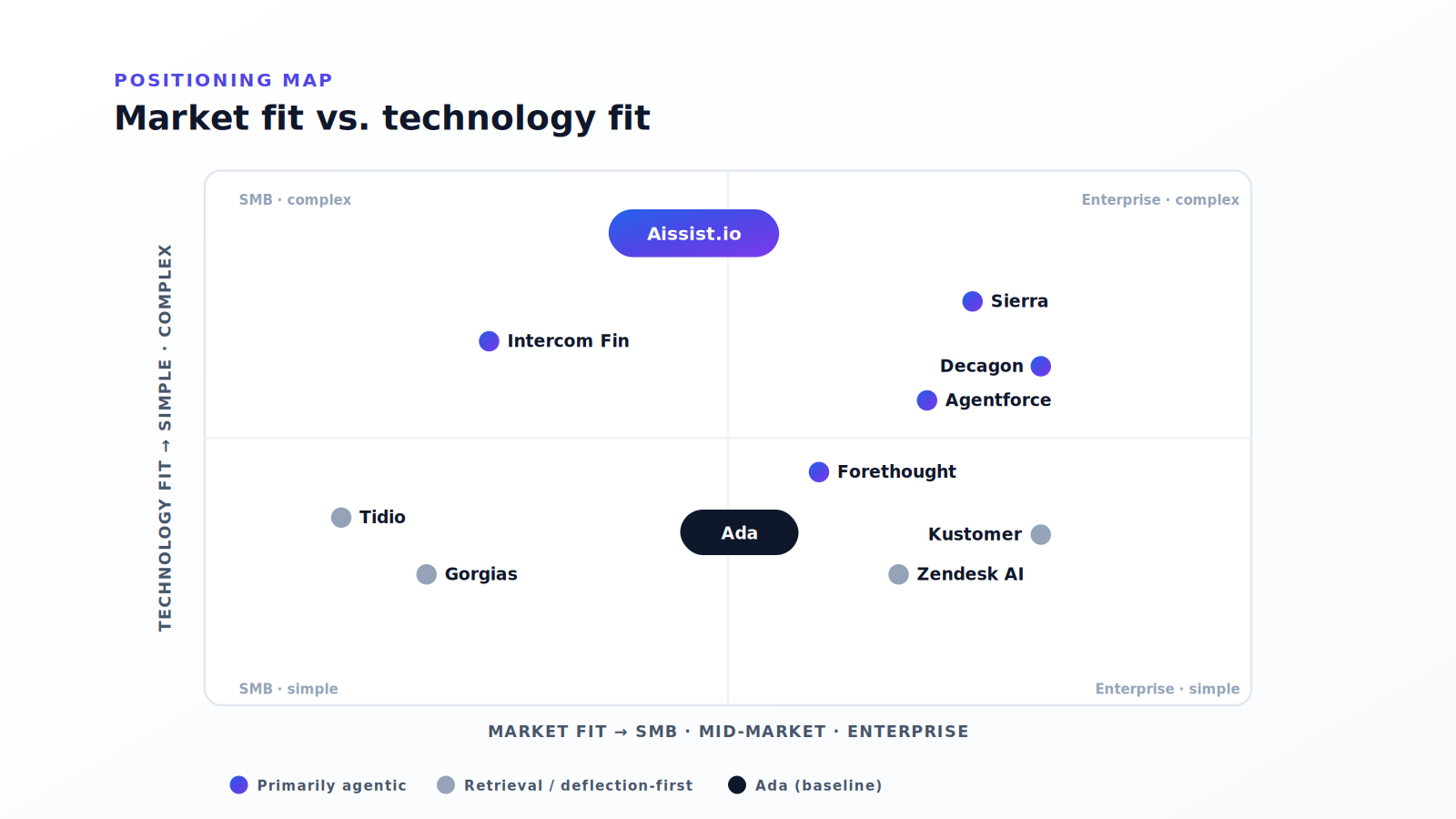
Two fits decide the shortlist, and they're the axes of the map above: market fit and technology fit. Market fit is more than which size bracket a tool targets or what it costs — it's the service, quality, and reliability behind the product: onboarding and support depth, how governed and hallucination-resistant the AI is, how cleanly it escalates, and whether the vendor can stand behind it in production. A cheap tool with strong benchmark numbers but thin support and shaky reliability is a poor fit for a team that needs dependable service. By segment, SMB Shopify stores are best served by Gorgias; mid-market teams by Aissist.io, Intercom Fin, and Forethought; large enterprises by Sierra, Decagon, and Agentforce — the tier Ada itself straddles — but weigh the service and reliability behind each, not just the label.
Technology fit is use-case fit: how complex is the work you need done? For simple use cases — tier-1 FAQs and deflection — a heavy agentic platform is overkill; a lighter retrieval-based tool resolves them at a fraction of the cost and effort. For complex use cases — multi-system workflows, refunds, account changes, regulated processes — a simple deflection bot won't be sufficient; you need a genuinely agentic tool that takes end-to-end action. The vertical axis maps that: the higher up, the more your use case justifies deeper technology. And if you're already committed to a platform, the native path is easiest: Agentforce for Salesforce, Zendesk AI for Zendesk, Gorgias for Shopify, Kustomer for high-volume B2C. Match the tool's complexity to your use case — no more, no less.
Choose on the ROI
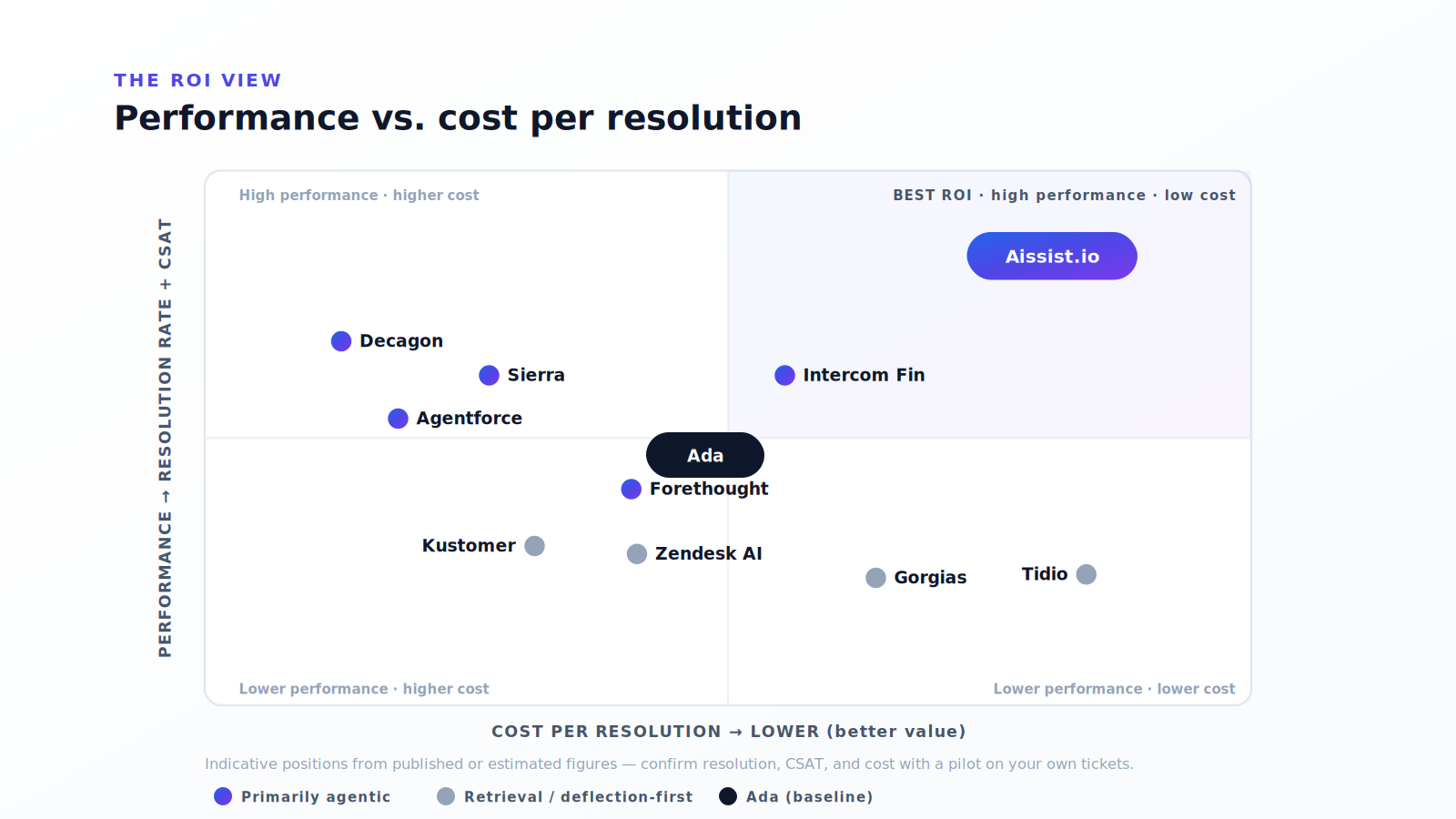
Once you have a fit shortlist, decide on return on investment, which comes down to two dimensions: performance (resolution rate and CSAT) and cost (per resolution). The sweet spot is the top-right of the chart above — high resolution and CSAT at a low cost per resolution. Enterprise platforms like Decagon, Sierra, and Agentforce deliver high performance but at high, custom cost; Intercom Fin and Aissist.io aim for high resolution at transparent, low per-resolution pricing below Ada's custom quotes; deflection-first tools trade resolution for a cheaper entry point. Two cautions: judge cost per resolution, not per seat or per message, and treat vendor-claimed resolution and CSAT numbers as best-case — our AI customer service benchmark shows they often compress in production. Run a short pilot on your own tickets, measure resolution and CSAT against a real cost per resolution, and hold each tool to the agentic standard — does it finish the work, or just answer?
See an agentic AI layer on your own stack. Aissist.io layers onto Zendesk, Intercom, Salesforce, Kustomer, Front, and Gorgias in minutes and resolves support and sales end-to-end — up to $0.60 per resolution, no rip-and-replace. Book a demo or explore the AI Operational Layer.
Key takeaways
There's no single best Ada CX alternative — there's a best one for your size, stack, and budget. For enterprise agentic depth, look at Sierra, Decagon, and Agentforce; for transparent per-resolution pricing, Intercom Fin; for an agentic layer on the help desk you already run, Aissist.io. Compare on all five pillars — technology, G2, market fit, cost, and performance — and remember that agentic tools resolve while deflection tools only reply. Shortlist two or three, pilot on real tickets, and decide on resolution rate and true cost per resolution. To benchmark an agentic pilot on your own stack, book a demo.
Sources
Vendor figures are linked inline where they appear. The pricing, resolution and ownership table was checked on 13 October 2026; G2 ratings were captured in August 2026, except Aissist.io's, read on 7 October 2026.
- Ownership and acquisitions: Salesforce's completion release for Fin (10 September 2026, also the source of the 30,000+ customer figure); Zendesk's Forethought completion release (26 March 2026) and add-on announcement (4 June 2026); the Hellman & Friedman and Permira completion release (November 2022); Kustomer's standalone announcement (May 2023).
- Funding and valuations: Ada's $130M Series C (BetaKit, May 2021); Sierra's May 2026 round; Decagon's $4.5B valuation (28 January 2026).
- Ada's resolution claims: the 84%, 80% and 83% figures appear on Ada's platform and about pages; our Ada CX review sets out where each appears.
- Aissist.io: G2 reviews (4.9/5, 45 reviews, AI Verified, read 7 October 2026); resolution and CSAT figures are self-reported.
Frequently asked questions
What is Ada (Ada CX)?
Ada is a customer-service automation platform founded in Toronto in 2016. It automates front-line support across messaging, voice, and email via its "AI Reasoning Engine" and Playbooks, and now markets itself as an "agentic customer experience" (Ada CX) platform. It targets mid-market and enterprise teams in financial services, gaming, and ecommerce, and prices on custom per-resolution contracts.
What are the best Ada CX alternatives in 2026?
The strongest Ada CX alternatives are Aissist.io, Sierra, Decagon, Intercom Fin, Salesforce Agentforce, Forethought, Zendesk AI, Gorgias, and Kustomer. Sierra, Decagon, and Agentforce compete most directly at the enterprise level; Intercom Fin and Aissist.io offer agentic resolution with transparent per-resolution pricing for mid-market and SMB teams.
How much does Ada cost?
Ada uses custom, per-resolution pricing and does not publish a public rate card. Third-party estimates put it at roughly $1–$3.50 per resolution with median annual spend near $70K, which is why pricing transparency is a common reason teams evaluate alternatives. For a normalized view of what AI agents cost per resolution, see Aissist.io's AI agent pricing benchmark.
Is Ada agentic or generative?
Ada is best described as hybrid. Its heritage is generative/deflection — retrieving answers and deflecting tickets — and it is adding agentic actions through its Reasoning Engine and Playbooks. Teams that need deep, reliable end-to-end resolution across multi-system workflows often prefer an agentic-first tool like Aissist.io, Sierra, or Decagon.
Which Ada competitor is best for mid-market teams?
Aissist.io and Intercom Fin are the most accessible for mid-market. Aissist.io layers agentic resolution onto your existing help desk with pricing up to $0.60 per resolution and a free tier; Intercom Fin offers transparent $0.99-per-resolution pricing and a mature product. Both give you end-to-end resolution without an enterprise contract or a migration.
Ada vs Sierra vs Decagon — what's the difference?
All three target enterprise CX but differ in heritage. Ada grew from deflection and is adding agentic actions; Sierra, from Bret Taylor and Clay Bavor, is agentic-first with a voice and marquee-brand focus; Decagon is agentic-first with a hallucination-screening supervisor model. All three price by custom contract, and Ada's median contract runs lowest.
Who owns Intercom Fin and Forethought now?
Salesforce owns Fin: Intercom renamed itself Fin, and Salesforce completed the acquisition on 10 September 2026, so it now sells both Fin and Agentforce. Zendesk owns Forethought, having completed that deal on 26 March 2026; since 4 June 2026 it sells Forethought AI agents as an add-on, and Forethought remains available to non-Zendesk customers.
Are vendor-claimed resolution rates reliable?
Treat them cautiously. Most published resolution and deflection figures are vendor best-case numbers, and independent testing shows claimed rates of 65–86% often compress to 40–70% in real production. Always run a pilot on your own tickets and measure resolution — issues genuinely solved end-to-end — rather than deflection, which can include abandoned conversations.
Do I have to replace my help desk to switch from Ada?
No. Some tools require a full platform migration, but an AI Operational Layer like Aissist.io sits on top of your existing help desk — Zendesk, Intercom, Salesforce, Gorgias, and others — and resolves conversations without a rip-and-replace. That's often the fastest way to get agentic resolution live, frequently in about ten minutes rather than a multi-month enterprise build.