What Is Ada CX? A 2026 Review of Ada's Agentic Customer Experience Platform
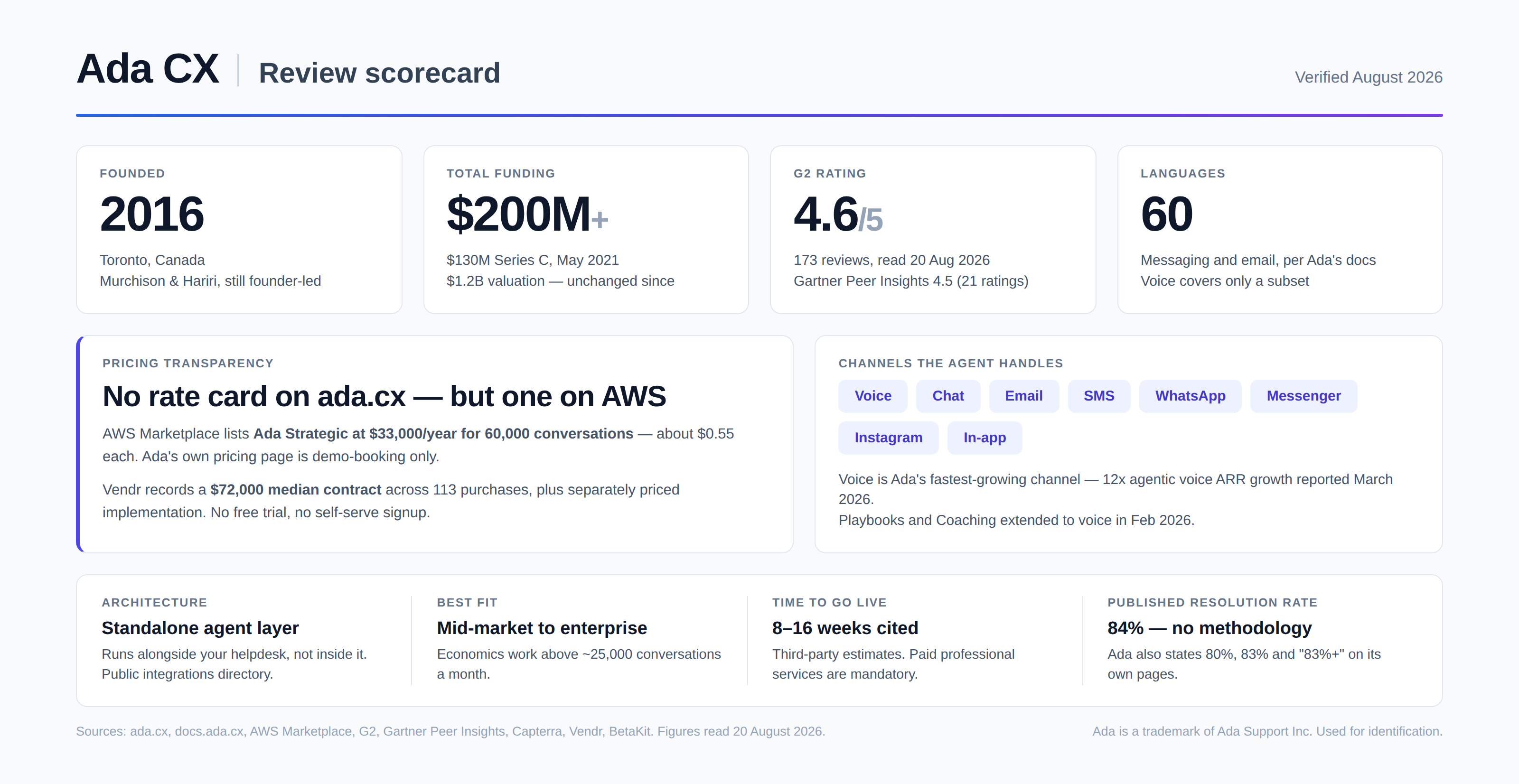
Ada CX is an enterprise AI customer service platform, founded in Toronto in 2016 by Mike Murchison and David Hariri, that deploys autonomous AI agents across voice, chat, email and messaging and runs alongside your helpdesk rather than inside it. Ada rates 4.6 on G2 across 173 reviews, says it has deployed 550+ enterprise AI agents, and publishes no rate card on its own website — though it does publish one on AWS Marketplace, a detail almost no review of Ada mentions. This review covers what Ada CX actually is, what it costs, where its published evidence is thin, and which teams it fits. If you have already decided Ada is not the fit, go straight to our Ada CX alternatives guide.
TL;DR:
- What it is: Ada CX ("ACX Platform") is a standalone agentic customer experience platform that resolves support conversations autonomously and hands off to your existing helpdesk.
- Best for: Mid-market and enterprise CX teams with high conversation volume, multilingual support needs, and a budget that starts around $33,000/year and typically lands near $72,000.
- Strongest capability: Multilingual breadth. Ada's documentation states native response generation and knowledge ingestion in 60 languages, which is at the top of this category.
- Biggest friction: Evidence quality. Ada's own pages simultaneously claim 4 billion, 4.1 billion, 5.5 billion and 6.4 billion interactions, and its headline resolution rate is published with no methodology.
- Not for: SMB teams, anyone who needs self-serve signup or a free trial, or anyone whose knowledge lives in Confluence, Notion or SharePoint rather than a help center.
- Rating: 4.6/5 on G2 across 173 reviews; 4.5/5 on Gartner Peer Insights across 21 ratings, read 20 August 2026.
The single most useful thing to know before reading any Ada pricing article, including this one: Ada does publish a real list price — $33,000 per year for 60,000 conversations — but only on AWS Marketplace, not on ada.cx. Almost every "Ada pricing" article on the web quotes competitor estimates while missing Ada's own published number.
Reviewed by Rob Jiang, Chief AI Engineer. Disclosure: this review is published by Aissist.io, which sells an agentic AI layer that competes with Ada. Ratings, prices and quotes come from Ada's own pages and documentation, AWS Marketplace, G2, Gartner Peer Insights, Capterra, Vendr and named press, all captured in August 2026.
How we evaluated Ada CX, and who wrote this
We build a competing product. Aissist.io sells an AI Operational Layer for customer service and sales, so we are not a neutral party and you should not read us as one. What we can offer instead is a review where every claim is sourced, every conflict of interest is labelled, and every gap is marked as a gap rather than filled with a plausible number.
Three rules governed this piece:
- Ada's own materials outrank everything. Where ada.cx or docs.ada.cx says something, we quote it and link it.
- Competitor claims about Ada are labelled as competitor claims. That includes most of the per-resolution pricing figures circulating online, which come from companies that sell against Ada — as do we.
- Where we could not verify something, we say so. Several widely repeated Ada facts do not survive checking, and we flag them explicitly below.
We evaluated Ada on six criteria: architecture and where it sits in your stack, agent capability and action-taking, channel and language coverage, pricing transparency, evidence quality behind its performance claims, and fit-to-segment. All figures were read on 20 August 2026.
Ada CX at a glance
| What it is | Standalone agentic customer experience (ACX) platform for support automation |
| Founded | 2016, Toronto, Canada |
| Founders | Mike Murchison (still CEO as of March 2026) and David Hariri |
| Funding | More than $200M raised. Series C of $130M in May 2021, led by Spark Capital, at a $1.2B valuation. No new round or valuation mark reported since |
| Growth | Ada reported 108% agentic AI ARR growth and 146% net revenue retention in March 2026. No absolute revenue figure disclosed |
| Architecture | Standalone agent layer — runs alongside your helpdesk, not inside it |
| Channels | Voice, email, chat, messenger, WhatsApp, SMS, Instagram, in-app, custom |
| Languages | 60 for messaging and email; voice supports only a subset |
| Pricing | No rate card on ada.cx. AWS Marketplace lists "Ada Strategic" at $33,000/year for 60,000 conversations |
| G2 | 4.6/5, 173 reviews (read 20 Aug 2026) |
| Gartner Peer Insights | 4.5/5, 21 ratings |
| Capterra | 4.7/5, 15 reviews |
| Best fit | Mid-market to enterprise CX teams with high volume and multilingual needs |
What is Ada CX?
Ada CX is an AI customer service platform that builds autonomous agents for voice, chat, email and messaging, connects them to a company's systems of record, and resolves conversations end-to-end rather than only answering questions. The company markets the product as the ACX Platform — short for Agentic Customer Experience — and describes itself as "an AI-native company on a mission to make customer experience extraordinary for everyone."
Ada was founded in 2016 in Toronto by Mike Murchison and David Hariri, and grew up in the era when "customer service AI" meant a scripted chatbot with an intent tree. That heritage matters, because the product has been progressively rebuilt around large language models since 2023 and rebranded from a chatbot builder to an agentic platform. The name is a nod to Ada Lovelace. It is unrelated to Ada Health, the symptom-checker app at ada.com, and unrelated to the Americans with Disabilities Act — a confusion worth naming, because it is the most common mix-up buyers report.
The platform is organised around four named layers, per Ada's platform page:
- Reasoning Engine™ — the intelligence layer that decides what the agent does. In February 2026 Ada launched a patent-pending "Unified Reasoning Engine" with what it calls a dual-reasoning architecture, extending a single intelligence layer across every channel including voice.
- Conversation Hub — the deployment layer that puts the agent onto specific channels.
- Performance Center — build, launch, monitor and improve. This is where Coaching, Scorecards and Recommendations live.
- Developer Toolkit — APIs, SDKs and an MCP server.
Two named features do most of the work in practice. Playbooks are structured workflows that let the agent execute multi-step standard operating procedures using real-time data — Ada's answer to the question of how an LLM agent handles a refund policy with seven conditions without hallucinating one. Coaching is the feedback loop: CX teams review conversations and correct the agent, and those corrections shape future behaviour.
Ada's customer list is genuinely enterprise-weighted: Cebu Pacific, Pinterest, Square, Sky, Grab, monday.com, Barnes & Noble, Life360, IPSY, Betsson, Brigit, Ancestry, Indigo, Malaysia Airlines and Loop Earplugs, among others. Across its homepage and platform page, Ada claims 350+ global businesses, 85+ countries and 550+ enterprise AI agents deployed — three separate figures on two pages rather than one audited statement of scale.
Who owns Ada, and is the company stable?
Ada is privately held and independent. Mike Murchison, the co-founder, was still CEO as of Ada's March 2026 growth announcement. Mike Gozzo serves as Chief Product and Technology Officer. Investors include Spark Capital, Tiger Global, Accel, Bessemer, FirstMark and Version One.
Two facts belong in an honest stability assessment, and no other review of Ada includes them.
First, the valuation is five years old. Ada raised $130M in May 2021 at a $1.2B valuation, led by Spark Capital. (Some secondary sources credit Tiger Global as lead; Ada's own announcement and Canadian tech press both say Spark led.) There has been no new equity round or reported valuation mark since — the only subsequent funding event we found is a CA$1.75M FedDev Ontario grant in March 2025, which is non-dilutive and sets no valuation. For a company in the hottest segment of enterprise software, a five-year gap between rounds is a data point, not a verdict — many well-run companies simply do not need capital — but it means the $1.2B figure you will see quoted is a 2021 number carried forward, not a current one.
Second, Ada cut staff three times. It laid off 23% of employees in 2020 during the pandemic, 16% (78 people) in September 2022, and ran a further undisclosed round in February 2023 that included its CTO. Headcount has since recovered to roughly 411 as of early 2026. That history is now three years old and Ada's reported growth since is strong — 108% agentic ARR growth, 146% net revenue retention, new London and Singapore offices — but a buyer signing a multi-year contract is entitled to know it.
We found no public security breach, lawsuit, or reported AI-failure incident involving Ada. That negative finding is worth stating plainly, because it is not true of every vendor in this category.
Architecture: where Ada CX sits in your stack
Ada is an agent layer, not a helpdesk. You keep Zendesk, Salesforce, Gorgias or your contact-centre platform, and Ada connects to it from the outside, fronting the conversation and transferring to a human in your existing tool when it cannot resolve. Ada's integrations directory describes the model plainly — for example, "transfer customers to a human agent in Gorgias over email and messaging channels."
That phrasing matters commercially. Connecting to your system of record is different from running inside it. Ada is additive to your support stack: a new platform, a new console, and a new line item on top of the tools you already pay for. It does not replace your helpdesk, and it does not remove your helpdesk bill.
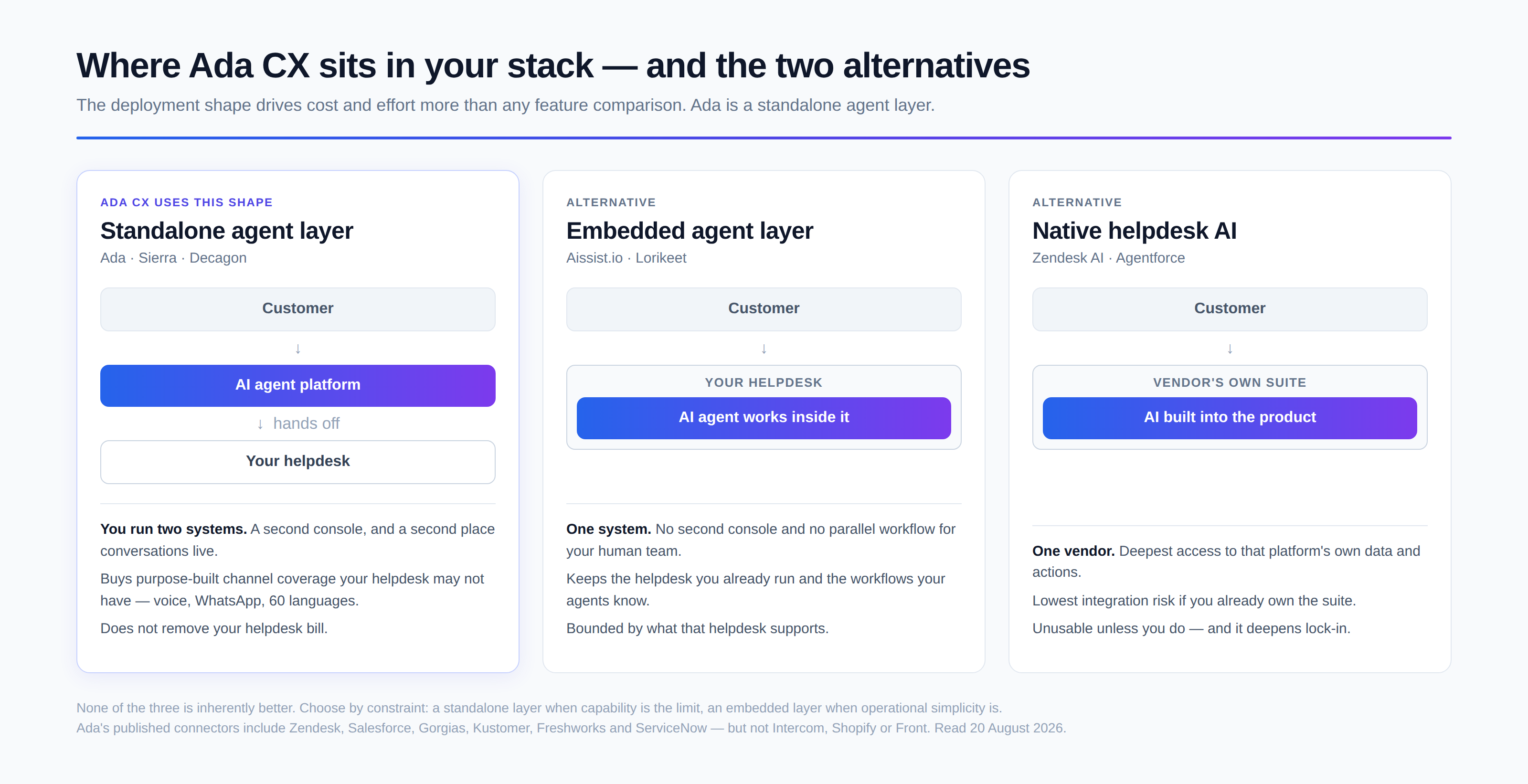
There are three deployment shapes in this category, and the difference drives cost and effort more than any feature comparison will — a separate question from whether the underlying system is agentic or generative:
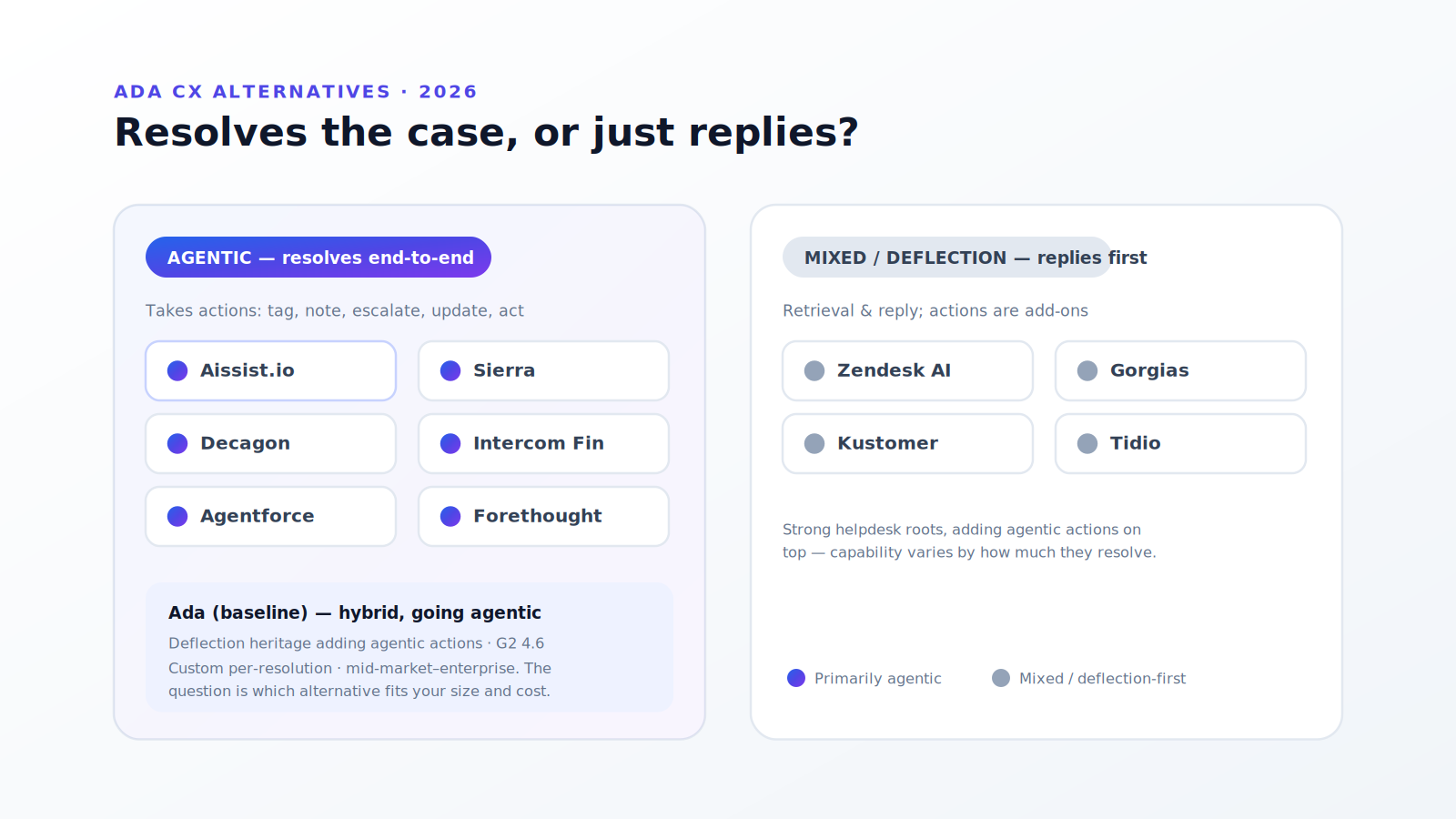
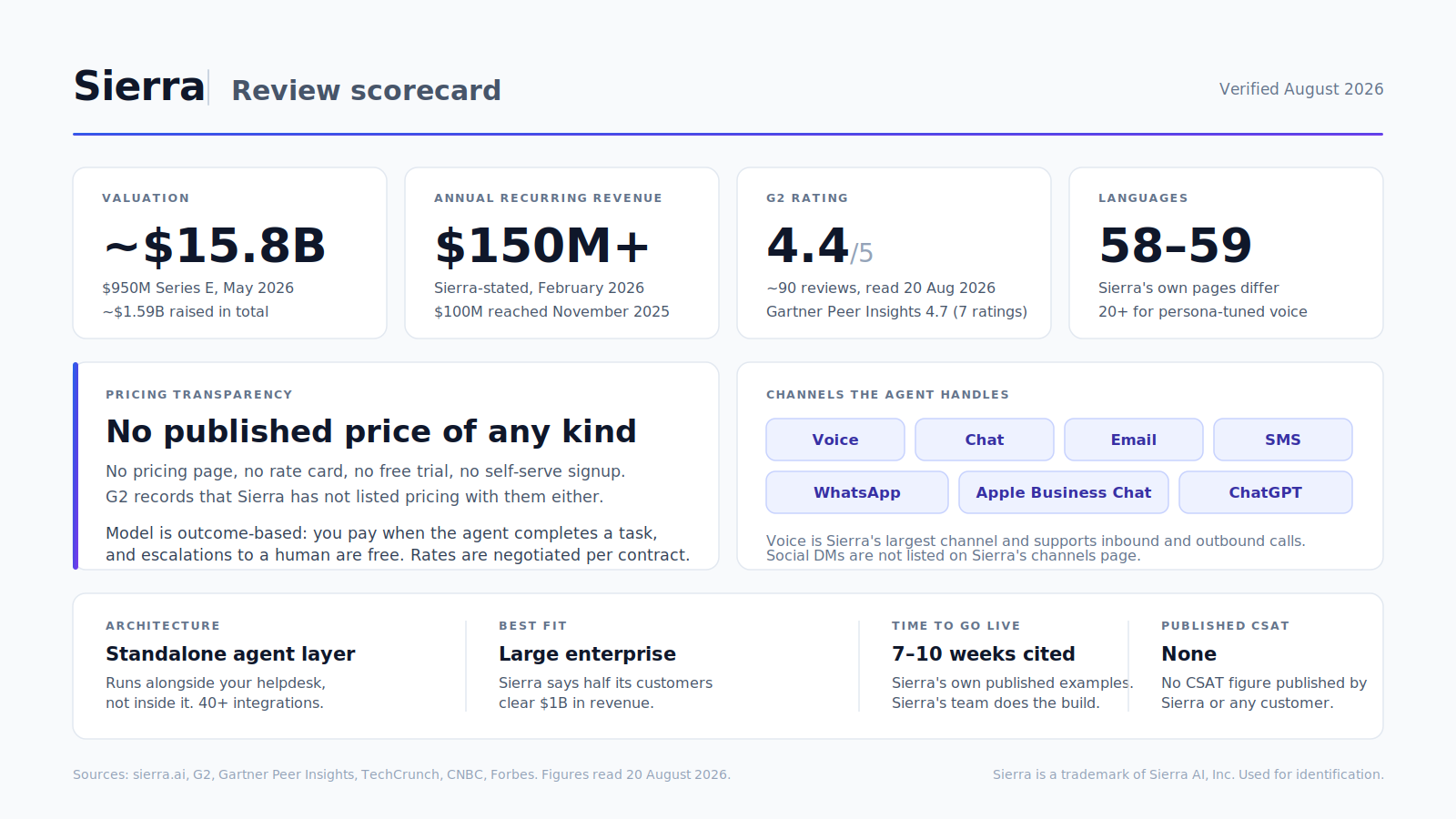
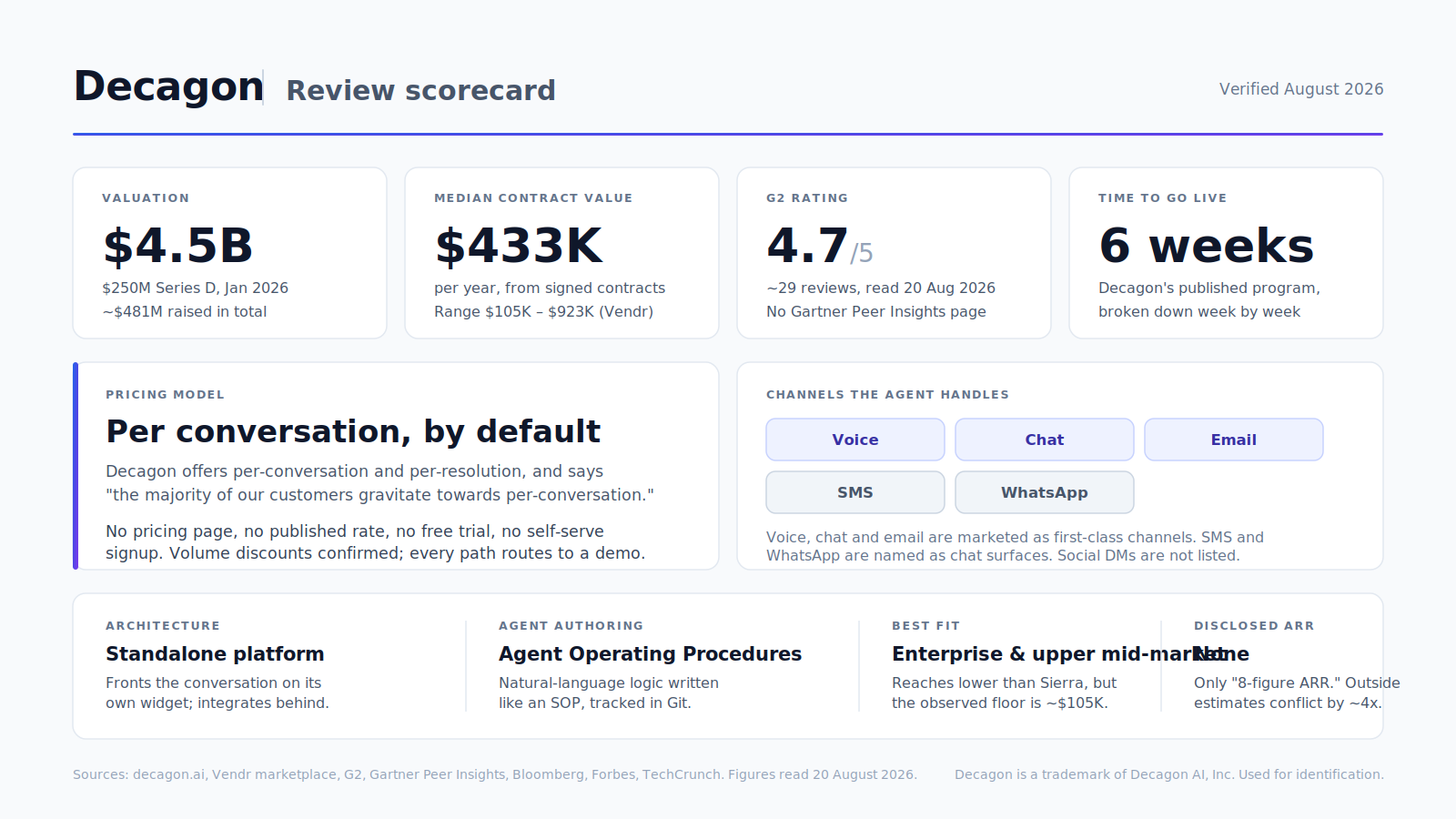
- Standalone agent layer — Ada, Sierra, Decagon. The agent fronts the conversation and hands off to your stack. You run two systems.
- Embedded agent layer — Aissist.io, Lorikeet, Intercom Fin on non-Intercom helpdesks. The agent works inside the helpdesk your team already uses.
- Native helpdesk AI — Zendesk AI, Salesforce Agentforce. You must already own the platform.
None of these is inherently better. A standalone layer gives you a purpose-built agent console and channel coverage your helpdesk may not have. An embedded layer means no second place to manage conversations and no parallel workflow for your human team. Which one is right depends on whether your constraint is capability or operational simplicity.
To Ada's credit, its integrations directory is public and specific, which is more than Sierra or Decagon offer. Published connectors include Zendesk, Salesforce, Freshworks, Genesys, Gladly, Kustomer, Help Scout, Dixa, NICE CXone, Gorgias, ServiceNow, Microsoft Dynamics, Aircall, Amazon Connect and Twilio Flex, plus unusual vertical depth in travel with Amadeus, Sabre and Galileo by Travelport — a real differentiator if you are an airline or OTA. Knowledge connectors include Contentful, Guru, Helpjuice, Paligo, GitHub and Docusaurus.
Three notable absences: Intercom, Shopify and Front do not appear on Ada's published directory. If one of those is your system of record, ask directly rather than assuming. Ada's knowledge ingestion is also help-center-shaped — competitors point out there are no native connectors for Confluence, Notion, SharePoint or Google Docs, and Ada's directory bears that out. If your institutional knowledge lives in a wiki rather than a public help center, budget for the migration work before you budget for the licence.
What Ada's AI agent can actually do
Channels: voice is the 2026 push
Ada's agents handle voice, email, chat, messenger, WhatsApp, SMS, Instagram, in-app and custom channels. Voice is where Ada has invested most visibly: it announced a second-generation Ada Voice in May 2025 alongside Recommendations, Scorecards, Coaching and Playbooks, and reported 12x growth in agentic voice ARR in its March 2026 results. The February 2026 Unified Reasoning Engine release extended Playbooks and Coaching to voice, which had previously been configured separately from chat.
Instagram and WhatsApp coverage is genuine and published, which is more than several enterprise competitors offer.
Languages: 60, but read the fine print on voice
Ada supports 60 languages with native response generation and knowledge ingestion in every one, according to Ada's own documentation. That is among the broadest coverage in the category and is the single strongest reason to shortlist Ada if you support a global customer base.
The caveat that Ada's marketing does not foreground: all 60 languages are available for messaging and email, but voice supports only a subset. Ada's documentation states that "voice supports a subset of Ada's languages today" without quantifying it, so if your use case is multilingual voice specifically, get the current supported-language list in writing before signing. Secondary sources still quote "over 50 languages" for Ada; the documentation figure of 60 is newer and primary, and it is the one to use.
Actions and Playbooks: real, but procedure-shaped
Ada's agents take actions, not just retrieve answers — looking up orders, processing changes, updating records through API integrations. The mechanism is Playbooks, which Ada describes as structured workflows for handling complex tasks and executing "multi-step SOPs using real-time data, without relying on rigid, scripted framework."
That design is a reasonable middle path between two failure modes. Pure decision-tree bots break the moment a customer says something off-script. Pure LLM agents with tool access are flexible but hard to constrain in regulated workflows. Playbooks give the model a procedure to follow while leaving the conversation itself free-form. The trade-off is that someone has to write the playbooks, and that someone is usually a combination of your CX ops team and Ada's implementation staff.
Coaching, Scorecards, and who actually maintains the agent
This is the question most reviews skip, and the best available evidence comes from Ada's own flagship case study. JL De Paz, Director of Customer Care Group at Cebu Pacific, describes the operating model directly: "Our goal is to make sure Charlie is giving the right responses and to maintain response quality. We look at different metrics and intents, review conversations daily, and immediately escalate anything that needs to be addressed to the proper team."
That is a fair and unglamorous picture of agentic AI in production at enterprise scale, and we would say the same about our own product. Even at Ada's best-documented deployment, a human team reviews agent output daily. Ada's Coaching, Scorecards and Recommendations features exist precisely to make that review loop efficient. Budget for the headcount, and ask any vendor in this category — including us — who does this work and how long it takes each week.
Ada CX pricing: the one number Ada does publish
Ada does not publish pricing on ada.cx. The pricing page is a demo-booking page: no tiers, no rates, no published floor, no free trial, no self-serve signup. This is standard for enterprise sales-led vendors — Sierra, Decagon and Gladly all do the same — but it means you cannot size the investment without entering a sales cycle.
Except Ada does publish a price, on AWS Marketplace. Its listing for "Ada - AI Agent" carries a real, public rate card:
| Dimension | Description | Cost / 12 months |
|---|---|---|
| Ada Strategic | includes 60,000 conversations | $33,000.00 |
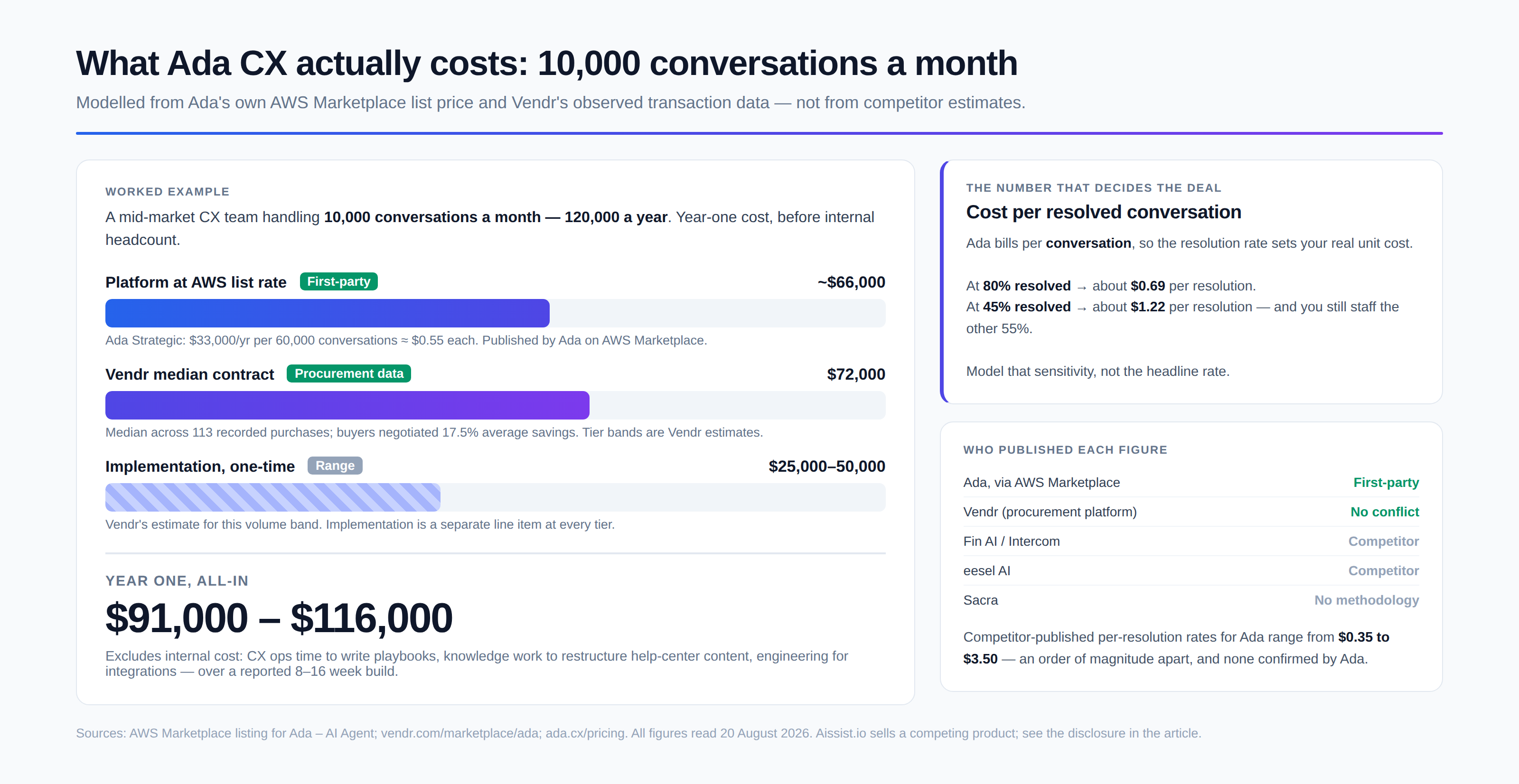
That works out to roughly $0.55 per conversation at list. The listing offers 24-month contracts "save up to 9%" and 36-month "save up to 4%" — the longer commitment carrying the smaller discount, which is unusual enough to be worth querying in a negotiation. It is a single tier rather than a full rate card, and enterprise deals are negotiated separately, but it is Ada's own published number and the most defensible pricing datapoint available. The same listing states the agent can "immediately start resolving more than 83% of customer service inquiries, onboarded entirely using existing help center content."
What third parties claim Ada costs
Read the source labels before the numbers. Most published Ada pricing comes from companies that sell against Ada — and so do we.
| Claim | Source | Conflict of interest |
|---|---|---|
| Median contract $72,000/year, from 113 recorded purchases, 17.5% average negotiated savings. Tiers: up to 25k conversations/mo = $30k–70k platform plus $15k–30k implementation; 25k–100k = $70k–150k plus $25k–50k; 100k+ = $150k–300k+ plus $50k–100k+ | Vendr | None — procurement data platform. The most credible third-party figure here |
| $1.00–$3.50 per conversation; year one $50k–150k+; implementation 8–16 weeks | Fin AI (Intercom) | Sells Fin, a direct competitor |
| Bills per conversation by default, per resolution as an exception — e.g. $0.35/conversation vs $1.50/resolution | eesel AI | Self-discloses as an Ada competitor |
| $0.99–$1.50 per resolved interaction | Sacra | Research firm, but no methodology published |
Vendr's $72,000 median across 113 purchases is the number to anchor on, because Vendr sells procurement software rather than a competing AI agent, and the median comes from observed transactions. Two caveats an honest reading requires: the tier bands on that page are Vendr's own modelling, not Ada tiers — Vendr states plainly that Ada "does not publish tier names or pricing publicly" — and the page contradicts itself on implementation cost, quoting both $25,000–$50,000 and $15,000–$40,000 for the same volume band. Treat the median as data and the bands as an estimate.
What the bands do establish is that implementation is a separate line item at every volume level, which corroborates that professional services are a paid, required part of an Ada rollout rather than an optional add-on.
The per-unit rates are the weakest data in the category. Four published figures — $0.35, $0.99, $1.50 and $3.50 — come from competitors or unmethodologied secondary sources, contradict each other by an order of magnitude, and none is confirmed by Ada. Treat any article that states a confident Ada per-resolution price as unreliable.
A worked example
Take a mid-market team handling 10,000 support conversations a month — 120,000 a year.
At the AWS list rate of roughly $0.55 per conversation, that is about $66,000 a year in platform cost, which sits neatly either side of Vendr's observed $72,000 median. Add Vendr's implementation range for that volume tier — $25,000 to $50,000 one-time — and year one lands between roughly $91,000 and $116,000, before any internal cost.
Then add the part no pricing page shows. At 8–16 weeks of implementation, you are funding CX ops time to write playbooks, knowledge-management time to restructure help-center content into a form the agent can ingest, and engineering time for integrations. Call it a quarter of a CX ops FTE for a quarter, conservatively.
The arithmetic that decides the deal is what happens to cost per resolved conversation when the resolution rate underperforms. If Ada bills per conversation and resolves 80%, effective cost per resolution is about $0.69. If it resolves 45% — the low end of what independent testing finds across this category — the same bill produces an effective $1.22 per resolution, and you are still paying humans to handle the other 55%. That sensitivity, not the headline rate, is what to model. Our AI customer service benchmark by industry shows how far claimed rates typically compress in production.
Three things to ask for as separate line items: the platform fee, the implementation fee, and whether unused conversations in a committed bundle roll over or expire.
Ada's performance claims, and how much to trust them
This is where our assessment is least flattering, and we want to be precise about why: the issue is not that Ada's numbers are implausible. It is that they are unsourced and internally inconsistent.
Ada publishes four different totals for the same metric. As of 20 August 2026, Ada's homepage runs a live counter reading roughly 4.1 billion total engaged customer conversations; its platform page says 6.4 billion customer interactions handled; its January 2026 Medallia partnership release says more than 5.5 billion interactions; and its about page says more than 4 billion. All four are live simultaneously on Ada's own properties, and they differ by more than 50%. The homepage figure is an incrementing counter rather than a fixed claim, which explains the gap with the about page — but not the two-billion spread against the platform page.
The headline resolution rate is also inconsistent, and published without methodology. Ada variously states an 84% automated resolution rate (homepage and platform page), "resolve over 80% of customer inquiries" (platform page), "automating 83% of customer conversations" (about page), and "more than 83%" (AWS Marketplace). No page defines what counts as a resolution, over what sample, or across which customers. In a category where "deflection," "containment" and "resolution" are routinely used interchangeably to mean very different things, that definition is the whole claim.
Two headline stats have no attribution at all. Ada's homepage claims "8× more productive than human agents" and "162% increase in CSAT scores" with no source, methodology, sample or named customer attached to either.
One correction worth making, because it is widely repeated. Ada's "357% ROI" figure is not from a Forrester Total Economic Impact study — no Forrester TEI exists for Ada. It comes from a single self-reported customer case study, Loop Earplugs. Ada's actual Forrester placements are Contender in The Forrester Wave: Conversational AI for Customer Service, Q2 2024, and Strong Performer in the Q3 2022 New Wave for Conversation Automation. Ada does not misrepresent this itself; secondary articles do.
To be fair to Ada, its named case studies are its strongest evidence and are considerably more specific than the aggregate claims. Cebu Pacific reports 34%+ higher automated resolution and a 50%+ CSAT increase. Dott moved from 32% to 77% automated resolution alongside a 17-point CSAT gain. monday.com reports a 42% reduction in average handle time. Those are self-reported and unaudited, as case studies always are, but they are attached to named companies with named metrics — a materially higher standard than "8× more productive."
Check the dates before you weigh them, though. Ada's frequently cited Wave case study — a 65% year-over-year ticket reduction in the first month — describes a deployment that went live in January 2020, on Ada's pre-generative platform. It is a fine result and a poor proxy for what today's agentic product does.
Our advice is the same one we would give about our own published numbers: ask for a reference customer at your volume, in your industry, and ask them what their resolution rate was at day 90. Vendor best-case figures across this entire category, ours included, compress in production — see our AI customer service benchmark for how far.
Reviews and ratings: what users actually say
| Platform | Score | Reviews | Read |
|---|---|---|---|
| G2 | 4.6 / 5 | 173 | 20 Aug 2026 |
| Gartner Peer Insights | 4.5 / 5 | 21 ratings | 20 Aug 2026 |
| Capterra | 4.7 / 5 | 15 | 20 Aug 2026 |
| TrustRadius | 9 / 10 | 1 — not meaningful | 20 Aug 2026 |
4.6 across 173 reviews is a strong, well-established rating — deeper than Sierra's or Decagon's public review base and a genuine point in Ada's favour. On Gartner Peer Insights, no reviewer rated Ada below 4 stars.
The praise clusters consistently around ease of use (23 mentions), exceptional support (21), quick customer support (17), natural language processing (17) and easy setup (13). Reviewers describe a drag-and-drop builder that saved hours of configuration, and Gartner reviewers specifically credit Ada's professional services and project management. Ada's implementation team is well regarded, which is not a small thing when implementation is mandatory.
The complaints cluster just as consistently, and the top one is structural: integration challenges (9 mentions), alongside usability issues (10), missing features (8), usage limitations (8) and AI limitations (7). Capterra reviewers put it more bluntly — "Setup and actually digging in deep to make this tool work is time consuming" and "integrating new features or adding additional channels can be complex, requiring significant time." A Gartner reviewer describes handoff integration with live-agent vendors as not seamless.
A fair reading: Ada is easy to start and harder to extend. The initial agent built from help-center content goes live quickly and reviewers like it. The friction appears when you add a channel, connect a system that is not on the standard connector list, or push the agent into workflows the out-of-box configuration did not anticipate.
One widely circulated claim we could not verify and would not use: a "Trustpilot 1.8/5" score for Ada, cited by a competitor. We found no such rating for Ada CX, and it most likely conflates Ada with a different company.
Security and compliance
Ada maintains a public trust centre at security.ada.cx, which is more transparency than several competitors offer. The artefacts listed are not all the same kind of thing, so it is worth separating them:
- Audited certifications: SOC 2 Type 2 and SOC 3, report period 1 October 2023 to 30 September 2024, and HIPAA, dated 30 September 2024
- Self-attestations: PCI DSS as an Attestation of Compliance, and WCAG 2.1 AA as a VPAT — both vendor-authored rather than third-party audited
- Regulatory posture: GDPR, CCPA, CPRA, PIPEDA
- Stated practice, not certification: the security program "primarily follows" CIS Controls v8.0
Two gaps to raise in a security review. ISO 27001 is not listed on Ada's trust centre — if you have seen it claimed for Ada, it is unverified, and you should ask directly. Data residency regions are not specified, which matters for EU or Canadian public-sector buyers. Note also that the displayed SOC 2 period ends September 2024; ask for the current report.
On the question every security team asks — does the vendor train on your data — Ada's published position is that it uses commercial models from providers including OpenAI and Anthropic with "no personal data or Ada proprietary included in their training," operates under zero-data-retention agreements where "LLM providers don't retain any of the data we pass to them," and fine-tunes only on de-identified per-customer data. That is a solid stance. The one structural criticism is that it lives on a blog post rather than in the formal trust documentation, where the "AI Training Data" section is a heading with no detail behind it. For a compliance file, ask for it in contract language.
Pros and cons
Pros
- Best-in-category language coverage — 60 languages with native response generation and knowledge ingestion, per Ada's documentation.
- Deepest public review base among agentic-first vendors — 4.6/5 across 173 G2 reviews, versus roughly 90 for Sierra and under 30 for Decagon.
- A published integrations directory, including unusual airline/travel depth (Amadeus, Sabre, Galileo) that no direct competitor matches.
- Ada actually publishes a price on AWS Marketplace — $33,000/year for 60,000 conversations — which is more transparency than Sierra, Decagon or Gladly offer.
- Well-regarded implementation and support teams, credited by both G2 and Gartner reviewers.
- A mature trust centre with SOC 2, HIPAA, PCI and a clear stance on LLM data retention.
Cons
- Evidence quality is weak at the aggregate level — four conflicting interaction totals, a resolution rate published without methodology, and two headline stats with no attribution at all.
- Integration friction is the most consistent complaint across G2, Capterra and Gartner reviews.
- Knowledge ingestion is help-center-shaped — no published native connectors for Confluence, Notion, SharePoint or Google Docs.
- Intercom, Shopify and Front are absent from the published integrations directory.
- Implementation is mandatory and priced separately — $15,000 to $100,000+ depending on volume, per Vendr's estimates, over a reported 8–16 weeks.
- No free trial, no self-serve signup, and no rate card on Ada's own site.
- Voice does not cover all 60 languages, despite multilingual breadth being Ada's strongest selling point.
- No new funding round or valuation mark since May 2021, following three rounds of layoffs between 2020 and 2023.
Who Ada CX is for, and who it isn't
Ada CX is a good fit if: you are a mid-market or enterprise CX team handling 25,000+ conversations a month; you support customers in many languages over chat and email; your knowledge already lives in a structured help center; you are in travel, airlines, gaming, fintech or ecommerce where Ada has vertical depth and named references; and you have budget for a $70,000-ish annual contract plus a separately priced implementation and a quarter of ramp time.
Ada CX is a poor fit if: you are an SMB or a small team — the economics do not work below roughly 25,000 conversations a month; you need to be live this month rather than this quarter; your institutional knowledge lives in Confluence, Notion or SharePoint; your system of record is Intercom, Shopify or Front; you need multilingual voice specifically; or you need a free trial or self-serve path to evaluate before committing to a sales cycle.
The deeper question is architectural, and it applies to every vendor in the standalone-layer group. Running Ada means running a second platform: a second console, a second place conversations live, and a second workflow for your human team when the agent hands off. For teams whose constraint is capability — global languages, voice, airline systems — that is a fair trade. For teams whose constraint is operational simplicity, an embedded agent layer that works inside the helpdesk you already run removes the second system entirely. Neither is universally right; know which constraint is yours before you shortlist.
Ada CX alternatives
If Ada is not the fit, the strongest alternatives fall into three groups. Enterprise standalone agents — Sierra and Decagon — compete with Ada on agentic depth at a higher price point and with thinner public review bases. Transparent per-outcome pricing — Intercom Fin, published as "from $0.99 per Fin outcome" — appeals to teams that want to model cost before a sales call, though note that "from" is a floor and an outcome is not identical to a resolution. Embedded layers — including Aissist.io, which resolves inside Zendesk, Salesforce, Kustomer, Front and Gorgias rather than alongside them — suit teams that do not want a second console.
For the full field with pricing, ratings and fit for each, see our 10 best Ada CX alternatives and competitors guide, or the head-to-head in Aissist.io vs Ada.
Compare Ada against an agentic layer on your own stack. Aissist.io deploys into the helpdesk you already run and resolves support and sales end-to-end — no second console, no rip-and-replace. Book a demo or read how we compare with Ada.
Frequently asked questions
What is Ada CX?
Ada CX is an enterprise AI customer service platform founded in Toronto in 2016 that deploys autonomous AI agents across voice, chat, email and messaging. It runs alongside your existing helpdesk rather than replacing it, resolving conversations end-to-end and handing off to human agents when needed. Ada markets it as the ACX (Agentic Customer Experience) Platform.
How much does Ada CX cost?
Ada publishes no rate card on ada.cx, but its AWS Marketplace listing prices "Ada Strategic" at $33,000 per year for 60,000 conversations — roughly $0.55 per conversation. Procurement platform Vendr reports a median contract of $72,000 per year across 113 recorded purchases, plus implementation fees of $15,000 to $100,000+ depending on volume.
Who owns Ada CX?
Ada is a private, independent company headquartered in Toronto, co-founded in 2016 by Mike Murchison and David Hariri. Murchison remains CEO as of March 2026. Investors include Spark Capital, Tiger Global, Accel, Bessemer and FirstMark. Ada has raised more than $200 million, most recently a $130M Series C in May 2021 at a $1.2 billion valuation.
Is Ada CX the same as Ada Health?
No. Ada CX (ada.cx) is a customer service AI platform for businesses. Ada Health (ada.com) is a separate German company that makes a consumer symptom-checker app. Neither is related to the Americans with Disabilities Act or the American Dental Association, both of which also use the "ADA" name.
How many languages does Ada CX support?
Ada's documentation states support for 60 languages with native response generation and knowledge ingestion in each. All 60 are available for messaging and email channels, but voice supports only a subset — a limitation worth confirming in writing if multilingual voice is your use case.
What resolution rate can you expect from Ada?
Ada claims an 84% automated resolution rate, though its own pages also state 80%, 83% and "more than 83%" and publish no methodology or definition of resolution. Named case studies are more credible: Dott reported moving from 32% to 77%, and Cebu Pacific reported a 34-point improvement. Expect real-world rates below vendor headline figures, and pilot on your own tickets.
Does Ada CX integrate with Zendesk and Salesforce?
Yes. Ada's published integrations directory lists Zendesk, Salesforce, Freshworks, Genesys, Gladly, Kustomer, Help Scout, Dixa, NICE CXone, Gorgias, ServiceNow, Microsoft Dynamics and several telephony platforms, plus airline systems including Amadeus and Sabre. Intercom, Shopify and Front are not listed — confirm directly if you use one of those.
How long does Ada CX take to implement?
Ada publishes no official implementation timeline. Third-party estimates put it at 8 to 16 weeks, and professional services are a required, separately priced part of every rollout rather than an optional add-on. Most of that time goes to restructuring knowledge content and building integrations, not to the agent itself.
Is Ada CX secure and compliant?
Ada maintains a public trust centre listing SOC 2 Type 2, SOC 3, HIPAA, PCI DSS attestation, GDPR, CCPA, CPRA, PIPEDA and WCAG 2.1 AA, with a security program following CIS Controls v8.0. ISO 27001 is not listed and data residency regions are not published. Ada states that LLM providers do not retain data passed to them and that fine-tuning uses de-identified per-customer data.
Is there a free trial of Ada CX?
No. Ada is sales-led with no free trial, no self-serve signup and no published pricing on its own site. Evaluating Ada requires booking a demo and entering a sales cycle. Buyers who want to model cost before talking to sales can use the AWS Marketplace list price of $33,000 per year for 60,000 conversations as a starting anchor.
Is Ada CX worth it?
Ada is worth it for mid-market and enterprise teams with high conversation volume, broad language requirements and structured help-center content — its 4.6/5 rating across 173 G2 reviews reflects a mature product with strong support. It is poor value below roughly 25,000 conversations a month, where the platform fee and mandatory implementation dominate the economics.
Changelog
- August 2026 — First published. All ratings, prices and product facts read 20 August 2026. Added Ada's AWS Marketplace list price ($33,000/year for 60,000 conversations), which is not published on ada.cx. Documented four conflicting interaction-count figures on Ada's own properties. Corrected two claims that circulate widely elsewhere: Ada's "357% ROI" figure is a Loop Earplugs case study, not a Forrester TEI (none exists for Ada), and Ada's Forrester Wave placement is Contender, not Challenger.