Sierra AI Review (2026): What It Does, What It Costs, and Who It's For
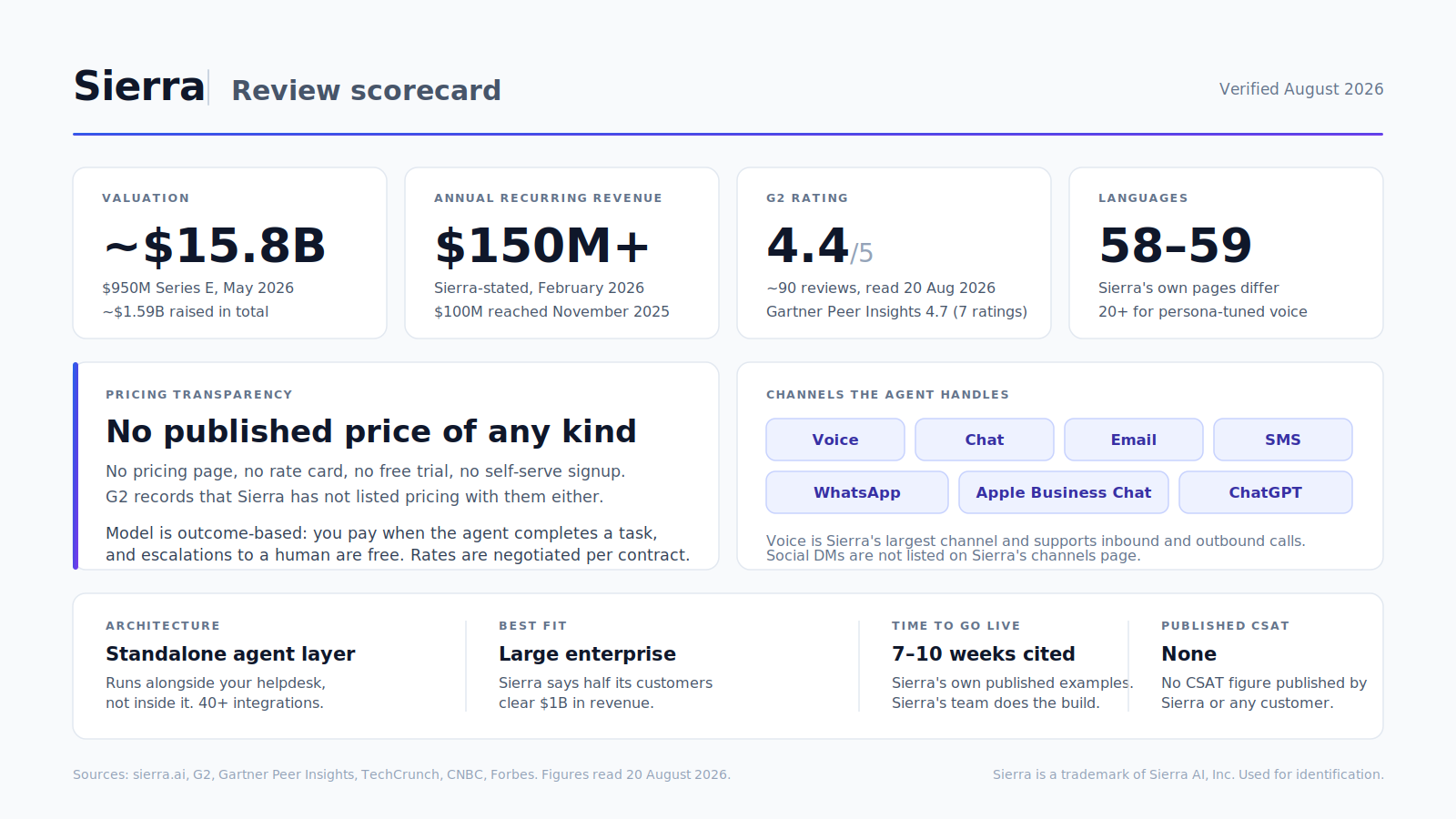
Sierra AI is an enterprise conversational AI platform, founded in 2023 by Bret Taylor and Clay Bavor, that builds autonomous agents for voice, chat, email and messaging and runs alongside your helpdesk rather than inside it. It rates 4.4 on G2 across roughly 90 reviews, serves what it says is over 40% of the Fortune 50, and publishes no pricing whatsoever. This review covers what Sierra does, what buyers report it costs, where its evidence is thin, and which alternatives fit which teams. If you have already decided Sierra is not the fit, go straight to our Sierra AI alternatives guide.
TL;DR:
- What it is: Sierra AI is a standalone conversational AI agent platform, founded in 2023 by Bret Taylor and Clay Bavor, that runs alongside your helpdesk rather than inside it.
- Best for: Large enterprises with a dedicated program budget. Sierra says half its customers exceed $1 billion in revenue.
- Strongest capability: Voice. It launched in October 2024 and Sierra says it became their biggest channel within months.
- Biggest friction: Sierra does not publish pricing. There is no pricing page, rate card, free trial or self-serve signup.
- Not for: SMB or most mid-market teams, anyone who needs to change agent behaviour themselves the same day, or anyone who needs budget predictability before signing.
- Rating: 4.4/5 on G2 across roughly 90 reviews, read 20 August 2026.
One thing to fix in your head before you read any Sierra pricing article, including this one: nearly every dollar figure circulating online about Sierra comes from a company that sells against it. Sierra has published none of them.
Reviewed by M.W., Co-founder. Disclosure: this review is published by Aissist.io, which sells an agentic AI layer that competes with Sierra. Ratings, prices and quotes come from Sierra's own pages, G2, Gartner Peer Insights and named press, all captured in August 2026.
How we evaluated Sierra, and who wrote this
We build a competing product. Aissist.io sells an agentic AI layer for customer service, so we are not a neutral party and you should not read us as one. What we can offer instead is a review where every claim is sourced and every gap is marked as a gap.
Three rules governed this piece:
- Sierra's own materials outrank everything. Where sierra.ai says something, we quote it and link it.
- Competitor claims about Sierra are labelled as competitor claims. That includes the pricing figures below, which come from companies that sell against Sierra — as do we.
- Where we could not verify something, we say so rather than filling the gap with a plausible number.
We evaluated Sierra on six criteria: architecture and where it sits in your stack, agent capability and action-taking, channel and language coverage, pricing transparency, evidence quality behind its performance claims, and fit-to-segment. All figures were read on 20 August 2026.
Sierra AI at a glance
| What it is | Standalone AI agent platform for customer service and support |
| Founded | 2023; publicly launched February 2024 |
| Founders | Bret Taylor (ex-Co-CEO of Salesforce, chair of OpenAI's board) and Clay Bavor (18 years at Google) |
| Funding | $950M raised May 2026, led by Tiger Global and GV, at a valuation Sierra describes as "over $15 billion" — press reported $15.8B post-money. Roughly $1.59B raised in total, per CB Insights |
| Revenue | Sierra stated "over $150M in ARR" in February 2026, after passing $100M in November 2025 |
| Architecture | Standalone agent layer — runs alongside your helpdesk, not inside it |
| Channels | Voice (inbound and outbound), messaging (web, in-app, WhatsApp, Apple Business Chat, SMS), email, Live Assist, ChatGPT |
| Languages | 55–59, depending on which Sierra page you read |
| Pricing | Outcome-based. No published rate, no trial, no self-serve signup |
| G2 | 4.4/5, ~90 reviews (read 20 Aug 2026) |
| Gartner Peer Insights | 4.7/5, but only 7 ratings — too small to be meaningful |
| Best fit | Large enterprise with a six-figure program budget |
What is Sierra AI?
Sierra AI is a conversational AI platform that builds autonomous customer-facing agents for voice, chat, email and messaging, and connects them to a company's systems of record so the agent can complete tasks rather than only answer questions. Sierra describes its own mission as helping "businesses build better, more human customer experiences with AI."
The company was founded in 2023 by Bret Taylor and Clay Bavor and launched publicly in February 2024. Taylor was co-CEO of Salesforce, CTO of Facebook, a co-creator of Google Maps, and currently chairs OpenAI's board. Bavor spent 18 years at Google, most recently leading Google Labs. That pedigree is a substantial part of why Sierra has raised roughly $1.59 billion in under three years. In its May 2026 round the company said it was "raising $950 million from new and existing investors, led by Tiger Global and GV, at a valuation of over $15 billion." Press reporting put the post-money figure at $15.8 billion; Sierra itself has only said "over $15 billion."
The platform is organised around a set of named components. Agent Studio is the build surface, where teams define agent behaviour through natural-language "Journeys" and collaborate in GitHub-style "Workspaces." Ghostwriter, launched April 2026, generates and modifies agents from a natural-language description. The Context Engine and Agent Data Platform supply memory and connect structured CRM data with unstructured conversation history. Horizon, launched July 2026 out of Sierra's acquisition of Takeoff, extends agents to long-horizon goals that unfold over days or weeks — Sierra's examples are originating a loan and obtaining prior authorisation for a healthcare procedure.
Sierra's customer list is unusually heavy at the top end: ADT, CarMax, Chime, Cigna, DIRECTV, Ramp, Rivian, Rocket Mortgage, SiriusXM, SoFi, Sutter Health, Uber, Vanguard and Wayfair, among others. In its year two review of 6 February 2026, Sierra said "one in four of our customers has revenue over $10 billion and 50% over $1 billion." In its May 2026 funding post it said it was "serving over 40% of the Fortune 50."
Architecture: where Sierra actually sits in your stack
Sierra is an agent layer, not a helpdesk. You keep Zendesk, Salesforce or your contact-centre platform, and Sierra connects to it from the outside. Sierra's own Agent Studio page describes the model plainly: "Leverage 40+ pre-built integrations to instantly connect your agent with third-party knowledge bases, systems of record, and contact centers."
That phrasing matters commercially. Connecting with your systems of record is different from running inside them. Sierra is additive to your support stack — a new platform, a new console, and a new line item on top of the tools you already pay for. It does not replace your helpdesk, and it does not remove your helpdesk bill.
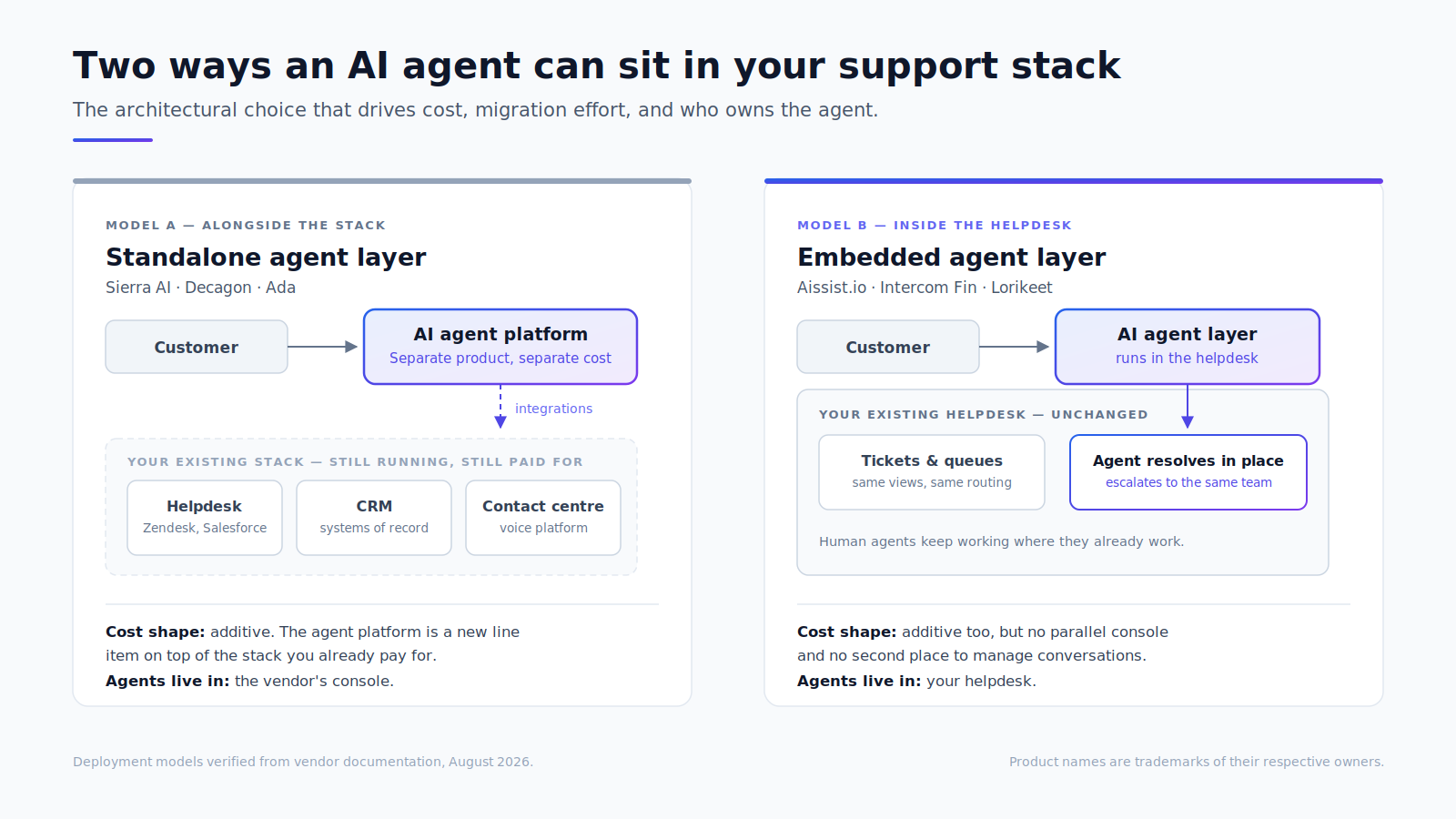
There are three deployment shapes in this category, and the difference drives cost and effort more than any feature comparison will — a separate question from whether the underlying system is agentic or generative:
- Standalone agent layer — Sierra, Decagon, Ada. The agent fronts the conversation and hands off to your stack. You run two systems.
- Embedded agent layer — Aissist.io, Intercom Fin on non-Intercom helpdesks, Lorikeet. The agent works inside the helpdesk your team already uses.
- Native helpdesk AI — Zendesk AI, Salesforce Agentforce. You must already own the platform.
None of these is inherently better. A standalone layer gives you a purpose-built agent console and channel coverage your helpdesk may not have — particularly voice, where Sierra is genuinely strong. An embedded layer means no second place to manage conversations and no parallel workflow for your human team. Which one is right depends on whether your constraint is capability or operational simplicity.
On the specific connector list, Sierra advertises "40+ pre-built integrations" but does not publish which ones. There is no live integrations directory on sierra.ai, and the developer documentation at docs.sierra.ai is behind a login. Third-party sources report native Zendesk, Salesforce and ServiceNow connectors. We could not verify support for Intercom, Freshdesk, Gorgias, Kustomer, Front or Shopify from any source, Sierra's or otherwise. If one of those is your system of record, ask directly.
What Sierra's agents can actually do
Channels: voice is the headline
Sierra's agents handle voice for both inbound and outbound calls, messaging across web, in-app, WhatsApp, Apple Business Chat and SMS, email, and Live Assist for human agents — plus one-click publishing of an agent into ChatGPT. Social DMs are not listed on Sierra's channels page, so do not assume Facebook or Instagram coverage.
Voice launched in October 2024 and, in a March 2025 post announcing its acquisition of Receptive AI, Sierra wrote: "Voice is now our biggest channel (it's only been available since October)." In August 2026 Sierra added Voice Personas, which lets an agent's delivery — pacing, interruption handling, voice and language switching — be configured separately from what it does. Sierra reported that for one agent, "pairing a natural voice with a persona increased resolution rates by almost 50 percent." No baseline, methodology or customer accompanies that figure, so treat it as directional rather than evidence.
Language coverage is worth pinning down in your own evaluation, because Sierra's pages disagree with each other: its voice page says "over 55 languages," its channels page says 58, and the same channels page describes voice models "tuned across 59 languages."
Actions: yes, and this is well evidenced
Sierra's agents take real actions, not just answer questions. Agent Studio states that integrations let agents take "real-time action on behalf of customers." The Agent OS 2.0 launch was subtitled "from answers to memory and action." Sierra also holds PCI DSS Level 1 Service Provider certification, which means its agents handle payments: Sierra says sensitive payment data "flows through dedicated PCI-certified infrastructure and never touches Sierra's core platform," and separately that "LLMs don't touch sensitive data."
Building and maintaining agents: the open question
This is the area where Sierra's own positioning and third-party accounts diverge most, and it is worth resolving in your own evaluation rather than trusting either side.
Sierra's stated position is code-optional. Its Agent Studio launch post says: "Everything that's possible programmatically — from sophisticated workflows for voice and chat to simulations and supervisors — can be done without code." Ghostwriter pushes further, letting you describe an agent in plain language and have it built. Bret Taylor's framing, quoted by TechCrunch: "The era of clicking buttons is over."
Against that, Sierra maintains a role it named itself — the agent engineer — who, in Sierra's own words, works "with our customers to design, build, and ship agents." That is a professional-services-led delivery model, and competitors claim it means customers often cannot make changes themselves. Those competitor claims are self-interested. But two independent signals partly corroborate the friction: Gartner Peer Insights reviewers flag "Complex Initial Integration" requiring "significant effort," and G2's aggregated review tags include complex configuration, difficult setup and integration issues.
A fair reading: Sierra ships real self-service tooling, and the initial build is still substantially done with Sierra's team. Ask your reference customers who edits the agent six months in.
Testing and guardrails — and the Gap incident
Sierra's evaluation tooling is a genuine strength and better documented than most of the category. Agent Studio lets teams "simulate conversations and evaluate your agent's performance against defined outcomes" and "build a test suite to detect and prevent potential regressions prior to releasing new versions." Voice agents get Voice Sims. Voice Personas are tested "against thousands of simulated interactions before deployment."
For runtime safety, Sierra runs two mechanisms it describes in Confidence in every conversation: Supervisors, in-the-moment guardrails that verify facts and enforce policy, and Monitors, which review every conversation for coherence, repetitiveness, factual grounding and sentiment.
There is one publicly reported failure worth knowing about. In December 2025, The Information reported that Gap.com's Sierra-built chatbot had been manipulated into off-brand responses. Sierra attributed the incident to a coordinated external attack: its head of communications, Rachel Whetstone, said a bad actor had been attempting to jailbreak over a dozen client agents since the previous week, and that Gap's guardrails had been "inadvertently misconfigured" for that deployment.
We include this because it is on the record with a named Sierra spokesperson, not because it settles anything. Sierra's account — an attacker probing many customers at once, against a deployment whose settings were wrong — is credible, and every vendor in this category, us included, ships guardrails that can be misconfigured. The buyer's takeaway is narrower and more useful: guardrail configuration is a per-deployment responsibility, not a platform-level guarantee. Ask any vendor who reviews your configuration, and how often.
Sierra AI pricing: what's published and what isn't
Sierra does not publish pricing. There is no pricing page on sierra.ai, no rate card, no published floor, no free trial and no self-serve signup. G2's pricing page for Sierra records the same: "Information about Sierra pricing, plan availability, and costs is not listed on G2 by the vendor." This is normal for enterprise sales-led vendors — Decagon, Ada, Gladly and Lorikeet all do the same — but it means you cannot size the investment without entering a sales cycle.
What Sierra does publish is the model. In Outcome-Based Pricing for AI Agents, published December 2024, Sierra states you "pay only when the software achieves specific, valuable outcomes," and that "if a case needs to be escalated, in most cases, there's no charge." Bret Taylor put it more concretely on the A Cheeky Pint podcast in March 2026: "if the AI agent resolves the case, no human intervention, there's a pre-negotiated rate for that. If we do have to escalate to a person, that's free."
Two qualifiers are worth carrying into a negotiation. First, the phrase "in most cases" appears twice in Sierra's pricing post and the exceptions are never defined. Second, chargeable outcomes are broader than support deflection — Sierra's own examples include "ecommerce purchases, memberships saved," which means the billing surface may extend past the tickets you were budgeting for.
What third parties claim Sierra costs
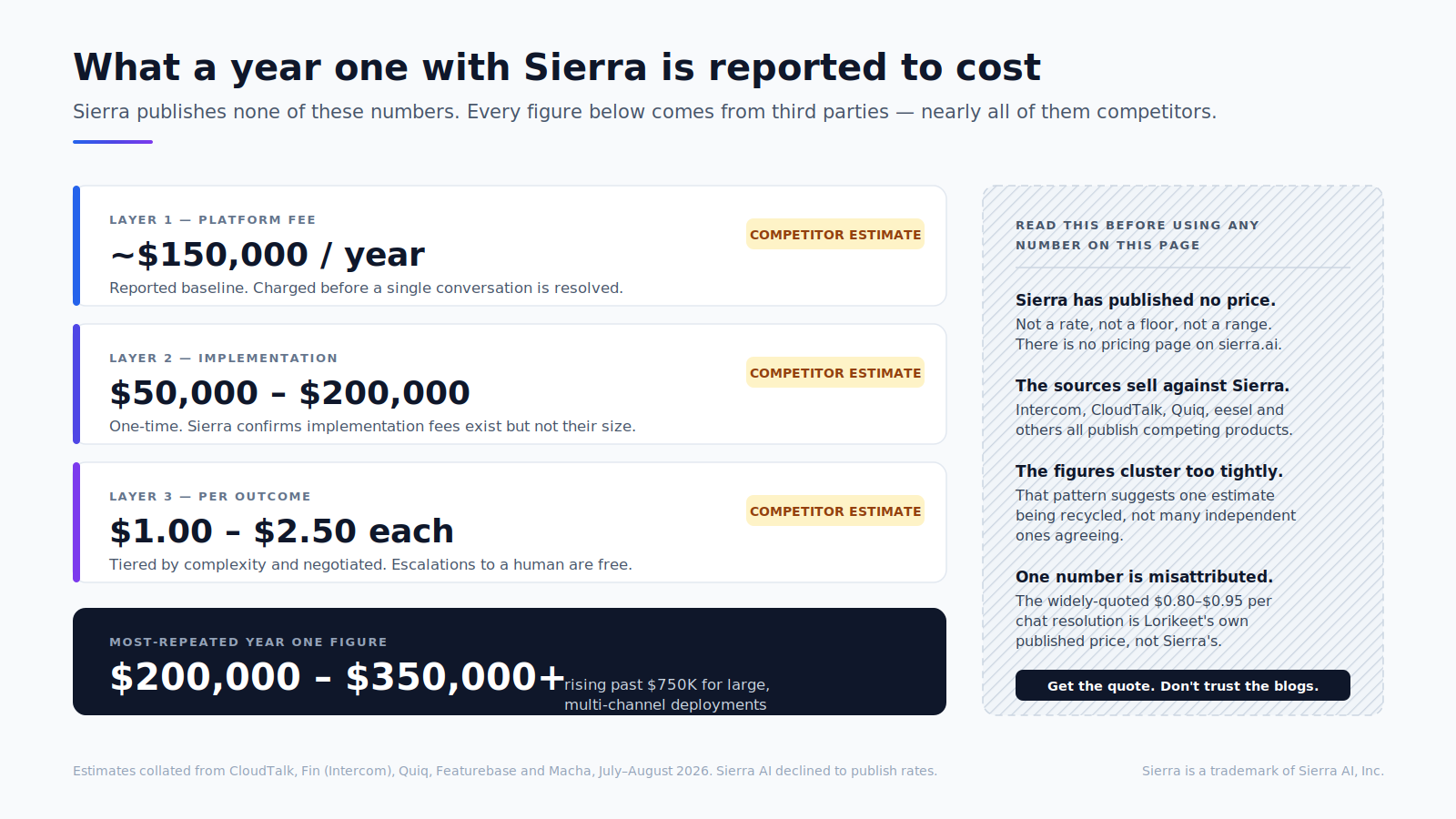
Read the caveat before the numbers. Every source below sells a competing product. CloudTalk, Fin (Intercom), Quiq, eesel, Featurebase and Macha are all vendors in this category, and so are we. The figures cluster unusually tightly, which is more consistent with one estimate being recycled than with several independent verifications.
Not one of the rows below carries a named publisher, a stated methodology or a read date — which is exactly what the provenance column says, row by row. We have deliberately not linked them either. Each row is a competitor's guess at a rival's price, published without methodology; linking would lend those pages authority we do not think they have earned and would pass them traffic on the strength of a number none of them can support. The rows are here because the figures are what a buyer will meet when they search — labelled as estimates so they can be discounted, not cited as evidence. Sierra publishes no rate card; the only reliable number is the one it quotes you.
| Component | Reported figure | Provenance |
|---|---|---|
| Platform fee | ~$150,000 / year | Competitor estimate — no named publisher, no methodology, no date |
| Implementation | $50,000 – $200,000 one-time | Competitor estimate — no named publisher, no methodology, no date |
| Per outcome | ~$1.00 – $2.50, tiered by complexity | Competitor estimate — no named publisher, no methodology, no date |
| Year one all-in | $200,000 – $350,000+ | Competitor estimate — the most repeated, and still unattributed |
| Large multi-channel deployments | $750,000 – $1,500,000+ | Competitor estimate — no named publisher, no methodology, no date |
To their credit, two of those sources are candid about the limits of their own math. CloudTalk states outright that "Sierra publishes no rates" and that its figures are "directional math, not quotes." Lorikeet's article, despite ranking for Sierra pricing, publishes no Sierra figures at all — only that "Sierra AI does not publish pricing publicly."
One correction worth knowing. The widely-quoted figures of $0.80–$0.95 per chat resolution and $1.20–$1.50 per voice resolution are Lorikeet's own published prices, not Sierra's. Lorikeet lists them in credits — 0.80–0.95 credits per chat, email or SMS resolution and 1.20–1.50 for voice resolutions up to three minutes — which work out to roughly a dollar per credit. Several aggregator articles have transplanted them onto Sierra. If you see those numbers presented as Sierra's, the article is unreliable.
A worked example
Take a team handling 2,000 support conversations a month, with 60% resolved autonomously — 1,200 outcomes.
At the reported $1.00–$2.50 per outcome, that is $1,200 to $3,000 a month in usage, or $14,400 to $36,000 a year. Add the reported ~$150,000 platform fee and $50,000–$200,000 implementation, and year one lands between roughly $214,000 and $386,000 — against usage that accounts for under 10% of the bill.
That arithmetic is the real story of Sierra's pricing — with the caveat that it is built entirely on estimates Sierra has not confirmed. At enterprise volume the platform fee amortises and outcome pricing becomes the dominant term, which is exactly the scale Sierra sells to. At mid-market volume the fixed costs dominate, and outcome-based pricing stops behaving like outcome-based pricing. If the reported platform fee is real, Sierra's model rewards volume and the break-even sits well above where most mid-market teams operate. Ask for the platform fee, the implementation fee and the outcome tiers as three separate line items, and ask whether there is an annual floor regardless of volume.
Reviews and ratings: what users actually say
Sierra holds 4.4 out of 5 on G2. The review count is inconsistent within G2 itself — the main reviews page showed 88 and the pros-and-cons view showed 95 when both were read on 20 August 2026 — so roughly 90 is the honest number. On Gartner Peer Insights Sierra scores 4.7, but from only 7 ratings, which is too small a sample to draw conclusions from and we would not weight it. We found no Sierra profile on TrustRadius or Capterra.
Roughly 90 reviews against $150M+ in ARR is a thin public footprint. That is typical of enterprise, NDA-heavy sales motions rather than a signal about the product.
What reviewers praise: ease of use, efficiency, integration capability, and — repeatedly — fast implementation and responsive support.
What reviewers criticise, in their own words from G2:
- "It's slow and lags a lot. It's also very difficult to navigate."
- "The main thing I would improve is the initial setup. It takes some time to get the workflows..."
- "One area where Sierra could improve is handling highly complex or context-heavy conversations."
- "lack of pricing transparency — you have to go through a full sales cycle just to get a quote"
Note that the last complaint comes from a paying customer, not a competitor. When users and vendors selling against Sierra independently raise the same objection, it is a real one.
Security and compliance
Sierra's trust and reliability page lists commitments to SOC 2, HIPAA, GDPR, PCI, FedRAMP High, CCPA, CSA STAR, ISO 27001 and ISO 42001. Sierra does not publicly distinguish which of these are third-party certifications from which are internal compliance postures, and it does not specify SOC 2 Type I versus Type II. Certificates sit behind its trust centre. If you are in a regulated industry, get the actual reports.
The most concrete and checkable claim is PCI: Sierra states it holds PCI DSS Level 1 Service Provider certification, the most stringent level, with payment data flowing through dedicated certified infrastructure.
Two gaps are worth raising in procurement. Sierra's public language says customer data is "only used as you instruct" and "never shared with other customers" — that is a data-sharing statement, not a no-training-on-your-data guarantee, and we found no explicit training commitment on its public materials. And we could not confirm data residency options on any Sierra-controlled page.
Pros and cons
Pros
- Genuinely strong voice, including outbound calling, persona control and simulation-based testing — the most complete voice story in this category.
- Serious evaluation tooling: simulations, regression test suites, and automated monitors that score coherence, grounding and sentiment on every conversation.
- Outcome-based pricing that does not charge for escalations, which aligns the vendor's incentive with resolution rather than volume.
- Deep enterprise proof at a scale few competitors can match, with named customers across banking, healthcare, telco and retail.
Cons
- No published pricing of any kind, and no trial. Evaluating Sierra requires a full sales cycle before you know whether it fits your budget.
- Six-figure year-one cost structure, per third-party reports, puts it out of range for SMB and much of mid-market.
- Reported difficulty with "highly complex or context-heavy conversations," raised independently by multiple G2 reviewers.
- Integration list is unpublished and documentation is login-gated, so you cannot verify support for your stack before talking to sales.
- It is an additional platform, not a layer inside your helpdesk — a second console for your team and an additive cost.
Who Sierra AI is for, and who it isn't
Sierra is a strong fit if: you are an enterprise with a dedicated AI program budget and an executive sponsor; voice is a primary channel; you need agents that complete multi-step transactions against systems of record; you operate in a regulated industry where PCI-certified payment handling matters; and you have the patience for a guided implementation run largely by Sierra's team — Sierra's own published go-lives run seven to ten weeks, on hand-picked examples.
Sierra is a poor fit if: you need a price before a sales cycle; you need to change agent behaviour yourself, today, without filing a request; you want to try before you buy; or your operational constraint is keeping your team in one system rather than adding a second. On budget we will not draw the line for you: Sierra publishes no price, and the six-figure numbers in circulation are competitor estimates (above), not Sierra's — size it from a quote, not from this page.
Sierra AI alternatives and competitors
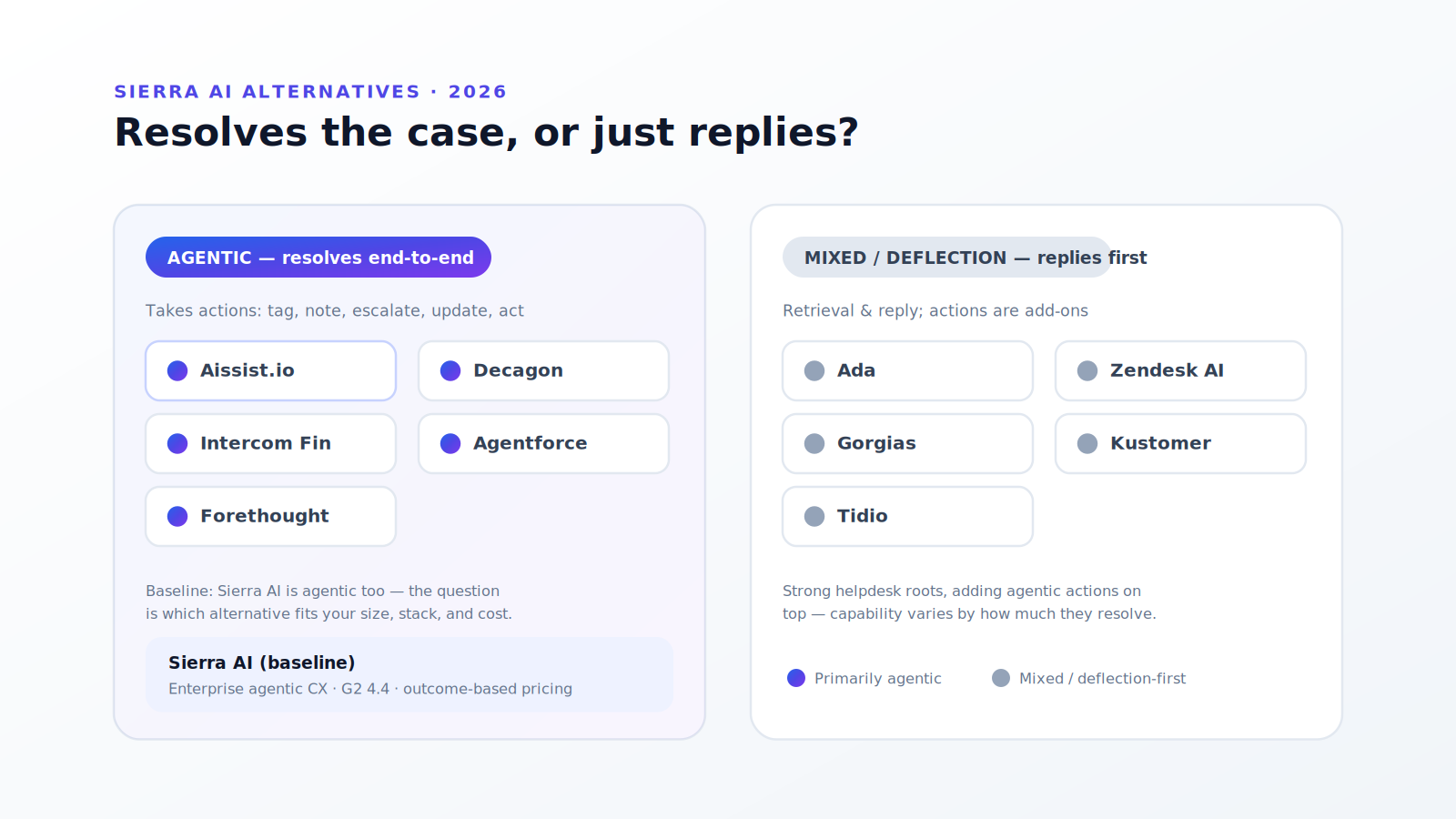
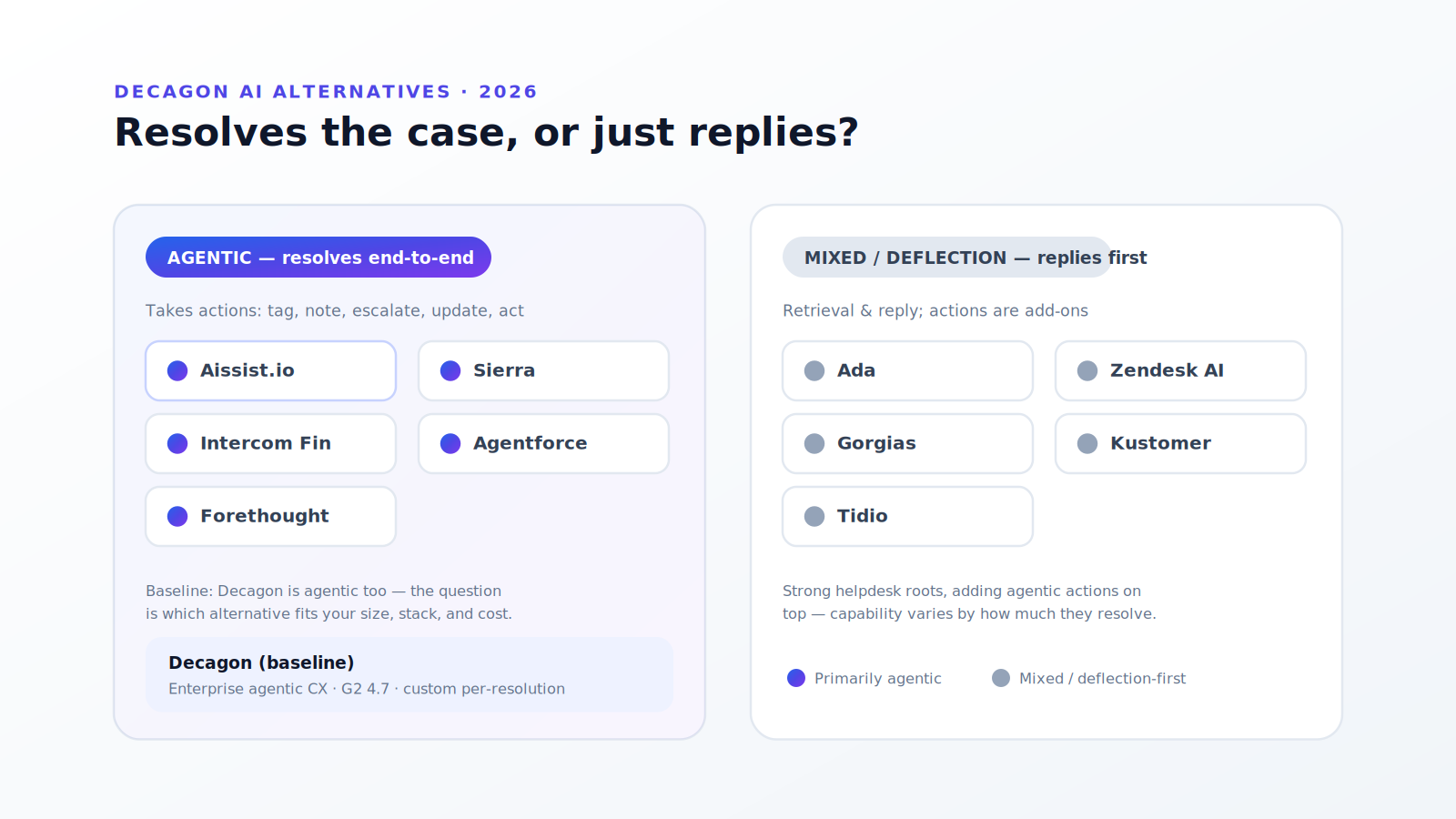
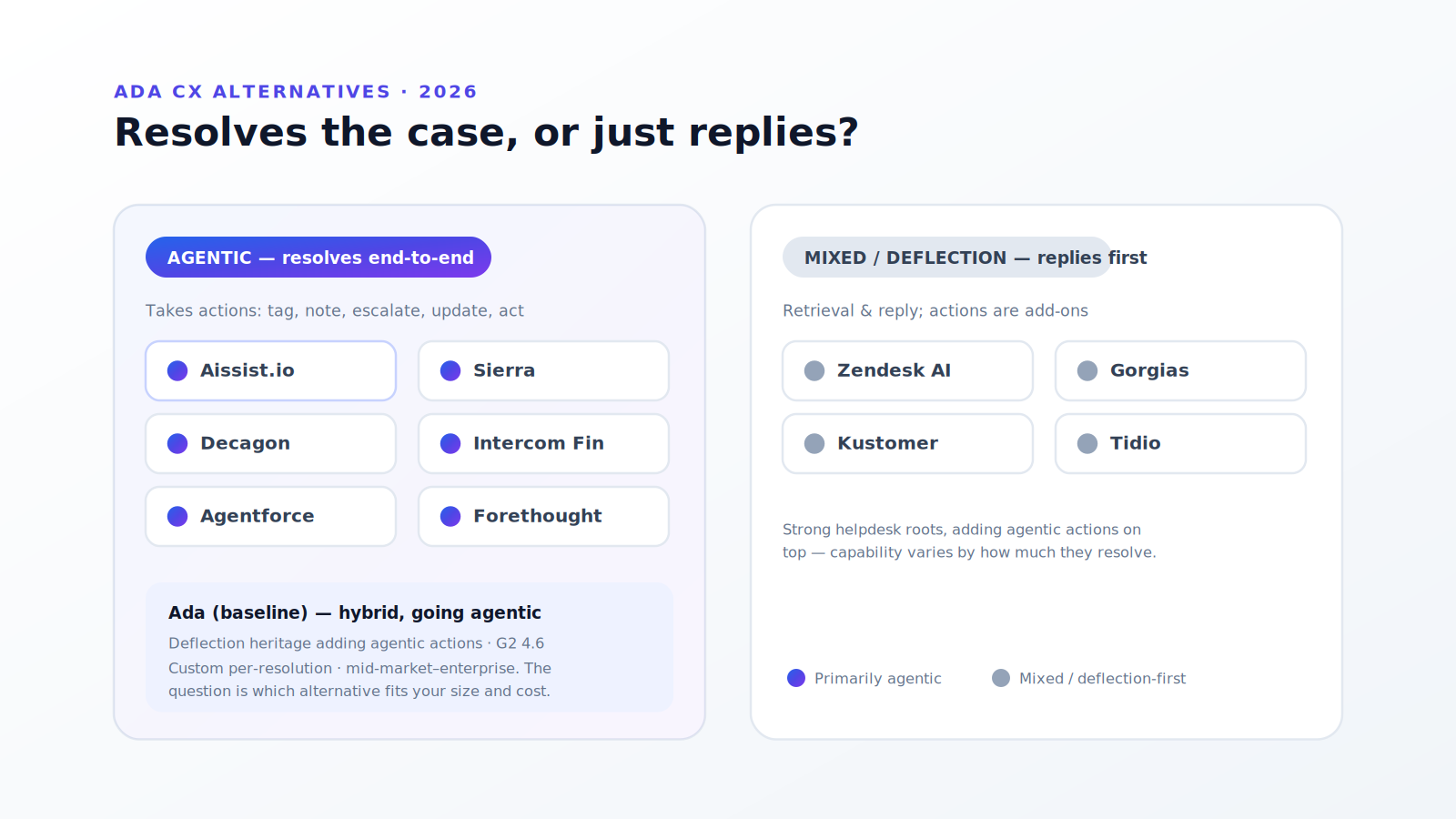
The table below covers the platforms most often evaluated against Sierra. It is organised by architecture rather than ranked, because the deployment model is the decision that actually narrows the list. All figures read 20 August 2026.
| Platform | Architecture | Deployment | Published price | G2 (20 Aug 2026) |
|---|---|---|---|---|
| Sierra | Agentic | Standalone layer | Not published | 4.4 (~90) |
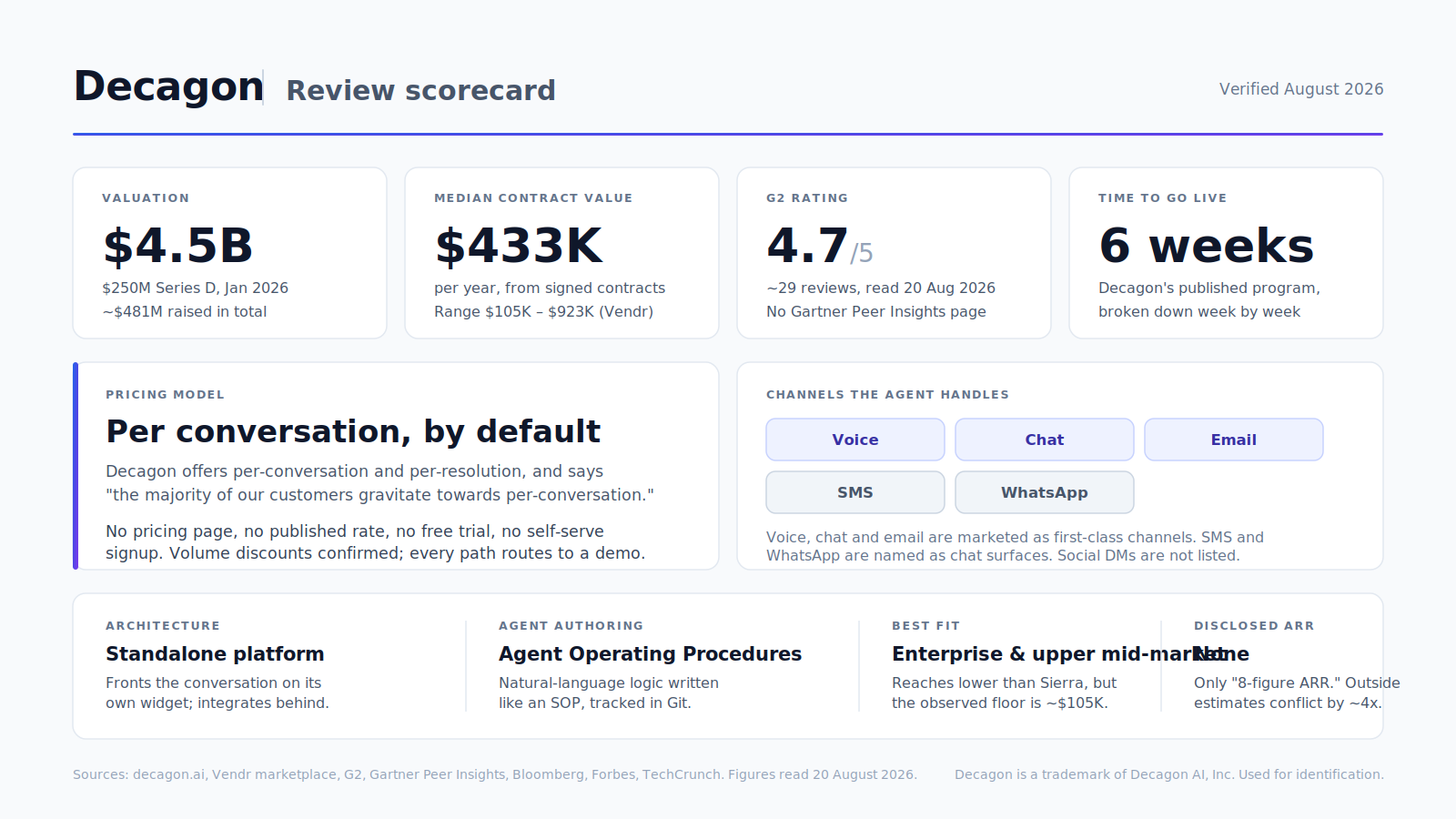
| Decagon | Agentic | Standalone layer | Not published | 4.7 (28) |
| Ada | Generative, multi-LLM | Standalone layer | Not published | 4.6 (173) |
| Gladly | Generative + agentic | Own helpdesk; AI also runs on Zendesk | Not published | 4.7 (1,115) |
| Intercom Fin | Generative + agentic | Layers onto existing helpdesk | From $0.99 per Fin outcome | 4.5 |
| Lorikeet | Agentic, workflow-driven | Layers onto existing helpdesk | 0.80–0.95 credits per chat resolution | No rating displayed |
| Aissist.io | Agentic multi-agent | Layers onto existing helpdesk | $0.20–$0.60 per resolution by channel | 4.9 (45) |
| Zendesk AI | Hybrid | Native — requires Zendesk | Per resolution, rate not published | 4.3 (7,044) |
| Salesforce Agentforce | Agentic | Native — requires Salesforce | $2.00 per conversation | 4.3 (1,202) |
Five notes on this table:
Published prices are not comparable to unpublished ones. Intercom Fin starts at $0.99 per Fin outcome, Aissist.io runs $0.20–$0.60 per resolution depending on channel, Salesforce Agentforce charges $2.00 per conversation whether or not anything was resolved, and Lorikeet publishes credit rates. Sierra, Decagon, Ada and Gladly publish nothing, and Zendesk bills per automated resolution without publishing the rate. Because Sierra's per-outcome rate is negotiated and confidential, no honest direct price comparison against Sierra is possible — and Sierra does not charge for escalations, which most per-resolution models do not match.
Forethought is no longer independent. Zendesk announced its acquisition on 11 March 2026 and completed it on 26 March 2026. It now ships as Forethought AI Agents by Zendesk. If you are reading a comparison that still lists Forethought as a standalone vendor, it is out of date. We cover what that means for buyers in Zendesk AI alternatives after the Forethought acquisition.
Decagon and Ada are the closest structural comparables to Sierra — standalone, enterprise, sales-gated, no published pricing. If Sierra's shape is right but the relationship isn't, start with our Decagon alternatives and Ada alternatives guides.
Aissist.io is not a like-for-like Sierra replacement, and we would rather say so. We serve a different buyer. Sierra is built for the Fortune 500 voice deployment with a program team behind it. Aissist.io is an agentic layer that runs inside the helpdesk you already have — Intercom, Zendesk, Front, Gorgias and HubSpot today, with Salesforce, Freshdesk and Kustomer announced — at $0.20–$0.60 per resolution depending on channel, with no contract and a free tier.
Our honest limitations against Sierra: 42 G2 reviews against Sierra's ~90, no Gartner Peer Insights presence, SOC 2 aligned rather than certified, no HIPAA or PCI certification, no published enterprise case study, and voice handled as message input rather than telephony. If your evaluation hinges on outbound calling, PCI-certified payment handling or a federal compliance posture, Sierra is the better tool and we would tell you that on a call.
How to choose between Sierra and the alternatives
- If voice is your primary channel and you have enterprise budget, choose Sierra — its voice stack, including outbound, personas and simulation testing, is the most developed in this comparison.
- If you need a price before a sales cycle, rule out Sierra, Decagon, Ada and Gladly — none publishes one. That leaves Intercom Fin, Aissist.io, Lorikeet and Salesforce Agentforce.
- If you already run Zendesk or Salesforce and are happy there, evaluate their native AI first — you avoid a second platform entirely, though you accept whatever resolution quality the incumbent ships.
- If your constraint is operational simplicity, choose an embedded layer over a standalone platform — Aissist.io, Intercom Fin or Lorikeet — because your team keeps one console and one workflow.
- If you are in fintech or healthtech with strict compliance requirements, shortlist Lorikeet and Ada alongside Sierra — all three carry HIPAA claims that lighter-weight vendors do not.
- If your monthly volume is low, get the platform fee and the implementation fee in writing before you shortlist a sales-gated vendor — where such fees exist they dominate a small bill, and outcome pricing will not save you. Sierra, Decagon, Ada and Gladly publish neither, so this is not something you can check without a quote.
- If you cannot verify a vendor's connector for your helpdesk on their public site, make the connector a contractual condition, not a discovery-call assurance. This applies to Sierra specifically, whose integration list is unpublished.
Frequently asked questions
What is Sierra AI?
Sierra AI is a conversational AI platform that builds autonomous agents for customer service across voice, chat, email and messaging. Founded in 2023 by Bret Taylor and Clay Bavor and launched in February 2024, it connects agents to a company's systems of record so they can complete tasks, not just answer questions. It runs alongside your helpdesk rather than inside it.
How much does Sierra AI cost?
Sierra does not publish pricing — there is no pricing page, rate card or free trial. It uses outcome-based pricing, charging only when an agent completes a task, with escalations to a human free. Third-party sources, nearly all competitors, report roughly $1.00–$2.50 per outcome plus a ~$150,000 annual platform fee and $50,000–$200,000 implementation. Sierra confirms none of these figures.
Is Sierra AI worth it?
For large enterprises with voice-heavy support and a dedicated program budget, Sierra's capability and enterprise proof justify the investment — it held 4.4/5 on G2 in August 2026 and reports serving over 40% of the Fortune 50. For SMB and most mid-market teams, the reported six-figure year-one floor means fixed costs dominate the bill, and a lower-commitment platform will deliver better economics.
Who owns Sierra AI?
Sierra AI is a private company owned by its founders, employees and investors. It has not been acquired. Bret Taylor and Clay Bavor founded it in 2023, and investors include Tiger Global, GV, Greenoaks Capital, Sequoia, Benchmark, ICONIQ and Thrive Capital. Its May 2026 round raised $950 million at a valuation Sierra describes as over $15 billion.
Does Sierra AI replace my helpdesk?
No. Sierra is an agent layer that runs alongside your existing helpdesk and connects to it through integrations. You keep paying for Zendesk, Salesforce or your contact-centre platform, and Sierra is an additional cost on top. Sierra advertises 40+ pre-built integrations but does not publish which systems they cover.
What are the best Sierra AI alternatives in 2026?
Decagon and Ada are the closest structural comparables — standalone enterprise platforms with sales-gated pricing. For teams that want the agent inside their existing helpdesk, Intercom Fin, Aissist.io and Lorikeet are the main options, and all three publish rates. If you already run Zendesk or Salesforce, their native AI removes the need for a second platform.
Can Sierra AI handle phone calls?
Yes. Sierra supports inbound and outbound voice calls, and voice became its largest channel within months of launching in October 2024. Its August 2026 Voice Personas feature configures pacing, interruption handling and voice or language switching separately from agent logic, across the 55 to 59 languages Sierra advertises. Sierra also ships Voice Sims for testing voice agents before deployment.
How long does it take to implement Sierra AI?
Sierra publicly cites go-lives of under 10 weeks for Singtel Group and seven weeks for an unnamed healthcare customer — both hand-picked examples. Third parties report typical deployments of four to ten weeks, with complex multi-channel, multi-market builds running several months. Sierra's own team does most of the build.
Is Sierra AI secure and compliant?
Sierra lists commitments to SOC 2, HIPAA, GDPR, PCI, FedRAMP High, CCPA, CSA STAR, ISO 27001 and ISO 42001, and states it holds PCI DSS Level 1 Service Provider certification. It does not publicly distinguish certifications from internal compliance postures, does not specify SOC 2 type, and publishes no explicit guarantee that it does not train on customer data.
Are Sierra AI's published resolution rates reliable?
Treat them as vendor-reported. Every performance figure we found — Airtable's 80% resolution rate, Rocket Mortgage's 4x conversion lift, the "almost 50 percent" voice improvement — was published by Sierra, not by the customer or an auditor. We found no CSAT figure of any kind. Our AI customer service benchmark puts median tier-1 automation near 41% across published programs, which shows how far vendor claims typically sit above it.
Evaluating Sierra and want a price you can see before a sales call? Aissist.io runs inside the help desk you already have, bills $0.20–$0.60 per resolution on a published rate card, and starts free. See how it works on your stack →
Changelog
- August 2026 — First published. Figures verified 20 August 2026: G2 4.4 (~90 reviews), Gartner Peer Insights 4.7 (7 ratings), $950M Series E at ~$15.8B, Voice Personas launch, Forethought's acquisition by Zendesk reflected in the alternatives table.