AISSIST is awarded Best Agentic AI for Business from CIOReview.
AissistAissist
Back to Insights
Buyer Guide·Agentic AI·Customer Support·Comparison

Decagon AI Review 2026: Pricing, Features & Alternatives

An independent Decagon AI review for 2026 — what the platform does, what buyers actually pay per year according to signed-contract data, and the alternatives that fit each team.

Alex G. · Aug 20, 2026 · 24 min read

Decagon AI Review (2026): What It Really Costs and Who It's For

Decagon is an enterprise AI customer service platform, founded in 2023 by Jesse Zhang and Ashwin Sreenivas, that runs autonomous agents across voice, chat and email and was valued at $4.5 billion in January 2026. It rates 4.7 on G2, publishes no pricing, and — unusually for this category — there is real signed-contract data showing what customers actually pay: a median of $432,750 a year. This review covers what Decagon does, what it costs, where its evidence is thin, and how it compares to Sierra. If you have already decided Decagon is not the fit, go straight to our Decagon AI alternatives guide.

TL;DR:

  • What it is: A standalone AI agent platform that fronts your customer conversations on its own chat widget and voice stack, then integrates with your helpdesk behind it.
  • Best for: Enterprise and upper mid-market teams with high conversation volume and a dedicated internal owner for the agent.
  • Strongest capability: Agent Operating Procedures — agent logic written in plain English like an SOP, version-controlled in Git.
  • What it actually costs: Median $432,750 a year across signed contracts, ranging $105,000 to $923,183.
  • Biggest friction: No published pricing, no trial and no self-serve — every evaluation starts with a demo request.
  • Not for: SMB, low-volume teams, anyone on Freshdesk, Gorgias or Front, or anyone who needs to buy without a sales cycle.
  • Rating: 4.7/5 on G2 across roughly 29 reviews, read 20 August 2026.

Unlike most vendors in this category, Decagon does not hide behind pricing vagueness — it publishes a detailed argument for how it prices, and there is procurement data showing where contracts actually land. That makes this one of the few AI agent platforms you can budget for before the first call.

Decagon AI review scorecard showing valuation, median contract value, G2 rating, pricing model, channels and time to go live

Reviewed by Lifan Xu, Co-founder (PhD, AI). Disclosure: this review is published by Aissist.io, which sells an agentic AI layer that competes with Decagon. Ratings, prices and quotes come from Decagon's own pages, Vendr, G2, Gartner Peer Insights and named press, all captured in August 2026.

How we evaluated Decagon, and who wrote this

We build a competing product. Aissist.io sells an agentic AI layer for customer service, so we are not neutral and you should not read us as neutral. What we offer instead is a review where every claim is sourced, every estimate is labelled as an estimate, and every gap is marked as a gap.

Three rules governed this piece:

  1. Decagon's own materials outrank everything. Where decagon.ai says something, we quote it and link it.
  2. Competitor claims about Decagon are labelled as competitor claims — including ours, and including the pricing estimates below.
  3. Where we could not verify something, we say so instead of filling the gap with a plausible number.

We evaluated Decagon on six criteria: architecture and where it sits in your stack, who can actually build and change the agent, channel and action capability, pricing transparency and real contract cost, evidence quality behind its performance claims, and reliability. All figures were read on 20 August 2026.

Decagon AI at a glance

What it isStandalone AI agent platform for customer service
FoundedAugust 2023
FoundersJesse Zhang (CEO, previously founded Lowkey, acquired by Niantic) and Ashwin Sreenivas (previously founded Helia, acquired by Scale AI; ex-Palantir)
Funding$250M Series D in January 2026 co-led by Coatue and Index Ventures, at $4.5B. Roughly $481M raised in total, per Sacra
RevenueNot published on a recurring basis. Forbes reported a claim of $30M+ annualised during 2025
ArchitectureStandalone platform — fronts the conversation, integrates with your helpdesk behind it
ChannelsVoice, chat and email as first-class channels; SMS and WhatsApp as chat surfaces
Languages70+, stated on the voice product page
PricingPer conversation by default, per resolution offered. No published rate, no trial, no self-serve
Observed costMedian $432,750/year; range $105,000–$923,183
G24.7/5, ~29 reviews (read 20 Aug 2026)
Gartner Peer InsightsNot listed in either relevant market
Best fitEnterprise and upper mid-market, high conversation volume

What is Decagon AI?

Decagon AI is a conversational AI platform that builds autonomous customer service agents for voice, chat and email, connects them to a company's systems of record so they can complete tasks, and lets customer experience teams define agent behaviour in plain English. Its own positioning line is "The AI concierge for every customer," and "concierge" is the load-bearing word across all its materials — the pitch is quality of experience, not just deflection.

The company was founded in August 2023 by Jesse Zhang and Ashwin Sreenivas, who met at an investor founder retreat that year. Zhang previously founded Lowkey, a gaming clip-sharing app acquired by Niantic in 2021. Sreenivas co-founded Helia, a computer-vision company acquired by Scale AI in 2020, after a stint as a deployment strategist at Palantir.

Funding has escalated quickly: $650 million valuation in October 2024, $1.5 billion in June 2025, then $250 million in January 2026 at $4.5 billion, co-led by Coatue Management and Index Ventures. Forbes headlined it "Decagon Triples Valuation To $4.5 Billion." A secondary share sale in March 2026 priced at the same $4.5 billion, and no newer round has surfaced as of August 2026. Sacra puts total capital raised at roughly $481 million; other trackers break the earlier rounds down differently.

On revenue, be sceptical of anything you read. Decagon does not publish an ARR figure on a recurring basis. TechCrunch reported that ARR "surpassed eight figures" in late 2024, and Forbes reported the company claiming $10 million annualised in 2024 and having "crossed at least $30 million in annualized revenue" during 2025. Outside estimates for the same period diverge sharply: Forbes put Decagon on track for roughly $12 million by end-2025, while Sacra estimates $44 million at end-2025 rising to about $100 million annualised by July 2026. Those last two are estimates, not disclosures, and they differ by nearly 4x for the same period. Treat any confident Decagon revenue number with suspicion.

Named customers include Deutsche Telekom, American Airlines, Snap, Chime, Duolingo, ClassPass, Ticketmaster, Hunter Douglas, Rippling, Oura, Noom and Curology, alongside Block properties Square and Cash App. Decagon's Series D post says "more than 100 new global enterprise customers, like Avis Budget Group, Block, and Deutsche Telekom, joined the Decagon family" in the preceding fiscal year.

Architecture: where Decagon sits in your stack

Decagon is a standalone platform, not something that runs inside your helpdesk. It fronts the customer conversation on its own surfaces — its hosted chat widget, its voice stack, its email handling — and integrates with your helpdesk and CRM behind it for data, actions, ticketing and escalation.

Three pieces of evidence make this unambiguous. Decagon's developer documentation has a section titled "Adding Decagon to your website," meaning Decagon ships a widget you install. Its own status page logs a "Chat widget display issue" as an incident, and a company cannot have outages in a widget it does not operate. And its integrations page describes the direction of travel plainly: integrations "connect your AI agent to the systems your team already relies on."

The practical consequence is the same as with Sierra: your helpdesk becomes the system of record and the human destination, not the runtime. Decagon is additive to your stack, not a replacement for it, and it does not remove your helpdesk bill.

One component does live inside a helpdesk — Decagon Assist, the copilot for human agents. A G2 reviewer complained in January 2025 that it was "only currently available for Zendesk" and asked for "a more universal version." Whether that restriction still holds in August 2026 is unclear; Decagon does not state it either way. Worth asking directly if agent-assist matters to you.

Integrations

Decagon publishes a short, category-led integration list rather than a full directory: Salesforce, Zendesk, Zendesk Sunshine and Intercom for helpdesk and CRM; Confluence, Contentful and Kustomer for knowledge; Amazon Connect and RingCentral for contact centre.

That list is enterprise-weighted and notably light on mid-market and e-commerce stacks. Freshdesk, Gorgias, Front, ServiceNow and Shopify are not named among the published integrations. The page says it supports systems "such as Salesforce, Intercom, Zendesk, and more," and Decagon clearly does custom API work — so absence from the list is not evidence of non-support. But if one of those is your system of record, treat the connector as something to confirm contractually rather than assume.

Agent Operating Procedures: who actually builds the agent

This is Decagon's sharpest idea and its most contested claim.

Agent Operating Procedures (AOPs) let teams "define agent behavior in natural language, the same way you train human agents with SOPs." Decagon says it pioneered the approach to give teams ownership over building agents without "complex SDKs or costly professional services." CX teams write the logic; engineering keeps control through Git-based version tracking. Duet, Decagon's agent-building assistant, auto-generates AOPs from past conversations, detects gaps in guardrails and entry criteria, and traces failures.

Note what that positioning is aimed at. Attacking "costly professional services" by name is a direct shot at the forward-deployed-engineer model that Sierra runs. It is a real philosophical difference, and it is worth testing in a reference call rather than taking on faith.

Because the reviews tell a more textured story. Users consistently praise Decagon's team — "exceptional support" is the single most-cited positive theme on G2 — but several describe a dependency:

  • "need to have a dedicated person on your team to manage the bot" — Director, Customer Experience, Mid-Market, January 2025
  • "lacks some self-serve customizability (ex. Deflection flows, APIs)" — IT, Mid-Market, August 2024
  • "the Decagon team walked us through" the Zendesk integration — E-Learning, Mid-Market, February 2025

The honest reading: self-serve in the product, high-touch in the engagement. Decagon does not advertise a professional services organisation, and reviewers rate its support extremely highly — this is as much a strength as a dependency. But budget for an internal owner. Nearly every reviewer who mentions staffing says you need one.

What Decagon's agents can do

Channels and languages

Decagon markets three first-class channels — voice, chat and email — and names SMS and WhatsApp as chat surfaces on its chat product page. Social DMs are not listed anywhere, so do not assume Facebook or Instagram coverage.

Language support is stated as "70+ languages with automatic detection and language switching" — but that figure appears on the voice product page specifically. We could not find a platform-wide language count for chat and email. Ask for the number that applies to your actual channel mix.

Actions

Decagon's agents complete tasks rather than only answering, and the company is unusually specific about which ones. From its own capabilities post: "Processing refunds and returns: Initiating a refund, calculating the correct amount, and generating a return shipping label"; "Subscription management: Upgrading, downgrading, or canceling a customer's subscription plan"; "Updating account details"; and appointment scheduling. Agents make authenticated API calls to create and update records and trigger workflows.

Chime's deployment is a concrete example: card replacement, deposit status updates and SMS subscription management, running across chat and voice.

Knowledge and how it stays current

Decagon's freshness mechanism is Suggestions, which detects "the areas where your AI agent falls short" from real conversations and drafts new knowledge content, drawing on "real-world resolutions from your human agents." Drafts require human approval before going live.

One detail worth knowing: the cadence is explicitly monthly — "Access new suggestions every month." That is a review cycle, not continuous learning. A G2 reviewer separately named "scheduled source sync" as a missing feature in January 2025.

Testing, guardrails and reliability

The tooling is genuinely strong

Decagon's evaluation stack is among the more developed in this category. Simulations validate agent behaviour before production with "scalable tests, granular checkpoints, and holistic evaluation," support scheduled recurring runs, and integrate with CI/CD to "test every agent version." Experiments A/B test agent versions against real conversations. Watchtower provides "always-on" 24/7 conversation monitoring and QA. Agent Workbench handles debugging.

For runtime safety, Decagon's engineering team published a layered guardrail design covering bad-actor detection, policy-defined escalation boundaries, brand voice enforcement, and — most specifically — response supervision, where a supervisor model performs hallucination checks and, when a response is "not properly grounded in the provided model context," can "revise the response or trigger an escalation path."

The reliability record, in context

Decagon publishes a public status page, which is voluntary transparency that most competitors in this category — including us — do not offer. Read what follows with that in mind: you are seeing Decagon's incidents because Decagon chose to show them.

The page's history begins on 2 June 2026 and logs 14 incidents through 20 August 2026. Most were short:

  • 2 June 2026 — a "Major service disruption" with elevated errors affecting conversations on all channels, 1 hour 19 minutes
  • 24 July 2026 — "Increase in Tool Failures," 22 minutes
  • 10–11 August 2026 — an issue with certain voice conversations, roughly 3 hours 21 minutes — the longest in the window
  • 19 and 20 August 2026 — degraded Salesforce integration performance, then instability affecting incoming calls

All 14 are marked resolved, and several are minor — a versioning tool dropping into read-only mode, a widget display glitch. Eleven weeks is not an annual rate, so do not extrapolate one.

The pattern worth asking about is not the count but the concentration: two of the three most recent incidents hit voice, the channel Decagon has been pushing hardest and added most recently. For an always-on customer-facing agent that is worth a question, not an alarm. Ask any vendor in this category — us included — for trailing twelve-month uptime and an SLA with credits attached, and treat a vendor that cannot produce one as the higher risk.

Decagon AI pricing: what's published and what buyers actually pay

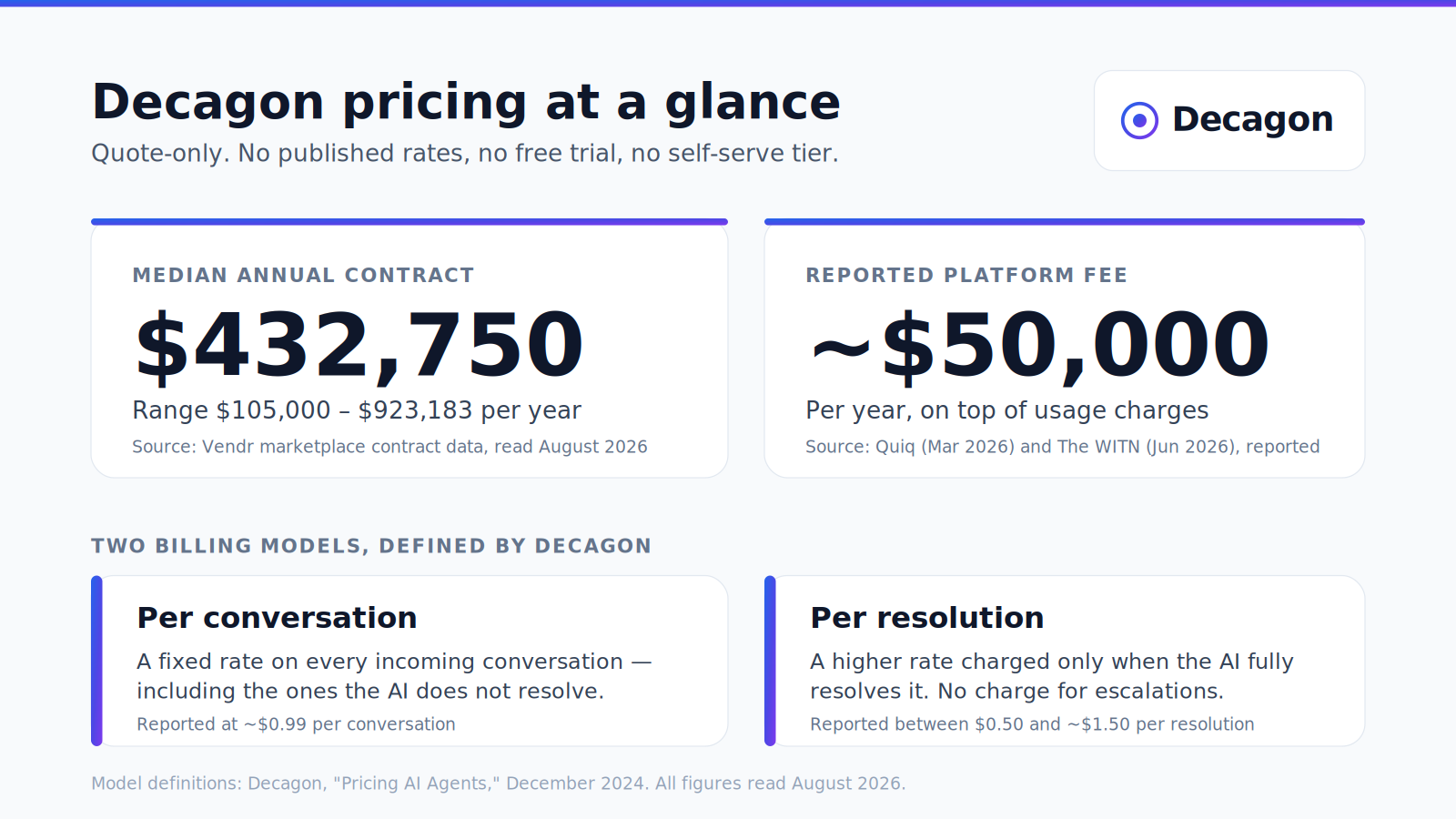
Decagon publishes no price. There is no pricing page — decagon.ai/pricing returns a 404 — no rate card, no free trial, no free tier and no self-serve signup. Every commercial path routes to a demo request. Capterra independently lists its starting price as "Contact vendor" with no trial and no free version.

What Decagon does publish, and this is genuinely more than most competitors offer, is a detailed account of its pricing model. Its pricing post describes two options: per-conversation pricing, "a fixed rate for every incoming conversation, with flexible pricing for higher volumes," and per-resolution pricing, "a higher fixed rate for each fully resolved conversation, with no charge for escalations." And it states plainly which one wins: "Both scale with the agent's work, but we've seen the majority of our customers gravitate towards per-conversation pricing."

Decagon's stated reasoning is that per-conversation costs "scale directly with usage" and let customers "avoid unpredictable invoices and the constant renegotiations often required with outcome-based pricing." Its glossary page on resolution-based pricing goes further, listing that model's weaknesses: definitional ambiguity over what counts as a resolution, month-to-month variance that makes forecasting hard, and vendor bias toward marking issues resolved.

That is a company publicly arguing against the pricing model its closest rival uses. Whether you find it persuasive or convenient depends on your volume — but it is a real, citable position, not marketing fog.

What buyers actually pay

Range chart of Decagon AI annual contract values showing a median of 432,750 dollars from signed contracts, alongside competitor-estimated scenarios by conversation volume

Here is where this review can do something the Sierra equivalent could not. Vendr, a procurement platform whose figures come from contracts its buyers actually signed, publishes Decagon data:

MetricFigure
Median contract value$432,750 per year
Range$105,000 – $923,183
Pricing modelPer-conversation, variable by volume
Payment termsNet 30 and Net 60
Buyer-reported discount"a 30% discount off list price for 1mil+ conversations"

Two caveats you should carry. Vendr does not publish the sample size or date range behind those figures, so this is transaction-derived data of unstated volume. And the numbers have moved: in June 2026 competitors citing Vendr reported a median near $386,000 with a top of range around $590,000. Our 20 August 2026 read shows $432,750 and $923,183 — a median up roughly 12% and a ceiling up roughly 56% in about ten weeks. Either the dataset grew or contracts are getting bigger.

Competitor-published estimates fill in the shape by volume: roughly $74,000–$95,000 a year at 2,000 conversations a month, $120,000–$180,000 at 10,000, $230,000–$270,000 at 15,000, and $525,000–$600,000+ at 50,000. Those come from companies that sell against Decagon, including us — but they sit broadly consistent with Vendr's observed middle, which raises confidence in the overall picture.

A worked example

Take a team handling 10,000 conversations a month — 120,000 a year.

At the competitor-estimated per-conversation rate of roughly $0.99, that is about $118,800 a year in usage, plus a reported platform fee around $50,000, landing near $170,000. That sits inside the estimated $120,000–$180,000 band and well below Vendr's observed median, which tells you the median contract represents materially higher volume than 10,000 a month.

The structural point: because Decagon bills per conversation rather than per resolution, you pay for the conversations the AI does not resolve. At a 70% resolution rate, roughly three in ten paid conversations still reach a human — and you have paid for both. That is the honest trade against outcome-based pricing: better forecasting, but you carry the cost of failure rather than the vendor.

Reviews and ratings

Decagon holds 4.7 out of 5 on G2 across roughly 29 reviews, read 20 August 2026. It does not appear in Gartner Peer Insights' "AI Agents for Customer Service and Support" market, nor in "Digital Customer Service and Support Technologies" — a checkable gap, particularly since Sierra is listed in the first of those. Its Capterra profile exists with zero reviews, and we found no TrustRadius page.

Roughly 29 reviews is thin for a company at a $4.5 billion valuation. It is a genuinely high score on a genuinely small sample, and both halves of that sentence matter.

What reviewers praise, by G2's own theme counts: exceptional support and quick feature deployment (12 mentions), implementation ease (11), AI integration quality (10), and a "skilled, knowledgeable team" (9). The dominant positive is the team, not the technology — worth saying plainly, because it is a real and consistent strength.

What reviewers criticise, in their own words:

  • "lacks maturity in some of its features" and "still building out guardrails" — Senior Technical Program Manager, Enterprise, February 2025
  • "some aspects of the product that are in their primative [sic] stages, such as user roles and audit logs" — Senior Analyst II, Mid-Market, February 2025
  • "may make mistakes or misunderstand unusual customer problems" — Software Engineer, Small-Business, August 2026
  • "takes some time to set up and fine-tune everything properly" — Logistics, Enterprise, July 2026
  • wants "more transparency into why the AI chooses certain actions" — AI Agents Builder, Mid-Market, August 2026
  • "You need to have a dedicated person on your team to manage the bot" — Director, Customer Experience, Mid-Market, January 2025

The governance complaints — roles and audit logs described as "primitive" — date from February 2025 and may well have been fixed since; we found no confirmation either way. The accuracy complaints on unusual or complex questions are more recent and recur across 2026 reviews.

On the performance numbers

Decagon publishes strong customer metrics. Handle them with the right labels:

  • Chime: "70% chat and voice resolution" — Decagon-published, no independent verification.
  • Chime: 60% decrease in support costs — footnoted by Decagon to Chime's 2025 S-1 filing. This is the only metric in the set with SEC-filing provenance, and it is correspondingly the strongest.
  • Duolingo: "80% Chat Deflection" — Decagon-published. Note it is deflection, not resolution; the two are not interchangeable. Decagon adds that Duolingo's prior vendor achieved 30% and had failed to launch chat automation after a year.
  • ClassPass: a "95% decrease in the cost of support conversations" — that is Decagon's own Series C wording, and it means the cost of a support conversation, not total support spend. The bare "95% cost reduction" that appears elsewhere overstates it.

We found no independently audited resolution or deflection figure for Decagon. That is normal in this category and not a criticism unique to them — our AI customer service benchmark puts median tier-1 automation near 41% across published programs, well below the headline numbers vendors typically advertise.

Security and compliance

Decagon's security page displays badges for SOC 2, ISO, HIPAA, PCI, CCPA, GDPR and the EU AI Act. The EU AI Act badge is a genuine differentiator — few competitors display it.

One procurement note: those badges are images, and the certification details — SOC 2 type, ISO standard number, audit dates — live behind Decagon's Trust Center at trust.decagon.ai rather than on the public security page. That is a normal arrangement, not a red flag; just request the actual reports during diligence, as you should from any vendor. Separate California and European DPA annexes exist and are substantive, which is better evidence of real compliance work than badges are.

On training, Decagon is explicit and quotable: "Decagon enforces zero-day retention with all AI providers like OpenAI and Anthropic, ensuring no conversation data is stored or used for training." Note the scope — that statement covers third-party model providers. It does not on its face address whether Decagon trains its own proprietary models on customer conversation data, and Decagon does claim proprietary models. That is a fair question to put to them, not an accusation. Data residency options are not stated publicly.

Decagon vs Sierra

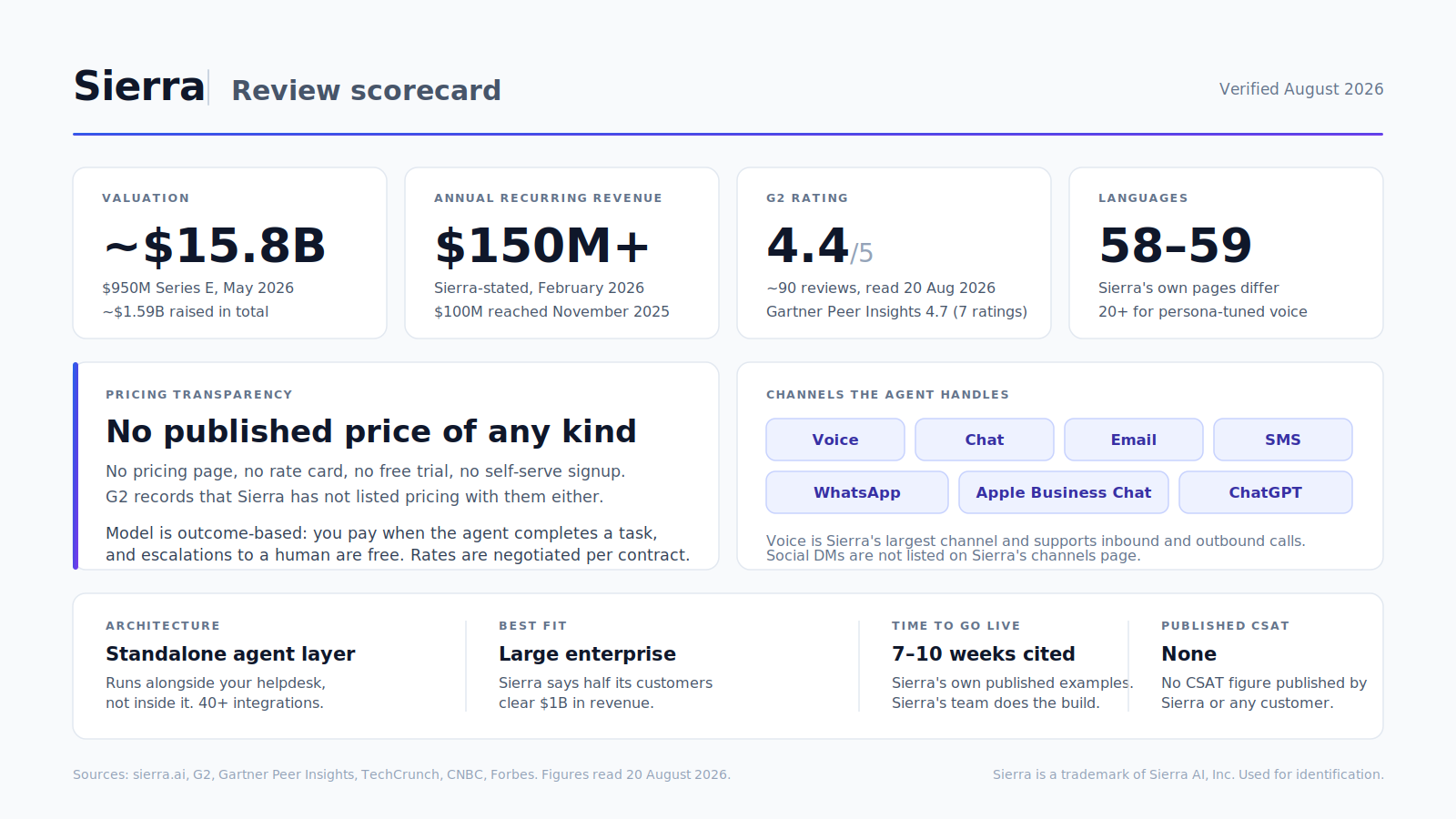
These two get compared constantly, and most comparisons overstate the differences. Both are standalone platforms that front the conversation. Neither publishes a price. Neither offers a trial or self-serve signup. Both cover roughly the same channel surfaces.

Comparison table of Decagon AI and Sierra AI across pricing model, agent authoring, services posture, scale, third-party proof and voice maturity

Six things genuinely separate them:

DecagonSierra
Pricing modelPer conversation by defaultOutcome-based, escalations free
Agent authoringAOPs — natural language, Git-trackedAgent Studio, Ghostwriter, plus an SDK
Services postureMarkets AOPs as avoiding "costly professional services"Runs agent engineers who build alongside customers
Scale$4.5B, no ARR disclosedOver $15B, $150M+ ARR stated
Third-party proofG2 4.7 (~29); not listed by GartnerG2 4.4 (~90); Gartner 4.7 (7 ratings)
VoiceAdded later, growing fast, recent incidentsSierra's largest channel

The pricing contrast is the one that should drive your decision. If your resolution rate will be high and stable, outcome pricing transfers risk to the vendor and Sierra's model is better for you. If your volume is spiky or your content is messy, per-conversation pricing is more forecastable and Decagon's model is better. Decagon has published the argument for its side; read it and decide whether your own numbers support it.

On scale, Sierra is roughly 3.4x the valuation with a disclosed revenue figure and Gartner coverage. On product sentiment, Decagon rates higher on a third of the review volume. Both of those are true at once, and neither settles it. Our full Sierra AI review covers the other side in the same depth, and our architecture comparison goes deeper on how single-agent and multi-agent designs handle complex work.

Pros and cons

Pros

  • Agent Operating Procedures are the best answer in this category to "who owns the agent six months from now" — plain-English logic, Git-tracked, editable by CX rather than engineering.
  • Real published implementation timeline: a six-week program broken down week by week, corroborated by reviewers reporting weeks rather than months.
  • Serious evaluation tooling — simulations with CI/CD integration, live A/B experiments, and 24/7 automated QA through Watchtower.
  • Per-conversation pricing is more forecastable than outcome pricing, and Decagon publishes its reasoning rather than hiding the model.
  • Actual contract data exists, so you can budget before the first sales call.
  • Support quality is the most consistently praised attribute across every review source.

Cons

  • No published pricing, no trial, no self-serve. A six-figure evaluation starts with a demo request.
  • Observed floor of about $105,000 a year puts it out of reach for SMB and much of mid-market.
  • 14 logged incidents between June and August 2026, including a self-labelled major disruption affecting chat and voice, and two recent voice incidents.
  • Published integration list omits Freshdesk, Gorgias, Front, ServiceNow and Shopify.
  • Review base is thin — roughly 29 on G2, and no Gartner Peer Insights listing — for a company at this valuation.
  • Reviewers report needing a dedicated internal owner, and recurring accuracy complaints on unusual or complex questions.
  • You pay for conversations the AI does not resolve.

Who Decagon AI is for, and who it isn't

Decagon is a strong fit if: you handle high conversation volume, ideally above 10,000 a month; you run Salesforce, Zendesk or Intercom; you want your CX team writing agent logic rather than filing engineering tickets; you value forecastable billing over vendor-carried risk; and you can staff a dedicated owner for the agent.

Decagon is a poor fit if: your annual budget for support automation is below six figures; your volume is low enough that a per-conversation model has no leverage; you run Freshdesk, Gorgias or Front; you need a price before a sales cycle; or you need mature role-based access and audit logging today and cannot wait to verify it.

Decagon AI alternatives and competitors

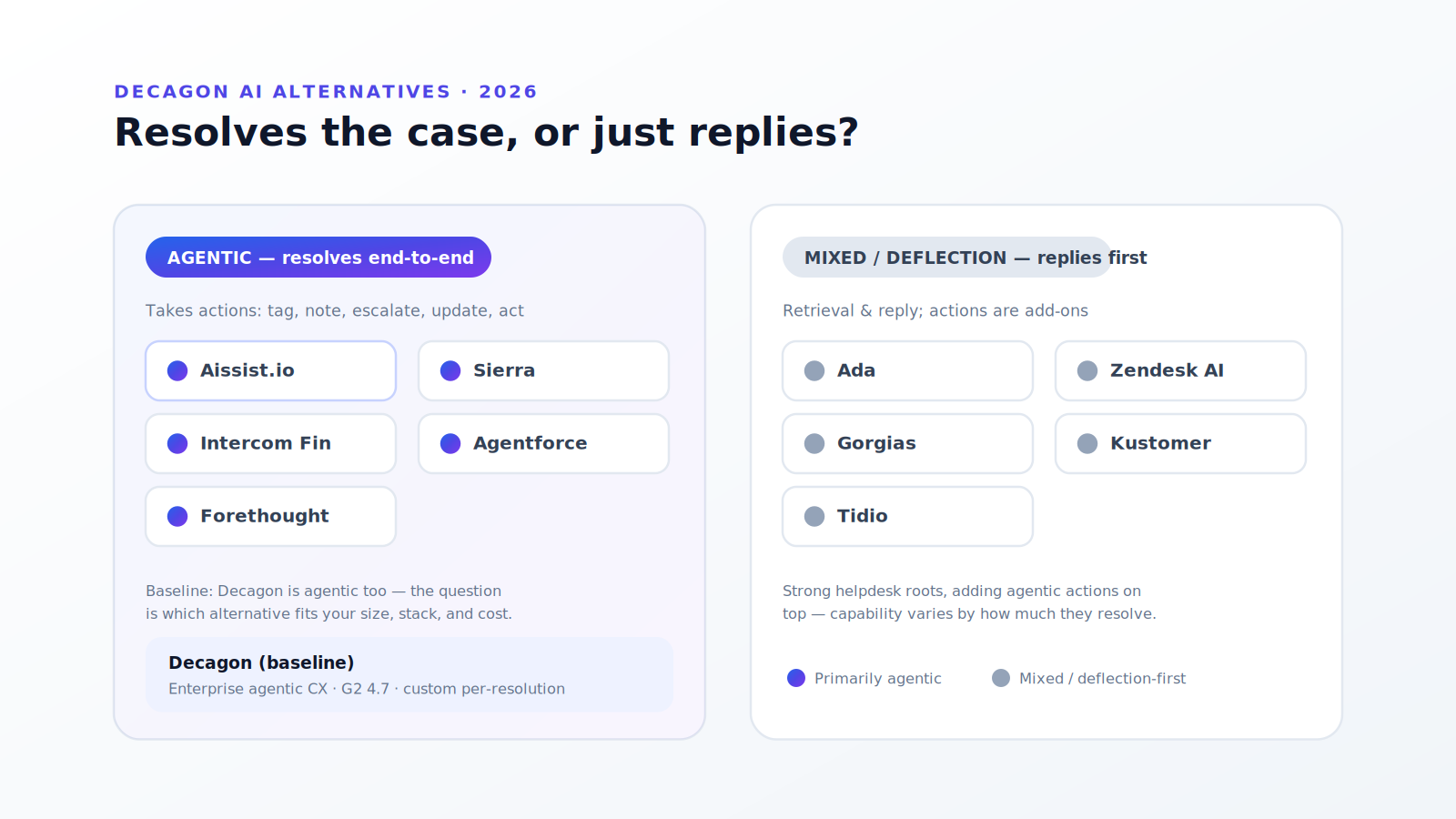
Organised by architecture, because the deployment model narrows the list faster than any feature comparison. All figures read 20 August 2026.

PlatformArchitectureDeploymentPublished priceG2
DecagonAgenticStandalone platformNot published4.7 (~29)
SierraAgenticStandalone platformNot published4.4 (~90)
AdaGenerative, multi-LLMStandalone platformNot published4.6 (173)
GladlyGenerative + agenticOwn helpdesk; AI also runs on ZendeskNot published4.7 (1,115)
Intercom FinGenerative + agenticLayers onto existing helpdeskFrom $0.99 per Fin outcome4.5
LorikeetAgentic, workflow-drivenLayers onto existing helpdesk0.80–0.95 credits per chat resolutionNo rating displayed
Aissist.ioAgentic multi-agentLayers onto existing helpdesk$0.20–$0.60 per resolution by channel4.8 (42)
Zendesk AIHybridNative — requires ZendeskPer resolution, rate not published4.3 (7,044)
Salesforce AgentforceAgenticNative — requires Salesforce$2 USD per conversation4.3 (1,202)

Four notes:

Sierra and Ada are the closest structural comparables — standalone, enterprise, sales-gated, no published pricing. Start with our Sierra AI review and Ada alternatives guides, or the full Decagon alternatives roundup.

Published prices are not comparable to unpublished ones. Because Decagon's per-conversation rate is negotiated and confidential, no honest direct comparison against the published per-resolution vendors is possible — the units differ and so does who carries the risk of a failed conversation.

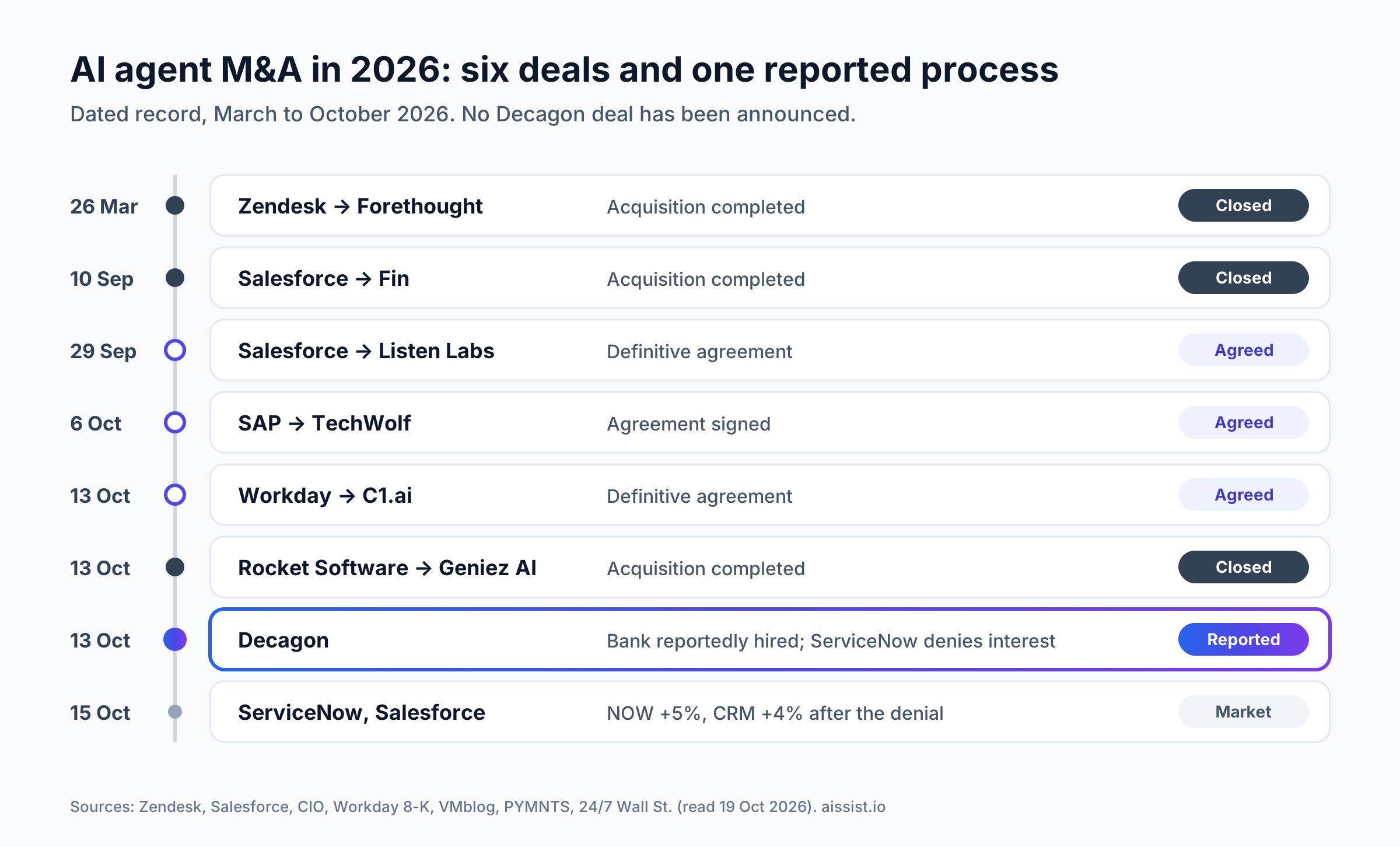
Forethought is gone as a standalone option. Zendesk completed its acquisition in March 2026, so older comparisons listing it as independent are out of date.

Aissist.io is not a like-for-like Decagon replacement, and we would rather say so. Decagon is built for the high-volume enterprise deployment with a program team behind it. Aissist.io is an agentic layer that runs inside the helpdesk you already have — Intercom, Zendesk, Front, Gorgias and HubSpot today, with Salesforce, Freshdesk and Kustomer announced — at $0.20–$0.60 per resolution, with no contract and a free tier. Our honest limitations against Decagon: 42 G2 reviews to their 4.7-rated 29 but no Gartner presence for either of us, SOC 2 aligned rather than certified, no HIPAA or PCI certification, no EU AI Act badge, no published enterprise case study of Chime's scale, and voice handled as message input rather than telephony. If you are running American Airlines' contact centre, Decagon is the better tool and we would tell you that on a call.

How to choose between Decagon and the alternatives

  • If your volume exceeds roughly 10,000 conversations a month and billing predictability matters more than transferring risk, choose Decagon — per-conversation pricing is exactly built for that shape.
  • If your resolution rate will be high and stable, look hard at outcome pricing instead — Sierra and Intercom Fin only charge when the agent succeeds.
  • If you need a price before a sales cycle, rule out Decagon, Sierra, Ada and Gladly — none publishes one.
  • If you run Freshdesk, Gorgias or Front, start elsewhere — those connectors are not on Decagon's published list.
  • If your constraint is operational simplicity, choose an embedded layer over a standalone platform — your team keeps one console and one workflow.
  • If voice is your primary channel today, weight Sierra's maturity against Decagon's recent voice incidents — and ask both for trailing twelve-month uptime.
  • If you cannot staff a dedicated agent owner, discount every platform in the top half of this table — reviewers of all of them report needing one.

Frequently asked questions

What is Decagon AI?

Decagon AI is an enterprise conversational AI platform that builds autonomous customer service agents for voice, chat and email. Founded in August 2023 by Jesse Zhang and Ashwin Sreenivas, it connects agents to a company's systems of record so they can complete tasks like refunds and subscription changes. It runs as a standalone platform alongside your helpdesk rather than inside it.

How much does Decagon AI cost?

Decagon publishes no pricing, but procurement platform Vendr reports a median contract value of $432,750 a year across signed contracts, ranging from $105,000 to $923,183. Decagon bills per conversation by default, with per-resolution offered as an alternative. There is no free trial, no free tier and no self-serve signup — every path routes to a sales demo.

Is Decagon AI worth it?

For enterprises handling more than roughly 10,000 conversations a month, Decagon's agent tooling, six-week implementation and 4.7 G2 rating make a strong case. For SMB and lower mid-market teams, the observed $105,000 contract floor means the economics do not work, and a per-resolution platform with published pricing will deliver better value at lower volume.

What is Decagon AI's valuation?

Decagon was valued at $4.5 billion in January 2026 after a $250 million Series D co-led by Coatue Management and Index Ventures. That tripled its $1.5 billion valuation from June 2025. A secondary share sale in March 2026 priced at the same $4.5 billion. Decagon has raised roughly $481 million in total.

Decagon vs Sierra — which is better?

They are architecturally similar; the real differences are pricing and scale. Decagon bills per conversation and publicly argues outcome pricing is unpredictable; Sierra bills per outcome and does not charge for escalations. Sierra is roughly 3.4x the valuation with $150M+ disclosed ARR and a Gartner listing; Decagon rates higher on G2 but on a third of the review volume.

What are Agent Operating Procedures?

Agent Operating Procedures, or AOPs, are Decagon's method for defining agent behaviour in natural language "the same way you train human agents with SOPs." CX teams write the logic in plain English while engineering retains control through Git-based version tracking. Decagon positions AOPs as an alternative to complex SDKs and professional services engagements.

Does Decagon AI replace my helpdesk?

No. Decagon fronts the customer conversation on its own chat widget and voice stack, then integrates with your helpdesk and CRM behind it for data, actions and escalation. You keep paying for Zendesk, Salesforce or Intercom. Its published integration list does not include Freshdesk, Gorgias, Front, ServiceNow or Shopify.

Is Decagon AI reliable?

Decagon publishes a public status page, which is more transparency than most competitors offer. It logs 14 incidents between June and August 2026, most resolved within an hour; the longest was about 3 hours 21 minutes on voice in August, and a "Major service disruption" on 2 June lasted 1 hour 19 minutes. All are resolved. Ask any vendor for trailing twelve-month uptime.

Is Decagon AI secure and compliant?

Decagon's security page displays badges for SOC 2, ISO, HIPAA, PCI, CCPA, GDPR and the EU AI Act, and it states it enforces zero-day retention with model providers so no conversation data is stored or used for training. Certification details sit behind its Trust Center rather than the public page, so request the actual reports during procurement.

Are Decagon's published resolution rates reliable?

Treat them as vendor-reported. Chime's 70% resolution, Duolingo's 80% deflection and ClassPass's cost reduction were all published by Decagon rather than the customer. One exception is stronger: Chime's 60% support-cost decrease is footnoted to Chime's 2025 S-1 filing. Note that deflection and resolution are different metrics and should not be compared directly.

Evaluating Decagon and want agentic resolution without a six-figure floor? Aissist.io runs inside the help desk you already have, bills $0.20–$0.60 per resolution, and starts free. See how it works on your stack →

Changelog

  • August 2026 — First published. Figures verified 20 August 2026: G2 4.7 (~29 reviews), no Gartner Peer Insights page, $4.5B valuation from the January 2026 Series D, Vendr median contract value $432,750, and 14 status-page incidents logged since June 2026.

Read Next

AG

Alex G.

Sr. Analyst

Alex is senior analyst at Aissist.io. He has 5 years experience on product management and marketing within AI industry.