Decagon pricing explained: what it costs, what drives the bill, and what to negotiate now
By Alex Gomez, Sr. Analyst, Aissist.io · Published 28 August 2026 · Last updated 19 October 2026
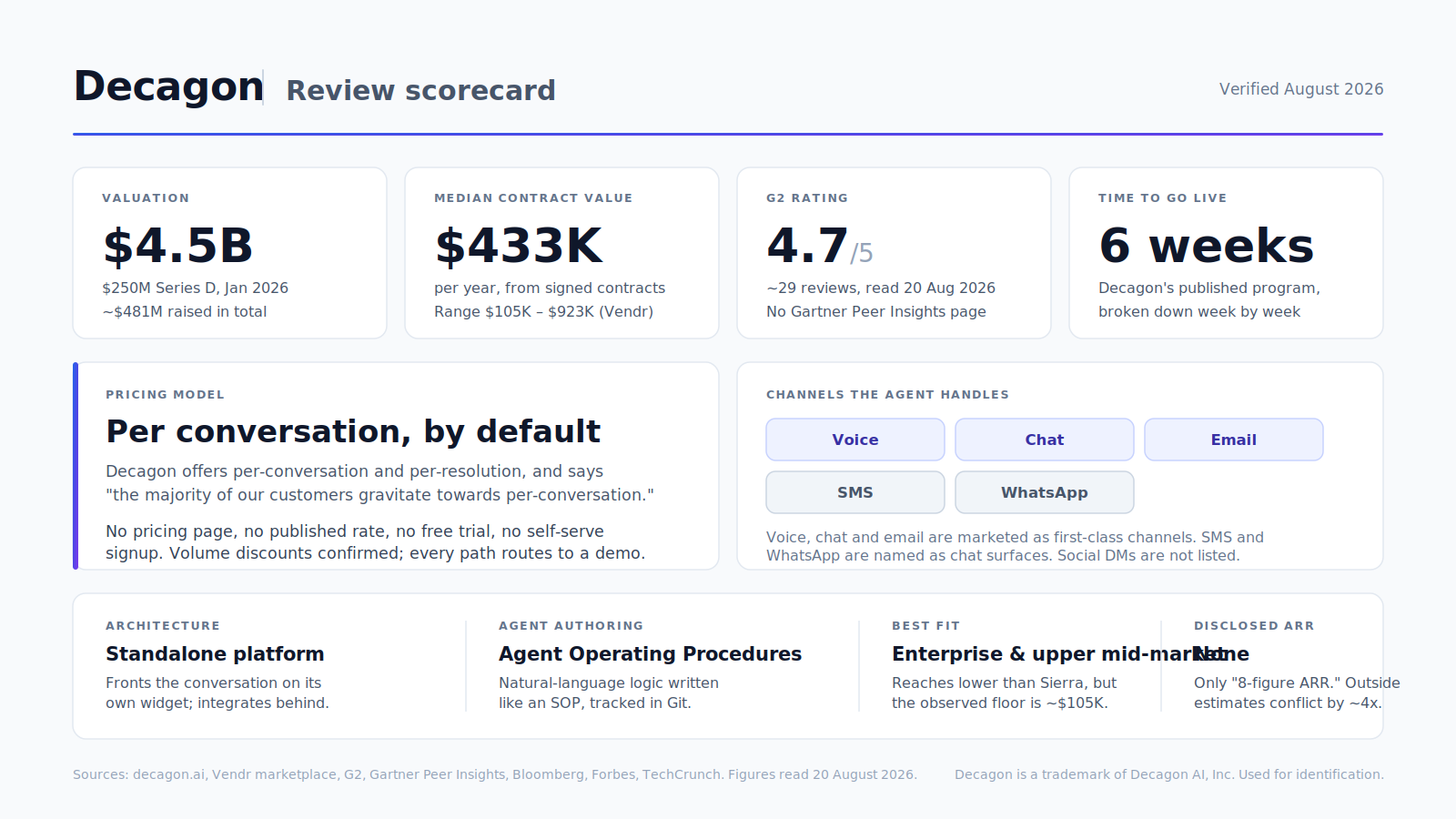
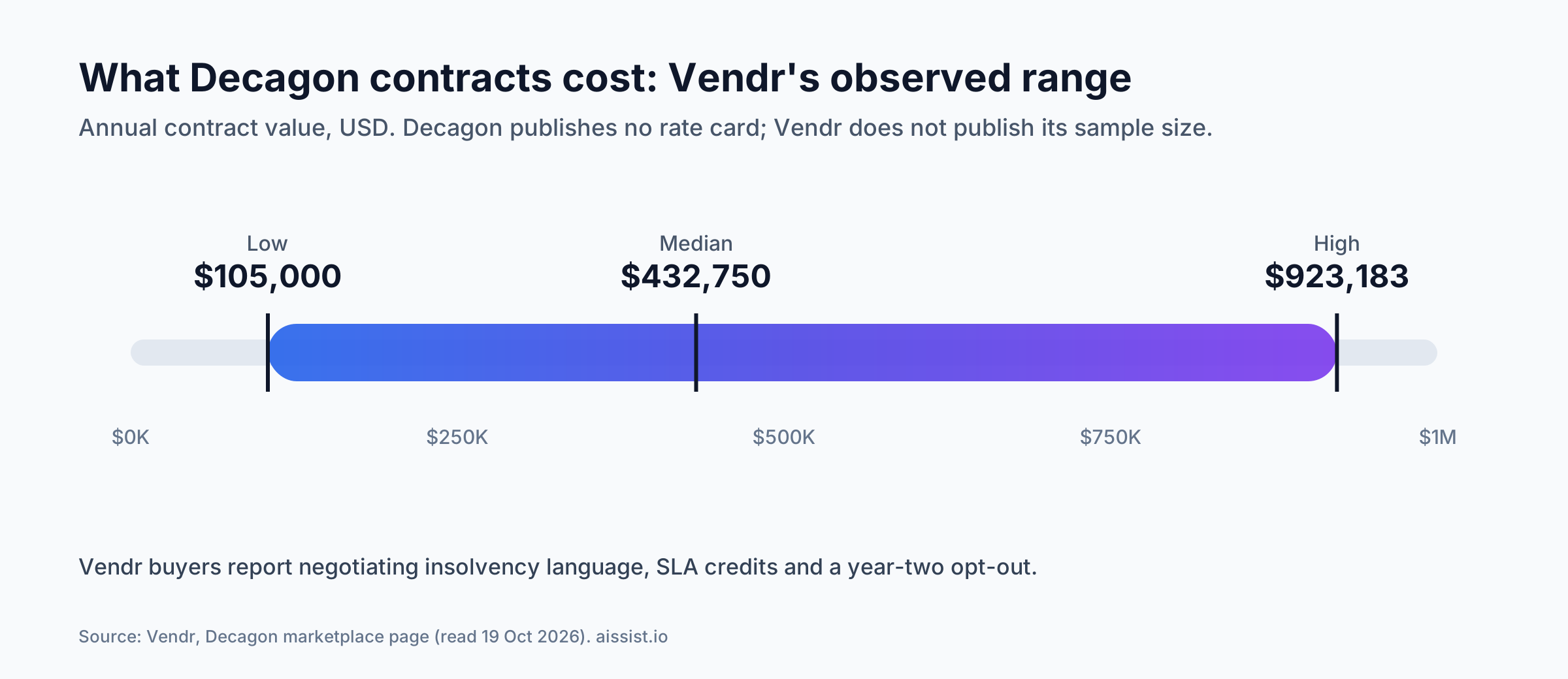
Decagon publishes no rate card. Vendr's buyer data puts the median annual Decagon contract at $432,750, and in October Business Insider reported that the company had hired a bank, which turns the fine print of that contract into the most important part of the price.
TL;DR: Decagon pricing is negotiated per deal, with Vendr reporting contracts from $105,000 to $923,183 a year; per-conversation billing wins above roughly 66% resolution, and change-of-control and exit terms now deserve as much negotiation as the rate.
Methodology & sources
- Contract values and negotiation outcomes from Vendr's Decagon page; billing models from Decagon's own pricing post.
- Unit rates are third-party estimates, not Decagon prices: about $0.99 per conversation and a ~$50,000 platform fee (Quiq), about $1.50 per resolution (Sacra, via My AskAI).
- Cost scenarios are our arithmetic and assume a 70% resolution rate for every vendor. Aissist figures: 83% average resolution, 4.8/5.0 CSAT, self-reported.
- All figures verified October 2026. Disclosure: this is Aissist's blog; Aissist sells a competing AI agent and publishes its per-resolution price.
How much does Decagon cost in 2026?
Decagon costs between $105,000 and $923,183 a year in the contracts Vendr has observed, with a median of $432,750. Vendr does not publish its sample size, so treat the range as directional, not as a quote.
The structure is clearer than the number. Vendr describes per-conversation pricing that varies with volume, billed monthly. Decagon's own pricing post offers two models: a fixed rate per incoming conversation, or a higher rate per fully resolved conversation with no charge for escalations. It adds that the vast majority of its customers choose per-conversation.
There is no free tier, no self-serve signup and no public rate. Third-party estimates fill the gap, with all the confidence that implies. Quiq, a competitor, estimates roughly $0.99 per conversation plus an annual platform fee of about $50,000. My AskAI cites a Sacra estimate of roughly $1.50 per resolution. Neither figure comes from Decagon, and both are worth testing in your own negotiation.
Two costs sit outside the rate. G2 reviewers report an average of two months to implement and four months to return on investment, so budget a quarter before savings arrive. And your helpdesk licences stay, because Decagon fronts conversations and hands off to the helpdesk behind it.
Per-conversation or per-resolution: which is cheaper?
Per-conversation is cheaper whenever the agent resolves more than about 66% of conversations, using the third-party estimates of $0.99 and $1.50. The break-even is simply $0.99 ÷ $1.50: above that resolution rate, paying for every conversation costs less than paying a premium for every resolution.
That explains why most Decagon customers choose per-conversation. A vendor confident in its resolution rate is happy to bill on volume; a buyer confident in theirs should be too. Below 66%, per-resolution protects you from paying for conversations the agent hands back.
The industry is drifting toward the second model anyway.
"We are moving beyond systems that manage conversations to AI that drives real outcomes." — Tom Eggemeier, CEO, Zendesk, on completing the Forethought acquisition, 26 March 2026
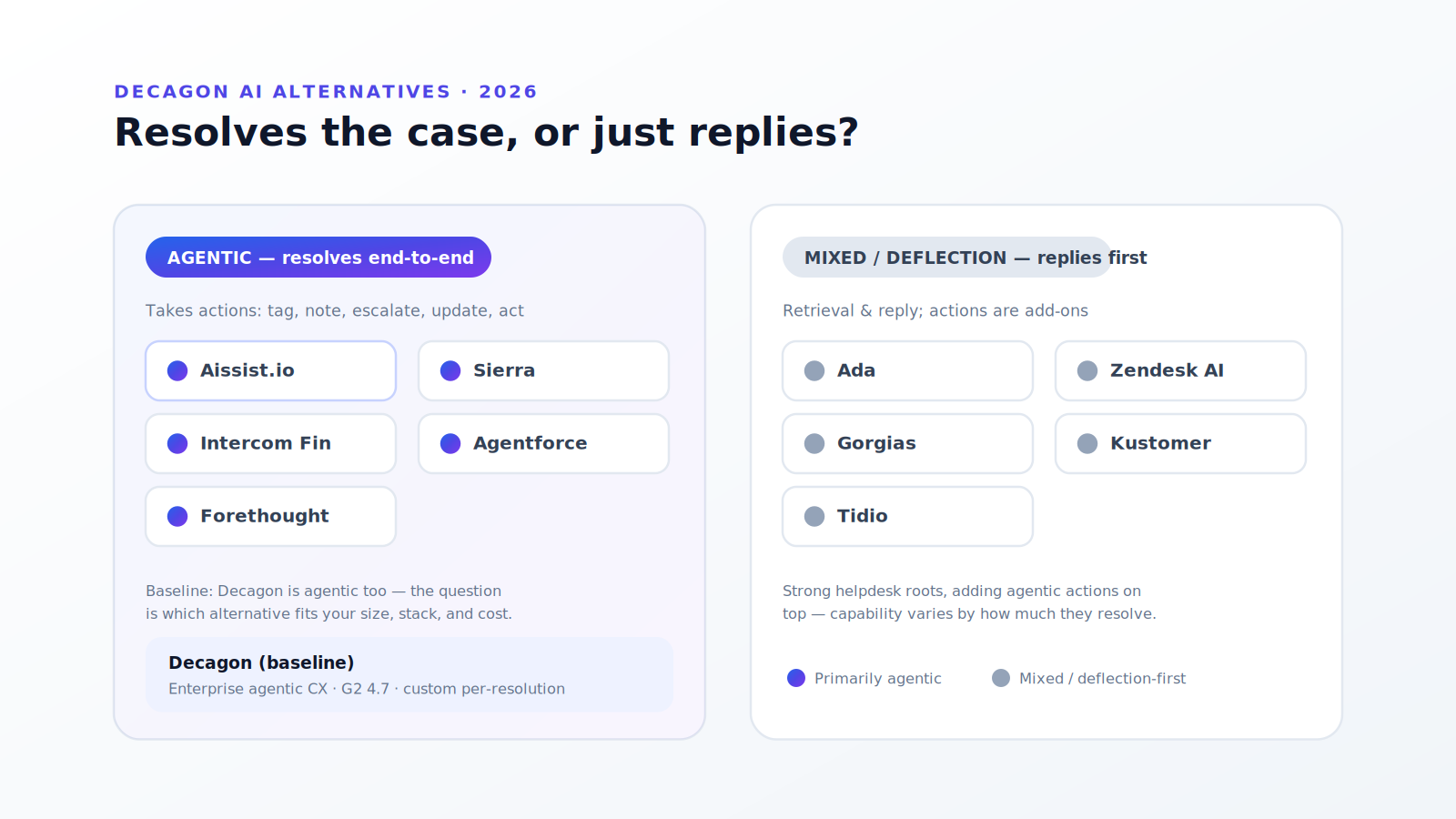
Outcome language is not the same as outcome pricing. Fin's pricing page charges $0.99 per outcome, which includes resolutions and procedure handoffs; Aissist charges $0.20 to $0.60 per resolution depending on channel, with handoffs to humans free. Read what counts as a billable event before comparing rates. A cheap unit with a generous definition can cost more than an expensive unit with a narrow one.
What does Decagon cost per resolution at your volume?
At 20,000 conversations a month, Decagon's estimated cost is about $1.71 per resolution on per-conversation billing. The platform fee makes small volumes expensive, and the effective rate falls as volume grows.
| Conversations/month (70% resolved) | Decagon per conversation* | Decagon per resolution* | Fin on another helpdesk | Aissist (chat, capped) |
|---|---|---|---|---|
| 3,000 | $85,640 ($3.40) | $87,800 ($3.48) | $24,948 ($0.99) | $15,120 ($0.60) |
| 10,000 | $168,800 ($2.01) | $176,000 ($2.10) | $83,160 ($0.99) | $50,400 ($0.60) |
| 20,000 | $287,600 ($1.71) | $302,000 ($1.80) | $166,320 ($0.99) | $100,800 ($0.60) |
| 32,000 | $430,160 ($1.60) | $453,200 ($1.69) | $266,112 ($0.99) | $161,280 ($0.60) |
Annual cost (cost per resolution), October 2026. Decagon columns use the third-party estimates above, including a $50,000 platform fee. Fin adds seat fees on Intercom's helpdesk and a 50-outcome monthly minimum elsewhere. Aissist is lower for email and after its 1,000 free tickets a month.
Two cautions. The 3,000 row sits below the lowest contract Vendr has seen, so Decagon is unlikely to sell at that size at all. And the table holds resolution rate constant at 70%. Real rates differ by vendor and by ticket mix, which is why a pilot on your own tickets beats any table, including this one.
Which contract terms matter now that a sale process is reported?
Change of control, exit and SLA terms matter most, because a sale changes who sets your roadmap without changing your contract. On 13 October, Business Insider reported that Decagon had hired a bank; the company most often named as a buyer answered within hours.
"To be clear, ServiceNow has no interest or intention of purchasing Decagon." — Amit Zavery, President, Chief Product Officer and Chief Operating Officer, ServiceNow, via PYMNTS, 13 October 2026
We make no prediction. The base rate is the record: six AI companies tied to the agent layer were bought or signed to be bought in seven months.
| Date (2026) | Vendor | Event | Status | Primary source |
|---|---|---|---|---|
| 26 Mar | Zendesk → Forethought | Acquisition completed | Closed | Zendesk |
| 10 Sep | Salesforce → Fin | Acquisition completed | Closed | Salesforce IR |
| 29 Sep | Salesforce → Listen Labs | Definitive agreement | Agreed | Salesforce |
| 6 Oct | SAP → TechWolf | Agreement | Agreed | CIO |
| 13 Oct | Workday → C1.ai | Definitive agreement | Agreed | Workday 8-K |
| 13 Oct | Rocket Software → Geniez AI | Acquisition completed | Closed | VMblog |
| 13 Oct | Decagon / ServiceNow | Bank reportedly hired; ServiceNow denies interest | Reported / denied | PYMNTS |
| 15 Oct | ServiceNow, Salesforce | NOW +5%, CRM +4% (sympathy move) | Market reaction | 24/7 Wall St. |
Acquirers buy for reach, and say so.
"The big strategic benefit of our decision to join Salesforce is magnitudes more businesses." — Eoghan McCabe, CEO and Co-Founder, Fin, on the Salesforce close, 10 September 2026
Decagon buyers already negotiate for this. Vendr reports buyers securing insolvency language, SLA credits in the MSA, a two-year term with a year-two opt-out, quarterly rather than annual payment, and a 30% discount above one million conversations. Add a change-of-control exit and a usable export of your procedures and logs. A pricing model you can leave is worth more than a rate you can't. Our vendor lock-in guide scores those exit terms vendor by vendor.
Decagon's price is a negotiation, and the exit clause is part of the price
Decagon suits large enterprises with steady, high volume and someone to own agent procedures: at 32,000 conversations a month, the estimated rate falls to about $1.60 per resolution. Below roughly 10,000, the platform fee dominates and Vendr's $105,000 floor applies. Whatever the volume, negotiate the term, the SLA and the change-of-control exit with the same energy as the unit rate. For the product itself, read our Decagon review; for options at lower commitment, see Decagon alternatives and Aissist vs Decagon.
Frequently asked questions
Does Decagon publish its pricing?
No. Decagon has no public rate card or free tier. Vendr reports a median annual contract of $432,750, with observed contracts from $105,000 to $923,183.
Is Decagon priced per conversation or per resolution?
Both are offered. Decagon says the vast majority of its customers choose per-conversation pricing, which is cheaper when the agent resolves more than about 66% of conversations.
Does Decagon charge a platform fee?
Decagon has not published one. Quiq, a competitor, estimates an annual platform fee of about $50,000 on top of usage.
Is Decagon affordable for a small company?
Rarely. Vendr's lowest observed contract is $105,000 a year, so teams below about 10,000 conversations a month usually pay more per resolution than with usage-priced tools.
What happens to my Decagon contract if Decagon is acquired?
Your contract terms govern it. Negotiate a change-of-control exit, data export rights and SLA credits before signing; no Decagon acquisition has been announced.
How does Decagon pricing compare with Aissist and Sierra?
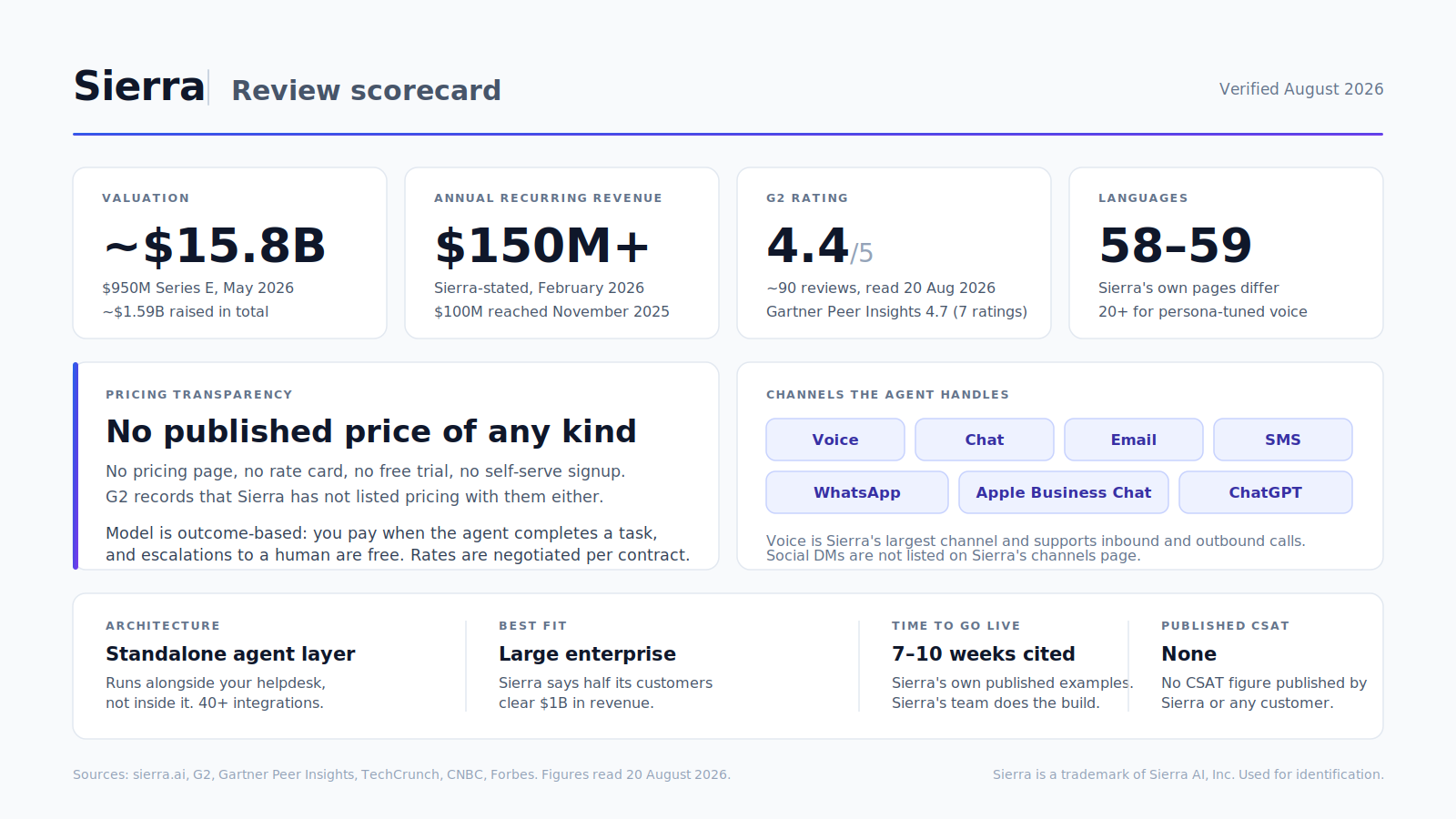
Decagon bills mainly per conversation on negotiated contracts; Aissist charges $0.20 to $0.60 per resolution with no contract. Our Decagon vs Sierra vs Aissist guide adds Sierra.
Changelog
- 19 October 2026 — Added contract terms and the 2026 M&A record after reports of a Decagon sale process; refreshed Vendr negotiation data; added Fin and Aissist to the cost table; dropped one unverifiable third-party rate.
- 28 August 2026 — Updated. Added the 66% break-even rule between per-conversation and per-resolution pricing, a volume-tiered cost table (10k / 20k / 32k conversations a month), a normalised seven-vendor comparison, G2 implementation and ROI data, Series D and revenue context, and two original graphics. Corrected the Decagon quote on customer preference to its verbatim wording. Vendr figures re-read on this date, unchanged at $432,750 median.
- 28 August 2026 — First published. Verified on this date:
decagon.ai/pricingreturns 404; Decagon's pricing post and resolution-based-pricing glossary page are live and quoted directly.