Helpdesk-Agnostic AI: How to Avoid AI Customer Service Vendor Lock-In
AI customer service vendor lock-in is not one risk. It is five, and all five are measurable — export format, deployment host, workflow portability, model dependency, contract shape. We scored seven AI support agents against their own live documentation, and the results do not favour the vendor writing this.
TL;DR: Architecture sets your lock-in ceiling and the contract sets your floor — but of seven AI support agents checked against their own live documentation in September 2026, three, Aissist.io included, publish no readable data-export path at all.
Methodology & sources
- Vendor documentation, pricing pages, developer API references, master subscription agreements and trust pages for Aissist.io, Ada, Decagon, Fin, Salesforce Agentforce, Sierra and Zendesk, all fetched 17 September 2026.
- Ratings and review quotes from G2 product profiles, read 17 September 2026.
- "Not published" means we could not find the item on any publicly readable vendor page on that date — not that the vendor lacks the capability.
- Disclosure: this is Aissist.io's blog. Aissist.io sells a helpdesk-agnostic AI agent and is scored on the same rubric below, including the two dimensions where it scores poorly.
This article scores the lock-in mechanics. For the deployment pattern it argues for, see adding AI to Zendesk without replacing your stack. For what the Salesforce acquisition changed for Fin customers specifically, see Intercom Fin alternatives after the Salesforce acquisition.
What does "helpdesk-agnostic" mean, and why does it change your lock-in profile?
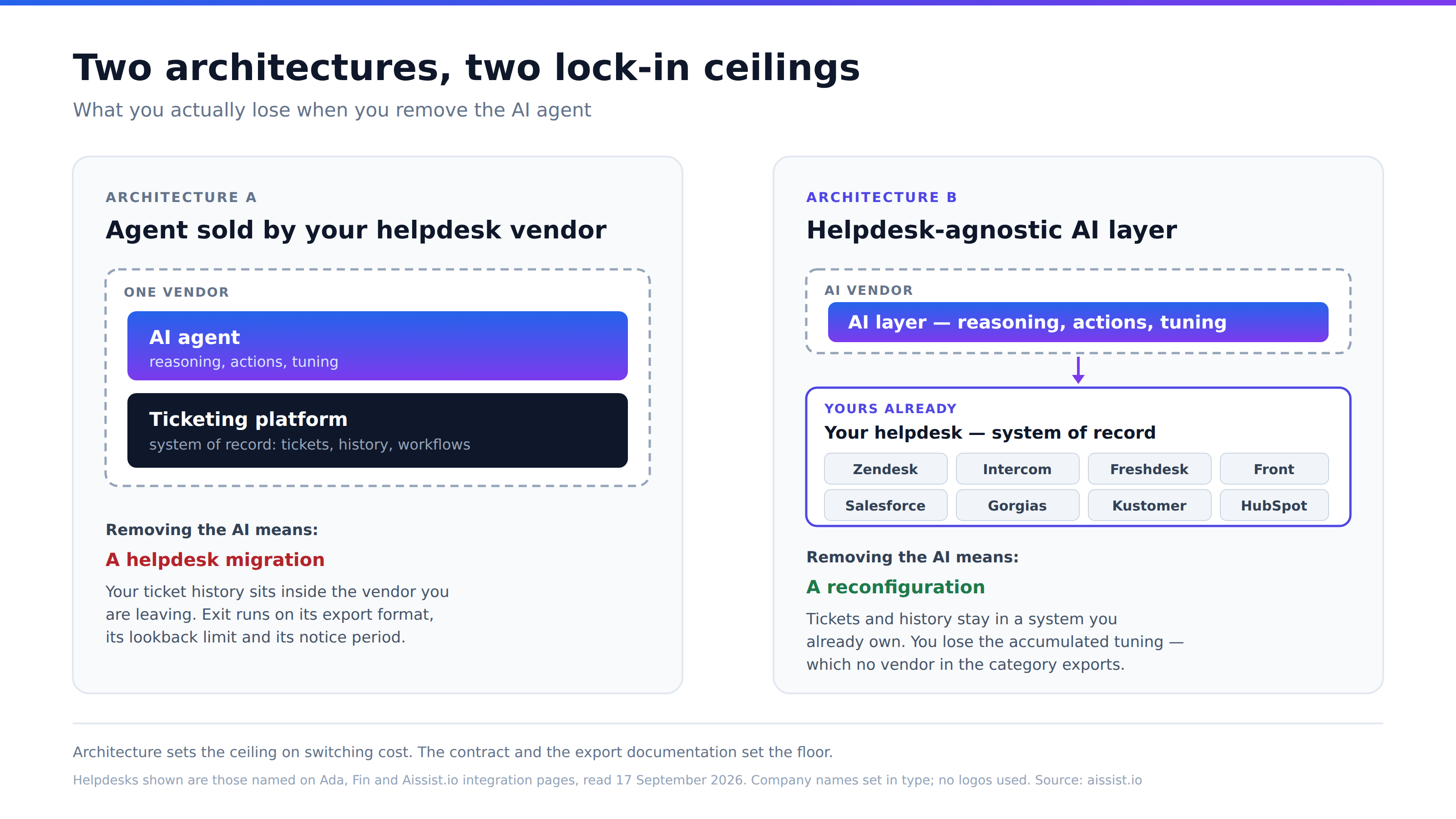
A helpdesk-agnostic AI agent is an AI customer service layer that runs on top of whichever helpdesk a company already uses — Zendesk, Intercom, Freshdesk, Salesforce, Gorgias, Front or Kustomer — instead of requiring the company to adopt the vendor's own ticketing platform. The helpdesk stays the system of record. Tickets, conversation history and agent workflows remain in a system the customer already owns and already knows how to export. The AI vendor supplies reasoning and actions, not the database.
That distinction sets a ceiling on how much damage leaving can do. If your tickets live in Zendesk and the AI is a layer on top of it, removing the AI costs you the tuning. If your tickets live in the AI vendor's platform, removing the AI means a helpdesk migration. Same decision, two different orders of magnitude.
Nobody in the category uses the phrase. Fin's own lock-in framework, published 27 March 2026, names the concept — it lists "whether the AI agent integrates with existing helpdesks or requires full platform adoption" as a lock-in dimension — and calls it "deployment flexibility" instead. Everyone is circling the same idea with a different clumsy label: Workato says "model-agnostic control plane," AvePoint says "multimodel AI strategy," the Agentic AI Foundation says "vendor-neutral."
The phrase matters now because September 2026 made the question concrete. Salesforce closed its acquisition of Fin on 10 September, buying what Marc Benioff called "the #1 customer agent" to sit alongside "the #1 CRM." One day earlier, Microsoft put Dynamics 365 Activate into public preview — an AI tool whose entire first release reads a Salesforce environment and generates a migration blueprint off it.
Two incumbents now treat each other's customers as extractable. Both are right that switching is the live question. Neither is a neutral party on how hard it should be.
"You don't want to have your data stuck with one vendor that's going to sort of try and keep your workloads going down a particular path. You want to be able to have some flexibility of which agents you can use, which models do you choose based on the workload." — Aaron Levie, CEO, Box, quoted by Constellation Research, 29 May 2026
How do you score AI customer service vendor lock-in?
Score it on five dimensions, and score each one on a mechanical fact rather than a promise: the export format, the named helpdesks, the config endpoint, the model provider, the notice period in days. Every dimension below has an answer a vendor either publishes or does not. "We're very open" is not an answer to any of them.
These are the five dimensions Fin's framework names, and credit where it is due — Fin got here before the rest of the category. Where we part company is the evidence. Fin rests its case on two statistics, "45% of enterprises say vendor lock-in has already hindered their ability to adopt better tools" and "67% of organizations aim to avoid high dependency on a single AI provider," both traced to a third-party blog rather than a survey with a published sample. The dimensions are right; what you measure them against is the part worth rebuilding.
| Dimension | The question to ask | Low-risk indicator | High-risk indicator |
|---|---|---|---|
| Data portability | How do I get conversations and AI transcripts out, in what format, reaching back how far? | Public export endpoint, JSON, no lookback cap, bulk or warehouse path documented | Export omits transcript text; one API call per calendar day; hard historical floor; docs behind a login |
| Deployment flexibility | Does this run on the helpdesk I already have, and does that helpdesk stay system of record? | Five or more named, individually documented helpdesk integrations; vendor is explicitly not the system of record | Requires the vendor's own ticketing platform; no helpdesk named anywhere public |
| Workflow portability | Can I export the tuning — instructions, knowledge, workflow logic — in a format anything else can read? | Config export endpoint returning open JSON; knowledge sourced from systems you already own | Import-only configuration; logic retrievable only in the vendor's proprietary schema, or not at all |
| AI model dependency | Which models, chosen by whom, and can I supply my own? | Named providers, documented model selection, bring-your-own-model supported | A single undisclosed proprietary model, or model choice that belongs to the vendor only |
| Contract structure | What is the notice period, the minimum commitment, and how many days do I have to export after termination? | Published term, notice period and post-termination export window, stated in days | Auto-renewal "for an equivalent term" at "then-current rates"; quantities non-reducible mid-term; no terms published at all |
The wording in that last cell is not hypothetical. Zendesk's Master Subscription Agreement renews subscriptions "for an equivalent term" unless either party gives 30 days' notice, and states that "Zendesk may apply then-current rates" on renewal — so a three-year deal quietly becomes another three years at a price nobody has quoted you yet. Salesforce's MSA §5.1 goes further: fees "are based on Services and Content subscriptions purchased and not actual usage," payment obligations are "non-cancelable," and "quantities purchased cannot be decreased during the relevant subscription term."
Read that clause next to an agentic roadmap. You are being asked to lock a seat count for a term during which the whole premise of counting seats is under revision.
"In the future, you have these AI agents that are crawling through the environment, where the AI agents are often doing tasks that are independent of the human being. And if they're doing that, it does not make a lot of sense to tie the licenses to a human that's doing the task." — Arun Chandrasekaran, analyst, Gartner, quoted in Fortune, 8 April 2026
How do the major AI support agents actually score?
Ada scores best on published mechanics, Sierra and Decagon score worst on documentation a buyer can read before signing, and Aissist.io — this article's author — scores well on architecture and badly on everything requiring a published commitment. Ratings below reflect what each vendor made publicly readable on 17 September 2026.
| Vendor (Sep 2026) | Data portability | Deployment flexibility | Workflow portability | Model dependency | Contract structure |
|---|---|---|---|---|---|
| Ada | Low — GET /v2/export/messages, JSON, 10,000 records/page, 12-month lookback | Low — 14+ named helpdesks, handoff architecture | Low–Moderate — Snapshot API exports config as JSON, but excludes conversations | Moderate — names OpenAI, Anthropic, Cohere; no customer model choice | Moderate — 1-year auto-renew, 30 days' notice; post-term window is "a reasonable period of time" |
| Zendesk AI agents | High — bot transcripts sit in a separate API, one calendar date per request, nothing before 1 Jan 2024 | Moderate — runs beyond Zendesk via the Forethought tier, priced on request | Moderate — configuration lives in Zendesk | High — "Zendesk AI selects the right model for each task"; no model choice documented | High — renews "for an equivalent term" at "then-current rates"; per-resolution price not published |
| Fin (Salesforce) | Moderate–High — CSV export omits conversation content; transcripts require REST pagination | Low — 9+ named helpdesks incl. Zendesk, documented and live post-acquisition | Moderate — Workflows export as JSON (built for EU Data Act); Custom Answers have no export endpoint | High — proprietary Fin Apex 1.0; no third-party provider disclosed, no model choice | Moderate — $0.99 per outcome published, 50 outcomes/month minimum, 30 days' notice |
| Salesforce Agentforce | Moderate — Bulk API 2.0, CSV only, results retrievable 7 days; 30-day post-term export window | High — built natively on the Salesforce Platform; no third-party helpdesk host documented | Moderate — agent logic retrievable as XML via Metadata API, in Salesforce-only schemas | Low — 40+ named models across four providers, plus BYOLLM at 30% fewer Einstein Requests | High — MSA §5.1: non-cancelable, quantities non-reducible mid-term; Flex Credits expire at term end |
| Decagon | Unknown — export and Fivetran doc pages exist but render empty or sit behind a login | Moderate — 4 named helpdesk/CRM integrations, plus MCP and custom APIs | Unknown — not published | Moderate–High — OpenAI and Anthropic named via partner pages; no model choice | Unknown — no MSA published; /legal/msa serves the marketing homepage |
| Sierra | Unknown — docs.sierra.ai is login-gated; no public API reference exists | Unknown — names zero helpdesk vendors on any public page | Unknown — not published | Moderate — 15+ models with automatic failover, but "without you having to hand-pick the models" | Unknown — public terms are website terms; only termination clause runs in Sierra's favour |
| Aissist.io | High — no export documentation published; the only documented API is inbound | Low — 8 named helpdesks; helpdesk stays system of record, with write-back | High — configuration is import-only; no documented export of instructions or sub-agents | Moderate — FAQ names OpenAI, Grok, Claude, Gemini; no BYO-model, and the trust center lists only OpenAI | Moderate–High — $0.2–$0.6 per resolution published and "no contract needed" on Growth, but no ToS is published and the DPA is robots-blocked |
Two corrections to the received story are worth stating, because both cut against easy narratives.
Fin did not become Salesforce-only. As of 17 September 2026, fin.ai still says Fin "works excellently with Salesforce, Hubspot, Freshdesk, and many other helpdesks," and a live Zendesk integration doc carries no deprecation notice. The acquisition press release commits to "rapid deployment on existing systems." It puts no time horizon on that, which is the fair thing to note — not that the support has gone.
Fin is no longer the multi-model option. Its AI engine page now claims a proprietary stack — "Fin Apex 1.0 is the generative core of Fin," with custom fin-cx-retrieval and fin-cx-reranker models — and argues explicitly against vendors that "apply a thin layer on top of a general-purpose LLM." Meanwhile Salesforce's supported models list names more than 40 models across OpenAI, Anthropic, Google and Amazon, and its BYOLLM path consumes "30% fewer Einstein Requests." On model dependency alone, the platform incumbent is now the open one.
Which dimension actually binds? Not the one you are checking
AI agent data portability binds, and it is the dimension buyers check last. Every vendor in the category has an answer ready for "which model do you use." Almost none has a readable answer for "how do I get three years of AI conversations and my accumulated tuning out, in a format something else can read."
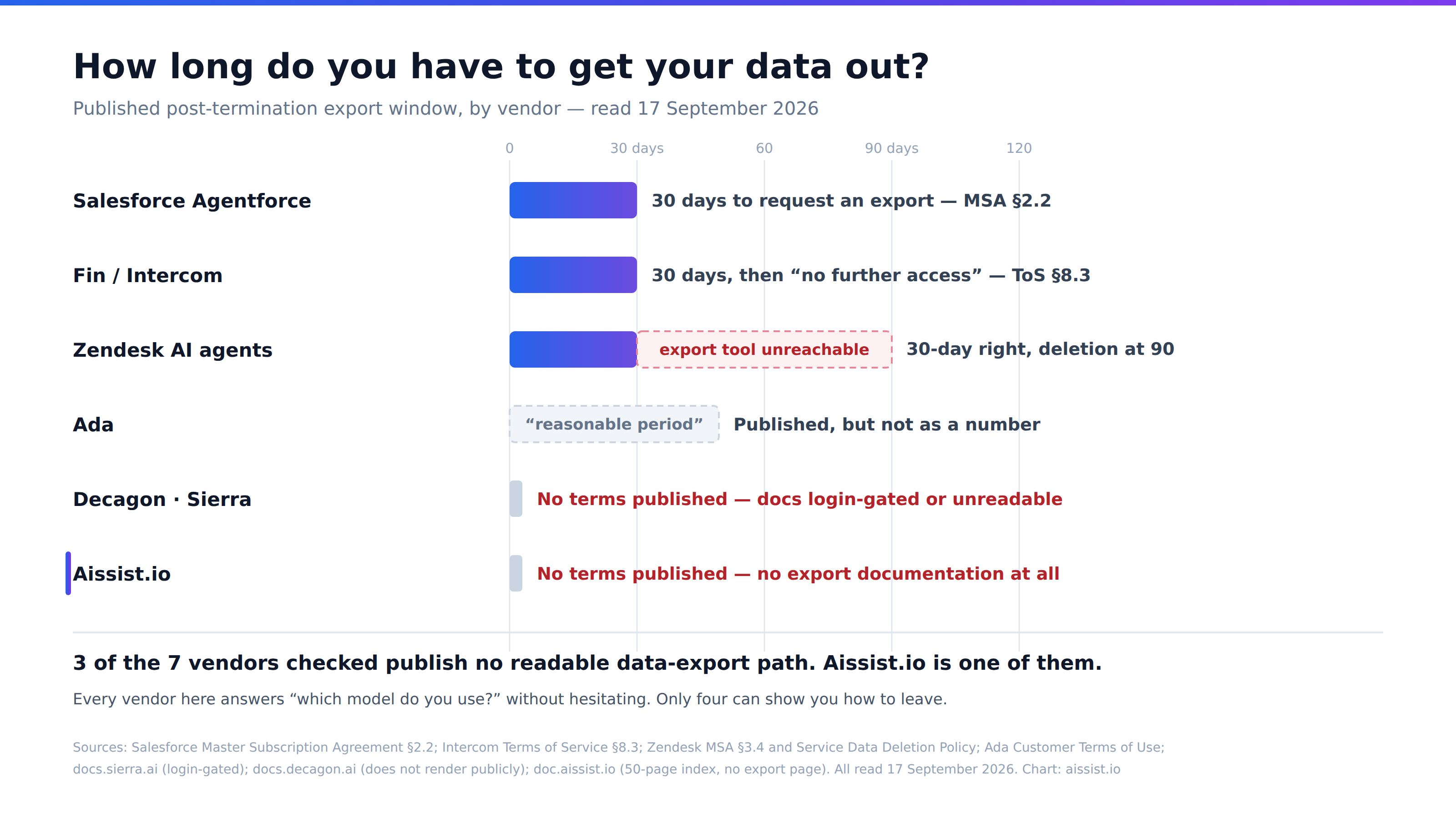
The mechanics are worse than the marketing. Zendesk's contract grants export rights "during and 30 days after the Subscription Term," while its Service Data Deletion Policy begins deleting 90 days after cancellation — and Zendesk's own help centre confirms that in between, the export tool is unreachable, so retrieval requires a support ticket asking for "a temporary account reactivation." The right to your data and the ability to fetch it are 60 days apart. Intercom's CSV conversation export states plainly that "conversation/message content is not included," so the transcripts you actually need come out only by paginating the REST API, and any conversation past 500 parts is silently truncated to the 500 most recent. Zendesk's bot transcripts live in an API that concedes it "does not follow the general mechanisms and conventions of most Zendesk APIs," accepts one calendar date per call, expires its download links in 24 hours, and reaches back no further than 1 January 2024.
Then there is the tuning, which is the asset nobody itemises. Aissist.io's own AI agent pricing benchmark puts new deployments at 40–50% resolution, improving roughly a point a month over six to twelve months. That curve is the switching cost. It is not in any export.
"Data/export rights need negotiation: Because of centralization, teams are advised to explicitly negotiate data ownership and export rights up front." — Mridul N., Senior Manager, small-business reviewer, G2 review of Sierra, 27 August 2026
Here is our own finding, and it is not flattering. Preparing this article we ran the same documentation check on Aissist.io. Its docs index runs to 50 pages and contains no export page; the one REST API doc describes Aissist calling your systems, not you retrieving data from Aissist; the security page covers AES-256 and TLS but publishes no retention period or deletion terms; and the footer link labelled "Terms of Service" points to a DPA that robots.txt blocks from being read. On data and workflow portability, Aissist.io scores exactly as poorly as Sierra and Decagon. Sitting on top of Zendesk genuinely lowers the ceiling. It does not raise the floor.
"The fundamental AI data portability concern that has motivated me for nearly three years now remains: in the AI future, will people be empowered or held hostage by their personal data?" — Chris Riley, Executive Director, Data Transfer Initiative, 1 September 2026
What should you put in the contract before you sign?
Put the export mechanism, the retention window and the notice period in writing as numbers, because the pattern across all seven vendors is that portability appears when something forces it. Fin's only open workflow-export endpoint exists, in Intercom's own documentation, "for EU Data Act compliance." Regulation produced that, not competition. Your contract is the other instrument that can.
Four clauses, phrased as the conditional they actually are:
- If the vendor is also your helpdesk, negotiate the export before the seat count — because leaving becomes a platform migration, not a vendor swap. Ask for the transcript export in JSON with no lookback floor, named in the order form. If you would rather not create that dependency, adding AI to Zendesk without replacing the stack is the cheaper version of the same decision.
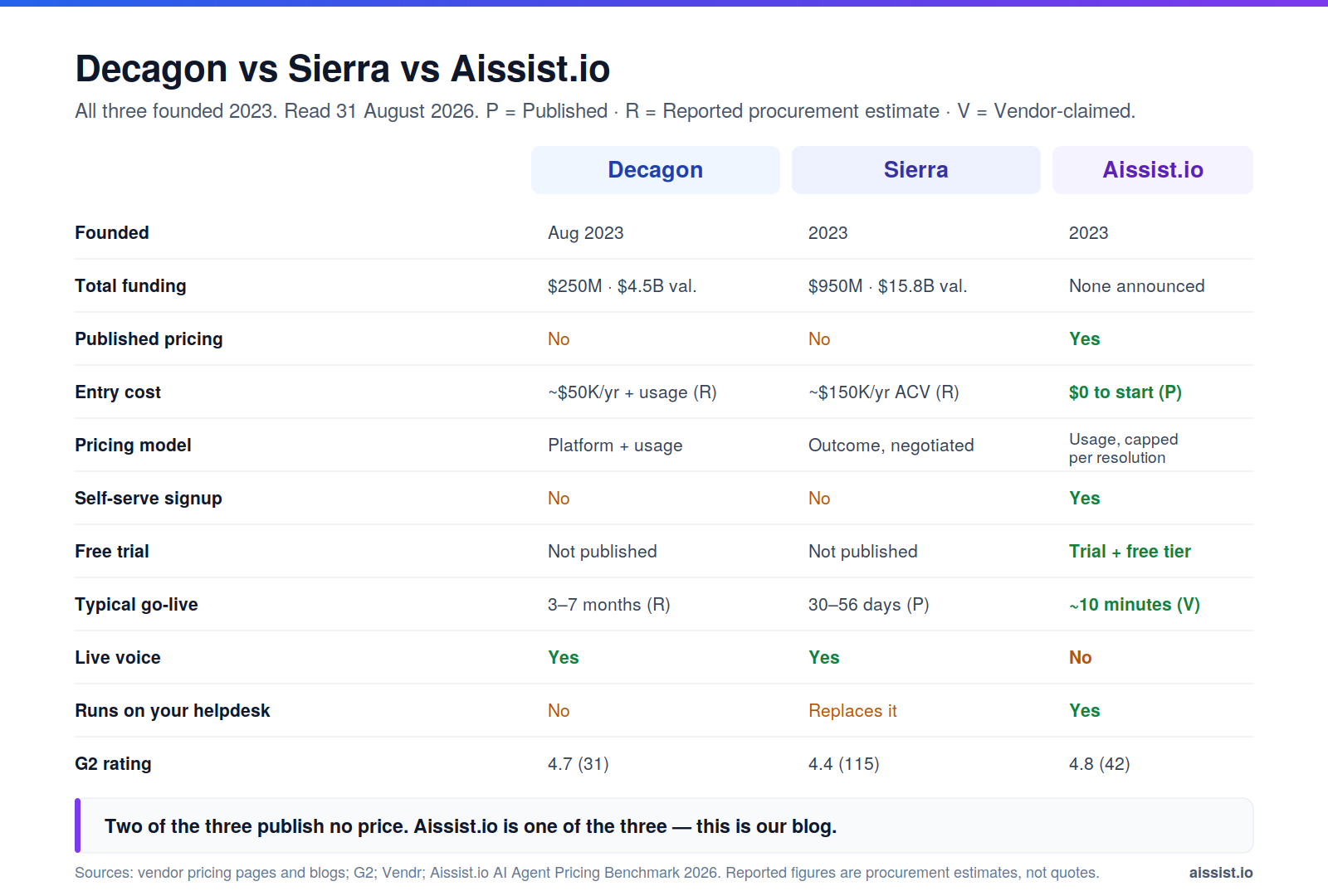
- If the vendor publishes no terms of service, treat the absence as the term — Decagon, Sierra and Aissist.io all fall here. Ask for a post-termination export window stated in days; "a reasonable period of time," Ada's published wording, is better than silence and still not a number.
- If you are signing multi-year, cap the renewal and the seat floor — Zendesk's "equivalent term" at "then-current rates" and Salesforce's non-reducible quantities are both defaults you can negotiate, and both are worth more than a discount.
- If model behaviour matters to your CSAT, ask who chooses the model — Sierra's 15+ models and automatic failover reduce Sierra's exposure to one provider. Read its own sentence: customers get this "without you having to hand-pick the models." Vendor-side multi-model and customer-side model choice are different products, and only Salesforce currently documents the second.
The peer-reviewed procurement literature has already written the sharpest version of this clause. Bright, Emeny, Jaeger, Larson, Lueck and Soltys, writing in the ITEA Journal in June 2026, propose language a commercial buyer can lift almost unchanged: "The Government shall retain unlimited rights to all training data provided by the Government, including derivative datasets created during contract performance." Swap "the Government" for your company name and you have the clause the category is missing.
Architecture sets your ceiling; the contract sets your floor
A helpdesk-agnostic AI agent is structurally less binding than an agent sold by your helpdesk vendor, and that is a real advantage rather than a positioning line: when the helpdesk stays the system of record, walking away from the AI costs you tuning rather than a migration. But architecture only caps the damage. Whether you can actually leave comes down to four things a vendor either publishes or does not — the export endpoint and its format, the lookback limit, the days you get after termination, and the notice period. The category is better at the architecture than the paperwork, and Aissist.io is no exception. Saying so is cheaper than being found out.
Score your shortlist on all five. If a vendor cannot show you the export before you sign, you have learned the answer.
All pricing, contract clauses, API limits and documentation gaps in this article were read from primary vendor sources on 17 September 2026. Vendor terms rotate; re-check any figure you plan to negotiate against. Next scheduled review: February 2027.
Frequently asked questions
What is vendor lock-in in AI customer service?
Vendor lock-in in AI customer service is the set of structural costs that make switching AI agent providers expensive or impractical: conversation data you cannot export, tuning you cannot transfer, a helpdesk you would have to migrate, and contract terms that renew before you can leave. It is measured on five dimensions, not one.
Can I keep my AI support agent if I switch help desks?
Only if the agent is helpdesk-agnostic. Ada names 14+ helpdesks, Fin names 9+ and Aissist.io names 8, all verified September 2026, so switching helpdesks under those agents is a reconfiguration. Salesforce documents no third-party helpdesk as a host for Agentforce, and Sierra names no helpdesk publicly at all.
Who owns my conversation data if I leave an AI support vendor?
You own it contractually; the question is whether you can retrieve it. Salesforce's MSA gives 30 days after termination to request an export, Intercom's terms say you have "no further access" after 30 days, and Zendesk starts deleting at 90 days while making the export tool unreachable once the account expires. Decagon, Sierra and Aissist.io publish no post-termination window.
What happens to my AI agent if my vendor gets acquired?
Contractual terms usually survive, but roadmap commitments do not. Fin's helpdesk integrations, including Zendesk, remain documented and live one week after Salesforce closed the acquisition on 10 September 2026, and the press release commits to "rapid deployment on existing systems" — with no stated time horizon. The protection is a contractual export right, not a press release.
Does multi-model AI reduce vendor lock-in?
Usually not for the customer. Sierra runs "15+ frontier, open-weight, and proprietary models" with automatic failover, which reduces Sierra's dependency on any single LLM provider — but its own page says customers get this "without you having to hand-pick the models." Only Salesforce currently documents customer-side model choice and a bring-your-own-model path.
How much does it cost to run an AI agent on the helpdesk I already have?
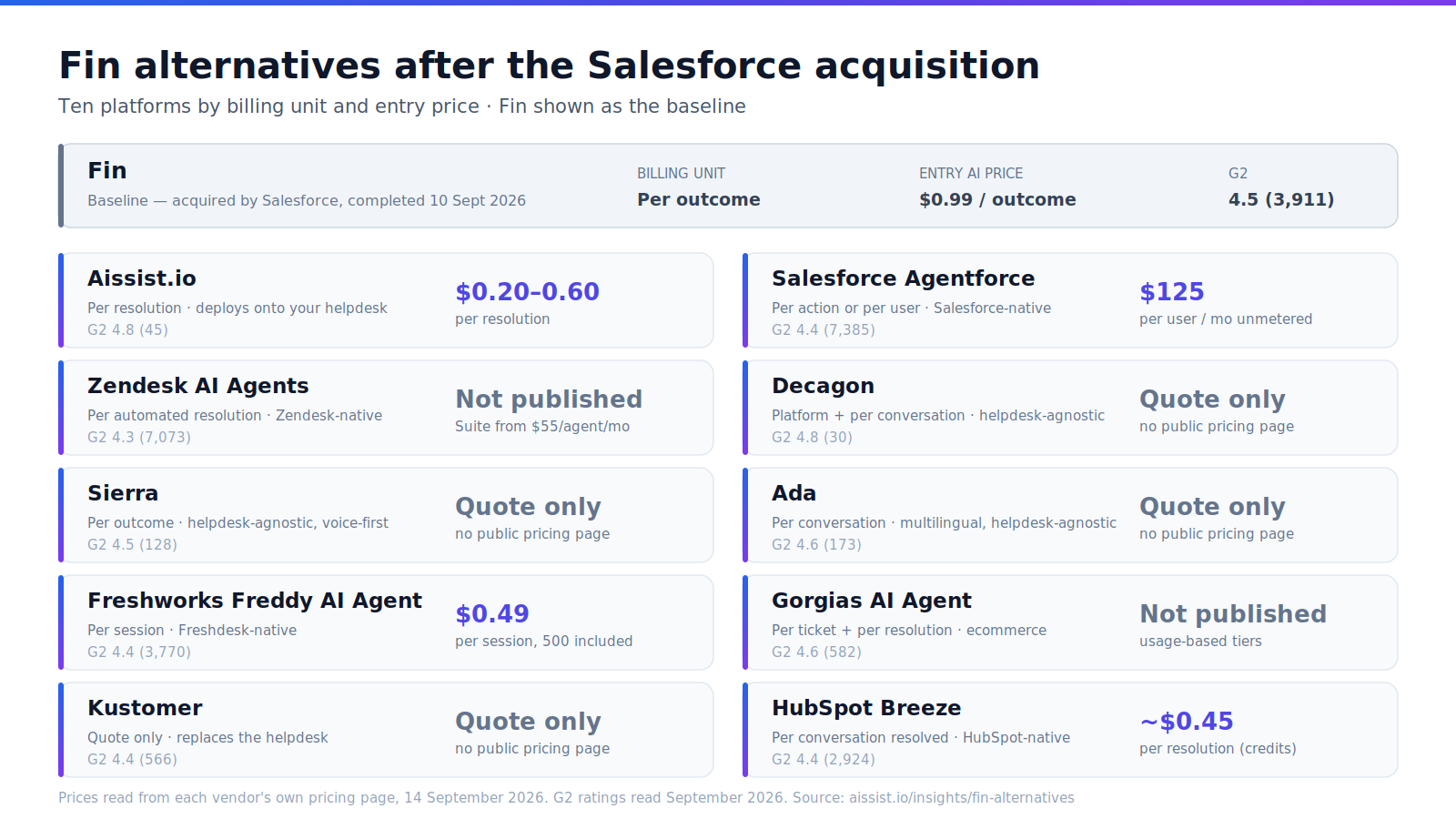
Published rates as of September 2026: Fin lists $0.99 per outcome with a 50-outcome monthly minimum, Aissist.io lists $0.2–$0.6 per resolution metered per AI interaction and capped by channel, and Salesforce lists Flex Credits at $500 per 100,000 credits, or $0.10 per Agentforce action. Zendesk publishes no per-resolution price at all.
Which AI support vendors publish a data export API?
Ada, Salesforce, Zendesk and Intercom all publish readable export documentation, though each has limits — Ada caps exports at a 12-month lookback, Salesforce's Bulk API 2.0 returns CSV only, and Zendesk's bot transcripts require a separate API. Decagon's export docs do not render publicly, Sierra's are login-gated, and Aissist.io publishes none.