Intercom Fin Alternatives After the Salesforce Acquisition
Compiled by Lucía Díaz, Director of AI Success, read on 14 September 2026. All pricing, ratings and performance figures verified September 2026. Disclosure: this guide is published by Aissist.io, which sells an agentic AI layer for customer service and sales and is ranked first on this page. We hold no affiliate, referral or paid-placement relationship with any other vendor mentioned, and no vendor reviewed it before publication. Vendor figures come from each vendor's own published material where one exists; where none exists we say so rather than estimate. Our own figures are self-reported and labelled as such.
Salesforce completed its acquisition of Fin on 10 September 2026, according to Salesforce's own press release (read 14 September 2026) — several months ahead of the early-2027 close that published analysis had forecast. If you run Fin today, nothing breaks this week. What changes is the shape of your next renewal — which is the only reason to be reading a page about Fin alternatives at all. For a large share of readers, the honest answer is that staying put is correct.
What changed, what it means for you, and what to do
| What changed | What it means for you | What to do |
|---|---|---|
| Salesforce completed the Fin acquisition on 10 Sept 2026 (Salesforce press release, read Sept 2026) | The deal is closed, not pending. Guidance written before September assumed a 2027 close and is now out of date | Re-date any internal memo that says "expected to close in FY2027" |
| Fin moves inside Salesforce AI Labs and will "continue to serve its customers," per Fin's own announcement (read Sept 2026) | Continuity is stated. Independence is not | Get your feature set and price written into your renewal, not implied |
| Salesforce agreed to pay approximately $3.6 billion, per Salesforce's June announcement (read 14 September 2026); terms were not re-disclosed at close | A $3.6B asset gets monetised through the acquirer's packaging, and Salesforce sells seats | Model your cost under a seat-priced scenario before you sign a multi-year term |
| Fin brings 30,000+ customers and a 76% average resolution rate (vendor-claimed, Salesforce press release, read Sept 2026) | Fin is a strong product. This is not a distressed-asset story | Do not switch on acquisition anxiety alone — switch on arithmetic |
| Fin still bills $0.99 per outcome with a 50-outcome monthly minimum on non-Intercom helpdesks, per Fin's pricing page (read 14 Sept 2026) | Today's pricing is intact. The question is what replaces it | Ask, in writing, how long $0.99 per outcome is guaranteed |
| Salesforce's own Agentforce resolves 62% of cases versus Fin's 76%, reported by Salesforce Ben (16 June 2026) | Fin is the better-performing agent of the two. That is why it was bought | If you are Salesforce-native, this acquisition is good news for you |
TL;DR:
- Best if you should stay: Salesforce Agentforce — for Salesforce-native shops, the acquisition makes staying the cheapest correct answer.
- Best for per-resolution cost control on your existing helpdesk: Aissist.io
- Best for enterprise CX with heavy custom workflows: Decagon
- Best for voice-plus-chat enterprise deployments: Sierra
- Best for teams already standardised on Zendesk: Zendesk AI Agents
- Best for budget-conscious mid-market: Freshworks Freddy AI Agent
- Best for Shopify ecommerce: Gorgias AI Agent
- Best for conversation-heavy CX on a unified data model: Kustomer
- Best for HubSpot-native revenue teams: HubSpot Breeze Customer Agent
The biggest buying trap in this category is comparing published resolution rates as though they mean the same thing. They do not, and the section on the 76% resolution rate below explains exactly how far apart the definitions are — including for our own numbers.
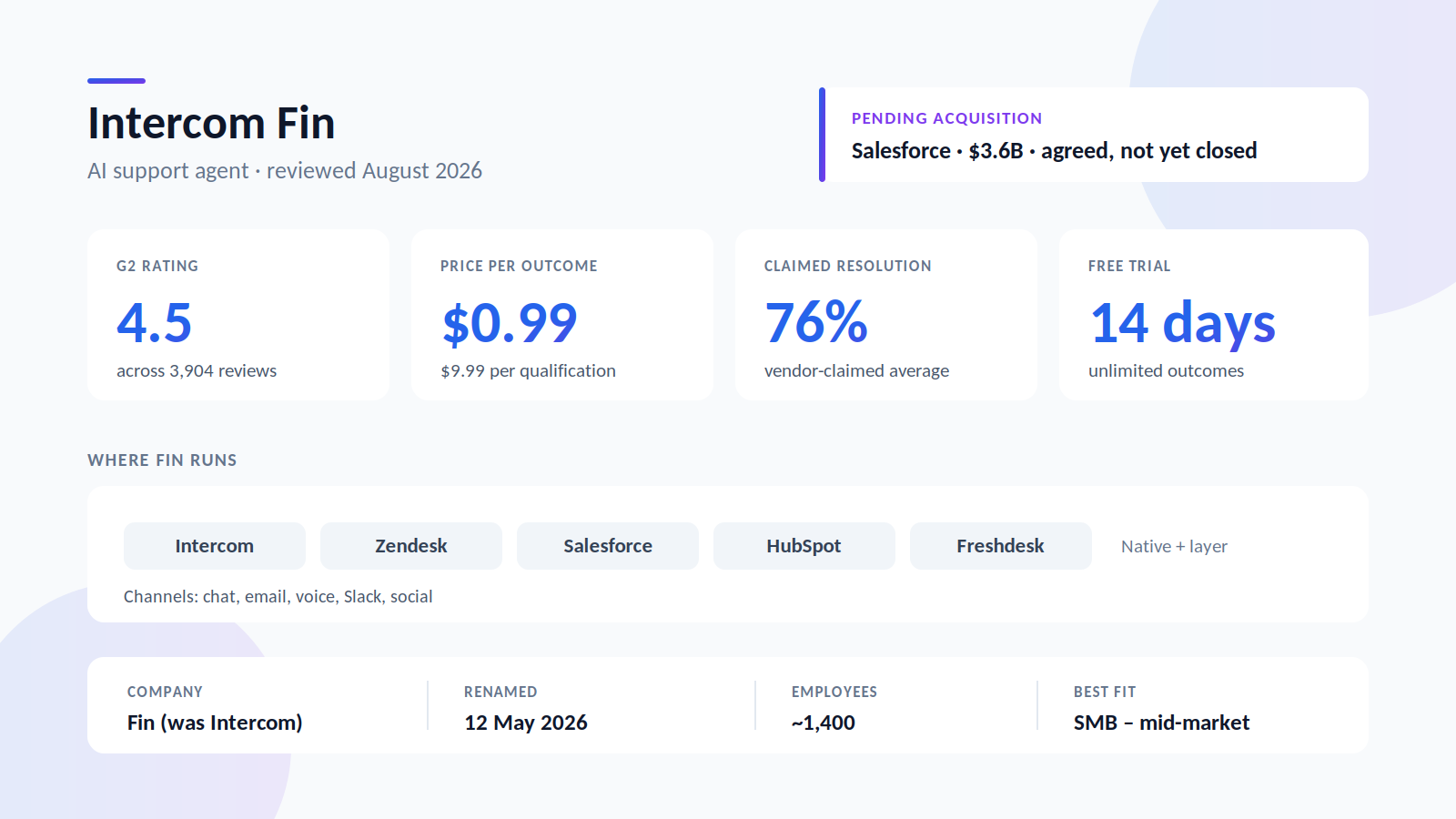
Is Intercom the same company as Fin?
No, and the distinction matters when you are reading a contract: Fin is the company, Intercom is the help desk product, and Fin is also the AI agent. Intercom renamed itself Fin on 12 May 2026, a month before Salesforce signed anything. The rename was the company promoting its AI agent's name to the corporate level, not a consequence of the acquisition.
The product name survived. From Intercom's own announcement (read 14 September 2026): "The name Intercom will still live on as the name of our customer service software platform that increasingly the best brands are choosing as their primary help desk."
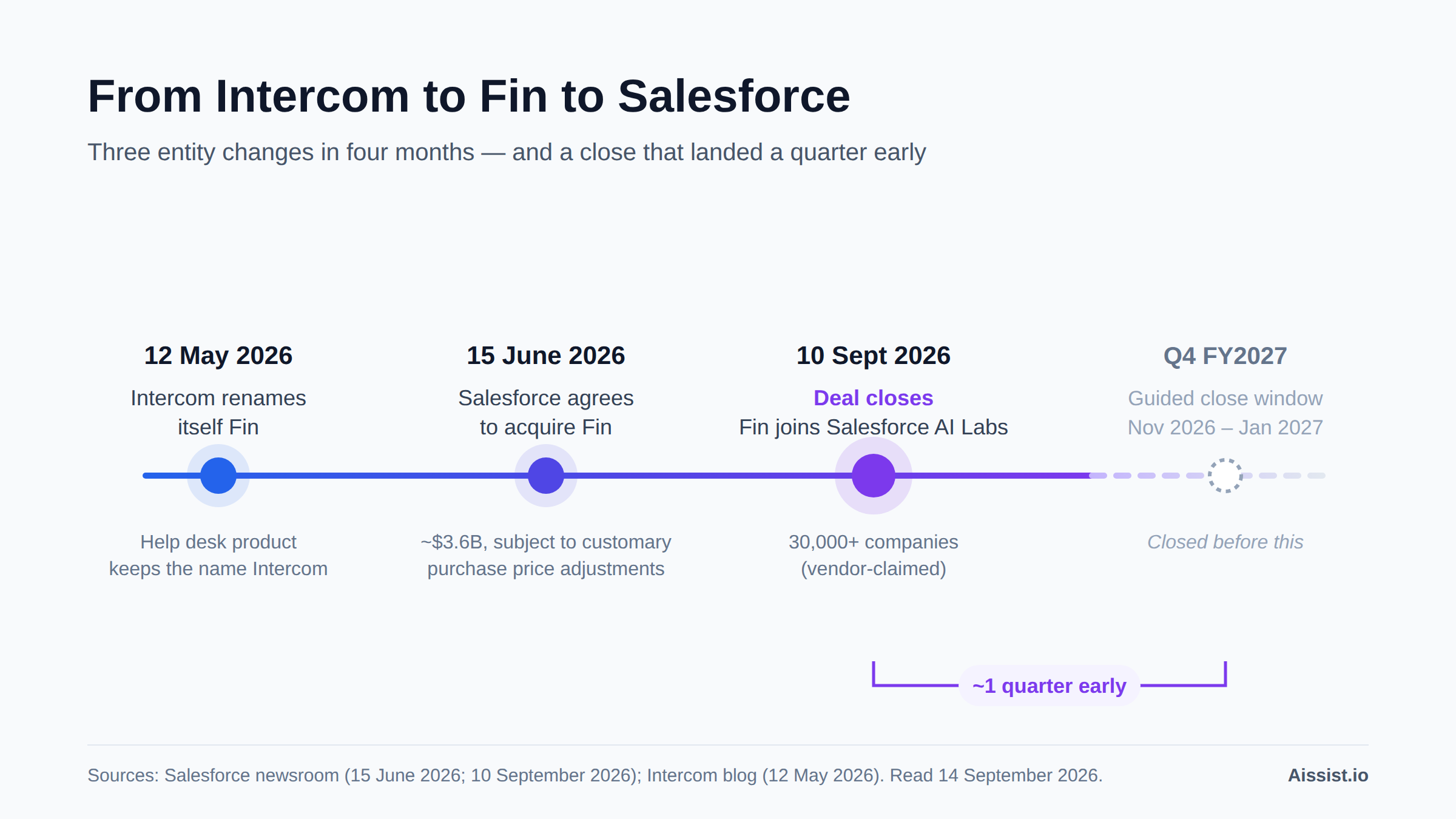
So the accurate shorthand is: the company is Fin, owned by Salesforce since 10 September 2026; the help desk is Intercom; the AI agent is Fin. If you run an agentic layer on top of Intercom — Aissist's Intercom integration, for instance — it connects to the help desk, and the rename changes nothing about it.
One detail in that timeline deserves more weight than it has had. Salesforce guided in June to a close in the fourth quarter of its fiscal 2027 — a window running November 2026 to January 2027 — and closed on 10 September 2026 instead, roughly a quarter early. Analysis written before September told buyers they had several quarters before integration became real. That runway is now one quarter shorter, which is why the renewal-timing table above is more urgent than the same advice looked in July.
Should you actually leave Fin?
For most Salesforce-native teams, no — staying is correct. Fin is the higher-performing of the two agents Salesforce now owns (76% resolution versus Agentforce's 62%, both reported by Salesforce Ben, 16 June 2026), and an acquirer that paid $3.6 billion is not going to degrade it in the first year. Switching costs you a re-implementation to gain nothing you do not already have.
Both sides framed the deal as expansion rather than absorption:
"The #1 customer agent meets the #1 CRM. The future of customer service is autonomous, intelligent, and built on trust. Fin brings proven agent technology and an extraordinary AI team to Salesforce, making Agentforce even more powerful for customer service."
— Marc Benioff, Chair and CEO, Salesforce, in the completion announcement, 10 September 2026
"I don't think there's a technology quite like Fin in the customer space. The big strategic benefit of our decision to join Salesforce is magnitudes more businesses and their customers that we can bring it to."
— Eoghan McCabe, CEO and Co-Founder, Fin, in the same announcement
Neither quote mentions pricing, which is the question every Fin customer is actually asking. Three situations change the "stay" answer. Run yourself through them in order.
1. Your renewal lands inside the next six months. This is the only window in which you have leverage and time simultaneously. Post-acquisition pricing rarely changes on day one; it changes at the first renewal cycle after integration, which for most vendors is 12–24 months out. A term signed now at today's $0.99 per outcome is a hedge. A term signed now without a price-protection clause is the opposite.
2. You run Fin on a helpdesk Salesforce does not own. Fin currently works with "help desks and systems companies already use," per Fin's announcement (read September 2026). That neutrality is a product decision, and product decisions at acquired companies are made by the acquirer. If your stack is Zendesk, Freshdesk, Gorgias, Front or Kustomer, you are running a third-party agent whose owner now sells a competing helpdesk. Worth watching, not worth panicking over.
3. Your per-resolution spend is already uncomfortable. At $0.99 per outcome plus $29 per helpdesk seat per month (Fin pricing, read 14 September 2026), a team resolving 2,000 conversations a month with AI is paying roughly $1,980 in outcomes alone. If that number already makes you wince, the acquisition is not your problem — your unit economics are, and they were before September.
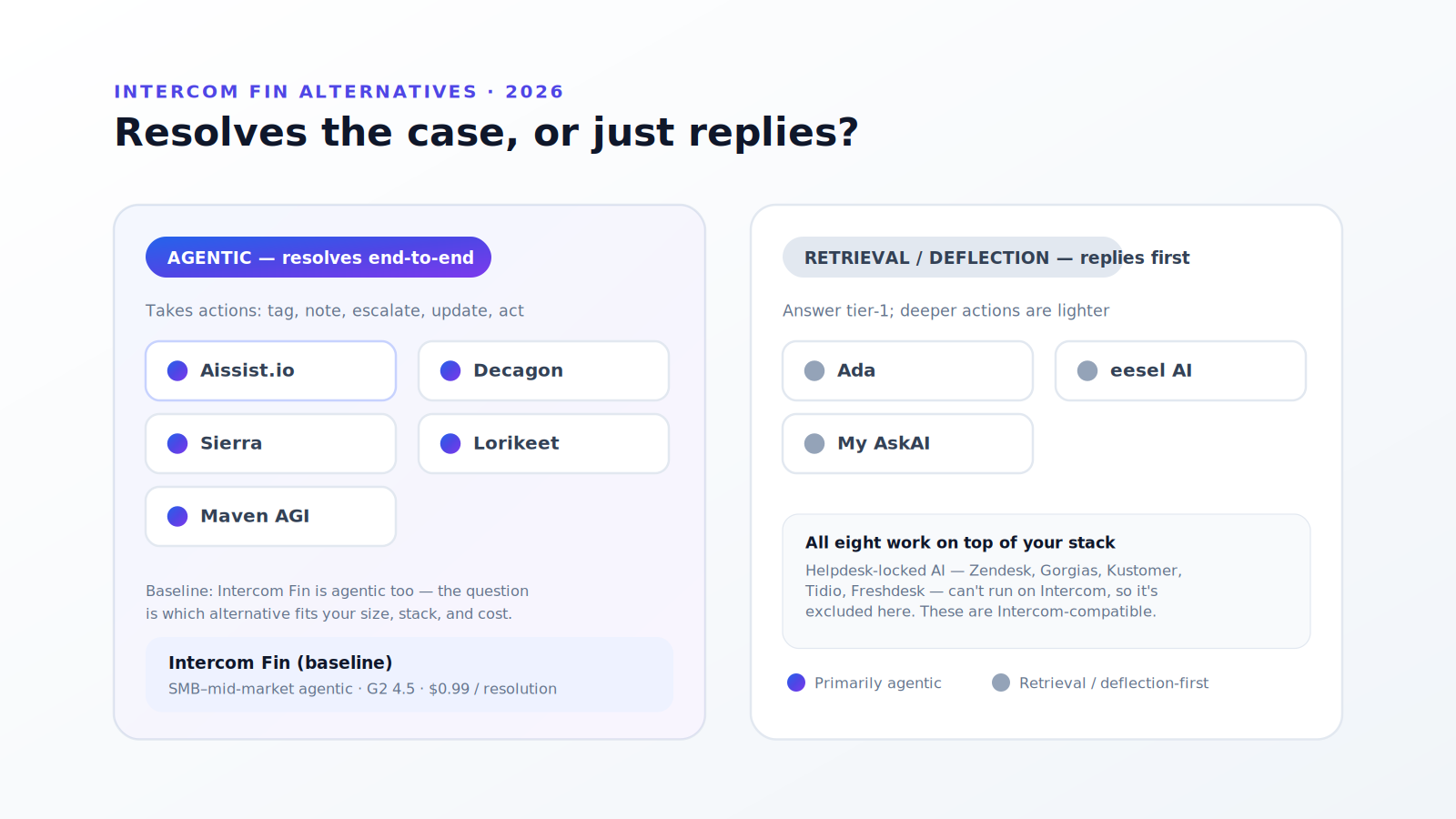
If none of the three apply, close this tab and go do something else. If one or more does, the rest of this page is the comparison. If you are staying on Intercom and only want to swap the AI layer, our Intercom Fin alternatives guide covers the eight helpdesk-agnostic agents that run on top of Intercom; this page is the broader question of whether to leave the platform at all.
The renewal-timing decision tree
Your renewal date decides your move, not the acquisition. Find your row:
| Your situation | The move | Why |
|---|---|---|
| Renewal in 0–6 months, Salesforce-native stack | Renew, and ask for 24-month price protection in writing | You are now a strategic customer of the acquirer. Use that once |
| Renewal in 0–6 months, non-Salesforce helpdesk | Run a two-vendor bake-off now, renew short (12 months) | Short term keeps the option open without a rushed migration |
| Renewal in 6–18 months, spend under ~$1,000/month | Do nothing. Re-check in Q2 2027 | Migration cost exceeds any plausible saving at this volume |
| Renewal in 6–18 months, spend over ~$3,000/month | Benchmark unit cost this quarter, decide next quarter | The saving is real at this volume; the deadline is not urgent |
| Multi-year term with no price-protection clause | Ask now, in writing, what is guaranteed through term | Written answers age better than account-manager reassurance |
| You were already unhappy with resolution quality | The acquisition is irrelevant. Evaluate on performance | Ownership does not fix a workload-fit problem |
The five questions worth sending to your account team, adapted from Richpanel's July 2026 analysis (read September 2026 — note that its forecast of a fiscal Q4 2027 close was overtaken by the actual 10 September 2026 completion): what changes at renewal, what standalone investment continues, which features are guaranteed through term, what data export you get, and what migration support exists if you leave.
How we compared these platforms
Six criteria, scored 0–5 each, with a 65% minimum to be listed. Here they are:
- Billing transparency — is the price published, with its unit, or is it quote-only?
- Deployment model — does it sit on the helpdesk you already run, or replace it?
- Action capability — can the agent execute (refund, order lookup, subscription change), or only answer?
- Performance evidence — is there a resolution figure, and is its definition disclosed?
- Stack neutrality — is the vendor's roadmap independent of a helpdesk it also sells?
- Third-party validation — G2 rating and review count, read September 2026.
What disqualifies a tool: no AI agent that can resolve autonomously (co-pilot-only products are out), no published G2 presence, or a product that requires replacing your helpdesk with no option to deploy onto it — unless the replacement is the point, as with Kustomer.
The bias disclosure: we will declare it up front — this is our blog, Aissist.io is one of the nine, and we rank it first. The reason is structural rather than loyalty: criterion 1 (published per-resolution pricing) and criterion 5 (stack neutrality) are two of six criteria, and Aissist scores at the top of both. It does not win criteria 4 or 6, and its cons list below is real. Three of the nine vendors here publish no price at all, which is the fact that shapes most of this table.
Pricing was read from each vendor's own live pricing page in September 2026. Where a vendor publishes nothing, the row says "quote only" and links the page anyway. Third-party estimates, where used, are labelled as reported and sourced to Aissist's AI Agent Pricing Benchmark (figures read from their sources 24 August 2026).
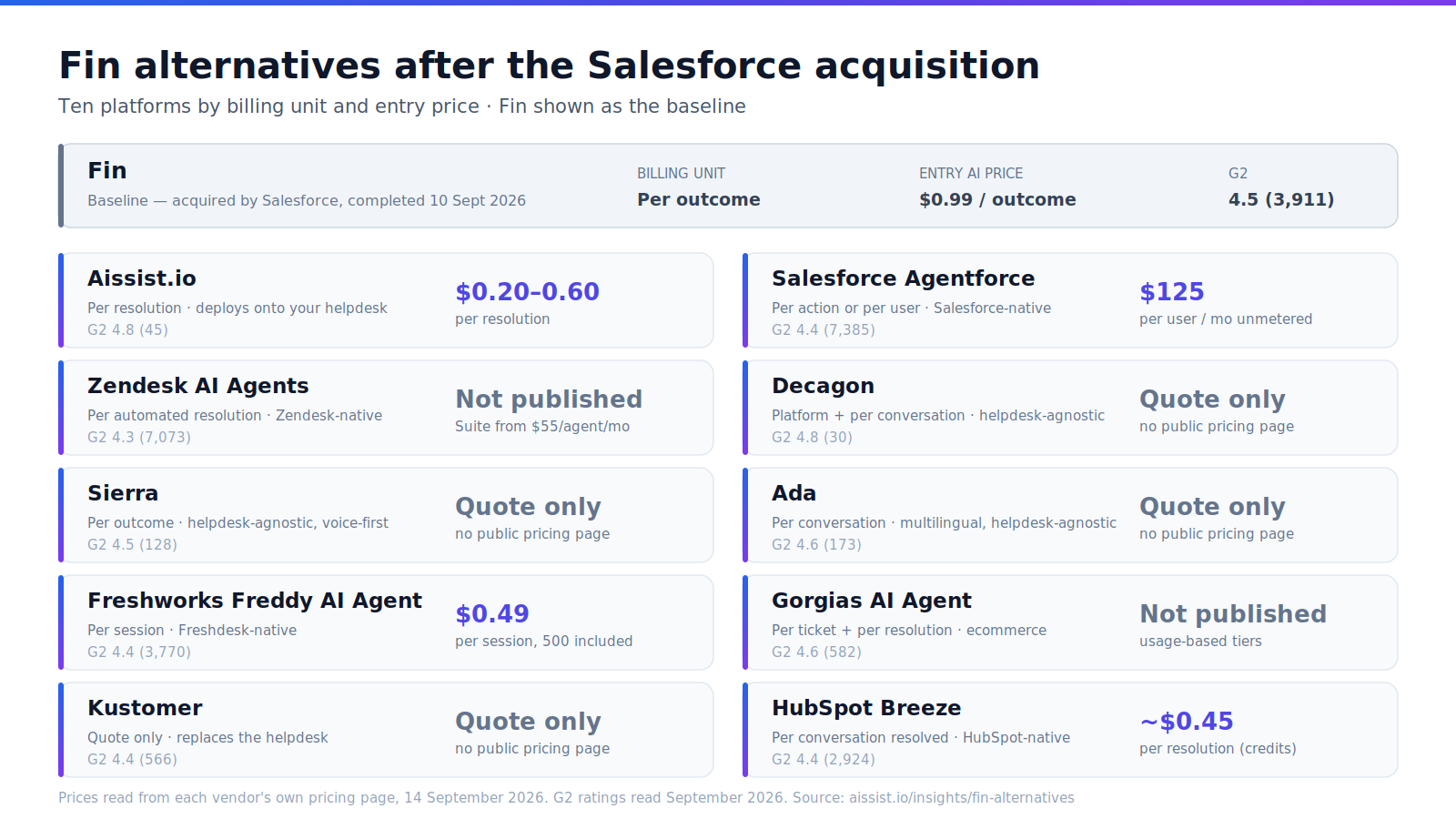
The 9 Fin alternatives at a glance
| Platform | Best for | Technology | Billing unit | Entry AI price | Deploys onto existing stack | G2 (read Sept 2026) |
|---|---|---|---|---|---|---|
| Fin (the incumbent, for reference) | The baseline you are comparing against | Agentic | Per outcome | $0.99/outcome, 50-outcome monthly minimum on non-Intercom helpdesks | Yes | 4.5 (3,911) |
| 1. Aissist.io | Per-resolution cost control on your current helpdesk | Multi-agent / agentic | Per resolution | $0.20–$0.60/resolution; free tier to 1,000 tickets/mo | Yes | 4.8 (45) |
| 2. Salesforce Agentforce | Salesforce-native teams who should stay | Agentic | Per action (Flex Credits) or per user | $125/user/mo unmetered, or $5/user/mo metered + Flex Credits | No — Salesforce-native | 4.4 (7,385) |
| 3. Zendesk AI Agents | Teams standardised on Zendesk | Agentic | Per automated resolution | Included in Suite plans from $55/agent/mo; per-resolution rate not published | No — Zendesk-native | 4.3 (7,073) |
| 4. Decagon | Enterprise CX with heavy custom workflows | Agentic | Platform + per conversation | Quote only | Yes | 4.8 (30) |
| 5. Sierra | Voice-plus-chat enterprise deployments | Agentic | Per outcome | Quote only | Yes | 4.5 (128) |
| 6. Freshworks Freddy AI Agent | Budget-conscious mid-market | Generative-retrieval + actions | Per session | $0.49/session after 500 included; Freshdesk from $19/agent/mo | No — Freshworks-native | 4.4 (3,770) |
| 7. Gorgias AI Agent | Shopify ecommerce | Agentic | Per ticket + per AI resolution | Usage-based; tier prices not published | No — Gorgias-native | 4.6 (582) |
| 8. Kustomer | Conversation-heavy CX on a unified data model | Agentic | Quote only | Quote only | No — Kustomer-native | 4.4 (566) |
| 9. HubSpot Breeze Customer Agent | HubSpot-native revenue teams | Agentic | Per conversation resolved (credits) | ~$0.45/resolution (50 credits at $9.00/1,000, annual) | No — HubSpot-native | 4.4 (2,924) |
The billing-unit column is the one worth screenshotting. Six different units appear in nine rows — per outcome, per resolution, per action, per session, per conversation, per seat — and vendors are not being coy by accident. A price is not comparable to another price until the units match, which is what the cost section below does.
Who each one is built for
| Platform | Best-fit team | Channels the agent handles | Runs on / integrates with | Time to first live ticket | Stated security posture |
|---|---|---|---|---|---|
| Aissist.io | SMB to mid-market | Chat, email, WhatsApp, SMS, social, forms | Intercom, Zendesk, Freshdesk, Kustomer, Front, Gorgias, Salesforce, HubSpot | ~10 minutes (vendor-claimed) | GDPR, ISO 27001 |
| Salesforce Agentforce | Mid-market to enterprise | Chat, email, voice, messaging | Salesforce Service Cloud | Weeks | Salesforce Trust platform |
| Zendesk AI Agents | SMB to enterprise | Chat, email, voice, messaging, social | Zendesk Suite | Days | SOC 2, ISO 27001, GDPR |
| Decagon | Mid-market to enterprise | Chat, email, voice, SMS | Zendesk, Intercom, Salesforce and others | Weeks | SOC 2, GDPR |
| Sierra | Enterprise | Chat, voice, email, SMS | Helpdesk-agnostic, API-led | Weeks | SOC 2, GDPR |
| Freshworks Freddy | SMB to mid-market | Chat, email, WhatsApp, social | Freshdesk, Freshchat | Days | SOC 2, ISO 27001, GDPR |
| Gorgias AI Agent | SMB to mid-market ecommerce | Chat, email, SMS, voice, social | Gorgias, with Shopify depth | Days | SOC 2, GDPR |
| Kustomer | Mid-market to enterprise | Chat, email, voice, SMS, WhatsApp, social | Kustomer platform | Weeks | SOC 2, GDPR, HIPAA add-on |
| HubSpot Breeze | SMB to mid-market | Chat, email, WhatsApp | HubSpot Service Hub | Days | SOC 2, GDPR |
Security postures in this table are as stated by each vendor on its own trust or security pages. Certifications rotate; verify yours in procurement rather than in a blog table, including this one.
1. Aissist.io — best for per-resolution cost control on your existing helpdesk
Aissist.io is a multi-agent AI operational layer that resolves customer service and sales conversations end to end on top of the helpdesk a company already runs, priced per resolution rather than per seat.
Technology: Multi-agent / agentic. Deploys onto: Intercom, Zendesk, Freshdesk, Kustomer, Front, Gorgias, Salesforce, HubSpot — it does not replace the helpdesk. Channels: chat, email, WhatsApp, SMS, social, web forms. Actions: executes — order lookups, refunds, subscription changes and CRM writes, not answer-only.
Performance: 83% resolution across projects and up to 98% on sales and support, with 4.8/5.0 CSAT from automated service (vendor-claimed, aissist.io, read September 2026). Like every performance figure on this page, ours is vendor-claimed on our own definition of resolution and is not independently audited — which is exactly the problem the section below is about.
G2: 4.8 (45 reviews), read September 2026 · Cost: $0.20–$0.60 per resolution depending on channel, metered per AI interaction and capped at the resolution price, per Aissist's pricing page (read 14 September 2026). Escalated cases are not charged. Free tier covers 1,000 tickets/month. No seat fee, no minimum.
Pros:
- Publishes an actual per-resolution price range with the charge trigger stated, which three of the nine vendors here do not.
- Sits on the helpdesk you already run — eight native integrations, no migration, ~10 minutes to deploy (vendor-claimed).
- Publishes its own fleet-wide resolution data under a strict definition, including the unflattering version.
Cons:
- 45 G2 reviews is a small evidence base next to Zendesk's 7,073 or Fin's 3,911 — real buyers should weight that.
- Configuration takes meaningful setup time before performance lands; multiple G2 reviewers flag the setup interface specifically.
- SMB and mid-market focus means large-enterprise procurement requirements (dedicated VPC, custom DPAs, formal RFP support) are a thinner story than Salesforce's.
Our take: Pick Aissist if your Fin bill is the problem and your helpdesk is not — the per-resolution model with no seat fee is the cleanest like-for-like swap on this list. Do not pick it if you need an enterprise procurement process with a large reference base, or if you were planning to replace your helpdesk anyway. See Decagon vs Sierra vs Aissist for the three-way version of this comparison.
2. Salesforce Agentforce — best for Salesforce-native teams who should stay
Salesforce Agentforce is the native AI agent layer inside Salesforce Service Cloud, resolving customer cases using Salesforce data and executing actions through Salesforce flows, and it is now the platform that owns Fin.
Technology: Agentic. Deploys onto: Salesforce Service Cloud — it is the stack, not a layer on it. Channels: chat, email, voice, messaging. Actions: executes through Salesforce flows and Apex.
Performance: 62% case resolution, compared to Fin's 76% (reported, Salesforce Ben, 16 June 2026). Salesforce bought the higher number, which is the most honest summary of this deal available.
G2: 4.4 (7,385 reviews) as Agentforce Service, read September 2026 · Cost: Service Cloud editions run $25 (Starter Suite), $100 (Pro Suite), $195 (Core), $395 (Advanced) and $550 (Max) per user per month; the Agentforce add-on is $125/user/month unmetered, or $5/user/month metered plus Flex Credits, per Salesforce's pricing pages (read 14 September 2026). Salesforce's own worked example puts case management at 3 actions = 60 credits = $0.30.
Pros:
- Now owns both Agentforce and Fin, so a Salesforce-native buyer has the clearest roadmap on this list.
- Deep native access to Salesforce data and flows without an integration layer.
- Published per-action credit examples, which is more pricing transparency than most enterprise vendors offer.
Cons:
- Lowest published resolution rate of the two agents Salesforce owns (62% versus Fin's 76%, reported by Salesforce Ben, 16 June 2026).
- Only viable if you are on Salesforce — there is no meaningful deploy-onto-someone-else's-helpdesk story.
- Flex Credits make total cost hard to forecast before deployment; the per-action model rewards simple cases and punishes multi-step ones.
Our take: If you run Service Cloud, this acquisition just made your roadmap better and your answer is to stay and consolidate. Do not pick Agentforce if your helpdesk is anything other than Salesforce — the economics stop making sense the moment you are paying for a platform you do not otherwise use.
3. Zendesk AI Agents — best for teams already standardised on Zendesk
Zendesk AI Agents are the native autonomous agents inside Zendesk Suite, resolving tickets across chat, email and voice and billed on automated resolutions rather than per seat.
Technology: Agentic, with Forethought's technology folded in after Zendesk's acquisition. Deploys onto: Zendesk Suite. Channels: chat, email, voice, messaging, social. Actions: executes via Zendesk actions and APIs.
Performance: Zendesk states that customers "pay only for customer requests that were successfully resolved by the AI agent, without any escalation to a human agent" (vendor-claimed, Zendesk pricing page, read 14 September 2026). Zendesk does not publish a single headline resolution rate on that page, which is a defensible choice and an inconvenient one.
G2: 4.3 (7,073 reviews), read September 2026 · Cost: Suite Team $55/agent/month and Suite Professional $115/agent/month paid yearly; Copilot add-on $50/agent/month; AI agents are included in every Suite and Support plan with pricing based on successful outcomes, but the per-resolution rate is not published — contact sales (Zendesk pricing, read 14 September 2026). Third-party procurement data puts the effective rate at roughly $1.50–$2.00 per resolution (reported, Aissist AI Agent Pricing Benchmark, figures read 24 August 2026).
Pros:
- Largest review base on this list at 7,073 G2 reviews, which is real evidence rather than a logo wall.
- Charges only on resolutions that avoid human escalation — a genuinely aligned billing trigger.
- Mature voice, workforce management and compliance tooling for teams that need all three.
Cons:
- Per-resolution price is not published, so you cannot model cost without a sales conversation.
- Lowest G2 rating in this comparison at 4.3, across the largest sample.
- Requires the Zendesk Suite, and the total cost of a $115/agent/month plan plus resolutions is what you are actually buying.
Our take: Zendesk AI Agents make sense if Zendesk is already your system of record and you are not going to move it. Do not pick it if you are shopping specifically to escape platform lock-in — you would be trading one vendor's roadmap for another's. Our Zendesk Action Credits write-up covers what changed in their billing this month.
4. Decagon — best for enterprise CX with heavy custom workflows
Decagon is an enterprise AI support platform that builds conversational agents on top of a company's existing helpdesk and back-office systems, with heavy emphasis on configurable workflows and guardrails.
Technology: Agentic. Deploys onto: Zendesk, Intercom, Salesforce and others — helpdesk-agnostic. Channels: chat, email, voice, SMS. Actions: executes against connected systems.
Performance: Decagon publishes customer outcomes through named case studies rather than a single fleet-wide rate; the platform is positioned as "the most advanced AI platform for customer support," with Eventbrite, Webflow and Substack named on its G2 profile (vendor-claimed, G2, read September 2026).
G2: 4.8 (30 reviews), read September 2026 · Cost: Quote only — Decagon publishes no public pricing page. Third-party procurement data reports roughly $50K/year platform plus ~$0.99 per conversation (reported, Aissist AI Agent Pricing Benchmark, figures read 24 August 2026).
Pros:
- Highest G2 rating on this list at 4.8, alongside Aissist.
- Helpdesk-agnostic, so it survives a future helpdesk migration.
- Strong enterprise references in ticketing, developer tools and publishing.
Cons:
- 30 G2 reviews is the smallest sample here — high rating, thin base.
- No published pricing at all, and reported platform minimums near $50K/year put it out of reach for most SMBs.
- Platform-plus-usage pricing means the effective per-resolution cost rises sharply at low volume.
Our take: Decagon fits enterprise teams with complex, bespoke workflows and a budget that clears a platform minimum. Do not pick it if you resolve fewer than a few thousand conversations a month — the platform fee swamps the unit economics. See our Decagon vs Sierra vs Aissist buyer's guide.
5. Sierra — best for voice-plus-chat enterprise deployments
Sierra is a conversational AI platform that deploys branded customer-facing agents across voice and chat for enterprises, connecting to existing business systems through APIs rather than sitting inside one helpdesk.
Technology: Agentic. Deploys onto: helpdesk-agnostic, API-led. Channels: chat, voice, email, SMS. Actions: executes against connected systems.
Performance: Sierra publishes no fleet-wide resolution rate. Its commercial model is outcome-based, meaning the vendor is paid when the agent resolves rather than per conversation (reported, Aissist AI Agent Pricing Benchmark, figures read 24 August 2026).
G2: 4.5 (128 reviews), read September 2026 · Cost: Quote only — no public pricing page. Reported effective rates run about $1.50 per resolution, or $1.50–$2.50 loaded (reported, Aissist AI Agent Pricing Benchmark, figures read 24 August 2026).
Pros:
- Strongest voice story on this list for enterprises replacing IVR as well as chat.
- Outcome-based pricing aligns vendor incentive with resolution rather than usage.
- Helpdesk-agnostic and API-led, so it fits unusual or homegrown stacks.
Cons:
- Publishes no pricing, so budgeting requires a sales cycle before you learn the number.
- Enterprise-weighted: implementation runs in weeks, not days, which rules out fast pilots.
- 128 G2 reviews is modest relative to the incumbents you would be replacing.
Our take: Sierra is the pick when voice is a first-class channel rather than a roadmap item and you have enterprise implementation capacity. Do not pick it if you want to be live this month or need a published price before a meeting. Our Sierra AI review goes deeper.
6. Freshworks Freddy AI Agent — best for budget-conscious mid-market
Freddy AI Agent is Freshworks' native autonomous agent inside Freshdesk and Freshchat, resolving customer conversations and billed per session rather than per resolution.
Technology: Generative-retrieval with action capability. Deploys onto: Freshdesk and Freshchat. Channels: chat, email, WhatsApp, social. Actions: executes via Freshworks automations and integrations.
Performance: Freshworks includes the first 500 Freddy AI Agent sessions on every Freshdesk tier (vendor-claimed, Freshdesk pricing, read 14 September 2026). Freshworks does not publish a headline resolution rate on the pricing page.
G2: 4.4 (3,770 reviews) for Freshdesk, read September 2026 · Cost: Freshdesk Growth $19, Pro $55 and Enterprise $89 per agent per month billed annually; Freddy AI Agent includes the first 500 sessions, with additional sessions at $49 per 100 — $0.49 per session; Freddy AI Copilot is $29/agent/month (Freshdesk pricing, read 14 September 2026).
Pros:
- Lowest published entry point on this list at $19/agent/month plus 500 included AI sessions.
- Per-session pricing is published with a clear number, which most enterprise vendors decline to do.
- Full helpdesk plus agent from one vendor, with one contract and one support line.
Cons:
- Billed per session, not per resolution — you pay whether or not the customer's issue was solved, which is the least buyer-aligned trigger here.
- Requires Freshdesk or Freshchat; there is no deploy-onto-your-existing-helpdesk option.
- At a 30% escalation rate, the effective cost per resolved conversation is meaningfully above the $0.49 headline.
Our take: Freddy is the value pick for mid-market teams already on Freshworks or willing to move there. Do not pick it if you want to pay only for outcomes — the session unit means you fund the failures too.
7. Gorgias AI Agent — best for Shopify ecommerce
Gorgias AI Agent is an ecommerce-native autonomous agent inside the Gorgias helpdesk, resolving order, shipping and returns conversations with deep Shopify integration and billed only when it resolves without human handoff.
Technology: Agentic. Deploys onto: Gorgias, with native Shopify depth. Channels: chat, email, SMS, voice, social. Actions: executes order lookups, refunds, cancellations and returns.
Performance: Gorgias charges an automation fee "when AI Agent resolves a ticket without human handoff," and a single ticket can incur both a helpdesk fee and an automation fee (vendor-documented, Gorgias billing docs, read 14 September 2026). That double-charge mechanic is disclosed clearly, which is more than most.
G2: 4.6 (582 reviews), read September 2026 · Cost: Usage-based — per ticket replied to from the helpdesk, plus a per-resolution automation fee. Gorgias's public pricing page describes the model but does not list tier prices or the per-resolution rate; its docs direct customers to their in-account billing page (Gorgias pricing and billing docs, read 14 September 2026). Third-party data reports $0.90–$1.00 per resolution (reported, Aissist AI Agent Pricing Benchmark, figures read 24 August 2026).
Pros:
- Best ecommerce depth here — order, shipping and returns actions work out of the box on Shopify.
- Never priced per agent, so adding seasonal headcount does not raise the subscription.
- Automation fee triggers only on resolution without handoff.
Cons:
- A ticket can incur both the helpdesk fee and the automation fee, so the effective cost per resolved ticket is higher than the automation fee alone.
- Tier prices are not listed on the public pricing page, which makes pre-sales modelling harder than it should be.
- Ecommerce-shaped: B2B, SaaS and services support are outside the sweet spot.
Our take: Gorgias is the obvious pick for a Shopify merchant already running Gorgias. Do not pick it if you are not in ecommerce, or if you need a single published number before a budget meeting. Our Gorgias alternatives guide has the seven-way comparison.
8. Kustomer — best for conversation-heavy CX on a unified data model
Kustomer is a customer experience platform built around a unified customer data model rather than a ticket queue, with AI agents that resolve conversations using the full customer timeline.
Technology: Agentic on a unified data model. Deploys onto: the Kustomer platform — it replaces the helpdesk. Channels: chat, email, voice, SMS, WhatsApp, social. Actions: executes against connected systems.
Performance: Kustomer publishes no fleet-wide resolution rate. Its own post-acquisition comparison page argues the case on architecture and cites its G2 standing rather than a resolution figure (observed, Kustomer, read September 2026).
G2: 4.4 (566 reviews), read September 2026 · Cost: Quote only. Kustomer states plainly: "Every CX team's setup is different, so we don't post one-size-fits-all pricing," with Voice, SMS and WhatsApp billed pay-as-you-go (Kustomer pricing, read 14 September 2026).
Pros:
- Customer-timeline data model handles conversation-heavy, relationship-driven support better than a ticket queue.
- Broadest native channel coverage on this list including voice, SMS and WhatsApp.
- HIPAA-enabled subscription available for regulated workloads.
Cons:
- No published pricing of any kind, including for the AI agent.
- Replacing your helpdesk is the deployment model, which makes it a migration rather than an addition.
- Moving off Fin to Kustomer trades one platform's roadmap risk for another's, which its own acquisition page does not address.
Our take: Kustomer fits teams that were already going to replace their helpdesk and want the data model to be the reason. Do not pick it if you only wanted to swap the AI layer — you would be buying a migration you did not ask for.
9. HubSpot Breeze Customer Agent — best for HubSpot-native revenue teams
HubSpot Breeze Customer Agent is the native AI agent in HubSpot Service Hub, resolving customer conversations using HubSpot CRM data and billed in credits per conversation resolved.
Technology: Agentic. Deploys onto: HubSpot Service Hub. Channels: chat, email, WhatsApp. Actions: executes against HubSpot CRM objects and workflows.
Performance: HubSpot charges 50 credits per conversation resolved, meaning the billing trigger is resolution rather than activity (vendor-documented, HubSpot Service Hub pricing, read 14 September 2026). HubSpot does not publish a headline resolution rate on that page.
G2: 4.4 (2,924 reviews) for Service Hub, read September 2026 · Cost: Service Hub Starter $20, Professional $100 and Enterprise $150 per seat per month on annual terms, with 500, 3,000 and 5,000 credits included respectively; Breeze bills 50 credits per conversation resolved, and credits cost $9.00 per 1,000 paid annually — about $0.45 per resolution (HubSpot pricing, read 14 September 2026). Professional and Enterprise carry one-time onboarding fees of $1,500 and $3,500.
Pros:
- Lowest published per-resolution cost on this list at roughly $0.45, derived from HubSpot's own credit rate.
- Billing trigger is a resolved conversation, not a session or a message.
- Service, sales and marketing data sit in one CRM, which matters for revenue-adjacent support.
Cons:
- Requires HubSpot Service Hub, and the seat price plus mandatory onboarding fee is the real entry cost.
- Narrower channel coverage than most here — no native voice agent.
- Credit pooling across Breeze features makes per-conversation forecasting less clean than a flat rate.
Our take: Breeze is the value answer for teams whose CRM is already HubSpot and whose support volume is moderate. Do not pick it if you need voice, or if you run your helpdesk somewhere else — the $1,500 onboarding fee is a poor way to discover that.
What these platforms actually cost at 2,000 tickets a month
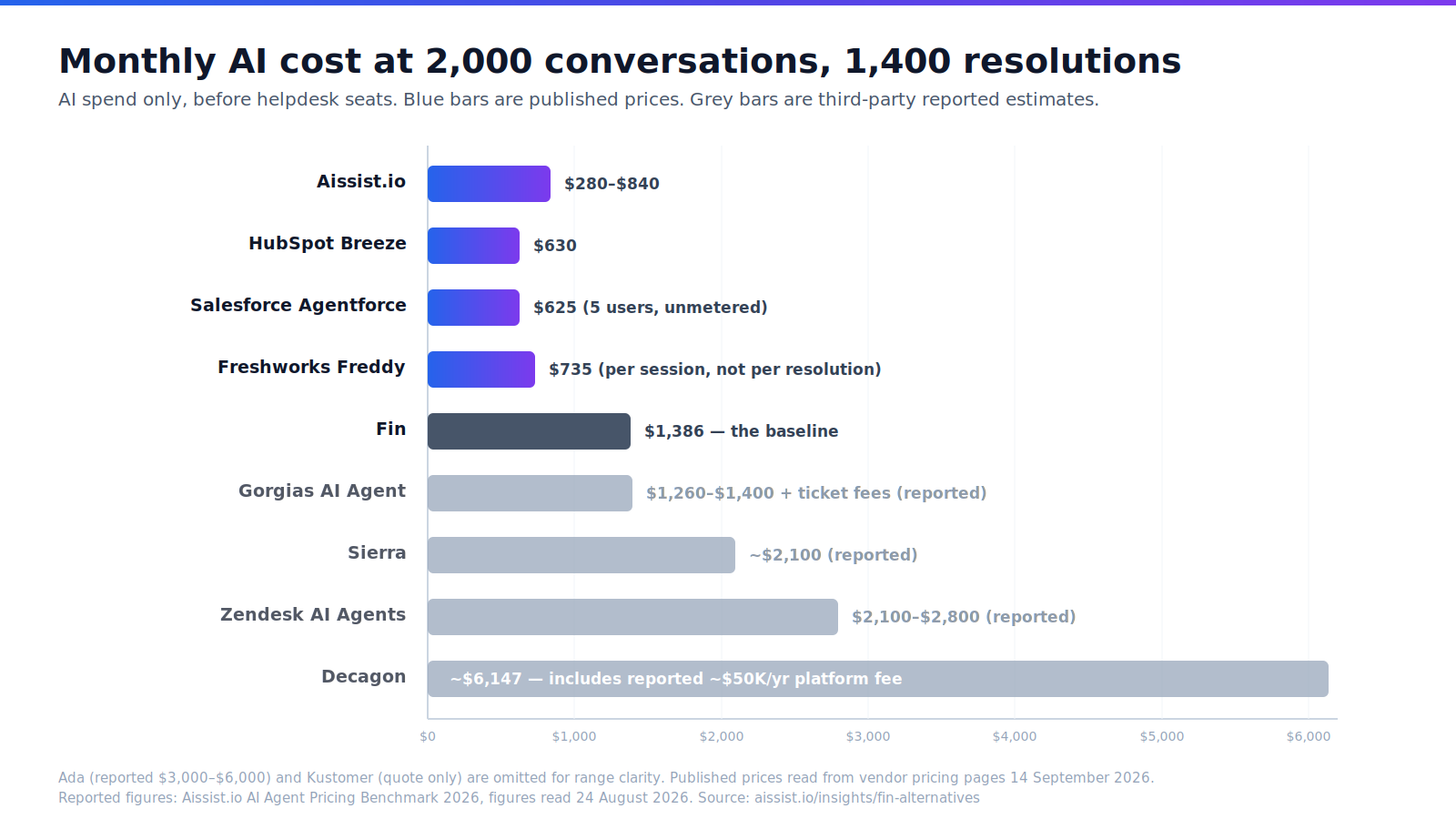
A team resolving 2,000 conversations a month with AI pays between roughly $900 and $4,000 depending on the billing unit alone. Here is the same workload run through each published model: 2,000 AI-handled conversations, 70% resolved without escalation (1,400 resolutions), five human agents on the helpdesk.
| Platform | Billing unit | Unit price (read Sept 2026) | AI cost/month | Helpdesk cost/month (5 seats) | Total/month |
|---|---|---|---|---|---|
| Fin | Per outcome | $0.99 | $1,386 | $145 ($29/seat) | ~$1,531 |
| Aissist.io | Per resolution | $0.20–$0.60 | $280–$840 | $0 (uses your existing helpdesk) | ~$280–$840 + your current helpdesk |
| HubSpot Breeze | Per conversation resolved | ~$0.45 (50 credits at $9/1,000) | $630 | $500 (Professional, $100/seat) | ~$1,130 |
| Freshworks Freddy | Per session | $0.49 (first 500 included) | $735 | $275 (Pro, $55/agent) | ~$1,010 |
| Gorgias AI Agent | Per ticket + per resolution | $0.90–$1.00 reported, plus ticket fee | $1,260–$1,400 + ticket fees | Usage-based, not published | Not fully modellable |
| Zendesk AI Agents | Per automated resolution | $1.50–$2.00 reported | $2,100–$2,800 | $575 (Suite Professional, $115/agent) | ~$2,675–$3,375 |
| Salesforce Agentforce | Per action or per user | $125/user/mo unmetered | $625 | $975 (Core, $195/user) | ~$1,600 |
| Decagon | Platform + per conversation | ~$50K/yr + ~$0.99 reported | ~$4,167 + $1,980 | Uses your existing helpdesk | ~$6,147 |
| Sierra | Per outcome | ~$1.50 reported | ~$2,100 | Uses your existing helpdesk | ~$2,100 + your helpdesk |
| Kustomer | Quote only | Not published | Not modellable | Not published | Quote only |
Published prices come from each vendor's own pricing page, read 14 September 2026 and linked in the blocks above. Figures marked reported come from third-party procurement data compiled in Aissist's AI Agent Pricing Benchmark (read 24 August 2026) and should be treated as estimates, not quotes.
The hidden costs that move the total more than the unit price:
- The required host-platform tier. A $0.99 outcome on a $115/agent/month Suite is not a $0.99 decision. Zendesk's five-seat helpdesk cost alone is $575/month before a single resolution.
- Onboarding fees. HubSpot Professional carries a one-time $1,500 fee and Enterprise $3,500 (HubSpot pricing, read September 2026).
- Platform minimums. Decagon's reported ~$50K/year floor dominates the model at any volume below several thousand conversations a month.
- The unit that charges for failure. Per-session and per-ticket billing charges you for conversations the AI did not solve. Per-resolution billing does not. Over 24,000 conversations a year, that distinction is worth more than the headline rate.
- Minimums. Fin applies a 50-outcome monthly minimum when used with non-Intercom helpdesks (Fin pricing, read September 2026) — immaterial at 2,000 tickets, material at 200.
Aissist's AI customer service benchmark puts the AI unit cost range across the category at $0.50–$2.37, with an all-in estimate near $5 once integration and engineering time are counted (compiled from 40-plus publications, vendor claims re-read 24 August 2026). The all-in number is the one your CFO will eventually find.
What the 76% resolution rate actually tells you
Salesforce's press release puts Fin's average resolution rate at 76% across 30,000+ customers, a vendor-claimed figure published on 10 September 2026 (read 14 September 2026). It is a real number from a serious product. It is also not directly comparable to any other number on this page, including ours, and here is why that matters more than the comparison itself.
Resolution rate has no standard definition in this category. Some vendors count a conversation resolved when the customer does not reply again. Some count it when the customer confirms. Some count deflection — the customer left the chat — as resolution. A 76% under one definition and a 60% under another can describe identical performance.
Our own figure is subject to exactly the same caveat. Aissist markets 83% resolution across projects and up to 98% on sales and support (vendor-claimed, aissist.io, read September 2026) — a vendor-claimed number on our own definition, published without an independent audit, which is the same standing as Fin's 76%. Comparing the two as though they measured the same thing would be a mistake, and we are not going to invite you to make it.
The variance between deployments matters more than the gap between vendors. Resolution rate on identical technology swings enormously with workload composition, how much of the customer's system the agent is connected to, and what escalation policy sits behind it. The vendor is constant across those deployments. The workload is not.
The practical consequence: the gap between a 76% vendor and an 83% vendor is smaller than the gap between your easiest ticket type and your hardest. Buying on a published rate differential of seven points is buying noise. Buy on unit economics, on whether the agent can execute actions or only answer, and on whether it deploys onto the stack you already run — those three are verifiable before you sign. Then run a two-week pilot on your own ticket mix and measure it yourself, using one definition applied to both vendors.
For context on where the category actually sits, Aissist's industry benchmark puts median tier-1 automation near 41% with a top quartile around 59% and best-in-class above 80%, compiled from 40-plus publications with vendor claims re-read 24 August 2026. Published vendor rates cluster well above the measured median, which tells you something about published vendor rates.
How to choose the right Fin alternative
Eight conditional rules. Find the one that describes you.
If your stack is Salesforce Service Cloud, then stay on Fin or consolidate onto Agentforce, because you are now a customer of the acquirer and this is the one scenario where the acquisition creates leverage rather than risk.
If your renewal is more than 12 months out and your AI spend is under $1,000/month, then do nothing until Q2 2027, because migration cost and re-tuning time exceed any plausible saving at that volume.
If your per-resolution spend exceeds $2,000/month on a non-Salesforce helpdesk, then benchmark per-resolution vendors this quarter, because a $0.40 unit-price difference across 2,000 monthly resolutions is roughly $9,600 a year, which is worth two weeks of evaluation.
If you are paying per session or per ticket rather than per resolution, then price the swap first, because you are currently funding conversations the AI failed to solve, and that is the single largest recoverable line in most AI support budgets.
If you need voice as a first-class channel, then shortlist Sierra or Kustomer, because the per-resolution chat specialists treat voice as a roadmap item rather than a shipped product.
If you sell on Shopify, then shortlist Gorgias, because order, shipping and returns actions work out of the box and the ecommerce-specific ticket types are the bulk of your volume.
If you cannot get a published price from a vendor before the third sales call, then assume the price is high, because vendors who price competitively publish, and vendors who publish nothing are pricing you rather than the product.
If your current resolution rate disappoints you, then audit your ticket mix before you audit your vendor, because the same technology produces very different resolution rates across deployments, and the workload explains more of that than the logo does.
What is an AI customer service agent, and how is it different from a chatbot?
An AI customer service agent is software that resolves a customer's request end to end — understanding the issue, retrieving the relevant data, executing the required action, and closing the conversation — without a human handling it. A chatbot answers; an agent acts. That distinction is the whole category.
The practical test is whether the software can change something in a system of record. A chatbot can tell a customer your return window is 30 days. An agent can look up the order, confirm it falls inside the window, issue the refund, update the CRM, and send the confirmation. Everything on this page can execute actions to some degree; the depth varies considerably.
Deflection and resolution are not synonyms. Deflection counts a conversation that did not reach a human, which includes customers who gave up. Resolution counts conversations where the issue was actually solved. Vendors who report deflection rates alongside resolution rates are usually reporting the larger number first, which is a sales decision rather than a lie, and worth reading carefully.
Agentic versus generative-retrieval describes how the software works. Generative-retrieval systems find the relevant document and generate an answer from it — fast, cheap, and brittle when a request needs several steps. Agentic systems plan a sequence, call tools, check results, and adapt — slower per turn and far more capable on multi-step requests. Most vendors now call themselves agentic. Some of them mean it.
Why the billing unit is the most important line in any contract. Four units dominate this category and they distribute risk very differently:
| Billing unit | You pay when | Who carries the risk |
|---|---|---|
| Per resolution / per outcome | The AI solves the issue without escalation | The vendor |
| Per conversation | A conversation starts, solved or not | You |
| Per session | A session runs, solved or not | You |
| Per seat | A human has a licence, regardless of AI volume | You, plus you pay twice during ramp |
Per-resolution pricing is the only unit where the vendor is paid for outcomes rather than activity. That is why it is the unit most likely to change after an acquisition by a company whose core business is seats — which brings this page back where it started.
What the acquisition does not change. Your data export rights, your contract term, and your current price are whatever your existing agreement says they are. Acquisitions do not rewrite signed contracts. They rewrite the offer you get at renewal, which is why the renewal-timing table above is the actionable part of this page and the vendor list is the optional part.
Keep your help desk, change the unit economics. Aissist.io adds an agentic AI layer to Intercom, Zendesk, Freshdesk, Gorgias, Kustomer, Front, Salesforce and HubSpot — resolving service and sales end-to-end at a published cost per resolution, with no migration. Get a free demo →
Frequently asked questions
What are the best alternatives to Intercom Fin in 2026?
The strongest Fin alternatives are Aissist.io for per-resolution cost control on an existing helpdesk, Decagon and Sierra for enterprise deployments, and the native agents in Zendesk, Freshworks, Gorgias, Kustomer and HubSpot if you are standardised on those platforms.
Did Salesforce actually complete the acquisition of Fin?
Yes. Salesforce completed the acquisition on 10 September 2026, according to Salesforce's press release (read September 2026). Fin now operates within Salesforce AI Labs. Analysis published before September that forecast a fiscal Q4 2027 close is out of date.
Should I switch away from Fin because of the Salesforce acquisition?
For most Salesforce-native teams, no. Fin resolves 76% of cases versus Agentforce's 62% (reported by Salesforce Ben, June 2026), so Salesforce bought the better agent. Switch only if your renewal is imminent, your helpdesk is not Salesforce, or your per-resolution spend already hurts.
How much does Fin cost after the Salesforce acquisition?
Fin still charges $0.99 per outcome with a 50-outcome monthly minimum on non-Intercom helpdesks, plus $29 per helpdesk seat per month when bundled with Intercom, per Fin's pricing page (read 14 September 2026). Qualification outcomes cost $9.99. No price change has been announced.
What is the cheapest alternative to Fin per resolution?
Aissist.io publishes $0.20–$0.60 per resolution with no seat fee (Aissist pricing, read September 2026), and HubSpot Breeze works out near $0.45 per resolved conversation on annual credits (HubSpot pricing, read September 2026). Breeze requires a HubSpot seat; Aissist deploys onto your existing helpdesk.
Will Fin still work with Zendesk and other non-Salesforce helpdesks?
Fin currently works with "help desks and systems companies already use," per Fin's own announcement (read September 2026). No change has been announced. Salesforce now owns a competing helpdesk, so get your integration commitments written into the contract rather than assumed.
Is a 76% resolution rate good for an AI support agent?
Yes, relative to the category. Aissist's industry benchmark puts median tier-1 automation near 41% and top quartile near 59% (compiled August 2026). But resolution definitions differ by vendor, so a 76% and an 83% from two vendors are not directly comparable.
How long does it take to migrate off Fin to another AI agent?
It depends on the deployment model. Agents that sit on your existing helpdesk (Aissist, Decagon, Sierra) avoid a helpdesk migration entirely and go live in minutes to weeks. Native agents (Zendesk, Freshworks, Gorgias, Kustomer, HubSpot) require moving your helpdesk first, which is a quarter, not a sprint.
What should I ask my Fin account manager right now?
Ask five things in writing: what changes at renewal, what standalone product investment continues, which features are guaranteed through your current term, what data export you receive if you leave, and what migration support exists. Written answers are the only ones worth anything in twelve months.
Which Fin alternatives publish their pricing?
Five of the nine publish usable numbers: Aissist.io ($0.20–$0.60/resolution), HubSpot Breeze (~$0.45/resolution via credits), Freshworks Freddy ($0.49/session), Salesforce Agentforce ($125/user/month unmetered), and Zendesk (plan prices, though not the per-resolution rate). Decagon, Sierra and Kustomer are quote-only — all read September 2026.
Is Intercom owned by Salesforce now?
Yes. Intercom renamed itself Fin on 12 May 2026, and Salesforce completed its acquisition of Fin on 10 September 2026. The help desk product is still called Intercom; the company that makes it is Fin, now a Salesforce company.
Changelog
- September 2026 (update) — Added entity clarification covering Intercom's 12 May 2026 rename to Fin and the distinction between the company, the help desk product and the AI agent. Upgraded the deal-value citation from secondary coverage to Salesforce's own June announcement. Added the acquisition timeline graphic.
- September 2026 — Page published following Salesforce's completion of the Fin acquisition on 10 September 2026. All pricing read from vendor pricing pages and all G2 ratings read 14 September 2026. Next scheduled refresh: February 2027.