Intercom Fin Review (2026): What It Costs, What It Resolves, and What Salesforce Changes
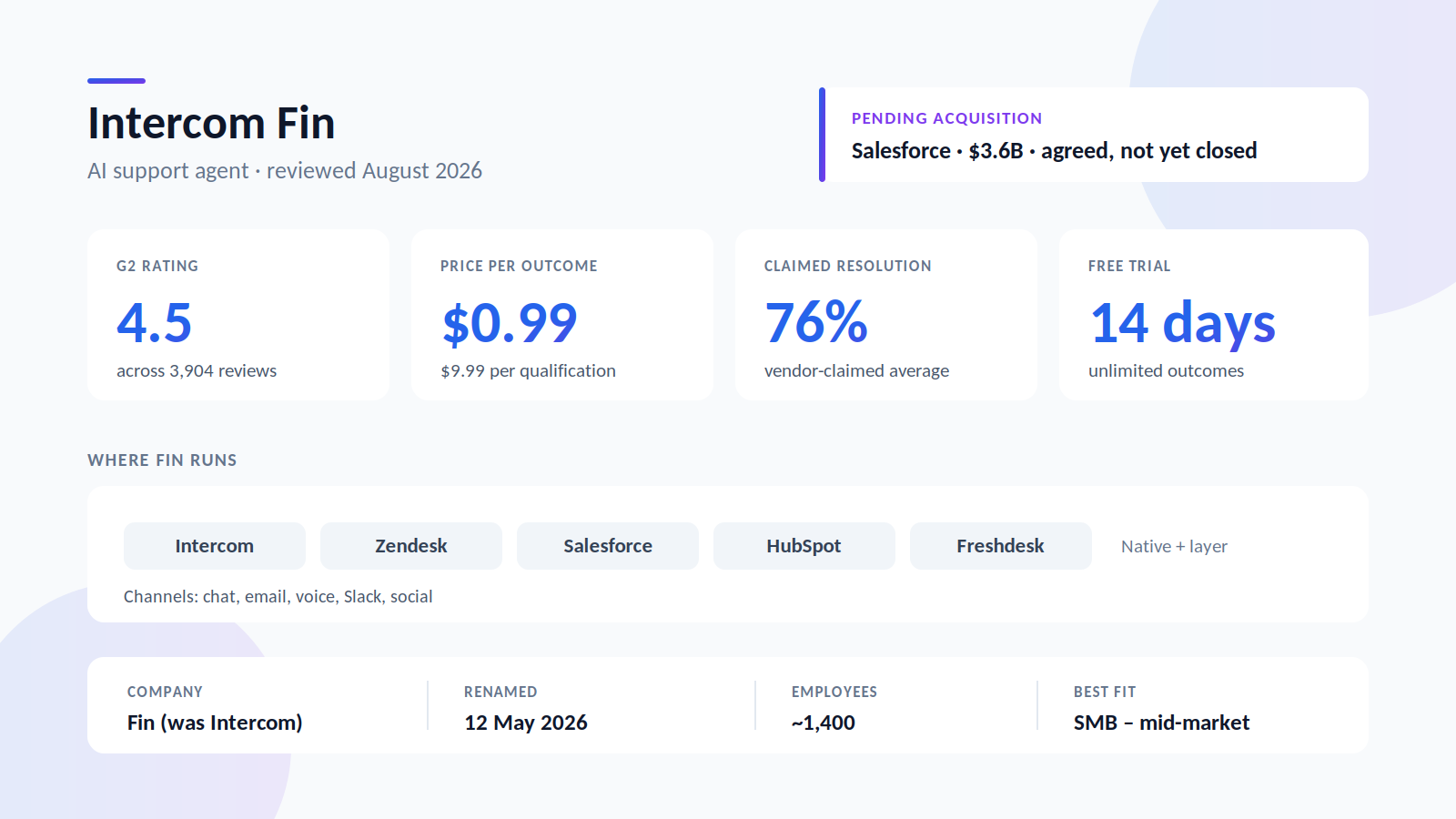
Intercom Fin is an AI support agent that resolves customer conversations end-to-end and bills $0.99 per outcome, and it is currently the most widely reviewed AI agent in the category at 4.5 on G2 across 3,904 reviews. Two things changed in 2026 that most articles about Fin have not caught up with: Intercom renamed the entire company to Fin on 12 May 2026, and Salesforce signed a definitive agreement to acquire it for $3.6 billion on 15 June 2026. This review covers what Fin does, what it really costs once you understand its four billable outcome types, where its resolution claims hold up, and what the pending Salesforce deal means for buyers. If you have already decided Fin is not the fit, go straight to our Intercom Fin alternatives guide.
TL;DR:
- What it is: An AI agent that resolves support conversations across chat, email, voice, Slack and social, running natively in Intercom or on top of Zendesk, Salesforce, HubSpot and Freshdesk.
- What it costs: $0.99 per outcome, with a separate $9.99 rate for lead qualifications. You are not charged when a conversation simply passes to your team.
- Company status: Intercom renamed itself Fin in May 2026. Salesforce agreed to acquire Fin for $3.6B in June 2026 — the deal has not closed yet, and is expected to close in Salesforce's Q4 FY2027 pending regulatory clearance.
- Best for: SMB and mid-market teams that want a published price, a real trial, and a fast deployment on the help desk they already run.
- Strongest capability: Transparent, outcome-based pricing and the deepest review base in the category by a wide margin.
- Biggest friction: What counts as a billable "resolution." Fin infers resolution from customer silence, and paying customers have publicly disputed how often that inference is wrong.
- Rating: 4.5/5 on G2 across 3,904 reviews, read 20 August 2026.
One thing to fix in your head before reading any Fin article, including this one: the company and the product now share a name. Fin is the AI agent, and Fin is also the company formerly called Intercom. Intercom is still the name of the help desk product.
Reviewed by M.W., Co-founder. Disclosure: this review is published by Aissist.io, which sells an agentic AI layer that competes with Fin. Ratings, prices and quotes come from Fin's and Salesforce's own pages, G2, Gartner Peer Insights and Intercom's public community forum, all captured in August 2026.
How we evaluated Fin, and who wrote this
We build a competing product. Aissist.io sells an agentic AI layer for customer service, so we are not a neutral party and you should not read us as one. What we can offer instead is a review where every claim is sourced, every vendor number is labelled as a vendor number, and every gap is marked as a gap.
Three rules governed this piece:
- Fin's and Salesforce's own materials outrank everything. Where their pages say something, we quote it and link it.
- Competitor claims about Fin are labelled as competitor claims. One widely-cited "independent test" of Fin turns out to be published by a company selling an alternative, and we say so rather than borrowing its number.
- Where we could not verify something, we say so rather than filling the gap with a plausible figure.
We evaluated Fin on six criteria: architecture and where it sits in your stack, agent capability and action-taking, channel and language coverage, pricing transparency and billing design, evidence quality behind its performance claims, and fit-to-segment. All figures were read on 20 August 2026.
Intercom Fin at a glance
Fin is a 4.5-rated AI support agent priced at $0.99 per outcome, resolving a claimed 76% of conversations across chat, email, voice, Slack and social, now owned by a company that Salesforce has agreed to buy for $3.6 billion.
| Attribute | Detail |
|---|---|
| What it is | AI agent that resolves support conversations end-to-end |
| Company | Fin — formerly Intercom, Inc., renamed 12 May 2026 |
| Founded | Intercom founded 2011; Fin the product launched 2023 |
| CEO | Eoghan McCabe, co-founder |
| Ownership | Salesforce signed a definitive agreement to acquire Fin for ~$3.6B cash on 15 June 2026. Not yet closed — expected Q4 FY2027, pending regulatory clearance |
| Headcount | ~1,400 employees |
| Architecture | Runs natively in Intercom, or as a layer on Zendesk, Salesforce, HubSpot and Freshdesk |
| Channels | Chat, email, voice, Slack, social |
| Languages | "Dozens," per Fin's own wording — no exact count published |
| Pricing | $0.99 per outcome; $9.99 per qualification. 14-day unlimited trial |
| Claimed performance | 76% average resolution rate across 12,000+ customers — vendor-claimed |
| G2 | 4.5/5, 3,904 reviews (read 20 Aug 2026) — the largest review base in the category |
| Gartner Peer Insights | 4.5/5, but only 19 ratings — too small to weight |
| Best fit | SMB and mid-market teams wanting published pricing and fast deployment |
What is Intercom Fin?
Intercom Fin is an AI agent that resolves customer support conversations end-to-end across chat, email, voice, Slack and social. It reads your knowledge base and connected systems and takes actions to complete a request rather than only replying to it. Fin runs inside Intercom's own help desk, or as a layer on top of Zendesk, Salesforce, HubSpot and Freshdesk.
The naming needs untangling before anything else makes sense, because it changed twice in 2026.
Fin launched as a product in 2023, built by Intercom, the customer messaging company founded in Dublin in 2011 by Eoghan McCabe, Des Traynor, Ciaran Lee and David Barrett. On 12 May 2026, the company renamed itself Fin. All ~1,400 employees now work for a company called Fin. McCabe's stated reasoning was that the old brand carried baggage the AI category punishes: "Fin is clearly our future, and the future of this new customer agent category. It's driving our renaissance and is about to be the largest part of our business."
Intercom did not disappear. It remains the name of the help desk product, and the company says it recently shipped "Intercom 2," a complete rebuild, with plans to "dramatically increase" investment in it. So today: Fin is the company, Fin is the AI agent, and Intercom is the help desk. Articles that treat "Intercom" and "Fin" as two competing products are describing a company structure that no longer exists.
Fin's named customers include Anthropic, Clay, Lightspeed, Rocket Money and Gamma. Fin says it serves "over 12,000 of the world's most forward-looking brands" and handles two million resolutions a week.
The Salesforce acquisition: what is agreed, and what is not
Salesforce signed a definitive agreement on 15 June 2026 to acquire Fin for approximately $3.6 billion in cash. Fin published its own note on the deal the same day. The single most important detail for anyone evaluating Fin right now is that the deal has not closed. Salesforce expects it to close in the fourth quarter of its fiscal year 2027, subject to regulatory clearances and customary closing conditions.
That distinction matters commercially. Until close, Fin operates as an independent company, its roadmap is its own, and nothing about your contract changes. After close, Fin becomes part of Salesforce.
Salesforce was specific about the strategic logic. Marc Benioff, Salesforce's Chair and CEO, said "Fin brings proven agent technology, a deep commitment to customer success, and an incredible AI team that will complement Agentforce." Salesforce's release frames Fin as the fast-deploy complement to its own platform: Fin's "packaged offerings and proprietary models will complement Agentforce's deeply customizable platform with additional fast-to-value deployment options for service organizations," particularly for SMB and commercial customers. For context on scale, Salesforce reported Agentforce at $1.2 billion in ARR in Q1 FY27.
McCabe framed it as distribution: "By joining forces with Salesforce, we can deploy it far and wide at a rate far faster than we could have ever achieved."
Three open questions the announcements do not answer, and which you should raise in a sales conversation:
What happens to Fin on competing help desks? Fin today runs on Zendesk, HubSpot and Freshdesk — all Salesforce competitors. Neither company has published a commitment to maintain those integrations after close. If your stack is Zendesk or Freshdesk, make the connector's continued support a contractual term rather than an assumption.
What happens to the Intercom help desk? Fin the agent is clearly the asset Salesforce is buying. Intercom the help desk overlaps directly with Salesforce Service Cloud. Nothing has been announced, but the strategic tension is real, and it is the harder question if Intercom is your system of record rather than just where Fin runs.
Will the pricing model survive? Fin's $0.99-per-outcome rate is the transparency benchmark in this category. Salesforce Agentforce bills $2.00 per conversation. Those are different models at different price points, and nothing guarantees the cheaper one persists.
One discrepancy is worth carrying into diligence. Salesforce's release says Fin serves "more than 30,000 companies," while Fin's own homepage says "over 12,000." The likeliest explanation is that the larger figure counts all Fin and Intercom customers while the smaller counts Fin customers specifically. Neither company states which, so we would not quote either number without that caveat.
Architecture: where Fin runs
Fin is unusual in this category because it works both ways — as native help desk AI and as a layer on someone else's help desk. Most competitors are one or the other.
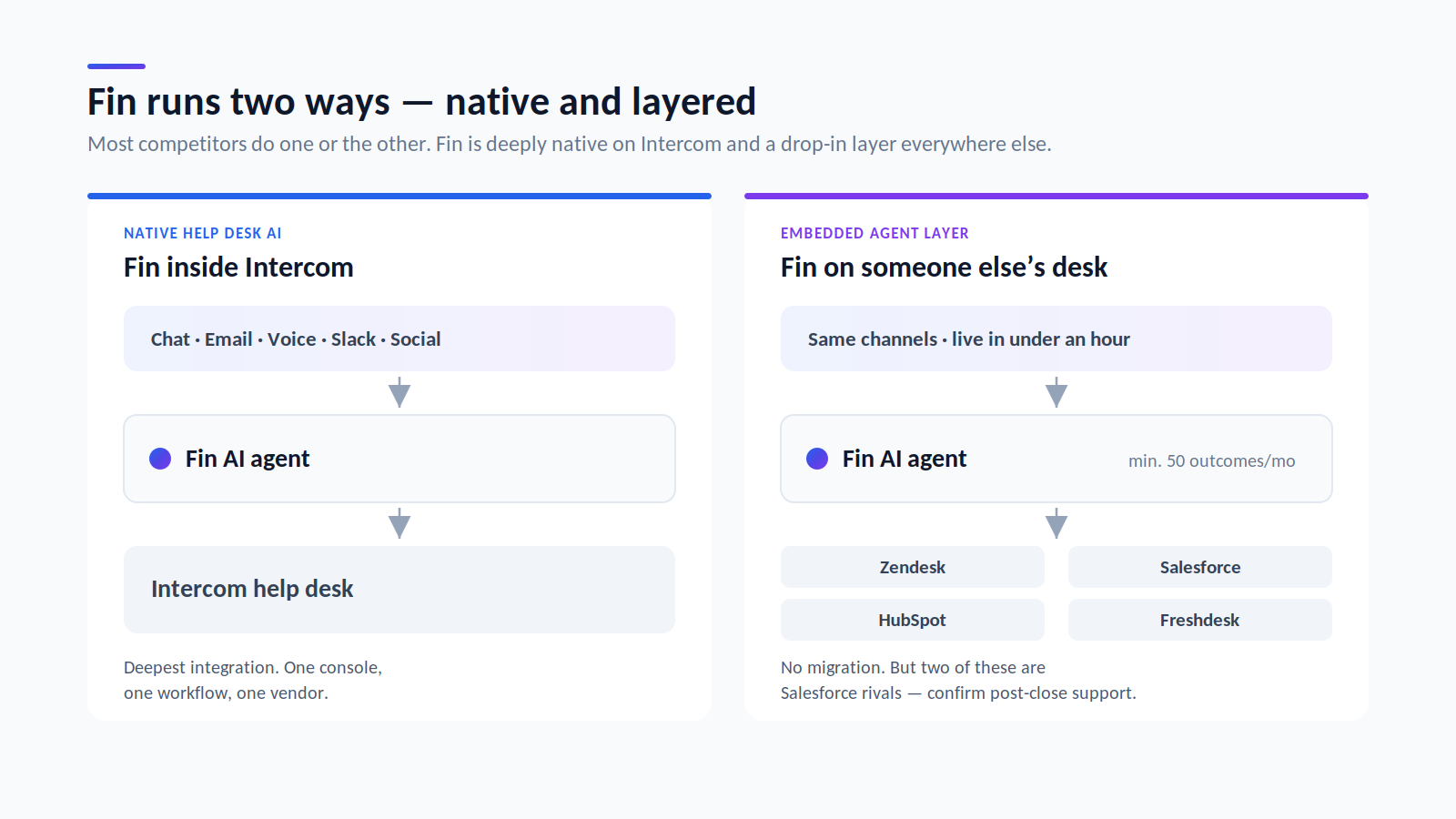
There are three deployment shapes in this category, and the difference drives cost and effort more than any feature comparison will — a separate question from whether the underlying system is agentic or generative:
- Standalone agent layer — Sierra, Decagon, Ada. The agent fronts the conversation and hands off to your stack. You run two systems.
- Embedded agent layer — Fin on a non-Intercom help desk, Aissist.io, Forethought. The agent works inside the help desk your team already uses.
- Native help desk AI — Fin on Intercom, Zendesk AI, Salesforce Agentforce. You must already own the platform.
Fin occupies two of those three boxes, which is a genuine advantage and the main reason it appears on so many shortlists. On Intercom it is native and deeply integrated. On Zendesk, Salesforce, HubSpot or Freshdesk it is a layer, and Fin claims deployment "in less than an hour." The standalone route carries a minimum of 50 outcomes a month, which is a low enough floor that small teams can genuinely start there.
The caveat is the one above: two of the four external help desks Fin supports are owned by Salesforce competitors, and the acquisition puts a question mark over how well those connectors get maintained.
What Fin can actually do
Fin resolves conversations end-to-end rather than only retrieving answers, and it works across chat, email, voice, Slack and social. Language coverage is the one place Fin is vaguer than its competitors — its own site says only that "Fin speaks dozens of languages," where Forethought publishes "100+" and Sierra publishes a specific count.
Two capabilities are worth calling out.
Voice is real but gated. Fin Voice exists, but Fin's pricing page states it "is offered on a custom pricing plan" and is "currently available to select customers working directly with our sales team." So voice is not something you can trial or self-serve, and it sits outside the published $0.99 rate. If voice is central to your evaluation, treat Fin's voice product as an enterprise sales conversation, not a feature you can switch on.
The model layer is multi-vendor. Fin runs on OpenAI, Anthropic and Google models alongside its own. It publishes comparative claims for its in-house models — a "2.8% higher resolution rate," "0.6 seconds faster time to first token," and a "65% reduction in hallucinations." Those are vendor benchmarks against a named competitor model, with no published methodology, so read them as directional. The more useful fact underneath is that Fin is not locked to a single model provider.
Intercom Fin pricing: the $0.99 outcome and what triggers it
Fin charges $0.99 per outcome, and $9.99 per outcome for lead qualifications. That second rate is real and almost nobody writes about it. Fin publishes its pricing openly, which in a category where Sierra, Decagon, Ada and Forethought publish nothing at all is a genuine and unusual strength.
What counts as a billable outcome
Fin bills on four outcome types, documented on its pricing page and in its help centre, and it charges once per conversation regardless of how many actions Fin takes inside it:
| Outcome type | Rate | What triggers it |
|---|---|---|
| Resolution | $0.99 | "No further help is requested after Fin's last answer" |
| Procedure handoff | $0.99 | Fin completes a defined procedure and hands off |
| Disqualification | $0.99 | Fin determines a lead does not qualify |
| Qualification | $9.99 | Fin qualifies a lead |
Crucially, Fin's pricing page states: "You're not charged when a conversation is simply passed to your team without an outcome." That is a meaningful protection and it is better than several competitors offer.
There is also a 14-day trial with "unlimited access to Fin outcomes, with no limits on usage," and no seat minimums or maximums during it. In a category where Sierra, Decagon and Forethought all replace trials with sales-led "proof of value" engagements, a real self-serve trial is a competitive advantage worth naming.
The "assumed resolved" problem
The most substantive criticism of Fin is not about answer quality — it is about how resolution is inferred. Fin's definition of a resolution is that no further help is requested after its last answer. Silence counts as success.
Paying customers have publicly disputed how often that inference is wrong, on Intercom's own community forum. In a thread titled "Fin's flawed assumed resolved & pricing design", a customer posting as bosbeest wrote that "Fin 'assumes' it resolved an issue way too often - i.e. when we step in before a customer clicks 'Speak to Human'." Their described consequence is worth quoting in full because it names four distinct costs at once: lower customer satisfaction, longer resolution times, incorrect Fin statistics, and more expensive invoices.
The same customer described the operational bind plainly: "I now have to watch how a stressed out customer asks for technical help, get an incorrect answer, try all the incorrect steps, get more stressed and frustrated whilst doing so." The incentive that creates — waiting for a customer to give up rather than intervening early — is the part worth thinking hard about before you sign.
The thread ran to roughly 30 replies with about seven community members engaging. Intercom staff participated: Mateusz Leszkiewicz pointed to knowledge base quality, noting "the better your knowledge base the better your Fin answers are," and Paul Byrne of Support Engineering acknowledged that "there's room for us to explore how Fin handles these edge cases" and committed to passing the thread along internally.
To be fair to Fin: this is a design trade-off, not a bug, and every outcome-based vendor has to draw the line somewhere. Inferring resolution from silence is a defensible choice and it is published openly rather than hidden. But it means your billed resolution rate and your true resolution rate are not the same number, and the gap widens the more proactively your human team intervenes. Ask in your trial how many billed resolutions were followed by a human reply within 24 hours.
A worked example
A team resolving 1,200 conversations a month with Fin pays $1,188 a month in outcomes, or $14,256 a year, before seat costs.
Take the same scenario we use across our reviews: 2,000 support conversations a month with 60% resolved autonomously — 1,200 outcomes a month, 14,400 a year. At $0.99, that is $14,256 a year in usage.
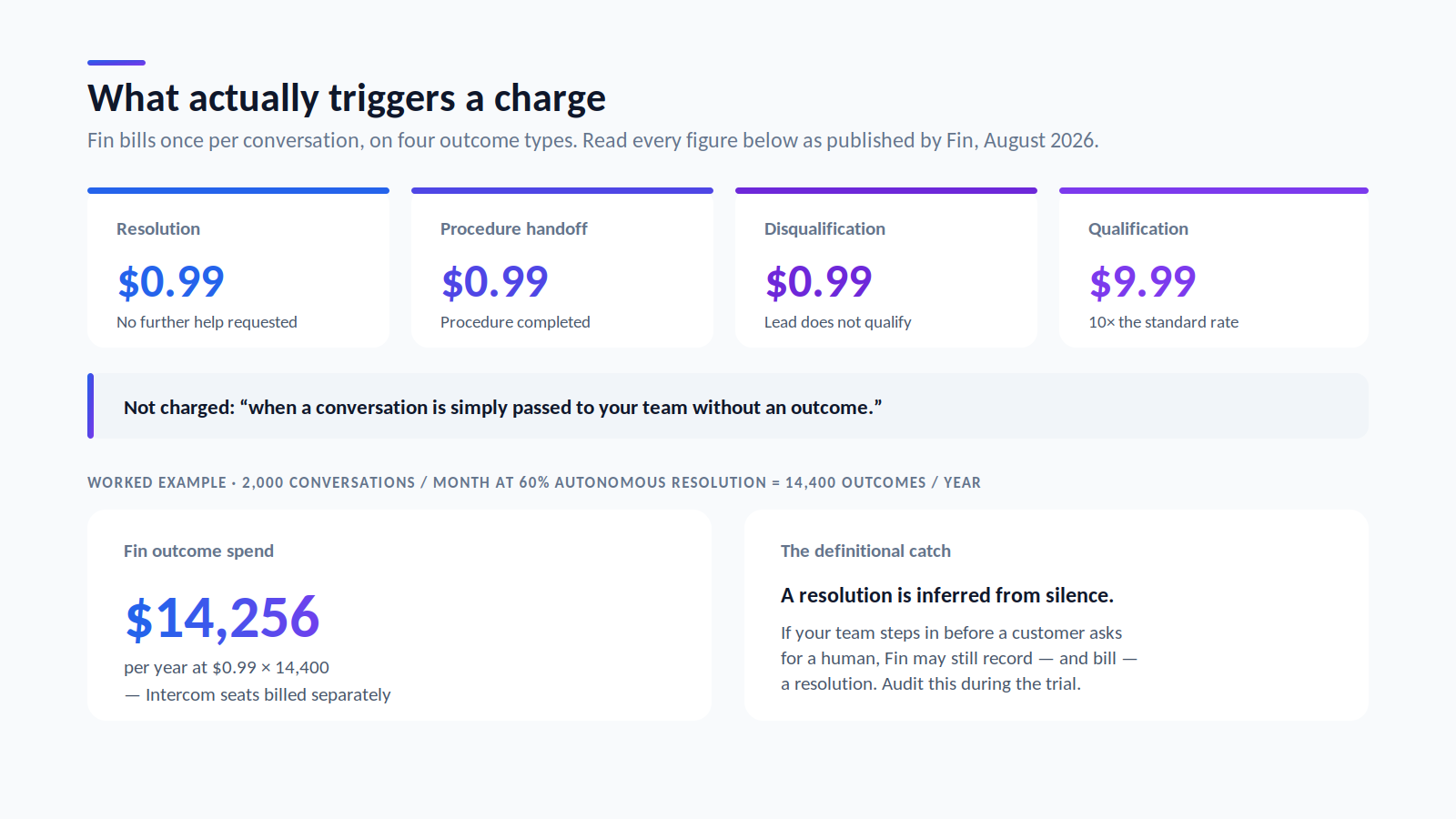
Two things make that number more honest than most in this category. It is a published rate rather than a negotiated one, and it excludes conversations merely passed to your team. Two things make it less complete than it looks. Seats are extra — Intercom's Essential, Advanced and Expert tiers are priced per full teammate, so the usage figure is not your bill. And any lead qualification work bills at $9.99, ten times the standard rate, which can move the total sharply if you use Fin for sales as well as support.
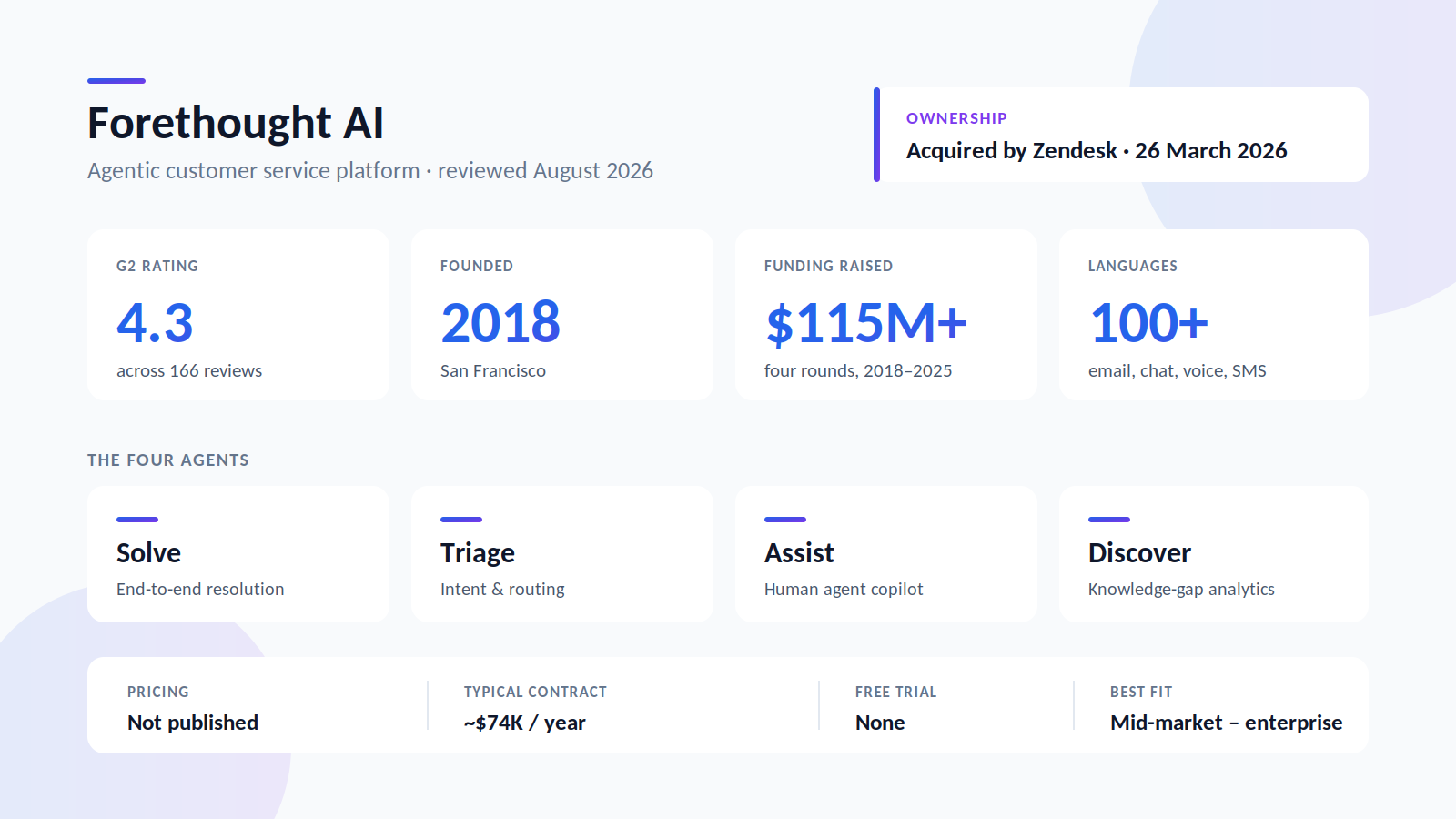
Compare that with the alternatives honestly. Salesforce Agentforce charges $2.00 per conversation whether or not anything is resolved, which at the same volume is more expensive and less aligned. Sierra, Decagon, Ada and Forethought publish no rate at all, and third-party procurement data puts Forethought's average contract near $74,000 a year. Aissist.io runs $0.20–$0.60 per resolution depending on channel. On published transparency, Fin is at the good end of this category, and we would rather say that than pretend otherwise.
Performance: does Fin really resolve 76%?
Fin claims a 76% average resolution rate across 12,000+ customers, "with many seeing over 85%." That figure is unusually well corroborated for a vendor claim, because Salesforce repeated it in the acquisition announcement — a document with far more legal exposure than a marketing page. Salesforce's release states Fin "resolves on average 76% of support volume end-to-end."
That is meaningfully stronger evidence than a homepage statistic. It is still not independent verification, and the definitional caveat from the pricing section applies directly: a "resolution" is a conversation where nobody asked for more help. A resolution rate built on that definition will read higher than one built on confirmed problem-solving.
Fin also publishes that its "average resolution rate increases 1% every month" and cites a "90% satisfaction score" on G2, which it says beats the nearest competitor by eight percentage points.
On independent testing, be careful what you cite. A widely-circulated article claims to have run its own multi-client test of Fin and to have measured a resolution rate far below Intercom's. We read it. It was published by a company that sells competing AI support agents and closes by offering to build alternatives for readers — a conflict disclosed only at the very end. It does not publish per-client sample sizes, ticket mix, knowledge base quality, or how it defined resolution. We are deliberately not repeating its headline number, because an unaudited figure from an unnamed rival gains false authority the moment a third party restates it — which is the trap we are warning you about. We mention the article at all because it ranks well and you will probably encounter it: when you do, check who published it and whether it defines resolution before you carry the number anywhere.
The honest summary: Fin's 76% is the best-evidenced headline resolution claim in this category, and it still rests on a definition of resolution that flatters it. Our AI customer service benchmark covers how far published claims typically sit above measured production results.
Reviews and ratings: what users actually say
Fin holds 4.5 out of 5 on G2 across 3,904 reviews, read 20 August 2026. That review base is the single most striking fact in this comparison: Forethought has 166, Sierra roughly 90, Decagon 28. Fin has more than twenty times the next-largest. On Gartner Peer Insights it scores 4.5, but from only 19 ratings — 53% five-star and 47% four-star, with nothing below three — a sample too small and too clustered to weight.
A large review base is not the same as a better product. It reflects Intercom's decade-long SMB distribution and a self-serve motion that generates reviews at a rate enterprise sales-led vendors never match. But it does mean the aggregate signal is far more reliable than a 28-review score.
What reviewers praise:
"What I like most about Fin is how quickly it provides helpful answers to common customer questions. The interface is simple, the responses feel natural." — Ardon G., Information Technology Technical Specialist, mid-market, on G2
Recurring positives across the review base: speed and ease of use, a genuinely intuitive interface, quick time to value, and automation that does not overwhelm small teams.
What reviewers criticise:
"Sometimes the information Fin shares is incorrect, and the customer comes back upset." — Marianna A., CS, small business, on G2
G2's aggregated cons cluster into five themes. Missing features, specifically around procedure visibility and conversation simulation. AI limitations on unusual formats, and occasional unhelpful answers. Integration gaps. A learning curve that requires ongoing monitoring rather than set-and-forget. And pricing, with reviewers noting that many capabilities cost extra on top of the outcome rate.
That last one is worth underlining because it is the most common misreading of Fin's pricing. The $0.99 rate is real and transparent, but it is not the whole bill — seats are separate, qualifications bill at $9.99, and voice sits on a custom plan entirely.
Security and compliance
Fin's compliance posture is one of the strongest in this category. Its trust page states Fin "holds SOC 2 Type II, ISO 27001, ISO 27701, ISO 27018, ISO 42001, HIPAA, and GDPR/CCPA compliance." ISO 42001, the AI management system standard, is still rare among support-AI vendors and worth credit. Fin also publishes a 99.8% SLA and offers data residency in the US, EU or Australia — a genuine differentiator, since several competitors offer US-only processing.
Fin names its model providers openly — OpenAI, Anthropic, Google, plus its own models — and states that "third-party AI providers are contractually restricted from using your data for training, with zero data retention policies in place once an output is generated."
One thing deserves a direct read, because it is the opposite of what most buyers assume. Fin does not commit to never training on your data. Its published position is: "Fin can use anonymized customer data for model fine-tuning, and you can opt out at any time with data deleted within 30 days."
That is an opt-out model on anonymized data, not a no-training default. It is disclosed plainly, which is more than several competitors manage — Forethought publishes no training commitment at all. But if your security review assumes no-training-by-default, Fin will fail that assumption unless someone actively opts out. Make the opt-out an onboarding step, not a later discovery.
Pros and cons
Fin's strengths are transparent pricing, a real trial and by far the deepest review base in the category; its weaknesses are a resolution definition that inflates its own headline metric and a pending acquisition that puts its non-Salesforce integrations in question.
Pros
- Published per-outcome pricing in a category where most competitors publish nothing — the transparency benchmark other vendors are measured against.
- No charge when a conversation is simply passed to your team, which aligns billing with outcomes better than per-conversation models.
- A genuine 14-day trial with unlimited outcomes and no seat minimums, where enterprise rivals offer only sales-led proof-of-value engagements.
- Runs both natively in Intercom and as a layer on Zendesk, Salesforce, HubSpot and Freshdesk, deployable in under an hour.
- 3,904 G2 reviews at 4.5 — more than twenty times the next-largest review base in this category.
- Strong compliance posture including ISO 42001 and US, EU or Australia data residency.
- The 76% resolution claim is corroborated in Salesforce's acquisition release, giving it more weight than a typical homepage statistic.
Cons
- Resolution is inferred from customer silence, so billed resolutions and genuinely solved problems are not the same number — a design paying customers have publicly disputed on Intercom's own forum.
- The $0.99 headline is not the whole bill: seats are separate, lead qualifications cost $9.99, and Fin Voice is on a custom plan.
- Language coverage is published only as "dozens," where competitors publish exact counts.
- Voice is gated to select customers via sales, so it cannot be trialled.
- Customer data is used for model fine-tuning by default on an opt-out basis rather than opt-in.
- The Salesforce acquisition is agreed but not closed, and neither company has committed to maintaining the Zendesk, HubSpot and Freshdesk integrations after close.
- Reviewers consistently report a learning curve and ongoing monitoring needs rather than set-and-forget operation.
Who Intercom Fin is for, and who it isn't
Fin is a strong fit if: you are an SMB or mid-market team that wants a price before a sales call; you already run Intercom, or run Zendesk, HubSpot or Freshdesk and want a layer rather than a migration; you want to trial the product on real tickets before committing; your support volume is high enough to benefit from automation but too small to interest enterprise vendors; and you need EU or Australia data residency.
Fin is a poor fit if: you need billed resolutions to match confirmed problem resolution exactly; voice is your primary channel and you want to evaluate it self-serve; you need a contractual no-training-on-customer-data default rather than an opt-out; you are a Zendesk or Freshdesk shop unwilling to carry integration risk through a Salesforce acquisition; or you need a published language count for a specific market.
Intercom Fin alternatives and competitors
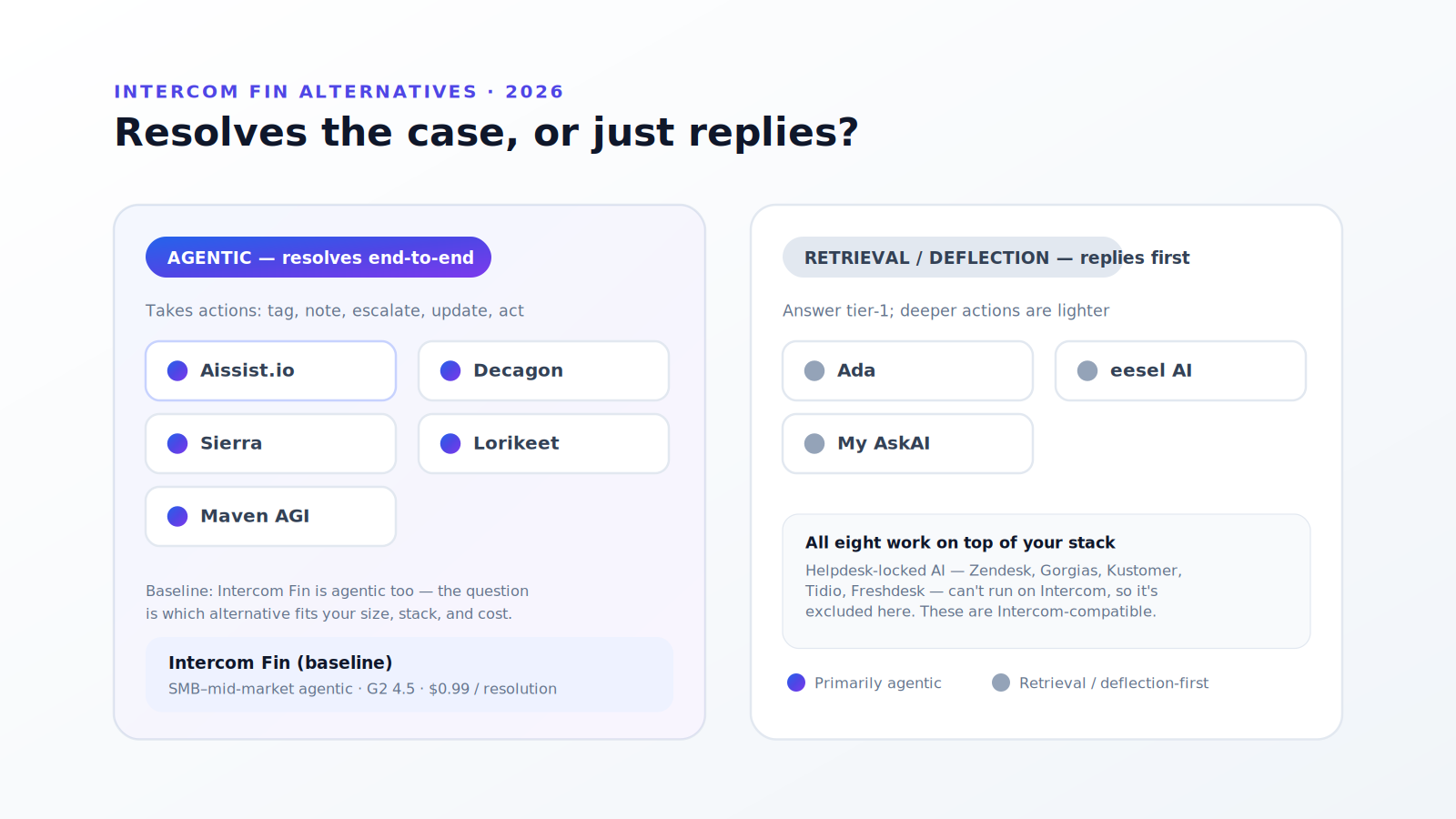
The platforms most often evaluated against Fin are Aissist.io, Sierra, Decagon, Ada, Forethought, Zendesk AI and Salesforce Agentforce. The comparison is organised by architecture rather than ranked, because deployment model is the decision that actually narrows the list. All figures read 20 August 2026. For the full field, see our Intercom Fin alternatives guide.
| Platform | Architecture | Deployment | Published price | G2 (20 Aug 2026) |
|---|---|---|---|---|
| Fin | Generative + agentic | Native on Intercom; layers onto Zendesk, Salesforce, HubSpot, Freshdesk | $0.99 per outcome; $9.99 per qualification | 4.5 (3,904) |
| Aissist.io | Agentic multi-agent | Layers onto existing help desk | $0.20–$0.60 per resolution by channel | 4.9 (45) |
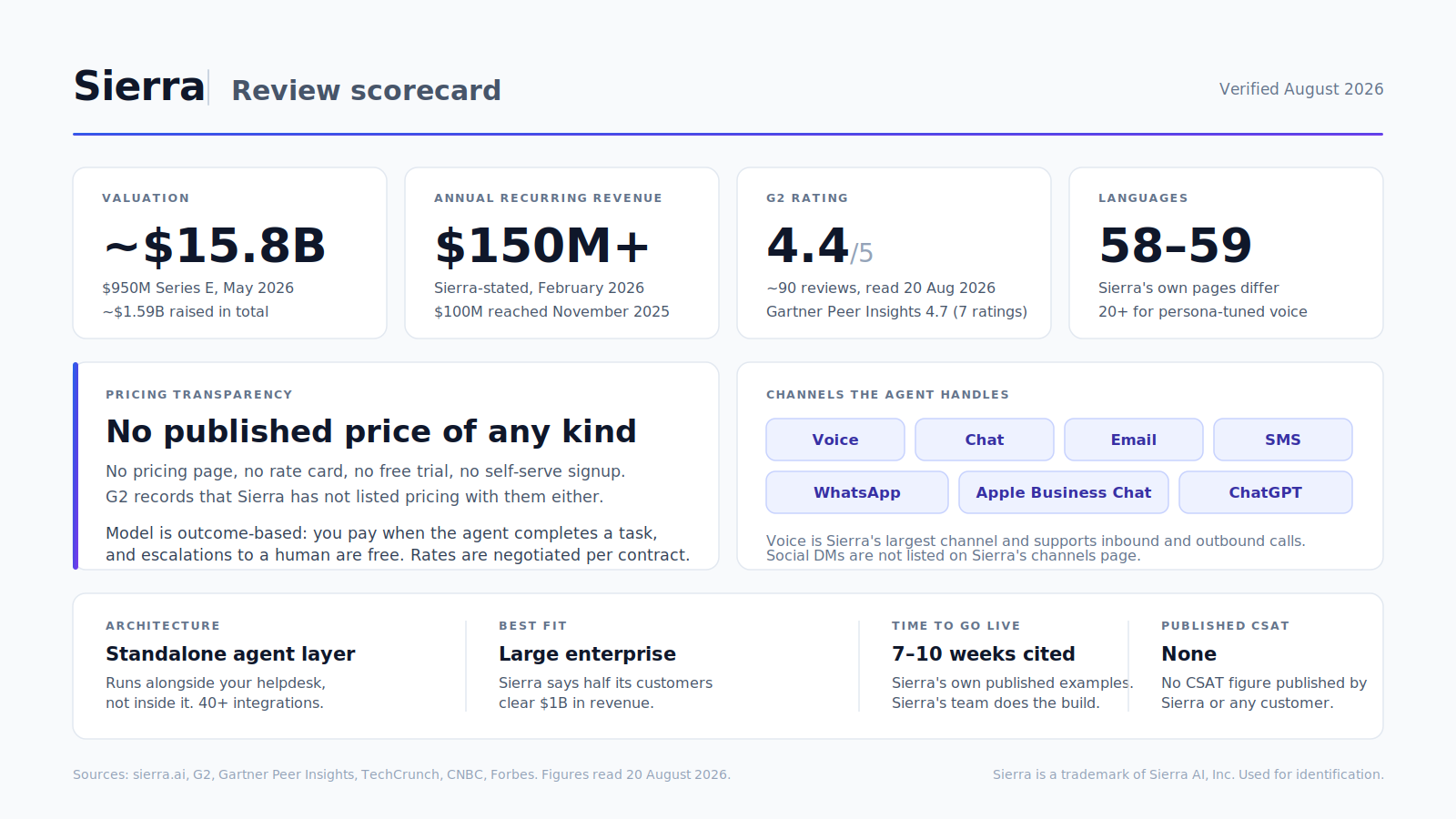
| Sierra | Agentic | Standalone layer | Not published | 4.4 (~90) |
| Decagon | Agentic | Standalone layer | Not published | 4.7 (28) |
| Ada | Generative, multi-LLM | Standalone layer | Not published | 4.6 (173) |
| Forethought | Agentic, four-agent | Embedded layer; Zendesk add-on | Not published | 4.3 (166) |
| Zendesk AI | Hybrid | Native — requires Zendesk | Per resolution, rate not published | 4.3 (7,031) |
| Salesforce Agentforce | Agentic | Native — requires Salesforce | $2.00 per conversation | 4.3 (1,202) |
Four notes on the comparison:
This category is consolidating fast, and two of these rows are moving. Zendesk acquired Forethought in March 2026 — we cover what that means in our Forethought AI review. Salesforce has now agreed to acquire Fin. Of the platforms above, only Aissist.io, Sierra, Decagon and Ada remain independent, and that is a real variable if you are signing a multi-year contract.
Fin sets the transparency benchmark, and it is the fairest reference price in the category. Only Fin, Aissist.io and Salesforce Agentforce publish rates at all. When a vendor tells you their pricing is competitive without showing you a number, Fin's $0.99 is the number to hold them to.
Sierra, Decagon and Ada compete at a different tier. They are enterprise, sales-gated, six-figure platforms. If Fin's shape is right but you need enterprise voice or a dedicated program team, start with our Sierra AI review and Decagon alternatives guides.
Aissist.io is the closest structural comparable to Fin, and here is where we genuinely differ. Both layer onto the help desk you already run and both publish per-resolution pricing. Aissist.io runs $0.20–$0.60 per resolution against Fin's $0.99, uses multi-agent reasoning built for multi-system procedures, and bills on completed work rather than inferred silence.
Our honest limitations against Fin: 42 G2 reviews against Fin's 3,904, no Gartner Peer Insights presence, SOC 2 aligned rather than certified, no ISO 42001, no published Australia data residency, and no voice product comparable to Fin Voice. Fin also has a self-serve trial and a decade of SMB distribution we cannot match. If review-base depth and a frictionless trial are what your evaluation turns on, Fin is the stronger choice and we would tell you that on a call. See the direct comparison in Aissist vs. Intercom Fin.
How to choose between Fin and the alternatives
The decision turns on three questions: whether you need a published price, whether inferred resolution is acceptable to your billing tolerance, and whether the Salesforce acquisition creates risk for your stack.
- If you need a price before a sales cycle, shortlist Fin first — it publishes a rate, a trial and a definition of what triggers a charge, which Sierra, Decagon, Ada and Forethought do not.
- If you already run Intercom, Fin is the default and the burden of proof sits with alternatives — the native integration is deeper than any layer will be.
- If you run Zendesk or Freshdesk, make integration continuity a contract term — Salesforce is acquiring Fin, and those are competitor platforms with no published post-close commitment.
- If billing precision matters more than headline rate, audit the resolution definition before signing — ask what share of billed resolutions saw a human reply within 24 hours, and run that check during the free trial.
- If you use Fin for lead qualification as well as support, model the $9.99 rate separately — at ten times the standard outcome price it can dominate a bill that looked cheap.
- If voice is your primary channel, treat Fin as an enterprise conversation or look at Sierra — Fin Voice is custom-priced and gated to select customers.
- If your security review requires no-training-by-default, either opt out at onboarding or choose a vendor whose default matches — Fin's published position is opt-out on anonymized data.
- If you need enterprise scale with a dedicated program team, look past Fin to Sierra or Decagon — Fin's strength is SMB and mid-market self-serve, and that is a different product philosophy.
Frequently asked questions
What is Intercom Fin?
Intercom Fin is an AI agent that resolves customer support conversations end-to-end across chat, email, voice, Slack and social. It reads your knowledge base and connected systems and takes actions to complete requests rather than only replying. It runs natively in Intercom's help desk or as a layer on Zendesk, Salesforce, HubSpot and Freshdesk.
Did Intercom change its name to Fin?
Yes. On 12 May 2026 Intercom, Inc. renamed itself Fin, and all roughly 1,400 employees now work for a company called Fin. The Intercom name survives as the help desk product, which the company says it recently rebuilt as "Intercom 2." So Fin is both the company and the AI agent; Intercom is the help desk.
Is Salesforce buying Intercom Fin?
Salesforce signed a definitive agreement on 15 June 2026 to acquire Fin for approximately $3.6 billion in cash. The deal has not closed. Salesforce expects it to close in the fourth quarter of its fiscal year 2027, subject to regulatory clearances, so Fin currently operates as an independent company.
How much does Intercom Fin cost?
Fin charges $0.99 per outcome for resolutions, procedure handoffs and disqualifications, and $9.99 per outcome for lead qualifications. It bills once per conversation regardless of how many actions Fin takes, and does not charge when a conversation simply passes to your team. Intercom seats are priced separately, and Fin Voice is on a custom plan.
What counts as a resolution in Fin's pricing?
Fin defines a resolution as a conversation where "no further help is requested after Fin's last answer." Resolution is inferred from customer silence rather than confirmed problem-solving, which means billed resolutions can exceed genuinely solved issues — a design paying customers have publicly disputed on Intercom's community forum.
Does Intercom Fin have a free trial?
Yes. Fin offers a 14-day trial with "unlimited access to Fin outcomes, with no limits on usage" and no seat minimums or maximums. That is a real differentiator: Sierra, Decagon and Forethought all replace trials with sales-led proof-of-value engagements instead.
What is Fin's resolution rate?
Fin claims a 76% average resolution rate across 12,000+ customers, with many exceeding 85%. That figure carries more weight than most vendor claims because Salesforce repeated it in its acquisition announcement. It still rests on Fin's own definition of resolution as customer silence, so treat it as a well-evidenced vendor figure rather than an independent benchmark.
Can I use Fin without Intercom?
Yes. Fin is sold standalone for Zendesk, Salesforce, HubSpot and Freshdesk at the same $0.99 per outcome, with a minimum of 50 outcomes a month and deployment Fin says takes under an hour. Note that Salesforce's pending acquisition creates some uncertainty around long-term support for competitor help desk integrations.
Is Intercom Fin secure and compliant?
Fin states it holds SOC 2 Type II, ISO 27001, ISO 27701, ISO 27018, ISO 42001, HIPAA and GDPR/CCPA compliance, publishes a 99.8% SLA, and offers data residency in the US, EU or Australia. One caveat: Fin uses anonymized customer data for model fine-tuning by default, with opt-out available and deletion within 30 days.
What are the best Intercom Fin alternatives?
The strongest alternatives are Aissist.io, Sierra, Decagon, Ada, Forethought, Zendesk AI and Salesforce Agentforce. Aissist.io is the closest structural comparable, layering onto your existing help desk at $0.20–$0.60 per resolution. Sierra and Decagon compete at the enterprise tier. Our full Intercom Fin alternatives guide compares the field.
Want outcome-based pricing without the inferred-resolution problem? Aissist.io runs inside the help desk you already have, bills $0.20–$0.60 per resolution on completed work, and starts free. See how it works on your stack →
Changelog
- August 2026 — First published as a full review, replacing our earlier Fin reviews roundup. Figures verified 20 August 2026: G2 4.5 (3,904 reviews), Gartner Peer Insights 4.5 (19 ratings), the 12 May 2026 Intercom-to-Fin rebrand, Salesforce's 15 June 2026 definitive agreement to acquire Fin for $3.6B pending a Q4 FY2027 close, the four-tier outcome pricing including the $9.99 qualification rate, and Fin's opt-out model-training position.