Forethought AI Review (2026): What It Does, What It Costs, and What Zendesk Changed
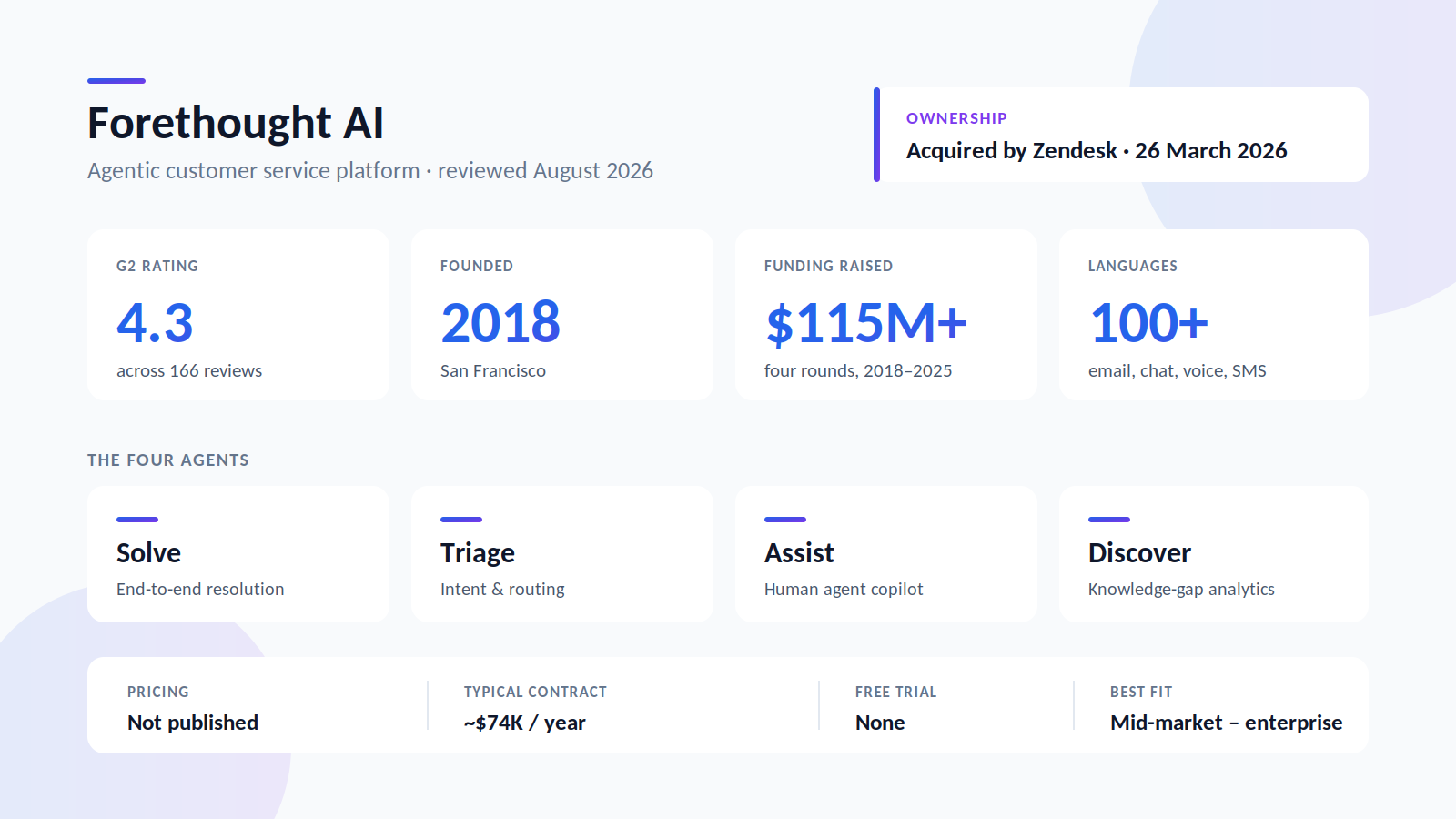
Forethought AI is an agentic customer service platform, founded in 2018 in San Francisco, that runs four specialised agents — Solve, Triage, Assist and Discover — across email, chat, voice, SMS and Slack. Zendesk acquired it on 26 March 2026, and it now ships both as "Forethought AI agents by Zendesk" and, still, as a standalone product for companies on other help desks. It rates 4.3 on G2 across 166 reviews and publishes no pricing at all. This review covers what Forethought does, what buyers actually pay, where its evidence is thin, and what the acquisition changed. If you have already decided Forethought is not the fit, go straight to our Forethought alternatives guide.
TL;DR:
- What it is: An agentic AI platform for customer service built on four agents — Solve (resolution), Triage (classification and routing), Assist (agent copilot) and Discover (analytics).
- Owned by: Zendesk, since 26 March 2026. Terms were never disclosed.
- Still sold standalone: Yes. Zendesk's own documentation confirms non-Zendesk customers can still buy it.
- Best for: Mid-market and enterprise support teams with a large existing ticket history and an annual automation budget in the mid five figures or above.
- Strongest capability: Triage. Intent, urgency and sentiment classification trained on your own ticket history is the thing reviewers consistently rate highest.
- Biggest friction: No published pricing, no free trial, and a substantial historical-data requirement before accuracy arrives.
- Not for: Small teams, anyone without years of ticket history, or anyone who needs a budget number before entering a sales cycle.
- Rating: 4.3/5 on G2 across 166 reviews, read 20 August 2026.
One thing to fix in your head before reading any Forethought article, including this one: most of the pages currently ranking for "Forethought AI" still describe it as an independent company. Forethought has not been independent since March 2026.
Reviewed by M.W., Co-founder. Disclosure: this review is published by Aissist.io, which sells an agentic AI layer that competes with Forethought. Ratings, prices and quotes come from Forethought's and Zendesk's own pages, G2, Capterra, Vendr and named press, all captured in August 2026.
How we evaluated Forethought, and who wrote this
We build a competing product. Aissist.io sells an agentic AI layer for customer service, so we are not a neutral party and you should not read us as one. What we can offer instead is a review where every claim is sourced, every vendor number is labelled as a vendor number, and every gap is marked as a gap.
Three rules governed this piece:
- Forethought's and Zendesk's own materials outrank everything. Where their pages say something, we quote it and link it.
- Competitor claims about Forethought are labelled as competitor claims. That includes most of the per-resolution pricing figures below, which come from companies that sell against Forethought — as do we.
- Where we could not verify something, we say so rather than filling the gap with a plausible number. Several widely-repeated Forethought statistics did not survive this rule.
We evaluated Forethought on six criteria: architecture and where it sits in your stack, agent capability and action-taking, channel and language coverage, pricing transparency, evidence quality behind its performance claims, and fit-to-segment. All figures were read on 20 August 2026.
Forethought AI at a glance
Forethought is a 2018-founded, Zendesk-owned agentic support platform rated 4.3 on G2, covering email, chat, voice, SMS and Slack in 100+ languages, with no published pricing and no free trial.
| Attribute | Detail |
|---|---|
| What it is | Agentic AI platform for customer service — resolution, classification, agent assist and analytics |
| Founded | 2018, San Francisco. Won TechCrunch Startup Battlefield that year |
| Founders | Deon Nicholas and Sami Ghoche. Nicholas is now listed as an advisor; Ghoche remains as VP, Applied AI |
| Owner | Zendesk. Announced 11 March 2026, closed 26 March 2026. Terms undisclosed |
| Funding before acquisition | $116M across four rounds, most recently a $25M Series D in May 2025 led by Blue Cloud Ventures |
| Products | Solve, Triage, Assist, Discover, Agent QA, Autoflows, Voice |
| Architecture | Embedded agent layer with 70+ integrations; also sold as a Zendesk add-on |
| Channels | Email, chat, voice, SMS, Slack, mobile, API. The Zendesk-branded SKU covers email, voice and chat only |
| Languages | 100+ |
| Scale | 1.2 billion interactions handled monthly — vendor-claimed, unverified |
| Pricing | Platform fee plus outcome-based component. No published rate, no free trial |
| G2 | 4.3/5, 166 reviews (read 20 Aug 2026) |
| Capterra | 4.5/5, but only 11 reviews — too small to weight |
| Best fit | Mid-market to enterprise with a large historical ticket corpus |
What is Forethought AI?
Forethought AI is a customer service automation platform whose agents resolve tickets end-to-end, classify and route incoming work, assist human agents in real time, and analyse conversations for knowledge gaps. It connects to the help desk you already run — Zendesk, Salesforce, Intercom, Gorgias, Genesys, Five9 and others — rather than replacing it.
The company was founded in 2018 by Deon Nicholas and Sami Ghoche and won TechCrunch's Startup Battlefield that year. Its original product was branded Agatha, a name that still lingers in odd places — Capterra's Forethought listing sits at a URL slug of Agatha to this day. The company raised $116M in total: a $9M Series A led by NEA in December 2018, a $17M Series B in October 2020, a $65M Series C led by STEADFAST Capital Ventures in December 2021, and a $25M Series D led by Blue Cloud Ventures in May 2025.
The platform is organised around four named agents, and understanding the split matters because they are sold and valued differently:
- Solve is the customer-facing agent. It handles inquiries end-to-end across email, chat, voice, SMS and Slack, and can take actions against connected systems rather than only retrieving answers.
- Triage classifies incoming tickets — intent, urgency, sentiment — using models trained on your own historical tickets, then tags and routes them. This is the component reviewers most consistently praise, and it is genuinely differentiated: most competitors classify with a general model rather than one fitted to your ticket corpus.
- Assist is the copilot inside the help desk for human agents: conversation summaries, step-by-step guidance and drafted responses.
- Discover is the analytics agent. It surfaces knowledge gaps and ticket trends and auto-generates knowledge base articles and Autoflows.
Three newer pieces sit alongside them: Autoflows, the agentic reasoning engine launched in 2023; Agent QA, which scores interactions and coaches agent performance; and Forethought Voice, launched March 2025 and extended with browser-based Web Calling on 29 June 2026 — notably, a product shipped three months after the acquisition closed.
Named customers from Forethought's own announcements include Airtable, Grammarly, Cohere, Datadog, Upwork, Cotopaxi, WordPress and Roadie, with Lime, Thumbtack, Carta and Crunchbase named in earlier years.
The Zendesk acquisition: what actually changed
Zendesk announced its intent to acquire Forethought on 11 March 2026 and completed the deal on 26 March 2026. Financial terms were not disclosed by Zendesk, by the completion release, or by TechCrunch's coverage. Any dollar figure you see attached to this deal is speculation.
Zendesk was explicit about why. In the March announcement, Zendesk said Forethought's capabilities "perfectly align with our vision for agentic service" and that "together, we will be scaling self-improving AI that learns from every interaction," claiming the deal accelerates "Zendesk's product roadmap by over a year." On close, Zendesk CEO Tom Eggemeier framed it as "moving beyond systems that manage conversations to AI that drives real outcomes."
The product became generally available as "Forethought AI agents by Zendesk" on 4 June 2026.
Four things are worth knowing before you sign:
The SKU split in two. There is now a Zendesk-sold add-on and a standalone Forethought product. They are not identical: Zendesk's documentation describes the add-on as covering email, voice and chat, while standalone Forethought advertises email, chat, voice, SMS, Slack, mobile and API. If SMS or Slack coverage matters to you, confirm which SKU you are being quoted.
Your data may move. Forethought's privacy policy now states that "as we integrate our services, your data may be migrated from Forethought's legacy infrastructure to the Zendesk AWS infrastructure and processed in any country where Zendesk or its service providers maintain facilities." For anyone with data residency constraints, that sentence is the most consequential fact in this review. Get the current and planned processing locations in writing.
One co-founder stepped back. Forethought's own about page now lists Deon Nicholas as "Co-founder & Advisor" and Sami Ghoche as "Co-founder & VP, Applied AI." Nicholas is no longer listed as CEO anywhere on the site. Founder transition after an acquisition is entirely normal; it is still worth knowing before you sign a multi-year contract on the strength of a roadmap promise.
Nothing has been sunset. We found no end-of-life date, forced-migration deadline or discontinuation notice in any Zendesk press release, the Zendesk help documentation, or on forethought.ai. The Forethought blog is still publishing under its own brand, most recently on 13 August 2026. Neither company has published guidance for existing standalone customers about renewals — which is an absence, not a reassurance. Ask about renewal terms explicitly.
Can you still buy Forethought if you are not a Zendesk customer?
Yes. This is the single most-asked and least-answered question about Forethought right now, and Zendesk's own help documentation settles it: "Zendesk customers can now purchase Forethought capabilities as an add-on," and "if you're not a Zendesk customer, Forethought is available to purchase."
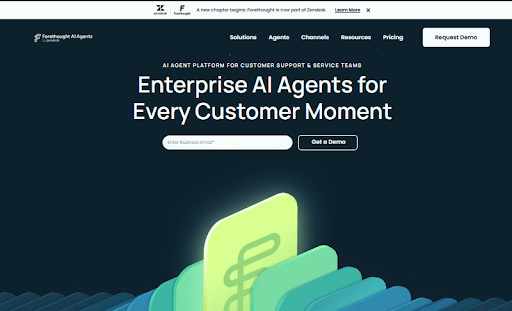
Forethought's homepage backs this up, still leading with the headline "Enterprise AI Agents for Any CX Platform" and still listing Salesforce, Intercom, Gorgias, Genesys and Five9 among its integrations.
The honest caveat: a platform-agnostic product owned by one of the platforms has a structural tension in it. We can see no commercial reason for Zendesk to invest in making Forethought excellent on Salesforce. Nothing published suggests they will stop — but if you are a Salesforce or Freshdesk shop, treat the depth of your specific connector as a diligence item, not an assumption. We cover the knock-on effects for Zendesk buyers in Zendesk AI alternatives after the Forethought acquisition.
Architecture: where Forethought sits in your stack
Forethought is an agent layer, not a help desk. You keep Zendesk, Salesforce, Intercom or Freshdesk, and Forethought connects into it. Forethought advertises "70+" integrations, naming Zendesk, Salesforce, Intercom, Gorgias, Genesys, Five9, 8x8, LiveChat, Notion, Airtable, Document360 and Stonly among them.
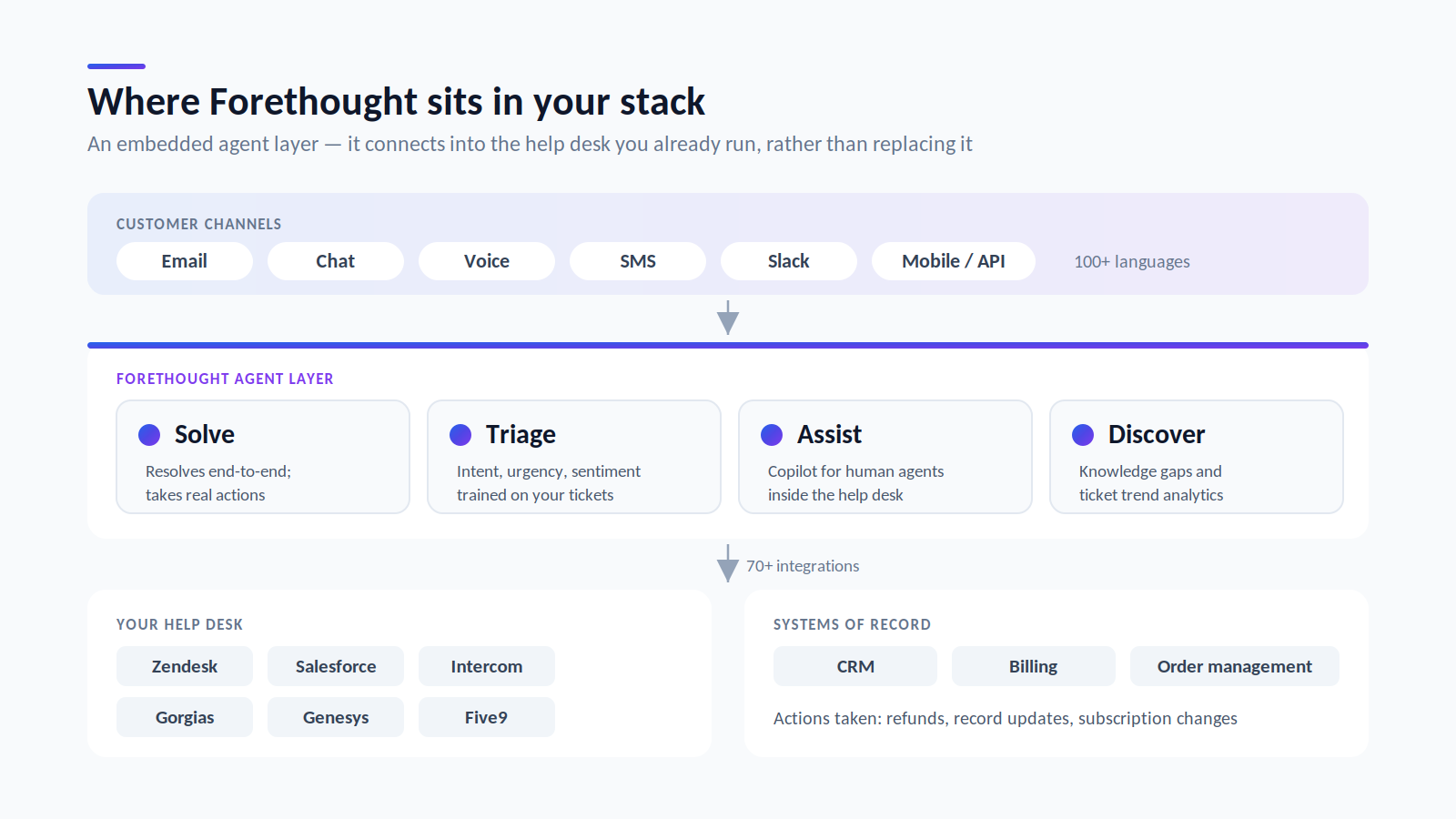
There are three deployment shapes in this category, and the difference drives cost and effort more than any feature comparison will — a separate question from whether the underlying system is agentic or generative:
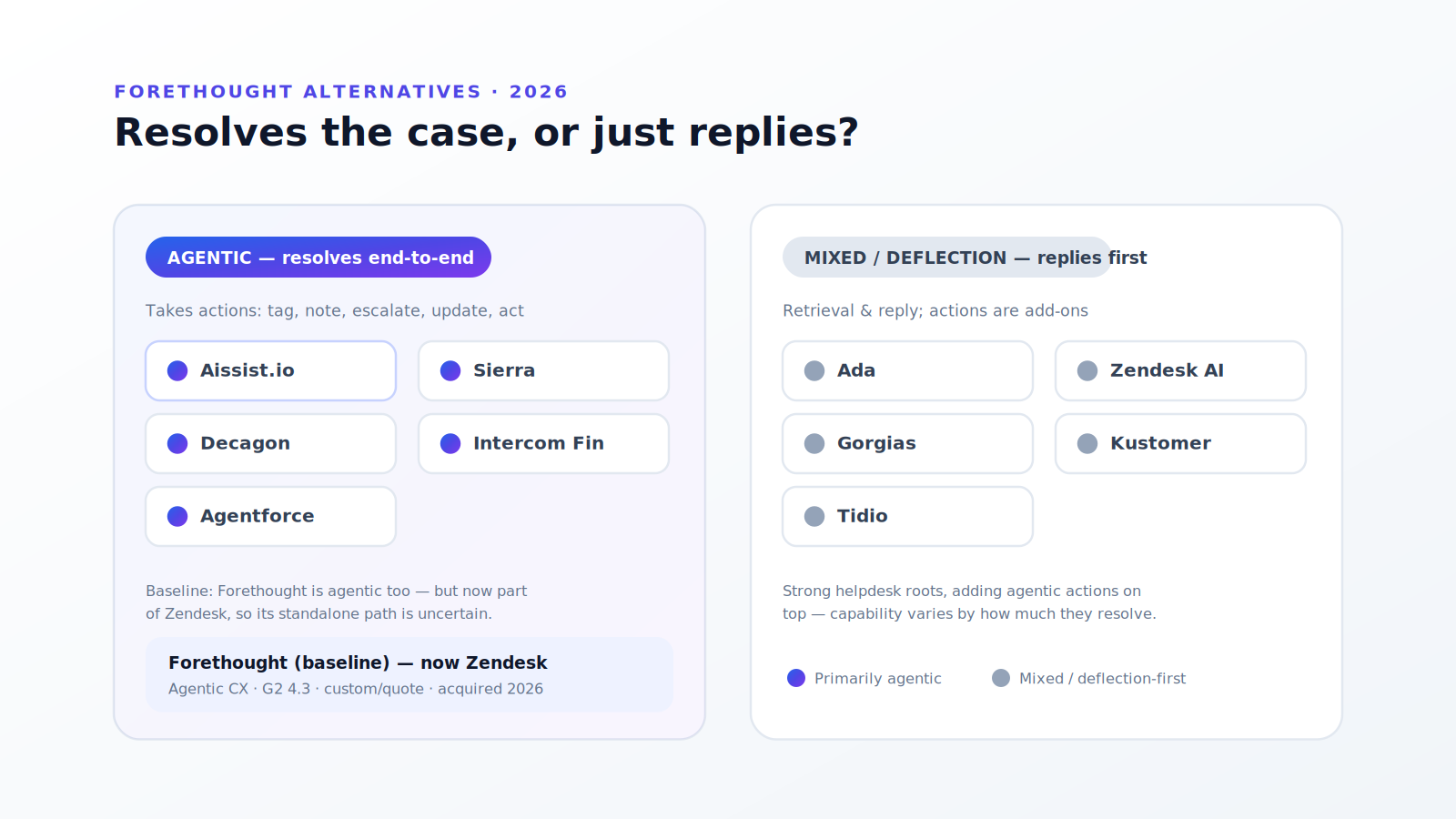
- Standalone agent layer — Sierra, Decagon, Ada. The agent fronts the conversation and hands off to your stack. You run two systems.
- Embedded agent layer — Forethought, Aissist.io, Intercom Fin on non-Intercom desks. The agent works inside the help desk your team already uses.
- Native help desk AI — Zendesk AI, Salesforce Agentforce. You must already own the platform.
Forethought's position is genuinely useful here: it sits in the embedded camp, which means no second console for your agents and no parallel workflow. Assist in particular is designed to live inside the help desk agents already have open. Post-acquisition, Forethought is drifting toward the third category for Zendesk customers while remaining in the second for everyone else — which is why confirming which SKU you are being quoted matters.
What Forethought's agents can actually do
Forethought's agents take actions, not just answer questions. Connected to CRMs, billing systems and order management tools, Solve can update records, process refunds and modify subscriptions. That is the line that separates an agentic platform from a retrieval chatbot, and Forethought is on the right side of it.
Two capabilities are worth calling out specifically.
Triage is the standout. Classification trained on your own ticket history — intent, urgency, sentiment — is harder to replicate than answer generation and is where Forethought's long head start shows. Forethought claims "up to 98% ticket prediction rate" for Triage. That is a vendor number with no published methodology, but the underlying capability is real and repeatedly confirmed in reviews.
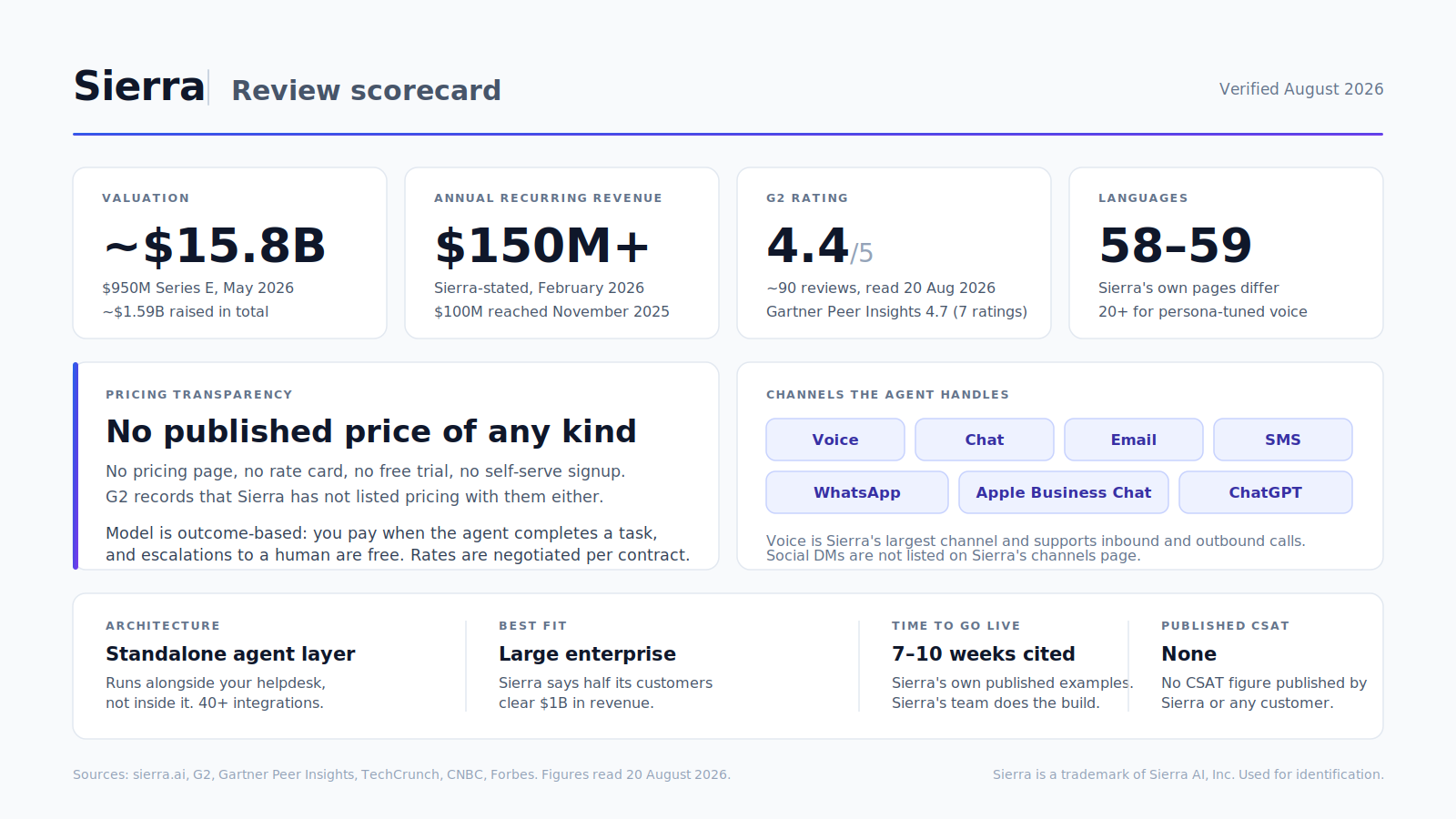
Voice is newer than the marketing suggests. Forethought Voice launched in March 2025, built with Cartesia, and browser-based Web Calling arrived in June 2026. That is a young stack by category standards — Sierra's voice product launched in October 2024 and adds outbound calling and simulation-based testing, as we cover in our Sierra AI review. We found no outbound-calling capability published by Forethought. If voice is your primary channel, confirm inbound and outbound coverage explicitly before shortlisting.
How much ticket history does Forethought need?
Forethought needs a substantial historical ticket corpus to perform well. Forethought does not publish a minimum, but it treats the question as a live one: its own FAQ carries an entry titled "How many tickets does Forethought need to work well?", and its Triage page describes the product plainly as "AI trained on your historical data." Third-party reviewers commonly cite a working threshold around 20,000 tickets. We could not verify that figure against any Forethought source, so treat it as a directional signal rather than a published requirement.
The historical-data requirement is the most under-discussed qualifying question in any Forethought evaluation, and it is not a criticism — it is the flip side of the thing Triage does well. Training on your corpus is why the classification is good. It is also why the product does not suit a team that does not have a corpus.
Practically: if you are a young team, a low-volume one, or you migrated help desks recently and lost your history, Forethought will underperform its own case studies, and vendors that learn from knowledge bases and documentation rather than ticket archives will serve you better. Ask the question directly in your first call — it is the fastest way to disqualify Forethought or confirm it. Our AI customer service benchmark covers how much of the variance between vendors is really variance in what they were given to learn from.
Forethought AI pricing: what's published and what isn't
Forethought does not publish pricing. Its pricing page lists three tiers — Team, Professional and Enterprise — with no numbers attached to any of them. Every tier carries a "Get a Quote" button. Zendesk publishes nothing for the add-on either; its help documentation says only "reach out to your sales representative."
What Forethought does publish is the model, verbatim: "Our pricing model is a blend of platform access fees and an outcome-based pricing cost." So there is a fixed component and a usage component, but no published rate for either.
There is also no free trial. Forethought offers "a Proof of Value (POV) instead of a traditional free trial" — a sales-led engagement, not a self-serve evaluation.
What buyers actually pay
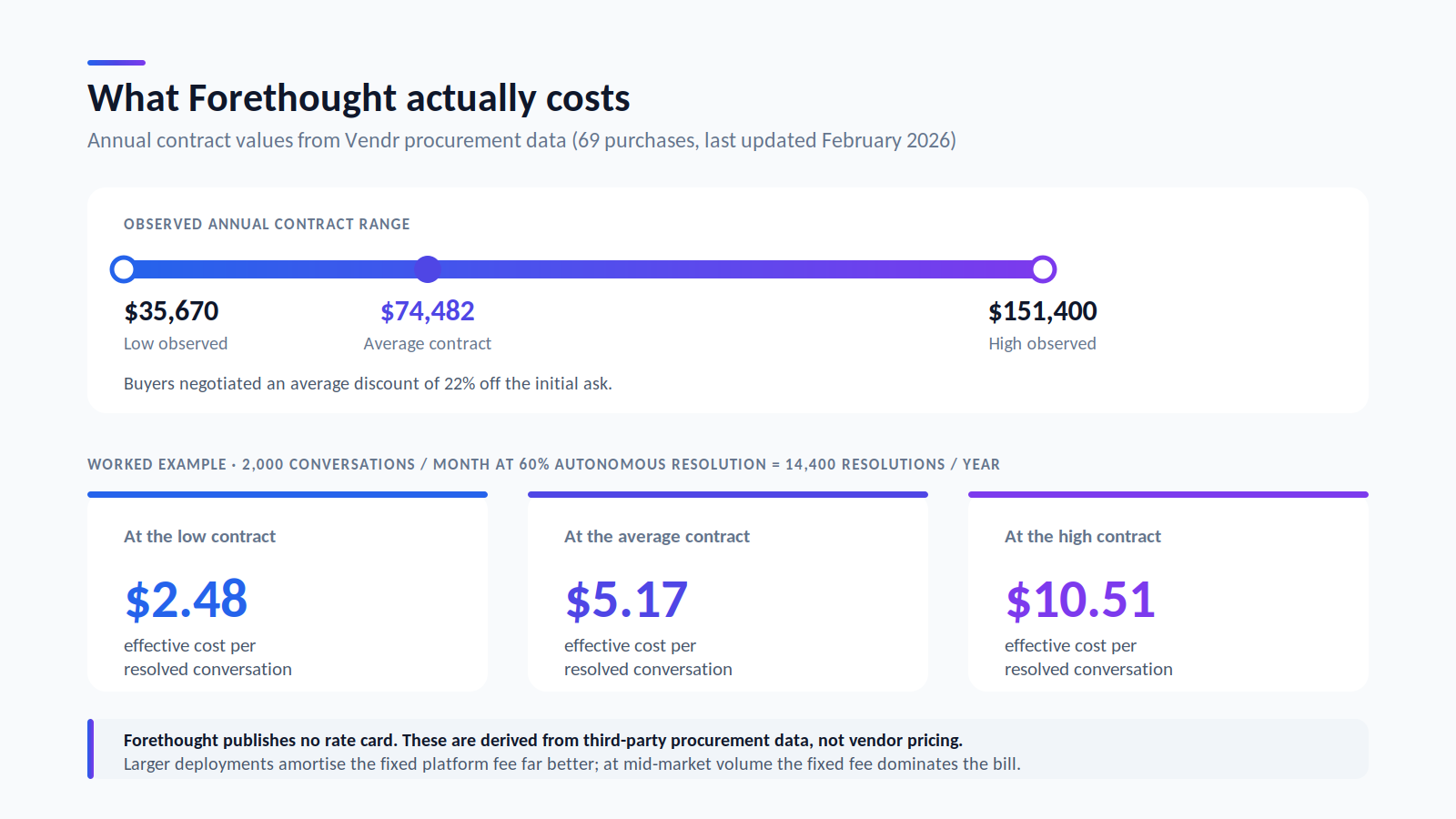
Forethought contracts average $74,482 a year and range from $35,670 to $151,400. The one non-competitor dataset on Forethought pricing comes from the procurement platform Vendr, based on 69 actual purchases:
| Metric | Figure |
|---|---|
| Average contract value | $74,482 / year |
| Range observed | $35,670 – $151,400 / year |
| Typical mid-market band | $60,000 – $150,000 / year |
| Average buyer discount off ask | 22% |
Two caveats carry real weight. Vendr's data was last updated February 2026 — before the acquisition closed, so post-close bundling into Zendesk contracts may have changed the shape of deals entirely. And the 22% average discount tells you something useful on its own: the first number you are quoted is not the number.
Per-unit rates are where the sources fall apart. Competitor-published estimates put Forethought anywhere from $0.07 to $0.12 per deflection, while another competitor puts it near $0.90 per resolved conversation. That is a spread of more than twelve times. All of these come from companies that sell against Forethought, and none is confirmed by Forethought. We would not use any of them for budgeting. The Vendr contract values are the only figures on this page we would take into a planning conversation, and even those predate the acquisition.
A worked example
A mid-market team resolving 14,400 conversations a year would pay roughly $5.17 per resolution at Forethought's average contract value. Take a team handling 2,000 support conversations a month with 60% resolved autonomously — 1,200 outcomes a month, 14,400 a year.
The honest answer is that you cannot compute this from published data, because Forethought publishes neither the platform fee nor the per-outcome rate. What you can do is work backwards from Vendr: at the $74,482 average contract value, that team is paying roughly $5.17 per resolved conversation across the whole contract. At the $35,670 floor it is $2.48; at the $151,400 ceiling it is $10.51. Any implementation fee sits on top of those figures.
Read those figures carefully, because they are not the same kind of number as a published per-resolution rate. $5.17 is a whole annual contract divided by resolutions; Intercom Fin's $0.99 and Aissist.io's $0.20–$0.60 are marginal rates that carry no platform fee. Comparing them directly would flatter us and mislead you. What the arithmetic does show is structural and worth carrying into a negotiation: at mid-market volume the fixed platform fee dominates the bill, and outcome-based pricing stops behaving like outcome-based pricing. At enterprise volume the same fee amortises across far more resolutions, which is precisely why Forethought sells to teams with scale.
Ask for the platform access fee, the implementation cost and the outcome rate as three separate line items, ask whether there is an annual minimum regardless of volume, and ask what happens to the rate at renewal. For a normalised view across the category, see our AI customer service benchmark.
Performance claims: is it 98% or 84%?
Forethought publishes two different resolution figures on its own website, and the gap between them is the most important thing to understand about its marketing.
Its homepage and Solve page claim "up to 98% resolution rate." Its Assist and Discover pages state "84% average resolution rate." Both are technically compatible — a ceiling and an average are different measurements — but they sit side by side across the same site, and the 98% is the one that ends up in third-party articles.
The other headline claims: "15x average return on investment," "55% average reduction in first response time," "up to 98% ticket prediction rate" for Triage, and a "<30 median days to go live." The ROI figure deserves the same scrutiny as the resolution rate — a claimed 15x average sits well above the 168% ROI in Forethought's own Cotopaxi case study, and no methodology is published for either.
Case-study figures, all vendor-published and customer-selected: Upwork at 90% accuracy, Cotopaxi at 168% ROI and 2,000+ agent hours saved, YAZIO at 80% deflection, Airtable at "60%+ of issues" resolved, Achievers at 93% first-contact resolution, and KickFin at a 72% self-serve rate.
Every performance number in this section is vendor-reported. We found no independently audited validation of any of them. The one analyst piece published on the acquisition — Futurum Group's assessment of 12 March 2026 — deliberately does not validate the resolution claims, offering market framing instead, with the single critical note that "the technical ambition is immense, but so are the risks."
Treat 98% as a best-case ceiling from a hand-picked deployment, 84% as the number Forethought is willing to describe as typical, and expect your own result to depend far more on your ticket corpus and knowledge quality than on the vendor you pick.
Reviews and ratings: what users actually say
Forethought holds 4.3 out of 5 on G2 across 166 reviews, read 20 August 2026. The profile has already been renamed "Forethought AI Agents by Zendesk" and carries G2's "AI Verified" badge. On Capterra it shows 4.5 from just 11 reviews — with no review below four stars, a sample far too small and too skewed to weight. TrustRadius lists 8.0 out of 10 from 5 reviews, effectively a dormant profile.
Forethought's G2 sub-scores tell a sharper story than the headline rating:
| Dimension | Score /10 | Responses |
|---|---|---|
| Product Direction (positive) | 9.3 | 106 |
| Business Partnership | 9.1 | 70 |
| Quality of Support | 8.9 | 108 |
| Ease of Use | 8.3 | 119 |
| Meets Requirements | 8.2 | 115 |
| Ease of Admin | 7.9 | 70 |
| Ease of Setup | 7.7 | 72 |
Buyers rate Forethought's vendor relationship and product direction highly and its implementation meaningfully lower. Ease of Setup, at 7.7 out of 10, is its weakest sub-score.
What reviewers praise, in their own words:
"The most capable Support focused AI solution we have tried with high quality built in analytics and impact forecasting/reporting." — Brendan D., Chief Customer Officer, mid-market (51–1,000 employees), 5.0★ on G2
"I like that the back-end setup with Forethought is easy to accomplish, allowing us to enable a client on Lumi Chat within one business day or less." — Alex K., Senior Manager, End User Support, enterprise (1,000+ employees), 4.5★ on G2
What reviewers criticise:
"Agent assist utilization is low due to multiple bugs… product went months with little attention." — Senior Manager, Partner Operations, mid-market, 1.0★ on G2, in a review titled "Need to Shift from Startup Mentality"
"The cost per deflection model of Forethought is high, despite the value it provides." — Mid-market reviewer on G2
"Future support on forethought in general seems to take awhile… Support then takes forever to fix or get us an answer." — Mid-market reviewer, education management, 3.5★ on G2
There is a real tension in those scores worth naming: Quality of Support rates 8.9 out of 10, yet the most vivid complaints in the reviews are about support responsiveness. Reading the reviews in volume, the pattern is that the account and CSM relationship is genuinely good while engineering turnaround on bugs and change requests is slow. Those are two different things, and the aggregate score hides the second one.
The recurring criticisms across G2, Capterra and third-party review sites cluster into six themes. Setup effort and learning curve is the most common, matching the 7.7 Ease of Setup score. The historical-data requirement comes second. Pricing opacity is raised by every third-party page we read. Reporting is a recurring theme — one G2 reviewer describes the analytics dashboards as "a bit messy" with "some native features only get[ting] partial functionality," and several third-party reviews echo it. Admin self-service is limited, with reviewers reporting that changes require vendor backend work. And escalation timing is described as inconsistent, including bots repeating themselves on issues they cannot resolve.
One note on sourcing. We searched extensively for Forethought discussion on Reddit and found essentially nothing substantive — the results are press releases and vendor pages. If you read an article citing "Reddit complaints" about Forethought, treat it with suspicion. We also could not access Trustpilot, so we have excluded a widely-repeated consumer-side rating from this review rather than publish a number we could not verify.
Security and compliance
Forethought's security page lists SOC 2, ISO 27001, GDPR, HIPAA and CCPA, with NIST CSF named as an alignment framework. PCI DSS is not mentioned anywhere on it. The exact wording matters more than the logo wall, and here it differs meaningfully between items:
| Standard | Forethought's language | Read as |
|---|---|---|
| SOC 2 Type II | "certified for SOC 2" | Certification |
| ISO 27001 | "compliant with ISO 27001" | Compliance posture, not a stated certificate |
| GDPR | DPA "reflects the requirements of the GDPR" | Contractual coverage |
| HIPAA | Badge says "HIPAA compliant"; body says controls are "aligned with the HIPAA requirements" | Alignment, not an attestation |
| PCI DSS | Not mentioned | Absent |
For PII and PHI, Forethought states that sensitive data is redacted at ingestion and the originals "securely deleted within 24 hours." Data centres are primarily in the United States, with EU-to-US transfers relying on standard contractual clauses — plus the post-acquisition migration of customer data to Zendesk AWS infrastructure described in its privacy policy.
One gap is worth raising directly in procurement: we found no explicit statement, on the security page or in the privacy policy, that Forethought does not train models on customer data. The closest published language is generic. This is complicated by the fact that per-tenant training is an advertised feature of Triage, which makes the absence of a cross-tenant isolation commitment a fair question rather than a gotcha. Ask for it in writing, and ask for the SOC 2 Type II report, an ISO 27001 certificate if one exists, and a HIPAA BAA if you need one.
Pros and cons
Forethought's strength is classification trained on your own ticket history; its weaknesses are pricing opacity, setup effort and a hard dependency on having that history in the first place.
Pros
- Best-in-class ticket triage. Classification trained on your own history for intent, urgency and sentiment is genuinely differentiated and the most consistently praised capability in reviews.
- Four coordinated agents covering the full lifecycle — resolution, routing, agent assist and analytics — rather than a single answer bot.
- Real action-taking against CRMs, billing and order systems, including refunds and subscription changes.
- Broad channel and language coverage on the standalone SKU: email, chat, voice, SMS, Slack and 100+ languages.
- Embedded rather than standalone — your agents keep one console, and there is no second workflow to run.
- Zendesk ownership brings balance-sheet stability and a stated roadmap commitment, which is a real benefit if you are a Zendesk customer.
Cons
- No published pricing of any kind and no free trial. Evaluating Forethought requires a sales cycle before you know whether it fits your budget.
- Accuracy depends on a large existing ticket history. Third-party reviewers put the working threshold near 20,000 tickets; Forethought does not publish a number, but its own Triage page confirms the models train on your historical data. Small teams are effectively out of scope.
- Ease of Setup is its weakest G2 sub-score (7.7/10), and implementation is repeatedly described as harder than expected.
- Reporting draws recurring criticism, with one G2 reviewer calling the analytics dashboards "a bit messy" — notable for a platform whose fourth agent is an analytics product.
- Admin self-service is limited; reviewers report that changes which feel simple require vendor backend work.
- Acquisition overhang: no sunset has been announced, but one co-founder has moved to an advisory role, customer data is migrating to Zendesk infrastructure, and no renewal guidance has been published for standalone customers.
- Voice is younger and narrower than the category leaders, with no outbound calling story comparable to Sierra's.
Who Forethought AI is for, and who it isn't
Forethought is a strong fit if: you are a mid-market or enterprise team with years of ticket history; ticket classification and routing is a real pain point and not an afterthought; you already run Zendesk, or you are comfortable with a Zendesk-owned vendor on another platform; you want agent assist and customer-facing resolution from one vendor; and you have a six-figure budget and the patience for a sales-led evaluation.
Forethought is a poor fit if: you need a price before a sales cycle; you do not have a large historical ticket corpus; your team needs to change agent behaviour itself without filing a vendor request; voice with outbound calling is your primary channel; you need a hard no-training-on-your-data commitment today; or you are a Salesforce or Freshdesk shop uncomfortable depending on a competitor-owned vendor for your automation layer.
Forethought AI alternatives and competitors
The platforms most often evaluated against Forethought are Sierra, Decagon, Ada, Intercom Fin, Aissist.io, Zendesk AI, Salesforce Agentforce and Gorgias. The comparison is organised by architecture rather than ranked, because deployment model is the decision that actually narrows the list. All figures read 20 August 2026. For the full field, see our Forethought alternatives guide.
| Platform | Architecture | Deployment | Published price | G2 (20 Aug 2026) |
|---|---|---|---|---|
| Forethought | Agentic, four-agent | Embedded layer; also a Zendesk add-on | Not published | 4.3 (166) |
| Sierra | Agentic | Standalone layer | Not published | 4.4 (~90) |
| Decagon | Agentic | Standalone layer | Not published | 4.7 (28) |
| Ada | Generative, multi-LLM | Standalone layer | Not published | 4.6 (173) |
| Intercom Fin | Generative + agentic | Native on Intercom; layers onto other desks | $0.99 per outcome | 4.5 (3,904) |
| Aissist.io | Agentic multi-agent | Layers onto existing help desk | $0.20–$0.60 per resolution by channel | 4.9 (45) |
| Zendesk AI | Hybrid | Native — requires Zendesk | Per resolution, rate not published | 4.3 (7,031) |
| Salesforce Agentforce | Agentic | Native — requires Salesforce | $2.00 per conversation | 4.3 (1,202) |
| Gorgias | Hybrid | Own help desk, ecommerce-focused | ~$0.90–$1.00 per AI resolution | 4.6 (567) |
Five notes on the comparison:
Published prices are not comparable to unpublished ones. Intercom Fin starts at $0.99 per outcome, Aissist.io runs $0.20–$0.60 per resolution depending on channel, and Salesforce Agentforce charges $2.00 per conversation whether or not anything is resolved. Forethought, Sierra, Decagon and Ada publish nothing. Because Forethought's rate is negotiated and confidential, no honest direct price comparison against it is possible — only the Vendr contract-value benchmark above.
Two more rows are moving, not just Forethought's. Intercom renamed itself Fin in May 2026, and Salesforce signed a definitive agreement to acquire Fin for $3.6 billion on 15 June 2026 — agreed but not yet closed, with a Q4 FY2027 target. Of the platforms above, only Aissist.io, Sierra, Decagon and Ada remain independent. We cover what that means for buyers in our Intercom Fin review.
Zendesk AI is now the incumbent path, not just a competitor. If you are on Zendesk, Forethought's technology is coming to you through the suite regardless. The question becomes whether to buy the add-on or wait for it to land natively — worth asking your Zendesk rep directly. We cover the trade-off in Zendesk AI alternatives after the Forethought acquisition and in Zendesk AI pricing explained.
Sierra, Decagon and Ada are the closest structural comparables — enterprise, sales-gated, no published pricing. If Forethought's shape is right but the ownership isn't, start with our Sierra AI review, Decagon alternatives and Ada alternatives guides.
Aissist.io is not a like-for-like Forethought replacement, and we would rather say so. We serve a different buyer. Forethought is built for the enterprise with years of ticket history and a program team behind it. Aissist.io is an agentic layer that runs inside the help desk you already have — Intercom, Zendesk, Front, Gorgias and HubSpot today — at $0.20–$0.60 per resolution, with no contract and a free tier, and it works from your knowledge base and documentation rather than needing a deep ticket archive to train on.
Our honest limitations against Forethought: 42 G2 reviews against its 166, no Gartner Peer Insights presence, SOC 2 aligned rather than certified, no HIPAA attestation, a shorter integration list than Forethought's 70+, no SMS or Slack channel coverage, and a triage capability that does not train per-tenant on your ticket corpus the way Forethought's does. If classification accuracy on a large existing corpus is the thing your evaluation turns on, Forethought is the stronger tool and we would tell you that on a call. See the direct comparison in Aissist vs. Zendesk Forethought.
How to choose between Forethought and the alternatives
The decision turns on three questions: whether you already run Zendesk, whether you have a deep ticket archive to train on, and whether you can accept a sales cycle before seeing a price.
- If you already run Zendesk, evaluate the Forethought add-on before anything else — the technology is coming into your suite regardless, and you avoid adding a vendor relationship.
- If you do not have a deep ticket archive, deprioritise Forethought — the models train on your corpus, so a team with little history will not reach the accuracy its case studies show. Third-party reviewers put the working threshold near 20,000 tickets; ask Forethought directly what it needs for your volume.
- If ticket classification and routing is your actual bottleneck, shortlist Forethought first — Triage is the strongest thing it does and few competitors train on your own history.
- If you need a price before a sales cycle, rule out Forethought, Sierra, Decagon and Ada — none publishes one. That leaves Intercom Fin, Aissist.io, Salesforce Agentforce and Gorgias.
- If outbound voice is your primary channel, look at Sierra before Forethought — Sierra publishes an outbound calling capability and Forethought does not.
- If you are a Salesforce or Freshdesk shop, make your connector's roadmap a contractual condition — a platform-agnostic product owned by a competing platform is a risk you can write into the contract rather than hope about.
- If your constraint is operational simplicity and monthly volume is under a few thousand conversations, choose an embedded layer with published pricing — the fixed platform fee will otherwise dominate your bill.
- If you need a written no-training-on-your-data commitment, get it before signing — Forethought publishes none, and per-tenant training is an advertised feature.
Frequently asked questions
What is Forethought AI?
Forethought AI is an agentic customer service platform built on four agents: Solve resolves customer inquiries end-to-end, Triage classifies and routes tickets by intent, urgency and sentiment, Assist acts as a copilot for human agents, and Discover analyses conversations for knowledge gaps. Founded in 2018 in San Francisco, it was acquired by Zendesk in March 2026.
Did Zendesk acquire Forethought?
Yes. Zendesk announced the acquisition on 11 March 2026 and completed it on 26 March 2026. Financial terms were not disclosed. The product became generally available as "Forethought AI agents by Zendesk" on 4 June 2026, and Zendesk said the deal accelerates its product roadmap by over a year.
Can I still use Forethought if I am not on Zendesk?
Yes. Zendesk's own documentation states that "if you're not a Zendesk customer, Forethought is available to purchase," and Forethought still markets itself as "Enterprise AI Agents for Any CX Platform" with Salesforce, Intercom, Gorgias, Genesys and Five9 integrations. Confirm the depth of your specific connector during evaluation.
How much does Forethought AI cost?
Forethought publishes no pricing. Its model is "a blend of platform access fees and an outcome-based pricing cost," with three unpriced tiers and a quote for each. Procurement data from Vendr, based on 69 purchases and last updated February 2026, shows an average contract value of $74,482 a year and a range of $35,670 to $151,400.
Is there a free trial of Forethought?
No. Forethought explicitly offers "a Proof of Value (POV) instead of a traditional free trial." That is a sales-led engagement rather than a self-serve evaluation, so you cannot test the product without entering a sales cycle.
How many tickets does Forethought need to work well?
Forethought publishes no minimum, though third-party reviewers commonly cite a working threshold near 20,000 tickets. Its Triage product is described on Forethought's own page as "AI trained on your historical data," so teams without a large ticket corpus — or that recently migrated help desks and lost history — will not reach the accuracy shown in its case studies.
Is Forethought agentic or generative AI?
Forethought is agentic. Its Solve agent resolves conversations end-to-end and takes real actions against connected CRMs, billing systems and order management tools, including refunds and subscription changes, rather than only retrieving and rephrasing knowledge base content. See our explainer on agentic AI vs generative AI.
Are Forethought's published resolution rates reliable?
Treat them as vendor-reported. Forethought's own pages claim both "up to 98%" and "84% average" resolution, and we found no independently audited validation of either. Its case-study figures are all vendor-published and customer-selected. Our AI customer service benchmark shows published claims routinely compressing in production.
What are the best Forethought alternatives?
The strongest alternatives are Aissist.io, Sierra, Decagon, Ada, Intercom Fin, Salesforce Agentforce, Zendesk AI and Gorgias. Sierra and Decagon compete at the enterprise tier; Intercom Fin and Aissist.io offer agentic resolution with published per-resolution pricing. Our full Forethought alternatives guide compares eight platforms in detail.
Is Forethought AI secure and compliant?
Forethought states it is certified for SOC 2, compliant with ISO 27001, and aligned with HIPAA requirements, with GDPR covered contractually and sensitive data redacted at ingestion. Note the wording differences: only SOC 2 is described as a certification. It publishes no explicit commitment that it does not train models on customer data.
Evaluating Forethought and short on ticket history? Forethought's models train on your historical data — its own Triage page says so — though it publishes no minimum, and the "20,000 tickets" threshold you will see quoted elsewhere is a third-party estimate we could not verify. Aissist.io takes the other approach: it runs inside the help desk you already have and learns from your knowledge and documentation rather than your ticket archive, bills $0.20–$0.60 per resolution, and starts free. See how it works on your stack →
Changelog
- August 2026 — First published as a full review, replacing our earlier Forethought overview. Figures verified 20 August 2026: G2 4.3 (166 reviews), Capterra 4.5 (11), Vendr contract benchmarks, the 26 March 2026 Zendesk acquisition close and 4 June 2026 GA of Forethought AI agents by Zendesk, the June 2026 Web Calling launch, and the standalone-availability confirmation from Zendesk's help documentation.