Decagon vs Sierra vs Aissist: The 2026 Mid-Market Buyer's Guide
Decagon and Sierra are both built for the enterprise, and neither publishes a price — Vendr reports Decagon contracts at a median of $432,750 a year, and Sierra's reported entry sits at roughly $150,000 plus setup. For a mid-market team the deciding factor is rarely capability; it is whether you can start at all without a six-figure commitment.
By Alex Gomez, Sr. Analyst · Published 31 August 2026 · Last updated 31 August 2026
TL;DR:
- Best for Fortune 50 and regulated enterprise: Sierra — $950M raised at a $15.8B post-money valuation, and 40% of the Fortune 50 as customers.
- Best for large enterprise concierge support: Decagon — $250M Series D at a $4.5B valuation, with reported contracts clustering around $432,750 a year.
- Best for mid-market teams that want a reliable agent at a budget price: Aissist.io — usage metered at $0.09 per interaction and capped at $0.20–$0.60 per resolution, a trial, and no frontloaded commitment.
The buying trap in this category: neither Decagon nor Sierra publishes a rate, so every price you will read about them — including the ones below — is a procurement estimate rather than a quote.
How we compared these three platforms
We scored three platforms on six criteria, and every figure on this page carries one of three provenance labels. The labels are the point: in a category where two of the three vendors publish no pricing at all, the difference between a rate and an estimate is the difference between a budget and a guess.
- Published — stated on the vendor's own pricing page, documentation or blog.
- Reported — procurement records (primarily Vendr), buyer disclosures, or analyst estimates. Directionally useful, not contractual.
- Vendor-claimed — a performance figure the vendor states about itself.
The six criteria: entry cost and pricing transparency; time to first live ticket; deployment model (self-serve vs vendor-led); channel and voice coverage; whether it runs on your existing helpdesk or replaces it; and independent review standing on G2.
We will declare the bias up front — this is our blog, and Aissist.io is one of the three. The reason it wins the mid-market criterion is structural: it is the only one of the three that publishes a rate and lets you start without a sales conversation. On the enterprise criteria, it loses, and the blocks below say so.
Pricing and funding facts were read on 31 August 2026. Sierra's and Decagon's entry costs come from Aissist.io's AI Agent Pricing Benchmark 2026, compiled July 2026 with sources re-read 24 August 2026.
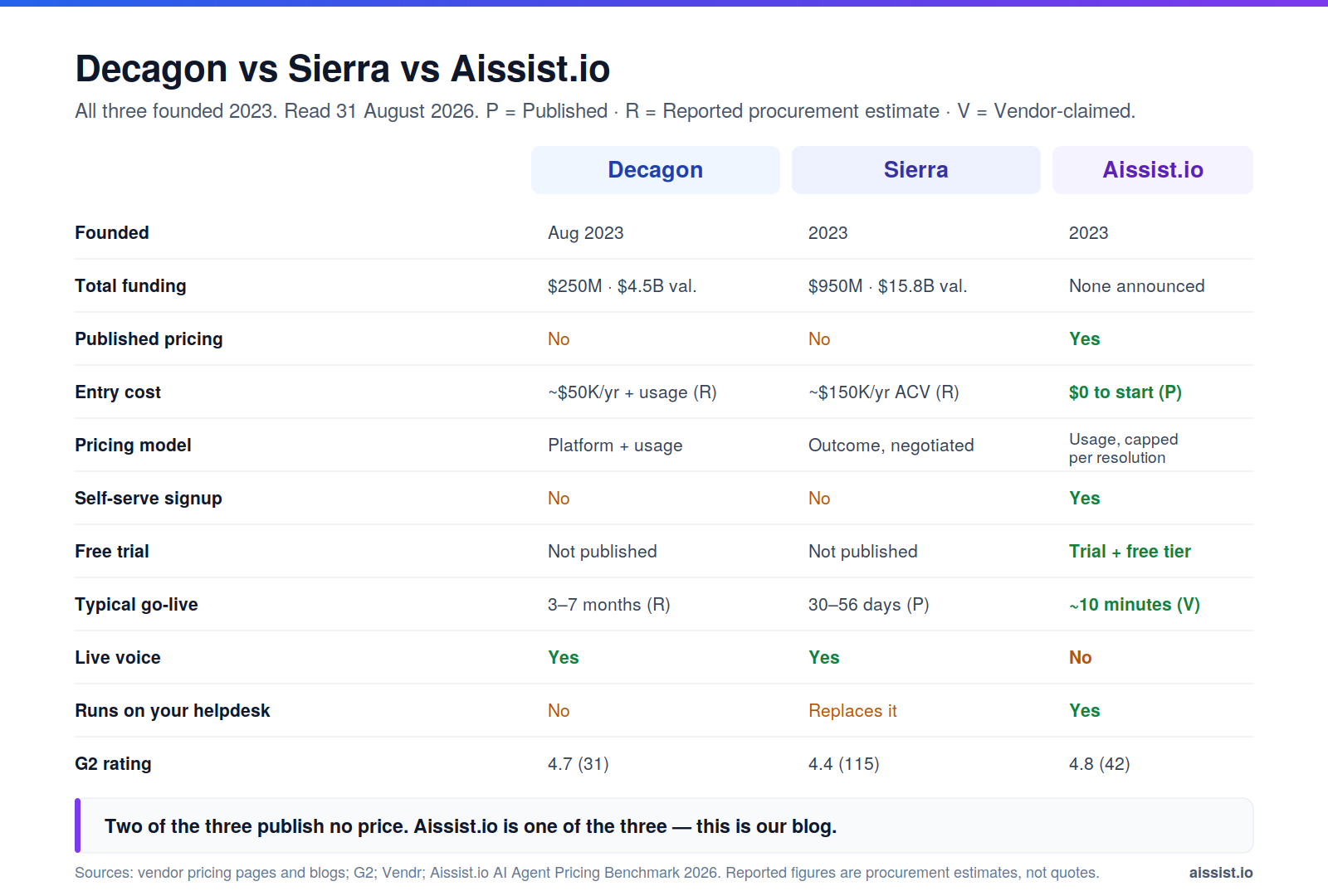
Decagon vs Sierra vs Aissist at a glance
| Decagon | Sierra | Aissist.io | |
|---|---|---|---|
| Founded | August 2023, by Jesse Zhang and Ashwin Sreenivas | 2023, by Bret Taylor and Clay Bavor; public February 2024 | 2023, Mountain View |
| Total funding | $250M Series D at a $4.5B valuation, January 2026 | $950M raised at a $15.8B post-money valuation, May 2026 | None announced |
| Published pricing | No | No | Yes — $0.20–$0.60 per resolution |
| Estimated entry cost | ~$50K/yr platform + ~$0.99/conversation (Reported) | ACV ~$150K+, setup $50K–$200K (Reported) | $0 to start — trial and free tier (Published) |
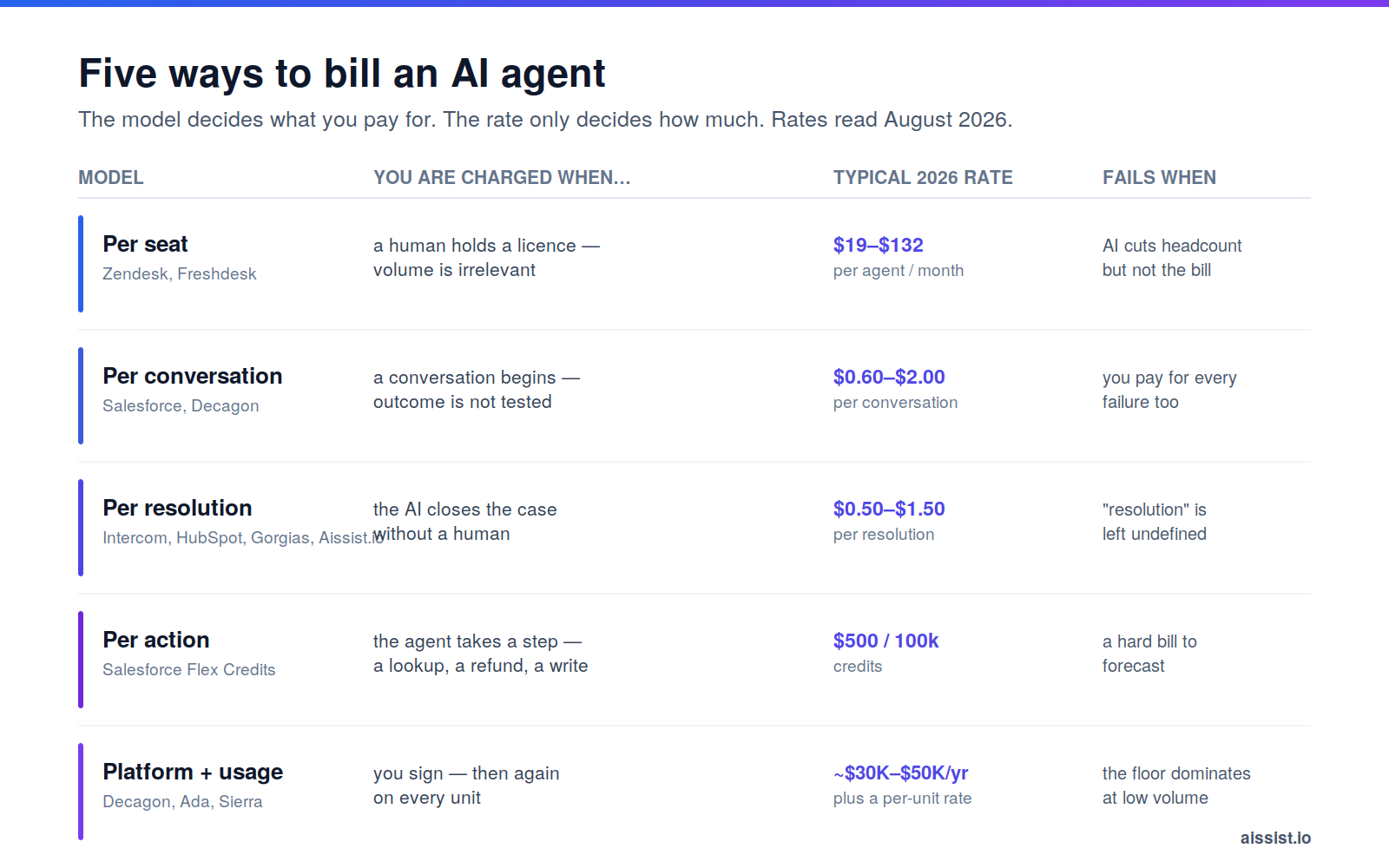
| Pricing model | Platform + usage | Outcome-based, negotiated per client | Usage, capped per resolution — $0.09 per interaction, capped at $0.25 for email/form/social and $0.60 for chat/WhatsApp/SMS; you pay the lower of the two |
| Self-serve signup | No | No | Yes |
| Free trial | Not published | Not published | Yes — trial, plus 1,000 free tickets/month |
| Typical go-live | 3–7 months (Reported) | 30–56 days on its own named deployments (Published) | ~10 minutes (vendor-claimed) |
| Voice | Yes — Decagon Voice | Yes — Voice Personas, shipped 7 August 2026 | No — voice messages only, no live voice |
| Omnichannel | Chat, email, voice, SMS | Chat, voice, email, SMS | Chat, email, WhatsApp, SMS, forms, social |
| Helpdesk-native | No — no helpdesk included | Replaces the conversation layer | Yes — runs on your existing helpdesk |
| G2 rating | 4.7 (31 reviews) | 4.4 (115 reviews) | 4.8 (42 reviews) |
All three companies were founded in 2023. What separates them is not age but go-to-market: two chose enterprise sales, one chose a published rate and a trial.
G2 scores read August 2026 from G2's Decagon vs Sierra comparison and Aissist.io's G2 listing. G2's comparison page shows an inconsistent review count for Sierra — 115 in the header, 83 in the summary table — so treat that count as approximate.
Who each one is built for
| Decagon | Sierra | Aissist.io | |
|---|---|---|---|
| Best-fit team | Large enterprise, F100 | Fortune 50, regulated verticals | SMB and mid-market |
| Buying process | Vendor-led, forward-deployed team | Vendor-led implementation | Self-serve, credit card optional |
| Where it runs | Its own platform | Its own conversation layer | Intercom, Zendesk, Freshdesk, Kustomer, Front, Gorgias, Salesforce, HubSpot |
| Contract shape | Annual, six figures reported | Annual ACV plus setup, reported | Annual, with pay-as-you-go available |
| The trade-off | Depth you pay for whether or not you use it | Enterprise programme, not a tool | No live voice, no enterprise programme |
1. Sierra — best for Fortune 50 and regulated enterprise
Sierra is an enterprise conversational AI company that builds branded, voice-capable AI agents for the world's largest companies, deployed as its own conversation layer through a vendor-led implementation.
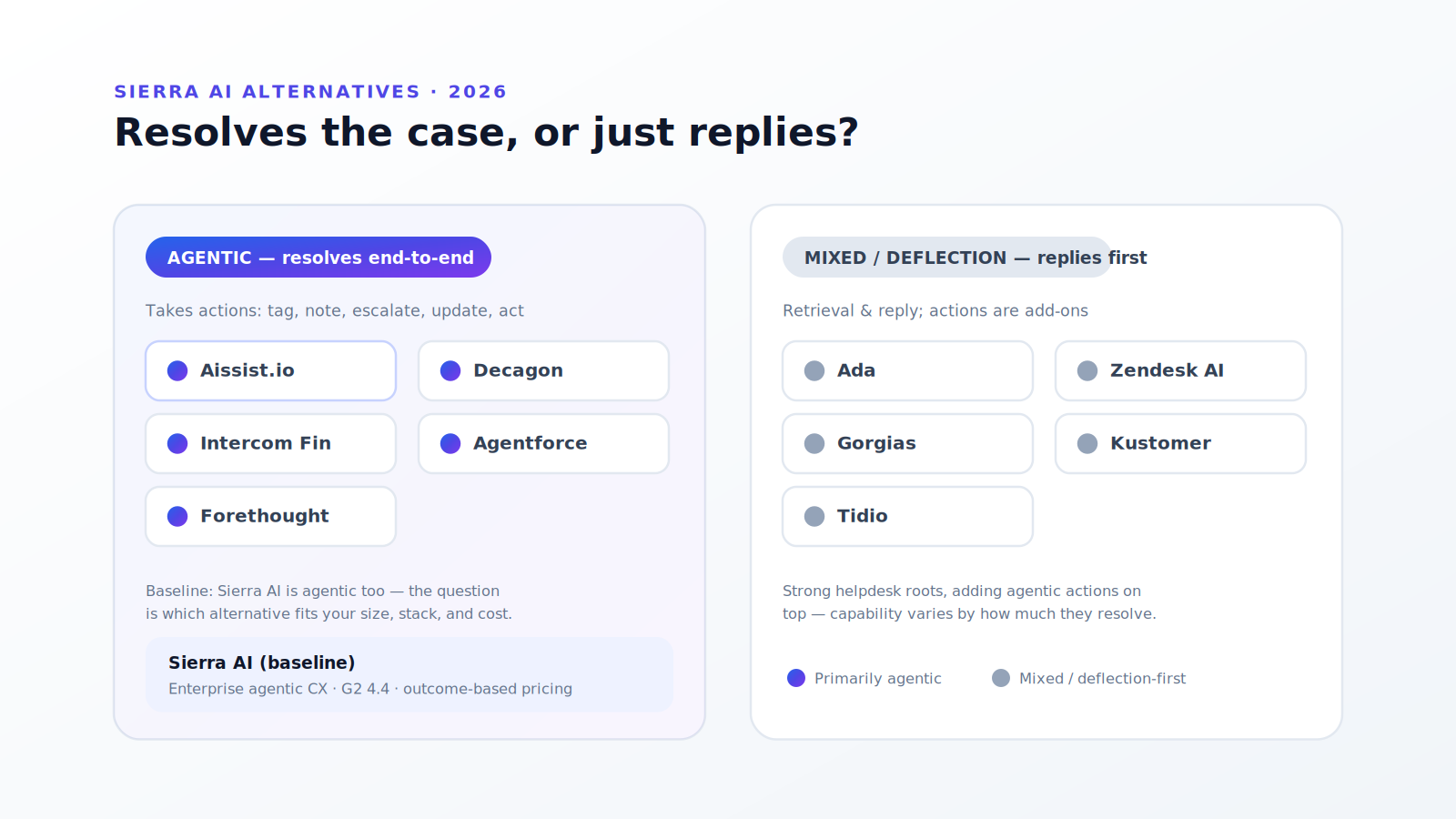
Technology: agentic, multi-agent with guardrails. Deploys onto: its own conversation layer, integrated into enterprise systems. Channels: chat, voice, email, SMS. Actions: full execution across enterprise systems, including bank-account connections through its Plaid partnership, announced 3 August 2026.
Performance: serves "one in three leading banks, 40% of the Fortune 50, and five of the ten biggest healthcare organizations" (vendor-claimed, Sierra, 14 August 2026). G2: 4.4 (115 reviews), read August 2026 · Cost: outcome-based, no published rate; ACV reported at ~$150K+ with setup of $50K–$200K (Reported).
Pros:
- The deepest voice capability of the three, with Voice Personas separating agent function from expression, shipped 7 August 2026.
- Release governance — checks, approvals and staged rollouts — shipped 20 August 2026, which is the tooling a regulated enterprise actually needs.
- Publishes its own deployment times: BBVA in 30 days, Next in 42, Singtel in 56.
Cons:
- No published rate card, so budgeting requires a sales cycle.
- Its fastest published deployment is 30 days — fine for a bank, slow for a 20-person support team.
- Expanding hard into enterprise geographies — a Munich office on 14 August 2026 and a Seoul office on 25 August 2026 — which is not where mid-market attention goes.
Our take: Sierra is the strongest product here for a company with a compliance function and a six-figure budget. Do not pick it if you need to be live before your next board meeting. More detail: Aissist vs Sierra.
2. Decagon — best for large enterprise concierge support
Decagon is an enterprise AI customer support platform that builds premium "concierge" AI agents for large enterprises, deployed on its own platform with a guided onboarding.
Technology: agentic, with Agent Operating Procedures that execute multi-step workflows. Deploys onto: its own platform; no helpdesk included. Channels: chat, email, voice, SMS. Actions: full workflow execution.
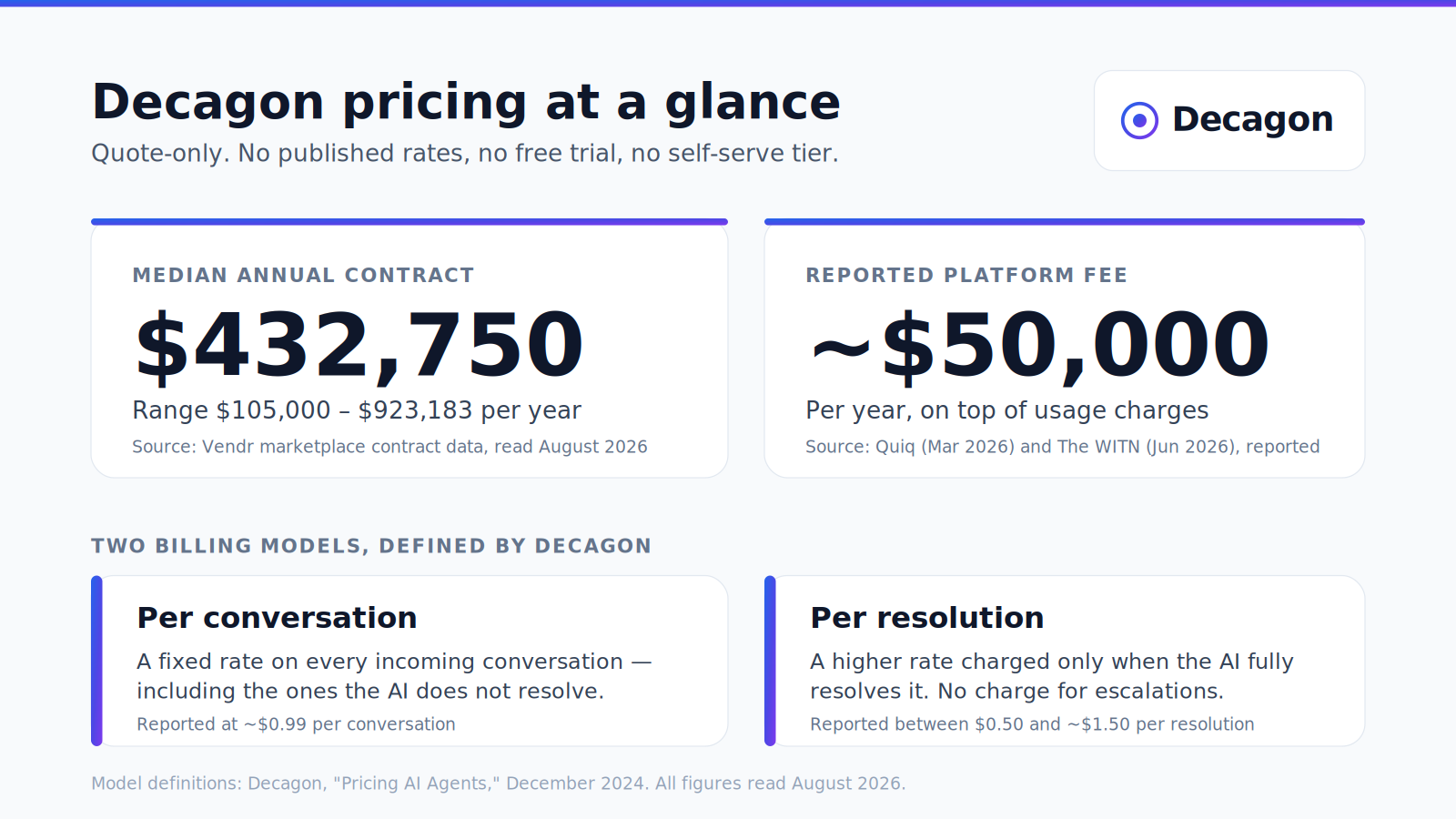
Performance: named customers are those Decagon publishes on its own case-studies page (vendor-claimed). G2: 4.7 (31 reviews), read August 2026 · Cost: ~$50K/yr platform plus ~$0.99 per conversation; Vendr reports a median annual contract of $432,750 across a $105,000–$923,183 range (Reported, Vendr, read 20 August 2026 — that page publishes neither a date nor a sample size).
Pros:
- The best-funded independent pure-play in the category — $250M Series D at a $4.5B valuation, announced 27 January 2026.
- Decagon Voice is a genuine voice agent, not a voice-message feature.
- Agent Operating Procedures handle multi-step workflows that simpler agents cannot.
Cons:
- Publishes no pricing, and the reported range spans nearly 9× from floor to ceiling.
- No helpdesk included, so the platform fee sits on top of whatever you already run.
- Reported deployments run 3–7 months.
Our take: Decagon is excellent at F100 scale and priced accordingly. Do not pick it if your annual support software budget is smaller than its reported median contract. More detail: Aissist vs Decagon and multi-agent vs single-agent architecture.
3. Aissist.io — best for mid-market teams that want budget pricing without a frontloaded commitment
Aissist.io is an agentic AI operational layer for customer support and sales that resolves conversations end to end on top of the helpdesk a team already runs, deployed self-serve in about ten minutes.
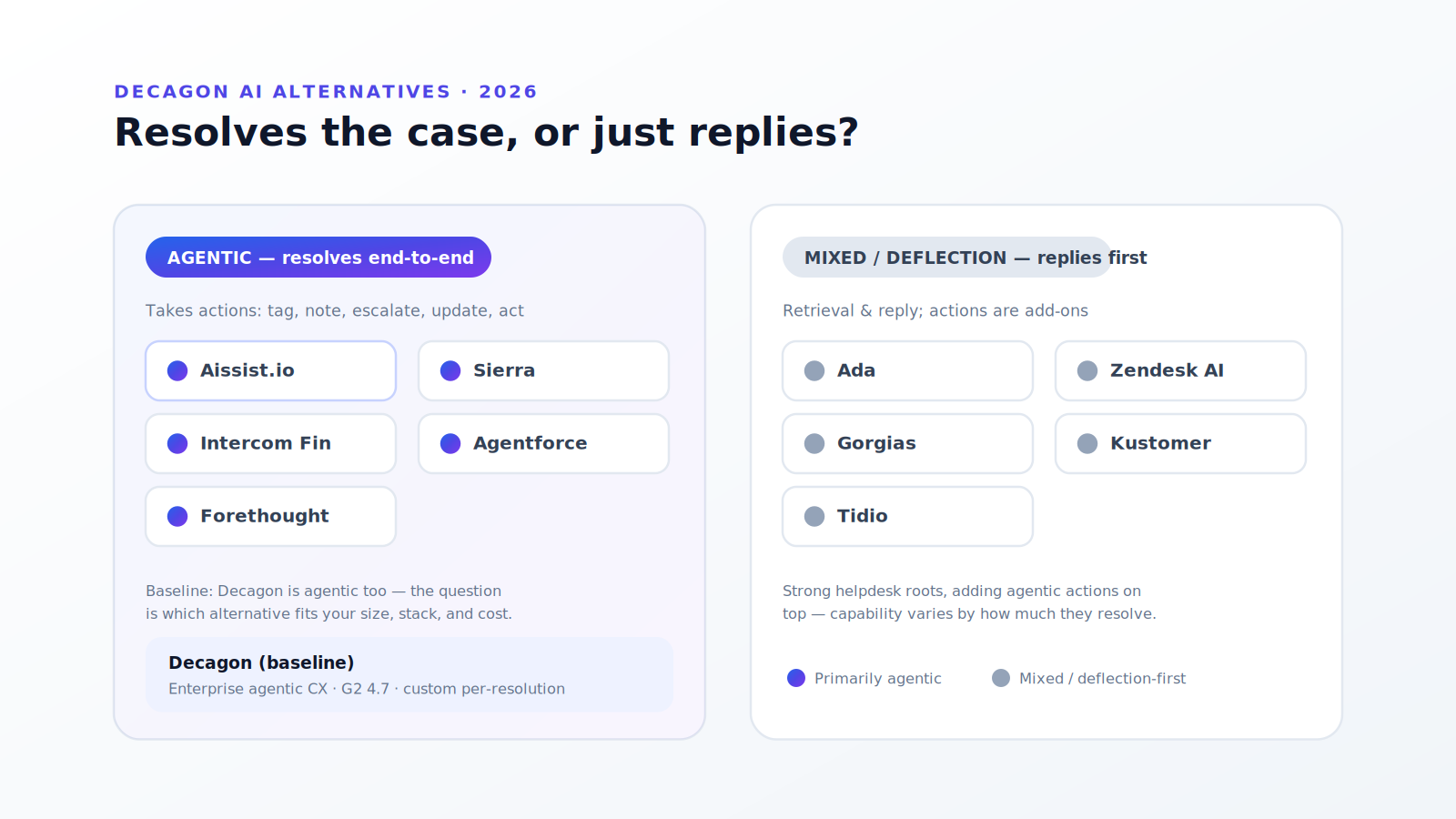
Technology: agentic, multi-agent (AgentMesh™). Deploys onto: Intercom, Zendesk, Freshdesk, Kustomer, Front, Gorgias, Salesforce and HubSpot. Channels: chat, email, WhatsApp, SMS, forms, social. Actions: end-to-end execution including tagging, replies, system updates and workflow triggers.
Performance: 83% average resolution rate (vendor-claimed, Aissist.io benchmark). G2: 4.8 (42 reviews), read August 2026 · Cost: usage, capped per resolution — $0.09 per interaction, capped at $0.25 per resolution for email, forms and social and $0.60 for web chat, WhatsApp and SMS, with the customer paying whichever is lower. No platform or seat fee. Annual contracts are standard, with pay-as-you-go available and a trial before commitment (Published, pricing).
Pros:
- The only one of the three with a published rate, and the only one that meters usage under a per-resolution cap rather than charging one blended rate.
- Runs on the helpdesk you already have, so there is no conversation layer to replace.
- A trial and a 1,000-ticket free tier let a team prove it on real traffic before committing to anything.
Cons:
- No live voice. Aissist.io states plainly that AgentMesh supports voice messages but "does not currently support real-time live voice communication" — if voice is a requirement, this is disqualifying.
- No announced funding, which is a legitimate vendor-risk question against competitors holding $250M and $950M.
- 42 G2 reviews is a thinner independent record than Sierra's 115.
Our take: Aissist.io is the right call for a mid-market team that wants a reliable agent at a budget price and the option to try it before committing. Do not pick it if you need a live voice agent or a named forward-deployed team.
What these three actually cost
At 2,000 tickets a month and a 60% resolution rate, the year-one gap between the cheapest and the most expensive of these three runs to roughly 25×. The Aissist figure is arithmetic from a published rate; the other two are modelled from reported procurement data and should be treated as indicative.
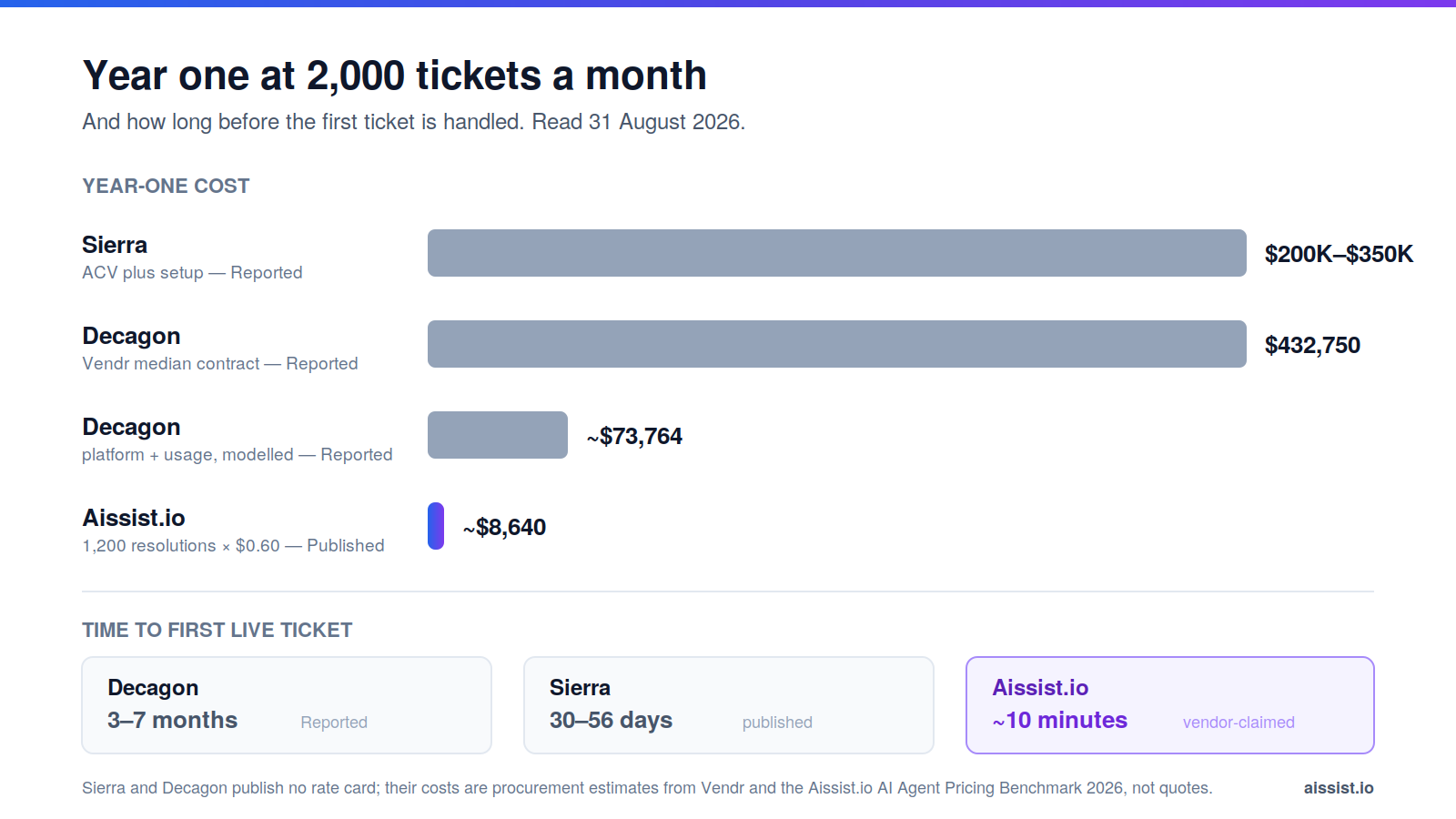
| Monthly | Year one | Provenance | |
|---|---|---|---|
| Aissist.io | $720 (1,200 resolutions at the $0.60 chat cap) | ~$8,640 | Published rate |
| Decagon | ~$6,147 (~$50K/yr platform ÷ 12 + 2,000 × $0.99) | ~$73,764 | Reported |
| Decagon, Vendr median contract | — | $432,750 | Reported |
| Sierra | ~$12,500 (ACV ~$150K ÷ 12) | ~$200,000–$350,000 with setup | Reported |
That Aissist figure is a ceiling, not a rate. Usage is metered at $0.09 per interaction and capped per resolution, so you pay the lower of the two — the $0.60 cap only binds on long chat threads. An email-led queue is capped at $0.25, taking the same volume to roughly $3,600 a year, and short conversations bill under the cap either way.
The hidden costs sit almost entirely on the enterprise side. Sierra's reported setup runs $50,000–$200,000 before the subscription starts, and Decagon's platform fee is charged whether or not conversation volume arrives. Aissist.io's hidden cost is different in kind: there is no forward-deployed team, so configuration is your team's time.
How to choose between Decagon, Sierra and Aissist
- If you are a Fortune 500 company in a regulated vertical, choose Sierra, because release governance, staged rollouts and named enterprise references are what your risk function will ask for, and Sierra ships all three.
- If you need a live voice agent, choose Sierra or Decagon, because Aissist.io does not support real-time voice at all — its own documentation says so.
- If you run under 50 support agents, choose Aissist.io, because both alternatives are reported to start above $150,000 a year, which is more than most mid-market teams spend on their entire support stack.
- If you need to be live in under a week, choose Aissist.io, because Sierra's own fastest published deployment is 30 days and Decagon's are reported at 3–7 months.
- If you want to keep your existing helpdesk, choose Aissist.io, because it deploys onto Zendesk, Intercom, Freshdesk and five others rather than replacing the conversation layer.
- If your evaluation depends on a published, auditable price, choose Aissist.io, because neither Decagon nor Sierra publishes one, and a procurement estimate is not a quote.
- If you want to prove it on your own traffic before signing anything, choose Aissist.io, because it is the only one of the three offering a trial and a free tier; the other two run vendor-led evaluations.
- If you have a six-figure budget and complex multi-step workflows, shortlist Decagon, because Agent Operating Procedures are built for exactly that and the $4.5B valuation buys engineering depth.
Frequently asked questions
Is Decagon or Sierra better for a mid-market team?
Neither is built for mid-market. Sierra targets the Fortune 50 and Decagon targets large enterprise, with reported entry costs of ~$150,000 and ~$50,000 a year plus usage respectively. Mid-market teams generally find the contract shape, not the technology, disqualifying.
How much does Decagon cost per year?
Decagon publishes no pricing. Vendr reports a median annual contract of $432,750 across a range of $105,000 to $923,183, read 20 August 2026, on a page that publishes neither a date nor a sample size. Treat it as indicative only.
How much does Sierra AI cost?
Sierra publishes no rate card and prices on negotiated outcomes. Reported figures put annual contract value at roughly $150,000 and upward, with setup of $50,000 to $200,000, giving year-one totals of $200,000 to $350,000 or more.
Which AI support agent works for a team under 50 agents?
Aissist.io is the only one of these three with a published rate and self-serve signup, at $0.20–$0.60 per resolution with 1,000 free tickets a month. Decagon and Sierra both require a sales cycle and report six-figure annual contracts.
Can any of these go live in under a week?
Only Aissist.io. It is self-serve and reports going live in about ten minutes on an existing helpdesk. Sierra's own fastest published deployment is 30 days at BBVA, and Decagon deployments are reported at 3–7 months.
Does Aissist support voice like Decagon and Sierra?
No. Aissist.io supports voice messages but states it "does not currently support real-time live voice communication." Decagon offers Decagon Voice and Sierra shipped Voice Personas on 7 August 2026, so for live voice both alternatives are ahead.
Do Decagon or Sierra offer a free trial?
Neither publishes a free trial or self-serve signup as of August 2026; both run vendor-led evaluations. Aissist.io offers a trial and a free tier of 1,000 tickets a month, so a pilot runs on real traffic before any commitment.
Which has the best G2 rating?
Aissist.io scores 4.8 from 42 reviews, Decagon 4.7 from 31, and Sierra 4.4 from 115, all read August 2026. Sierra's larger review base is the more statistically meaningful record, and G2's own page shows an inconsistent count for it.
Want to see it on your own tickets first? Aissist.io runs on the helpdesk you already have, with a trial and 1,000 free tickets a month before any commitment. See pricing · Book a consultation →
Changelog
- 31 August 2026 — First published. Funding and valuation figures read from Decagon's Series D announcement (27 January 2026) and reporting on Sierra's May 2026 round. Sierra's Korea (25 August), release governance (20 August) and DACH (14 August) announcements read from Sierra's own blog. Entry-cost estimates carried from the AI Agent Pricing Benchmark 2026 and Vendr, both labelled Reported. G2 scores and Aissist.io pricing read 31 August 2026. Aissist.io founding date, location and contract terms are company-stated.