Zendesk Action Credits: What They Meter and Who Actually Pays
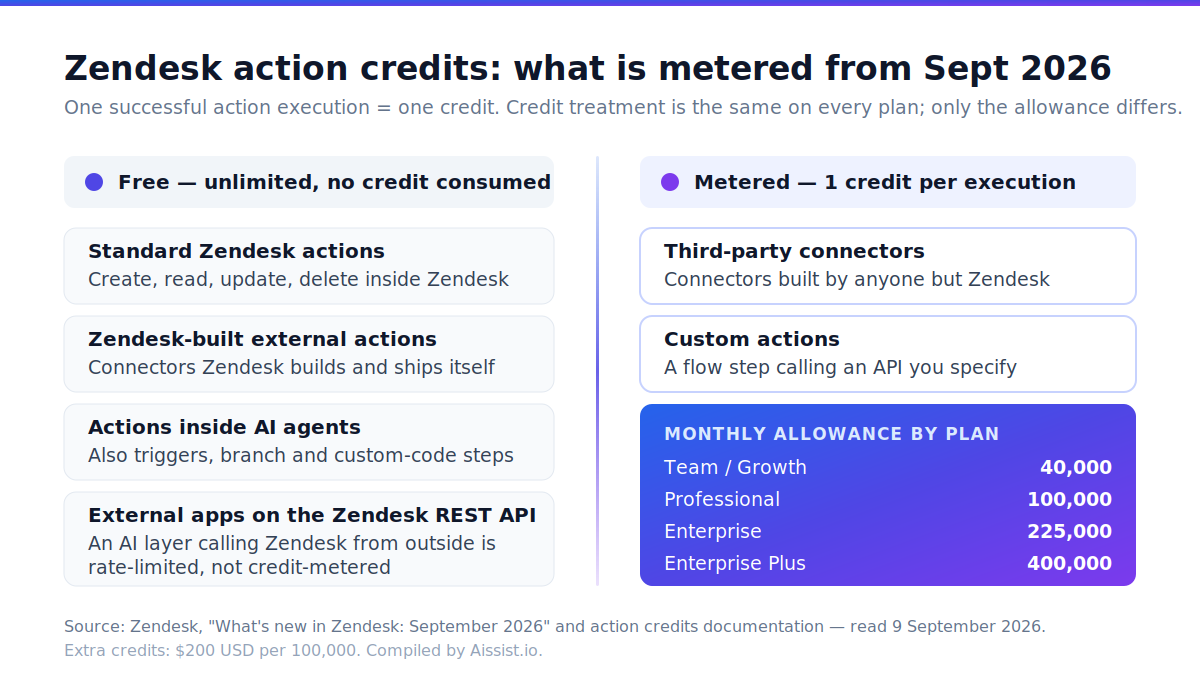
TL;DR — Zendesk action credits meter action-flow step executions, and since September 2026 they apply only to third-party connectors and custom actions. Native Zendesk actions are now free and unlimited, which for most accounts is a cost decrease. Allowances run 40,000–400,000 credits a month by plan, with extras at $200 USD per 100,000. The line rarely bites: on Suite Professional at three metered steps per ticket, the first dollar of overage arrives at 33,333 tickets a month. Aissist.io is unaffected, because it connects over the Zendesk REST API as an external application rather than running as a step inside Zendesk's action builder.
Zendesk's September 2026 release notes state that the platform now "allows unlimited automation of Zendesk operations, including all standard Zendesk actions and Zendesk-built external actions, without affecting credit usage" (read 9 September 2026). That is good news on the bill. It is also the clearest statement yet about which half of your automation Zendesk intends to charge for.
We'll declare the bias up front — this is Aissist's blog, and Aissist.io sells an AI operational layer that plugs into Zendesk. So the arithmetic below is shown in full, including the parts where staying native is cheaper.
What Are Zendesk Action Credits?
Short answer: A Zendesk action credit is the unit of measurement for action usage — one successful action execution consumes one credit.
Zendesk defines actions as "steps or operations performed by action flows that create, read, update, or delete something in Zendesk or a connected external system," and states that "action credits are the unit of measurement used to calculate your usage of actions," on its action credits monitoring documentation (read 9 September 2026).
Two things follow from that definition, and both matter more than the credit price.
First, credits meter action flows — the workflows you build in Zendesk's action builder. They do not meter tickets, agents, conversations, or AI resolutions. Those have their own meters.
Second, credits only ever counted a subset of steps. Zendesk's documentation lists flow triggers, flow-control and custom-code steps, asset actions, Jamf Pro actions and Microsoft Intune actions as consuming nothing, and confirms on its actions in AI agents page that action flows in AI agents do not consume action credits (read 9 September 2026).
Zendesk announced action credits on 15 January 2026 and began enforcing allowances on 15 April 2026, per the same announcement page. The nine months since have been the market learning what the meter actually touches.
What Changed in September 2026?
Short answer: Zendesk removed native actions from the meter entirely, leaving third-party connectors and custom actions as the only things that consume credits.
The release notes put it in one sentence: "Action credits now apply to third-party connectors and custom actions only" (read 9 September 2026).
Here is the before-and-after, by action type. Credit treatment does not vary by plan — the allowance does, and that table follows in the next section.
| Action type | What it is | Credits, Jan–Aug 2026 | Credits, from Sept 2026 |
|---|---|---|---|
| Standard Zendesk actions | Create, read, update or delete inside Zendesk | 1 per execution | None — unlimited |
| Zendesk-built external actions | Connectors Zendesk builds and ships itself | 1 per execution | None — unlimited |
| Third-party connectors | Connectors built by anyone other than Zendesk | 1 per execution | 1 per execution |
| Custom actions | A flow step calling an API you specify | 1 per execution | 1 per execution |
| Action flows inside AI agents | Actions an AI agent runs | None | None |
| Triggers, branch and custom-code steps | Flow control and utility | None | None |
| Asset, Jamf Pro, Microsoft Intune actions | ITSM-specific actions | None | None |
| External app calling the Zendesk REST API | An AI layer or integration outside Zendesk | Not metered — rate-limited | Not metered — rate-limited |
Source: Zendesk September 2026 release notes and action credits documentation, both read 9 September 2026.
Read the top four rows together and the shape is unmistakable: the actions Zendesk builds are free, and the actions anyone else builds are metered.
How Many Action Credits Does Each Zendesk Plan Include?
Short answer: Zendesk includes 40,000 to 400,000 action credits per month depending on plan, and sells more at $200 USD per 100,000 credits.
Both figures come from Zendesk's action credits announcement (read 9 September 2026); the add-on rate is not listed on Zendesk's public pricing page, which is its own kind of answer.
| Plan | Action credits / month | Action credits / year | Seat price (paid yearly) |
|---|---|---|---|
| Support Team | 40,000 | 480,000 | $19 USD per agent/month |
| Suite Team (and Growth) | 40,000 | 480,000 | $55 USD per agent/month |
| Suite / Support Professional | 100,000 | 1,200,000 | $115 USD per agent/month |
| Suite / Support Enterprise | 225,000 | 2,700,000 | Quote only |
| Suite Enterprise Plus | 400,000 | 4,800,000 | Quote only |
Seat prices read from Zendesk's pricing page on 9 September 2026, annual billing. Zendesk sends email notifications at 80% and 100% of allowance, and additional credits are bought through support in units of 100,000 actions.
Two other meters sit alongside this one and are frequently confused with it. Copilot costs $50 USD per agent per month paid yearly, and AI agents are billed on automated resolutions — outcome-based, with no per-resolution rate published on the pricing page (read 9 September 2026). We break both down in Zendesk AI pricing explained.
At What Ticket Volume Do Action Credits Actually Cost You Money?
Short answer: On Suite Professional, above 100,000 metered executions a month — which is 33,333 tickets if each runs three third-party or custom steps.
The formula is one line:
Tickets before overage = plan allowance ÷ metered steps per ticket
Take a realistic order-status flow. The AI agent reads the ticket, looks up the order in your commerce platform (1 metered step), checks the carrier (1 step), writes the outcome back to your CRM (1 step), and updates the Zendesk ticket (0 steps — native, now free). Three metered steps per ticket.
| Monthly tickets | Metered steps each | Credits used | Professional allowance | Over / under | Add-on cost |
|---|---|---|---|---|---|
| 5,000 | 3 | 15,000 | 100,000 | 85,000 under | $0 |
| 20,000 | 3 | 60,000 | 100,000 | 40,000 under | $0 |
| 50,000 | 3 | 150,000 | 100,000 | 50,000 over | $200 (1 unit) |
| 50,000 | 6 | 300,000 | 100,000 | 200,000 over | $400 (2 units) |
Arithmetic from Zendesk's published allowance (100,000/month, Professional) and add-on rate ($200 per 100,000), read 9 September 2026.
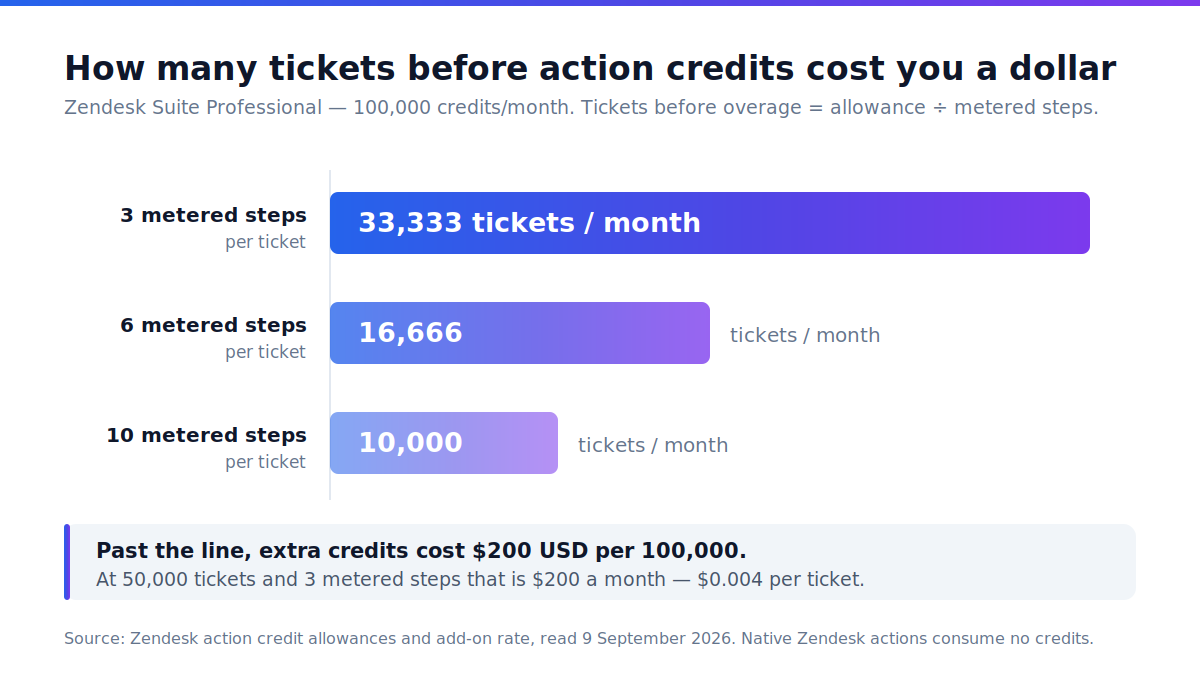
At 50,000 tickets and three metered steps, the overage works out to $0.004 per ticket. You will spend more than that in meeting time discussing it. Even the heavy case — six metered steps at 50,000 tickets — lands at $0.008 per ticket.
So the honest conclusion: for the overwhelming majority of Zendesk accounts, the action-credit line is a rounding error, and the September change made it smaller. Anyone selling you panic about it is selling you something.
Does the Zendesk Action Credit Change Affect Aissist.io?
Short answer: No. Aissist.io does not consume Zendesk action credits, because it connects as an external application over the Zendesk REST API rather than running as a step inside Zendesk's action builder.
Action credits meter action-flow step executions inside Zendesk. Traffic from an outside application is governed by Zendesk's REST API rate limits instead — 200 requests per minute on Team, 400 on Growth and Professional, 700 on Enterprise and 2,500 on Enterprise Plus, per Zendesk's developer rate limit documentation (read 9 September 2026). Those limits are throughput ceilings, not a billed meter.
The Aissist.io Zendesk integration is authorized as a gateway that reads tickets, sends customer-facing replies, writes back ticket fields, and triggers actions in connected systems — all from outside Zendesk. Verify it in your own account rather than taking our word for it: Admin Center's action credit usage dashboard attributes every credit to the flow step that consumed it, so a gateway that runs no flow steps contributes nothing to the total.
One honest caveat, because it is the case where the answer flips. If your team builds a custom action inside a Zendesk action flow that calls any external vendor — Aissist included — that step consumes one credit per execution. The credit follows where the step runs, not which logo is on the other end of it. If you have built it that way, your Admin Center usage dashboard will show it.
Is It Cheaper to Stay Native or Add a Third-Party AI Layer?
Short answer: On the action line specifically, staying entirely native is now cheaper — that line is zero.
If your automation only touches Zendesk objects, there is no credit cost and no third-party meter to think about. That is the concession the arithmetic demands, and any page that skips it is not doing arithmetic.
The comparison people attempt next is usually a toll booth against a taxi fare, because the two meters price different things. Action credits price integration plumbing. Aissist.io's pricing prices the resolution: $0.09 USD per AI interaction, capped at $0.25 per email resolution and $0.60 per web chat resolution — you are charged the lower of the two (read 9 September 2026), with a free tier up to 1,000 tickets per month. Aissist.io reports 83% average resolution and 4.8/5.0 average CSAT across its projects through 31 March 2026 (vendor-claimed, AgentMesh™ product page, read 9 September 2026).
So the decision rule is not about $200 of credits. If your workflows resolve inside Zendesk and your resolution rate is already where you want it, stay native. If the gap you are trying to close is resolution rate and cost per resolved ticket, that is the meter to compare — and Zendesk does not publish a per-resolution rate on its pricing page, so a like-for-like comparison requires a quote from your account team.
Cost is rarely where the Zendesk conversation lands anyway:
"I dislike that everything is an add-on. You have to purchase everything individually and it can get quite pricy."
— Lisa M., Customer Experience Content Team Manager, mid-market, in a G2 review of Zendesk Support Suite dated 17 June 2026 (independently reported)
What Does the Action Credit Change Tell You About Bundled AI Pricing?
Short answer: It is not a price increase — Zendesk shrank the metered surface — but it made the shape of the bundle explicit.
The actions Zendesk owns are free; the actions anyone else builds are metered. That is a normal commercial decision, and every platform vendor makes it. It is worth naming because the shape can change again, in either direction, on the vendor's schedule and not yours.
That is the practical argument for keeping the AI layer independent of the host platform's meter — the case we make in adding AI to Zendesk without replacing your stack. It is an argument about who sets the terms, not about $200.
What Else Shipped in the September 2026 Zendesk Release?
Short answer: Two changes beyond action credits matter operationally — AI agent cloning now copies full configuration, and the resolution dashboards gained brand and tier filtering plus export.
Both come from the same September 2026 release notes (read 9 September 2026).
Cloning an AI agent "now duplicates the AI agent's full configuration, including procedures, actions, knowledge sources, search rules, segments, and personalization settings." That closes a real gap for anyone running a sandbox-to-production promotion path, where partial clones meant rebuilding half the agent by hand.
On the usage side, both the resolution usage and resolution allowance dashboards let you "filter by brand and tier," and the resolution usage dashboard adds export "for any selected date range." Multi-brand accounts have wanted per-brand resolution attribution since outcome-based pricing arrived; being able to export it is what makes it a finance conversation rather than a screenshot.
Key Takeaways
Zendesk action credits meter action-flow steps and, since September 2026, only third-party connectors and custom actions consume them. Allowances of 40,000–400,000 per month mean most accounts never reach overage; on Suite Professional at three metered steps per ticket, the first dollar arrives at 33,333 tickets a month.
Aissist.io is unaffected because it runs over the Zendesk REST API, outside the action builder — unless you deliberately wrap it in a custom action step, in which case that step is metered like any other. Check your own number in Admin Center rather than taking anyone's word for it, including ours.
Wondering what your Zendesk automation actually costs per resolved ticket? See how AgentMesh resolves end-to-end on top of the Zendesk you already run. Get a free demo →
Frequently Asked Questions
What is a Zendesk action credit?
A Zendesk action credit is the unit measuring action usage in Zendesk's action builder. One successful action execution consumes one credit. Zendesk defines actions as steps that create, read, update or delete something in Zendesk or a connected external system.
Do native Zendesk actions consume action credits?
No. Since September 2026, standard Zendesk actions and Zendesk-built external actions consume no credits and carry unlimited automation rights, per Zendesk's September 2026 release notes (read 9 September 2026). Only third-party connectors and custom actions consume credits.
How many action credits does Zendesk include?
Zendesk includes 40,000 credits per month on Team and Growth plans, 100,000 on Professional, 225,000 on Enterprise and 400,000 on Enterprise Plus, per Zendesk's action credits announcement (read 9 September 2026). Annual allowances are twelve times the monthly figure.
How much do extra Zendesk action credits cost?
Extra action credits cost $200 USD per 100,000 credits, bought through Zendesk support in units of 100,000, per Zendesk's action credits announcement (read 9 September 2026). The rate is not published on Zendesk's public pricing page.
Do Zendesk AI agents consume action credits?
No. Zendesk's documentation states that action flows in AI agents do not consume action credits, and that actions run from the "Run on demand" trigger for Copilot and AI agents are also excluded (read 9 September 2026). AI agents are billed separately on automated resolutions.
Does Aissist.io consume Zendesk action credits?
No. Aissist.io connects to Zendesk as an external application over the Zendesk REST API, not as a step inside Zendesk's action builder, so its traffic is bounded by API rate limits rather than metered in credits. Custom action steps you build that call Aissist would consume credits.
At what volume do Zendesk action credits start costing money?
Divide your plan allowance by the metered steps per ticket. On Suite Professional's 100,000 monthly credits, that is 33,333 tickets at three metered steps, 16,666 at six steps, and 10,000 at ten steps. Below those volumes, overage is zero.
Do Zendesk API calls count against action credits?
No. Zendesk's REST API is governed by rate limits — 200 requests per minute on Team, 400 on Growth and Professional, 700 on Enterprise, 2,500 on Enterprise Plus (read 9 September 2026) — not by action credits. Rate limits throttle throughput; they do not generate a charge.