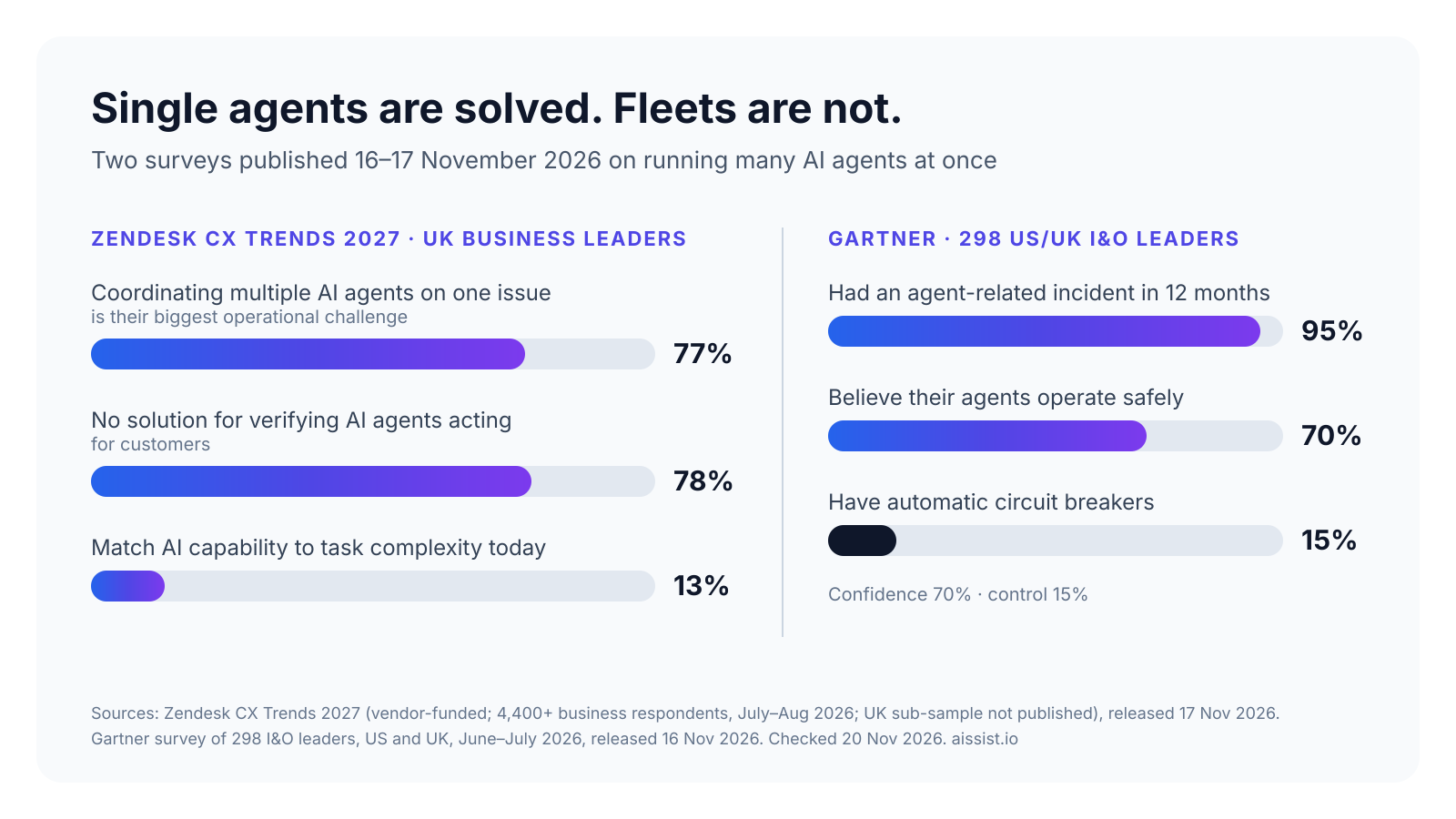
In Zendesk CX Trends 2027 (n=4,400+ business respondents, fielded July–August 2026), 77% of UK business leaders called coordinating multiple specialised AI agents on one customer issue their biggest operational challenge. That is Zendesk's own vendor-funded research: the UK sub-sample size, margin of error and fieldwork firm are not published, and Zendesk competes with us.
TL;DR: A second AI agent creates four ownership problems routing never had — record, handoff, tiebreak, stop button — and Gartner found only 15% of organisations can automatically stop runaway agents.
Methodology & sources
- Zendesk CX Trends 2027 (UK figures, released 17 Nov 2026); Gartner (16 Nov 2026); Microsoft Windows at Ignite (17 Nov 2026).
- Aissist figures are stated across its own deployments (benchmark).
- Checked 20 Nov 2026. Disclosure: this is Aissist's blog; Aissist sells multi-agent AI for customer service.
What is multi-agent orchestration in customer service?
Multi-agent orchestration in customer service is the layer that decides which AI agent acts on a ticket, what it sees, and who stops it.
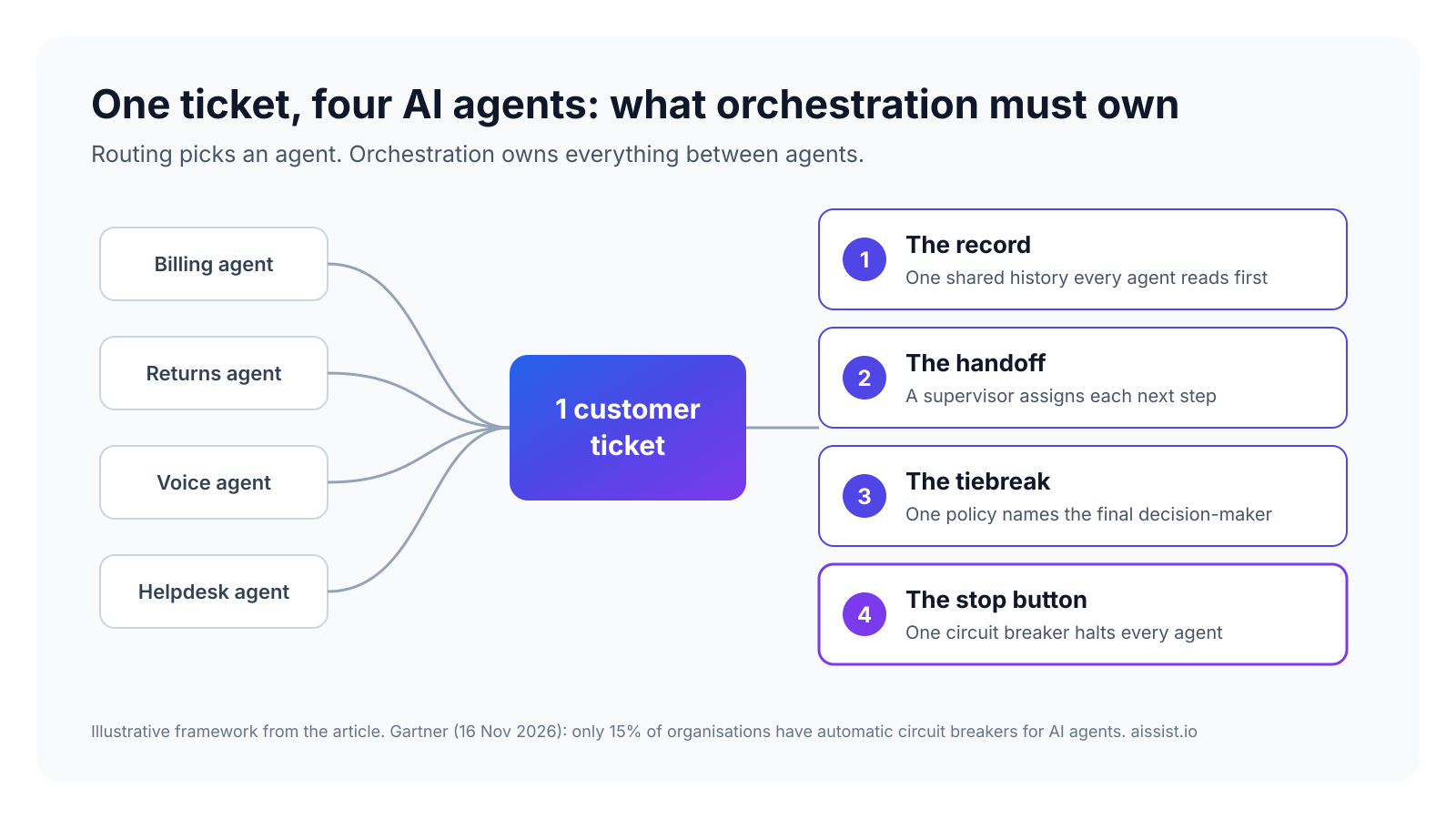
Routing sends a ticket to one agent and walks away. Orchestration stays: one record, handoffs, tiebreaks and the off switch. Routing is a switchboard; orchestration is a shift manager.
Four vendors' agents on one queue — billing, returns, voice, the helpdesk's own — need one. Most teams are early: only 13% of UK business leaders in Zendesk's research match AI capability to task complexity today, though 66% expect to within 12–24 months.
"Leaders need to give their AI workforce clear direction, measure its performance and decide where human judgement is needed." — Shashi Upadhyay, President of Product, Engineering and AI, Zendesk
What breaks when you run a second AI agent?
Four things break when AI agents multiply, and each is an ownership question rather than a model-quality one.
| What breaks | Why it breaks when agents multiply | What has to own it |
|---|---|---|
| The conversation record | Each vendor's agent keeps its own transcript; the next starts cold | One shared record every agent reads and writes |
| The handoff decision | Agents pass to each other, a human or nobody; tickets loop or drop | A supervisor that plans and assigns each step |
| The confidence tiebreak | Two agents disagree — refund or deny — each above its own threshold | One policy naming the final decision-maker |
| The stop button | One agent's error spreads through the rest at machine speed | An out-of-band circuit breaker that halts every agent |
The first three show up as a customer reading their order number to a third agent in a row. The fourth shows up as an incident. Nobody misses a stop button until they need one.
A fifth seam sits on the customer's side: 78% of UK business leaders in the same research have no solution for verifying AI agents that act for customers.
How wide is the governance gap?
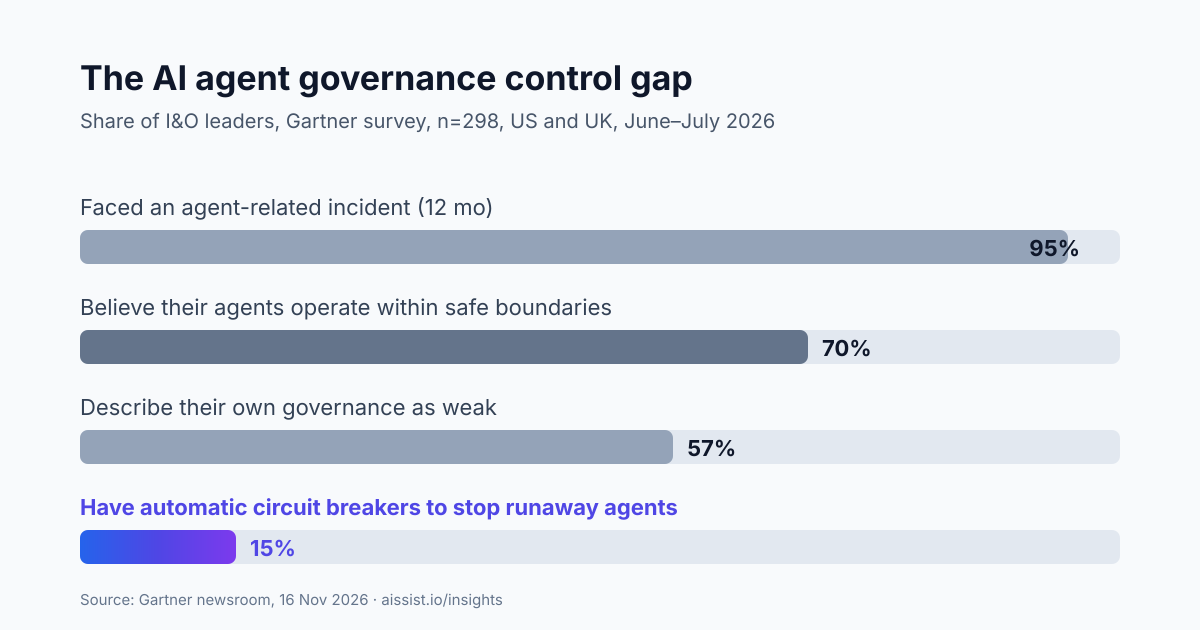
Wide: 95% of organisations had an agent-related incident in the past year, yet only 15% can stop runaway agents automatically.
| Gartner, 16 Nov 2026 (298 US/UK I&O leaders, surveyed June–July 2026) | Share |
|---|---|
| Faced at least one agent-related incident in the past 12 months | 95% |
| Describe their current governance as weak | 57% |
| Believe their AI agents operate within safe boundaries | 70% |
| Have automatic circuit breakers to stop runaway agent errors | 15% |
The gap between 70% and 15% is confidence without control. Gartner surveyed infrastructure leaders, but the stop-button row reads the same on a support queue.
"As dependence on agents grows, I&O leaders have less flexibility to switch them off." — Nathan Hill, Distinguished VP Analyst and Chief of Research, Gartner
A day later, Microsoft's Windows team announced new agent containment in Microsoft Execution Containers. Three parties in two days said the same thing: single agents are solved; fleets are not. (Our governance gap analysis covers the controls.)
What should you ask before you run a second AI agent?
Ask who owns each break, and how you will prove the fleet works, before a second agent touches a live queue.
- Which system holds the single conversation record, and does every agent write to it?
- Who decides the handoff: a supervisor agent, a rule, or whichever agent answers first?
- When two agents disagree, whose confidence threshold wins, and is that written down?
- Can one person stop every agent at once, without calling a vendor?
- Do you measure resolution and CSAT for the whole fleet, not per agent?
If the answer to question four is "open a ticket with the vendor", you have your answer.
A supervisor architecture answers questions two and three by design. On Aissist's AgentMesh™, a super agent plans the work, activates the sub-agents it needs and makes the final decision (how it works); Aissist reports 83% average resolution (up to 98% in mature deployments) and 4.8/5.0 CSAT. Question four needs a signal before a switch: Agent Insight scores AI and human agents against your own standards and feeds Evolve™.
Orchestration is an ownership problem, not a routing problem
Adding AI agents is easy; owning what happens between them is the work. Before a second agent goes live, name the owner of the record, the handoff, the tiebreak and the stop button. If any has no owner, you are running a crowd, not a fleet.
Frequently asked questions
What is AI agent sprawl in customer support?
AI agent sprawl is several AI agents, often from different vendors, working the same queues with no single layer owning the record, the handoffs or the off switch.
How do you coordinate multiple AI agents on one ticket?
Give every agent one shared conversation record and pass work through a supervisor, so each agent reads the full history instead of starting cold.
What are the most common multi-agent AI customer service problems?
Customers repeating themselves, handoff loops, contradictory answers, and errors spreading because nobody can stop every agent at once.
How should multi-agent AI customer service be priced?
Per verified outcome, not per agent or message; 81% of UK business leaders in Zendesk's CX Trends 2027 agree.