AI Agent Guardrails for Customer Service: The Five Layers, and What the Customer Sees When One Fires
AI guardrails are the controls that decide what an AI agent may read, say and do in a customer conversation, and what happens instead when it may not. This guide maps the five layers, and what the customer actually sees in the second each one fires.
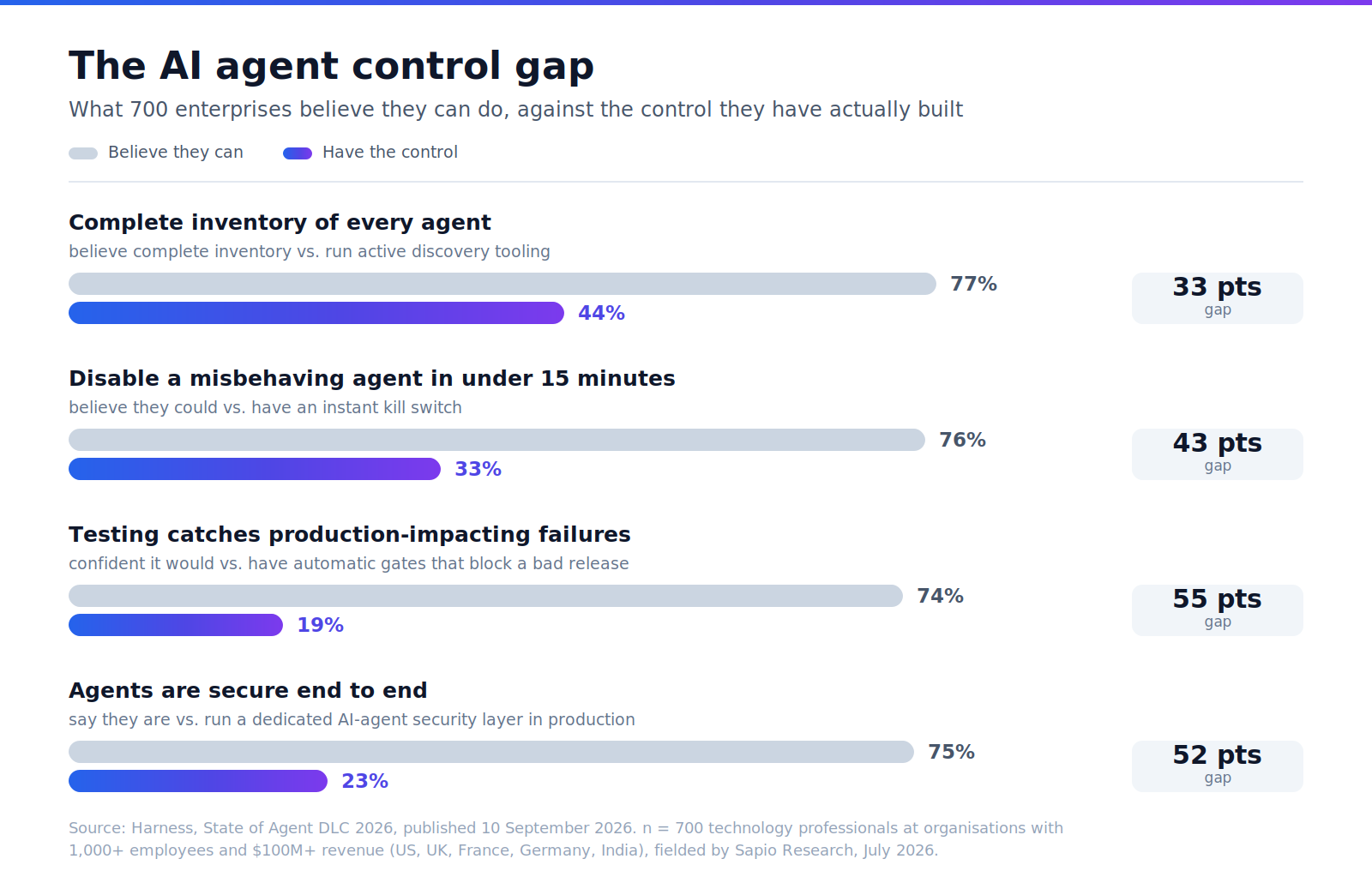
TL;DR: Guardrails fail customers when a block ends in a dead end, not when they block; BCG finds just 5% of companies have complete agent controls, so design five layers, each with a visible exit.
Methodology & sources
- Third-party: BCG Applied AI Index 2026 (1,300+ CxOs, 20+ sectors, published 30 September 2026); written testimony to the US Senate HSGAC subcommittee hearing of 30 September 2026; Moffatt v. Air Canada, 2024 BCCRT 149; Oracle and NVIDIA launch announcements, 28–30 September 2026.
- First-party: Aissist.io's published Weltrade customer story and Aissist's internal reliability SLA (vendor-claimed).
- SERP review: the guardrails guides from Fin, Mixdesk and Lorikeet, read 8 October 2026.
- All figures verified October 2026. Disclosure: this is Aissist's blog, and Aissist sells AI agents for customer service.
Why do AI guardrails matter more to the customer than to the vendor?
AI guardrails matter to the customer because a blocked action that ends in a dead end loses them, while a wrong answer that gets corrected often does not. Most guides on the first page of results describe guardrails from the vendor's side: what the agent is stopped from doing. Mixdesk's comes closest to the customer, with sample fallback wording. But the customer only ever sees one thing — the reply that appears in the second the block happens.
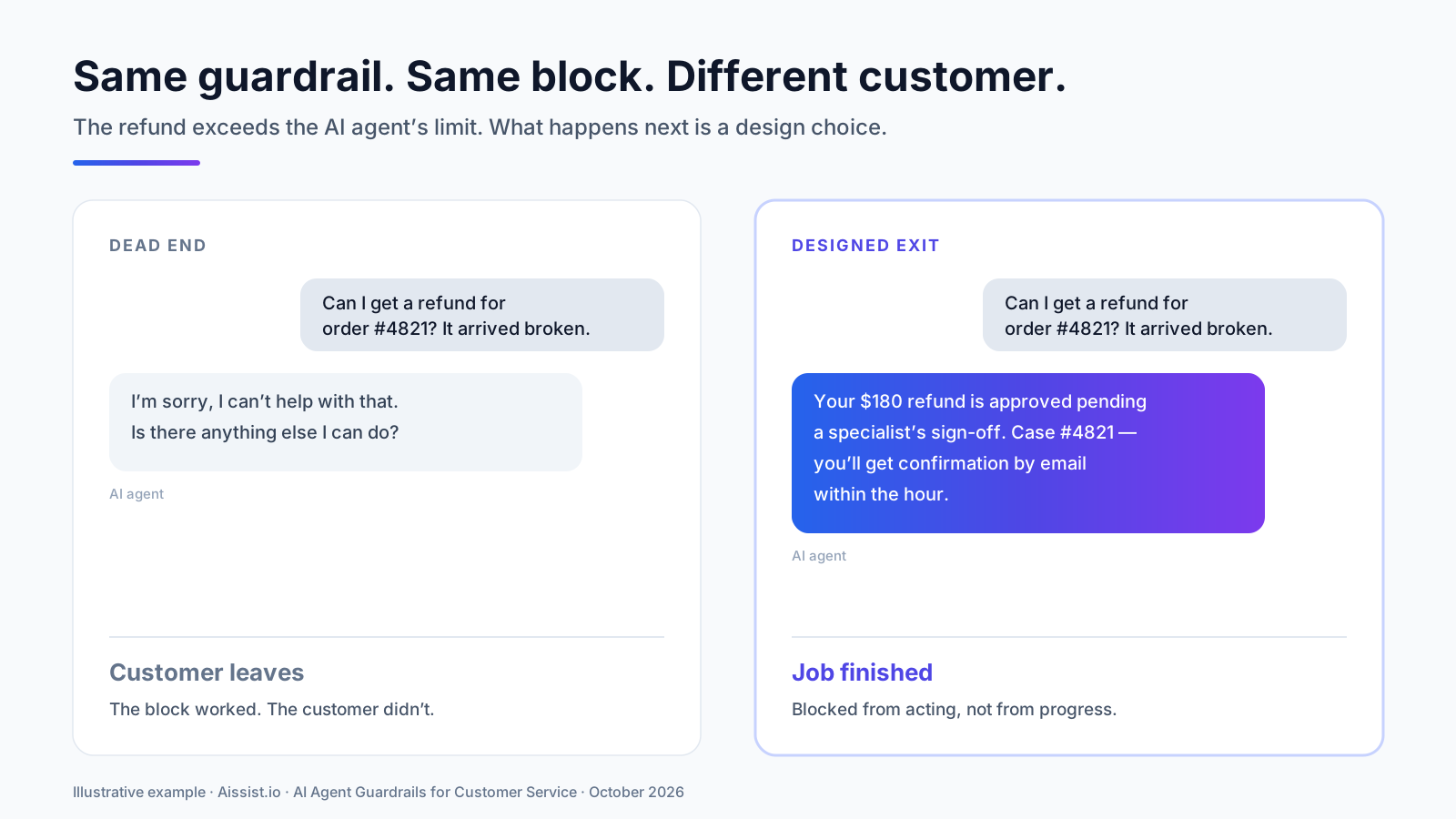
That second is where CX leaders are judged. A refund the agent cannot authorize is fine if the customer hears "a specialist will approve this within the hour, and here is your case number." It is a lost customer if they hear "I can't help with that."
The stakes are real, and they land on the company. When Air Canada's chatbot invented a bereavement-fare policy, a British Columbia tribunal ordered the airline to pay $812.02 in damages, interest and fees, according to Dentons' summary of the decision, and rejected the idea that the bot was responsible for itself.
"It should be obvious to Air Canada that it is responsible for all the information on its website." — Christopher C. Rivers, Tribunal Member, Moffatt v. Air Canada, 2024 BCCRT 149
Most companies are not ready for that liability. BCG's survey of more than 1,300 executives found that companies with all six of its AI controls generate three times the agentic AI value of companies with one. Controls, in other words, are not the brake. A badly designed exit is.
What are the five layers of AI agent guardrails?
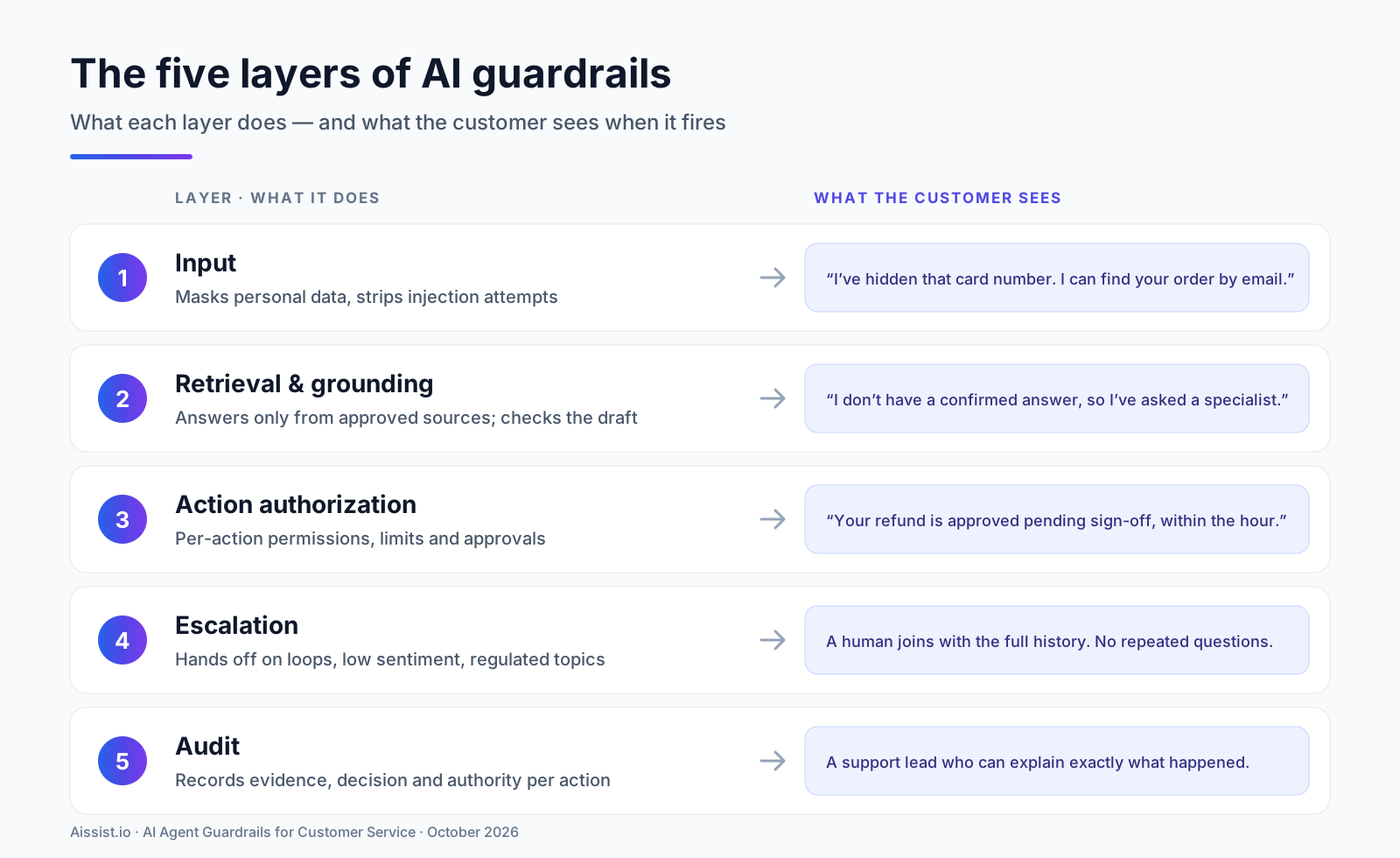
The five layers are input, retrieval and grounding, action authorization, escalation, and audit — one for each moment a customer conversation can go wrong. Most guides, Fin's and Lorikeet's included, list four types and skip the two that matter most to buyers now: grounding and the audit record.
- Input guardrails screen what the customer sends: personal data to mask, prompt-injection attempts, requests outside the agent's scope.
- Retrieval and grounding makes the agent answer only from approved sources, then checks the draft reply against what it retrieved. This is where output checks belong. Even grounded, the best large language models still invent content about 3% of the time, and familiar flagship models 6–15%, on Vectara's hallucination leaderboard as reported on Aissist's Reliable AI page (May 2026). LLM guardrails narrow that gap; they do not close it.
- Action authorization sets AI agent permissions: which systems the agent can write to, with what limits, and which actions need approval. Oracle's Fusion Claw, launched 30 September 2026, formalizes this as an "operating envelope" of permissions and approval thresholds; NVIDIA's Sentry, part of its Open Agent Safety Platform announced 28 September, enforces zero-trust access to tools and APIs from outside the agent.
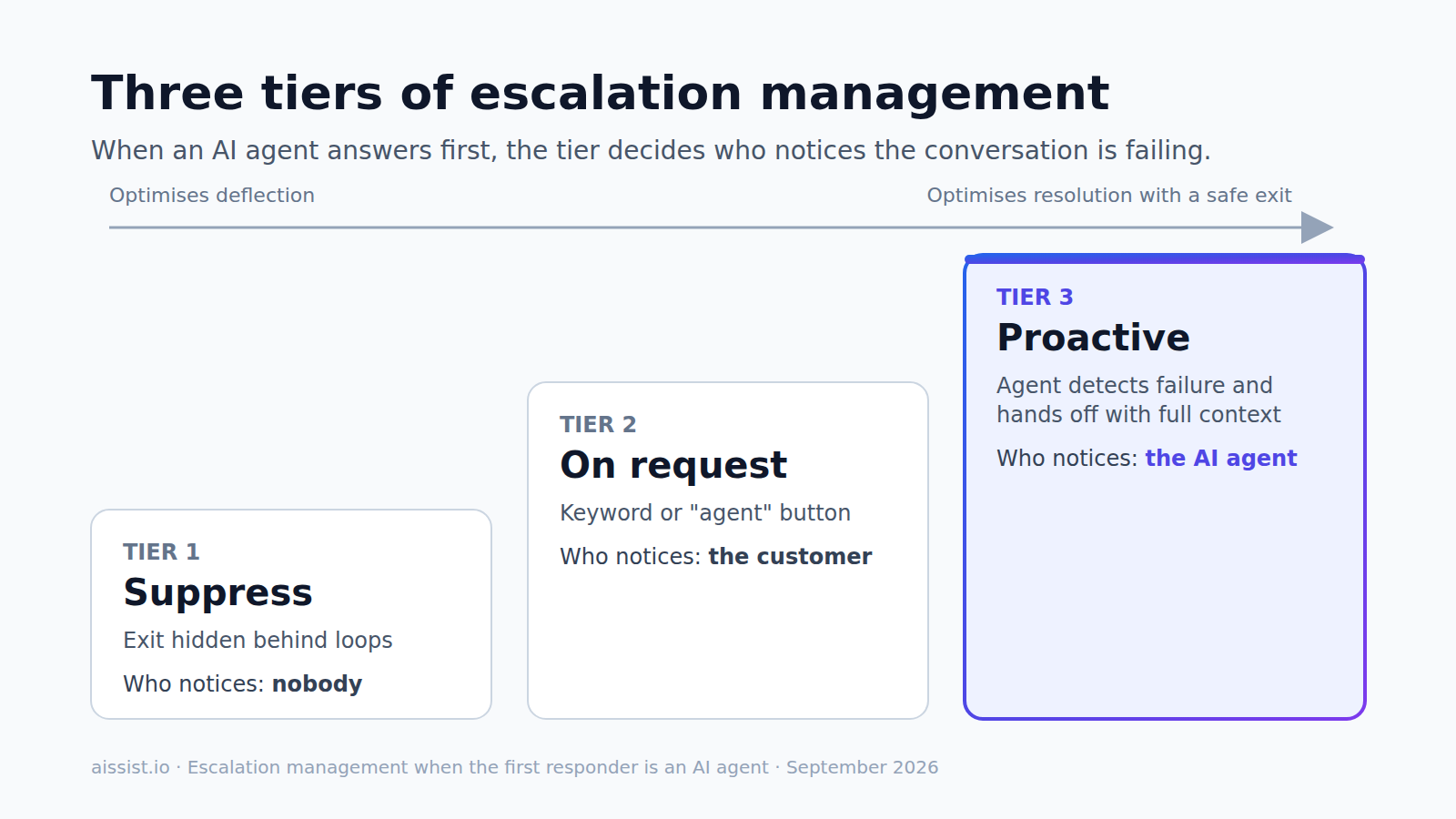
- Escalation decides when a human takes over, and what context travels with the case.
- Audit records the evidence, the decision and the authority behind every action. Oracle ships this as a per-process "Outcome Receipt." It is the layer you only miss after an incident.
"AI's extraordinary potential for society will only be realized if we solve AI safety." — Jensen Huang, Founder and CEO, NVIDIA, at the Open Agent Safety Platform launch
What does the customer see when a guardrail fires?
When a guardrail fires, the customer should see a next step — a clarifying question, a corrected answer, a pending approval or a warm handoff — never a refusal with nothing after it. The table below maps eight common customer service scenarios to the layer that catches them.
| Scenario | Layer | Mechanism | What the customer sees |
|---|---|---|---|
| Customer pastes a full card number | Input | PII detection masks it before the model reads it | "For your security I've hidden that number. I can look up your order by email instead." |
| Message tries to override instructions | Input | Injection classifier strips the instruction | A normal answer to the real question; the attempt is logged |
| Question has no answer in the knowledge base | Grounding | Retrieval returns nothing above threshold | "I don't have a confirmed answer, so I've asked a specialist" — not a guess |
| Draft reply quotes a price not in the source | Grounding | Output check against retrieved text | The corrected price, with a link to the pricing page |
| Refund above the agent's limit | Action authorization | Per-action cap routes to approval | "Your refund is approved pending sign-off; you'll get confirmation by email within the hour" |
| Request to change the account owner | Action authorization | Write blocked, identity step required | A verification step, then the change or a handoff |
| Customer is angry after three failed turns | Escalation | Sentiment and loop detection | A human joins with the full history; no repeated questions |
| Customer later disputes what the agent did | Audit | Per-action record of evidence and authority | A support lead who can say exactly what happened and why |
Notice that the right column is written in the customer's words. That is the test. If a guardrail's customer-facing outcome cannot be written as a sentence a person would want to read, it is not finished.
How do you keep a guardrail from becoming a dead end?
You keep a guardrail from becoming a dead end by giving every block an exit that finishes the customer's job, then using each block as evidence for the next fix. A guardrail that fires the same way every week is not protection; it is an unfinished workflow.
Exits come first. If an action is blocked for lack of permission, route it to approval and tell the customer the wait; if an answer is blocked for lack of a source, hand off rather than guess. In Aissist's published Weltrade deployment, the agent resolved 65% of inquiries outright, and handed 25% to humans as structured tickets carrying a summary, full context and next steps — because many backend workflows were not yet API-accessible. The agent was blocked from acting, but the customer was not blocked from progress.
Then close the loop. In Aissist, AgentMesh™ executes inside the permissions it is given; Pulse™ sees which guardrails fire, on which contacts, and why; Evolve™ turns a repeated block into a changed instruction or a new permission, so the same contact resolves next week. Aissist holds itself to an internal error-rate SLA of under 1% for all policy and factual errors combined, under 0.1% for business-impacting errors and under 0.01% for irreversible ones (vendor-claimed, internal SLA).
Evaluation is what makes the loop possible. Manual QA reviews 1–2% of interactions, according to Solidroad figures cited on Aissist's Evaluable AI page. A guardrail you only see in a 2% sample is a guardrail you are guessing about.
"We recommend that all model inference during training (e.g., reinforcement learning), evaluations and deployment be monitored." — Marius Hobbhahn, CEO, Apollo Research, written testimony to the US Senate HSGAC subcommittee, 30 September 2026
For handoff design, see escalation management when the first responder is an AI agent.
How should you configure AI guardrails for customer service?
Configure AI guardrails layer by layer, write the customer-facing exit before the rule, and review what fired every week. This checklist is ordered the way a deployment should run.
- Mask personal data at input before any model or log sees it.
- Restrict answers to approved sources, and route "no confident source" to a human rather than a guess (seven ways to prevent hallucinations).
- Check every draft reply's prices, dates and policies against the retrieved text before sending.
- Give the agent write access only to the actions it needs, each with a per-action limit.
- Route actions above a limit to approval, and tell the customer the expected wait.
- Escalate on loops, low sentiment, regulated topics and explicit requests — before the customer asks twice.
- Pass the full conversation, summary and attempted actions to the human on every handoff.
- Record evidence, decision and authority for every action, retained long enough to answer a dispute.
- Evaluate every conversation, not a sample, and review which guardrails fired each week.
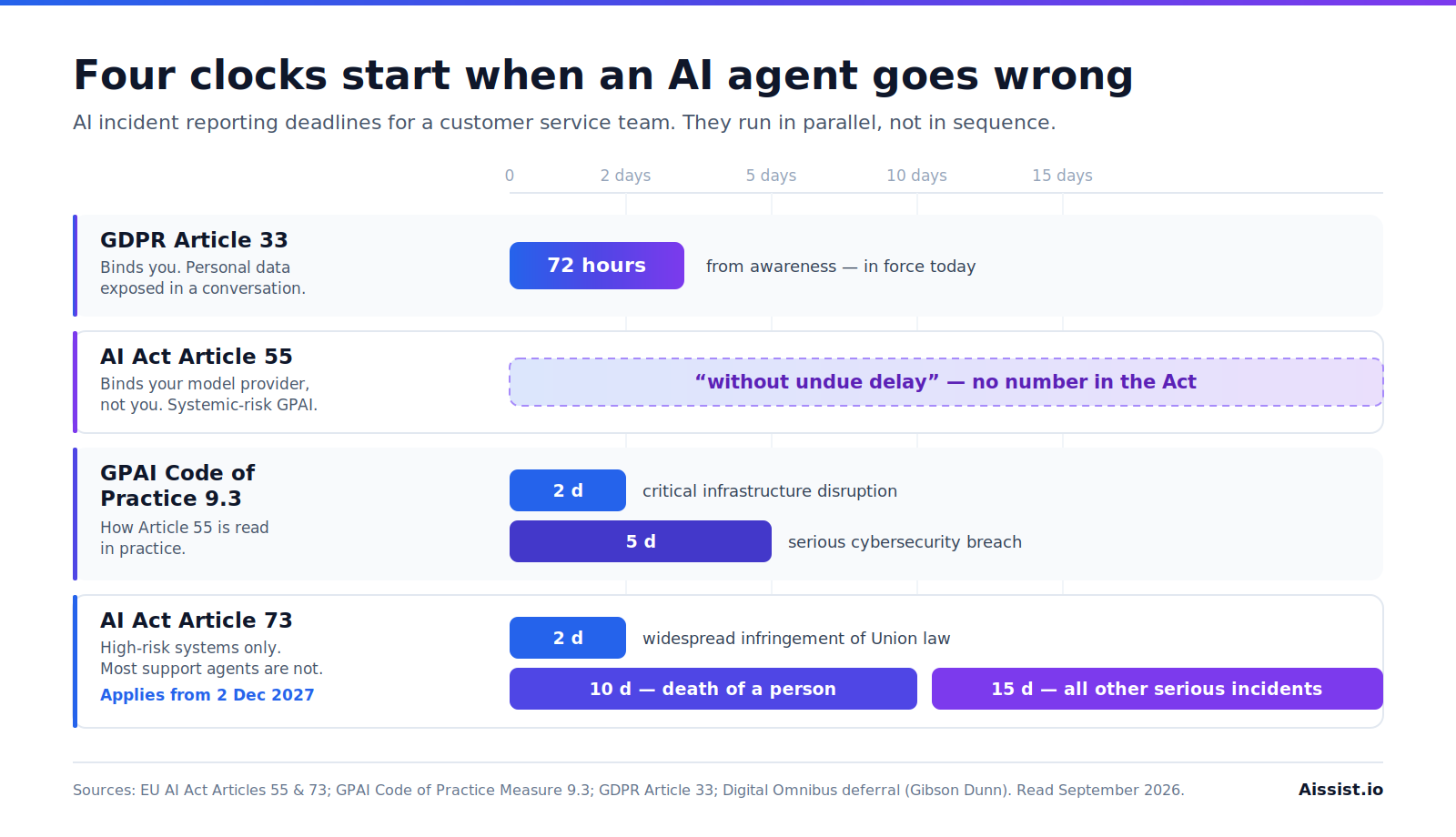
- Name an owner and a reporting path for guardrail incidents (AI incident reporting for support teams).
A guardrail is only as good as its exit
The industry has settled on "guardrails" as the word for agent control, and the week of 28–30 September made that plain: Oracle's audit receipts, NVIDIA's Open Agent Safety Platform and a Senate hearing on rogue agents. But buyers who score guardrails by what they block will buy agents that refuse well and resolve badly. Score them instead by the right-hand column: what the customer sees, and whether the block turns into a fix. If you are unsure where your own controls stand, the confidence-vs-control gap is the honest place to start.
Frequently asked questions
What are AI guardrails?
AI guardrails are the controls that decide what an AI agent may read, say and do in a conversation, and what happens instead when it may not. In customer service they span input screening, grounding, action permissions, escalation and audit.
What is the difference between AI guardrails and LLM guardrails?
LLM guardrails filter what a language model reads and writes. AI agent guardrails add controls over actions — which systems the agent can change, within which limits — plus escalation and an audit record of what it did.
What is grounding in AI?
Grounding means an AI answers only from approved sources, such as your help centre and policies, and its reply is checked against that source before sending. It reduces invented answers but does not eliminate them.
What are AI agent permissions?
AI agent permissions define which actions an agent can take in which systems — issue a refund, change an address, cancel an order — and the limits on each. Actions beyond a limit should route to human approval, not fail silently.
Do guardrails lower resolution rates?
Poorly designed ones do, because every block becomes a handoff or an abandoned chat. Guardrails with designed exits, and a loop that converts repeated blocks into new instructions or permissions, protect customers without capping resolution.
How often should guardrails be reviewed?
Review which guardrails fired weekly in the first months, then at least monthly, and after every policy, product or pricing change. A guardrail that fires on the same contact type every week signals a workflow to fix.