The 12 Best Agentic Commerce Platforms in 2026
Only 23% of U.S. consumers trust generative AI to handle a payment transaction on their behalf, against 72% who have already used an AI assistant, according to Visa research released 9 September 2026 (Harris Poll, 2,065 U.S. consumers, fielded 26–28 May 2026). That gap — people will let an agent shop, but not pay — is the entire commercial story of agentic commerce platforms in 2026, and it explains why the most interesting product in this category is not the shopping agent but the authorisation rail underneath it.
Compiled by Rob Jiang, Chief AI Engineer, from vendor documentation read on 14 September 2026. Disclosure: this guide is published by Aissist.io, which sells an agentic AI layer for customer service and sales. Aissist.io does not sell a checkout, a payment rail or a shopping agent, and does not appear in this ranking — every platform here is a potential integration partner rather than a competitor. We hold no affiliate, referral or paid-placement relationship with any vendor on this page, and no vendor reviewed it before publication. Figures are taken from each vendor's own published material where one exists; where none exists we say so rather than estimate.
TL;DR
- Best overall, and the only one you can turn on today at a published price: Shopify
- Best in-assistant checkout on the clearest merchant terms: Microsoft Copilot Checkout
- Best delegated-payment primitive: Stripe
- Best reach into shopping intent: Google
- Best single integration across three assistants: PayPal
- Best network-grade authorisation rail: Visa Intelligent Commerce
- Best for agents that need someone else to own the chargeback: Crossmint
- Best agent on your own storefront: Salesforce Agentforce Commerce
- Best for buying from merchants who never opted in: Rye
- Best for discovery, no longer for checkout: OpenAI / ChatGPT
- Best scale, least published: Amazon
- Best issuer-side coverage in enabled markets: Mastercard Agent Pay
The biggest buying trap in this category is assuming that "supports agentic commerce" means an agent can complete a purchase — for most of these platforms it means the agent can fill a cart and then hand your customer back to a browser.
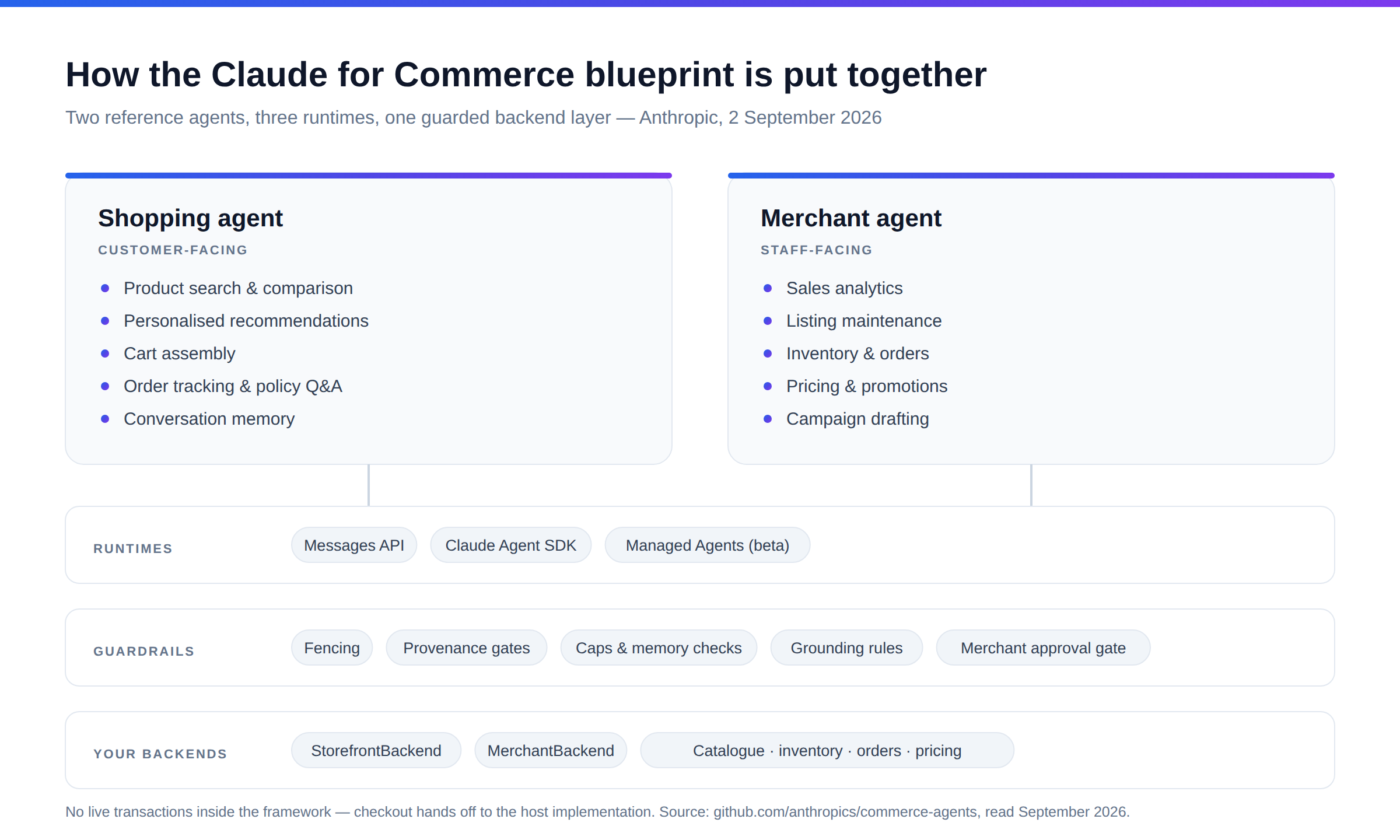
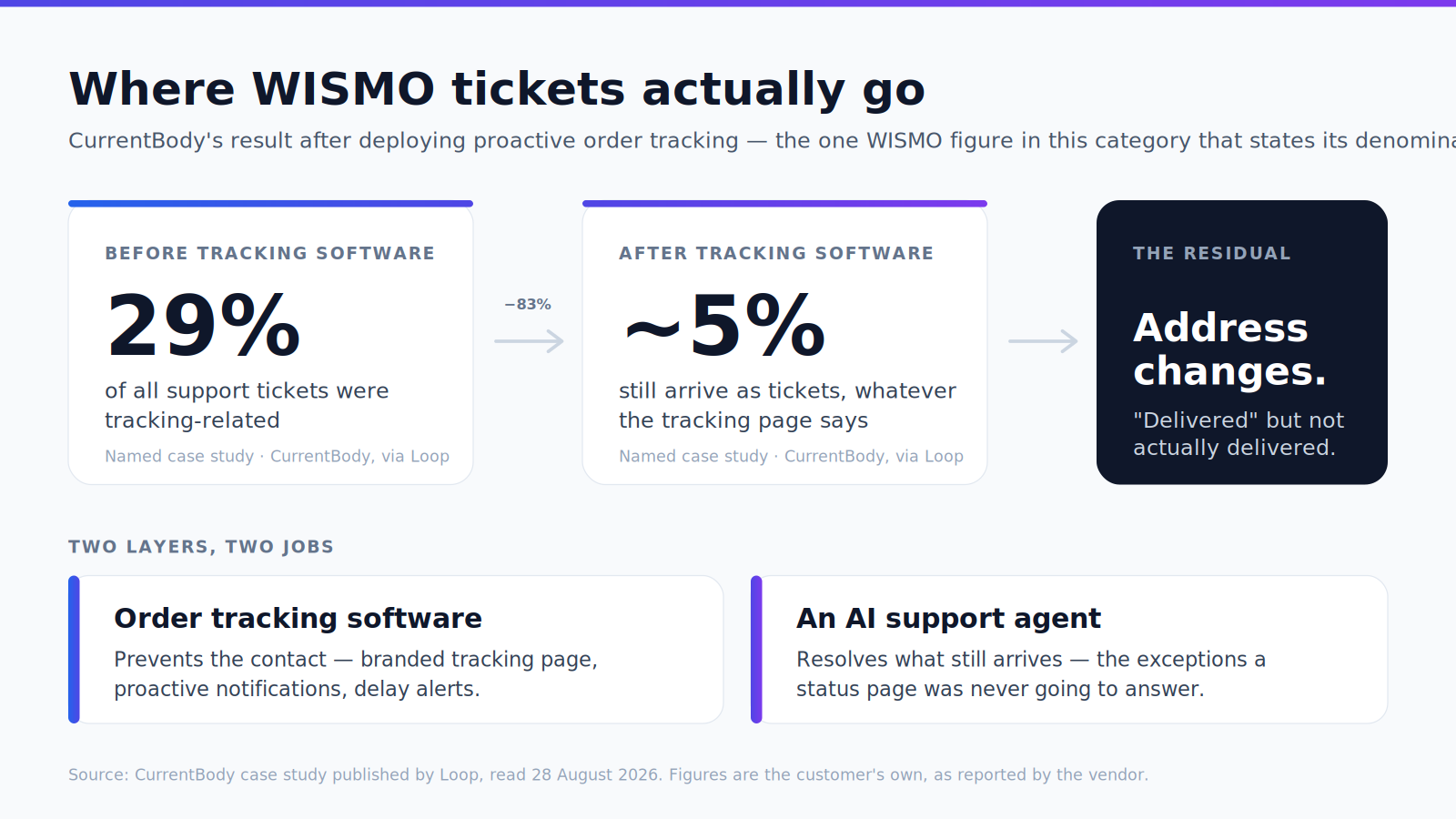
This guide covers the platforms that let an agent transact. For what Anthropic's commerce agent changes for merchants, see Claude for Commerce. For the post-purchase contact volume these orders create, see best order tracking and WISMO software.
How we compared these agentic commerce platforms
We scored every platform out of 30 across six criteria, five points each, and listed only platforms where at least one step of a real purchase is shipped and documented today. Announcements and "coming soon" roadmaps did not qualify — which is why Adobe Commerce, whose February 2026 post commits to UCP and ACP without naming an availability date, is absent, and why Anthropic's Claude for Commerce, launched this month, is too new to score — we covered it separately in Claude for Commerce: what it is and what to watch.
The six criteria:
- Checkout completeness — how far the agent gets: browse, cart, authorise, settle, without the buyer leaving the assistant.
- Merchant terms published — can you read the price, eligibility rules and geography without booking a call.
- Protocol portability — does one integration reach more than one agent surface, on an open specification.
- Access — self-serve, application, or closed.
- Post-purchase clarity — what the platform publishes about returns, disputes and who is liable when the agent gets it wrong.
- Evidence of live use — named merchants, published volumes, third-party verification.
Ties break on checkout completeness first, then evidence of live use. Pricing was read from each vendor's own live pricing page on 14 September 2026; where a vendor publishes no price we write "not published" rather than estimating, and every performance figure is labelled vendor-claimed, case-study or independently reported.
The bias is declared in full above, and it is worth restating in one line: Aissist.io sells none of these products, which is why we can afford to be blunt about all twelve. Criterion 5 is the axis we care about most, because we run customer service automation for e-commerce operators, and it is the axis on which this category currently scores worst.
The rubric also exposes what causes most shortlisting mistakes: "agentic commerce platform" describes three different products. There are surfaces (where the agent shops: ChatGPT, Google, Copilot, Amazon), merchant plumbing (how your catalogue and checkout reach those surfaces: Shopify, Stripe, Salesforce), and authorisation rails (how the money moves: Visa, Mastercard, PayPal, plus independents like Rye and Crossmint). Every block below carries its layer, because comparing across layers is how a shortlist ends up with two products that do not compete.
The 12 agentic commerce platforms at a glance
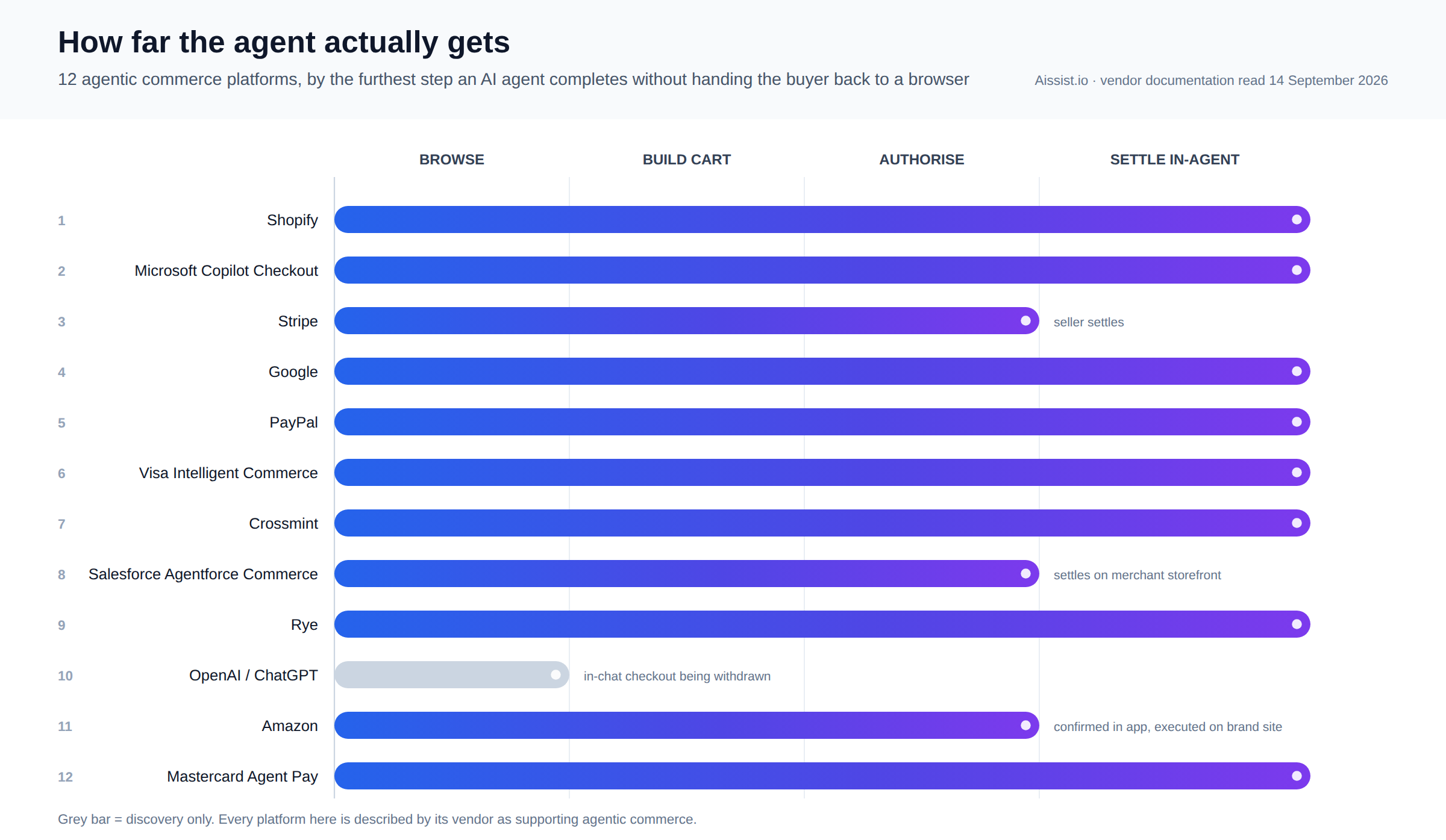
Eight of the twelve platforms let an agent settle a payment without the buyer leaving the assistant; three stop at authorisation and one now stops at browsing. Every figure below was read from the vendor's own documentation on 14 September 2026.
| # | Platform | Layer | Browse | Cart | Authorise | Settle in-agent | Protocols | Published price | Score /30 |
|---|---|---|---|---|---|---|---|---|---|
| 1 | Shopify | Merchant plumbing | Yes | Yes | Yes | Yes (Google, Copilot) | UCP, ACP | $0/mo + 2.9% + 30¢ | 27 |
| 2 | Microsoft Copilot Checkout | Surface | Yes | Yes | Yes | Yes | UCP | $0 commission + PSP fees | 23 |
| 3 | Stripe | Merchant plumbing | Yes | Yes | Yes | Seller settles | ACP, UCP, MPP, x402 | $0.15 per SPT + 2.9% + 30¢ | 22 |
| 4 | Surface | Yes | Yes | Yes | Yes | UCP, AP2 | Not published | 21 | |
| 5 | PayPal | Authorisation rail | Yes | Yes | Yes | Yes | ACP, UCP, AP2 | 3.49% + $0.49 (Checkout rate) | 20 |
| 6 | Visa Intelligent Commerce | Authorisation rail | Yes | Yes | Yes | Yes | TAP, ACP, UCP, MPP, x402 | Free in sandbox; quote only in production | 19 |
| 7 | Crossmint | Independent executor | Yes | Yes | Yes | Yes | x402 live; ACP/AP2 roadmap | Quote only for checkout | 19 |
| 8 | Salesforce Agentforce Commerce | Merchant plumbing | Yes | Yes | Yes | On merchant storefront | ACP, UCP | $0.10 per agent action; platform quote only | 18 |
| 9 | Rye | Independent executor | Yes | Yes | Yes | Yes | None (protocol-independent) | $149/mo + $0.05 per order | 18 |
| 10 | OpenAI / ChatGPT | Surface | Yes | No | No | Being withdrawn | ACP | No fees on ChatGPT-originated purchases | 18 |
| 11 | Amazon | Surface | Yes | Yes | Yes | Confirmed in-app, executed on brand site | None published | Not published | 15 |
| 12 | Mastercard Agent Pay | Authorisation rail | Yes | Yes | Yes | Yes | AP2, ACP, UCP, A2A, MCP, x402 | Not published | 15 |
Read the "Settle in-agent" column before anything else. Four of the twelve either never complete a purchase inside the assistant or are actively moving away from doing so, and that single column reorders most shortlists.
Who each agentic commerce platform is built for
Geography decides this shortlist more than features do: Microsoft is US buyers only, Rye is US shipping only, Google is US, Canada and Australia, and Stripe is the widest at 34 countries. Fit, reach and stated post-purchase position for all twelve:
| Platform | Best-fit merchant | Where the agent runs | Time to first agent order | Geography | Stated post-purchase position |
|---|---|---|---|---|---|
| Shopify | SMB to enterprise on or off Shopify | ChatGPT, Google AI Mode, Gemini, Copilot, Perplexity, Shop | Active by default for eligible stores | Not published | Merchant retains "full ownership of the customer relationship and post-purchase experience" |
| Microsoft | US merchants with one PSP | Copilot | Application; Shopify stores auto-enrolled | US buyers, English, USD only | "You are the merchant of record" |
| Stripe | Sellers wanting the payment primitive | Any ACP or UCP agent | Self-serve seller side; agent side waitlisted | 34 countries | Seller is merchant of record |
| Retailers with Merchant Center in good standing | AI Mode in Search, Gemini | Interest form, then selection | US, Canada, Australia | "You will remain the seller of record"; return policy required to qualify | |
| PayPal | Braintree merchants | ChatGPT, Google AI Mode, Gemini, Perplexity | Request access form | US launch, ~200 markets claimed | Seller Protection offered, with a Braintree carve-out |
| Visa | Agent builders, issuers, acquirers | Any Visa-accepting merchant | Sandbox open to independent developers | N. America, APAC, Europe, CEMEA, LAC | Evidence trail, no liability rule |
| Crossmint | Agent developers wanting no merchant integration | Amazon, Shopify stores, any guest checkout | Production only — no staging environment | US Visa cards for agentic cards | Crossmint is merchant of record and handles chargebacks |
| Salesforce | Enterprises on Commerce Cloud | Own storefront, ChatGPT | Requires a Commerce account executive | English locales | Not published |
| Rye | Developers buying from the long tail | Any merchant URL | Self-serve, 30-day trial | US shipping only | Merchant keeps the returns relationship |
| OpenAI | Brands optimising for discovery | ChatGPT | Approved partners only | US | Merchant owns "fulfillment and returns to support" |
| Amazon | Brands joining Shop Direct | Amazon Shopping app, amazon.com | Via feed syndicators | US, subset of customers | Brand handles delivery, returns and service |
| Mastercard | Issuers and certified agents | Agent surfaces in enabled markets | Unpublished certification | LAC, Hong Kong, US via ACP | Audit trail "may be used to help" resolve disputes |
1. Shopify — best for merchants who want agent checkout live at a published price
Shopify's Agentic Storefronts is a sales channel inside Shopify Admin that syndicates a merchant's catalogue to AI assistants and completes the resulting orders, deployed by enabling the channel in the Shopify Admin, where it is active by default for eligible stores.
Layer: Merchant plumbing — the catalogue and checkout layer feeding every major surface.
Deploys onto vs. replaces: Deploys onto. The Agentic plan exists for brands not on a Shopify storefront, opening Shopify Catalog to them without a replatform, across ChatGPT, Google AI Mode, Gemini, Copilot, Perplexity and the Shop app.
How far the agent gets: All four steps, with the last one channel-dependent. Shopify's help documentation states that where direct checkout is activated, "customers can complete their purchases in the channel's Shopify-powered direct checkout without having to leave the AI channel" — while on ChatGPT they "complete their purchase on your online store checkout in a ChatGPT in-app browser, or in a new tab" (read September 2026).
Protocols: UCP, co-developed with Google and licensed under Apache 2.0, release v2026-04-08; plus ACP for the ChatGPT path.
Merchant requirements: Products must meet Shopify Catalog requirements, the merchant accepts the Agentic Storefronts Supplemental Terms, and payment runs through Shopify Payments or a third-party provider. Eligibility is assessed per business, product, customer location, payment setup and AI channel.
Cost: $0 USD per month with card rates from 2.9% + 30¢ USD online, per Shopify's pricing page (read September 2026), with "no transaction fees beyond standard processing rates." A charge triggers only on a completed sale.
Pros:
- The only platform here a merchant can switch on at a published, self-serve rate with no monthly subscription.
- Native in-channel settlement on Google and Microsoft surfaces, not a redirect.
- Co-author of UCP, which carries ACP, AP2, A2A and MCP interoperability.
Cons:
- The Agentic plan cannot publish an online store or sell through an online store checkout, and excludes Shopify Messaging, gift cards, manual order creation and Shop post-purchase offers.
- "Eligibility doesn't guarantee that your products are displayed in a specific AI answer" — each channel decides.
- Geography and restricted categories for the Agentic plan are not published.
Our take: Shopify has the least distance between "we should try this" and "we took an agent order," and it is the only entry whose cost you can calculate without a sales call. Skip it if you specifically need in-assistant checkout on ChatGPT, where the purchase still completes in an in-app browser. Our e-commerce AI customer service benchmark covers what those orders cost to support.
2. Microsoft Copilot Checkout — best for in-assistant settlement on the clearest merchant terms
Microsoft Copilot Checkout is an in-assistant purchasing surface that lets shoppers complete a transaction inside Microsoft Copilot, deployed through a Microsoft Merchant Center account, a UCP-compliant product feed and a single payment service provider.
Layer: Surface — where the shopper and the agent meet.
Deploys onto vs. replaces: Deploys onto. Microsoft's agentic commerce page states: "You are the merchant of record. Copilot does not become merchant of record" (read September 2026). Launch brands named by Microsoft in January 2026 were Urban Outfitters, Anthropologie, Ashley Furniture and Etsy.
How far the agent gets: All four steps. Shoppers "discover, decide, and pay—without ever leaving the Copilot experience."
Protocols: UCP, which Microsoft calls "a complementary layer to Merchant Center feeds that turns product data into executable commerce actions." Microsoft named ACP as its standard in January 2026 and names only UCP today — a nine-month protocol change worth pricing into any integration estimate.
Merchant requirements: A Microsoft Merchant Center account, return policy, customer support and Copilot Checkout store settings, native checkout eligibility per product, and one of three PSPs — PayPal, Stripe or Shopify. "Copilot Checkout supports a single PSP checkout partner per merchant."
Cost: No commission. Microsoft's own FAQ answer, verbatim: "No. Today, Microsoft does not take a commission or affiliate fee" (read September 2026). PSP processing fees apply separately and are not published by Microsoft.
Pros:
- The most unambiguous published merchant terms in the category: zero commission, stated merchant-of-record position, named PSPs.
- Genuine end-to-end settlement inside the assistant, not a hand-off.
- Shopify merchants are auto-enrolled with an opt-out window, removing the integration project entirely.
Cons:
- "Only English-language merchants who sell to US buyers are eligible at this time (supporting USD)."
- One PSP per merchant means no payment routing, no failover and no regional processor strategy.
- Microsoft disclaims accuracy directly — "Copilot can occasionally make mistakes, so verify key product information, pricing, and purchase terms on the retailer's website." A fair disclaimer, and a preview of the tickets it generates.
Our take: If you are a US merchant who wants one agentic checkout live on terms you can forward to finance without redlining, this is the one. Skip it if you sell outside the US or need more than one processor.
"Today's shoppers expect to go from search to purchase in a single conversation… With Copilot Checkout, Shopify merchants can meet customers exactly when intent peaks while remaining at the center of every interaction and in control from start to finish."
— Nayna Sheth, Head of Product for Agentic Payments, Microsoft, quoted in Shopify's UCP announcement, 11 January 2026
3. Stripe — best for the delegated-payment primitive itself
Stripe's Agentic Commerce Suite is a payments and catalogue platform that syndicates a seller's product feed to AI agents and settles agent-initiated purchases through the seller's existing Stripe account, deployed by onboarding in the Stripe Dashboard and uploading a CSV catalogue feed.
Layer: Merchant plumbing, carrying the only priced payment primitive in the category.
Deploys onto vs. replaces: Deploys onto an existing Stripe account; the seller creates the PaymentIntent and remains merchant of record. Reaches any ACP- or UCP-compatible agent, subject to per-agent approval. Stripe named Kate Spade, Best Buy and Coach as live adopters at Sessions 2026.
How far the agent gets: Browse, cart and authorise, with the seller settling. The mechanism is the Shared Payment Token: "an SPT is a scoped grant to use the customer's payment method," granted by the agent to the seller's Stripe profile with max_amount, currency and expires_at limits, per Stripe's SPT documentation (read September 2026).
Protocols: The broadest set here — Stripe's docs list "UCP or ACP" for sellers and "MPP or x402" for machine payments. Stripe co-maintains ACP with OpenAI; the specification is Apache 2.0, stable version 2026-04-17, marked Beta.
Merchant requirements: An activated Stripe account with published terms, privacy and return policy; tax configuration; and a CSV feed refreshed daily for products and every 15 minutes for pricing and inventory. Each agent must individually accept a connection request. Available in 34 countries.
Cost: $0.15 USD per Shared Payment Token issued, plus card processing of 2.9% + 30¢ USD per successful domestic transaction, both from Stripe's pricing page (read September 2026). Agent-side catalogue syndication is quote only.
Pros:
- The only published per-agent-transaction unit price in this comparison.
- Both commerce standards and both machine-payment standards through one account.
- Issuing for agents solves the other direction — virtual cards with spend controls for agents doing the buying.
Cons:
- The agent-side product and the
com.stripe.paymentsUCP handler are both private preview, behind a waitlist. - Feed operations are unforgiving: "in replace mode, any product not included in the uploaded file is permanently deleted from Stripe's catalog," and price mismatches cause checkouts to fail.
- The APIs run on preview versions, so integration work carries a maintenance tail.
Our take: Stripe is right if you want to own the payment mechanics rather than rent a surface, and it is the only vendor that has priced the thing everyone else merely describes. Do not expect a finished product — much of the agent side is still waitlisted.
"AI is the biggest platform shift for the economy since the internet, and in the not-too-distant future agents will account for most transactions online."
— Patrick Collison, CEO and cofounder of Stripe, Stripe Sessions 2026, 29 April 2026
4. Google — best for reach into shopping intent
Google's agentic commerce stack is a two-layer system — the Agent Payments Protocol for payment authorisation and the Universal Commerce Protocol for commerce actions — powering Universal Cart and native checkout inside AI Mode in Search and the Gemini app, deployed through a Google Merchant Center account plus a UCP integration.
Layer: Surface, with the deepest protocol investment of any.
Deploys onto vs. replaces: Deploys onto. Google Merchant Center states: "You will remain the seller of record" (read September 2026). Retailers live or activating as of Google's May 2026 shopping update include Nike, Sephora, Target, Ulta Beauty, Walmart and Wayfair.
How far the agent gets: All four steps, on Google's own surfaces. Merchant Center documents the shift plainly: where the older checkout button meant "the transaction occurs on your site," with UCP-powered checkout "the checkout happens directly on Google's surfaces," using funding PANs stored in Google Wallet.
Protocols: AP2 v0.2, Apache 2.0, donated to the FIDO Alliance in April 2026, with standardisation continuing in FIDO's working groups; plus UCP, co-developed with Shopify, Etsy, Wayfair, Target and Walmart. AP2 launched with "more than 60 organizations" per Google Cloud.
Merchant requirements: A Merchant Center account in good standing with approved products; native_commerce(checkout_eligibility) set per product; return policies defined in Merchant Center, per sub-account for advanced accounts; a customer-service contact method; and selection after an interest form. Subscriptions, personalised goods, age-restricted items and digital goods must be excluded.
Cost: Not published. No fee, commission or rate appears on Google's Merchant Center help pages, the UCP developer overview or the UCP announcement posts (all read September 2026).
Pros:
- The largest pool of shopping intent of any surface, with agentic checkout wired into Search.
- The only platform here that makes a published return policy a condition of eligibility — a rare piece of post-purchase discipline.
- AP2 inside the FIDO Alliance is the category's strongest governance signal; a protocol in a standards body outlives one in a vendor's repo.
Cons:
- No published merchant pricing at all, which makes a business case hard to build.
- Access is by interest form and selection, and checkout is "available for select US merchants at this time," with rollout limited to the US, Canada and Australia.
- Google warns that "the UCP is an evolving standard, and not all features defined in the spec are available on Google's surfaces."
Our take: Google is where the demand is, and the return-policy requirement means it has thought harder about the back end than anyone else here. Do not build a forecast on it until a rate card exists.
5. PayPal — best for one integration across three assistants
PayPal's Agentic Commerce Services is a merchant-side acquiring and catalogue product — Agent Ready for accepting agent-initiated payments and Store Sync for exposing a catalogue to assistants — deployed by existing PayPal and Braintree merchants after requesting access.
Layer: Authorisation rail, on the acquiring side.
Deploys onto vs. replaces: Deploys onto Braintree, reaching ChatGPT, Google AI Mode, Gemini and Perplexity "without building separate integrations for each." PayPal's Agent Ready page claims "up to 400M active accounts," footnoted to Q2 2024 data — though PayPal's own Perplexity release says "430+ million active PayPal accounts globally."
How far the agent gets: All four steps. On the ACP path, "customers authorize PayPal as their payment method" and the merchant's app "receives a delegated token to process transactions through Braintree" — a single-use nonce bound to merchant ID with amount and time restrictions. On the UCP path, "Google returns a single-use payment token that you process through Braintree."
Protocols: ACP (integration doc last updated 10 June 2026), UCP via the Google Pay handler, MCP inside the ACP integration, and AP2, where PayPal is a named partner.
Merchant requirements: Braintree is mandatory, and merchants "must complete this form to contact the AI team at PayPal and request access." Existing PayPal merchants activate immediately; new merchants go through sales.
Cost: No agentic-specific pricing is published — PayPal's business fee schedule contains no mention of agentic commerce, Agent Ready or AI agent transactions (read September 2026). The standing rates the flow rides on are published: PayPal Checkout 3.49% + $0.49 USD, standard card 2.99% + fixed fee, international +1.50%, and a $20.00 USD chargeback fee — the only published unit cost of a dispute in this comparison.
Pros:
- One integration reaches four assistants: the best surface coverage per unit of engineering effort here.
- The only vendor that attaches a named protection product to agent-initiated transactions: "Seller Protection for eligible agentic-initiated transactions helps guard against unauthorized transactions and item-not-received claims."
- Published standing rates, including a published chargeback fee.
Cons:
- That Seller Protection promise carries a carve-out that largely undoes it here: PayPal's own footnote says "for Enterprise Payments (Braintree) merchants, Seller Protection is only available on purchases made with the Pay with PayPal button" — and Agent Ready is the Braintree product.
- Chargeback Protection is "subject to a monthly loss cap," and Braintree merchants "may be addressed additional chargeback fees by acquiring banks and card networks, which will not be waived but will be passed through to you at cost."
- No consumer-facing spend limits, merchant-category limits or revocation controls are documented, unlike Visa and Mastercard.
Our take: PayPal buys the most surface coverage for the least integration work, and it is the only vendor that has written "agentic" into a protection product. Read footnote 1 before you rely on that protection, and skip PayPal entirely if you are not already on Braintree.
6. Visa Intelligent Commerce — best network-grade authorisation rail
Visa Intelligent Commerce is a card-network agentic commerce platform that issues agent-specific pass-through payment tokens bound to a consumer's passkey, deployed via APIs and a self-hosted MCP server on Visa Developer, with a companion merchant-side identity spec called the Trusted Agent Protocol.
Layer: Authorisation rail, issuer side.
Deploys onto vs. replaces: Deploys onto existing Visa acceptance — tokens are "intended for use at Visa-accepting merchant locations," maintaining the merchant-to-user relationship. Launch AI partners in April 2025 included Anthropic, IBM, Microsoft, Mistral AI, OpenAI, Perplexity, Stripe, Samsung and Klarna.
How far the agent gets: All four steps, with the tightest documented consent mechanism in the category. Visa's developer documentation states that "payment tokens are bound to user devices and secured using Passkeys," and that "the agent requests the user to authenticate the Payment Instruction using their Passkey." Transactions operate within user-defined spending limits and merchant categories.
Protocols: Visa calls the platform "protocol-agnostic, supporting TAP, x402, MPP, ACP, and UCP through one integration." The Trusted Agent Protocol uses RFC 9421 HTTP Message Signatures and distinguishes a browsing agent from a paying agent via an agent-browser-auth or agent-payer-auth tag. TAP's repository is not under an open-source licence — it is governed by Visa Developer Center Terms of Use. Visa is not on Google's AP2 partner list.
Merchant requirements: Independent developers can access the platform, with step-up verification and a passkey at onboarding. TAP targets merchants who want to "securely recognize and transact with Visa-approved AI agents" — approval criteria are not published. Available across North America, Asia-Pacific, Europe, CEMEA and LAC, with the product page cautioning that it "is currently in the process of deployment."
Cost: "Free to use in Sandbox. Contact Visa for fees in Production" — Visa Developer, read September 2026. More than most networks disclose, and still not a price.
Pros:
- Passkey-bound tokens with per-transaction amount and merchant controls: the most specific consumer consent mechanism documented by any platform here.
- Protocol-agnostic by design, covering both commerce standards and both machine-payment standards through one integration.
- Visa amended its Core Rules effective 18 April 2026 to recognise agentic transactions, adding section 4.1.24 and two glossary terms — the only platform here that has moved a rulebook.
Cons:
- Production pricing is quote only, and "Visa-approved" agent status has no published criteria.
- No revocation mechanism or revocation latency is published.
- Visa's own July 2026 agentic payments report states that "liability remains legally ambiguous" — candour we respect, and a real limitation.
Our take: Visa has built the most rigorous consent and identity layer in agentic commerce, and it is the only participant whose own research contradicts its marketing in a useful direction. Do not pick it expecting a merchant product — this is infrastructure for agent builders, issuers and acquirers.
"We believe the entire payments ecosystem has a responsibility to ensure sellers can trust AI agents as much as they trust their best customers and networks."
— Jack Forestell, Chief Product and Strategy Officer, Visa, Trusted Agent Protocol launch, 14 October 2025
7. Crossmint — best for agents that need someone else to own the chargeback
Crossmint is an agentic payments infrastructure company providing agent wallets, agent-issued virtual cards and an agentic checkout API that lets an AI agent buy real goods from third-party merchants, delivered as a hosted API with Crossmint acting as merchant of record.
Layer: Independent executor — it needs no cooperation from the merchant at all.
Deploys onto vs. replaces: Neither. Crossmint operates against merchants who have integrated nothing, covering "all products on Amazon, Shopify stores and any other website with guest checkout" — over 1 billion SKUs, per its agentic checkout page. Crossmint reports being "trusted by more than 40,000 clients" (vendor-claimed, PR Newswire, 2 June 2026).
How far the agent gets: All four steps, paid with cards via Visa Intelligent Commerce or Mastercard Agent Pay, or with stablecoins.
Protocols: x402 is live in production. Crossmint's own comparison page describes a "multi-protocol architecture designed to support MPP, ACP and AP2 as they mature" — a roadmap, not shipped support.
Merchant requirements: None, which is the entire product. Crossmint Europe is authorised by Spain's CNMV as a crypto-asset service provider, Crossmint Financial Services US is registered with FinCEN as a money services business, and Crossmint Canada is registered with FINTRAC.
Cost: Checkout transaction fees are quote only — "fees per transaction, typically charged to users. Tiered pricing that improves with volume," per Crossmint's pricing page (read September 2026). Adjacent products are priced: wallets free to 1,000 monthly active wallets then "starts at $0.05 per MAU"; tokenization "starts at $0.01/action."
Pros:
- The only platform here that answers the post-purchase question: Crossmint "acts as Merchant of Record and handles returns and chargebacks—zero operational overhead."
- Works against merchants who have never heard of ACP, UCP or AP2, which is most merchants.
- Licensed in three jurisdictions, PCI Level 1 and SOC 2 certified.
Cons:
- Crossmint's own documentation states that "agent checkouts can only be tested in production today as there is no staging environment for it," and that "there are no webhooks in v1," requiring polling.
- The agentic cards API is limited to "eligible US-issued Visa credit and debit cardholders."
- No G2 rating or review count is displayed for Crossmint, so there is no independent quality signal at all.
Our take: Crossmint inverts the model, taking on merchant-of-record status and eating the chargebacks — both the most useful thing anyone in this category has done and a real concentration of risk in a young company. Do not ship on it without accepting that your first integration test is a live purchase.
8. Salesforce Agentforce Commerce — best agent on your own storefront
Salesforce Agentforce Commerce is the agentic layer of Salesforce Commerce Cloud — Shopper, Buyer and Merchant agents plus Agentic Commerce Search — deployed as configured capabilities on top of an existing Commerce Cloud subscription rather than as self-hosted software.
Layer: Merchant plumbing, oriented toward owned properties rather than third-party surfaces.
Deploys onto vs. replaces: Requires Salesforce Commerce Cloud — the heaviest platform dependency in this comparison. Runs on the merchant's own storefront, plus ChatGPT ("available now" as of Salesforce's 6 July 2026 release) and the Gemini app ("arriving in coming months").
How far the agent gets: Browse, cart and checkout on the merchant's own storefront, per Salesforce Help (read September 2026), with off-site settlement via ACP and UCP integrations.
Protocols: ACP, announced October 2025 with the disclaimer that "any unreleased services or features referenced here are not currently available and may not be delivered on time or at all"; and UCP, announced January 2026 with timelines still to be finalised.
Merchant requirements: Commerce Cloud B2C or B2B, a SLAS client, Managed Runtime for Storefront Next, and a conversation with a Commerce account executive — Agentic Commerce Search cannot be configured self-serve.
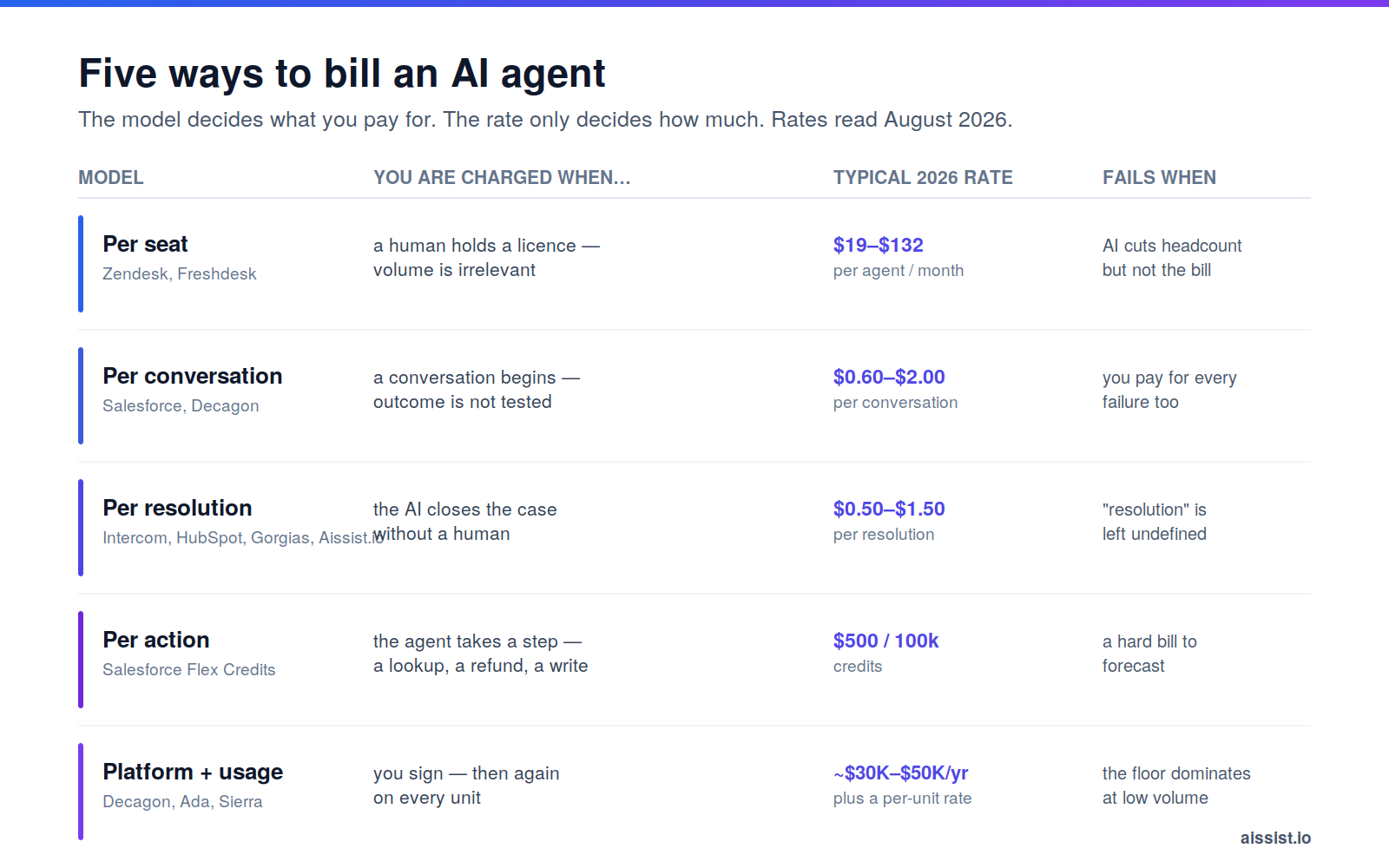
Cost: The AI metering is published; the platform is not. Agentforce actions cost $0.10 USD each — "one Agentforce action consumes 20 Flex Credits ($0.10 USD)" at "$500 USD per 100,000 Credits," per Salesforce Help (read September 2026). Add-ons run $125 USD per user per month. Every Commerce Cloud line item on Salesforce's pricing page reads "Contact for pricing."
Third-party rating: Salesforce B2C Commerce scores 4.3 / 5 across 604 reviews and Agentforce 4.3 / 5 across 1,226 reviews on G2 (independently reported, read September 2026).
Pros:
- The agent runs on the merchant's own storefront, where the merchant keeps the data, the margin and the relationship.
- Per-action pricing lets you model AI cost precisely.
- The largest independent review base of any platform here, by a wide margin.
Cons:
- The platform underneath is quote only, so a published $0.10 per action tells you very little about total cost.
- Setup is gated behind an account executive, and the B2B merchandising agent supports English locales only, with data masking not supported.
- Both protocol commitments shipped with forward-looking disclaimers attached.
Our take: Salesforce's argument — that commerce will happen predominantly on owned properties while AI surfaces drive referral — is the most coherent strategic position of any vendor here. Do not pick it unless you are already on Commerce Cloud, because the platform, not the agent, is the purchase.
"Referral traffic to brand sites will be hugely influenced by AI platforms — Gemini, ChatGPT, Anthropic — and social apps like Instagram and TikTok. But commerce itself will happen predominantly on owned and operated properties: your website, your app, your messaging channels, your stores."
— Nitin Mangtani, EVP & GM, Agentforce Commerce, Salesforce, Agentforce Commerce announcement, 24 June 2026
9. Rye — best for buying from merchants who never opted in
Rye is an agentic checkout execution company whose Universal Checkout API turns a product URL plus a tokenized payment method into a completed order on merchant sites, requiring no merchant integration, delivered as a hosted REST API with TypeScript and Python SDKs.
Layer: Independent executor.
Deploys onto vs. replaces: Neither — Rye drives the merchant's own live checkout with browser automation, across "15,000+ merchants" (vendor-claimed, Rye's product page, read September 2026).
How far the agent gets: All four steps, via the Checkout Intents API: product validation, pricing and availability, shipping selection, tax calculation and checkout submission, plus automatic promo-code optimisation.
Protocols: Deliberately none of its own — Rye targets "the long tail of merchants that no single protocol or platform covers." It consumes Skyfire KYA agent identity tokens, verified at the merchant edge by F5 Distributed Cloud Bot Defense, and is a founding member of the Agentic Commerce Consortium.
Merchant requirements: None. The requirement falls on the developer: a Rye account and a tokenized payment method. US shipping only.
Cost: The clearest rate card in the category. $149 USD per month on the Developer plan including $50 of free credits, then $0.05 per order placed and $0.02 per product fetch, with a 30-day free trial, per Rye's pricing page (read September 2026). Third-party platform costs pass through with no markup.
Pros:
- Published unit economics with named charge triggers — an order placed, a product fetched — which nobody else here matches.
- Reaches merchants who have adopted no protocol and signed no agreement, which is most of the web.
- Explicitly leaves the merchant as merchant of record: "the merchant keeps the customer, the data, the returns relationship, and the brand experience."
Cons:
- Rye's marketing page claims "99% order reliability," while its own whitepaper (September 2025) measured 65% reliability with 35% manual fulfillment on generic AI flows, the 99% figure applying to Amazon specifically (case-study, vendor-published). Rye has published no updated per-surface figures, so the gap stands on the public record.
- Scope is narrow: "single-item orders, pre-selected variants via URL, US shipping only."
- Browser automation against live checkouts is structurally adversarial to merchant bot defences, which is precisely why the identity integration exists.
Our take: Rye publishes the most honest engineering document and the most transparent pricing in this category, which together make its marketing-versus-whitepaper reliability gap more forgivable than it would otherwise be. Do not build a multi-item, international or high-volume flow on it yet.
10. OpenAI / ChatGPT — best for discovery, no longer for checkout
OpenAI runs a product discovery layer inside ChatGPT fed by merchant catalogues ingested through the Agentic Commerce Protocol, deployed by approved partners submitting a product feed — and as of March 2026, buyers are handed off to the merchant's own checkout rather than paying inside ChatGPT.
Layer: Surface. The most-discussed entry here, and the one that has moved furthest backwards.
Deploys onto vs. replaces: Deploys onto — merchants keep their own checkout and always were merchant of record. Named ACP merchants include Target, Sephora, Nordstrom, Lowe's, Best Buy, The Home Depot, Wayfair, Shopify and Walmart.
How far the agent gets: Browse and evaluate only. OpenAI's merchant page states, verbatim: "We're moving away from a standalone Instant Checkout experience in ChatGPT and prioritizing better shopping discovery and merchant-owned checkout experiences," and "users can discover and evaluate products in ChatGPT, but purchases are completed on merchant-owned websites or apps" (read September 2026). OpenAI's own explanation, from March 2026: "we've found that the initial version of Instant Checkout did not offer the level of flexibility that we aspire to provide."
Protocols: ACP, co-maintained with Stripe, Apache 2.0, stable version 2026-04-17, marked Beta.
Merchant requirements: "Onboarding product feeds in ChatGPT is currently available to approved partners." Shopify and Etsy catalogues are pre-integrated. US only, with broad category exclusions covering adult content, alcohol, nicotine, gambling, weapons, prescription-only medications and unlicensed financial products.
Cost: "There are no fees on purchases that start in ChatGPT" — OpenAI merchant page, read September 2026. This supersedes the September 2025 launch statement that "merchants pay a small fee on completed purchases"; that fee's size was never published.
Pros:
- Zero fees, clearly stated, on both ChatGPT-originated and merchant-site purchases.
- ACP is a real open standard with a real maintainer pair, and has become the interoperability floor for most of this list.
- Enormous discovery audience, with Shopify and Etsy catalogues pre-integrated.
Cons:
- The in-chat purchase flow merchants integrated for is being withdrawn — the single most important fact in this category, and the reason this entry ranks tenth rather than first.
- Access remains gated to approved partners, US only, with wide category exclusions.
- Documentation lags the change: OpenAI's Instant Checkout help article now returns a 404, while a separate help page updated within the last month still references an Instant Checkout option.
Our take: Treat ChatGPT as the best discovery channel in commerce and stop treating it as a checkout. The company that made "buy it in ChatGPT" a category has concluded the merchant's own checkout is better, which is worth more than any roadmap slide.
11. Amazon — best scale, least published
Amazon runs a first-party agentic shopping assistant — Rufus, renamed Alexa for Shopping in May 2026 — that researches, builds carts, auto-buys at target prices and, through "Buy for Me," transacts on third-party brand sites on the customer's behalf, with merchant supply via Shop Direct product feeds.
Layer: Surface, and a closed one.
Deploys onto vs. replaces: Deploys onto — for Buy for Me, the brand store remains merchant of record and "handles delivery, returns, exchanges, and customer service." Amazon reports that "Rufus assisted over 300 million customers in 2025" (vendor-claimed, Amazon newsroom, 13 May 2026), and that customers who use it "are over 60% more likely to make a purchase" (vendor-claimed, Amazon newsroom, 18 November 2025).
How far the agent gets: All four steps, in a hybrid shape. Amazon's Buy for Me announcement describes the customer confirming an Amazon checkout page, after which "Amazon securely provides the customer's encrypted name, address, and payment details to complete checkout on the brand's website."
Protocols: None published. Merchant ingestion is proprietary feeds, not an open commerce protocol.
Merchant requirements: Shop Direct connects catalogues through third-party feed syndicators — Feedonomics, Salsify and CEDCommerce — with a direct merchant portal "coming soon." Amazon reports Shop Direct covers "over 100 million products from more than 400,000 merchants." Buy for Me is live for a subset of US customers.
Cost: Not published. No fee, commission or referral rate for Buy for Me or Shop Direct appears on either Amazon newsroom page (read September 2026).
Pros:
- By a distance the largest proven agentic shopping audience, with published usage figures no one else matches.
- Buy for Me genuinely completes purchases on brand sites the customer has never visited.
- Brand participation is opt-in, and the brand keeps the customer service relationship.
Cons:
- Nothing about the commercial terms is published — no fees, no SLA, no category policy, no eligibility criteria.
- No open protocol support, so every integration is Amazon-specific and non-portable.
- Amazon's posture toward third-party agents is adversarial: it sued Perplexity over Comet's shopping on Amazon, won a preliminary injunction, then lost it on 4 August 2026 when the Ninth Circuit vacated it, holding that "it is the user who 'accesses' Amazon's computers, with the help of the Assistant." The court added that the outcome "does not impair Amazon's ability to regulate access to Amazon.com via private terms of service," so the contractual right to block agents survives.
Our take: Amazon has the demand and publishes the least, which is what you would expect from the party with the strongest position. Pick it for reach, and do not expect to model the economics in advance.
12. Mastercard Agent Pay — best issuer-side coverage in enabled markets
Mastercard Agent Pay is a card-network agentic payments infrastructure that issues Agentic Tokens — dynamic, limited-use credentials — to registered and certified AI agents, deployed through issuers, acquirers and checkout partners rather than through a self-serve developer product.
Layer: Authorisation rail, issuer side.
Deploys onto vs. replaces: Deploys onto existing Mastercard acceptance and tokenisation. Live in Latin America and the Caribbean, Hong Kong, and the US via ChatGPT and ACP; Mastercard reports "nearly 100% of issuers in Latin America enabled with agentic token technology" (vendor-claimed, Mastercard LAC release, 24 March 2026).
How far the agent gets: All four steps, gated by agent registration. Mastercard's developer guidance states: "only registered agents can transact through the network. Each agent goes through a security review before being certified." Card numbers "are never exposed to agents."
Protocols: The widest declared set of any entry — AP2 (Mastercard is a named partner), ACP, UCP, A2A, MCP and x402 — plus engagement with the FIDO Alliance, EMVCo, IETF and W3C. Verifiable Intent, co-developed with Google and launched March 2026, creates "a tamper-resistant record of what a user authorized when an AI agent acts on their behalf."
Merchant requirements: Effectively unpublished. The Agent Pay product page carries no application process, no sales path, no availability dates and no geographies, and the developer use-case documentation at developer.mastercard.com/mastercard-checkout-solutions/documentation/use-cases/agent-pay/ returned a 404 on 14 September 2026. Access runs through issuers and acquirers.
Cost: Not published. No pricing or fee appears on the Agent Pay product page, the April 2025 launch release, the Agent Pay for Machines release or the Verifiable Intent page (all read September 2026). Mastercard does not publish a "contact us for fees" line either.
Pros:
- Verifiable Intent is the most sophisticated consent-recording mechanism published by anyone, cryptographically linking verified identity, the exact instruction and the transaction outcome.
- Near-total issuer enablement in Latin America gives it real depth in a market where nobody else has any.
- Multi-rail settlement across cards, accounts and stablecoins through Agent Pay for Machines.
Cons:
- Agent certification is a closed gate with no published criteria, and there is no published sandbox or self-serve access path.
- No pricing, availability dates or geographies are published for the product itself.
- Mastercard's own developer guide concedes the two-tier consequence: agents without scheme-level credentials "lack the dispute resolution and purchase protection that certified agents provide" — while Mastercard publishes no document defining what that protection actually is.
Our take: Mastercard has done the deepest thinking about proving what a user asked for and the least work on telling anyone how to buy it. Pick it if you are an issuer or a certified agent in an enabled market; there is currently no way in for a merchant acting alone.
What agentic commerce actually costs: a worked example
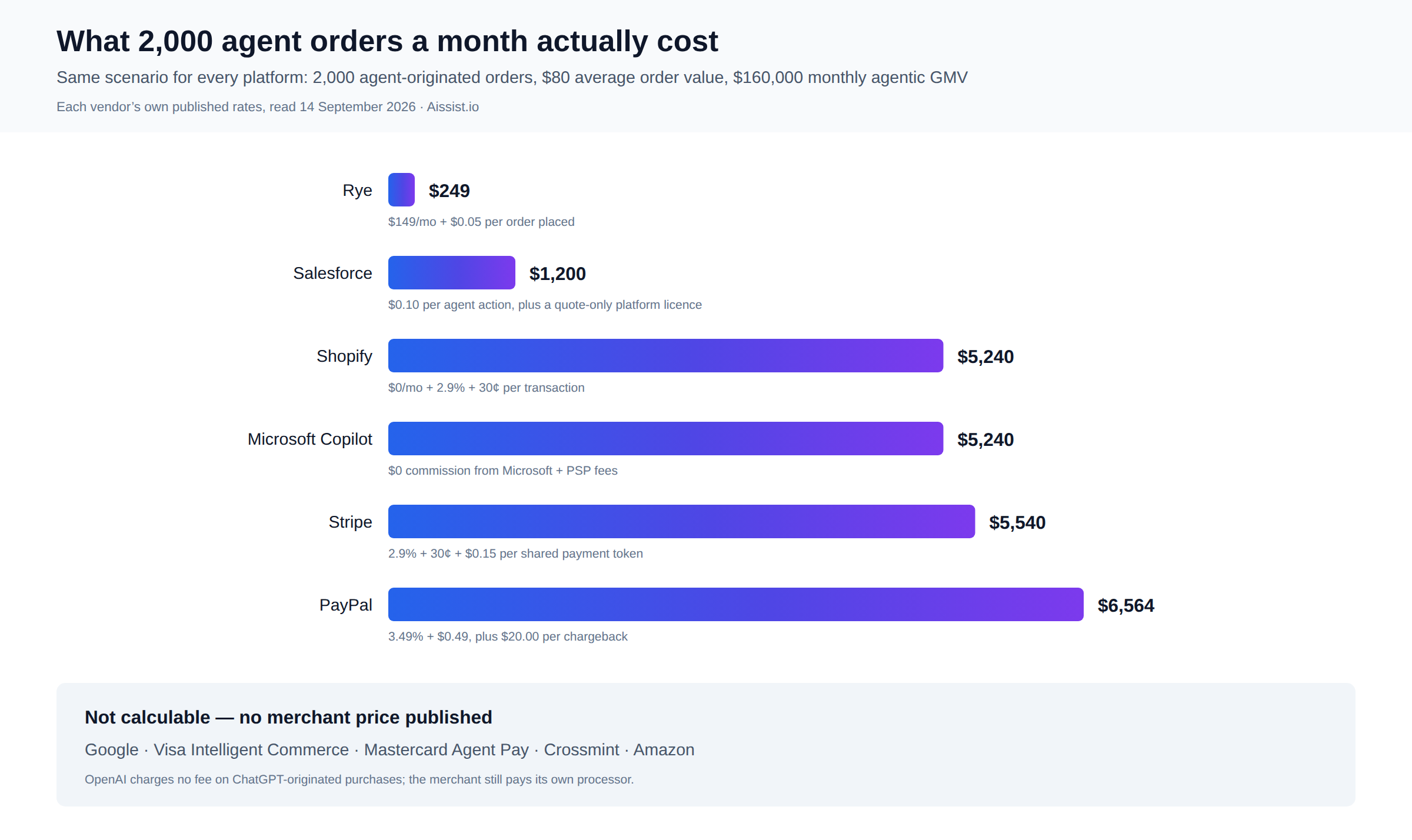
A merchant doing 2,000 agent-originated orders a month at an $80 average order value — $160,000 of monthly agentic GMV — pays between $249 and $6,564 a month depending on the platform, and cannot calculate the figure at all for five of the twelve. All rates below are the vendors' own published figures, read September 2026, applied to that one scenario.
| Platform | Published billing | Monthly cost on 2,000 orders / $160,000 GMV |
|---|---|---|
| Rye | $149/mo + $0.05 per order placed | $249 plus card processing and pass-through platform costs |
| Shopify Agentic plan | $0/mo + 2.9% + 30¢ per transaction | $5,240 |
| Microsoft Copilot Checkout | $0 commission + PSP fees | $5,240 via Stripe rates; Microsoft's own take is $0 |
| Stripe | 2.9% + 30¢ + $0.15 per shared payment token | $5,540 |
| Salesforce | $0.10 per agent action + quote-only platform | $1,200 in agent actions, assuming six agent actions per order — Salesforce publishes no per-order action count — plus the platform licence |
| PayPal | 3.49% + $0.49 (PayPal Checkout rate) | $6,564, plus $20.00 per chargeback |
| Not published | Not calculable | |
| Visa | Free in sandbox; quote only in production | Not calculable |
| Mastercard | Not published | Not calculable |
| Crossmint | Quote only for checkout | Not calculable |
| Amazon | Not published | Not calculable |
| OpenAI | No fees on ChatGPT-originated purchases | $0 to OpenAI; merchant pays its own processor |
Three things that table hides, and every one of them costs money.
Required underlying plans. Salesforce's published $0.10 per action sits on top of a Commerce Cloud licence that is quote only across every SKU, and Agentforce add-ons list at $125 USD per user per month. Microsoft's zero commission sits on top of a PSP's fees. A published AI price attached to an unpublished platform price is not a price.
Feed operations. Stripe requires pricing and inventory refreshed every 15 minutes and documents that price mismatches cause checkouts to fail; Google requires a return policy configured per sub-account before a product is even eligible. That is engineering time, recurring, and nobody bills you for it in a line item you can see.
The support cost of an agent-authorised order. Every order placed by an agent that the customer did not personally click through can generate a contact the merchant has to resolve, and those contacts are more expensive than normal ones because the customer did not see what the agent saw. On Aissist.io's e-commerce AI customer service benchmark, an e-commerce contact costs $0.50–$2.00 resolved by AI versus roughly $6–$13 handled by a human — a 6–12× swing per resolved contact (vendor-claimed, read September 2026). For a concrete version of that arithmetic on a real store, Game Room Shop automated 60% of its presales resolutions on Shopify and Gorgias (case-study). Whichever number applies to you, it is not in the table above, and it is not on any vendor's pricing page either.
Nobody has written the runbook for disputing a purchase a machine authorised
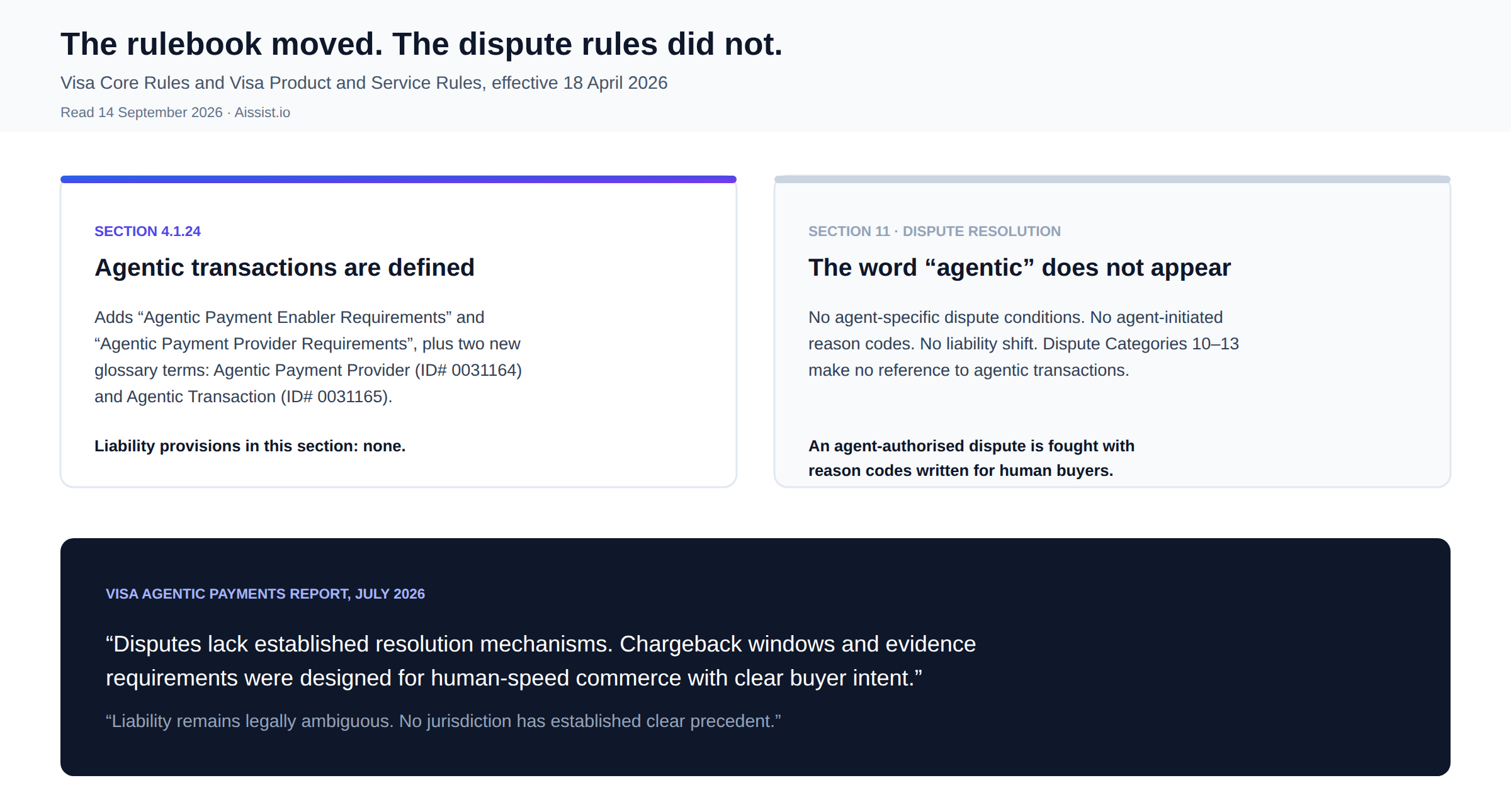
No card network, protocol body, platform or regulator has published an end-to-end process for what happens when an AI agent buys the wrong thing — as of 14 September 2026, the rulebooks recognise agentic transactions while the dispute rules do not. This is the single largest gap in agentic commerce, and it is the one that lands on customer service rather than on engineering.
The evidence is unusually clean, because it comes from the networks themselves.
Visa amended the rulebook and left the dispute chapter alone. The Visa Core Rules effective 18 April 2026 added section 4.1.24, "Agentic Payment Enabler Requirements," and two glossary terms — "Agentic Payment Provider" and "Agentic Transaction." Section 11, Dispute Resolution, contains no reference to agentic transactions, no agent-specific dispute conditions and no agent-initiated reason codes. An agent-authorised dispute today is fought with reason codes written for human buyers.
Visa says so itself. Visa's July 2026 agentic payments report states that "disputes lack established resolution mechanisms. Chargeback windows and evidence requirements were designed for human-speed commerce with clear buyer intent," and that "liability remains legally ambiguous. No jurisdiction has established clear precedent for how responsibility is distributed among the human who delegated authority, the platform that hosted the agent, the model provider, and the merchant." The same company's product page says commerce signals "allow for the quick resolution of most disputes." Both statements are Visa's, published four months apart.
The protocols stop at confirmation. The Agentic Commerce Protocol's checkout specification carries a Refund object as webhook event data and defines no return initiation, no merchant-initiated refund endpoint, no dispute or evidence submission, and no support integration. OpenAI's stated design keeps "orders, payments, and compliance on their existing commerce stack." Mastercard's audit trail "may be used to help avoid and/or resolve potential cardholder disputes" — an evidentiary aid, carefully hedged, not a rule.
The regulators have not arrived. Payments counsel at FBT Gibbons wrote in May 2026 that while "the CFPB may have considered this in the abstract, it has not addressed it directly," and that agentic commerce "creates a category Reg E did not contemplate: a standing authorization granted to an agent to initiate transactions on a consumer's behalf, without transaction-specific consent." In the UK, Pinsent Masons concluded in July 2026 that "it is unclear whether liability sits with the consumer who deployed the agent, the developer of the AI system, the payment service provider, or the merchant."
Here is what that means operationally, and it is the part vendor pages skip. OpenAI's launch documentation assigned merchants merchant-of-record status "across the purchase journey–from fulfillment and returns to support and communication," while the protocol gives merchants no channel back to a customer who is sitting inside someone else's assistant. The merchant owns the liability and does not own the conversation. Every platform above has solved discovery, most have solved authorisation, and precisely one — Crossmint, by taking merchant-of-record status itself — has done anything about what comes next.
"Where it gets murkier is everything short of outright fraud."
— Reshmi Suresh, Head of Agentic Commerce, Worldpay, "Agentic commerce liability is still being written", 30 July 2026
If you are standing up agentic checkout this year, write the internal runbook before the first order: which queue an agent-originated dispute lands in, what evidence you file, who talks to the customer, and what you tell them when your record and the agent's transcript disagree. Nobody is going to hand you that document. Our order tracking and WISMO software comparison covers the adjacent problem — the post-purchase contact volume that arrives whether or not anyone planned for it.
How to choose an agentic commerce platform
Choose by the stack you already run, not by the platform's capabilities — in this category the right answer is decided by your processor, your commerce platform and the countries you ship to. Eight rules:
If you want an agent-completed order this quarter at a price you can calculate, choose Shopify, because the Agentic plan is $0 per month with published card rates and is active by default for eligible stores.
If you sell to US buyers in USD and want in-assistant settlement with no commission, choose Microsoft Copilot Checkout, because Microsoft publishes "no commission or affiliate fee" and states plainly that you remain merchant of record.
If you want to own the payment mechanics rather than rent a surface, choose Stripe, because the Shared Payment Token at $0.15 per token issued is the only published unit price for the delegated-payment primitive itself.
If discovery volume matters more than checkout mechanics, choose Google, because agentic checkout runs inside AI Mode in Search — and budget for the fact that no merchant fee is published.
If you are already on Braintree and want four assistants from one integration, choose PayPal — then read footnote 1 on the Agent Ready page, because Seller Protection for Braintree merchants applies only to the Pay with PayPal button.
If you are building the agent rather than the store, choose Visa Intelligent Commerce, because passkey-bound tokens with per-transaction amount and merchant-category controls are the strongest published consent mechanism, and the sandbox is free.
If your agent must buy from merchants who have integrated nothing, choose Rye or Crossmint — Rye if you want published unit pricing and the merchant to keep the returns relationship, Crossmint if you want someone else to be merchant of record and absorb the chargebacks.
If commerce should stay on your own properties and you already run Commerce Cloud, choose Salesforce Agentforce Commerce, because the agent sits on your storefront where you keep the data and the margin — and because the platform decision was made years ago anyway.
What is agentic commerce, and what is an agentic checkout?
Agentic commerce is commerce in which an AI agent performs part or all of a purchase on a person's behalf — finding the product, building the cart, authorising the payment, or completing the order. Bain & Company uses the tightest published definition: purchases "initiated, influenced, or completed by third-party AI agents or retailer-hosted agents, excluding shopping journeys that only use AI-assisted search or discovery" (Bain, 17 December 2025).
An agentic checkout is the narrower thing: the moment the agent authorises and settles a payment rather than handing the buyer to a browser. That distinction is the whole reason this comparison exists. Four of the twelve platforms above do not do it, and one of them — OpenAI — built it, shipped it, and has moved away from it.
The market numbers are large and worth keeping apart from each other. Bain forecasts US agentic commerce at $300–500 billion by 2030, roughly 15–25% of e-commerce (independently reported, December 2025). McKinsey QuantumBlack forecasts $3–5 trillion globally by 2030 on a much broader definition of orchestrated revenue (independently reported, 17 October 2025). They are not additive and they are not comparable; different geographies, different definitions.
The traffic is already here and the purchases largely are not. Adobe reported that traffic from AI sources to US retail sites grew 393% year over year in Q1 2026, and that AI-referred traffic converted 42% better than non-AI channels in March 2026 — a reversal from converting 38% worse in March 2025 (Adobe Digital Insights, 16 April 2026, independently reported). Salesforce measured agentic search growing 200% year over year as a first step in purchase journeys (Salesforce, 28 July 2026, independently reported).
But Riskified's survey of 5,400+ consumers across nine countries found that while 73% of shoppers use AI somewhere in their shopping journey, only 13% have completed a purchase after being referred by an AI assistant (independently reported, 20 October 2025). And one merchant put a number on it publicly: Mountain Warehouse told BigCommerce's Commerce Live EMEA audience that just 0.3% of its revenue has come through agentic commerce (BigCommerce, 25 April 2026, case-study).
That is the honest shape of the category in September 2026: enormous traffic growth, improving conversion, a trust ceiling on payment, and a revenue contribution that most merchants would still round down.
What about the protocols? Three matter. ACP, the Agentic Commerce Protocol, is maintained by OpenAI and Stripe, Apache 2.0, stable version 2026-04-17. UCP, the Universal Commerce Protocol, is co-developed by Google, Shopify, Etsy, Wayfair, Target and Walmart, Apache 2.0, release v2026-04-08, with AP2, A2A and MCP support built in. AP2, the Agent Payments Protocol, is Google's payment-authorisation layer, v0.2, Apache 2.0, donated to the FIDO Alliance in April 2026. Supporting a protocol is not the same as shipping a checkout — and as Microsoft's move from ACP to UCP in nine months shows, it is not the same as a stable integration either.
Agent-authorised orders still land in your support queue. Aissist.io resolves service and sales end-to-end on the help desk you already run — Shopify, Gorgias, Zendesk and the rest — at a predictable cost per resolution. Get a free demo →
Frequently asked questions
Which AI assistants can actually complete a purchase in 2026?
Microsoft Copilot, Google's AI Mode and Gemini, Perplexity, and Amazon's Alexa for Shopping can complete purchases inside the assistant. ChatGPT is moving away from it — OpenAI states purchases "are completed on merchant-owned websites or apps" (read September 2026).
Is ChatGPT Instant Checkout still available?
OpenAI is withdrawing it. Its merchant page states: "We're moving away from a standalone Instant Checkout experience in ChatGPT and prioritizing better shopping discovery and merchant-owned checkout experiences" (read September 2026). Residual availability persists — a help page updated within the last month still references an Instant Checkout option.
What does it cost a merchant to accept agentic commerce orders?
Roughly 2.9% + 30¢ to 3.49% + $0.49 per transaction, plus any platform fee. Shopify's Agentic plan is $0 per month, Microsoft takes no commission, and Stripe adds $0.15 per shared payment token. Google, Visa, Mastercard, Amazon and Crossmint publish no merchant price at all.
Who is liable when an AI agent buys the wrong thing?
Nobody has published an answer. Visa's own July 2026 report states that "liability remains legally ambiguous" and that "no jurisdiction has established clear precedent." Visa's Core Rules recognise agentic transactions without adding any agent-specific dispute reason code.
What is the difference between ACP, UCP and AP2?
ACP (OpenAI and Stripe) and UCP (Google, Shopify and partners) are commerce protocols covering catalogue, cart and checkout. AP2 (Google, now donated to the FIDO Alliance) is a payment-authorisation protocol that sits underneath either. All three are Apache 2.0 licensed, and UCP has AP2 support built in.
Can an AI shopping agent buy from a merchant that has not integrated anything?
Yes. Rye's Universal Checkout API and Crossmint's agentic checkout both drive merchants' live checkouts without any merchant integration, covering Amazon, Shopify stores and any site with guest checkout. Merchants retain the contractual right to block agents through their terms of service.
Do merchants stay merchant of record in agentic commerce?
Usually yes. Microsoft states "you are the merchant of record," Google states "you will remain the seller of record," and Stripe, OpenAI, Shopify and Rye all keep the merchant in that role. The exception is Crossmint, which acts as merchant of record itself and handles returns and chargebacks.
How much agentic commerce revenue do merchants actually see today?
Very little so far. Riskified found only 13% of shoppers have completed a purchase after an AI assistant referral, against 73% who use AI somewhere in the journey (October 2025). Mountain Warehouse reported publicly that agentic commerce accounts for 0.3% of its revenue (April 2026).
Is Amazon blocking third-party AI shopping agents?
Amazon has tried. It sued Perplexity over its Comet browser and won a preliminary injunction, which the Ninth Circuit vacated on 4 August 2026, holding that "it is the user who 'accesses' Amazon's computers." The court noted the ruling "does not impair Amazon's ability to regulate access to Amazon.com via private terms of service."
What should a support team prepare before launching agentic checkout?
A dispute runbook, because no vendor supplies one. Decide which queue agent-originated disputes land in, what evidence you file, who owns the customer conversation, and what an agent tells a customer whose recollection differs from the transcript. The Agentic Commerce Protocol defines no returns, dispute or support endpoints at all.
Changelog
- September 2026 — First publication. Twelve platforms scored; all pricing, protocol versions and G2 figures read 14 September 2026. Records OpenAI's withdrawal of standalone Instant Checkout (March 2026), Visa Core Rules section 4.1.24 effective 18 April 2026, AP2's donation to the FIDO Alliance (April 2026), and the Ninth Circuit's 4 August 2026 ruling in Amazon v. Perplexity.
Next scheduled review: February 2027.