The Best AI SDR and AI Sales Agent Tools in 2026: Outbound and Inbound, Ranked Separately
Compiled by Alex Gomez. Published September 24, 2026 · Last updated September 24, 2026.
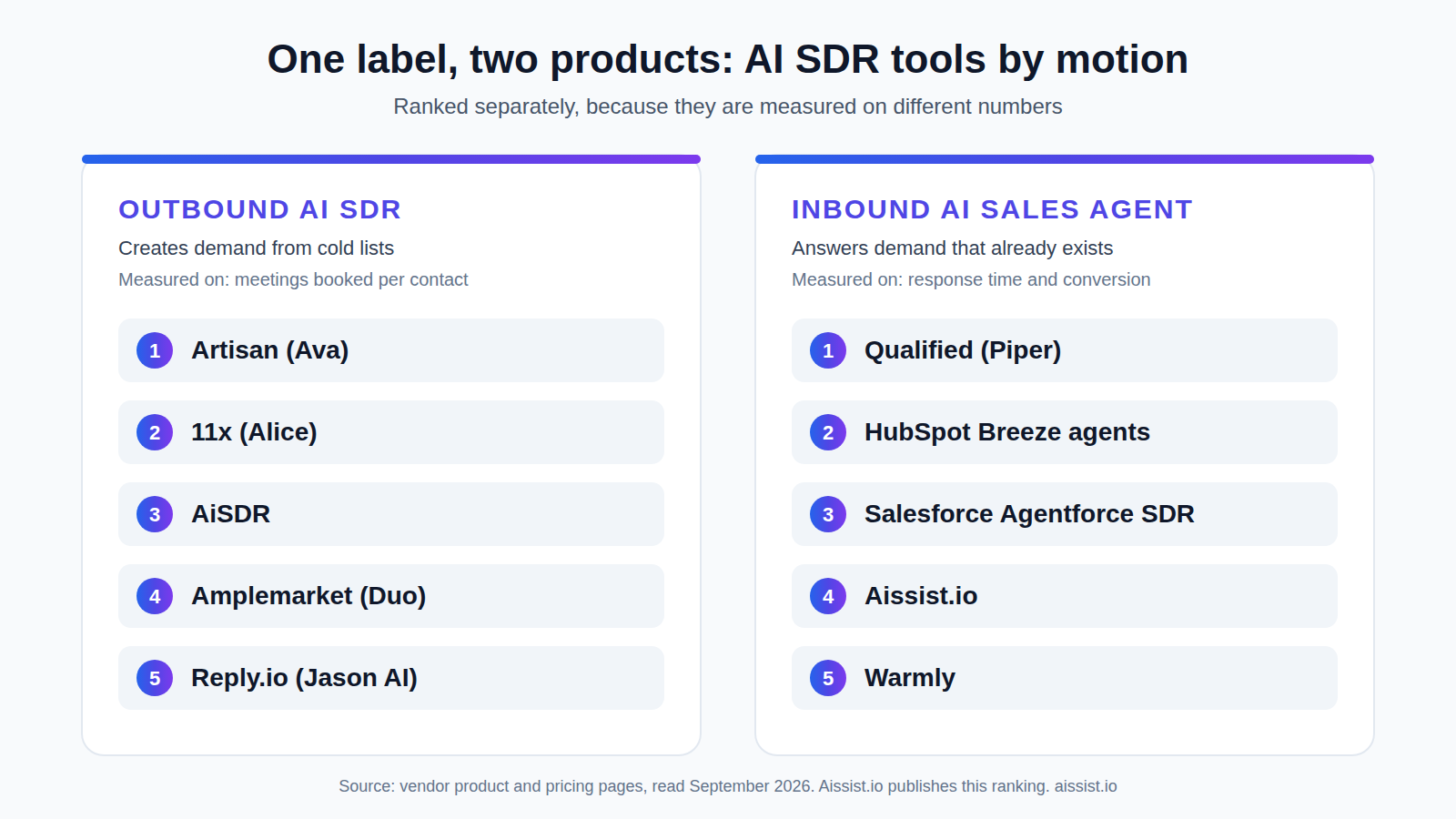
An AI SDR is software that does the work of a sales development rep: it finds prospects, writes and sends outreach, handles replies, and books meetings. The label now covers two different products. Outbound AI SDRs create demand from cold lists and are judged on meetings booked per contact. Inbound AI sales agents answer demand that already exists, such as a form fill, a website chat or a pricing-page visit, and are judged on response time and conversion.
TL;DR: Choose outbound or inbound first, then insist on a rate with a denominator. Belkins' 2025 data puts cold email replies at 0.45% of 7.5 million emails sent, so a claim with no denominator doesn't tell you much.
Methodology & sources
- 10 vendors, each placed in the roster that matches its main motion. Ranked on four criteria: fit to that motion, a performance claim with a published denominator, pricing transparency, and native CRM write-back.
- Pricing, data sources, integrations and claims were read from each vendor's own pricing, product and integration pages. Quotes come verbatim from vendor case-study pages and company announcements, and are attributed by name.
- Independent reply-rate benchmarks: Belkins (7.5M emails, 2025) and Hunter (31M emails, 2025). Lead response data: InsideSales (5.7M inbound leads).
- G2 ratings are left out because we couldn't verify them independently this month.
- All figures verified September 2026. Disclosure: this is Aissist's blog, and Aissist sells an inbound agent. It appears in the inbound roster under the same rubric as everyone else, and it isn't ranked first.
Why are outbound and inbound AI SDRs different products?
Outbound and inbound AI SDRs do opposite jobs, so they have different cost drivers and success metrics. An outbound agent's main inputs are a contact database and sending capacity, and it's measured on meetings booked from a cold list. An inbound agent's main inputs are your CRM and your website, and it's measured on how fast it responds and how many existing leads it converts.
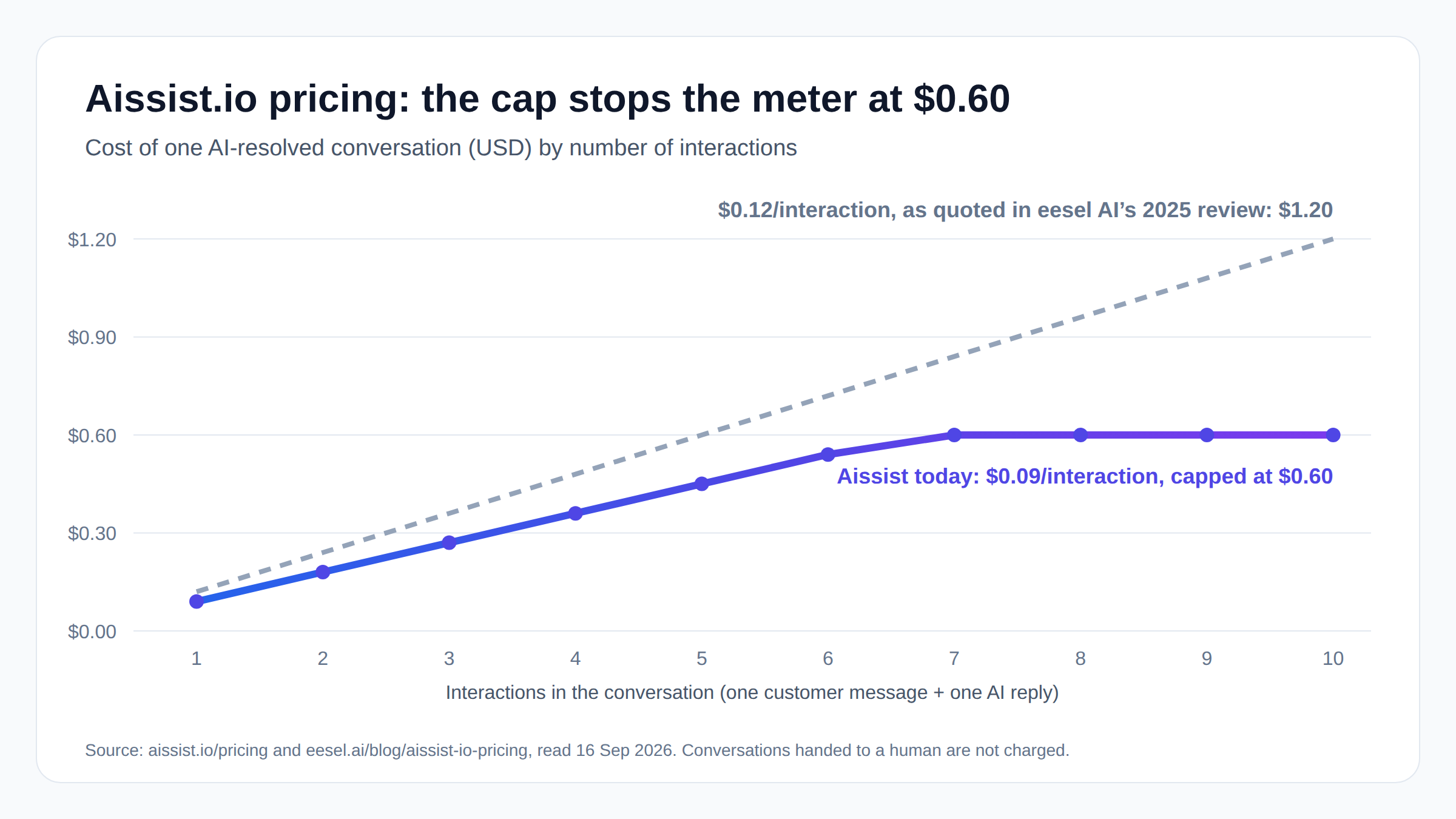
The two groups also price differently. Outbound vendors bill by volume: 11x charges "per lead, not per send", and Salesforge bills per contact. Inbound vendors bill for conversations handled. Salesforce lists Agentforce at "$2 per conversation", and Aissist bills $0.20–$0.60 per resolution. One model charges for the leads you reach, the other for the leads who reach you.
The category is also shifting. HubSpot's Fall '26 Spotlight added Content and Campaign agents and relaunched its Prospecting Agent. AI Agent Store's weekly roundup describes HubSpot as treating agents as "outcome-focused digital workers rather than auxiliary chatbots." Salesforce's Claudeforce partnership with Anthropic ships "37 prebuilt sales skills" into Claude and is scheduled for open beta in September 2026.
Which numbers should you believe?
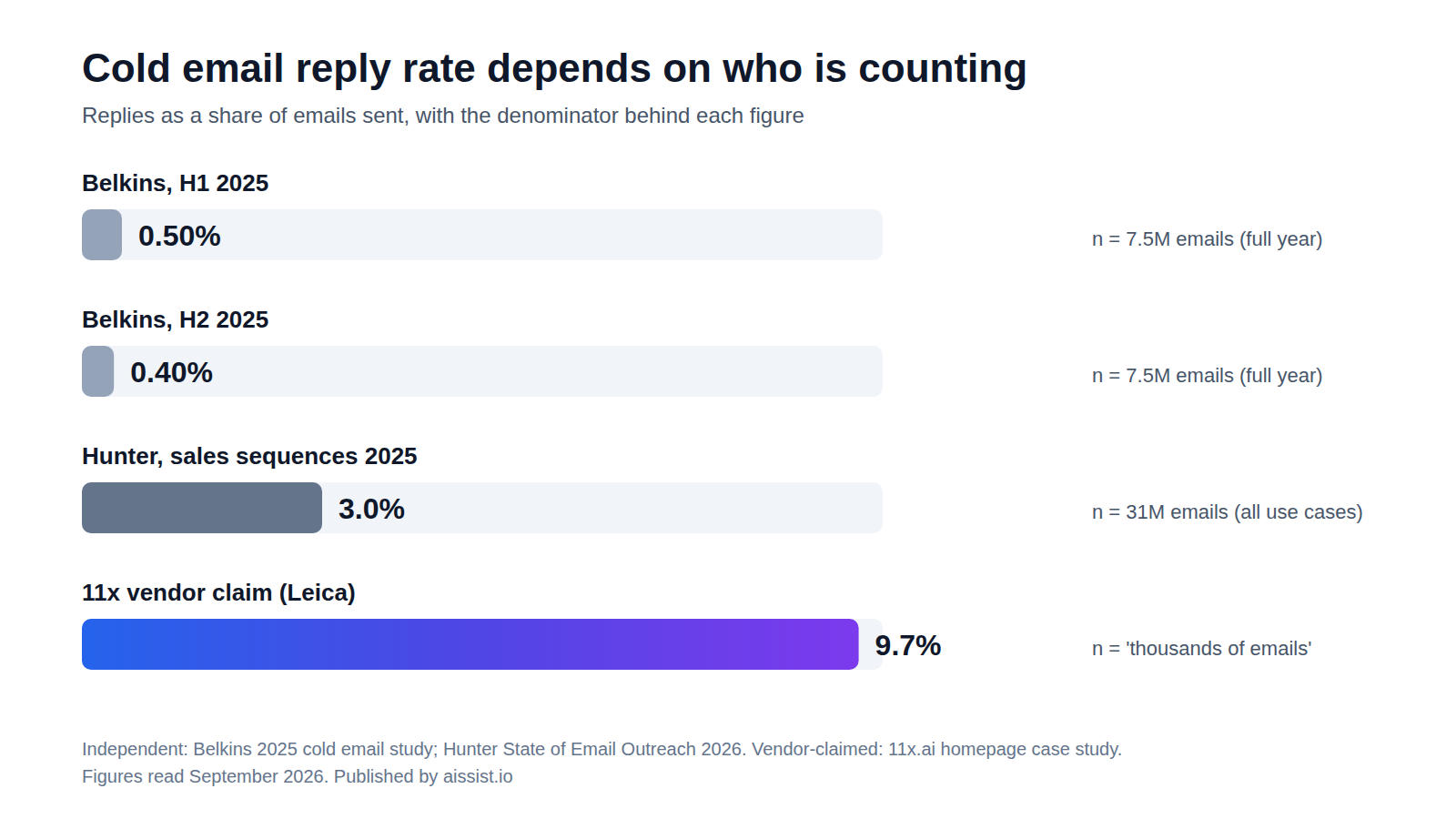
Believe a rate only when it comes with a denominator: replies out of emails sent, or meetings out of prospects contacted. Belkins found that the average reply rate across 2025 was 0.45%, or 34,393 replies from 7.5 million cold emails. It also fell from 0.50% in the first half of the year to 0.40% in the second. Hunter's study of 31 million emails puts the average sequence reply rate at 4.5%, and 3% for sales specifically.
The two benchmarks differ by a factor of ten because they measure different things. That's why a bare "2x more replies" means nothing without the baseline behind it.
AI SDRs are also sending into this decline. Belkins attributes it to more teams competing for the same inboxes and to stricter Google and Microsoft filtering. Hunter reports that "69% of US-based decision makers say it bothers them if AI was used to write the email." When every inbox gets similar AI-written sequences, the vendor's contact data matters more than its copywriting.
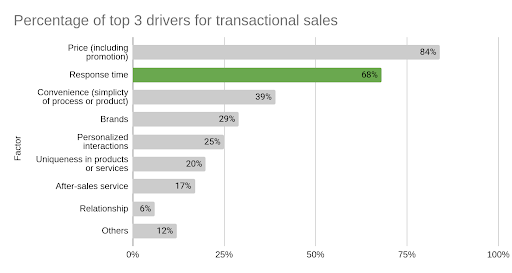
Inbound agents work from a different number. InsideSales, analysing 5.7 million inbound leads at 400+ companies, found that "conversion rates are 8x greater in the first five minutes" and that "only 0.1% of inbound leads are actually engaged in under 5 minutes." Most of that lost demand came from leads who had already raised their hand. We make the same point about response time in sales.
How do the 10 AI SDR tools compare?
Artisan has the only outbound performance claim with a clear denominator, and HubSpot has the only inbound one. Neither of HubSpot's measures a sales outcome.
| Tool | Motion | Data source | CRM write-back | Pricing metric (Sep 2026) | Published claim, and its denominator |
|---|---|---|---|---|---|
| Artisan (Ava) | Outbound | Own: 250M+ contacts | Salesforce, HubSpot (two-way) | Quote only, tiered by leads/month | $52 CPL from 400k+ emails. Denominator: yes |
| 11x (Alice) | Outbound | Own real-time lead database | Salesforce, HubSpot (bi-directional) | Per lead; Growth from $3,750/mo annual | 9.7% reply rate "across thousands of emails". Vague |
| AiSDR | Outbound | Own: 300M+ leads | HubSpot two-way; Salesforce on Scale | Monthly plan; from $250/mo | 1–3% prospect-to-meeting, "directional". No sample |
| Amplemarket (Duo) | Outbound | Own: contact allowances by plan | Salesforce, HubSpot | Per plan; Startup $600/mo annual | "Up to 100% more replies". None |
| Reply.io (Jason AI) | Outbound | Own: 1B+ contacts | HubSpot, Salesforce, Pipedrive | Per active contact; $500–$1,000/mo | "Double your response rate". None |
| Qualified (Piper) | Inbound | Website visitors, CRM, intent | Salesforce, HubSpot | Quote only | "6x SDR efficiency" (one customer). None |
| HubSpot (Breeze agents) | Both | HubSpot Smart CRM | Native | Credits; Customer Agent $0.50/resolution | 65% resolution across 8,000+ customers (service). Denominator: yes |
| Salesforce Agentforce SDR | Inbound | Salesforce Data Cloud | Native | $2 per conversation, or Flex Credits | 20 qualified leads/day per rep (pilot). None |
| Aissist.io | Inbound | Your helpdesk and CRM | HubSpot contact/company properties; Salesforce account data | $0.20–$0.60 per resolution | Replies in 5–20 seconds; up to 80% of lead qualification automated. None |
| Warmly | Inbound | Website de-anonymisation, intent | CRM sync on all plans | From $20,000/yr (Inbound Chat) | "3x more qualified pipeline". None |
Seven of the ten publish a headline figure without a denominator, and that includes us.
The best outbound AI SDR tools
For outbound prospecting, Artisan leads because it's the only vendor that publishes a claim you can check.
1. Artisan (Ava): best for teams replacing a full outbound SDR function. Artisan's Ava is an AI BDR that prospects from a 250M+ contact database and books meetings over email and social. It publishes no prices. Its case-study page does show a cost per lead from a stated number of emails.
"We've replaced our entire outbound sales team with Artisan, and they help close $100K deals day after day." — Jason Lemkin, Founder & CEO, SaaStr, Artisan
2. 11x (Alice): best for predictable, volume-based budgeting. 11x's Alice runs multichannel outbound and handles replies. Growth starts at $3,750 a month on an annual contract for 2,000 new prospects a month. The price stays the same "whether Alice runs three touchpoints or thirty."
"Since putting Alice on autopilot, we've increased qualified meetings 5x while freeing our team." — Russell Thomas, CEO, MMB Networks, 11x
3. AiSDR: best entry price. AiSDR starts at $250 a month with no long-term contract. Its 1–3% prospect-to-meeting range is the most honest planning figure in this group, though the company itself calls it "directional."
4. Amplemarket (Duo): best for combining email, call and LinkedIn steps in one sequence. Its Startup plan is $600 a month for two users.
5. Reply.io (Jason AI): best contact coverage. Reply.io claims a database of 1B+ contacts, priced by active contacts.
The best inbound AI sales agents
For inbound demand, Qualified's Piper is the most complete purpose-built option. HubSpot and Salesforce win if you're already on their CRM.
1. Qualified (Piper): best for website pipeline at B2B companies. Piper talks to website visitors by video, voice or text chat and books meetings. Qualified says more than 500 companies use it. Pricing is quote-only across three tiers.
"At Sinch, Piper the AI SDR Agent does the work of 13 SDRs." — Jonathan Bean, CMO, Sinch, Qualified
2. HubSpot Breeze agents: best if you already run HubSpot. The agents run natively in the CRM and bill per outcome. Only HubSpot's Customer Agent has a denominator, and it measures service resolutions, not sales. HubSpot's Revenue Agent also looks like a sales tool from its name, but it follows up on overdue invoices.
"Outcome-based pricing removes that risk. You pay when it works, full stop." — Jon Dick, Chief Customer Officer, HubSpot
3. Salesforce Agentforce SDR: best for Salesforce-native lead nurturing. It nurtures inbound leads by email and logs every interaction to the lead record, at $2 per conversation.
4. Aissist.io: best for inbound sales that shares a queue with support. AgentMesh™ answers inbound leads on chat, email, WhatsApp and SMS, and writes back to HubSpot contact and company properties. Its Salesforce write-back covers case, customer and account data, but our Salesforce integration page doesn't name the lead or opportunity objects. Aissist's sales figures have no denominator either.
5. Warmly: best for de-anonymising website traffic. Warmly identifies anonymous visitors and routes them into chat or email. Plans start at $10,000 a year.
Your motion decides the tool, then the denominator decides the vendor
If you don't have enough inbound demand, choose an outbound AI SDR from a vendor whose contact data you can test. Treat any reply-rate claim above Hunter's 4.5% average as unproven until the vendor shows you the sample behind it. If you already have inbound demand and slow follow-up, an outbound tool won't fix that. Choose an inbound agent, and measure it on speed-to-first-response and conversion from leads who asked. For how the two motions fit together, see agentic AI for sales.
Frequently asked questions
What is an AI SDR?
An AI SDR is software that does a sales development rep's job: prospecting, writing outreach, handling replies and booking meetings. Outbound AI SDRs work cold lists. Inbound AI sales agents respond to leads who have already made contact.
How much does an AI SDR cost?
Published prices range from AiSDR's $250 a month to 11x's $3,750 a month on an annual contract, and Artisan and Qualified are quote-only. Inbound agents usually bill per conversation or per resolution, such as Salesforce's $2 per conversation.
Can an AI SDR replace human SDRs?
For some tasks, yes. Qualified's customer Sinch says Piper "does the work of 13 SDRs." But Gartner expects 75% of B2B buyers to prefer sales experiences that prioritize human interaction by 2030, so most teams keep humans on qualified conversations.
What reply rate should I expect from an AI SDR?
Expect somewhere between 0.4% and 4.5%, depending on how replies are counted. Belkins measured 0.45% of 7.5 million emails sent in 2025, and Hunter measured a 4.5% average sequence reply rate across 31 million emails.
Will AI SDR emails hurt my domain's deliverability?
They can. Google tells bulk senders to keep spam rates below 0.3%, and Yahoo sets the same limit. High-volume AI sequences with weak targeting are an easy way to exceed it.
Is sales automation software the same as an AI SDR?
No. Sales automation software sends sequences and syncs activity on rules a person sets. An AI SDR chooses who to contact, what to write and how to handle replies, and does it autonomously.