Best eSIM Platform Providers 2026: 6 Compared for Travel and Telecom Brands
Compiled by Alex Gomez. All partner programs, pricing, developer docs and support terms were read from primary sources in October 2026; Trustpilot figures come from Aissist.io's eSIM benchmark, collected September 2026. Disclosure: this guide is published by Aissist.io, which sells an agentic AI layer for customer service and sales. Holafly is an Aissist.io customer; none of the six platforms is an Aissist.io product, and we hold no affiliate or paid-placement relationship with any of them.
TL;DR: Coverage maps are nearly identical, so choose an eSIM platform by who answers the customer when activation fails; Holafly leads because it supports end customers itself, with a 4.62 Trustpilot score across 106,428 reviews.
- Best for travel brands that don't want to staff eSIM support: Holafly
- Best for fintechs and apps launching a full mobile plan: Gigs
- Best for banks and airlines needing licensed telco depth: 1GLOBAL
- Best for teams that want wholesale control and own their support: eSIM Go
- Best for resellers that want a large self-serve catalog: Airalo Partners
- Best for OTAs adding eSIM at checkout: Celitech
How did we compare these eSIM platforms?
We judged six platforms on five criteria: support ownership, provisioning paths, commercial transparency, coverage, and BSS depth. Support ownership carries the most weight, because Aissist's eSIM customer service benchmark found that activation failures are the main complaint in 18% of low-star eSIM reviews, and customer service in another 11%.
Methodology & sources
- Vendor product, partner and developer pages for all six platforms, read October 2026.
- Ratings from Aissist's eSIM benchmark: 377,827 Trustpilot reviews across 20 brands, collected September 2026.
- Telna, Kigen and Teal were researched but left off: their public offers target IoT or connectivity resellers rather than consumer-facing brands.
- Disclosure: this is Aissist's blog, and Holafly is an Aissist customer. Holafly ranks first on the support-ownership criterion, which is published here before the list so you can weigh it yourself.
The six eSIM platforms at a glance
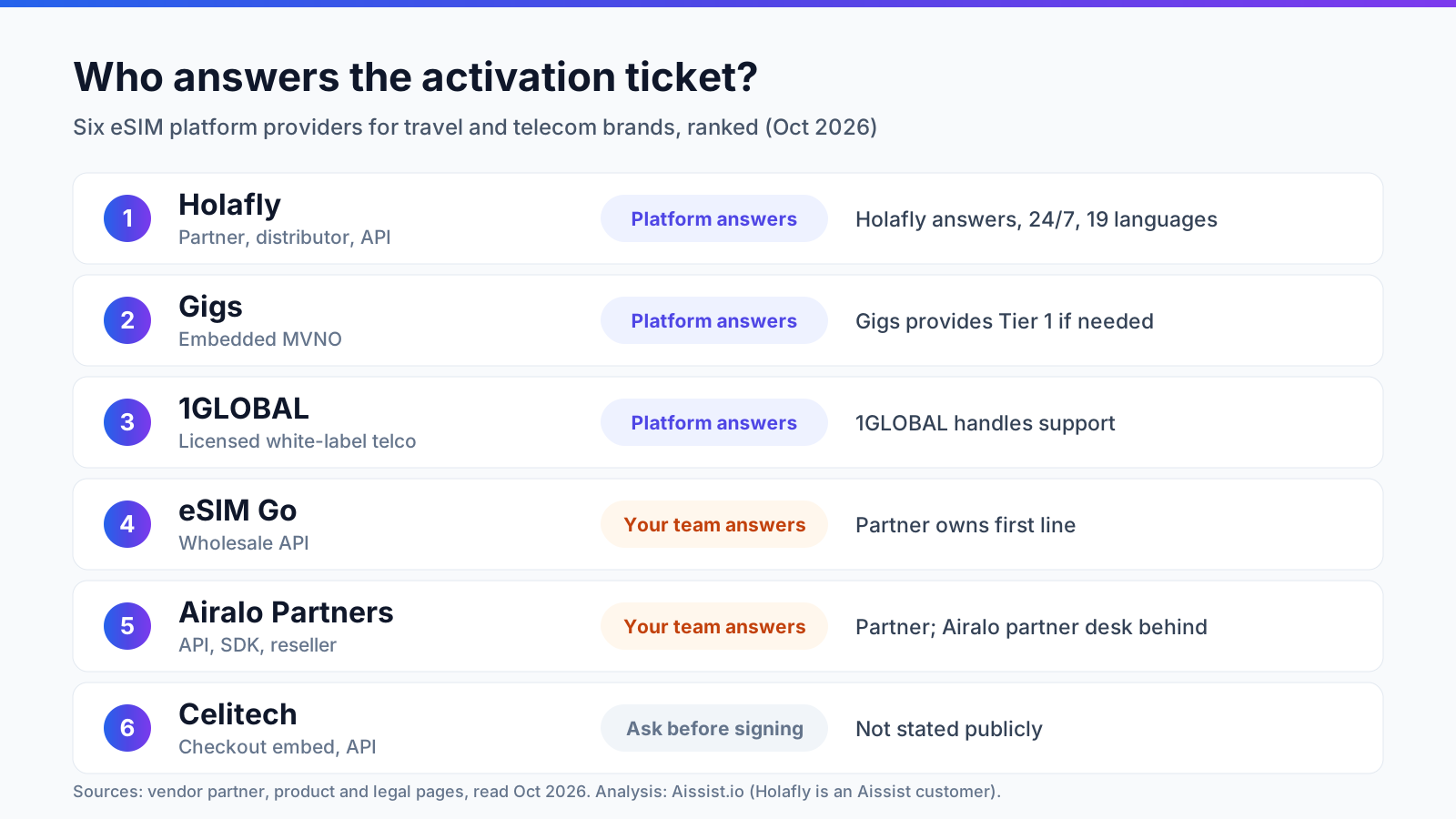
The six platforms split into three models: partner with an established eSIM brand, embed a full mobile operator, or buy wholesale connectivity and run the rest yourself.
| Platform | Model | Coverage (Oct 2026) | Commercial model | Who answers the end customer |
|---|---|---|---|---|
| Holafly | Affiliate, distributor, API | 200+ destinations | Commission or wholesale; rates not public | Holafly, 24/7 in 19 languages |
| Gigs | Embedded MVNO, carrier of record | Global roaming; no country count | Not public | Gigs provides Tier 1 if needed |
| 1GLOBAL | Licensed telco, white-label | 200+ roaming destinations | Quote only | 1GLOBAL handles network and support |
| eSIM Go | Wholesale API and portal | 190+ countries, 500+ networks | Wholesale, no platform fee, $10K/month minimum credited | Partner owns first line |
| Airalo Partners | API, SDK, reseller platform | 200+ countries and regions | Net pricing above a minimum retail price | Partner, with Airalo partner desk behind |
| Celitech | API and checkout embed | 215+ countries and regions | No setup fees; rates not public | Not stated publicly |
Which provisioning model creates the most support load?
Emailed QR codes have the most failure points, one-tap links fewer, and in-app installs the fewest, but in-app installs move every remaining failure into your own queue. No platform publishes ticket rates by install path, so the table below maps the mechanism, not a measured rate.
| Install path | What breaks | Ticket it creates |
|---|---|---|
| QR code by email | Customer tries to scan with the phone being set up; code already used | "Can't scan," "QR invalid," reissue requests |
| One-tap link (iOS 17.4+) | Link opened inside an app, or on the wrong device | "Nothing happens when I tap" |
| In-app install | Your app's error states, payment, top-up | Every issue lands with your brand |
| All three | Data roaming off, line not selected on arrival | "Installed but no internet" |
Apple's one-tap path works because the link carries the SM-DP+ address and activation code, so nothing is typed by hand. eSIM Go's help center documents the format and notes the link must open outside the app. Every install guide says "scan the QR code." Few mention that the QR code is usually on the phone you're trying to scan it with.
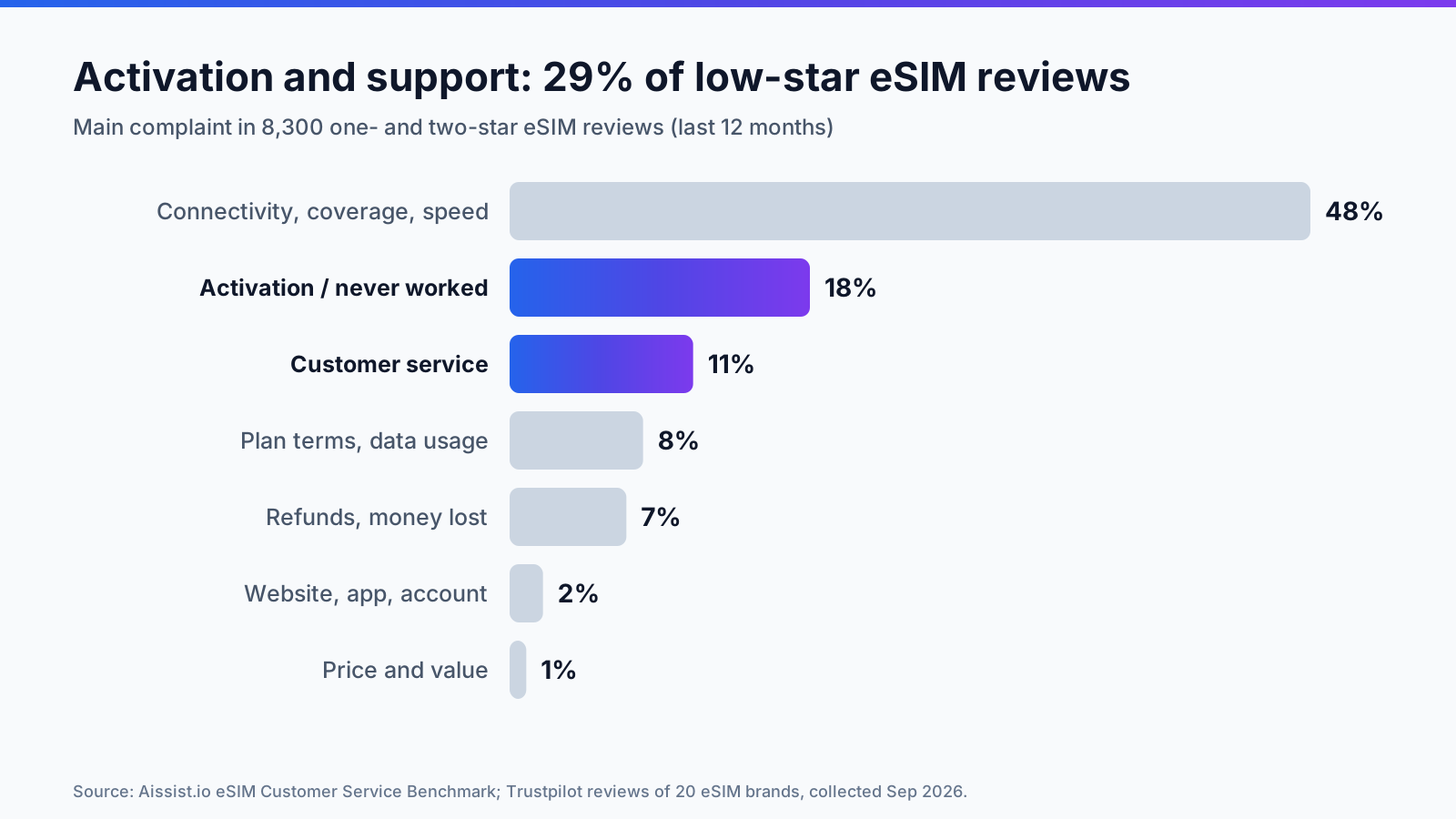
The benchmark's support data shows what happens when those tickets go unanswered: slow or no reply drives 28% of support complaints, unfixed problems 29%, and a bot wall with no human 13%. Whoever owns the first line needs volume capacity, not a FAQ page. We see this first-hand: in Aissist's Holafly case study, AI agents handle roughly 100,000 daily service inquiries, many of them multi-step activation troubleshooting.
"Not only our sales and support operations increased by 3X during peak season, the CSAT improved." — Jefersson Arana, Senior Manager of AI, Holafly
1. Holafly — best for travel brands that don't want to staff eSIM support
Holafly is a travel eSIM provider whose partner programs let brands sell its catalog through affiliate links, a distributor platform or an API, with Holafly supporting end customers. Holafly's partner page says it manages eSIMs after sale and assists clients 24/7 in 19 languages, across 200+ destinations and 2,000+ travel partners. Its distributor program adds the API and a Business Center for wholesale purchasing, commission tracking and invoicing.
- Pro: the strongest support record at scale: 4.62 on Trustpilot from 106,428 reviews, with only 7.4% at 1–2 stars, per Aissist's benchmark.
- Pro: a January 2026 launch added permanent business data plans, used by Nike, Deloitte and Airbnb.
- Con: co-branding is documented; full white-label terms are not published.
- Con: data-only travel plans, with no domestic number or voice.
"…remove the guesswork that companies face when managing mobile data internationally." — Alex Bryszkowski, VP of B2B & Partnerships, Holafly
Our take: the lowest-effort route to a credible eSIM offer. Skip it if you need your own brand on every screen.
2. Gigs — best for fintechs and apps launching a full mobile plan
Gigs is an embedded telecom platform that lets brands run a complete mobile service, including talk, text and data, inside their own app. Gigs acts as carrier of record, automates taxes, handles payments, and provides Tier 1 support when users can't self-serve. Customers include Revolut, Klarna and Cash App.
- Pro: the deepest BSS on this list, from checkout to compliance.
- Pro: an agentic AI operator module for service automation.
- Con: no public pricing or country count.
- Con: more than a travel add-on needs.
"Revolut Mobile is a truly differentiated alternative designed to change the industry." — Hadi Nasrallah, General Manager Telco, Revolut
Our take: build here if mobile is a product line. Skip it for a checkout upsell.
3. 1GLOBAL — best for banks and airlines needing licensed telco depth
1GLOBAL is a licensed telecom provider that sells white-label travel and domestic eSIMs to brands through its Connect API, with one-tap in-app installation or QR delivery. 1GLOBAL says it handles network and support for embedded brands, and lists Revolut, N26, Lidl and Jazeera Airways as customers.
- Pro: MVNO status in 10+ countries and full licensing in 40+, per its site.
- Pro: compliance, KYC and VAT built in.
- Con: quote-only pricing.
- Con: enterprise sales cycle.
"We are delighted to be able to offer the 1GLOBAL service to our passengers." — Andrew Ward, VP Marketing & Customer Experience, Jazeera Airways
Our take: the safe pick for regulated brands. Skip it if you need to launch this month.
4. eSIM Go — best for teams that want wholesale control and own their support
eSIM Go is a wholesale eSIM platform that gives brands an API, partner portal and webhooks to sell travel data under their own name. eSIM Go covers 190+ countries on 500+ networks, charges no platform fee and credits a $10,000 monthly minimum toward plans sold. More than 400 travel eSIM brands run on it, including Lufthansa and Wizz Air.
- Pro: the most transparent commercial model here.
- Pro: QR, one-tap and in-app install paths.
- Con: its service agreement makes first-line support the partner's job.
- Con: the monthly minimum excludes small pilots.
Our take: the best margins if you already run support. Skip it if you don't.
5. Airalo Partners — best for resellers that want a large self-serve catalog
Airalo Partners is the B2B arm of the Airalo travel eSIM marketplace, offering an API, SDK, WooCommerce plugin and reseller platform. Airalo's partner API guide describes net pricing above a minimum retail price, no upfront fees, and white-label or Airalo-branded eSIMs across 200+ destinations.
- Pro: fast self-serve integration with webhooks for low data and top-ups.
- Pro: a 24/7 partner support desk.
- Con: 3.98 on Trustpilot with 20.6% of reviews at 1–2 stars, per Aissist's benchmark.
- Con: end-customer support scope isn't stated publicly.
Our take: strong for online resellers. Confirm who answers your customers before signing.
6. Celitech — best for OTAs adding eSIM at checkout
Celitech is a travel eSIM platform that lets online travel agencies sell data plans through a one-line embed or API, activated by QR code. Celitech cites 215+ countries and regions, no setup fees, SOC 2 certification, and customers including Expedia and KAYAK.
- Pro: integration in days, built for checkout flows.
- Pro: strong OTA customer roster.
- Con: end-customer support terms are not public.
- Con: QR-only activation is documented on its site.
Our take: a clean ancillary-revenue add-on. Skip it if you need in-app install.
How do you choose an eSIM platform for your brand?
Decide who will answer the activation ticket first, then pick the platform that matches.
- If you have no support team for connectivity, choose Holafly, because it supports end customers itself.
- If mobile is a product line with billing and numbers, choose Gigs or 1GLOBAL, because both carry the regulatory load.
- If you run support already and want margin, choose eSIM Go, because wholesale is transparent and the first line is yours anyway.
- If you want a large catalog with self-serve integration, choose Airalo Partners or Celitech, because both integrate in days; confirm end-customer support terms first.
- If you own first-line support on any platform, staff for multilingual, multi-step activation troubleshooting at peak season, because travelers contact you from the arrivals hall, not office hours. Our multilingual AI customer service comparison covers the options.
Support ownership is the real platform decision
Coverage is a commodity: five of six platforms claim roughly 200 destinations. The difference is who picks up when an eSIM installs but won't connect. Pick a platform that owns that moment, or budget to own it yourself. For cross-industry context, see Aissist's AI customer service benchmark.
Owning the first line doesn't have to mean hiring for peak season. Aissist.io resolves eSIM activation and plan questions end to end on the helpdesk you already run, in the customer's language. See the eSIM benchmark →
Frequently asked questions
What is an eSIM platform provider?
An eSIM platform provider supplies the connectivity, provisioning and commercial tooling a brand needs to sell eSIM data plans. Models range from affiliate programs to full white-label mobile operators.
What is SM-DP+ in eSIM provisioning?
SM-DP+ is the GSMA-defined server that stores and delivers eSIM profiles to devices. QR codes and one-tap links both point the phone to an SM-DP+ address and activation code.
What is the cheapest eSIM platform for a travel company?
None publish full rate cards. eSIM Go is the most transparent, with no platform fee and a $10,000 monthly minimum credited toward plans; Airalo uses net pricing above a minimum retail price.
Do eSIM platforms include BSS?
Embedded operators such as Gigs and 1GLOBAL include billing, tax and compliance. Wholesale platforms such as eSIM Go provide APIs and portals, and leave customer-facing BSS to the brand.
Why do eSIM activations fail?
Most failures come from scanning issues, reused codes, data roaming left off, or the wrong line selected on arrival. Activation is the main complaint in 18% of low-star eSIM reviews, per Aissist's benchmark.
Changelog
- Oct 21, 2026 — First published. Six platforms reviewed; vendor pages read October 2026.