The 11 Best Multilingual AI Customer Service Platforms in 2026
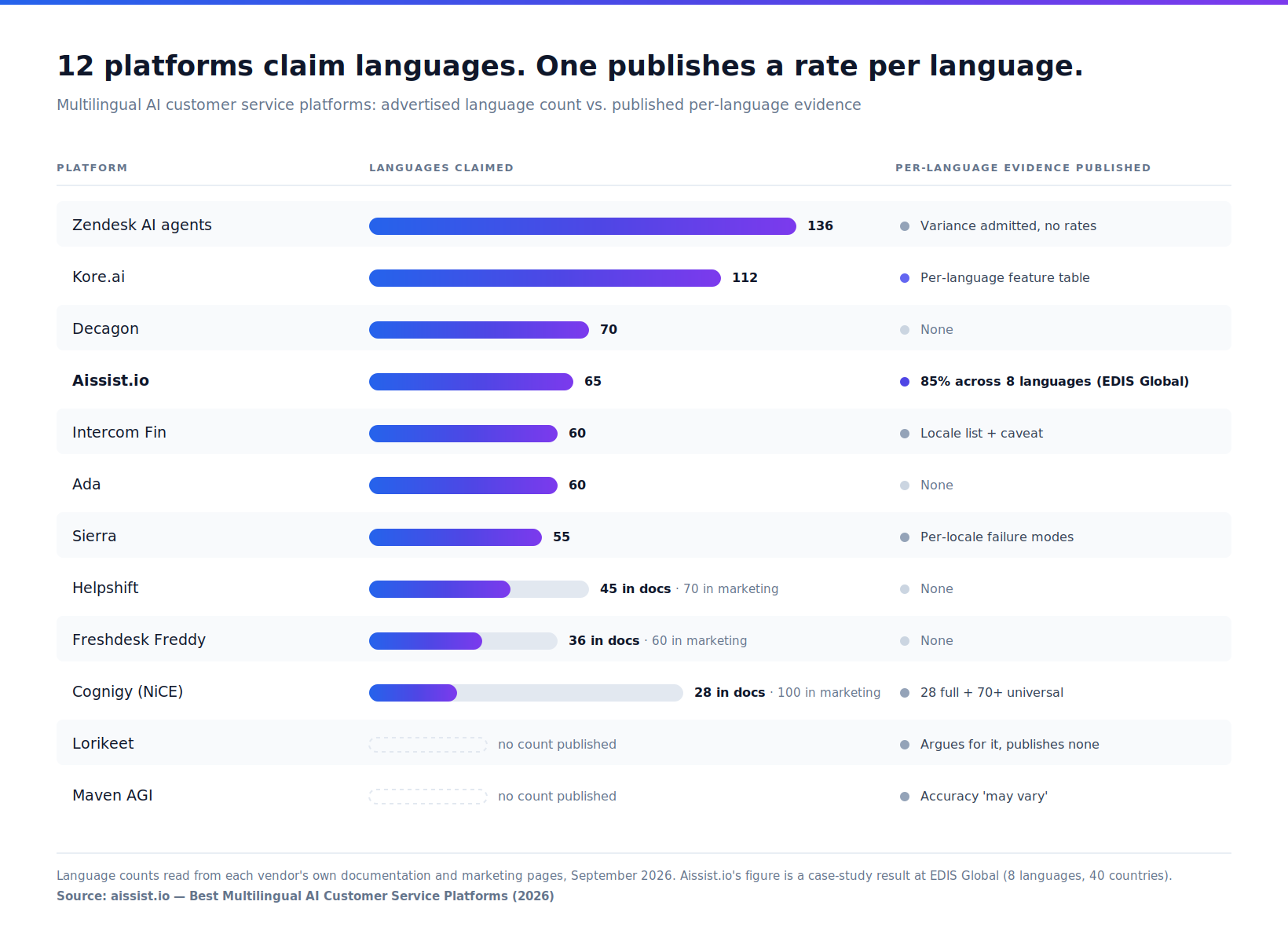
The best multilingual AI customer service platform is the one that publishes what it resolves per language, not how many languages it lists. Across eleven platforms checked on 9 September 2026, nine publish a language count and not one publishes resolution rates broken out by language. The single exception is a case study: Aissist.io reports 85% resolution across 8 languages at EDIS Global (customer story, read September 2026). Every other performance figure in this category is blended and language-unspecified.
All language counts, prices and ratings were read from vendor-owned pages and from G2 between 5 and 9 September 2026, and re-verified against the source page before publication. Aissist.io sells a product in this category and ranks first here — the methodology section states the criterion it wins on, and its entry carries the same twelve fields and a real cons list like every other platform.
TL;DR:
- Best for multilingual resolution you can actually price: Aissist.io — 65+ languages, $0.09 per interaction, capped at $0.60 per resolution
- Best for a published, checkable language list: Intercom Fin — 60+ languages, and it says in writing which ones are unpredictable
- Best if you already run Zendesk: Zendesk AI agents — 136 languages in docs, billed only on verified resolutions
- Best for teams that will run per-language QA: Lorikeet — the only vendor arguing publicly that language counts are meaningless
- Best for large multi-market consumer brands: Decagon — 70+ languages, 15-language deployment at Rituals
- Best for multilingual voice: Sierra — 55+ spoken languages, and a published account of what breaks per locale
- Best for EU-regulated contact centres: Cognigy (NiCE) — 28 fully supported languages plus 70+ via Universal Locale, ISO 27701 and BSI C5
- Best for seeing feature coverage per language before you sign: Kore.ai — publishes a per-language capability table covering 112 languages
- Best for gaming studios: Helpshift — 45 languages in docs, in-game and console channels
- Best for SMBs on a session budget: Freshdesk Freddy AI Agent — $0.49 per session, the cheapest headline unit here
- Best for enterprise security review: Maven AGI — ISO 42001 and PCI DSS 4.0 Level 1, from $25,000 per year
The buying trap in this category is simple: a language count measures what the model will attempt, not what it will resolve, and no vendor's marketing page distinguishes the two.
How we compared these multilingual AI customer service platforms
We scored eleven platforms from 0–5 on six criteria, for a maximum of 30, and listed every tool that scored 20/30 (65%) or higher. Pricing and language counts were read from vendor-owned pages, and G2 scores and review counts are independently reported figures read from G2, all between 5 and 9 September 2026. No figure here was carried over from another comparison article, and every performance figure below is labelled vendor-claimed, case-study or independently reported.
The six criteria:
- Published language coverage — how many languages, and is the actual list public or just the number?
- Per-language evidence — does the vendor publish anything about how it performs by language, or only a count?
- Architecture — native generation in the customer's language, or an English answer run through a translation layer?
- Comparable pricing — is a billing unit and a real number published, or is it quote-only?
- Channel and switching parity — does voice cover the same languages as chat, and can the agent switch language mid-conversation?
- Deploys onto your stack — does it sit on the helpdesk you already run, or does adopting it mean replacing it?
What disqualified a tool: no published multilingual documentation of any kind, or no single figure verifiable against a vendor-owned page this week. Two tools we scored fell below the floor and we name them so the omission is visible rather than silent. Crescendo.ai claims 50+ languages on its multilingual support page but publishes no architecture description, no price on its pricing page, and had 0 G2 ratings when we read it. Forethought claims 100+ languages on its Solve page and no price at all; its G2 score is 3.3/5 from 13 reviews (independently reported, G2, read September 2026).
We'll declare the bias up front — this is our blog, and Aissist.io ranks first. The reason is structural rather than loyalty: criterion 2 is the axis Aissist wins, because it is the only vendor here with a published resolution rate attached to a named language count. It is one criterion of six, and Aissist scores mid-pack on two others. Its cons list below is real and includes the thing our own site does not publish.
The 11 multilingual AI platforms at a glance
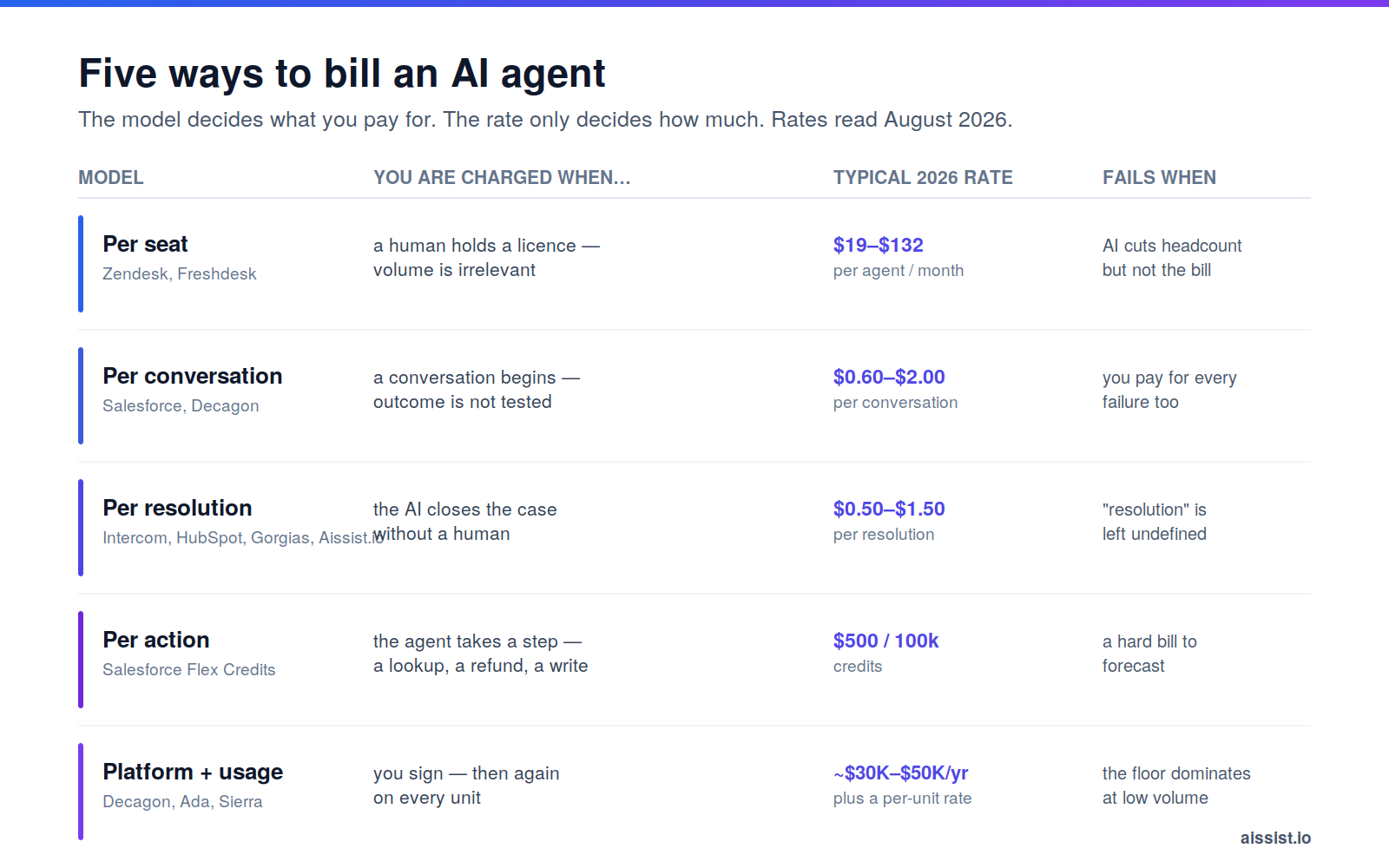
Billing units here are genuinely non-comparable — per resolution, per conversation, per session, per 15 minutes — so the table normalises the unit into its own column. A $0.49 session and a $0.99 resolution are not two prices for the same thing.
| Platform | Languages claimed | Per-language evidence published | Billing unit | Entry price (verified Sept 2026) | Deploys onto existing helpdesk | G2 (reviews) |
|---|---|---|---|---|---|---|
| Aissist.io | 65+ | One case study: 85% across 8 languages | Per interaction, capped per resolution | $0.09/interaction, capped $0.60/resolution | Yes | 4.8 (45) |
| Intercom Fin | 60+ (64 locales listed) | Language list + written unpredictability caveat; no rates | Per outcome | $0.99/outcome, $49.50/mo minimum | Yes | 4.5 (3,910) |
| Zendesk AI agents | 136 in docs; "up to 80" in marketing | Variance acknowledged in docs and FAQ; no rates | Per verified resolution | Not published; host plan $19–$115/agent/mo | No | 4.3 (7,064) |
| Lorikeet | No count published, by design | Argues the metric matters; publishes none of its own | Per successful resolution | From $1,500/mo, billed annually | Yes | No ratings yet |
| Decagon | 70+ | None; claims uniform quality across 15 languages | Per conversation or per resolution | Quote only | Yes | 4.7 (31) |
| Sierra | 55+ voice ("34 and counting" in blog) | Per-locale failure modes described; no rates | Per resolved outcome | Quote only | Yes | 4.5 (128) |
| Cognigy (NiCE) | 28 fully supported + 70+ Universal Locale | Tiered support published; tokenisation caveat | Not published | Quote only | Yes | 4.6 (13) |
| Kore.ai | 100+ (112 rows in feature table) | Per-language feature table (capability, not performance) | Per 15-minute session | Not published | Yes | 4.6 (505) |
| Helpshift | 70+ marketing; 45 in docs | None; 45 generic vs 34 custom-trained tiers in docs | Not published | Quote only | No | 4.3 (384) |
| Freshdesk Freddy | 60+ marketing; ~36 in docs | None | Per session, not per resolution | $0.49/session + $29–$119/agent/mo | No | 4.4 (3,770) |
| Maven AGI | No number published | Glossary concedes accuracy "may vary" | 12-month contract minimum, scaled to resolutions | From $25,000/12 months | Yes | 4.8 (28) |
Nine of eleven publish a language count. One of eleven publishes a resolution rate next to one.
Who each multilingual AI platform is built for
| Platform | Technology class | Best-fit team | Channels the agent handles | Voice language parity | Stated security & compliance |
|---|---|---|---|---|---|
| Aissist.io | Agentic, multi-agent | SMB and mid-market, multi-country | Web chat, in-app, WhatsApp, SMS, email, forms, social | Voice-message input; no voice-channel language list published | ISO 27001 certified, GDPR, "SOC 2 aligned", AES-256 |
| Intercom Fin | Agentic + retrieval, translation fallback | High-volume tech and SaaS | Voice, email, Messenger, Slack, WhatsApp, SMS, Instagram, Facebook | Voice on fin.ai; language parity not published | SOC 2 Type II, ISO 27001/27018/27701/42001, HIPAA, AIUC-1; US/EU/AU residency |
| Zendesk AI agents | Agentic, native tier + auto-translate tier | Teams already standardised on Zendesk | Messaging, email, voice, web, mobile, social | Multilingual voice in EAP | SOC 2 II, ISO 27001:2022, FedRAMP LI-SaaS; HIPAA and residency are paid add-ons |
| Lorikeet | Agentic, native reasoning per language | Fintech, healthtech, insurance | Phone, SMS, chat, email, WhatsApp | Voice priced separately; parity not published | ISO 27001, SOC 2, HIPAA |
| Decagon | Agentic | Large consumer brands across many markets | Chat, voice, email, outbound calling | Not published | SOC 2, ISO 27001, HIPAA, PCI, GDPR, EU AI Act |
| Sierra | Agentic, native-first voice | Enterprise voice-led CX | Chat, SMS, WhatsApp, email, voice, ChatGPT | Voice is the primary channel; 55+ spoken | SOC 2, HIPAA, GDPR, PCI DSS Level 1, FedRAMP High, ISO 27001, ISO 42001 |
| Cognigy (NiCE) | Hybrid: native NLU + machine translation | EU enterprise contact centres, high voice volume | Voice/IVR via Genesys, NiCE CXone, Amazon Connect, Five9, Avaya, Twilio | 100+ voice via machine translation, bounded by ASR/TTS | ISO 27001, ISO 27701, ISO 42001, SOC 2 II, TISAX, BSI C5 |
| Kore.ai | Hybrid: 5 native NLU libraries + translation | Enterprises needing on-prem or VPC deployment | Voice-heavy, contact centre and digital | Not published separately | SOC 2 II, PCI DSS, ISO 27001:2022, GDPR, CCPA, EU AI Act |
| Helpshift | Translation layer over agent messaging | Game studios, mobile-first | In-game, web widget, email, Discord, WhatsApp, social, SMS, console | Not applicable | SOC 2 II, ISO 27001, GDPR, COPPA, HIPAA; EU/US/APAC residency |
| Freshdesk Freddy | Generative retrieval; legacy bots manually translated | SMB and mid-market on Freshworks | Email, webchat, WhatsApp, social | No voice channel listed | SOC 2 Type 2, ISO 27001:2013, CCPA |
| Maven AGI | Agentic, single reasoning engine; English-pivot retrieval | Enterprise with heavy security review | Web chat, in-app, SMS, WhatsApp, social DMs, email, voice via Twilio/Genesys | "Any language" claimed; no list | SOC 2 II, ISO 27001:2022, ISO 42001:2023, PCI DSS 4.0 Level 1 |
1. Aissist.io — best for multilingual resolution you can actually price
Aissist.io is an agentic AI operational layer that resolves customer service and sales end to end in 65+ languages, deployed on top of the helpdesk a business already runs rather than replacing it.
Technology: Agentic, multi-agent — AgentMesh™ routes a case across specialist sub-agents rather than answering from a single retrieval pass. Deploys onto: Existing stack. Intercom, Zendesk, Gorgias, Front and HubSpot are live; Freshdesk, Kustomer and Salesforce are marked "coming soon" on the integrations page (read September 2026). Channels: Web chat, in-app chat, WhatsApp, SMS, email, online forms, social. Text, image, document, audio and video inputs. Actions: Executes. Aissist.io publishes "looking up orders, processing refunds, updating records" via API on its digital agent page. Languages: "AgentMesh supports 65+ languages. Language is auto-detected, conversations happen in the user's language by default, and the system can switch freely across languages when needed," per the AgentMesh product page (read September 2026). The list of 65 is not published. Per-language evidence: EDIS Global reports 85% resolution across 8 languages in 40 countries (case-study, EDIS Global story, read September 2026). This is the only figure in this comparison that pairs a resolution rate with a language count. Performance: 83% average resolution rate, up to 98% automation, 4.8/5 CSAT on automated support (vendor-claimed, aissist.io, read September 2026). Holafly reports 75% CX resolution and 95% sales resolution at 4.8/5 CSAT (case-study, Holafly story). G2: 4.8 (45 reviews), read September 2026 · Cost: "$0.09 per interaction, capped at $0.60 per resolution — you pay the lower of the two" (USD). $0.25 per resolution on email, forms and social; $0.60 cap on web chat, WhatsApp and SMS. A resolution counts only when the AI fully resolves without escalation; handovers are free. 1,000 tickets/month free tier. No seat licence (pricing, read September 2026).
"Aissist.io transformed our customer service operations. The AI handles complex technical queries with expertise that often surpasses our human agents, while seamlessly escalating when needed." — Gerhard Kleewein, CEO, EDIS Global (customer story)
Pros:
- The only vendor here publishing a resolution rate against a named language count
- Lowest verified per-resolution ceiling here at $0.60, against Intercom Fin's $0.99
- Runs on the helpdesk you already own, with no seat licence
Cons:
- One case study is not a per-language breakdown. Aissist.io publishes no rates across all 65 languages, does not publish the list of 65, and does not say which languages its deployment data is thickest in
- Its own site ships in exactly two languages: English and Spanish
- ISO 27001 certified and GDPR-compliant, but only "SOC 2 aligned" on the security page, with no published data residency regions
Our take: Choose Aissist.io if your volume is spread across many countries and you want a per-resolution ceiling you can forecast before signing. Skip it if procurement requires SOC 2 Type II attestation or contractual EU data residency, or if you need Salesforce or Kustomer live today. Compare units in the cost benchmark of AI service.
2. Intercom Fin — best for a published, checkable language list
Intercom Fin is an agentic AI support agent that resolves customer conversations across 60+ languages, sold standalone or inside Intercom, and priced per resolved outcome.
Technology: Agentic with retrieval, plus an explicit translation fallback — "when Fin can't find relevant support content in the customer's language, it will translate existing support content in your chosen fallback language" (Intercom multilingual docs, read September 2026). Deploys onto: Both. Native in Intercom, and Intercom states Fin "also works excellently with Salesforce, Hubspot, Freshdesk, and many other helpdesks" (fin.ai). Channels: Voice, email, Intercom Messenger, Slack, WhatsApp, SMS, Instagram, Facebook Messenger. Actions: Executes — updates accounts, processes payments and refunds, reads and writes to third-party systems. It cannot book or confirm meetings, per Intercom's Fin FAQ. Languages: 60+, with 64 named locale entries listed in the multilingual setup docs, including regional variants (read September 2026). Per-language evidence: No published rates, but the most useful written caveat in the category: "Fin's ability to respond with AI-generated answers in languages other than those listed above is currently unpredictable, regardless of what language your support content is in" (Fin FAQ, read September 2026). Intercom also lets customers filter resolution and deflection metrics by language in-product — it just doesn't publish the output. Performance: 76% average resolution rate across 12,000+ customers (vendor-claimed, fin.ai, read September 2026); 85% average resolution rate among top-10 performers across 110M+ conversations, data refreshed 20 May 2026 (vendor-claimed, Fin benchmarks). Hallucination rate stated as under 1%. G2: 4.5 (3,910 reviews), read September 2026 · Cost: $0.99 USD per outcome — resolutions, procedure handoffs and disqualifications each count. A resolution is triggered when "no further help is requested after Fin's last answer," an implicit standard. Standalone minimum 50 outcomes/month = $49.50/month floor, with no seat costs. Inside Intercom, seats run $29–$132/agent/month (fin.ai pricing, read September 2026).
"With one click we were able to reduce volumes for our bilingual and trilingual agents by more than 30%." — Ed Leurebourg, Global CX Operations Manager, Deliverect (Intercom blog)
Pros:
- Publishes the actual locale list, not just a number, so you can check your markets before buying
- Tells you in writing where the model becomes unreliable — rare in this category
- ISO 42001, HIPAA, AIUC-1, and US/EU/AU data residency
Cons:
- $0.99 is the highest published per-resolution rate here, and "procedure handoffs" and "disqualifications" bill at the same rate
- The implicit resolution standard — nobody asked again — bills conversations a stricter definition would not
- Translation fallback means some answers are English content rendered into the customer's language, not content authored for that market
Our take: Choose Fin if you want a language list you can audit and outcome pricing without a seat licence. Skip it if your volume makes $0.99 per outcome outrun your budget, or if most of your traffic sits outside its 64 locales.
3. Zendesk AI agents — best if you already run Zendesk
Zendesk AI agents are agentic resolution bots built into the Zendesk Suite, documented for 136 languages plus a further 28 via automatic translation, and billed only on resolutions a language model verifies.
Technology: Agentic on a native tier, with a separate 28-language machine-translation tier layered beneath it.
Deploys onto: Replaces. Zendesk AI agents are included in Suite and Support plans, so using them means running Zendesk as your helpdesk.
Channels: Messaging, email, voice, web, mobile, social. Multilingual voice is still in early access (Zendesk support docs, read September 2026).
Actions: Executes — agents "take action and resolve requests independently" across connected systems (Zendesk AI agents page).
Languages: 136 in the documented full-support list, per Zendesk's language docs (read September 2026) — but the multilingual marketing page says "up to 80 languages." Zendesk contradicts itself, and the docs are the defensible number.
Per-language evidence: No rates, but three separate written caveats — more than any other vendor here, including "we cannot guarantee that an AI agent will be fluent in" languages outside the documented list, and an admission on the marketing page itself that "multilingual performance varies across languages."
Performance: Hello Sugar 66% automation; TeamSystem 80% automation; Babbel 50%+ resolution; Action Property Management 80% automated resolution (all case-study, Zendesk AI agents page, read September 2026). No aggregate benchmark and no CSAT figure published.
G2: 4.3 (7,064 reviews), read September 2026 — the largest review base here · Cost: Per verified resolution, price not published on any Zendesk-owned page we could find; /service/ai/ai-agents/pricing/ returns 404. Zendesk defines three tiers and bills only the strictest: assisted escalations and contained resolutions "do not count against your resolution allowance." Host plans run $19 (Support Team) to $115 (Suite Professional) per agent/month billed annually, with Copilot a further $50/agent/month (Zendesk pricing, read September 2026).
Pros:
- The strictest billable resolution definition here — containment alone doesn't bill
- 136 documented languages, the broadest verifiable text coverage in this comparison
- FedRAMP LI-SaaS authorisation and GDPR Binding Corporate Rules
Cons:
- No published per-resolution price anywhere, so true cost is unknowable until you're in a sales cycle
- Marketing says 80 languages, docs say 136 — a buyer cannot tell which a contract honours
- HIPAA eligibility and data residency are both paid add-ons
Our take: Choose Zendesk AI agents if you already run Zendesk and want a resolution definition that won't quietly inflate your bill. Skip it if you're on another helpdesk, or if you need a price before a sales call. To layer an agent on top of Zendesk rather than inside it, see the Zendesk integration approach.
4. Lorikeet — best for teams that will run per-language QA
Lorikeet is an agentic AI support platform for complex, regulated workflows that deliberately publishes no language count, arguing that the number is not the thing worth measuring.
Technology: Agentic with native per-language reasoning. Lorikeet describes "one workflow, language as a presentation layer, the same guardrails and audit format across every language" and claims the agent "reasons, acts, and stays compliant in each language" rather than translating an English agent (Lorikeet multilingual guide, read September 2026). Deploys onto: Existing stack — Zendesk, Stripe and internal APIs. Channels: Phone, SMS, chat, email, WhatsApp. Actions: Executes, extensively — appointment rescheduling, medication delivery changes, reservation upgrades, subscription cancellations, refund processing, transaction lookups. Languages: No count published. "Most vendors will quote you a number of supported languages. That number tells you almost nothing." Auto language switching mid-conversation is documented. Per-language evidence: The most useful published thinking in the category, and none of its own data. Lorikeet writes that "major languages (Spanish, French, German, Portuguese, Mandarin) are well supported by frontier models" while "the risk concentrates in lower-resource languages," and that per-language resolution rate is "the metric vendors least like to share." It does not share its own. Performance: 99% accuracy, 97% faster resolution, first response under one minute against a ~30-minute baseline (vendor-claimed, lorikeetcx.ai, read September 2026). G2: No ratings — "rated 0.0 stars by 0 verified reviews," read September 2026 · Cost: The most transparent tiering here. Start is $1,500 USD/month billed annually for under 5,000 monthly tickets, at 0.95 credits per chat/email/SMS resolution and 1.50 for voice under three minutes; Scale is $4,000/month for 5,000–20,000 tickets at 0.80 and 1.20; Enterprise is custom (Lorikeet pricing, read September 2026). Note the rates are quoted in credits and the USD value of a credit is not published, so the effective per-resolution cost is not calculable from public information. Charge trigger: "We only charge for successfully resolved tickets."
Pros:
- The only vendor publishing a charge trigger you can hold it to — unresolved tickets are refundable by policy
- Publishes tiered pricing with volume bands, which eight of eleven vendors here do not
- The clearest public account of why language counts mislead
Cons:
- Argues loudly that per-language resolution rates are the metric that matters, then publishes none of its own
- Prices in credits without publishing a credit's dollar value, so the headline rate is not actually a price
- Zero G2 reviews as of September 2026, so there is no third-party signal at all
Our take: Choose Lorikeet if you run fintech, healthtech or insurance workflows and intend to build per-language QA yourself. Skip it if you need a verifiable unit cost, or if under 5,000 tickets a month makes an $18,000 annual floor hard to justify.
5. Decagon — best for large multi-market consumer brands
Decagon is an agentic AI customer service platform supporting 70+ languages with automatic detection and mid-conversation switching, deployed over existing ticketing platforms and CRMs.
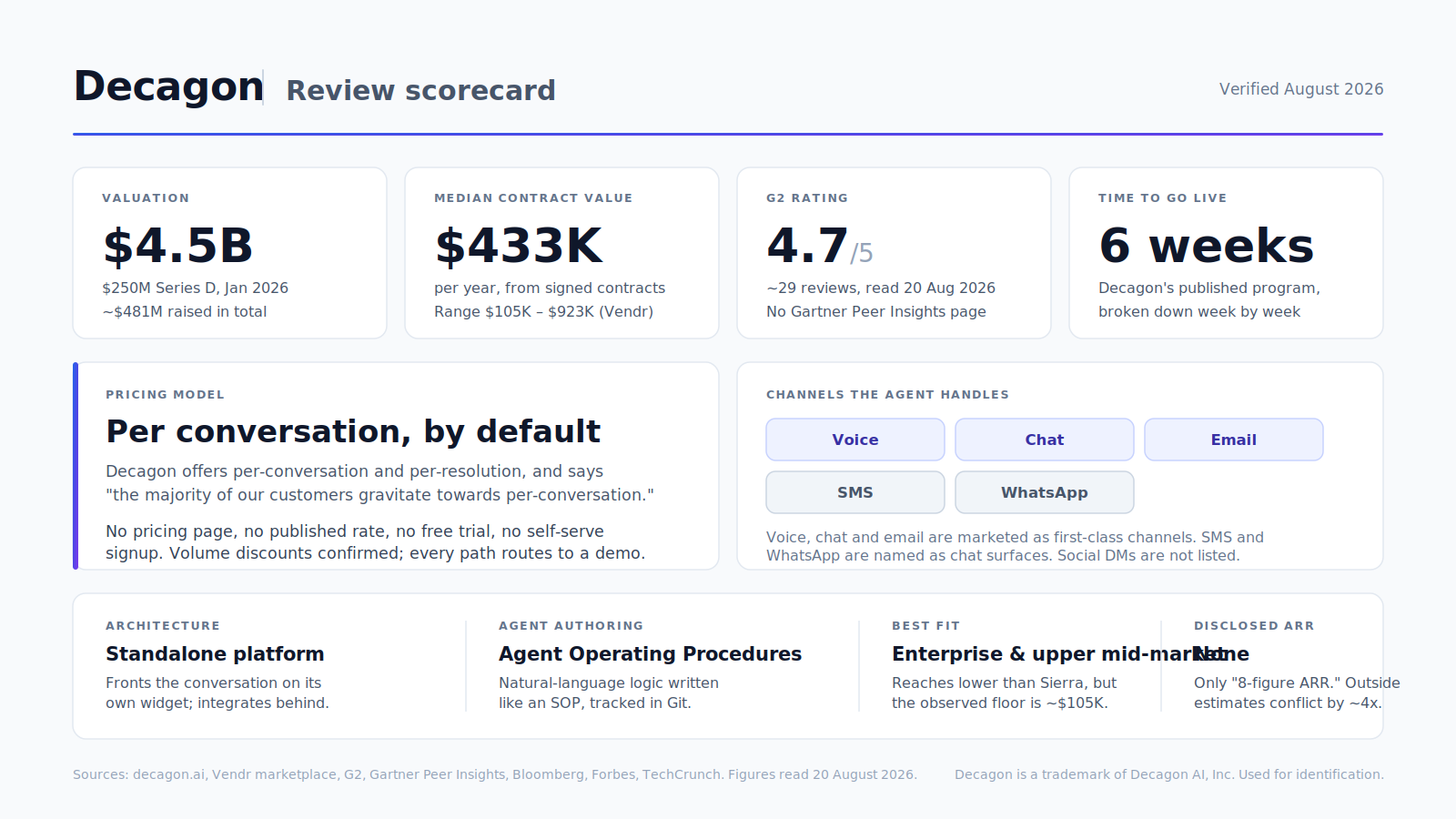
Technology: Agentic. Native versus translation architecture is not stated on any Decagon page we read. Deploys onto: Existing stack — integrates with ticketing platforms and CRMs rather than replacing them. Channels: Chat, voice and email, plus outbound calling. Actions: Executes, with guardrails documented around identity verification and refunds (Decagon platform overview, read September 2026). Languages: "Support customers in 70+ languages with automatic detection and language switching," per Decagon's voice page (read September 2026). Notably, the claim appears only on the voice page — the platform overview carries no language claim at all. Per-language evidence: None, and Decagon publishes the opposite claim. Its Rituals case study states the brand "supports 15 languages across 19 countries" and that Decagon handled "language, tone, and nuance, without a single compromise on quality" (Rituals case study, read September 2026). No per-language rates back that up. Performance: Chime 70% chat and voice resolution; Duolingo 80% deflection; Valon 50%+ voice deflection; Oura 3x CSAT increase; Rippling 32% deflection increase (all case-study, decagon.ai, read September 2026). G2: 4.7 (31 reviews), read September 2026 · Cost: Quote only — decagon.ai/pricing returns 404. Decagon publishes two models without figures: per-conversation, "a fixed rate for every incoming conversation," and per-resolution, "a higher fixed rate for each fully resolved conversation, with no charge for escalations." It adds that "the majority of our customers gravitate towards per-conversation pricing" (Decagon pricing blog).
"During peak holiday and Black Friday season, we can see up to 9,000 cases a day. With our agent, Ray, handling a significant portion of that volume, we had zero customer relations backlog for the first time ever." — Rommy Verschelling, Head of Customer Relations, Rituals, a 15-language deployment across 19 countries (Decagon case study)
Pros:
- The strongest named-logo evidence here — Chime, Duolingo, Rituals, Oura, ClassPass, Rippling, all with published figures
- Publishes both billing models and explains the trade-off
- SOC 2, ISO 27001, HIPAA, PCI, GDPR and EU AI Act coverage on one page
Cons:
- Steers customers toward per-conversation billing, which charges on every inbound whether or not anything was resolved
- Claims 15-language delivery "without a single compromise on quality" with no per-language data behind it
- The 70+ language claim appears only on the voice page, and the pricing URL 404s
Our take: Choose Decagon if you're a large consumer brand with markets in the dozens and want peers you can call as references. Skip it if you need outcome-only billing, or if an unevidenced quality claim is something your team would have to defend internally.
6. Sierra — best for multilingual voice
Sierra is an agentic AI platform for customer-facing voice and chat agents, supporting over 55 spoken languages with native-level fluency and mid-conversation switching, billed on resolved outcomes.
Technology: Agentic, native-first for voice. Sierra states its agents "don't just translate; they listen." Deploys onto: Existing stack, via an Agent SDK — "build once and deploy across any channel." Channels: Chat, SMS, WhatsApp, email, voice and ChatGPT. Actions: Executes — "your agent can go beyond answering questions and take action to support customer requests, like updating a subscription or submitting a warranty" (Sierra platform page, read September 2026). Languages: "Speak in over 55 languages" on the voice product page, against "34 and counting" in its engineering blog. Cite the range, not one end of it. Per-language evidence: No rates, but the most technically specific account of per-language variance published by any vendor here — Sierra names transcription, synthesis and formality as varying by locale, and states that "before any multilingual agent goes live, native speakers test, refine, and vet interactions" (Sierra engineering blog, read September 2026). Performance: Not published. No resolution rate, deflection rate or CSAT figure appears on Sierra's homepage or product pages; customer testimonials are qualitative. G2: 4.5 (128 reviews), read September 2026 · Cost: Outcome-based, quote only — sierra.ai/pricing returns 404. Sierra states: "If the conversation is unresolved, in most cases, there's no charge," with outcomes including resolved conversations, ecommerce purchases and memberships saved (Sierra pricing blog, read September 2026).
Pros:
- Names specific per-language failure modes — transcription in Portuguese, formality in Hindi — rather than asserting uniform quality
- States that native speakers vet every multilingual agent before launch, a process claim no competitor makes
- The deepest compliance stack here: FedRAMP High, PCI DSS Level 1, ISO 27001 and ISO 42001
Cons:
- Publishes no resolution rate, deflection rate or CSAT figure, so performance is unverifiable from public sources
- Its own language count contradicts itself, 55+ on the product page against 34 in the blog
- Outcome-based pricing with no published rate means two customers may pay materially different amounts for the same result
Our take: Choose Sierra if voice is your primary multilingual channel and you want a vendor treating per-locale quality as an engineering problem. Skip it if you need to compare cost, or if a public resolution benchmark is part of your evaluation.
7. Cognigy (NiCE) — best for EU-regulated contact centres
Cognigy, now part of NiCE, is an enterprise conversational AI platform for voice-led contact centres, supporting 28 fully localised languages plus 70+ more through a Universal Locale, deployed over Genesys, NiCE CXone, Amazon Connect, Five9 and Avaya.
Technology: Hybrid — native NLU for the core set, machine translation beyond it. Cognigy explicitly tells buyers to choose per language: "You can decide to use human-crafted or machine-translated responses based on several factors, including the size of the audience who needs content in a specific language, the importance of particular replies... or regulatory requirements" (Cognigy multilingual showcase, read September 2026). Deploys onto: Existing stack — layers over incumbent CCaaS rather than replacing it. Channels: Voice and IVR primarily, through contact-centre integrations including Twilio and RingCentral. Actions: Inbound and outbound call handling, barge-in and DTMF, answering-machine detection, SIP-header routing, agent handoff. Transactional depth beyond call control is not documented on its primary pages. Languages: "Over 100 languages," split into 28 fully supported and 70+ via Universal Locale (Cognigy NLU docs, read September 2026). Voice Gateway claims 100+ languages and 1,000+ synthetic voices. Per-language evidence: No rates, but a published technical limitation by language family: "languages like Chinese, Japanese, and Thai don't use spaces, which can affect the accuracy of Keyphrase detection." The 28/70+ tiering is itself a structural admission that coverage is uneven. Performance: E.ON reports a 70% automation rate across 2M+ annual conversations with 30+ live AI agents (case-study, Cognigy E.ON study, read September 2026). Lufthansa Group handles 16M+ conversations a year, peaking at 375,000 AI conversations daily (case-study, Cognigy Lufthansa study). Voice Gateway claims 99.7% successful intent recognition (vendor-claimed). G2: 4.6 (13 reviews), read September 2026 — an implausibly small base for a platform of this footprint, likely a split listing following the NiCE acquisition · Cost: Quote only. Both cognigy.com/pricing and /pricing-cognigy-ai return 404.
"We believe Cognigy.AI to be the most comprehensive, user-friendly Conversational AI platform on the market today, which empowers our business users and developers to build advanced, multi-lingual AI Agents at scale." — Nick Allgaier, Product Manager "Digital Assistants," Lufthansa Group Hub Airlines (Cognigy case study)
Pros:
- The only vendor here holding TISAX and BSI C5 alongside ISO 27001, 27701 and 42001 — the strongest EU regulatory posture in the comparison
- Publishes its language tiering openly, so you can see which 28 get native treatment before committing
- Voice at genuine scale, evidenced by a named airline group running 375,000 AI conversations a day
Cons:
- No published pricing of any kind, and two 404ing pricing URLs
- Voice coverage is bounded by the intersection of ASR, TTS and NLU, which Cognigy does not publish as one list — the "100+" is not a coverage guarantee
- Despite a German headquarters and EU-specific certifications, we found no page stating EU data residency as an offering
Our take: Choose Cognigy if you run a European contact centre with heavy voice volume and a compliance function that reads certifications line by line. Skip it if you need published pricing, or if your volume is text-first and mid-market.
8. Kore.ai — best for seeing feature coverage per language before you sign
Kore.ai is an enterprise conversational AI platform supporting 100+ languages with a published per-language feature matrix, deployable in public cloud, private VPC, hybrid or on-premises.
Technology: Hybrid. Native NLU assets exist for a small core: "The default Synonym library is available only for English, French, Spanish, German, and Chinese languages" (Kore.ai docs, read September 2026). The remaining 98 lean on translation. Deploys onto: Both — the most flexible deployment model here, including on-prem and dedicated VPC. Channels: Voice-heavy, across contact-centre and digital channels. Actions: Agentic build-and-govern platform. Specific transactional examples are not documented on its primary pages. Languages: "100 plus" per the platform docs; the Agent AI feature table lists 112 rows and states no total (read September 2026). Per-language evidence: The single most useful artifact in this comparison, and it isn't a resolution rate — it's a feature-tier table. Kore.ai's supported languages doc (read September 2026) gives English eight capabilities and gives Afrikaans, Albanian and Zulu one, across 112 listed languages. Kore.ai never says in prose that capability degrades by language; it publishes a table that shows it. Performance: Not published. No vendor resolution or deflection percentage appears on Kore.ai's primary pages. G2: 4.6 (505 reviews), read September 2026 — the second-largest review base here · Capterra: 4.4 (17 reviews) · Cost: Billed per 15-minute session, an outlier unit: "A 31-minute conversation = 3 sessions (0-15 min, 16-30 min, 31-end)" (Kore.ai usage plans, read September 2026). Three tiers — Essential, Advanced, Enterprise — with no published dollar figures; kore.ai/pricing returns 404.
Pros:
- Publishes a per-language capability table, letting you check exact markets against exact features before signing
- 505 G2 reviews at 4.6, the strongest combination of score and sample size here
- On-premises and dedicated-VPC deployment for organisations that cannot use multi-tenant cloud
Cons:
- Billing per 15-minute session penalises exactly the long, complex conversations a good agent should handle
- Native NLU assets exist for five languages out of 112 listed, so most coverage is translation-mediated
- No published price and no published resolution rate
Our take: Choose Kore.ai if you need on-prem deployment and want to verify feature coverage in your specific languages first. Skip it if your conversations run long, since the 15-minute unit works against you.
9. Helpshift — best for gaming studios
Helpshift is a player-support platform for game studios with an AI layer, Care AI, that resolves in-game and cross-channel issues, with a documented 45-language translation service.
Technology: Translation layer, stated plainly: "Language AI allows consumers to engage in their native language, even if agents don't speak the language" (Helpshift support docs, read September 2026). The service covers conversations, FAQ translation and text templates. Deploys onto: Replaces. Helpshift is the helpdesk; Care AI layers onto Helpshift. Channels: In-game messaging, web widget, email, Discord, WhatsApp, social, SMS, push, and console via QR code — the only vendor here with console support. Actions: Executes — resolves tickets, adds private notes, updates custom issue fields, checks entitlement data and grants items directly, validates transactions and processes refunds (Helpshift Care AI page). Languages: "Over 70 languages" in marketing, against 45 in the documented list for generic Language AI engines and only 34 for custom-trained engines (Helpshift language docs, read September 2026). Per-language evidence: None published. The 45-versus-34 tiering implies uneven capability, but Helpshift never states it as a quality position. Performance: 70%+ automation rates (vendor-claimed, helpshift.com, read September 2026). Named studios: KRAFTON $10.6M total savings at 75% automation; Trailmix 93% automation at 4.3 CSAT; KIXEYE 90% deflection; SYBO 77% automation at 4.3/5 CSAT; Rovio 91% deflection across 23 titles (all case-study, Helpshift LLM info page). G2: 4.3 (384 reviews), read September 2026 · Capterra: 3.9 (29 reviews) · Cost: Quote only. Pricing is "solution-based and modular, not one-size-fits-all plans," customised on four inputs: interaction volume, solutions activated, capabilities used, and geography and language coverage (Helpshift pricing, read September 2026). Helpshift is the only vendor here that prices language coverage as an explicit line item.
Pros:
- The deepest published case-study evidence in gaming, with named studios and dollar figures
- Console and in-game channels no general-purpose platform offers
- EU, US and APAC data residency plus COPPA compliance, which matters for a player base including minors
Cons:
- Marketing says 70+ languages; the docs list 45, and 34 for custom-trained engines, with the gap unexplained
- The AI is explicitly a translation layer, not native in-language reasoning
- Language coverage is a pricing input, so broadening your markets raises your bill directly
Our take: Choose Helpshift if you run a game studio needing in-game and console support alongside the AI. Skip it if you are outside gaming, or if you want native in-language reasoning rather than real-time translation.
10. Freshdesk Freddy AI Agent — best for SMBs on a session budget
Freddy AI Agent is Freshworks' generative AI support agent inside Freshdesk Omni, billed per session rather than per resolution, and marketed for 60+ languages.
Technology: Generative retrieval. Legacy Freddy self-service bots are explicitly manually translated — the setup requires you to "download the main language's bot script" and "replace the main-language text with the required translations" (Freshdesk docs, read September 2026). Deploys onto: Replaces. Freddy AI Agent is an add-on to Freshdesk Omni plans and requires a Freshworks seat plan. Channels: Email, webchat, WhatsApp and social. No voice channel is listed on the Freddy AI Agent page. Actions: Executes — processes refunds, updates orders, verifies details, processes exchanges, schedules pickups, checks inventory, updates bookings, upgrades subscriptions (Freddy AI Agent page, read September 2026). Languages: "60+" in marketing, against approximately 36 named languages in the Freddy AI Agent language table in Freshworks' own documentation. Freshworks does not reconcile the two. Per-language evidence: None. Freshworks publishes no per-language rates, no quality caveat, and no statement that performance varies by language. The manual per-language script translation workflow implies quality is the customer's responsibility. Performance: Not published. No resolution rate, deflection rate or CSAT figure appears on the Freddy AI Agent product page or the Freshdesk Omni pricing page. G2: 4.4 (3,770 reviews), read September 2026 · Capterra: 4.5 (3,471 reviews) · Cost: $49 USD per 100 AI Agent sessions, so $0.49 per session — the cheapest headline unit here, and the only one that isn't outcome-based. A chat session is "all interactions between the end user and the AI Agent within 24 hours"; an email session spans 72 hours from the customer's first email. You are billed whether or not anything was resolved. 500 sessions are included free for new customers. Host plans run $29 (Growth), $79 (Pro) and $119 (Enterprise) per agent/month billed annually (Freshdesk Omni pricing, read September 2026).
Pros:
- $0.49 per session is the lowest published unit price here, and 500 free sessions let you test before spending
- 3,770 G2 reviews at 4.4 plus 3,471 Capterra reviews at 4.5 — one of the two deepest third-party bases here
- A broad action inventory for the price, including refunds, exchanges and inventory checks
Cons:
- Bills per session, not per resolution — the AI can fail entirely and you still pay
- 60+ languages in marketing against ~36 in documentation, with no reconciliation and no per-language evidence
- The weakest published security posture here: SOC 2 Type 2 and CCPA, ISO 27001:2013 rather than the current 2022 revision, and no verifiable HIPAA, PCI or residency claim
Our take: Choose Freddy AI Agent if you already run Freshworks, your volume is modest and a low session price beats outcome certainty. Skip it if you need voice, or if paying for unresolved sessions is something your finance team would notice.
11. Maven AGI — best for enterprise security review
Maven AGI is an agentic AI customer service platform with a single reasoning engine across chat, email and voice, deployable over existing helpdesks including Zendesk, Salesforce and Intercom.
Technology: Agentic, single reasoning engine across channels rather than separate builds per channel. Its published description of multilingual architecture is English-pivot: "AI agents can retrieve information from an English knowledge base and generate responses in the customer's language" (Maven AGI glossary, read September 2026). Deploys onto: Existing stack — 30+ integrations, plus copilot mode inside existing helpdesks. Channels: Web chat, in-app messaging, SMS, WhatsApp, social DMs, email; voice via Twilio, Vonage, Cisco, Zendesk Talk and Genesys. Actions: Executes — its voice demo shows appointment rescheduling handled end to end. Languages: No number published anywhere on mavenagi.com. Maven says "any language" and "handles... multiple languages." It is worth noting that Maven's own comparison article (published 11 August 2026) assigns precise language counts to fifteen competitors while giving none for itself. Per-language evidence: No rates, but a written concession in its glossary: "Accuracy is highest for widely spoken languages and may vary for less common languages or highly technical domain-specific terminology." This appears on an educational page describing the category, not a Maven spec sheet — read it as Maven's published position, not a disclosed product limitation. Performance: Up to 93% of customer queries answered autonomously; Papaya Pay 90% of inquiries answered autonomously; K1x 80% of tickets resolved; Mastermind 93% of live-chat questions answered (vendor-claimed, from Maven's own competitive comparison, read September 2026 — a vendor-authored comparison page, so weigh accordingly). G2: 4.8 (28 reviews), read September 2026 — the highest score here on the smallest meaningful base · Cost: From $25,000 USD per 12 months, a 12-month contract, on the AWS Marketplace listing (read September 2026). This is a contract minimum rather than a published per-unit rate; pricing scales with volume of resolutions, defined as "a customer query the AI agent handles end to end without human intervention," covering all channels under one model. Additional AWS infrastructure costs may apply. mavenagi.com/pricing redirects to a demo form.
Pros:
- ISO 42001:2023 and PCI DSS 4.0 Level 1 alongside SOC 2 Type II and ISO 27001:2022
- A single reasoning engine across channels, so a language works the same way in voice as in chat by design
- An actual published price floor via AWS Marketplace, which most quote-only vendors do not offer
Cons:
- Publishes no language count for its own product while assigning precise counts to fifteen competitors in its own comparison content
- $25,000 a year is the highest verified entry point here, and it is a floor rather than a rate
- Its HIPAA claim appears on a resources page but not its main trust page; GDPR and residency are not published
Our take: Choose Maven AGI if you have an enterprise security review to satisfy and want certifications that survive it. Skip it if your volume can't absorb a $25,000 annual floor, or if you need to know how many languages you're actually buying.
What multilingual AI customer service actually costs
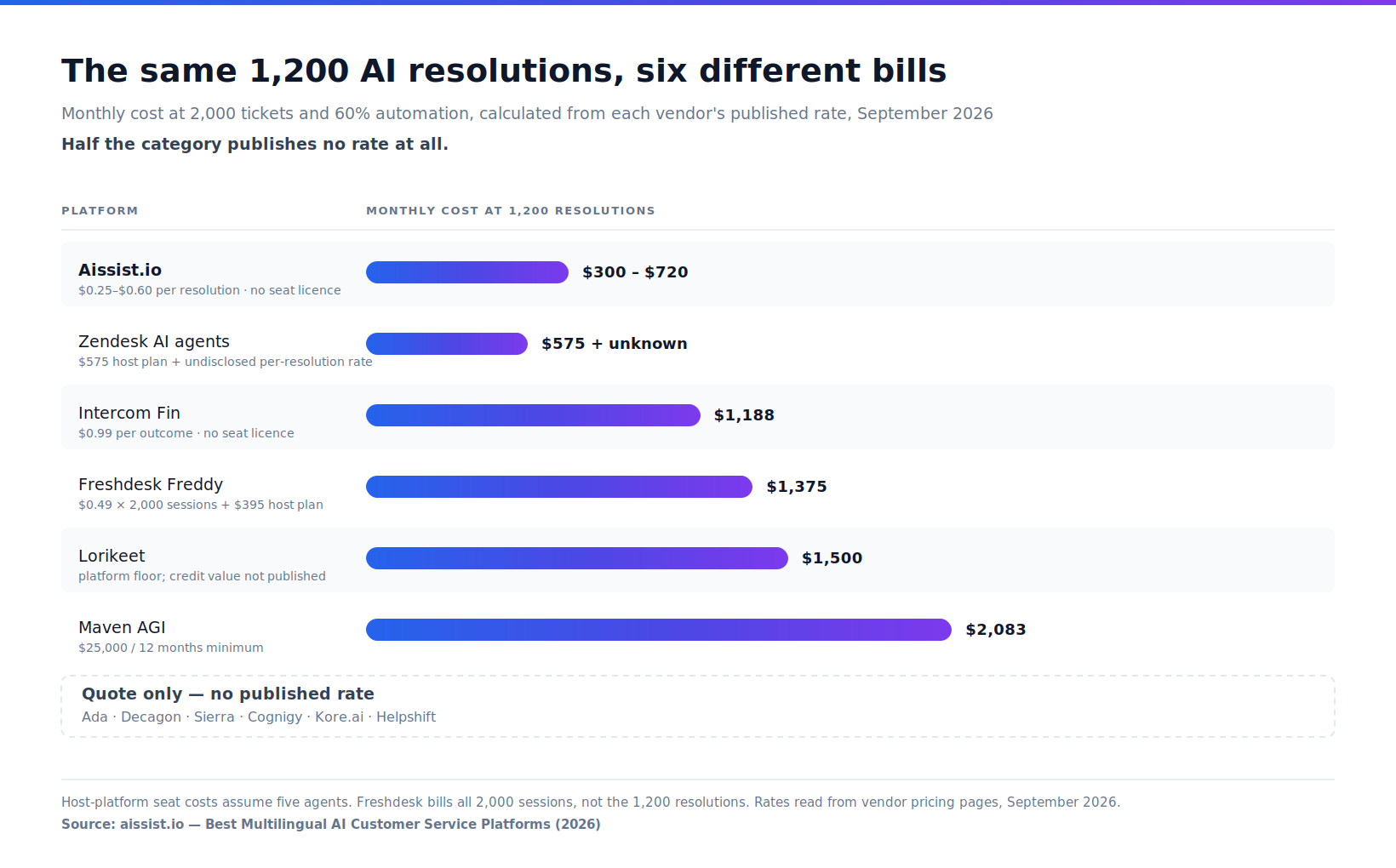
At 2,000 tickets a month with 60% automation — 1,200 AI resolutions, spread across six languages — the published monthly cost ranges from $300 to $2,083, a nearly 7× spread, and four of eleven vendors will not tell you which end they sit at. Every figure below is calculated from the vendor's own published rate, read September 2026, and excludes the human agents you still employ.
| Platform | Billing unit | Rate | AI cost at 1,200 resolutions/mo | Required host plan (5 agents) | Monthly total |
|---|---|---|---|---|---|
| Aissist.io | Per interaction, capped per resolution | $0.25 (email/social) – $0.60 (chat/WhatsApp) cap | $300 – $720 | $0 — no seat licence | $300 – $720 |
| Freshdesk Freddy | Per session (2,000 sessions, not 1,200) | $0.49/session | $980 | $395 (Pro, $79 × 5) | $1,375 |
| Intercom Fin | Per outcome | $0.99/outcome | $1,188 | $0 standalone | $1,188 |
| Lorikeet | Per resolution + platform fee | 0.95 credits/resolution (USD value not published) | Not calculable | Included in tier | $1,500 floor |
| Maven AGI | Per resolution | $25,000/12 months minimum | Contract floor | Plus AWS infrastructure | ~$2,083 |
| Zendesk AI agents | Per verified resolution | Not published | Unknown | $575 (Suite Professional, $115 × 5) | $575 + unknown |
| Decagon, Sierra, Cognigy, Kore.ai, Helpshift | Various | Quote only | Unknown | Varies | Quote only |
Three things this table makes visible that a price list does not.
The unit changes the bill more than the rate does. Freshdesk's $0.49 looks like half of Intercom's $0.99 until you notice Freshworks bills all 2,000 sessions and Intercom bills only the 1,200 outcomes. The cheaper rate produces the more expensive month.
Host-platform tiers are real money. A Zendesk AI agent needs Zendesk underneath it — $575 a month for five agents on Suite Professional before a single resolution is billed. Freshdesk Freddy needs a Freshworks seat plan. Aissist.io, Intercom Fin standalone and Lorikeet do not charge for seats.
Language coverage is sometimes itself a line item. Helpshift lists "geography and language coverage" as one of four inputs to its quote, which means adding markets raises your bill directly. No other vendor here prices languages separately, though several price voice separately, and voice is where language coverage thins out fastest.
Hidden costs worth budgeting for: Zendesk charges extra for HIPAA eligibility and for data residency; Kore.ai's 15-minute session unit triples the cost of a 31-minute conversation; Maven AGI notes that AWS infrastructure costs sit on top of its $25,000 floor. For a wider unit-cost comparison across ten vendors, see Aissist's cost benchmark of AI service.
How to choose a multilingual AI customer service platform
Pick on the constraint that actually binds you, not on the language count. Seven rules:
If your volume sits in Spanish, French, German, Portuguese or Mandarin, choose almost any vendor here, because frontier models handle those well — Lorikeet's own guidance states that "major languages... are well supported by frontier models" and that "the risk concentrates in lower-resource languages." Optimise for price and billing unit instead.
If your volume includes a low-resource language — Vietnamese, Thai, Tagalog, Swahili — choose a vendor that publishes per-language detail and insist on a paid pilot in that language, because a blended resolution rate will hide the gap. Kore.ai's feature table and Intercom's locale list are the two artifacts that let you check before you buy.
If you run Zendesk and cannot leave it, choose Zendesk AI agents, because its resolution definition is the strictest here — assisted escalations and merely-contained conversations don't bill. Just accept that you'll learn the price in a sales call.
If you need to forecast cost before signing, choose Aissist.io, Intercom Fin, Lorikeet or Freshdesk Freddy, because they are the only four with a published rate. The other seven are quote-only, and a quote-only vendor cannot be compared on cost at all.
If voice is your primary multilingual channel, choose Sierra or Cognigy, because voice language coverage is bounded by speech recognition and synthesis, not just the language model. Freshdesk Freddy has no voice channel at all.
If you must not replace your helpdesk, choose Aissist.io, Lorikeet, Decagon, Sierra, Cognigy, Kore.ai or Maven AGI, because Zendesk, Freshdesk and Helpshift all require you to run their platform. The rip-and-replace question is usually settled before the language question.
If procurement requires SOC 2 Type II attestation or contractual EU data residency, choose Intercom Fin, Sierra, Maven AGI or Cognigy, because those are the strongest published postures here. Aissist.io is ISO 27001 certified and GDPR-compliant but describes itself as "SOC 2 aligned" rather than certified, and publishes no residency regions — if that is a hard gate, it is a hard gate.
What is multilingual AI customer service?
Multilingual AI customer service is the use of an AI agent to detect a customer's language, answer in it, and resolve the request end to end without a human translator or a language-specific support team. It differs from translated support, where a human agent's reply is machine-translated after the fact, and from language-based routing, where a ticket is sent to a human who speaks the language.
Three architectures sit behind the marketing, and they produce materially different results:
| Architecture | How it works | Where it breaks |
|---|---|---|
| Native generation and ingestion | Knowledge is read and the answer is generated in the customer's language | Fewest failure points; hardest to build, so language lists are shorter |
| English-pivot retrieval | Knowledge is retrieved in English, the answer is generated in the target language | Domain terms, product names and regulatory phrasing drift in translation |
| Translation layer | An English answer is machine-translated on the way out | Tone, formality and brand terms degrade; the agent cannot reason in-language |
Maven AGI describes the second in its own glossary. Helpshift documents the third explicitly, and Intercom uses it as a fallback when in-language content is missing.
Why language count is a vanity metric
A language count tells you which languages the model will attempt, not which ones it resolves. The distinction has a number attached: Lorikeet, writing about the category rather than a competitor, states that "an agent at 90% resolution in English can quietly sit at 60% in Portuguese, and an English-only QA process will never see it." Sierra's engineering team puts the same point in technical terms — "transcription that performs accurately in Japanese might miss nuance in Portuguese" — and adds that "the right combination of models... varies by locale."
Kore.ai supplies the clearest proof without ever making the argument. Its published feature table gives English eight capabilities — dialogs, localisation, greeting messages, custom summary, summarisation, answers, playbooks and coaching — and gives Afrikaans, Albanian and Zulu one. All 112 are counted toward the "100+ languages" headline.
Cognigy's structure says the same thing differently: 28 languages fully supported, 70+ more through a Universal Locale. Helpshift's docs list 45 languages for generic engines and 34 for custom-trained ones. Zendesk states the risk outright: "we cannot guarantee that an AI agent will be fluent in them."
What to measure instead
Ask every vendor on your shortlist for four numbers, in writing, per language you actually serve:
- Resolution rate by language — not blended, and not deflection. Nobody in this comparison publishes it, but every vendor can produce it from their own analytics; Intercom confirms its product filters resolution and deflection metrics by language.
- CSAT by language — a model that resolves in Portuguese at 60% and annoys the other 40% costs more than it saves.
- Escalation rate by language, which is the honest inverse of resolution and harder to dress up.
- Who tested it — Sierra says native speakers vet every multilingual agent before launch, and Zendesk advises testing "in the exact languages, channels, and tasks you plan to support" using "native speakers or reviewers from the target community." Ask which of your languages a native speaker has actually reviewed.
Then run a paid pilot in your second-largest language, not your largest. English will look fine. The second language is where you find out what you bought.
The honest caveat about our own numbers
Aissist.io does not publish per-language resolution rates either. It publishes one case study — EDIS Global, 85% resolution across 8 languages in 40 countries — plus deployments at Holafly and WELTRADE serving multilingual user bases with no language breakdown. Its 65+ figure is a count like everyone else's, and the list of 65 is not public. Nor does Aissist.io publish which of the 65 its data is thickest in — the named deployments a buyer can check do not name their languages either, EDIS Global's eight included. A buyer whose volume sits in a low-resource language should ask for a paid pilot rather than take the count on trust. Aissist's own benchmark pages carry the same disclosure: "This is a synthesis, not a study... there is no N to quote."
Publishing the gap is not a strategy. It is the state of the category, and pretending otherwise is how a buyer ends up with sixty languages and one market.
Frequently asked questions
What is the best multilingual AI customer service platform in 2026?
Aissist.io leads this comparison because it is the only vendor publishing a resolution rate attached to a named language count — 85% across 8 languages at EDIS Global — at $0.09 per interaction, capped at $0.60 per resolution. Intercom Fin is the strongest alternative with a published locale list.
How many languages do AI customer service agents actually support well?
Frontier models handle roughly five to ten high-resource languages reliably — English, Spanish, French, German, Portuguese, Italian, Mandarin, Japanese — regardless of the count a vendor advertises. Kore.ai's own published feature table gives English eight capabilities and Afrikaans, Albanian and Zulu one, across 112 listed languages.
Which multilingual AI customer service platform is cheapest?
Aissist.io has the lowest published rate at $0.09 per interaction, capped at $0.60 per resolution, or $0.25 on email, forms and social. Freshdesk Freddy's $0.49 per session is a lower headline number but bills every session, resolved or not, so it costs more at the same volume.
Do AI agents really resolve tickets in every language they claim to support?
No vendor publishes evidence that they do. Intercom states in its own documentation that Fin's answers in unlisted languages are "currently unpredictable," and Zendesk's marketing page concedes that "multilingual performance varies across languages." Ask for resolution rate by language before signing.
Can an AI agent switch language mid-conversation?
Yes — Aissist.io, Lorikeet, Decagon, Sierra and Maven AGI all document mid-conversation language switching without losing context or restarting the ticket. Aissist.io auto-detects language by default and "can switch freely across languages when needed," per its AgentMesh product page.
What is the difference between multilingual AI and translated customer support?
Multilingual AI reasons and resolves in the customer's language; translated support generates an English answer and machine-translates it on the way out. The second approach loses brand terms, formality and domain vocabulary, and the agent cannot reason about in-language content it never read.
Does multilingual AI customer service work for voice as well as chat?
Not equally. Voice coverage is bounded by speech recognition and synthesis quality, not just the language model — Zendesk's multilingual voice is in early access, and Freshdesk Freddy has no voice channel at all. Sierra and Cognigy are the strongest voice-first options.
Which AI customer service platforms work without replacing my helpdesk?
Aissist.io, Lorikeet, Decagon, Sierra, Cognigy, Kore.ai and Maven AGI all deploy onto an existing helpdesk. Zendesk AI agents, Freshdesk Freddy and Helpshift require running their own platform, since the AI is sold as an add-on to it.
How should I test a multilingual AI agent before buying?
Run a paid pilot in your second-largest language, not your largest, and measure resolution rate, CSAT and escalation rate separately for it. Zendesk's own guidance recommends testing "in the exact languages, channels, and tasks you plan to support" with native speakers from the target community.
Is there a Spanish-language version of this comparison?
Aissist.io maintains a Spanish mirror of its product, pricing and technology pages at aissist.io/es, including "más de 65 idiomas principales" and the same per-resolution pricing. The insights section, including this comparison, is currently English-only.
Evaluating multilingual AI support? Aissist.io publishes its per-resolution price, its resolution definition, and the one deployment where a resolution rate sits next to a language count. See the pricing →
Changelog
- October 2026 — One platform removed; eleven platforms listed and every count updated.
- September 2026 — First publication. Twelve platforms scored; all language counts, prices and G2 ratings read from vendor-owned pages between 5 and 9 September 2026. Crescendo.ai and Forethought reviewed and excluded below the 20/30 floor. Next scheduled refresh: February 2027.
Aissist.io sells a product in this category, which is a reason to check every linked source rather than take this comparison on trust. Prices and ratings rotate; the verification date on each figure is the date it was read.