The 10 Best Shipping Protection and Package Insurance Apps in 2026
Compiled by Lifan Xu, Co-founder. All pricing, terms, filing windows, Shopify App Store ratings and API documentation were read from primary sources on 21 September 2026. Disclosure: this guide is published by Aissist.io, which sells an agentic AI layer for customer service and sales. None of the ten vendors on this page is an Aissist.io competitor — they fund shipping claims, we resolve tickets — and we hold no affiliate, referral or paid-placement relationship with any of them. No vendor reviewed this page before publication.
TL;DR: Shipping protection apps split into three funding models — merchant self-funded, vendor-funded guarantee, and underwritten insurance — and only two of the ten, Order Protection and InsureShield, publish an API that tells your support agent where the replacement is.
Best for, at a glance
- Best for answering claim status inside a support ticket: Order Protection
- Best for high-volume DTC brands that want claims off their desk: Route
- Best for merchants who want a named carrier and zero balance-sheet exposure: Seel
- Best for brands already selling product warranties: Extend
- Best for high-value, freight and multi-carrier shipments: InsureShield by UPS Capital
- Best for a long filing window on an underwritten policy: Onward
- Best for concierge resolution under your own brand: Corso
- Best for self-funding without leaving Gorgias: ShipAid
- Best for high-margin merchants with low claim rates: Navidium
- Best for small stores that want the cheapest self-funded widget: Captain Shipping Protection
The buying trap in this category is assuming the checkbox at checkout is insurance. For six of the ten apps here, it is explicitly not — and one vendor prints that on its own sales page as a selling point.
How we compared these shipping protection apps
We scored every app on five criteria, 0–5 each, and required 15/25 to be listed. The criteria are deliberately the ones vendor marketing tends to skip.
- Claim funding model, stated plainly. Does the merchant fund payouts from collected fees, does the vendor fund them, or is there a real insurance policy behind the risk?
- Underwriting transparency. Is a carrier named in a legal document, is a licensed producer named, and does the vendor say clearly whether the shopper is an insured party?
- Published economics. Does the merchant know what it costs before a sales call — percentage of cart, SaaS fee, revenue share, or all three?
- Claim terms. How long the customer has to file, who decides the claim, and whether the stated turnaround is a contractual commitment or marketing copy.
- Support-stack visibility. Can a support agent see claim status inside the ticket — via a documented API or a native helpdesk widget — or does someone have to go looking in another tab?
What disqualified an app: no published price anywhere on the vendor's own properties, or a claim-funding model we could not determine from primary sources. Two otherwise credible apps fell out on that basis; both are named below rather than quietly dropped.
The bias, declared up front. This is Aissist.io's blog, and Aissist sells AI customer service software. None of the ten vendors here is a competitor — they fund claims, we resolve tickets — but criterion 5 does reward vendors whose data reaches a helpdesk, which is the axis we care about professionally. Weight it accordingly, or ignore it and read the other four.
A second disclosure, about a source we lean on. This article cites a presentation titled Package Protection Offerings, hosted by the National Association of Insurance Commissioners and delivered to its Market Regulation and Consumer Affairs (D) Committee in Phoenix on 18 March 2024. It was not written by NAIC staff. Per the committee's own minutes, it was presented by Corinne Carr of Route Insurance — a direct commercial competitor of most vendors it names. That does not make its legal argument wrong, and regulators have made similar points independently. It does mean "the NAIC found" would be the wrong phrase, and we do not use it.
Methodology and sources
- Pricing, terms of service, filing windows and API documentation read directly from each vendor's own pages on 21 September 2026. Where a vendor's Shopify App Store listing and its own pricing page disagree, both figures are shown.
- Ratings and review counts read from the Shopify App Store on 21 September 2026. This category has almost no G2 presence; Corso's listing carries a single review, so app-store ratings are the available independent signal and should be read as such.
- API claims were verified by reading each vendor's published specification or developer documentation, not its marketing pages.
- Aissist.io's own figures are drawn from its published e-commerce AI customer service benchmark and labelled vendor-claimed, on the same terms as everyone else's.
What actually differs between shipping protection apps?
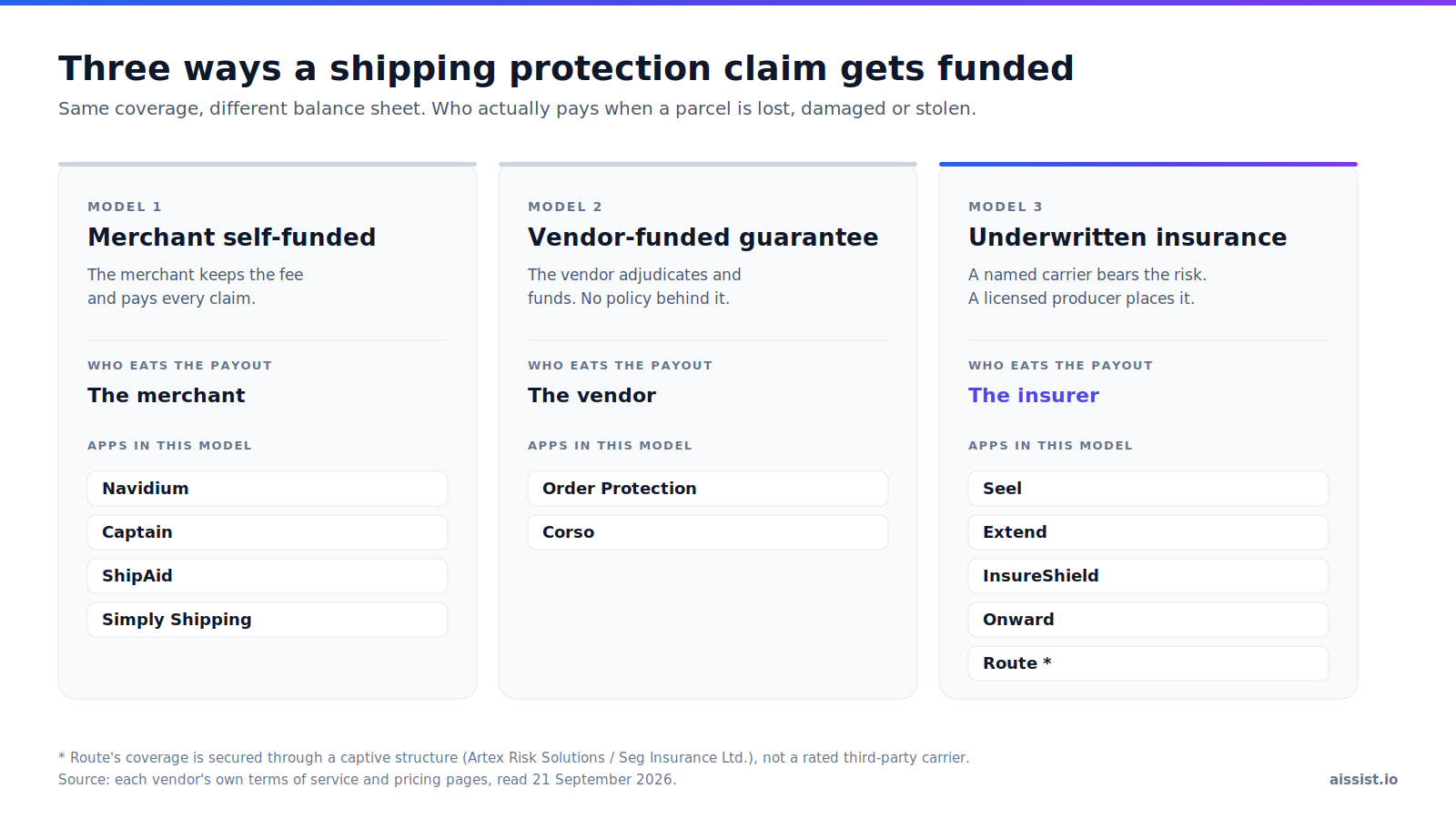
The coverage barely differs; the funding does. Every app here covers the same three events — lost, damaged, stolen — and the real distinction is who is out of pocket when one happens.
Model 1: merchant self-funded. The app collects a fee from the shopper at checkout, the merchant keeps it, and the merchant pays every claim out of that pot. Navidium, Captain, ShipAid and Simply Shipping Protection work this way. Navidium's own homepage is unambiguous: "Manage claims in house while leveraging protection fees to cover your losses when an inevitable shipping error occurs. Whatever is left each month becomes your profit."
Model 2: vendor-funded guarantee. The vendor collects the fee, adjudicates the claim and funds the payout, but no insurance policy sits behind it. Corso and Order Protection operate here. Corso's terms of use say so in capitals: the coverage "IS NOT AND SHALL NOT CONSTITUTE INSURANCE OF ANY KIND WHATSOEVER."
Model 3: underwritten insurance. A licensed carrier bears the risk and a licensed producer places the coverage. Extend, InsureShield, Onward and Seel name carriers or agencies in legal documents. Extend's terms are the clearest: shipments are "insured under a cargo insurance policy (the 'Extend Policy') issued to Extend by Overtime Insurance Solutions Corporation and produced through Extend Insurance Agency, Inc."
Why this is not a philosophical distinction: state regulators have said the first two models may be unlicensed insurance. Oklahoma Insurance Commissioner Glen Mulready issued a consumer alert on 28 November 2023 warning about "package protection" offerings from unlicensed providers.
"When shopping online for the holidays, pay close attention to your shipping protection options and who is offering the coverage. Legitimate shipping insurance providers will be licensed companies or producers." — Glen Mulready, Insurance Commissioner, Oklahoma Insurance Department, 28 November 2023
The 2024 presentation to the NAIC's D Committee put it harder, arguing such offerings "are nothing short of fraud and the unauthorized transaction of insurance" and pre-empting the self-insurance defence: "Self-insurance is not the collection of premiums from unrelated consumers in exchange for the assumption of risk for fortuitous losses outside the control of the assuming party." Its slide listing sites for regulators to review named Navidium, ShipAid, Corso, Onward, Simply Shipping and others.
No enforcement action against any vendor in this roundup has been published that we could find, and several disclaim insurance status deliberately and in writing rather than sloppily. Whether those disclaimers hold up is a question for a regulator, not a blog. What a merchant needs to know today is which model they are buying, and that is answerable in one table.
The 10 shipping protection apps at a glance
| Platform | Best for | Funding model | Who eats the payout | Merchant cost (Sep 2026) | Shopify App Store (Sep 2026) |
|---|---|---|---|---|---|
| Order Protection | Claim status inside a ticket | Vendor-funded guarantee | Order Protection, credited back monthly | Contracted revenue share; % not published | No public listing (collaborator install) |
| Route | High-volume DTC | Underwritten via captive structure | Route, after merchant fronts it | $0 SaaS; merchant remits 100% of fees | 4.0 (376) |
| Seel | Zero balance-sheet exposure | Underwritten insurance | Seel | $0; customer-paid | 4.9 (294) |
| Extend | Warranties plus shipping | Underwritten cargo policy | Overtime Insurance Solutions Corp. | Not published | 4.8 (22) |
| InsureShield | High-value and freight | Underwritten insurance | Authorized insurer, via UPS Capital agency | $0.80 per $100 insured value | 3.8 (46) |
| Onward | Long filing window | Underwritten insurance | Voyager Indemnity Insurance Company | $0 SaaS; rest not published | 5.0 (25) |
| Corso | Branded concierge resolution | Vendor-funded guarantee | Fee pool, administered by Corso | % of revenue generated; number not published | 4.9 (20) |
| ShipAid | Self-funding inside Gorgias | Merchant self-funded | The merchant | $0 SaaS + 9–15% of guarantee revenue | 4.8 (24) |
| Navidium | Low claim rates, high margin | Merchant self-funded | The merchant | $0–$99.99/month; merchant keeps 100% of fees | 4.8 (391) |
| Captain | Cheapest self-funded widget | Merchant self-funded | The merchant | $11–$49/month + 3.99% of protection sales | 4.9 (312) |
Two things fall out of that table immediately. The vendor with the best app-store rating in the category, Onward at 5.0, has 25 reviews; the vendor with the most reviews at 391, Navidium, is a tool for doing it yourself. Star ratings here measure installation experience, not claim experience, and nobody reviews a shipping protection app on the day their claim gets denied.
The claim-funding table nobody publishes
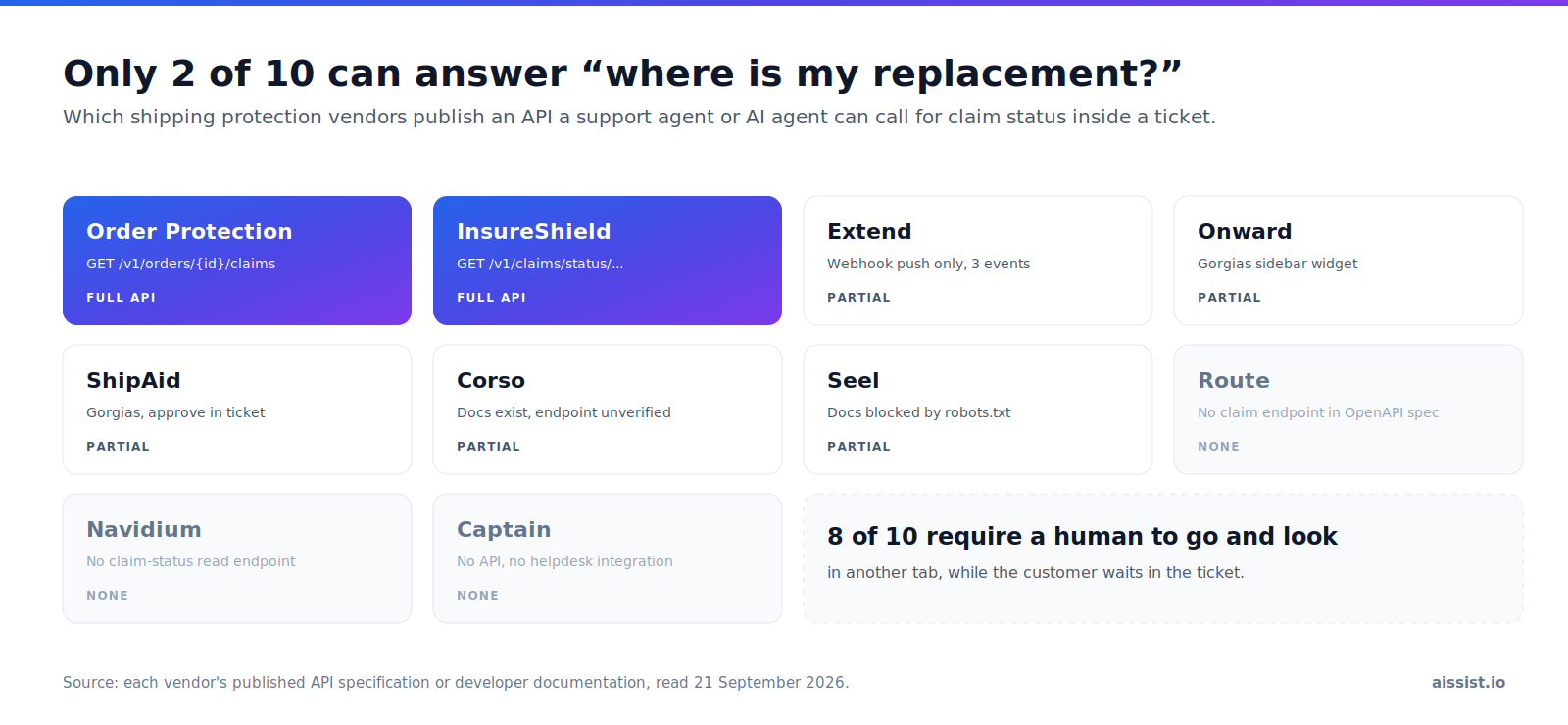
Four of these ten apps name an insurance carrier in a legal document; six name none, and two of the ten publish an API that can tell a support agent whether a claim was approved. Every cell below carries a real figure or an explicit "not published" — a blank cell would have been the easy way out, and the absence of this table on page one is exactly why the category is hard to buy in.
| Platform | Named underwriter | Merchant cost (Sep 2026) | Customer filing window | Stated claim turnaround | Claim-status API for a support agent |
|---|---|---|---|---|---|
| Order Protection | None named; none found in reachable terms | Contracted % of protection fees; not published | 45 days from fulfilment | 24–48 hours (merchant docs); "1-hour or less" (marketing) | Yes — GET /v1/orders/{id}/claims, returns claimState |
| Route | Coverage "secured via Artex Risk Solutions through Seg Insurance Ltd." | $0 SaaS; merchant remits 100% of collected fees weekly | 30 days from "delivered"; 365 days outer limit | "usually in a matter of hours" — marketing, no SLA | No — published OpenAPI spec has no claim-status endpoint |
| Seel | Seel Insurance Inc. or Arch Specialty Insurance Company | $0; fee set by Seel "in its sole discretion" | 7 days from "delivered"; 90 days from order date | Not published | Not verified — developer docs blocked by robots.txt |
| Extend | Overtime Insurance Solutions Corporation | Not published; shopper pays $2.99 per shipment | 5 days after estimated delivery (US) | "Most issues are resolved in minutes" — marketing | Push only — 3-event claim webhook; no GET-by-claim endpoint |
| InsureShield | Not named — "an authorized insurance company" | $0.80 per $100 insured value ($10K limit, major carriers) | 90 days concealed damage; 9 months otherwise | "typically... within a matter of days" — marketing | Yes — GET /v1/claims/status/claimNumber/{}/policyNumber/{} |
| Onward | Voyager Indemnity Insurance Company (via Shipsurance) | $0 SaaS; percentage of cart not published | 120 calendar days from date of shipment | 1–2 business days (published by a merchant, not Onward) | No public API; Gorgias sidebar widget only |
| Corso | None — terms disclaim insurance entirely | % of revenue generated; number not published | 60 days from purchase date | 53-minute average response — marketing metric | Docs exist; claim-status endpoint not verified |
| ShipAid | None — terms disclaim insurance entirely | $0 SaaS + 15% under 200 orders/mo, 12% to 500, 9% above | Merchant-set | Not published | No public API; Gorgias integration |
| Navidium | None — "we aren't an insurance company" | $0 / $29.99 / $49.99 / $99.99 per month by order volume | Merchant-set | Not published | No — plugin endpoints only, no claim-status read |
| Captain | None — "we are not an insurance firm and do NOT underwrite plans" | $11 or $49/month + 3.99% of protection sales | Merchant-set | Not published | No API, no helpdesk integration |
Read the last column first. Eight of ten vendors cannot tell your support agent, inside the ticket, whether a claim was approved. That is the column this article exists for, and we will come back to it.
Read the filing-window column second. Corso's 60 days runs from the purchase date, not the delivery date, which means a slow-shipping order quietly spends its own claim window in transit. Seel gives a shopper 7 days from the carrier's "delivered" scan to report a stolen package — someone who takes a two-week holiday is out of luck. Onward's 120 days and InsureShield's nine months are the outliers in the other direction, and both sit behind real policies.
Who each one is built for
| Platform | Best-fit merchant | Who decides the claim | Helpdesk integrations | Coverage cap |
|---|---|---|---|---|
| Order Protection | Mid-market DTC with a real support team | Order Protection | Gorgias, Zendesk, Richpanel, Kustomer | Up to $5,000 |
| Route | High-volume DTC, 11,000+ merchants claimed | Route, at its "sole advisement" | None documented | Per policy terms |
| Seel | Merchants wanting returns and shipping in one app | Seel | Not documented | Item value actually paid |
| Extend | Brands already selling product warranties | Extend | Not documented | Per policy terms |
| InsureShield | High-value, freight and LTL shippers | The insurer | Not documented | $10,000 per shipment (major carriers) |
| Onward | Mid-market DTC wanting real coverage | Onward | Gorgias | $5,000 per package |
| Corso | Brands wanting resolution under their own name | Corso | Not documented | $1,000 declared value |
| ShipAid | Gorgias shops that want to self-fund | The merchant | Gorgias | Merchant-set |
| Navidium | High-margin, low-claim-rate merchants | The merchant | None documented | Merchant-set |
| Captain | Small stores under 1,000 orders/month | The merchant | None | Merchant-set |
1. Order Protection — best for answering claim status inside a support ticket
Order Protection is a vendor-funded package protection service for Shopify and BigCommerce merchants that adjudicates lost, stolen and damaged-parcel claims itself, reimburses the merchant for approved payouts, and exposes claim state through a documented REST API.
Funding model: Vendor-funded guarantee. Who eats the payout: Order Protection — the merchant's store executes the reship or refund via webhook, and Order Protection credits it back monthly. Underwriter: None named; the public terms of service could not be retrieved from the vendor's site this run, so the insurance question is genuinely open here.
Merchant cost: A contracted revenue share, described in Order Protection's finance documentation as "Your contracted percentage of Order Protection fees generated." No percentage is published. The payout formula is unusual: merchants receive the greater of their revenue share or their claim reimbursements, never both.
Filing window: "Customers must file their claim within 45 days of the order being fulfilled." Claim turnaround: Order Protection's merchant documentation states "Most claims are processed within 24-48 hours"; its shopper-facing page markets "a refund, reshipment or store credit in 1-hour or less." Both are vendor-claimed, and they are not the same promise.
Shopify App Store: No public listing — installation is by collaborator access, so there is no rating to cite. Claim status in your helpdesk: The best in the category. GET /v1/orders/{sourceOrderId}/claims returns claim objects with a claimState enum covering 14 states, plus native widgets for Gorgias, Zendesk, Richpanel and Kustomer.
In a published case study, Oh Polly's median claim resolution time fell from 68.2 hours to 11 hours — an 84% reduction — across 31,268 protected orders.
"We no longer have to raise investigations and claims with the carrier for orders protected by Order Protection, which has streamlined the process and spared time for other priorities." — Emily Mcmorran, CX Lead, Oh Polly (case study)
Pros
- The only vendor with a documented
GETendpoint returning claim state for an order ID, so an agent can answer "where is my replacement" without leaving the ticket. - Four native helpdesk widgets, each showing claim status and type in the sidebar rather than only a link out.
- The vendor adjudicates and funds, so a bad month of porch piracy is not a bad month for the merchant's P&L.
Cons
- No pricing published anywhere; the revenue share is per-contract, so comparing it to a 3.99% or 9% competitor requires a sales call.
- No insurance carrier is named, and the terms of service page returns no readable body text — the weakest transparency among the funded options.
- No public Shopify App Store listing, so there is no independent review signal at all.
Our take: Order Protection is the pick when your support team, not your finance team, is the constraint — it is the only vendor whose claim data reaches an agent mid-conversation. Do not pick it if you need a named carrier behind the risk, or if you cannot get a straight revenue-share answer before signing.
2. Route — best for high-volume DTC brands that want claims off their desk
Route is a post-purchase platform combining package protection with order tracking, used by more than 11,000 merchants per its Series B announcement, where shoppers pay a premium at checkout and Route handles claims through an automated resolution flow.
Funding model: Underwritten, through a captive-style structure rather than a household-name carrier. Who eats the payout: Route — but the merchant fronts it first: "The reimbursement process is how Route pays you back for any customer refunds or replacements that are first funded through your online store." Underwriter: Route's insurance page states coverage "is secured via Artex Risk Solutions through Seg Insurance Ltd. and policy number 26-1," effective 1 January 2026 to 1 January 2027. Artex is a captive-insurance manager, which is materially different from buying paper from a rated third-party carrier.
Merchant cost: $0 SaaS. Route's own WordPress plugin listing states the service "costs customers up to 2% of their cart total (with a minimum of $.98)" and that "Customers typically pay around one percent of the cart value." The merchant collects that fee and remits 100% of it to Route weekly, per Route's billing FAQ — no revenue share is disclosed.
Filing window: 30 days from the carrier's "delivered" timestamp; lost domestic packages no sooner than 7 and no later than 30 days from the last checkpoint; 365 days from purchase as an outer limit. Claim turnaround: "usually in a matter of hours" for claims needing a human — marketing language, not an SLA. Route's decision authority is explicit in the policy: replacement, repair or refund happens "based on the sole advisement of Route."
Shopify App Store: 4.0 stars across 376 reviews — the most polarised distribution in the category, with 70% five-star and 20% one-star. Claim status in your helpdesk: No. We read Route's published OpenAPI specification this run; it documents POST /orders, POST /shipments and GET /quote, and no endpoint returning claim status.
"The claims resolution process is straightforward and easy for customers to navigate." — La Ligne (United States), Shopify App Store review, 16 June 2026
Pros
- The largest claims operation in the category by the vendor's own count — 1.6 million claims resolved at 97% customer satisfaction (vendor-claimed).
- Bundles protection with order tracking, so one vendor covers both the WISMO question and the claim that follows it.
- A real policy document with named filing windows and a 365-day outer limit, published openly rather than gated.
Cons
- The merchant fronts every payout from its own store before Route reimburses, which is a working-capital cost nobody advertises.
- No claim-status read endpoint in the published API, so claim state cannot reach a support agent programmatically.
- The 4.0 rating with 20% one-star reviews is the second-weakest independent signal here, and there is no merchant revenue share to offset it.
Our take: Route is the safe default for a high-volume DTC brand that wants claims to be somebody else's operational problem and can absorb fronting the payouts. Skip it if you want the protection fee to be a revenue line rather than a pass-through.
3. Seel — best for merchants who want a named carrier and zero balance-sheet exposure
Seel is a post-purchase protection provider offering shipping protection and return assurance for Shopify merchants, where Seel bears the risk on its own or a third-party carrier's paper and pays approved claims directly to the shopper as a prepaid card.
Funding model: Underwritten insurance. Who eats the payout: Seel, explicitly — "Seel owns the risk, so we bear the cost." Underwriter: Seel is the only vendor here naming a rated third-party carrier alongside its own entities, in a disclosure repeated across its merchant terms and shopper pages: "Insurance benefits are provided by Seel Insurance Inc. or Arch Specialty Insurance Company, and policies are offered and administered by Seel Insurance Services, Inc., depending on jurisdiction and product availability." Note the "or" — the disclosure does not say which applies where.
Merchant cost: $0. Seel's Worry-Free Delivery page states "Seel's products are customer-paid, meaning merchants don't pay for anything." The shopper's fee is not published and is set by Seel "in its sole discretion," varying "from product to product, transaction to transaction, and Customer to Customer."
Filing window: The tightest here for delivered parcels — 7 days from the carrier's "delivered" update for both theft and damage, 90 days from the order date for loss. Claim turnaround: Not published. Seel claims a "99% eligible claim approval rate" (vendor-claimed), and approved claims are paid "in a prepaid credit card via email" rather than to the original payment method.
Shopify App Store: "Seel Worry‑Free Purchase" holds 4.9 stars across 294 reviews. Claim status in your helpdesk: Not verified. A developer portal exists at developer.seel.com, but its documentation pages are disallowed by robots.txt, so we could not confirm whether a claim-status endpoint exists.
"Against a backdrop of escalating logistics risks, Seel helped Elegoo successfully mitigate after-sales risk—with lightning-fast payouts, and zero disputes." — Kevin Wang, Co-Founder, Elegoo (vendor case study)
Pros
- The clearest risk transfer in the category: a named third-party carrier, a named licensed producer entity, and an explicit statement that Seel bears the loss.
- Covers returns and shipping in one install, which removes a vendor from the post-purchase stack rather than adding one.
- 4.9 stars across 294 reviews is the strongest combination of rating and sample size among the underwritten options.
Cons
- A 7-day filing window from the "delivered" scan is genuinely short for stolen packages, and shoppers who travel will miss it.
- The shopper's fee is set at Seel's sole discretion and published nowhere, so a merchant cannot model checkout impact before launch.
- Payouts arrive as a prepaid card by email rather than a refund to the original payment method, which generates its own support tickets.
Our take: Seel is the right answer for a merchant who wants shipping risk genuinely off the balance sheet and will accept a short claim window to get it. Do not pick it if your customers are slow to notice missing parcels, or if a prepaid-card refund would be a step backwards for your brand.
4. Extend — best for brands already selling product warranties
Extend is a protection-plan platform that sells product warranties and shipping protection through a single merchant integration, insuring covered shipments under a named cargo insurance policy and automating a majority of claims without human review.
Funding model: Underwritten cargo insurance. Who eats the payout: The insurer, with the shopper as loss payee — "While you are not an insured under the Extend Policy, any reimbursement, if applicable, will be directed to you as a loss payee." Underwriter: Overtime Insurance Solutions Corporation, produced through Extend Insurance Agency, Inc., per Extend's terms. Worth noting for balance: Extend describes building its own vertically integrated insurance stack, so a named carrier here is not necessarily an arms-length third party.
Merchant cost: Not published. The shopper price is $2.99 per shipment on Extend's shipping protection page. Extend and its agency "may earn commission or other compensation in connection with making coverage available."
Filing window: 5 days after the estimated delivery date for lost or stolen parcels in the US, 20 days outside it, and "As soon as it is delivered" for damage. Claim turnaround: "Most issues are resolved in minutes" — marketing language. Extend claims a 52% average attach rate and "up to 76% of claims automated" (both vendor-claimed).
Shopify App Store: "Extend Shopper Operations" holds 4.8 stars across 22 reviews. Claim status in your helpdesk: Push only. Extend publishes a claim-status webhook (claim_approved, claim_denied, claim_in_review) but no documented endpoint returning a claim by ID; its own documentation routes status lookup through the Merchant Portal UI, which is a reliable signal that no read API exists.
"With Extend Shipping Protection, our customers are protected and we save millions" — Ali Oner, CEO, Boutique Rugs (vendor press release)
Pros
- A flat, published $2.99 per shipment is the only shopper-facing price here you can quote without a sales call or a percentage calculation.
- One vendor for product warranties and shipping protection, consolidating two post-purchase contracts into one.
- The cleanest underwriter disclosure in the category — named carrier, named licensed agency, explicit loss-payee status.
Cons
- A 5-day US filing window after estimated delivery is the second-shortest here, and "estimated" delivery dates are not always the delivery date.
- Merchant economics are entirely unpublished — no revenue share, no take rate, no tier pricing.
- 22 Shopify reviews is a thin independent signal for a company of Extend's size and funding.
Our take: Extend earns its place if you already sell warranties and want one contract covering both risks, and the flat $2.99 makes checkout modelling trivial. Look elsewhere if your customers routinely report problems more than five days after the estimated delivery date.
5. InsureShield (UPS Capital) — best for high-value, freight and multi-carrier shipments
InsureShield is UPS Capital's multi-carrier shipping insurance product, offering per-shipment coverage arranged through a licensed insurance agency, with published per-$100 rates, contractual filing deadlines, and a public claims API.
Funding model: Licensed insurance. Who eats the payout: The insurer — "any resulting claim payment will be directed to you as a loss payee." Underwriter: Not named. The product disclosure says coverage "is underwritten by an authorized insurance company and offered through UPS Capital Insurance Agency, Inc., a licensed insurance producer," and the terms of service say coverage "may be underwritten by various insurance companies." The licensed entity named is the agency, not the risk-bearer — an odd omission from the most insurance-native vendor here.
Merchant cost: $0.80 per $100 of insured value with a $10,000 limit for major carriers, and $0.95 per $100 with a $5,000 limit for other carriers, per its Shopify App Store listing. Free to install; Order Scoring is priced separately at $0.30 per order scored.
Filing window: The most generous here, and contractual rather than marketed — "within 90 days from the date of delivery" for concealed loss or damage, "within nine months from the date of delivery" for all other claims. Claim turnaround: "We typically pay claims within a matter of days assuming all required documents have been provided" — marketing, hedged twice, with no contractual payment SLA in the terms.
Shopify App Store: "InsureShield & CommerceShield" holds 3.8 stars across 46 reviews — the lowest rating in this roundup, with review text pointing at claim denials. Claim status in your helpdesk: Yes. GET /v1/claims/status/claimNumber/{}/policyNumber/{} returns a customerDisplayStatus field with states including "Claim Received", "Documents Pending", "Investigation Pending", "Submitted for Payment", "Paid" and "Denied".
"UPS Capital improved our processes by making them a lot less stressful, and freed up time for a staff member." — John Modica, Logistics Manager, Made PC (case study)
Pros
- Real insurance from a licensed producer, with per-$100 rates published openly — the only vendor whose price you can calculate for any cart value without asking.
- A nine-month filing window written into the contract, roughly nine times the next-longest term here.
- A public claims API with a status enum granular enough to drive an automated reply, plus document upload.
Cons
- The carrier is never named — "an authorized insurance company" is less disclosure than Extend, Onward or Seel give.
- 3.8 stars across 46 reviews is the weakest independent signal in the roundup, and merchants cite denials specifically.
- The claims API PDF is dated September 2023 and its documented base URLs look like staging hosts, so production endpoints need confirming before you build.
Our take: InsureShield is the correct choice when the parcels are genuinely valuable — freight, LTL, high-ticket electronics — and you want an insurance contract rather than a guarantee. It is a poor fit for a $40 AOV apparel brand looking to turn protection into a revenue line, because it is a cost, not a margin.
6. Onward — best for a long filing window on an underwritten policy
Onward is a package protection provider for Shopify merchants whose coverage sits behind a named insurance carrier, adjudicated by Onward's own claims team rather than the merchant, with a 120-day filing window and a Gorgias sidebar widget for support agents.
Funding model: Underwritten insurance. Who eats the payout: Voyager Indemnity Insurance Company, with Onward LLC named as certificateholder. Underwriter: Voyager Indemnity Insurance Company, disclosed on the Shipsurance coverage terms page for the Onward program — notably on a third party's site, not Onward's own. Onward appeared on the 2024 NAIC presentation's list of unlicensed providers; the carrier-backed program documented today does not match that description, and we could not determine whether the structure changed or the list swept it in. We state both facts and draw no conclusion.
Merchant cost: $0 SaaS, per Onward's own comparison blog. The percentage of cart charged to the shopper is not published; a merchant help page describes the cost as "calculated based on the subtotal of the order."
Filing window: 120 calendar days from the date of shipment, per the carrier terms — the second-longest here after InsureShield. Claim turnaround: "Most claims are resolved in just 1–2 business days" — published by a merchant on its own FAQ, not by Onward, which is weaker provenance than it first appears. The carrier terms promise only "prompt payment" with no day count.
Shopify App Store: "Onward Checkout+" holds 5.0 stars across 25 reviews. Claim status in your helpdesk: Partial. There is no public API, but Gorgias's documentation confirms the widget "will automatically show in the ticket sidebar," letting agents open the order in Onward and file a claim. No status fields are enumerated.
In a published case study, OpenStore reported a 50% increase in attach rate and more than $400,000 in net revenue lift across a year.
"Onward has become a true extension of our team. They provide excellent service to our brands and always reply to customers within the hour." — Dov Quint, Storefronts Lead, OpenStore (case study)
Pros
- A named carrier with $5,000 per-package limits and a 120-day filing window — real coverage rather than a guarantee with an insurance-shaped name.
- Onward adjudicates, so claim decisions are not the merchant's argument to have with its own customer.
- A Gorgias sidebar widget means agents can at least see and file without a separate login.
Cons
- The carrier is disclosed only on Shipsurance's site — the one vendor here with real insurance behind it does not lead with the fact.
- No pricing of any kind is published: not the percentage, not the revenue share, not the attach economics.
- 25 reviews is a thin sample, and Shopify's own surfaces showed inconsistent counts on the day we read them.
Our take: Onward is the strongest underwritten option for a mid-market DTC brand that wants a long claim window and a vendor that handles the conversation. Pass if you need published economics before a sales call, or if you run anything other than Gorgias.
7. Corso — best for concierge resolution under your own brand
Corso is a post-purchase platform combining returns, exchanges, warranties and shipping protection, where a concierge team resolves protected claims in the merchant's name and payouts are funded from the pool of customer-paid protection fees rather than an insurance policy.
Funding model: Vendor-funded guarantee. Who eats the payout: The fee pool, administered by Corso — "Each claim is funded from protection fees collected, not your operating margin." Underwriter: None. Corso's terms of use state in capitals that the coverage "IS NOT AND SHALL NOT CONSTITUTE INSURANCE OF ANY KIND WHATSOEVER." Corso was named on the 2024 NAIC presentation's list.
Merchant cost: Corso's pricing page says "Corso charges a percentage of the revenue the platform generates for your store" — the percentage is not published. The same page advertises "$0 Fixed Fees" and "Unlimited Claims."
Filing window: 60 days, running from the purchase date rather than the delivery date — a distinction that matters on a slow fulfilment. Coverage is capped at $1,000 of declared value, the lowest cap in this roundup. Claim turnaround: No SLA. Corso publishes a 53-minute average response and 97.3% customer satisfaction (vendor-claimed marketing metrics). Its positioning is blunt about what it is not: "No insurance adjudication, no exclusions, no police reports. Just resolution."
Shopify App Store: The consolidated "Corso" app holds 4.9 stars across 20 reviews; the older "Shipping Protection by Corso" listing is now delisted. Claim status in your helpdesk: Not verified. Corso publishes a developer site documenting a public Shop API, a Commerce API and webhooks, but the endpoint pages we tried returned 404.
"Corso has proved that they are a part of our team just as much as we are a part of theirs. Easy to get ahold of and work through any issues." — Cotopaxi (United States), Shopify App Store review, 17 March 2026
Pros
- Claims are resolved under the merchant's brand by a concierge team, so the customer never meets a third-party claims portal.
- Funded from the fee pool rather than the merchant's margin, which gives the self-funded model's upside without the merchant adjudicating.
- Returns, exchanges, warranties and shipping protection in one app — the broadest post-purchase footprint here.
Cons
- The $1,000 declared-value cap is the lowest in this roundup and rules out high-ticket categories outright.
- A 60-day window running from purchase rather than delivery quietly shortens itself on every slow shipment.
- No price published, no carrier, and 20 Shopify reviews plus a single G2 review — the thinnest independent signal in the roundup.
Our take: Corso suits a brand that cares most about the customer never leaving its own brand experience during a claim, and that ships items comfortably under $1,000. Avoid it if you sell high-ticket goods or if your fulfilment routinely takes more than a couple of weeks.
8. ShipAid — best for self-funding without leaving Gorgias
ShipAid is a delivery-guarantee platform for Shopify merchants where the brand, not ShipAid, promises to replace undelivered or damaged orders, the merchant adjudicates every claim, and ShipAid takes a percentage of guarantee revenue instead of a monthly fee.
Funding model: Merchant self-funded. Who eats the payout: The merchant — "ShipAid does not provide any products or services directly to consumers, but instead provides a service that allows brands to facilitate product replacement to their customers." Underwriter: None, and the disclaimer is the most carefully drafted in the category: "ShipAid does not provide insurance and does not provide indemnification against loss, damage, or liability arising from a contingent or unknown event." ShipAid was named on the 2024 NAIC presentation's list. Its marketing line is a fair summary of the posture: "We don't insure packages, we protect relationships."
Merchant cost: $0 monthly. A tiered platform fee on guarantee revenue only: 15% under 200 orders/month, 12% from 200–500, 9% above 501, per ShipAid's pricing page. Its Shopify listing states a flat 9%, so confirm which applies to a new install.
Filing window: Merchant-set; no default published. Claim turnaround: Not published. ShipAid's help centre is clear about who decides: "You approve, deny, refund, or reship from your SHIPAID dashboard or inside Gorgias. You keep full control of decisions."
Shopify App Store: "SHIPAID ‑ Shipping Guarantee" holds 4.8 stars across 24 reviews. Claim status in your helpdesk: Partial. No public API documentation exists, but claims can be approved and resolved from inside Gorgias, which is more than most self-funded tools offer.
"ShipAid has proven to be a win-win for our customers and our business. We're able to offer a hassle-free delivery guarantee to all of our customers and it is funded by the revenue generated by ShipAid." — Galactic Snacks (United States), Shopify App Store review, 4 December 2023
Pros
- Claim decisions and resolutions happen inside Gorgias, so the support agent already handling the conversation can close it.
- No monthly fee at all — the vendor only earns when the guarantee earns, which aligns incentives on attach rate.
- Legal drafting that states the model plainly rather than dressing a guarantee in insurance language.
Cons
- The merchant funds every payout and carries the full loss-ratio risk, with no cap and no carrier.
- The "10,000+ merchants" claim on ShipAid's own story page sits awkwardly beside 24 Shopify reviews; treat it as marketing until corroborated.
- No published filing window or turnaround, so the customer-facing terms are entirely the merchant's to write and defend.
Our take: ShipAid is the best self-funded option for a Gorgias shop that wants claims handled by the team already in the inbox. Do not choose it if you have not modelled your claim rate, because the merchant is the entire balance sheet behind the promise.
9. Navidium — best for high-margin merchants with low claim rates
Navidium is a self-funded shipping protection widget for Shopify and WooCommerce that lets a merchant charge its own protection fee at checkout, keep 100% of it, and pay claims in-house through a merchant-controlled claims portal.
Funding model: Merchant self-funded, and Navidium is the category's loudest advocate for it. Who eats the payout: The merchant — "Whatever is left each month becomes your profit." Underwriter: None. Navidium's homepage states: "Firstly, we aren't an insurance company. We don't communicate with your customers at any time."
The regulatory context deserves a straight statement rather than a hint. The 2024 NAIC presentation described "one such unlicensed app" that "affirmatively encourages merchants to 'ditch' legitimate insurance offerings." Navidium's homepage headline, still live on 21 September 2026, reads "Ditch Traditional Shipping Insurance & Shipping Insurance Apps." Readers can draw their own conclusion; we note again that the presentation was delivered by a competitor and that no enforcement action against Navidium has been published that we could find.
Merchant cost: Free up to 50 orders/month; $29.99/month to 500 orders; $49.99/month to 1,000; $99.99/month unlimited, per its Shopify App Store listing. "Unlike any others, Navidium doesn't take a % of your revenue, you keep every penny of it." The shopper fee is set by the merchant as a percentage or a fixed amount.
Filing window: Merchant-set. Claim turnaround: Merchant-set — "You decide when to approve or deny claims, and control the outcome and customer journey."
Shopify App Store: 4.8 stars across 391 reviews — the largest review base in this roundup. Claim status in your helpdesk: No. The only published API surface is the WooCommerce plugin's four endpoints, and its /claim endpoint processes a one-time code from a return link rather than returning status for an order.
"we're getting to retain revenue and actually assist our customers with replacing orders that get lost instead of their claims getting denied." — Disciple Threads (United States), Shopify App Store review, 15 July 2026
Pros
- The merchant keeps 100% of collected fees with no revenue share — the best gross economics in the category if the claim rate stays low.
- Complete control over approvals means no third party denying a claim in your brand's name, which is the complaint that shows up most in reviews of the funded models.
- 391 reviews at 4.8 stars is the deepest independent signal here by a wide margin.
Cons
- The merchant carries 100% of the loss with no cap, no carrier and no reinsurance — an uncapped liability booked as revenue.
- No claim-status API and no helpdesk integration, so every "where is my replacement" is a manual lookup.
- Review volume cuts both ways: one merchant of four years wrote on 30 August 2026, "You might think you're making extra revenue with this app, but you are actually losing far more money in abandoned carts."
Our take: Navidium is the right tool for a high-margin merchant with a genuinely low claim rate and the discipline to reserve against the liability. It is the wrong tool if you have not calculated your break-even claim rate — and the next section calculates it.
10. Captain Shipping Protection — best for small stores that want the cheapest self-funded widget
Captain Shipping Protection is a low-cost self-funded protection widget for Shopify that adds a merchant-configured fee to the cart or checkout, retains the fee entirely for the merchant, and provides a customer-facing claim portal the merchant administers.
Funding model: Merchant self-funded. Who eats the payout: The merchant — "Shipping protection fees paid by the customer are retained entirely by the merchant" and can be used "to offset the cost of the claim for a refund as needed." Underwriter: None — its Shopify listing states "We are not an insurance firm and do NOT underwrite plans."
Merchant cost: $11/month plus 3.99% of shipping protection sales on Standard, or $49/month plus 3.99% on Plus for Shopify Plus stores, per Captain's own pricing page. The Shopify App Store listing shows only the $11 and $49 figures — the 3.99% does not appear there, so a merchant budgeting from the listing alone will be short.
Filing window: Merchant-configurable, with no default published. Claim turnaround: Not published; the merchant adjudicates and sets whether customers may request a refund, a reorder, or both.
Shopify App Store: 4.9 stars across 312 reviews, carrying a "Built for Shopify" badge. Claim status in your helpdesk: No. Captain's complete documentation index lists 15 pages and none is an API reference, and no Gorgias, Zendesk or Re:amaze integration is documented.
"App is exactly what I was looking for. Super fast and helpful support when some customization was needed. Thank you!" — Bitsy Zoo (United States), Shopify App Store review, 27 April 2026
Pros
- The cheapest entry point in the category at $11/month, with a "Built for Shopify" badge and 4.9 stars across 312 reviews.
- Granular fee configuration — percentage of cart snapped to price variants, fixed fees, or tiered rules by cart value.
- The merchant keeps the fee and controls the entire claim experience, including whether refunds or reorders are offered.
Cons
- The 3.99% revenue share is published on Captain's site but absent from its Shopify listing, which is exactly the kind of discrepancy that ruins a first month's reconciliation.
- No API and no helpdesk integration of any kind, so claim status lives only in the Shopify admin.
- No legal entity is named in any policy document; support runs through a
shipwill.orgaddress and the product has been indexed under at least three names.
Our take: Captain is a sensible first shipping protection app for a small store testing whether customers will opt in at all. Replace it once you have enough claim volume to need reporting, integrations, or somebody else's balance sheet.
Also evaluated, not ranked
Two apps met the review threshold on quality but failed criterion 3 — published economics — so they are named here rather than ranked.
ShipInsure (4.8 stars, 68 reviews, read 21 September 2026) publishes a $0.98 shopper minimum and a merchant revenue share of $0.05 to $0.15 per order by volume, but the percentage of cart above that minimum appears nowhere in its documentation, so the shopper cost on a high-value cart cannot be determined. Its terms are also unusually direct about what the shopper is buying: "Shipping Protection is not insurance sold to you by ShipInsure," and "you are not an insured or additional insured under any policy unless expressly stated in writing." Gorgias and Zendesk widgets exist; no public API does.
Simply Shipping Protection (4.6 stars, 131 reviews, read 21 September 2026) prices at $4.99 to $49.99 per month on its Shopify listing with a 10% commission on the free tier, but the vendor's own help centre publishes a different set of tiers, and the two do not reconcile. Its product page is nonetheless the most honest document in this entire category, and it is worth quoting at length because no competitor says it out loud:
"No underwriter, no regulated product. … Every opt-in is a contingent liability. … you are self-insuring a loss you have not modelled … you have just added a mechanism for your customers to invoice you." — Simply Shipping Protection product page, Lucent Commerce, read 21 September 2026
A vendor warning you about its own product's risk is not a red flag. It is the clearest statement of the self-funded trade-off anyone in this category has published, and every merchant evaluating Model 1 should read that sentence twice.
What shipping protection actually costs a merchant
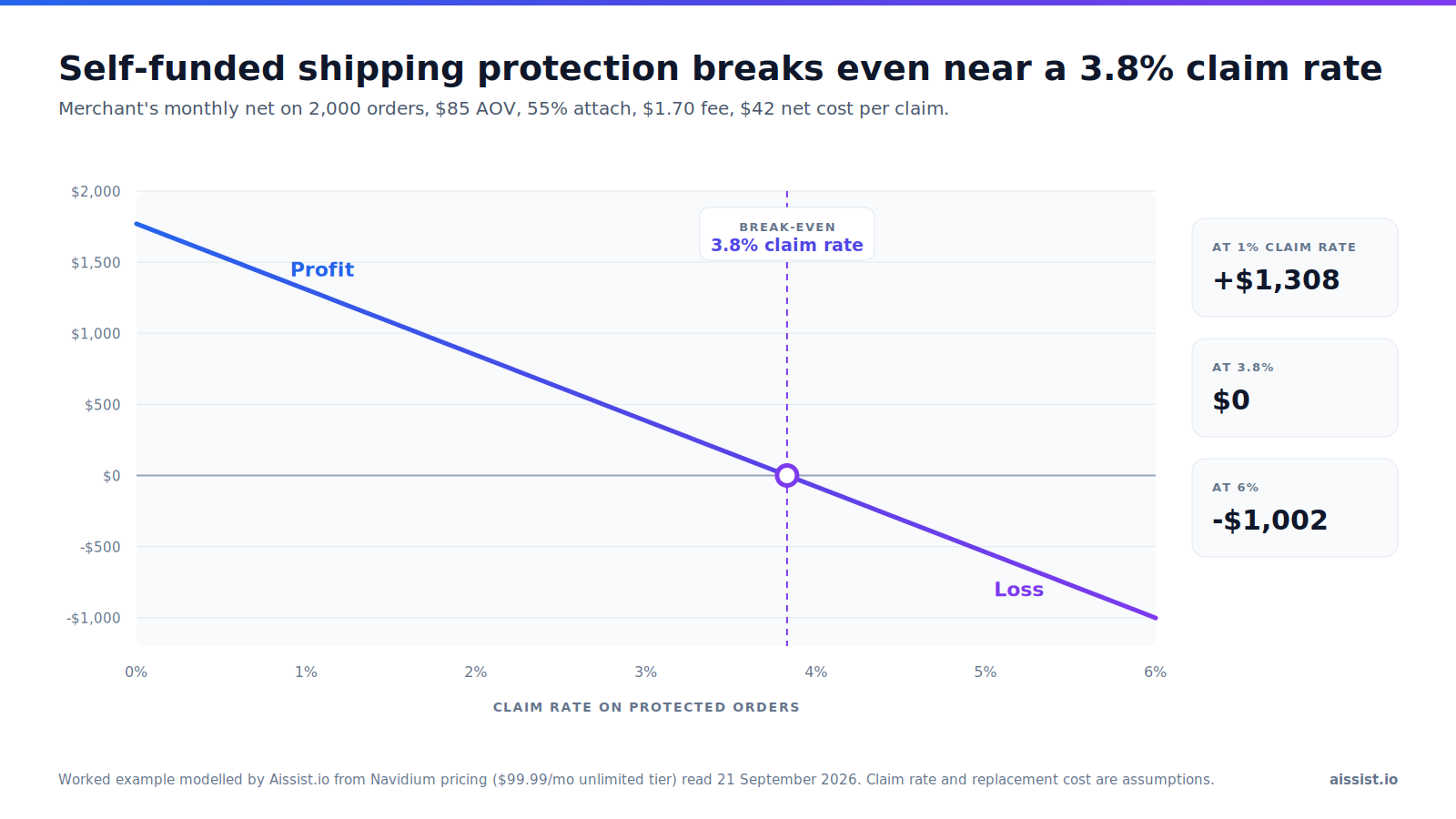
Self-funded shipping protection stops making money at roughly a 3.8% claim rate — below that you keep the spread, above it you are paying customers to file claims against you. Here is the arithmetic, because nobody in this category publishes it.
The scenario. 2,000 orders a month, $85 average order value, a 55% attach rate (Corso reports "well over half" and Extend reports 52%, so this is a middling assumption), a $1.70 protection fee at 2% of cart, and a net replacement cost of $42 per claim — cost of goods plus reshipping, not retail value. That produces 1,100 protected orders and $1,870 in monthly protection revenue. Use your own numbers; the shape is what matters.
| Model (Sep 2026 pricing) | Monthly fee | Vendor's cut | Merchant keeps | Break-even claim rate |
|---|---|---|---|---|
| Navidium — self-funded | $99.99 (unlimited tier) | $0 | $1,770.01 | 3.8% of protected orders |
| Captain — self-funded | $11.00 | 3.99% = $74.61 | $1,784.39 | 3.9% |
| ShipAid — self-funded | $0 | 9% = $168.30 | $1,701.70 | 3.7% |
| Route — underwritten | $0 | 100% of fees remitted | $0 | n/a — Route pays claims |
| Seel — underwritten | $0 | Fee set by Seel | $0 | n/a — Seel pays claims |
| Order Protection — vendor-funded | $0 | Contracted share | Greater of share or reimbursements | n/a — vendor pays claims |
Worked example modelled by Aissist.io from vendor pricing read 21 September 2026. Vendor fees are sourced; the attach rate, claim rate and $42 replacement cost are scenario assumptions, not measured figures.
Three things this table makes obvious. First, the three self-funded apps land within 0.2 percentage points of each other — the SaaS fee and the revenue share barely matter next to the claim rate, so choosing between them on price is choosing on the wrong variable. Second, a merchant at a 1% claim rate keeps about $1,300 a month and a merchant at 6% loses about $1,000, from the same app with the same settings. Third, the funded models convert that variance into zero, which is the entire product.
The hidden costs nobody itemises. Route's merchants front every payout before reimbursement, which is a working-capital line. Captain's 3.99% is absent from its Shopify listing. Both Captain and Simply Shipping Protection publish order-volume caps that a growing store will breach mid-month. And the 2024 NAIC presentation notes a cost that appears on no pricing page at all: "Shopping platforms receive monthly fees from the app developers that are tied to revenue – usually a 20% share."
One merchant review from this run is worth more than the model. Macedon Perfumes wrote on 10 July 2026 that they had been "dropped by a major shipping protection provider due to claim volume caused entirely by carrier failures" and moved to a self-funded tool. That is the economics of this category in one sentence: the funded models price risk, and a merchant whose claim rate exceeds the price gets repriced or dropped.
How to choose a shipping protection app
If you cannot absorb a bad month, choose an underwritten option — Seel, Extend, InsureShield or Onward — because a named carrier converts a variable loss into a fixed zero.
If your claim rate is reliably under 2% and your margins are healthy, choose a self-funded app like Navidium or Captain, because at that rate the spread between fees collected and claims paid is real profit rather than deferred liability.
If your support team is the constraint, choose Order Protection or InsureShield, because they are the only two vendors that publish an endpoint returning claim status for an order, and everything else means an agent opening another tab.
If your parcels are worth more than $1,000, rule out Corso on the declared-value cap and look at InsureShield, whose major-carrier limit is $10,000 per shipment.
If your customers routinely report problems weeks after delivery, choose InsureShield (nine months) or Onward (120 days) and avoid Extend (5 days) and Seel (7 days from the delivered scan), because a generous window is worth more than a fast payout to a customer who missed the fast window.
If you run Gorgias, shortlist ShipAid, Onward and Order Protection, because those three put claim actions in the sidebar your agents already have open.
If your legal or finance team will ask who underwrites this, choose Seel, Extend or Onward, because those three name a carrier in a document you can forward — and be ready to explain that six of the ten apps in this category name none.
If you sell product warranties already, choose Extend, because consolidating two post-purchase protection contracts with one vendor removes an integration rather than adding one.
What is shipping protection, and is it package insurance?
Shipping protection is an optional fee a shopper pays at checkout for a promise that a lost, damaged or stolen parcel will be replaced or refunded — and in most implementations it is not insurance, because no licensed carrier bears the risk. That distinction is the whole reason this category is confusing, and the vendors are not always the ones confusing it.
Shipping insurance is a regulated product. A licensed insurer assumes the risk of a fortuitous loss in exchange for a premium, a licensed producer places the coverage, and a state insurance department can intervene if the insurer fails. InsureShield, Extend, Onward and Seel all name at least one of those entities in a legal document.
Shipping protection, as the term is used by most Shopify apps, is a service guarantee. The merchant or the app provider promises to make the customer whole, funded from the pool of fees collected, with no carrier and no regulator standing behind it. If the provider stops paying, the customer's recourse is a chargeback and the merchant's recourse is a contract dispute.
The argument that this distinction is legally meaningful rather than semantic runs as follows, per the presentation given to the NAIC's D Committee in March 2024: "The term 'insurance' is often defined as one party paying another party consideration (i.e., 'premium') in exchange for assuming risk of loss that is outside the assuming party's control," and coverage for porch piracy "is, by definition, insurance." The vendors' counter-argument is that they are software companies and the merchant is the risk-bearer — an attempt to place the transaction outside the definition by placing the vendor outside the transaction.
For a merchant, the practical consequence is narrower than the legal debate. Self-funding means you have created a liability that sits on your books, is not reserved against, and grows with your order volume. It also means the protection fee is your revenue, which is why the model exists. Both things are true at once.
The handoff nobody prices: what you are still answering
Every one of these apps ends the same way — with a customer in your inbox asking where the replacement is. The claim being funded, adjudicated and approved by a third party does not move that conversation anywhere; it just means the person answering it now needs information from a system they may not have access to.
The helpdesk vendors have noticed. On 18 September 2026, Zendesk launched pre-configured Industry Agents for retail and e-commerce that "connect out of the box to Shopify, Stripe, Narvar, and Riskified" — post-purchase infrastructure wired straight into the support stack. Shipping protection claims are conspicuously not on that list.
This is the finding from reading all ten vendors' documentation in a single session on 21 September 2026, and it was more lopsided than we expected. Two of ten publish an endpoint a support tool can call to get claim status for an order: Order Protection's GET /v1/orders/{id}/claims and InsureShield's GET /v1/claims/status/.... Extend pushes three webhook events and documents status lookup as a portal workflow. Route's published OpenAPI specification contains no claim endpoint at all. Four vendors have no public API of any kind. For the majority of this category, the honest answer to "can my helpdesk see claim status" is: only if a human goes and looks.
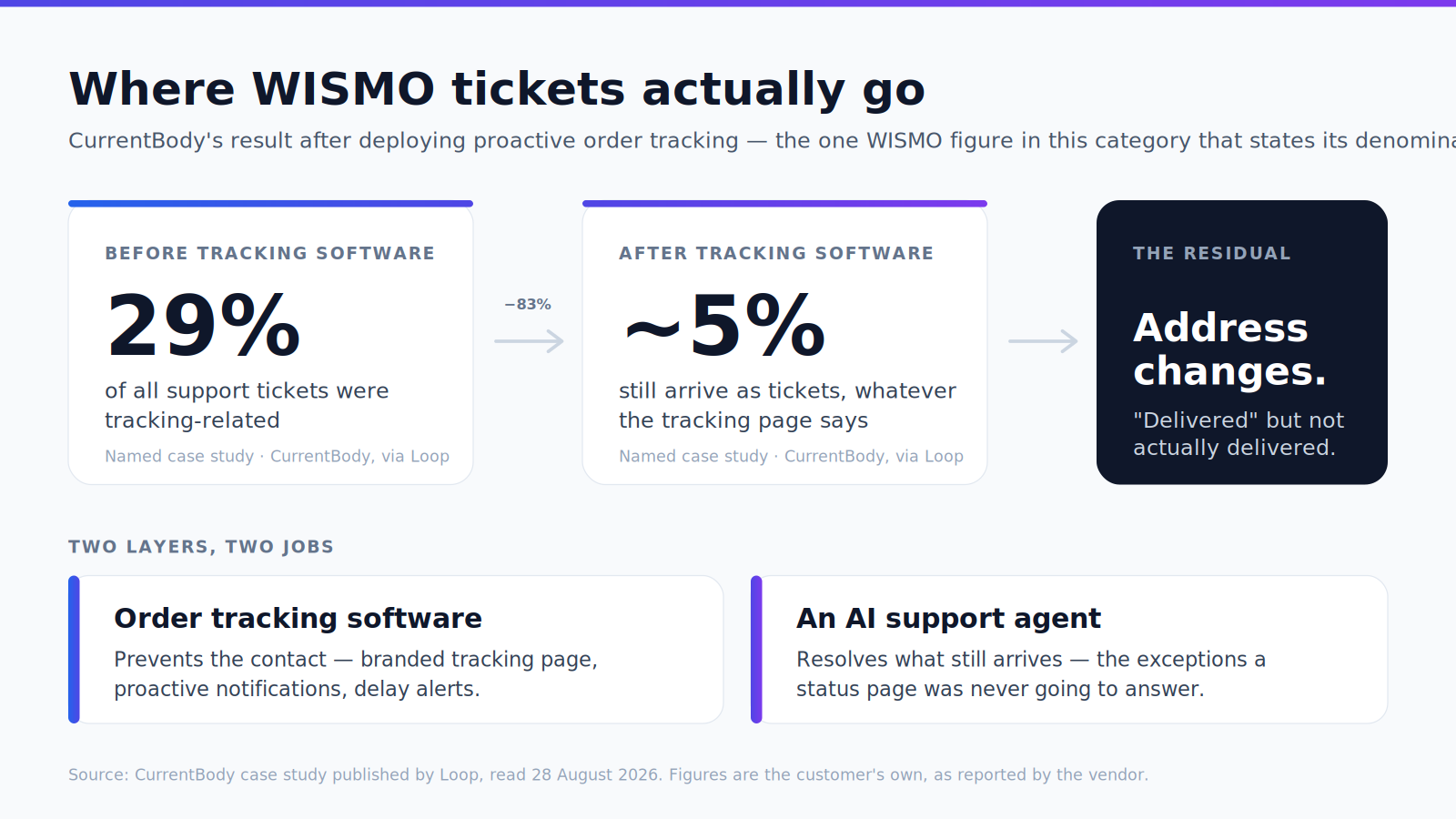
That matters because parcel claims sit directly beside the largest ticket category in e-commerce support. In one deployment documented in our order tracking and WISMO software review, CurrentBody reported that tracking inquiries made up 29% of all support tickets before it addressed them proactively. Claim-status questions are the tail of that same conversation: the parcel didn't arrive, the claim went in, and now there is a second thread about a replacement that no tracking number covers yet.
Aissist.io's e-commerce benchmark reports roughly 83% average resolution on service and 4.8/5.0 CSAT at about $0.60 per resolution across its deployments (vendor-claimed). Those numbers depend on the AI agent being able to read the systems that hold the answer — which, for shipping protection claims, is the two-of-ten problem above. Where a vendor exposes claim state, an agent in Gorgias or Zendesk can answer the question and close the ticket. Where it does not, the best available outcome is a well-written holding reply and a human following up, which is what GameRoomShop's 60% automation rate looks like in practice: structured questions resolve, edge cases escalate.
We'll declare the interest again, since this is the section where it bites: Aissist sells the software that answers these tickets. That is exactly why we went and read ten API specifications instead of ten pricing pages, and it is why criterion 5 exists. If claim-status visibility doesn't matter to your operation, the other four criteria stand on their own — and if you are shipping into peak season, it will matter around the second week of December.
The funding model decides who pays; your helpdesk decides who answers
Choose the funding model first, because it is the only decision in this category that is genuinely hard to reverse. Self-funded apps hand you the margin and the liability together; vendor-funded guarantees and underwritten policies take both away. The break-even sits near a 3.8% claim rate for every self-funded app we priced, which means the choice is about your claim rate and your appetite for variance, not about an $11 or a $99 monthly fee.
Then choose for the second decision, which nobody markets and everybody lives with: after the claim is approved, somebody still has to tell the customer. Ten vendors, two APIs. If your support volume is already the expensive part of your post-purchase operation, weight that column heavily — and if it is not yet, it will be the first time a carrier has a bad week in December.
The claim gets paid; the ticket still lands with you. Aissist.io resolves service and sales conversations end-to-end on the help desk you already run — including the "where is my replacement" follow-ups a protection app hands back. See the ecommerce benchmark →
Frequently asked questions
What is the best shipping protection app for Shopify in 2026?
There is no single best app — there are three funding models. Order Protection ranks first here for merchants who need claim status inside a support ticket, Seel for merchants wanting a named carrier and zero balance-sheet exposure, and Navidium for high-margin stores with low claim rates willing to self-fund.
Is shipping protection the same as shipping insurance?
No. Shipping insurance is underwritten by a licensed insurer and placed by a licensed producer; most shipping protection apps are service guarantees funded from collected fees with no carrier behind them. Of the ten apps reviewed here, four name a carrier or licensed agency in a legal document and six explicitly do not.
How much does shipping protection cost?
It depends on who pays. Route charges shoppers up to 2% of cart with a $0.98 minimum, Extend charges a flat $2.99 per shipment, and InsureShield charges merchants $0.80 per $100 of insured value. Self-funded apps charge the merchant $0 to $99.99 a month plus, in some cases, 3.99% to 15% of protection revenue (all read September 2026).
Is self-funded shipping protection legal?
State insurance regulators have publicly questioned it. The Oklahoma Insurance Department warned consumers about unlicensed "package protection" in November 2023, and a 2024 presentation to the NAIC's Market Regulation and Consumer Affairs Committee argued such offerings constitute the unauthorized transaction of insurance. That presentation was delivered by a competing vendor, and no published enforcement action against the apps named in it was found in this review.
Who pays when a shipping protection claim is approved?
It depends entirely on the model. With Navidium, Captain, ShipAid and Simply Shipping Protection the merchant pays from the fees it collected; with Corso and Order Protection the vendor funds the payout; with Seel, Extend, Onward and InsureShield an insurance policy pays, though Route's merchants front the payout and are reimbursed afterwards.
How long do customers have to file a shipping protection claim?
Between 5 days and nine months, depending on the app. Extend allows 5 days after estimated delivery, Seel 7 days from the "delivered" scan, Route 30 days, Order Protection 45 days from fulfilment, Corso 60 days from purchase, Onward 120 days from shipment, and InsureShield nine months from delivery for most claims.
Can my helpdesk see shipping protection claim status?
Only with two of the ten apps reviewed. Order Protection publishes GET /v1/orders/{id}/claims returning a claim state, and InsureShield publishes GET /v1/claims/status/claimNumber/{}/policyNumber/{}. Extend pushes claim events by webhook, Onward, ShipAid and ShipInsure offer helpdesk sidebar widgets, and the rest require a manual lookup.
Does shipping protection hurt checkout conversion?
It can, and merchants report both outcomes. Corso reports that "well over half" of customers keep the protection and Extend reports a 52% average attach rate (both vendor-claimed), but one Navidium merchant of four years wrote in August 2026 that the app cost them "far more money in abandoned carts" than it earned. Test it as an opt-in before making it opt-out.
What claim rate makes self-funded shipping protection unprofitable?
Roughly 3.8% of protected orders, on the worked example in this article — 2,000 orders a month, 55% attach, a $1.70 fee and a $42 net replacement cost. Below that the merchant keeps the spread; above it the program costs money. Substitute your own claim rate and replacement cost, because both vary more than the vendor fees do.
Changelog
- September 2026 — First publication. Ten apps ranked; pricing, terms, filing windows, Shopify App Store ratings and API documentation read from primary sources on 21 September 2026. Added the claim-funding comparison table and the self-funded break-even model. ShipInsure and Simply Shipping Protection evaluated but not ranked on unpublished economics.