The Peak Season Support Playbook: BFCM 2026
This Black Friday customer support playbook works backwards from 27 November 2026, and its central claim is that the decision that matters is not how many temps to hire — it is whether your cost scales back down in December. US shoppers spent $44.2 billion online across the five days of Cyber Week 2025, hitting $16 million a minute in the 8–10pm peak, according to Adobe Analytics (independently reported, 2 December 2025). A 4× ticket spike handled entirely by humans costs roughly $48,000 in a month; the same spike at 70% AI resolution costs about $17,760, without replacing anything you already run.
By Lucía Díaz, Director of AI Success · Published 31 August 2026 · Last updated 31 August 2026
TL;DR:
- Black Friday: 27 November 2026. Cyber Monday: 30 November 2026. Eight weeks of preparation starts the week of 2 October.
- Cyber Week 2025 drew $44.2 billion in US online spending, Black Friday alone $11.8 billion, per Adobe Analytics — the ticket spike follows the sales spike by about 48 hours.
- A 4× spike costs $48,000 a month human-only versus $17,760 with AI at 70% resolution, using ecommerce contact costs of $6–$13 from Aissist.io's benchmark.
- Seat-based pricing makes you size for peak and pay for twelve months. Outcome-based pricing charges for the peak in the peak month and drops back in December.
- You can still deploy in the final fortnight. Aissist.io goes live on an existing helpdesk in about ten minutes, with no migration and no rip-out.
- Mid-peak changes — a shipping cutoff, an extended returns window, a sold-out SKU — are written as plain-language instructions, not reconfigured as flows.
How much does a 4× ticket spike actually cost?
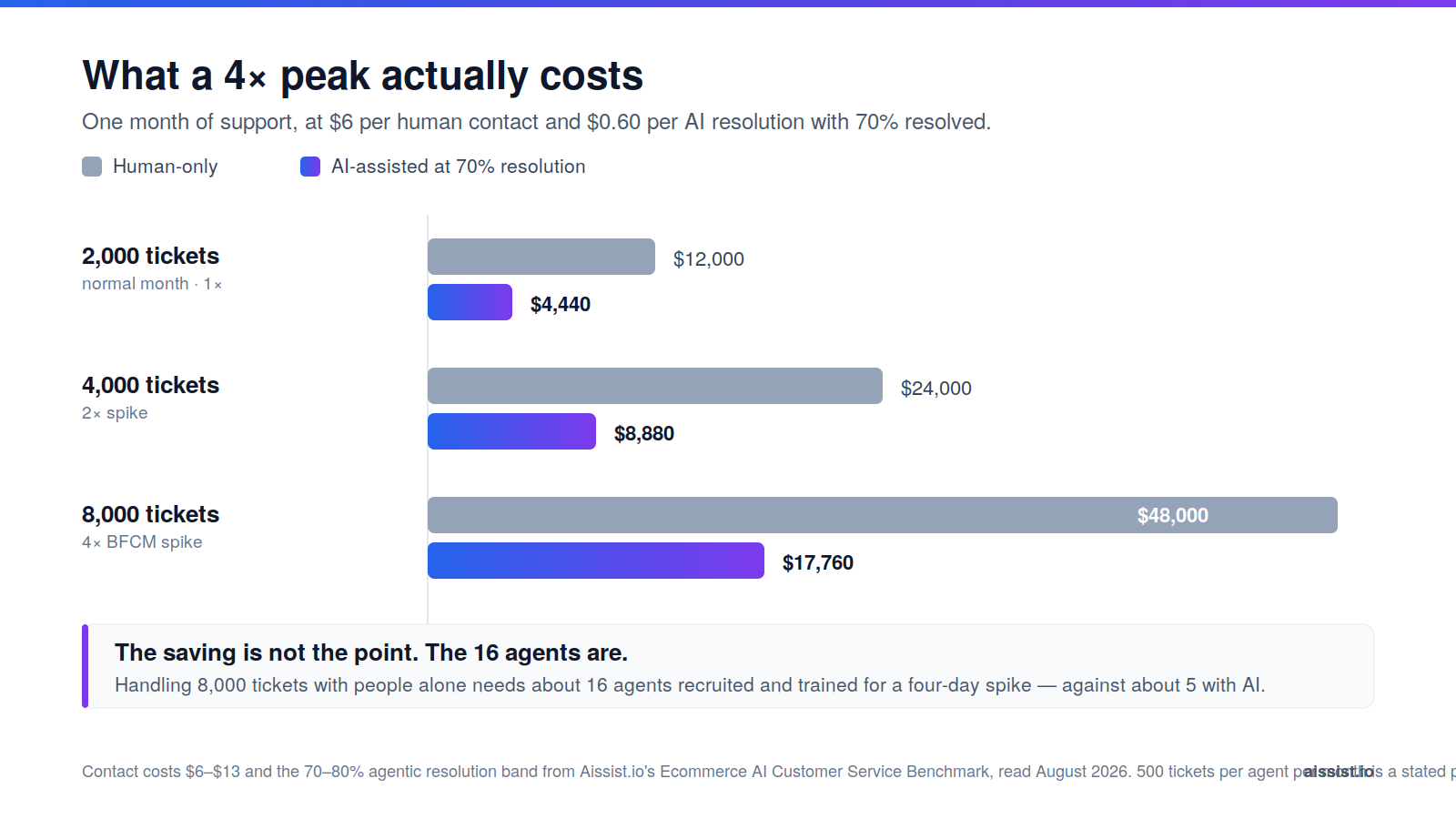
A support team running 2,000 tickets a month that spikes to 8,000 over BFCM faces roughly $48,000 in that month if humans handle everything, against about $17,760 with AI resolving 70%. The arithmetic uses $6 per human-handled contact — the low end of the $6–$13 ecommerce range in Aissist.io's ecommerce benchmark — and a 70% AI resolution rate, the low end of the 70–80% agentic band the same benchmark reports for ecommerce mixes.
| Monthly tickets | Human-only at $6/contact | AI-assisted at 70% resolution | Agents needed |
|---|---|---|---|
| 2,000 (normal) | $12,000 | $4,440 | 4 → 2 |
| 4,000 (2×) | $24,000 | $8,880 | 8 → 3 |
| 8,000 (4×) | $48,000 | $17,760 | 16 → 5 |
The AI-assisted column is $0.60 per resolution on the 70% the AI closes, plus $6 per contact on the 30% that reaches a person. Ecommerce-native rates sit in the same band — Gorgias lists $0.90 per automated resolution, read August 2026. Agent counts assume 500 tickets per agent per month — a planning assumption, not a benchmark.
The interesting number is not the saving. It is the 16 in the bottom row: staffing for a 4× peak with humans alone means recruiting and training sixteen agents for a spike that lasts four days, then carrying or releasing them in December.
Why does pricing model matter more than price at peak?
Seat-based pricing forces you to size for your busiest week and pay for it all year; outcome-based pricing charges for the peak in the month it happens. That is the whole volume-elasticity argument, and it only becomes visible in a seasonal business.
| Sized for a 4× peak | What December costs | |
|---|---|---|
| Per seat | 16 seats provisioned, annual licence | The same 16 seats |
| Per resolution | No provisioning — capacity is not a line item | Back to the 1× bill |
At $115 per agent per month on Zendesk Suite Professional (Zendesk pricing, read August 2026), sixteen seats is $22,080 a year in licences before a single salary. The per-resolution equivalent for a year with one 4× month and one 2× month is roughly $11,520 — and nothing to cancel afterwards.
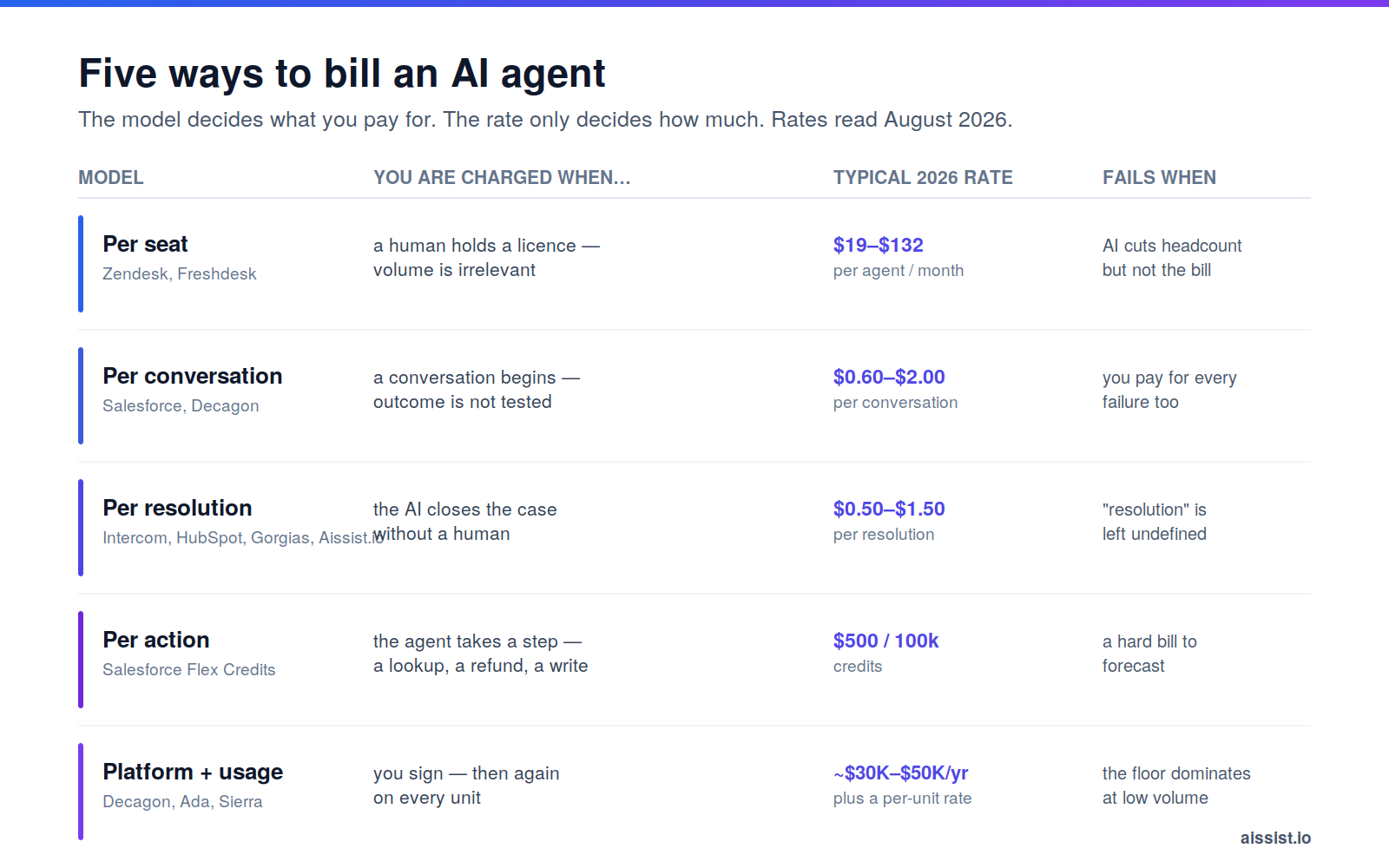
Neither model is wrong. Per seat is the cheaper shape for a flat-volume business with stable headcount. Peak-season ecommerce is the exact opposite of that, which is why the pricing model deserves more scrutiny in October than the rate does. The five models are compared in full in AI agent pricing models.
What is the week-by-week countdown to Black Friday 2026?
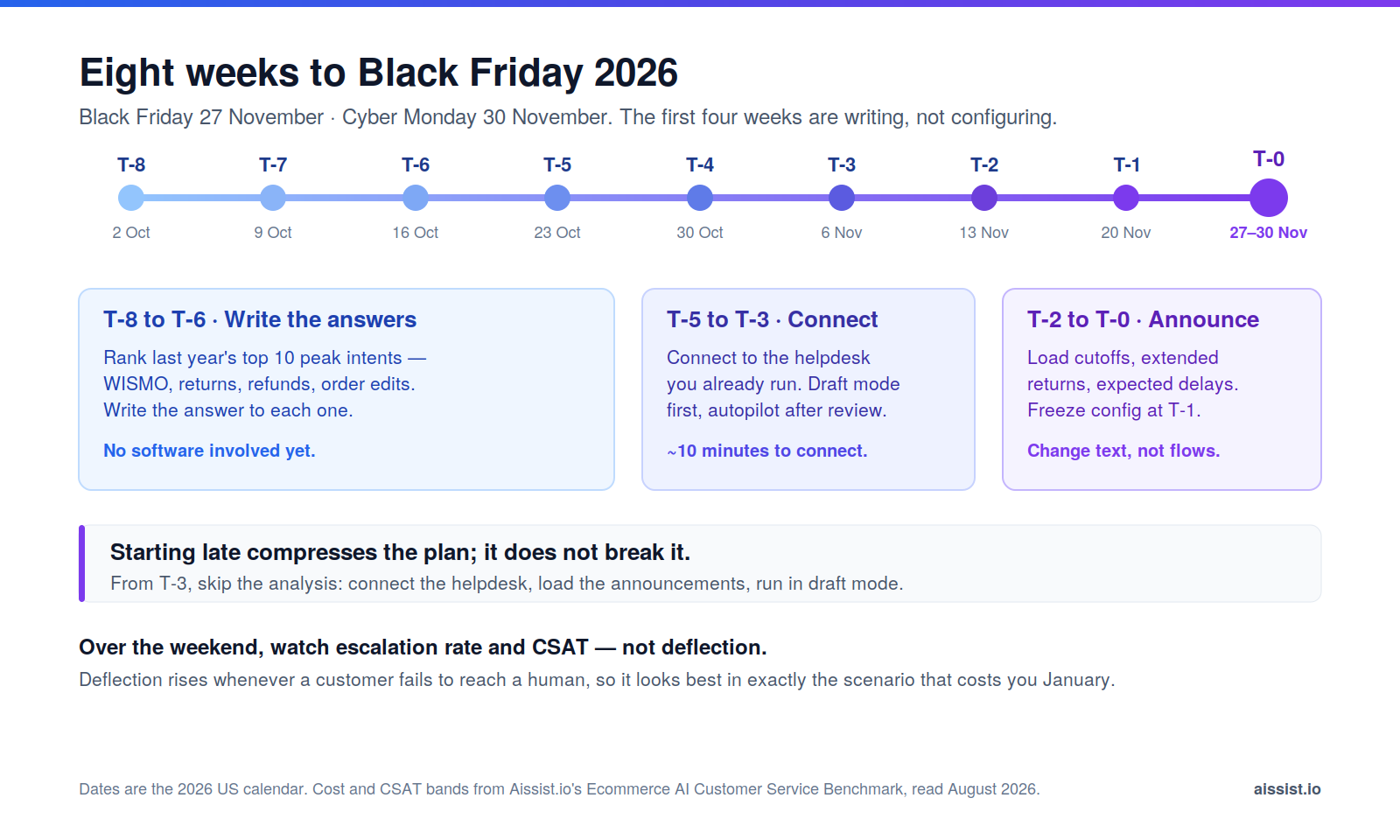
Eight weeks is enough, and the first four are about content rather than technology. The table below works backwards from Friday 27 November 2026.
| Week | Dates | What to do |
|---|---|---|
| T-8 | w/c 2 Oct | Pull last year's peak tickets. Rank the top 10 intents by volume — WISMO, returns, refunds, order edits, address changes |
| T-7 | w/c 9 Oct | Write the answers to those 10 intents. This is the work; everything downstream depends on it |
| T-6 | w/c 16 Oct | Confirm your promotion calendar, shipping cutoffs and returns window in writing |
| T-5 | w/c 23 Oct | Connect AI to your existing helpdesk. Run it in draft mode so humans approve every reply |
| T-4 | w/c 30 Oct | Review a sample of drafts. Fix the answers that are wrong; do not fix the ones that are merely terse |
| T-3 | w/c 6 Nov | Switch the top 3 intents to autopilot. Keep the rest in draft |
| T-2 | w/c 13 Nov | Load the peak announcements: cutoff dates, extended returns, expected delays |
| T-1 | w/c 20 Nov | Freeze changes. Brief the human team on what the AI now handles and what still escalates |
| T-0 | 27–30 Nov | Watch escalation rate and CSAT, not deflection. Adjust announcements, not configuration |
A team starting at T-3 rather than T-8 skips the analysis and goes straight to connecting the helpdesk and loading announcements. The plan compresses; it does not break.
How late can you still deploy AI before Black Friday?
Late enough that the deadline is not the constraint — Aissist.io connects to an existing helpdesk and goes live in about ten minutes (vendor-claimed, pricing). There is no migration, no data warehouse project and no conversation layer to replace.
That matters in November for one specific reason: every alternative to a fast deployment is worse at this point in the calendar. Recruiting seasonal agents takes weeks and the training lands in the week you can least afford it. Replatforming your helpdesk in November is not a plan, it is a hazard. And by comparison, enterprise AI deployments are slow by design — Sierra's own fastest published rollout is 30 days.
The practical rule: if you are more than a week out, you have enough time to connect, run in draft mode, review, and switch on. If you are inside a week, connect it in draft mode anyway and let it write suggested replies for your humans. A drafting assistant deployed on the Tuesday of peak week still takes real minutes off every ticket, and it carries no risk of a wrong answer reaching a customer.
How do you change AI behaviour mid-peak without a developer?
You write the change down in plain language, the same way you would tell a new hire. Peak season is a fortnight of moving targets — a shipping cutoff moves, a SKU sells out, a promotion gets extended by 48 hours — and the failure mode of rules-based automation is that every one of those needs a flow rebuilt by whoever owns the tool.
Instructions and announcements handle the two kinds of change separately:
- An instruction changes how the AI behaves: "Customers asking about orders placed after 19 December should be told delivery is not guaranteed before the 25th."
- An announcement changes what it proactively tells people: "Free returns are extended to 31 January for all orders placed during BFCM."
Both are text. Neither is a flow, a decision tree, or a ticket to engineering. Aissist.io's approach is set out in no flows, no trees, no rules, no code — the point is that the person who knows the policy is the person who can change the behaviour, at the hour the policy changes.
This is the part of a peak-season playbook that most vendors skip, because for most tools the honest answer is "raise a ticket with your implementation partner."
What does this look like when it works?
Two named ecommerce deployments, both published with their numbers. GameRoomShop reports 60% of inbound conversations fully resolved without a human touching them, and — the peak-season part — eliminating the need for additional hiring (case-study, GameRoomShop).
Sunroom reports that 100% of inbound sales inquiries are handled by AI, with 98% resolved end to end and only 2% escalated to human staff, primarily edge cases and exceptions (case-study, Sunroom).
Both are vendor-published customer stories rather than independent audits, and should be read as such. What makes them useful for peak planning is the shape rather than the size: neither team hired for a spike, and neither replaced their existing stack to get there.
On the customer side, the benchmark reports AI-resolved CSAT in ecommerce at 82–93% positive, which is the number worth watching in December — if resolution climbs while CSAT falls, the automation is suppressing escalation rather than solving problems.
The BFCM pre-flight checklist
Run this in the week of 20 November. Every item is a yes/no.
- The top 10 peak intents have written answers, reviewed by someone who knows the policy.
- Shipping cutoff dates are loaded as an announcement, with the exact dates, not "late December."
- The returns window is stated in the AI's instructions, including any BFCM extension.
- Escalation rules are explicit — what always goes to a human, and how fast.
- Out-of-stock behaviour is defined: what the AI says when a SKU sells out mid-promotion.
- The human team has been briefed on which intents the AI now owns.
- Draft mode has been tested on real tickets, with a sample reviewed for accuracy.
- A rollback is one switch, and someone on duty knows where it is.
- CSAT and escalation rate are on a dashboard you will actually look at on the Friday.
- Someone owns announcements during the weekend, with authority to change them without a meeting.
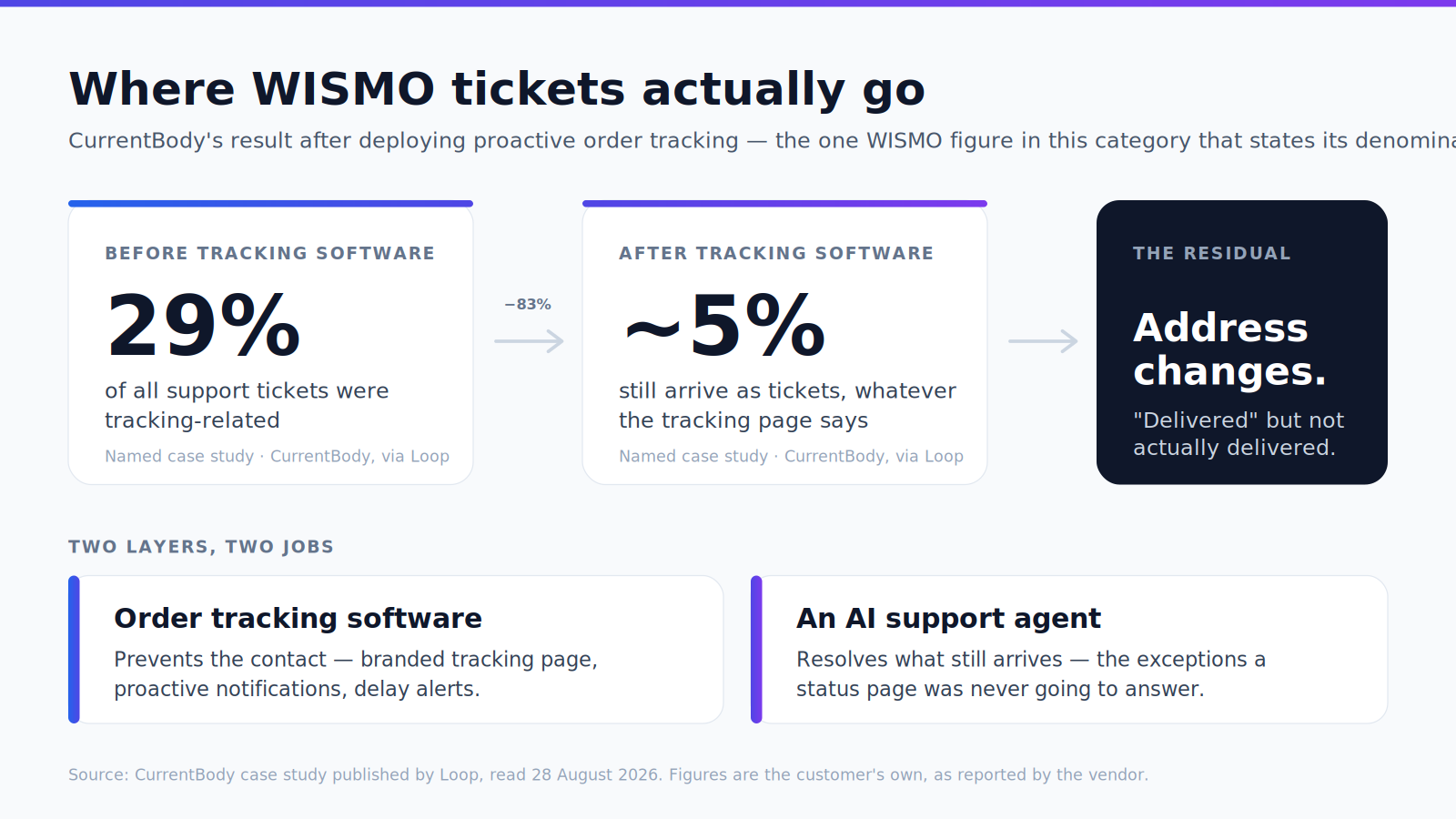
Order-tracking questions dominate this list for a reason — WISMO, returns and refunds are the highest-volume, most-automatable intents in ecommerce. If you have not yet cut WISMO at the source, order tracking software prevents the contact before support has to resolve it.
Three weeks out and nothing deployed? Aissist.io connects to the helpdesk you already run in about ten minutes — draft mode first, so a human approves every reply before peak week. See pricing · Book a consultation →
Key takeaways
The BFCM support decision is a shape decision, not a volume decision: a 4× spike costs about $48,000 a month in human handling and about $17,760 at 70% AI resolution, and the pricing model determines whether that cost falls again in December. Eight weeks is a comfortable runway and the first four weeks are writing answers, not configuring software. If you are late, you are less late than you think — a ten-minute deployment onto the helpdesk you already run, in draft mode, still helps on the Tuesday of peak week. And through the weekend itself, watch escalation rate and CSAT rather than deflection, because the metric that makes peak look successful is not the one that makes customers come back in January.
Frequently asked questions
When is Black Friday 2026?
Black Friday falls on 27 November 2026, with Cyber Monday on 30 November 2026. An eight-week support preparation window starts the week commencing 2 October 2026, and the first four of those weeks are spent writing answers rather than configuring tools.
How much does a Black Friday ticket spike cost?
A team going from 2,000 to 8,000 monthly tickets faces roughly $48,000 in that month at $6 per human-handled contact. With AI resolving 70%, the same spike costs about $17,760. Ecommerce contact costs range $6–$13 per Aissist.io's benchmark.
Is it too late to deploy AI support before Black Friday?
Not if you are more than a week out. Aissist.io connects to an existing helpdesk and goes live in about ten minutes, so the constraint is your answer content, not the software. Inside a week, deploy in draft mode so humans approve every reply.
How many agents do I need for a 4× peak?
At 500 tickets per agent per month, 8,000 tickets needs about 16 agents handled entirely by humans, or about 5 with AI resolving 70%. The recruiting and training for sixteen seasonal agents lands in the weeks you can least afford the disruption.
Do I have to replace my helpdesk to add AI for peak season?
No. Aissist.io runs on Zendesk, Intercom, Freshdesk, Gorgias, Kustomer, Front, Salesforce and HubSpot rather than replacing them. Replatforming a helpdesk in November is a risk with no upside; the AI layer sits on the stack you already run.
How do I change AI behaviour when a promotion changes mid-peak?
Write it down. An instruction changes behaviour ("orders after 19 December are not guaranteed by the 25th") and an announcement changes what the AI proactively tells customers. Both are plain text, so the person who owns the policy makes the change.
What should I measure over the BFCM weekend?
Escalation rate and CSAT, not deflection. Deflection rises whenever customers fail to reach a human, so it looks best in exactly the scenario that damages January revenue. AI-resolved CSAT in ecommerce runs 82–93% positive per Aissist.io's benchmark.
Which ticket types automate best during peak?
WISMO, returns, refunds, order edits and address changes — well-defined, repetitive intents that make up the bulk of ecommerce peak volume. Open-ended technical support automates less well, which is why an ecommerce mix outperforms a SaaS one at the same maturity.
Changelog
- 31 August 2026 — First published. Cyber Week 2025 spending read from Adobe Analytics' 2 December 2025 release. Ecommerce contact costs ($6–$13), the 70–80% agentic resolution band and AI-resolved CSAT (82–93% positive) from Aissist.io's Ecommerce AI Customer Service Benchmark. Seat pricing read from Zendesk, and Gorgias's $0.90 per automated resolution from its own pricing post, both August 2026. GameRoomShop and Sunroom figures are vendor-published customer stories. BFCM dates are the 2026 US calendar.