Checked 17 Nov 2026 · rechecked monthly · every row carries a dated source or it does not go in.
TL;DR: Do companies allow AI agents? They split three ways — serve, gate or block — and Visa's benchmark, where 54% of failed shopping runs still ended in a purchase, shows why blocking at the front door does not keep agent mistakes out of support.
| Company | Stance | What exactly is restricted or enabled | Announced | Dated source |
|---|---|---|---|---|
| United Airlines | Block | Unauthorized third-party AI agents may not search, book, buy or manage trips on united.com, the app, or via agencies and aggregators. Research elsewhere is still allowed; agent bookings made before 11 Nov are not cancelled. | 11 Nov 2026 | Skift, 11 Nov 2026 |
| eBay | Block (approved exceptions) | User agreement bars "buy-for-me agents, LLM-driven bots, or any end-to-end flow that attempts to place orders without human review" unless eBay approves. | Posted 20 Jan 2026; effective 20 Feb 2026 | The Register, 22 Jan 2026 |
| Amazon | Block (undisclosed agents) | Sued Perplexity to stop Comet agents accessing the store and customer accounts; says it expects to partner with third-party agents later. | 4 Nov 2025 | Retail Dive, 4 Nov 2025 |
| Zendesk (Open Service Directory) | Serve | Open spec plus public directory of verified support destinations. Brands control what is shared and when human review is required; the directory does not access private customer data or take service actions. | Spec 13 Oct 2026; launched in Outcome AI Platform, AI Summit, 10–12 Nov 2026 | Zendesk, 13 Oct 2026; CX Network, 11 Nov 2026 |
| Betterment | Serve | OSD launch partner | 13 Oct 2026 | Zendesk, 13 Oct 2026 |
| ElevenLabs | Serve | OSD launch partner | 13 Oct 2026 | Zendesk, 13 Oct 2026 |
| Flex | Serve | OSD launch partner | 13 Oct 2026 | Zendesk, 13 Oct 2026 |
| TeamSystem | Serve | OSD launch partner | 13 Oct 2026 | Zendesk, 13 Oct 2026 |
| TBAuctions | Serve | OSD launch partner | 13 Oct 2026 | Zendesk, 13 Oct 2026 |
| Telekom Payment S.A. | Serve | OSD launch partner | 13 Oct 2026 | Zendesk, 13 Oct 2026 |
| Wireless Logic | Serve | OSD launch partner | 13 Oct 2026 | Zendesk, 13 Oct 2026 |
| Cresta (Sentry-0.1) | Gate | Real-time model that detects personal AI agents in conversations, so businesses can set topic guardrails and send account changes or payments to extra verification. Cresta says detection does not replace identity verification. | 12 Oct 2026 | Cresta, 12 Oct 2026 |
Methodology & sources
- Inclusion rule: a row ships only with a dated primary source or dated first report. Rows are rechecked monthly; changes go in the changelog.
- Primary sources: Zendesk, Cresta, Visa and Talkdesk announcements; coverage of United's and eBay's terms and Amazon's lawsuit.
- First-hand: we read the Open Service Directory developer docs (version 0.3.0, marked draft) on 17 Nov 2026.
- Aissist figures: 83% average resolution and 4.8/5.0 CSAT, from Aissist's AI customer service benchmark.
- Disclosure: this is Aissist's blog. Aissist sells AI agents that resolve and act on support requests, which is a gate-lane product.
What are the three lanes, and what does each cost?
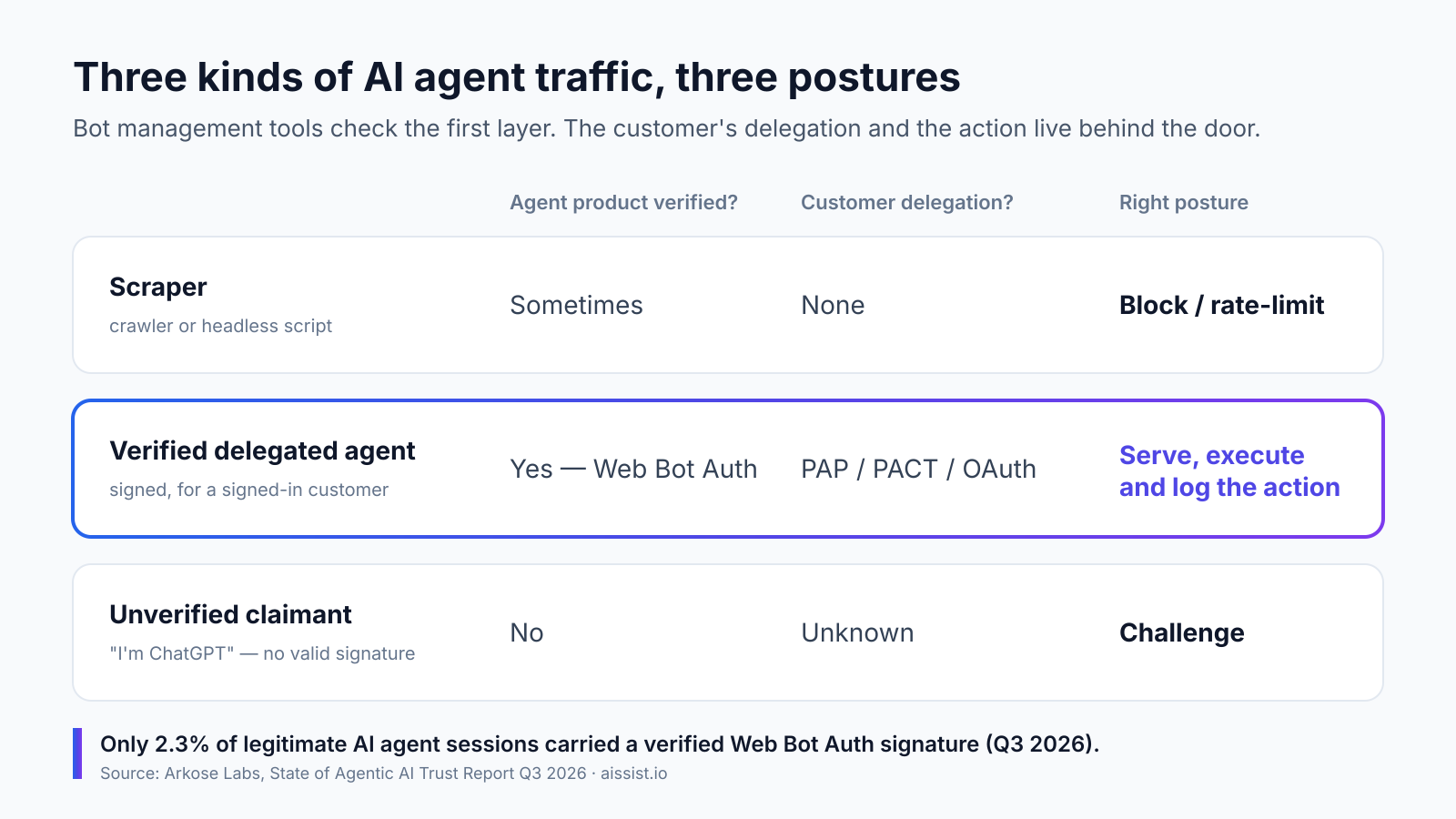
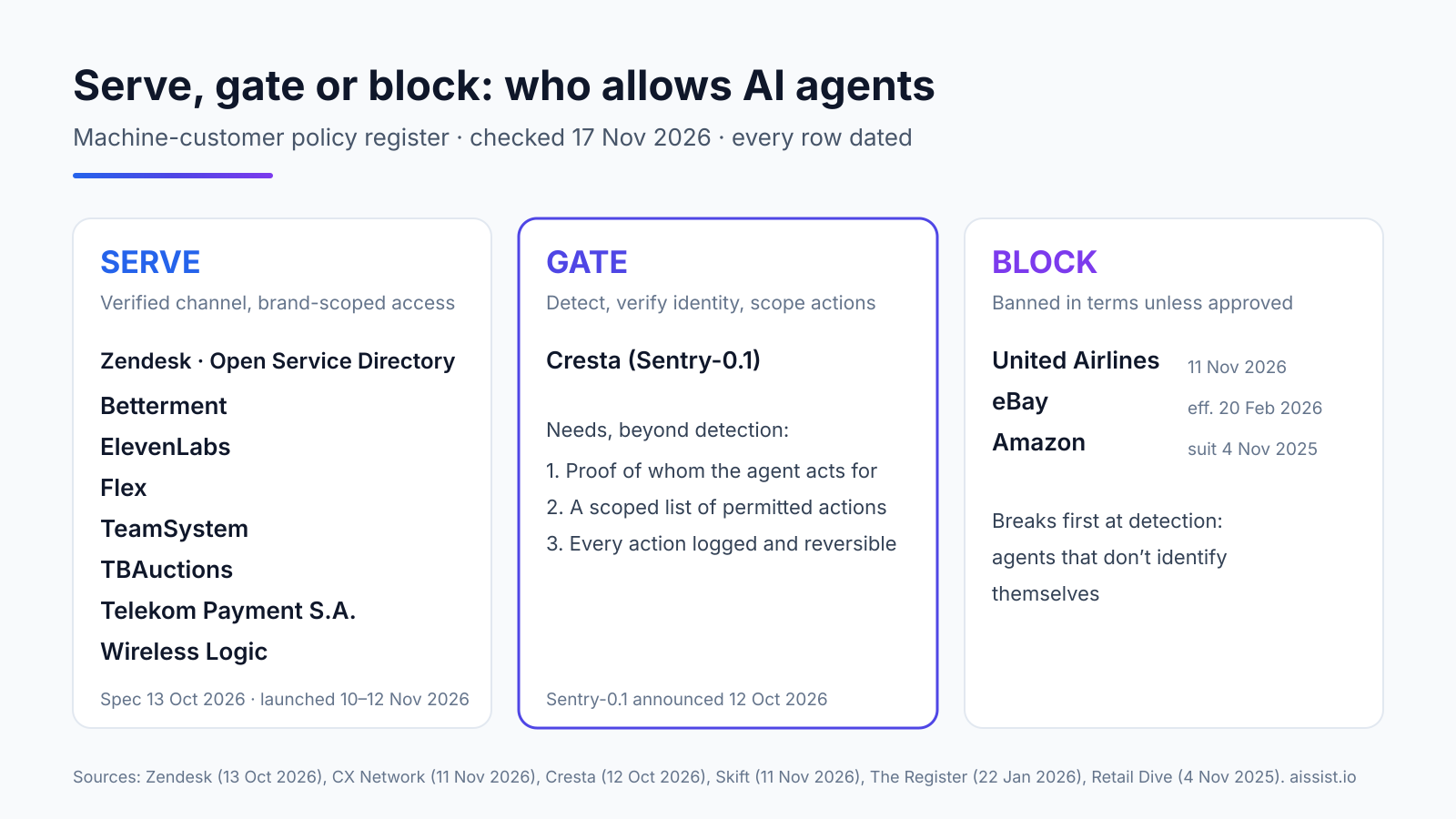
Every company answering "do we allow AI agents?" has picked one of three lanes: serve agents through a verified channel, gate them behind detection and identity checks, or block them in the terms of service. The lanes rest on different bets about how much agent traffic is coming, and each fails in a different place.
| Lane | What it assumes | What it costs you | What breaks first |
|---|---|---|---|
| Serve | Agents become a mainstream channel; verified routing beats fighting it | A published listing, per-agent scope for data and actions, a human-review path | Scope: the agent asks for something the listing never anticipated |
| Gate | Agents are customers' delegates, but each request must prove who and what | Detection, identity verification, permissioned actions that are logged and reversible | Verification: a detected agent with no way to prove whom it acts for |
| Block | Agent traffic stays small and the terms of service hold | Enforcement, cancelled bookings, and the agents' mistakes arriving as tickets | Detection: agents that don't identify themselves |
The block lane's failure point already has a court filing. Amazon's complaint says Perplexity configured Comet to not identify the agent's activity in the Amazon Store, according to Reuters via The Star. A ban is a policy for the traffic you can see.
Even the blockers leave a door ajar. eBay allows agents with its prior permission, and United's FAQ says it doesn't yet work with any third-party agents but wants direct, secure integrations, as Silicon Report notes — which is a gate with nobody standing at it yet.
Why does the block lane still land in your support queue?
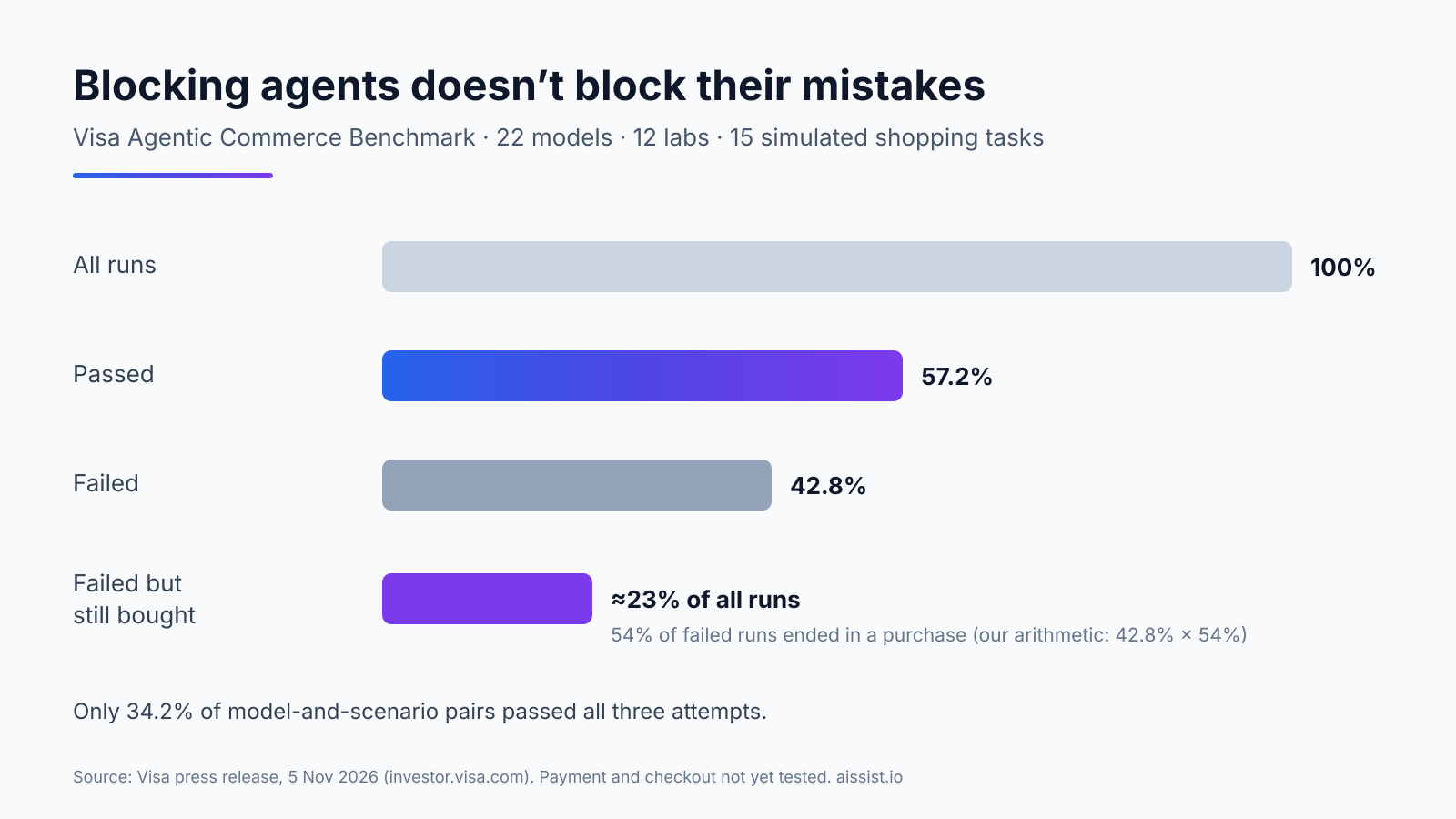
Blocking stops an agent from transacting on your site, but it does not stop agents from buying the wrong thing elsewhere and the customer contacting you about it. The reliability data says those mistakes are common.
Visa's Agentic Commerce Benchmark, released 5 November, put 22 models from 12 labs through 15 shopping tasks. They passed 57.2% of runs, and only 34.2% of model-and-scenario pairs passed all three attempts. Visa adds that 54% of failed runs still ended in a purchase — roughly one run in four, by our arithmetic, ending in a product that missed the shopper's requirements. The tasks were simulated; Visa says checkout and payment testing comes next.
"AI agents have the potential to power the next era of commerce, but trust is key to making it work." — Rubail Birwadker, Global Head of Growth, Visa
A wrong purchase becomes a return, a dispute and a ticket. None of those routes through the front door the block lane guards. Meanwhile retailers are building for agents faster than shoppers trust them: Talkdesk's 2026 survey found 89% of US retail leaders have optimized for purchasing agents or are planning or testing them, while just 15% of US consumers would let an agent buy with their payment details.
"We have to find a way, though, that makes the customer experience good. Right now, I would say the customer experience is not." — Andy Jassy, CEO, Amazon, on third-party agents, via Customer Experience Dive
What does the gate lane actually require?
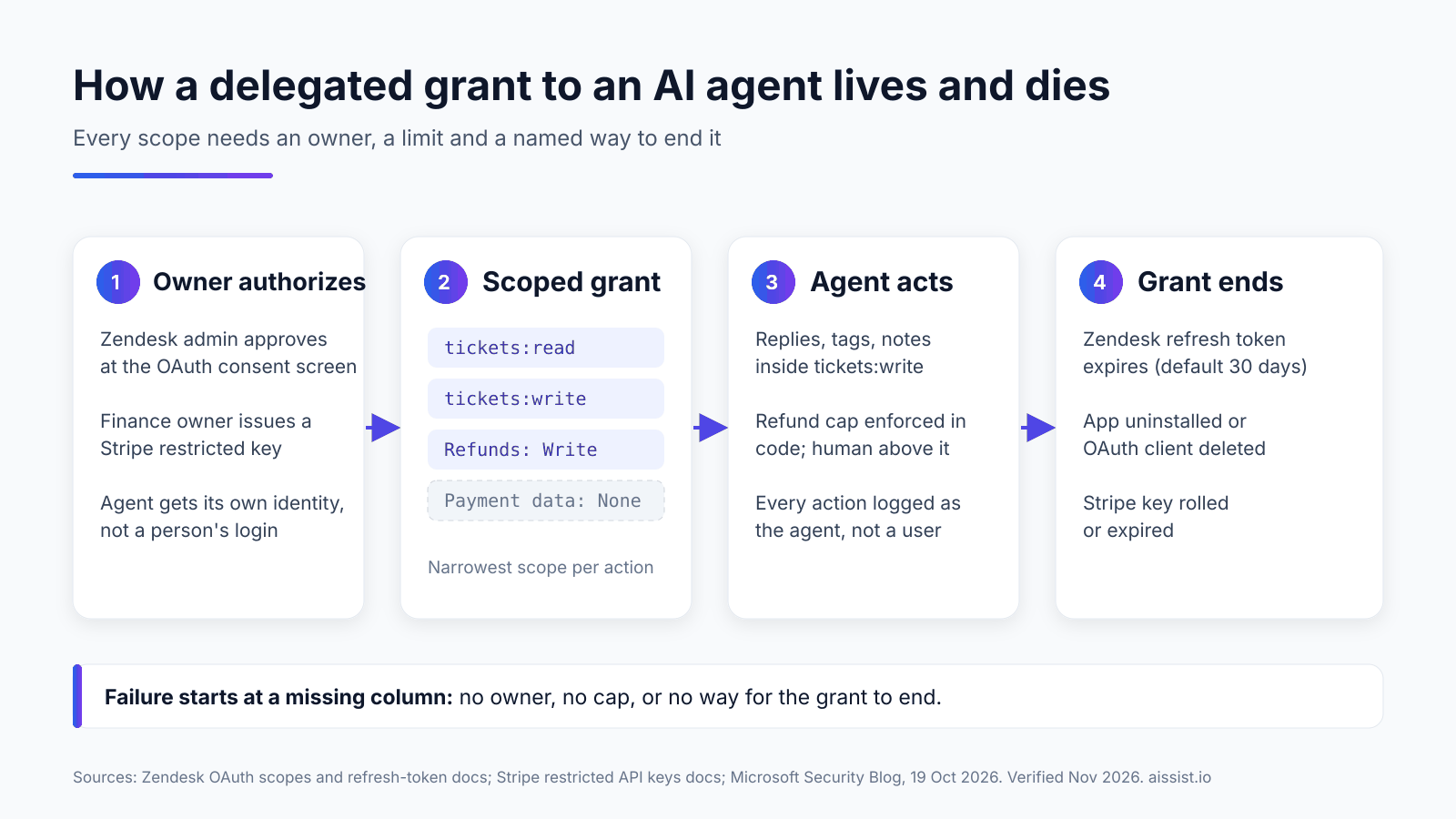
Gating requires three things detection alone does not give you: proof of whom the agent acts for, a scoped list of actions it may take, and a system that can log and reverse every action. The vendors building this lane say so themselves.
"No single signal should determine whether a customer receives service or whether a sensitive action is approved." — Ping Wu, CEO, Cresta
Cresta reports that personal-agent traffic to its customers spiked more than 80x in mid-September, and it built Sentry-0.1 to flag those callers. But its own guidance sends account changes and payments to extra verification or customer approval. Recognising an agent is the start of the check, not the check.
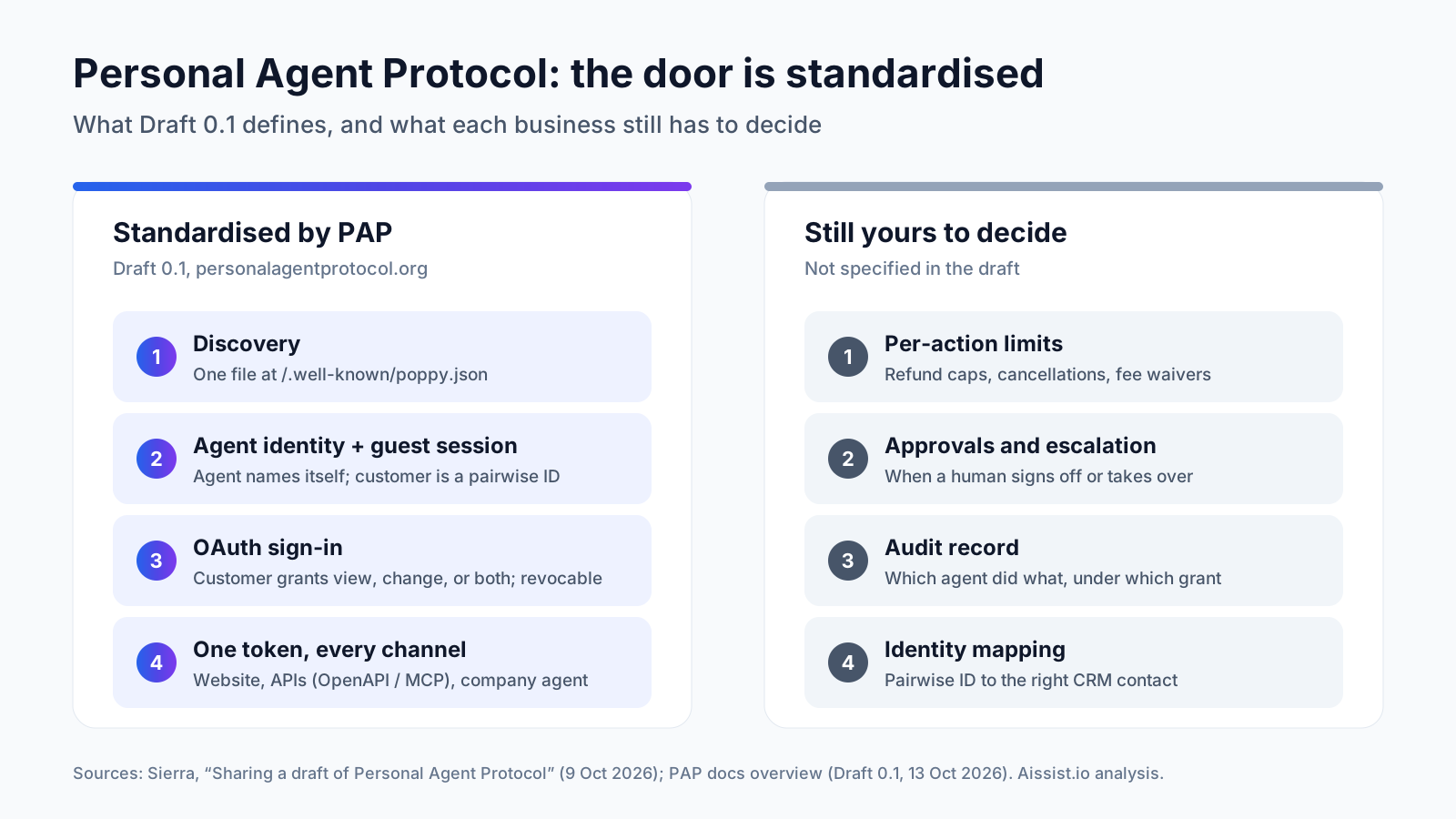
The serve lane hands off the same work. When we read the Open Service Directory docs on 17 November, version 0.3.0 (still marked draft) states that the directory doesn't handle authentication, permissions or the operations a support agent offers — the brand's own agent does. Zendesk's routing gets the assistant to the right door; what happens inside is yours.
That is where a support platform earns its place. The gate needs an agent on your side that verifies the customer, takes the action in your helpdesk, and records it so a human can undo it. Aissist's AgentMesh™ reports an 83% average resolution rate and 4.8/5.0 CSAT on its benchmark page. For the mechanics, see our explainers on delegated authorization and the personal agent protocol.
Five questions before you write an AI-agent policy
A workable machine-customer policy answers five questions in writing before the first agent calls.
- Which requests may an agent make, and which may it only read? Order status is not a refund. United's terms separate researching from booking; yours should separate reading from changing.
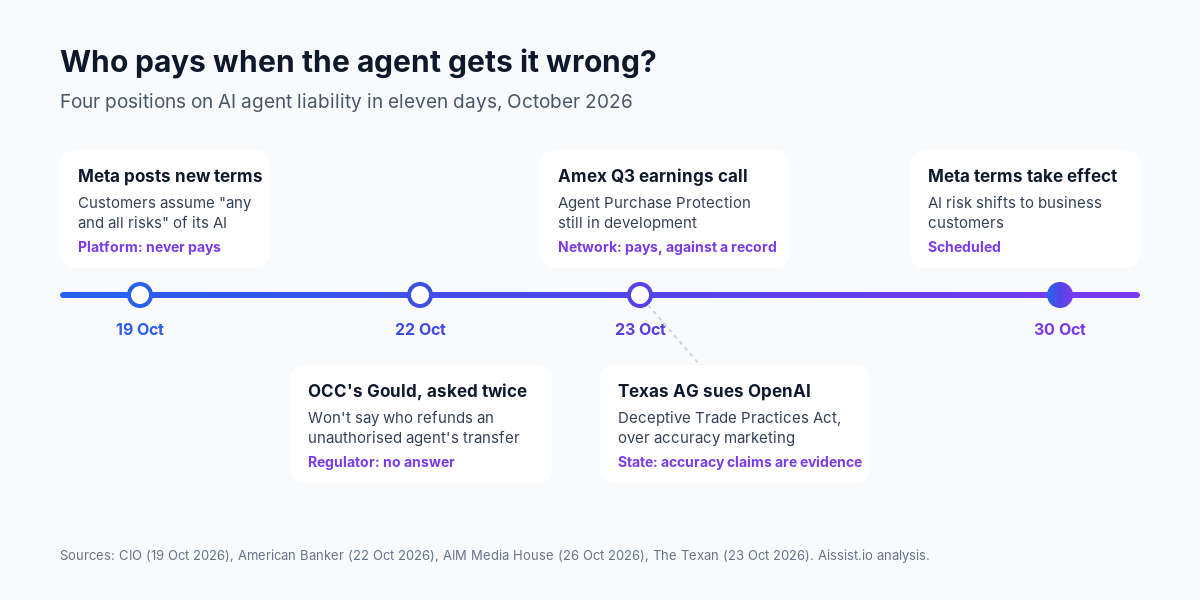
- How will you know whom the agent acts for? Detection tells you it's software. Identity verification tells you it's authorised — see AI agent liability in customer service.
- Can every agent-initiated action be logged and reversed? If not, keep that action human-only until it can.
- Where does a request go when it needs a person, and does the context travel? Zendesk's OSD post describes escalation to the support team with the conversation history attached. Re-asking a delegate everything defeats the delegation.
- What will you publish, and when will you recheck it? United published a help page and revised its Contract of Carriage on 11 Nov 2026, according to Unite.AI. A policy nobody can find is a policy agents will not follow.
Run your current setup against these with our AI agent security review, and compare detection tooling in best bot management tools for AI agents.
Do companies allow AI agents to contact customer support?
Some serve AI agents through verified channels, some gate them behind identity checks and limits, and some block them in their terms of service.
As of 17 November 2026, the register above shows no industry default. Airlines and marketplaces lean toward blocking, support platforms are building the serve and gate lanes, and commerce networks are standing up the buy side — see best agentic commerce platforms. The practical answer for a support team is narrower: whatever your front door says, the customer whose agent got it wrong will still reach you.
Gate is the only lane that scales — and it is a support problem, not a firewall problem
The block lane is a bet that agent traffic stays small, and it exports its failures into support anyway; the gate lane is the only one that scales. Gating is only as good as what sits behind detection: identity verification, a scoped list of permitted actions, and a system that logs and reverses what the agent did. Start with the five questions, publish the answers, and treat the agent as a customer's delegate who must prove its mandate. We'll keep the register current — next check, December 2026.
Frequently asked questions
Which companies block AI shopping agents?
United Airlines (announced 11 Nov 2026), eBay (user agreement effective 20 Feb 2026) and Amazon against undisclosed agents (lawsuit filed 4 Nov 2025). eBay and United both leave room for agents they approve.
Can an AI agent contact customer support on my behalf?
Increasingly yes, where the company publishes a verified channel such as a Zendesk Open Service Directory listing. Where a company blocks agents, transactions they make can be cancelled; United reserves that right in its Contract of Carriage.
Is it legal for a company to ban AI agents?
Companies impose bans through contract terms, such as United's Contract of Carriage and eBay's user agreement. Whether a given ban is enforceable depends on jurisdiction and facts. This is not legal advice; ask a lawyer.
How do businesses detect AI agents in support conversations?
Through self-disclosure, conversational-pattern models such as Cresta's Sentry-0.1, and emerging verified-identity protocols. Cresta says no single signal is conclusive, so detection should trigger verification rather than replace it.
How reliable are AI shopping agents today?
In Visa's November 2026 benchmark, 22 models passed 57.2% of simulated shopping runs, and only 34.2% of model-and-scenario pairs passed all three attempts.
How often is this register updated?
Monthly. Every row carries a dated primary source or first report; rows that lose their source are removed and noted in the changelog.
Changelog: 17 Nov 2026 — register published with 12 rows.