Aissist has been named Most Innovative CX Technology at CX Today's CX Awards 2026, a category judged on originality and potential. The idea behind it: let AI run the operation, not just answer the customer.
TL;DR: CX Today's blind-judged panel recognised Aissist for an AI-native operation that executes work end to end, explains what happened, and improves itself — and customer support and sales are where it starts, not its limit.
Methodology & sources
- Award details from CX Today's winners announcement and category guide; product facts from aissist.io product pages and customer stories.
- Aissist figures: 83% average resolution (up to 98% in mature deployments), 4.8/5.0 CSAT.
- All facts verified November 2026. Disclosure: this is Aissist's blog, celebrating Aissist's award.
What did CX Today recognise as the most innovative CX technology?
CX Today recognised an approach, not a feature: an AI-native operation for the whole business, delivered first in customer support and sales. The CX Awards category guide describes Most Innovative CX Technology as celebrating genuinely novel approaches, judged on originality and potential. According to CX Today, every entry was judged blind, with brand names removed, by a panel of 25 enterprise leaders and analysts. Nobody won on logo recognition, which is fortunate for a small team.
"Every one of these winners earned their place on the evidence." — Rob Wilkinson, Chair of the judging panel, CX Today
Support and sales came first for a practical reason: that is where volume, cost and customer patience collide every day. Starting there was a strategic choice. It says nothing about where the approach ends.
"We started with customer support and sales because that's where the pressure is highest. It was a strategic choice, not a limit of the approach." — Michael Wei, Founder, Aissist
Why does an AI-native operation start with execution?
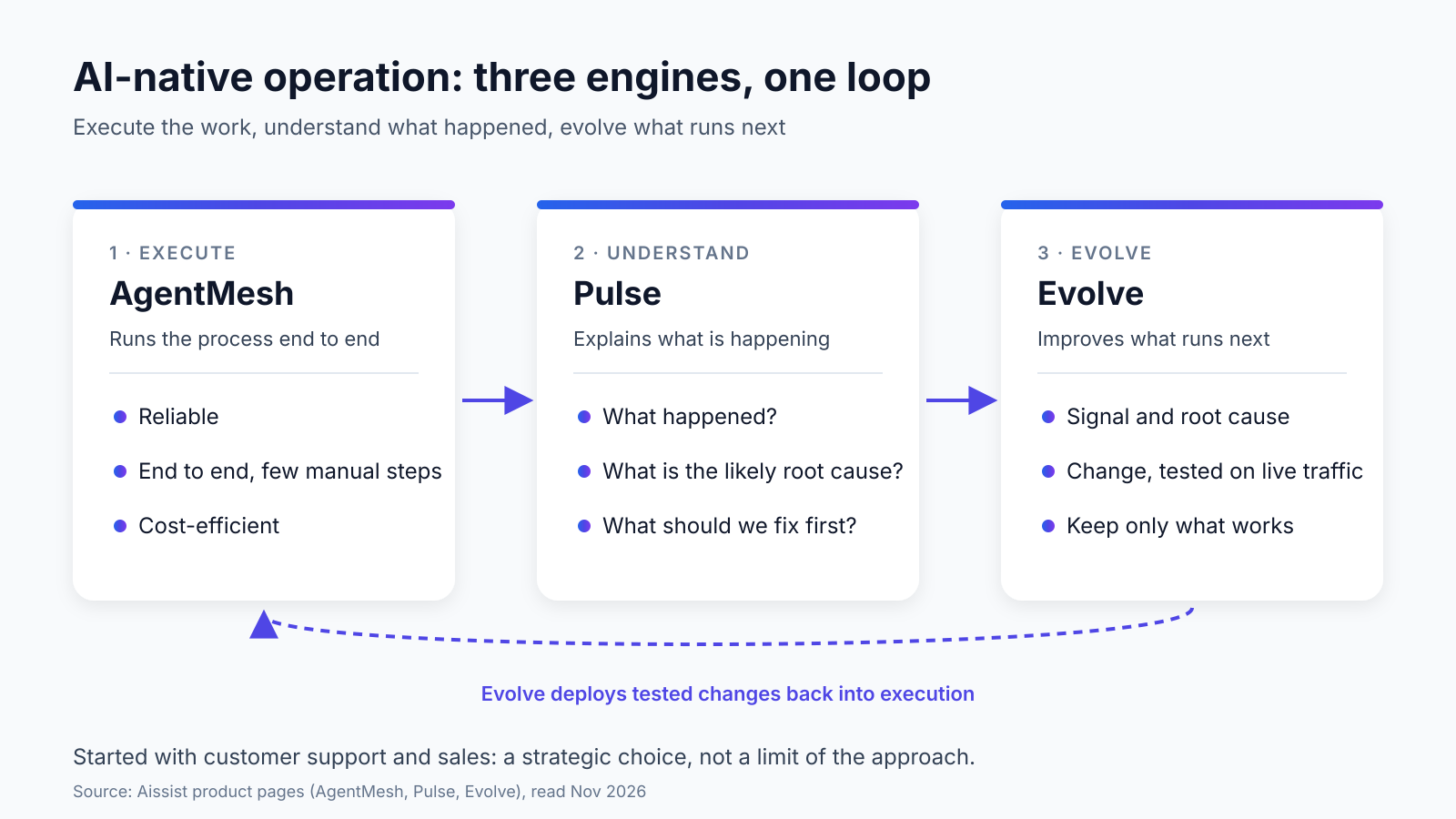
Business operations still run on manual steps, and every manual step costs speed and consistency. A process is only as fast as its slowest hand-off, so the first job is a reliable execution engine that runs the work from end to end. It has to meet three criteria:
- Reliable. An engine that is right most of the time still needs a human checking all of the time.
- End to end. The more manual steps a process keeps, the more likely one of them becomes the bottleneck for the whole thing.
- Cost-efficient. Automation that costs more than the people it relieves is a hobby, not an operation.
AgentMesh™ is that engine. It works inside the helpdesk and CRM a team already runs, and Aissist reports an 83% average resolution rate (up to 98% in mature deployments) with 4.8/5.0 CSAT.
"We built Aissist to remove the dependency on linear scaling, so teams can handle growth without continuously adding headcount." — Lifan Xu, Co-founder, Aissist, via CIOReview
What happens when something goes wrong?
When an incident hits, a business needs three answers fast: what happened, the likely root cause, and how to fix it. Those critical moments decide how far a business can go, so we built Pulse™ to answer them in real time rather than in next week's report.
On 30 October 2026, a carrier-side outage cut mobile data for a global telecom provider's subscribers. Support volume reached about 20x normal within the hour. An AI operations agent traced the spike to a carrier connectivity outage in about 25 minutes, Pulse's Ask Engine confirmed it independently, and CSAT for the AI's conversations that night held at 4.8/5.0.
The same questions apply on good days. When an online payments company launches a new product, it wants to know what users are saying and which improvements to prioritise — this week, not next quarter.
Can the operation improve itself?
Yes: once execution and intelligence share one system, the findings can change how the work runs. That is the job of Evolve™. It reads the signals Pulse produces, diagnoses the root cause, tests a change on live traffic, keeps what works and rolls back what doesn't.
Low-risk changes apply automatically. Anything touching policy, compliance, pricing or brand goes to a human for approval. Every change is measured against resolution, CSAT, sentiment and conversion together, so fixing one number can't quietly break another. Signals and root-cause analysis run in production today; the fully self-evolving loop is running with design partners.
Picture the outage above. Once the root cause is known, agents should stop walking customers through phone resets and say plainly that the carrier is down. Evolve exists to make that switch without waiting for someone to rewrite the playbook.
Execution without insight is fast but blind. Insight without execution is a very good report. The loop is the product.
Support and sales are the starting line, not the boundary
The award recognises a model that any operation can run on: execute reliably end to end, understand what happened, and evolve what runs next. We built it where the pressure was highest, in support and sales. The same engines apply wherever work still runs on manual steps.
See the operation that won. Read how teams run support and sales on Aissist. Read customer stories →
Frequently asked questions
What is the Most Innovative CX Technology award?
It is a CX Today CX Awards 2026 category that recognises genuinely novel approaches to customer experience technology, judged on originality and potential by a blind panel.
What does "AI-native operation" mean?
An AI-native operation is one where AI runs the work end to end, explains what happened, and improves the process itself, with humans approving high-risk changes.
Is Aissist only for customer support?
No. Aissist started with customer support and sales by choice; the execute, understand, evolve approach applies to any process driven by manual steps.
How does Aissist find the root cause of an incident?
Pulse and Aissist's AI operations agents read live conversations and system signals to identify what changed. In one telecom outage, the root cause was traced in about 25 minutes.