White-Label AI Customer Support: What Agencies and BPOs Should Actually Ask For
White label AI customer support means reselling a vendor's AI agent under your own brand — and the six terms that decide whether it is profitable are branding depth, data ownership, billing unit, reseller margin, minimum commitment, and the client-transfer clause. Most of them are not published anywhere. Across nine platforms checked on 9 September 2026, three publish a per-resolution price, two publish no price at all, and not one publishes a client-transfer clause or a minimum commitment.
All pricing, terms, and quotes in this article were read from the vendors' own live pages on 9 September 2026. Aissist.io sells a partner program, so treat the last section as what it is — we have declared the bias and sourced our own numbers the same way we sourced everyone else's.
TL;DR:
- The "white label AI customer support" market is really two markets: flat-fee agency chatbot licences ($97–$497 per month, unlimited markup, you do all the work) and per-resolution support platforms ($0.20–$1.25 per resolution, vendor does the resolution). Comparing them on price alone is how agencies pick wrong.
- Per-resolution pricing survives a margin stack; fixed monthly fees do not. A variable-only platform holds the same gross margin at 1,000 resolutions as at 10,000. A platform with an unquoted monthly fee can go negative on a small account.
- "White label" ranges from removing a widget badge to end-to-end brand ownership. Chatbase charges $99 per month to remove "Powered By Chatbase" (Chatbase pricing, read September 2026). CustomGPT.ai states plainly that "fully unbranded delivery is not offered on standard programs" (CustomGPT.ai, read September 2026).
- No platform we checked publishes a client-transfer clause. Get it in writing before the client asks to go direct, not after.
What does "white label AI customer support" actually mean?
White label AI customer support is a reseller arrangement in which an agency or BPO deploys a vendor's AI support agent under its own brand, bills the end client directly, and keeps the difference between the vendor's price and the client's price. The vendor supplies the model, the integrations, and the resolution engine. You supply the brand, the client relationship, and — usually — the blame when something breaks.
The phrase covers four very different depths of branding, and vendors use the same two words for all four:
| Branding depth | What the client sees | What still shows the vendor |
|---|---|---|
| Skinned | Your logo and colours in the chat widget | "Powered by [vendor]" badge, vendor domain, vendor emails |
| Badge removed | No vendor badge in the widget | Vendor domain, admin console, notification emails |
| Domain-level | Your subdomain, your widget, your admin login | Vendor branding in billing, docs, legal terms |
| End-to-end | Your brand everywhere the client or their customers ever look | Nothing customer-facing |
Ask which row you are buying. Seven of the nine platforms below describe their branding depth somewhere public; Intercom and Zendesk describe it nowhere. Even so, "white label" as a marketing phrase almost never tells you which row — and a sales call is a slow, expensive way to discover you bought row one.
What do the nine platforms actually publish?
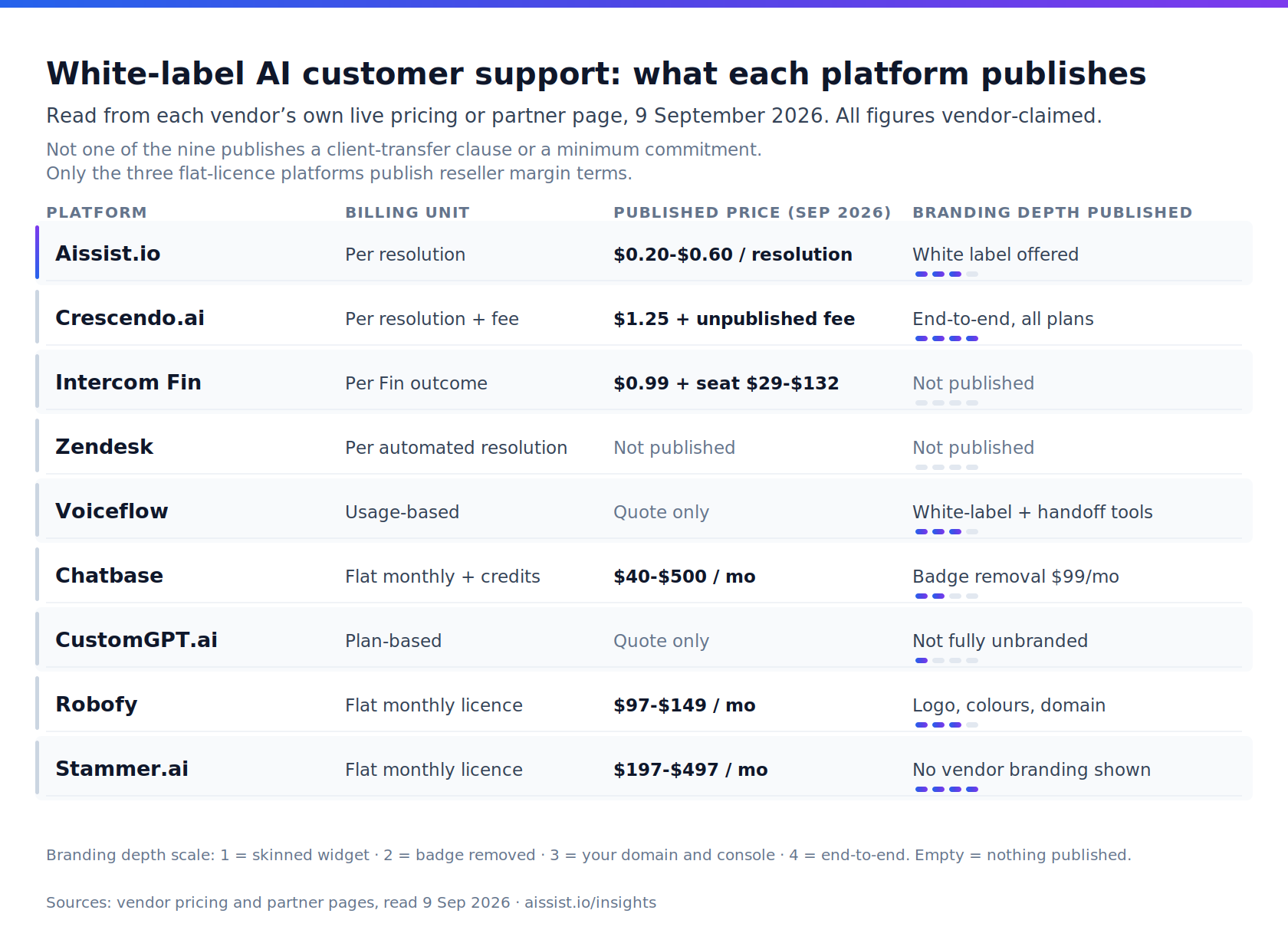
Across eight named platforms plus Aissist.io, five publish a usable price, three publish reseller margin terms, and not one publishes a minimum commitment or a client-transfer clause. Everything below was read from the vendor's own page on 9 September 2026; "not published" means exactly that, not "bad."
| Platform | Billing unit | Published price (Sept 2026) | Branding depth published | Reseller margin | Client-transfer clause |
|---|---|---|---|---|---|
| Aissist.io | Per resolution | $0.20–$0.60 USD per resolution; 1,000 free tickets/month | White label offered (partnership page) | Not published | Not published |
| Crescendo.ai | Per resolution + monthly fee | $1.25 USD per resolution + fixed monthly fee (fee not published) | End-to-end: chat, email and voice, "included by default in all plans" | Not published | Not published |
| Intercom (Fin) | Per Fin outcome | "From $0.99 per Fin outcome"; seats $29 / $85 / $132 per seat/month, billed annually | Not published | Not published | Not published |
| Zendesk | Per automated resolution | Suite Team $55, Suite Professional $115 per agent/month paid yearly; per-resolution price not published | Not published | "Bigger discounts… extra margin opportunities", no figures | Not published |
| Voiceflow | Usage-based | Quote only | "White-labeling and client handoff tools" for Agencies & Partners | Not published | Handoff tools named, terms not published |
| Chatbase | Message credits, flat monthly | $40 / $150 / $500 per month (700 / 4,000 / 15,000 credits) | Badge removal $99 USD/month add-on | Keep the markup (flat licence) | Not published |
| CustomGPT.ai | Plan-based | Quote only | "Fully unbranded delivery is not offered on standard programs" | "Set by agreement" | Not published |
| Robofy | Flat monthly licence | $97 / $137 / $149 per month | "Your logo, your colors, your domain" | "Keep 100% of every payment your clients make… No commissions" | Not published |
| Stammer.ai | Flat monthly licence | $197 / $497 per month | "Clients never see Stammer branding" | "Zero revenue sharing (keep 100% of markup)" | Not published |
Two things fall out of that table. First, the only platforms that publish margin terms are the flat-licence ones — Robofy, Stammer.ai and, implicitly, Chatbase — because a flat licence has no margin question to answer: you keep whatever you charge above it. Every per-resolution platform sets margin by agreement. Second, the column that matters most in year three is empty for all nine.
Are you buying a chatbot licence or a resolution engine?
The "white label AI customer support" category contains two incompatible products: agency chatbot builders sold as a flat monthly licence, and support-resolution platforms sold per resolved conversation. The economics run in opposite directions and the labour model is completely different. Nobody on the current first page of results says this, which is why agencies keep comparing a $137 licence to a $0.99 resolution and concluding the licence wins.
A flat-licence chatbot builder — Robofy at $97–$149 per month, Stammer.ai at $197–$497 per month — gives you unlimited markup and unlimited work. Stammer.ai's own published example is a client costing "~$12/month" billed at "$499/month" (Stammer.ai pricing, read September 2026). That spread is real, and so is everything on your side of it: knowledge-base curation, helpdesk integration, escalation design, QA, and the 2am incident.
A per-resolution support platform — Aissist.io, Crescendo.ai, Intercom's Fin, Zendesk's AI agents — charges only when work gets done and carries much more of the delivery. Zendesk bills an automated resolution only when a conversation "passes the verification performed by our LLM," and states that conversations failing verification "do not consume an automated resolution" (Zendesk help centre, read September 2026). Aissist.io counts a resolution only when the AI fully resolves without escalation, excludes chitchat, and does not charge for cases handed to a human (Aissist.io pricing, read September 2026).
Pick the licence if you are selling a lead-capture bot on a website. Pick the resolution platform if your client is going to measure you on ticket volume and CSAT. The unit economics of each model are worked through in more depth in our guide to AI agent pricing models.
Does per-resolution pricing survive a margin stack?
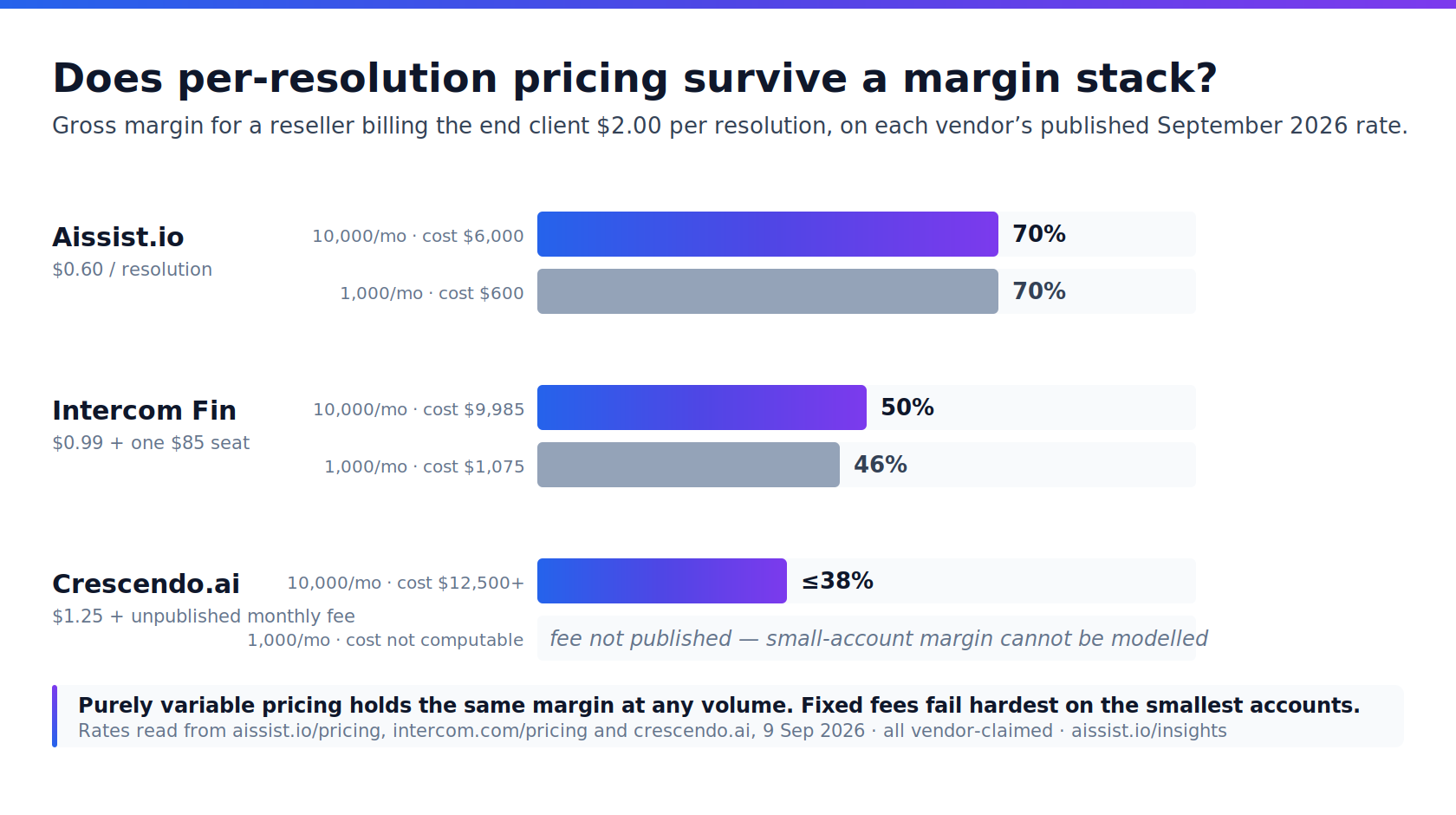
Yes — variable per-resolution pricing holds its gross margin at any volume, because your cost and your revenue scale together. Fixed monthly fees do not, and they fail hardest on exactly the small accounts agencies use to start a channel. Here is the arithmetic, using each vendor's published rate and a client billed at $2.00 per resolution.
| Platform cost (published, Sept 2026) | 10,000 resolutions/mo — revenue $20,000 | 1,000 resolutions/mo — revenue $2,000 |
|---|---|---|
| Aissist.io at $0.60 (chat cap) | Cost $6,000 → 70% gross margin | Cost $600 → 70% gross margin |
| Intercom Fin at $0.99 + one Advanced seat ($85/mo) | Cost $9,985 → 50% gross margin | Cost $1,075 → 46% gross margin |
| Crescendo.ai at $1.25 + unpublished monthly fee | Cost $12,500 + fee → ≤38% gross margin | Cost $1,250 + fee → not computable |
| Zendesk (per-resolution price not published) | Not computable | Not computable |
The bottom-right cell is the whole point. Crescendo.ai's blog states a fixed monthly fee covering "AI agent deployment, full white-labeling, software licensing, integrations, quality assurance, and ongoing maintenance" and adds that "there are no hidden costs or surprises" (Crescendo.ai, published 30 December 2025) — but does not publish the fee. You cannot model a small account against a number you do not have, and small accounts are where a reseller channel either compounds or quietly dies.
One more line to check before you sign: the billing unit you buy in must be the billing unit you sell in. If the vendor bills every AI touch and you bill your client per resolved case, the gap between those two definitions is your margin, and it moves every time the vendor retunes a model.
Who owns the customer data — you, the vendor, or your client?
In a white-label deal there are three parties and one dataset, and the contract has to say which of you owns it, which of you is the processor, and whether any of it trains the vendor's models. Two of the nine platforms answer that in public. The rest answer it in a DPA you will not see until legal review.
The published answers, read 9 September 2026:
- Robofy states "Your client data is never shared or used for training" (Robofy reseller page).
- CustomGPT.ai states that customer content "is not used for public model training" and that each agent is "its own data silo with no data sharing between agents" (CustomGPT.ai).
- Aissist.io publishes GDPR and ISO 27001 certification (Aissist.io reliable AI) but does not publish partner data-ownership terms.
Three questions to put in writing, in this order: Is my client the data controller and the vendor a sub-processor under my agreement, or does the vendor contract directly with my client? Is conversation data used to train models that serve other customers, including my competitors? And if I leave, do I get the knowledge base, the conversation history, and the tuning back in a usable format, or just a CSV and best wishes?
That last one is the expensive question. A knowledge base you cannot export is a switching cost the vendor gets to set later.
What happens to your contract if the client goes direct?
Nothing you will like, unless the reseller agreement names the outcome in advance — and none of the nine platforms publishes a client-transfer clause. The scenario is not hypothetical: you win the account, you tune the agent for eighteen months, the client's new VP of CX gets a call from the vendor's enterprise team, and the vendor has both the relationship and the data.
Three clauses worth insisting on:
- A non-solicitation window on accounts you introduce, with a stated length.
- A named transfer price — if your client goes direct, you receive a defined multiple of trailing monthly revenue, or the account converts to a referral commission for a stated term.
- A portability commitment — the knowledge base, escalation rules and conversation history export in a documented format within a stated number of days.
Everest Group's Sahil Shah, Practice Director, put the underlying pressure well in a September 2026 analysis of AI-era outsourcing contracts:
"An AI-first delivery model breaks all three assumptions at once, and it is breaking them faster than most Master MSAs and SoWs can be renegotiated."
— Sahil Shah, Practice Director, Everest Group, "Why the traditional BPO contract is starting to break in the age of AI", 2 September 2026
For BPOs specifically, the pressure is arithmetic. Everest Group notes that an offshore human agent delivers roughly 1,800 productive hours per year (independently reported, Everest Group, read September 2026). An AI agent has no such ceiling, which is why per-seat resale economics are being replaced by per-outcome ones — and why the transfer clause is now worth more than the discount schedule.
What should you walk away from?
Walk away from any white-label AI support deal that refuses to put a number or a named term against these eight items. None of them is unreasonable to ask for, and a vendor's willingness to answer is the cheapest signal you will get about the next three years.
- A "white label" that stops at the widget. If the vendor's name survives on the sending domain, the admin console, or the notification emails, that is a skin, not a white label.
- A monthly platform fee the vendor will not quote before you commit. You cannot price a small account against an unknown fixed cost.
- A billing unit that differs from the one you bill your client in. The gap is your margin and you do not control it.
- No written answer on model training. "We take privacy seriously" is not an answer; "conversation data is not used to train models serving other customers" is.
- No named client-transfer path. If it is not in the agreement, the answer is whatever the vendor decides on the day.
- Margin that lives on a discount schedule rather than in the contract. Discount schedules get revised; contracts get renegotiated.
- An SLA that covers platform uptime but not your escalation path. Your client will not care that the platform was up while their queue was not.
- A minimum commitment with no ramp. If the floor is set before you have signed a client, the vendor has transferred its sales risk to you.
What does Aissist.io commit to?
Aissist.io publishes a white-label partner program, a per-resolution price of $0.20–$0.60, and a resolution definition that excludes chitchat and human handovers — which is enough for a partner to model margin before the first call. The bias disclosure stands: this is our blog, and the terms below are what is currently published, not a substitute for a signed agreement.
What is published, read 9 September 2026:
- Branding. The partnership page offers "White Label Solutions — Offer Aissist's powerful AI capabilities under your own brand" (vendor-claimed).
- Price and unit. $0.20–$0.60 USD per resolution — roughly $0.25 for email and form, $0.60 capped for chat, WhatsApp and SMS — with 1,000 free tickets a month (Aissist.io pricing, vendor-claimed).
- What triggers a charge. A resolution counts only when the AI fully resolves the request without escalation; chitchat does not count and cases handed to a human are not charged (vendor-claimed).
- Channel results so far. 10+ active partners across 10+ countries, 99% partner satisfaction and $10M+ in partner-generated revenue (partnership page, vendor-claimed).
- Compliance. GDPR and ISO 27001 certified (reliable AI, vendor-claimed).
- A deployed example. The EDIS Global customer story reports 85% resolution and 50% cost reduction across 8 languages and 40 countries (case-study). Ask every vendor on your shortlist how the number they quote you was defined and measured, because a case-study headline and a strict end-to-end resolution rate are rarely the same figure.
"Aissist.io transformed our customer service operations. The AI handles complex technical queries with expertise that often surpasses our human agents, while seamlessly escalating when needed."
— Gerhard Kleewein, CEO, EDIS Global (customer story)
Data ownership, reseller margin, minimum commitment and client-transfer terms are set in the partner agreement rather than published — the same gap every other vendor on this page has. Ask for all four in writing, from us and from everyone else on the shortlist. The AI Operational Layer is the product a partner actually resells; the partnership program is where the terms get set.
Key takeaways
White label AI customer support is a real channel with an unusually thin public record: none of the nine platforms checked in September 2026 publishes a client-transfer clause or a minimum commitment, only the three flat-licence platforms publish margin terms, and two publish no price at all. Decide first which product you are buying — a flat-fee chatbot licence where the labour is yours, or a per-resolution engine where the resolution is the vendor's — because the margin behaves differently in each.
Then negotiate the six terms in the table, and treat the vendor's willingness to answer as data. And keep one thing in view while you do it: resolution rates vary enormously between accounts on identical technology, because workload composition and system access drive the result more than the logo does. Whatever you resell, the resolution rate you promise your client should start from a pilot on that client's own tickets, not from a marketing page — including when the vendor quoting 90% is us.
Frequently asked questions
What is white label AI customer support?
White label AI customer support is an arrangement where an agency or BPO resells a vendor's AI support agent under its own brand, bills the end client directly, and keeps the difference. The vendor supplies the model and integrations; the reseller supplies the brand, the client relationship, and usually the front-line accountability.
How much does a white label AI support platform cost in 2026?
Published rates split by model. Flat agency licences run $97–$497 per month (Robofy $97–$149, Stammer.ai $197–$497, Chatbase $40–$500). Per-resolution platforms run $0.20–$1.25 per resolved conversation (Aissist.io $0.20–$0.60, Intercom Fin from $0.99, Crescendo.ai $1.25 plus an unpublished monthly fee). All read September 2026.
What margin can an agency make reselling AI customer support?
On published rates, a per-resolution platform billed to the client at $2.00 per resolution yields roughly 38–70% gross margin depending on the vendor's rate and fixed fees. Flat-licence platforms advertise higher spreads — Stammer.ai publishes a ~$12 cost against a $499 client price — but the reseller absorbs all integration, tuning and support labour.
Which white label AI platforms let you remove vendor branding completely?
Crescendo.ai states white-labeling is "included by default in all plans" across chat, email and voice. Robofy and Stammer.ai advertise full dashboard and domain branding on their flat licences. Chatbase charges $99 per month to remove its badge. CustomGPT.ai states that fully unbranded delivery is not offered on standard programs. All read September 2026.
Who owns customer data in a white label AI support deal?
It depends entirely on the reseller agreement, and most vendors do not publish it. Get three things in writing: whether your client is the data controller with the vendor as your sub-processor, whether conversation data trains models serving other customers, and what you can export in a usable format if you leave.
What happens if my client wants to buy from the vendor directly?
Whatever the reseller agreement says — and none of the nine platforms reviewed publishes a client-transfer clause. Negotiate three things upfront: a non-solicitation window on accounts you introduce, a named transfer price or referral commission if the client converts, and a portability commitment covering knowledge base and conversation history.
Is per-resolution or flat-fee pricing better for a reseller?
Per-resolution pricing protects gross margin at every volume because cost and revenue scale together; a purely variable rate holds the same margin at 1,000 resolutions as at 10,000. Flat-fee licences give unlimited markup at high volume but lose money on small accounts and load all delivery labour onto the reseller.
Can BPOs partner with AI support vendors instead of competing with them?
Yes, and the contract economics are shifting to encourage it. Everest Group notes an offshore human agent delivers roughly 1,800 productive hours a year, a ceiling AI does not have, which is pushing outsourcing deals from per-seat toward per-outcome pricing. Reselling AI resolution alongside human escalation is the version of that shift a BPO controls.
What does a "resolution" actually mean for billing?
Definitions differ, so read them. Zendesk bills an automated resolution only when the conversation passes LLM verification and was not escalated. Aissist.io counts a resolution only when the AI fully resolves without escalation, excludes chitchat, and does not charge for human handovers. Intercom bills "per Fin outcome" without publishing the criteria.
Reselling AI support under your own brand? Aissist.io publishes its per-resolution price and its resolution definition so partners can model margin before the first call. See the partnership program →
Changelog
- 09 September 2026 — First published. Pricing, branding and partner terms read on this date from the live pages of Crescendo.ai, Intercom, Zendesk, Voiceflow, Chatbase, CustomGPT.ai, Robofy, Stammer.ai and Aissist.io. Verified on this date: Zendesk publishes no per-automated-resolution price on any public page; Crescendo.ai publishes $1.25 per resolution but not the accompanying monthly fee; Voiceflow and CustomGPT.ai publish no price at all.