Agentforce Pricing Explained (2026): Flex Credits, Per-Action and Per-Resolution Costs
Agentforce pricing starts at $0.10 per action through Flex Credits. The alternatives are $2 per conversation or $2 per Help Agent resolution, and per-user add-ons run $125 to $550+ a month, according to Salesforce's Agentforce pricing page. That covers the price list. The more useful number is the cost of each case the agent actually closes.
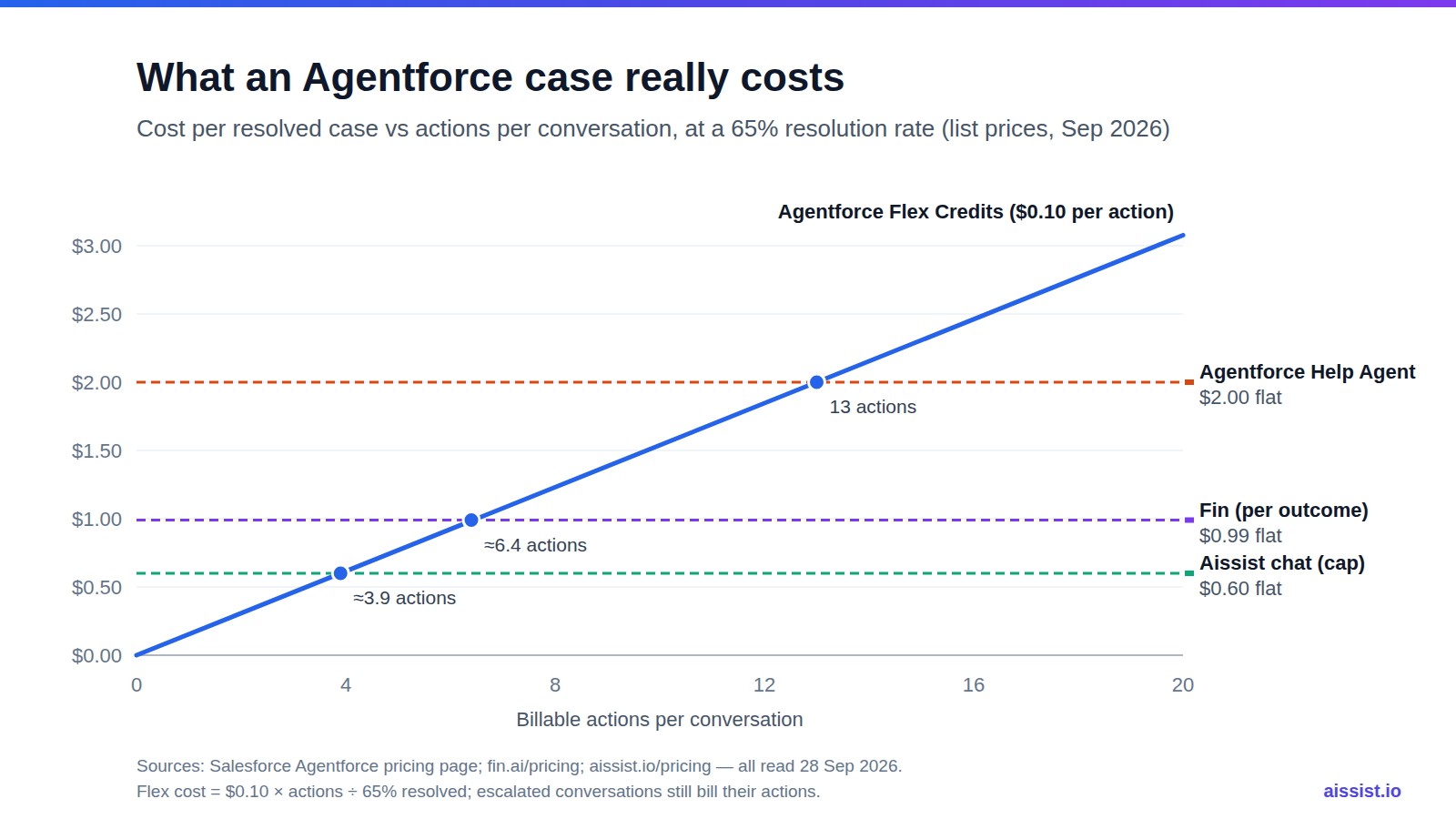
TL;DR: At Salesforce's $0.10 list rate per action and 65% resolution, Agentforce beats a $0.60 per-resolution price only below about four actions per conversation. Above that the $0.60 meter wins; past 13 actions, so does Salesforce's $2 Help Agent.
Methodology & sources
- Prices were read from the vendors' own pricing pages, help centres and press releases on 28 September 2026. Every figure in the article links to the page it came from.
- The worked examples use Salesforce list prices only. They hold the resolution rate at 65% for every vendor, which sits between the 62% (Agentforce Help Agent) and 76% (Fin) rates Salesforce Ben reported. The examples leave out edition seats, Data 360 usage, implementation, negotiated discounts and Aissist's 1,000 free tickets a month.
- First-party data comes from Aissist's AI Agent Pricing Benchmark 2026, which was re-verified on 14 September 2026.
- Disclosure: this is Aissist's blog. Aissist sells AI customer service that is priced per resolution, so it appears in the comparison. Its figures follow the same sourcing rules as everyone else's.
How much does Agentforce cost in 2026?
Agentforce costs $0.10 per action on Flex Credits ($500 per 100,000 credits, 20 credits per action), $2 per conversation, or $2 per Help Agent resolution. Per-user licences run from $5 to $550+ a month, according to Salesforce's pricing page (read September 2026). Salesforce publishes the meters. It doesn't publish what you'll spend on everything around them.
Salesforce sells Agentforce in two ways. You can license people, meaning your employees who use Agentforce inside Salesforce. You can also meter work, meaning what the agent does for your customers. For customer-facing service, the metered rows are the ones that matter.
| Agentforce option (Sep 2026) | List price | Billing unit | Notes |
|---|---|---|---|
| Flex Credits | $500 per 100,000 credits | Per action (20 credits = $0.10) | Standard or custom action; voice uses different multipliers |
| Conversations | $2 | Per conversation | Can't run in the same org as Flex Credits |
| Help Agent Resolutions | $2 | Per resolution | Generally available July 2026 (CIO); no charge on escalation |
| Agentforce User License | $5 | Per user / month | Requires Flex Credits |
| Agentforce add-ons (Sales, Service, Field Service) | $125 | Per user / month | Employee-facing |
| Agentforce Industries add-ons | $150 | Per user / month | Employee-facing |
| Agentforce 1 Editions | From $550 | Per user / month | Includes 2.5M Flex Credits per org per year |
| Salesforce Foundations | $0 | Flat | Entry access |
| Voice action credit rate | Not published | — | Pricing page says only that "multipliers differ" |
| Data 360 consumption | Not published | — | Not listed as a requirement on the pricing page |
| Implementation and services | Not published | — | No rate published |
Two rules on that page catch buyers out. First, "Flex Credits and Conversations will not be supported in the same org," so you pick one meter per org. Second, Salesforce Help says the 100,000 free Flex Credits in Salesforce Foundations go to "customers with Enterprise Edition or above." Agentforce sits on top of a Salesforce edition you are already paying for, and the Agentforce pricing page doesn't include that edition's price.
The 2.5 million credits bundled with Agentforce 1 Editions sound like a lot. They buy 125,000 actions a year. A service desk handling 10,000 conversations a month at eight actions each would use them up in under seven weeks.
What does a Flex Credit actually buy?
One Flex Credit costs half a cent, and one Agentforce action uses 20 credits, so each action costs $0.10, as Salesforce set out when it introduced Flex Credits in May 2025. Salesforce describes actions as work such as "updating customer records, automating complex workflows, or resolving cases." You pay for each step the agent takes, not for the result.
That means the meter runs on every conversation, including the ones that end with a human. If a chat triggers five actions and then escalates, you pay 50 cents and still pay your agent to finish the job. Per-action pricing charges for effort. Per-resolution pricing charges for results.
Salesforce offered the other model in June 2026. Help Agent charges $2 per resolved conversation and nothing when the customer escalates or leaves unhappy. Getmacha's reading of the rate card puts that at 400 credits per resolution, and CIO reports that it is sold in pre-purchased packs of at least 1,000 resolutions.
"We define successful resolution as the user's question doesn't need a human escalation." — Kishnan Chetan, EVP and GM of Agentforce Service, Salesforce, speaking to CIO
That leaves an Agentforce buyer with three meters that behave very differently:
- Flex Credits bill every action, whether or not the case is resolved.
- Conversations bill every conversation at a flat $2, whether or not it is resolved.
- Help Agent bills only resolved conversations, at $2.
None of these is a trick. The catch is the unit. A Flex Credit price tells you what one step costs, and your cost per case depends on how many steps the agent takes.
What does Agentforce cost per resolved case?
Agentforce's cost per resolved case equals $0.10 × actions per conversation ÷ resolution rate. At a 65% resolution rate, that works out to $0.46 at three actions, $1.23 at eight and $2.31 at fifteen, using Salesforce's list rates. The per-resolution meters stay flat however hard the agent works: $2 for Help Agent, $0.99 for Fin and $0.60 for Aissist chat.
| Actions per conversation | Agentforce Flex, per resolved case | vs Help Agent ($2.00) | vs Fin ($0.99) | vs Aissist chat ($0.60) |
|---|---|---|---|---|
| 3 (FAQ plus one lookup) | $0.46 | Cheaper | Cheaper | Cheaper |
| 6 | $0.92 | Cheaper | Slightly cheaper | More expensive |
| 8 (look up order, check policy, update, confirm) | $1.23 | Cheaper | More expensive | More expensive |
| 15 (multi-system refund or exchange) | $2.31 | More expensive | More expensive | More expensive |
List prices, 65% resolution rate for every vendor. Break-even with Flex: about 3.9 actions vs $0.60, 6.4 vs $0.99, 13 vs $2.00.
Volume changes the size of the bill, not the price of each case. At list rates every meter here is linear, so eight actions per conversation costs $1.23 per resolved case at any volume:
| Monthly conversations | Resolved (65%) | Agentforce Flex, 8 actions | Help Agent | Fin | Aissist chat (cap) |
|---|---|---|---|---|---|
| 2,000 | 1,300 | $1,600 | $2,600 | $1,287 | $780 |
| 10,000 | 6,500 | $8,000 | $13,000 | $6,435 | $3,900 |
| 50,000 | 32,500 | $40,000 | $65,000 | $32,175 | $19,500 |
This matches the one page-one result that does the maths. Getmacha (24 September 2026) prices 5,000 conversations at three actions each at $1,500 a month on Flex Credits, against $6,000 on Help Agent at a 60% resolution rate. Getmacha concludes that "per action is cheaper than per resolution for almost every service agent." That holds against Salesforce's own $2 meter. Against a $0.60 or $0.99 meter, it holds only for agents that take very few steps.
Aissist's own benchmark found the same spread. When Aissist's analysts re-ran the September pricing benchmark, Agentforce showed the widest range of any vendor we track: $0.49 to $4.19 per resolution, driven entirely by how many billable actions each resolution consumed. The benchmark's own summary is that "the agent decides how many billable actions a resolution takes." The number that sets the price is one the buyer doesn't control.
So before you model Agentforce, pull a week of transcripts and count the tool calls your agent would need. It's a boring afternoon, and it tells you more than the rate card will.
How does Agentforce pricing compare with Fin, Zendesk AI, Sierra, Decagon and Aissist?
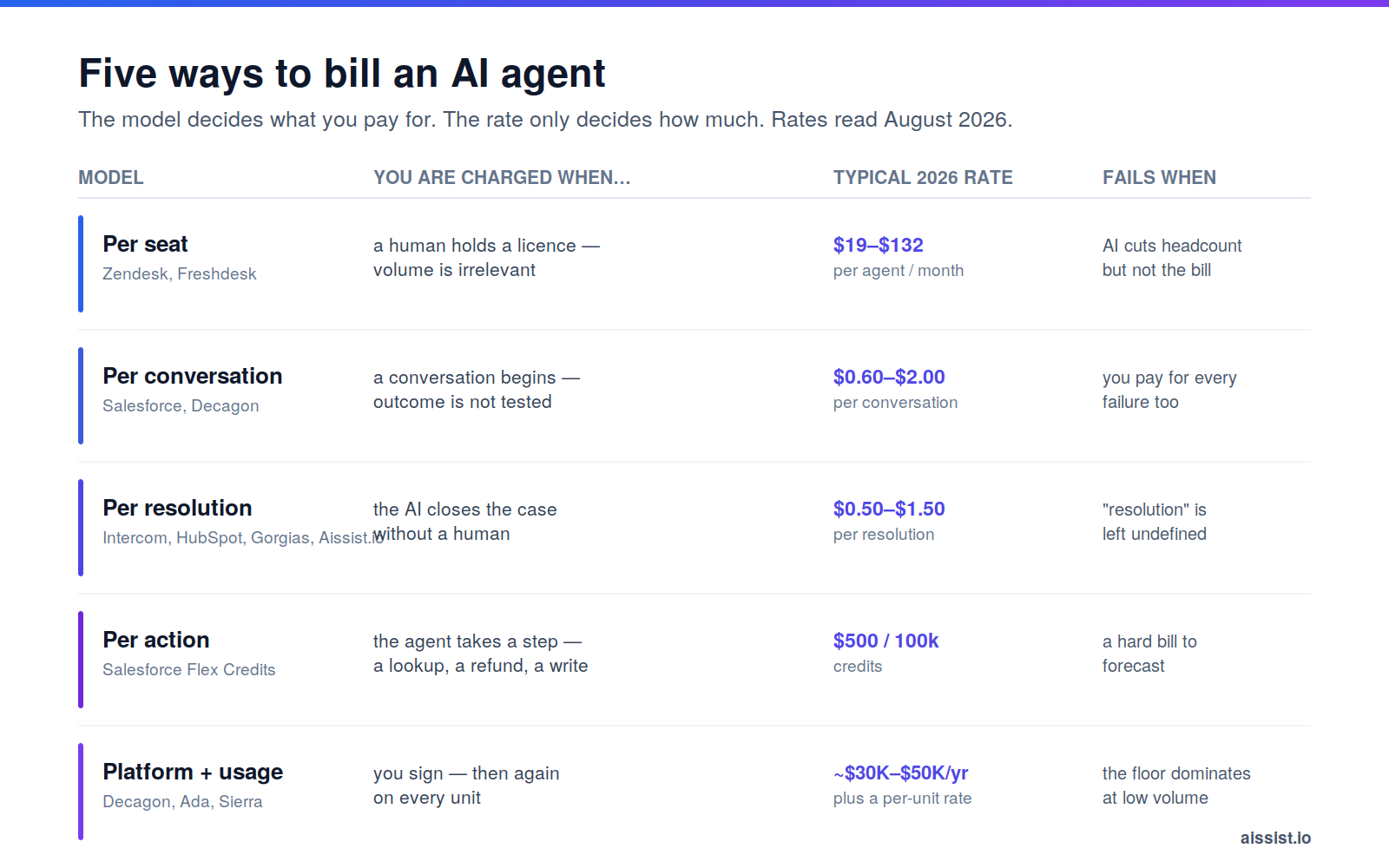
Agentforce's Flex Credits are the only meter here that charges per action. Zendesk AI, Aissist and Salesforce's own Help Agent charge per resolution, Fin and Sierra charge per outcome, and Decagon usually charges per conversation. The table shows what each vendor bills for and who decides whether that thing happened. That matters more than the headline rate.
| Vendor | Billing unit (Sep 2026) | Published rate | What triggers a charge | Source |
|---|---|---|---|---|
| Salesforce Agentforce | Per action (Flex Credits) | $0.10 per action | Every action, resolved or not | Salesforce pricing, read 28 Sep 2026 |
| Agentforce Help Agent | Per resolution | $2.00 | No human escalation and the customer doesn't say it failed | Salesforce pricing; CIO, read 28 Sep 2026 |
| Fin (Salesforce) | Per outcome | $0.99; qualification $9.99 | One outcome per conversation; resolution, procedure handoff, disqualification and routing all bill | Fin pricing, read 28 Sep 2026 |
| Zendesk AI agents | Per verified resolution | Not published; "Contact Zendesk Sales" | Only "Verified Resolutions" count against the allowance | Zendesk help, read 28 Sep 2026 |
| Sierra | Per outcome | Not published | Resolved conversation, saved cancellation, upsell and similar outcomes | Sierra blog, read 28 Sep 2026 |
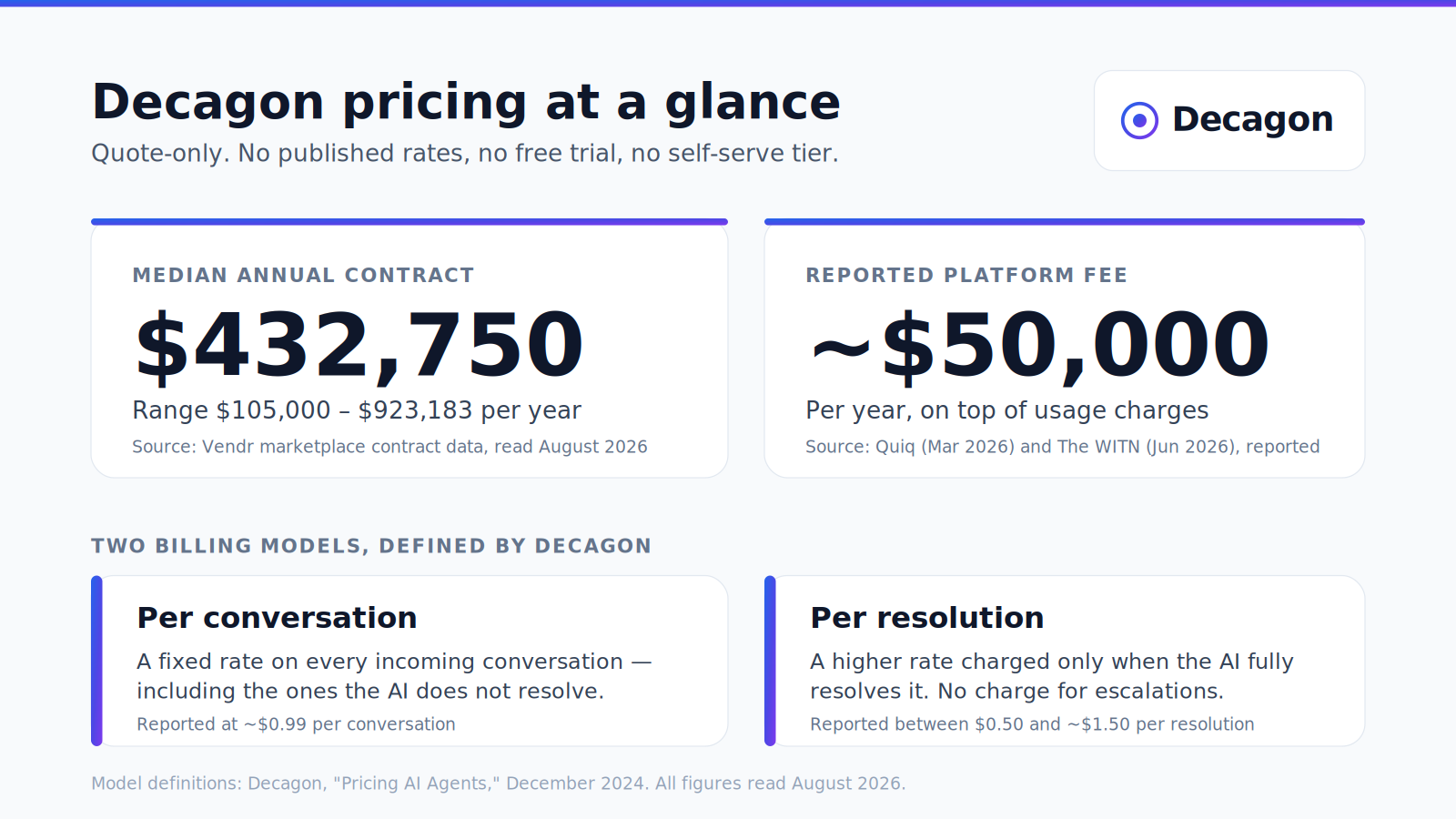
| Decagon | Per conversation (default) or per resolution | Not published | Every conversation, or each resolved one at "a higher fixed rate" | Decagon blog, read 28 Sep 2026 |
| Aissist | Per interaction, capped per resolution | $0.60 chat / $0.25 email (cap) | Resolved without escalation; handovers not charged | Aissist pricing, read 28 Sep 2026 |
Sierra AI pricing is the hardest to pin down. Sierra publishes no rates. It explains the model in one line:
"With outcome-based pricing, Sierra gets paid only when we complete a task for you." — Elliot Greenwald, Sierra blog
Aissist's benchmark reports about $1.50 per Sierra resolution. That is a reported figure, not a published one, and Sierra's outcomes include upsells and saved cancellations as well as support resolutions. Zendesk hasn't published a per-resolution price either since it moved to resolution tiers on 18 May 2026. The Zendesk AI pricing breakdown and Decagon pricing breakdown cover what buyers report paying.
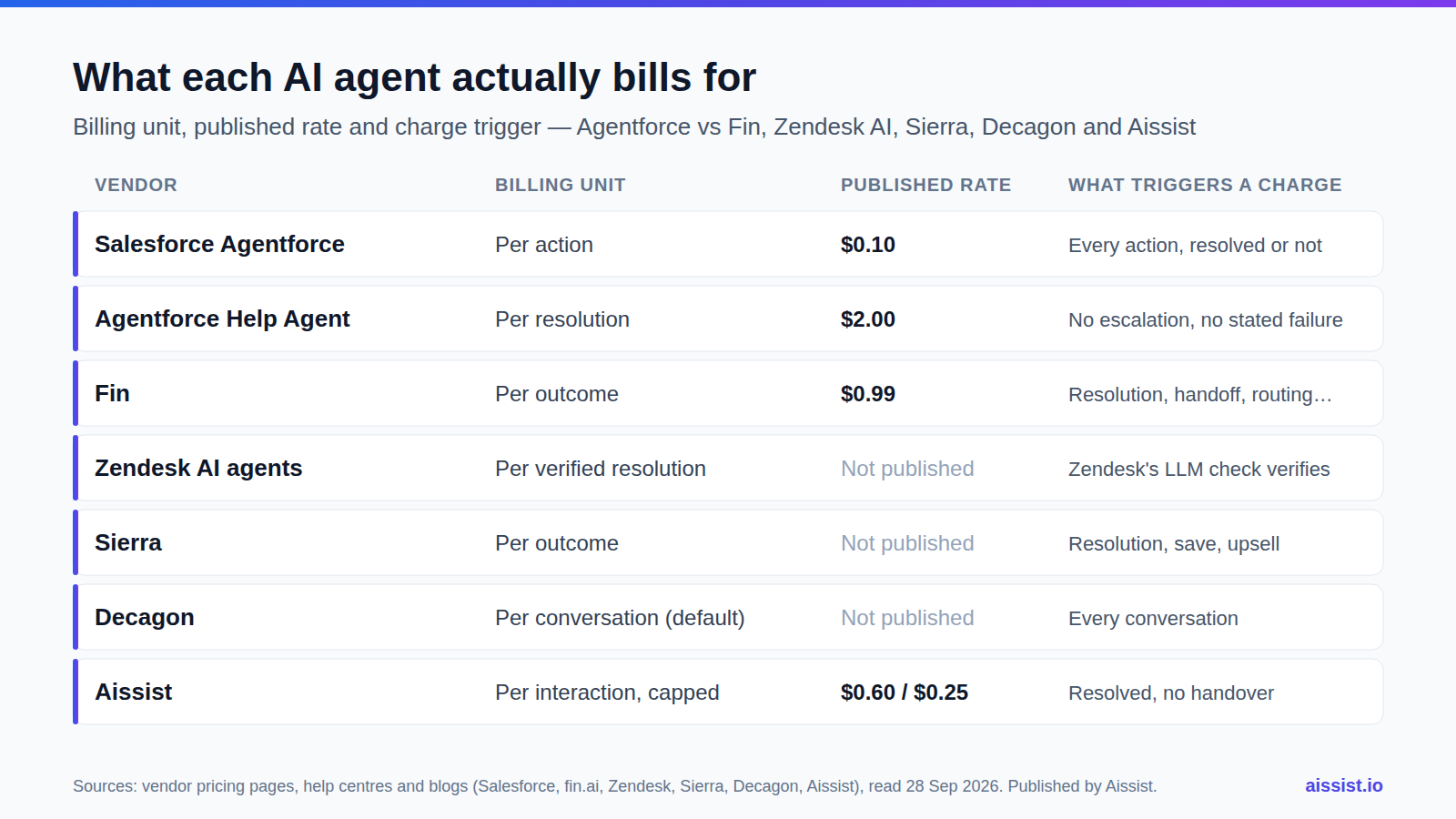
Look at the "what triggers a charge" column before the price column. Fin's $0.99 applies to a procedure handoff as well as a resolution. Zendesk's own model decides which resolutions are verified. Agentforce Flex charges for every action whatever the outcome. Every "per resolution" price rests on somebody's definition of resolved, so find out whose. The price comparison tool converts quotes on different meters into a common cost per resolution.
What should Fin customers expect now that Salesforce owns it?
Fin's pricing has not changed yet: $0.99 per outcome, with a 50-outcome monthly minimum on non-Intercom helpdesks, according to Fin's pricing page (read September 2026). Salesforce's completion announcement on 10 September says Fin "will continue to serve its customers" and still "works seamlessly with the help desks and systems companies already use." It says nothing about pricing.
"The big strategic benefit of our decision to join Salesforce is magnitudes more businesses and their customers that we can bring it to." — Eoghan McCabe, CEO and Co-Founder, Fin, Salesforce press release
Salesforce paid about $3.6 billion for Fin and its more than 30,000 customers. At Dreamforce on 22 September it unveiled AIforce and Headless 360. None of this says Fin's price will change. But Salesforce now runs four customer-service meters: per action, per conversation, per resolution and Fin's per outcome. Companies rarely keep four meters for one job for long.
Fin's own unit is already wider than a resolution. Its pricing page bills "outcomes", which include $0.99 handoffs and $9.99 qualifications. The question at renewal is whether the next change reaches your contract. Check these clauses before you sign:
- Meter lock. Is the billing unit (outcome, resolution, action or credit) fixed for the whole term, or can the vendor change it on notice?
- Price protection. Is there a cap on the renewal increase, and does it still apply if the product is repackaged or renamed?
- Outcome definition. Is it written into the contract, and does a handoff or disqualification bill at the same rate as a resolution?
- Credit conversion. If you're moved to Flex Credits, what rate converts unused outcomes, and do credits expire at the end of the year?
- Audit rights. Can you export the conversation-level data that shows why each charge was made?
"What's the outcome? Both parties need to agree on the outcome and metrics." — Larry Dignan, Editor in Chief, Constellation Insights, Constellation Research
Clause five matters most. An outcome price is only fair if both sides can count the outcomes.
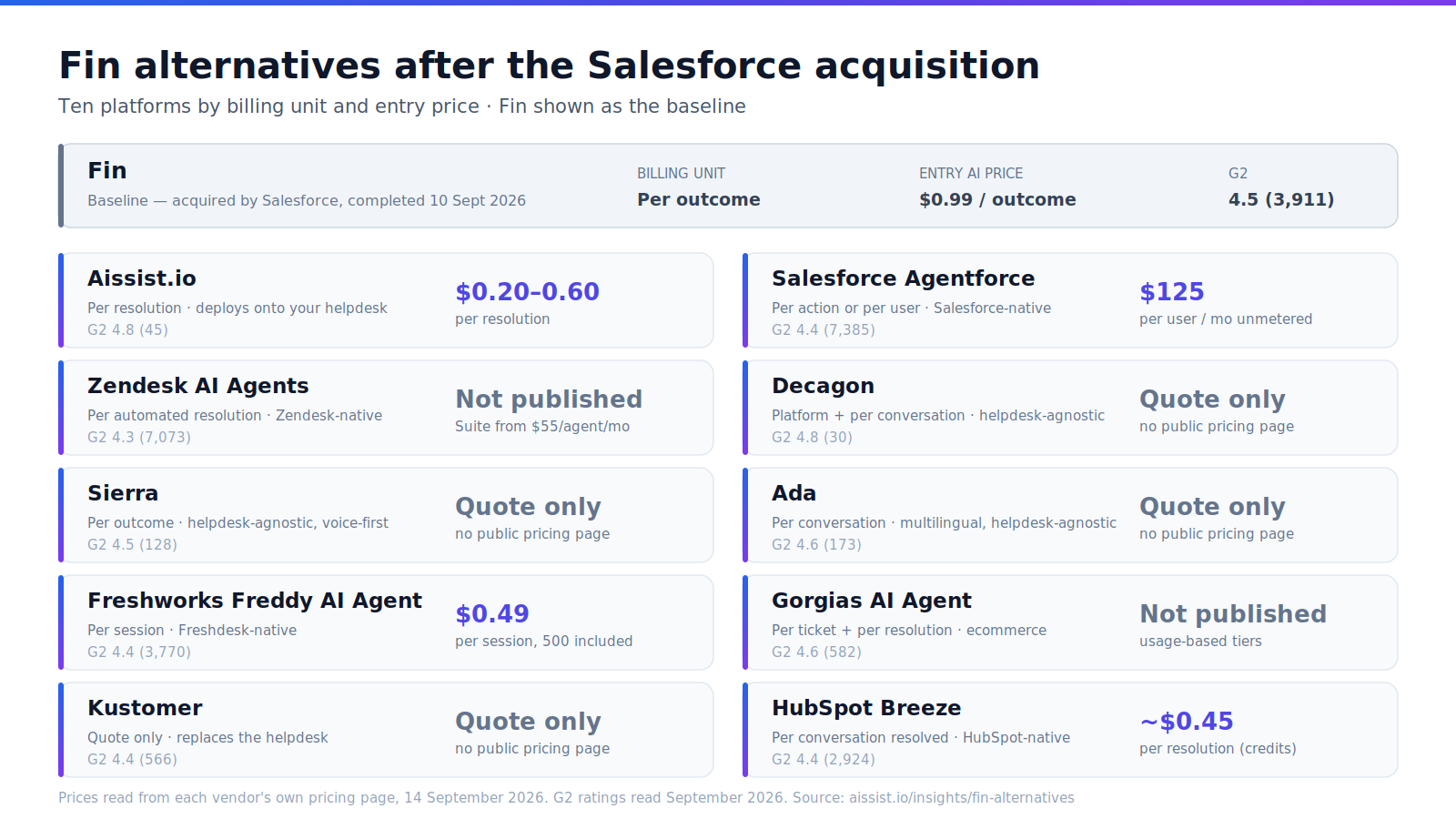
If you're reviewing options before the renewal rather than after it, our guide to Fin alternatives after the acquisition compares nine vendors.
Agentforce pricing is only as predictable as your action count
Agentforce is priced fairly for what it meters, but it meters effort, and a buyer can't read their cost per case from the price list. Low-action agents on Flex Credits can undercut every per-resolution vendor here, including us: $0.46 at three actions beats Aissist's $0.60 chat cap. Once conversations need more than about four actions, or escalate often, a $0.60 per-resolution price costs less and is easier to forecast.
Start by counting tool calls per conversation in a week of real transcripts. Multiply by $0.10, divide by your resolution rate, and compare the result with a per-resolution quote. If the answer is close, choose the meter that doesn't charge you when the AI fails. Five pricing models, compared shows how the same workload prices under each model.
Frequently asked questions
How much does Agentforce cost per conversation?
Agentforce costs $2 per conversation on Salesforce's Conversations meter. On Flex Credits, a conversation costs $0.10 for each action the agent takes, so three actions cost $0.30 and ten cost $1.00. Salesforce doesn't allow Flex Credits and Conversations in the same org.
What is a Flex Credit in Salesforce Agentforce?
A Flex Credit is Salesforce's consumption unit for Agentforce, sold at $500 per 100,000 credits, or half a cent each. A standard or custom action uses 20 credits ($0.10). Voice actions use different multipliers that the pricing page doesn't list.
Is Agentforce Help Agent cheaper than Flex Credits?
Help Agent is cheaper only when your agent uses many actions per conversation. At a 65% resolution rate, Flex Credits cost less than Help Agent's $2 per resolution until about 13 actions per conversation. Help Agent never charges for escalated conversations, and Flex Credits do.
How much does Fin AI cost after the Salesforce acquisition?
Fin still lists $0.99 per outcome, with a 50-outcome monthly minimum on non-Intercom helpdesks. On Intercom plans, helpdesk seats add $29 per seat per month. Qualification outcomes bill at $9.99. Salesforce hasn't announced any pricing change since the deal closed on 10 September 2026.
Does Intercom Fin pricing charge for conversations it hands off?
Yes, in some cases. Fin's pricing page lists "procedure handoff" as a billable outcome at $0.99, alongside resolution, disqualification and self-serve routing. Fin bills one outcome per conversation, so ask how a procedure handoff is defined before you sign.
How much does Sierra AI cost?
Sierra doesn't publish prices. It charges per outcome, such as a resolved conversation, a saved cancellation or an upsell. Aissist's September 2026 benchmark reports about $1.50 per Sierra resolution, which is a reported figure, not a list price.
Do I need Data 360 or a Salesforce edition to use Agentforce?
Salesforce Help ties the 100,000 free Flex Credits to Enterprise Edition or above, and that edition is billed separately from Agentforce. The Agentforce pricing page doesn't list Data 360 as a requirement, so ask in scoping whether your agents need it.