AI Agent Change Management: What a Release Process Must Contain Before Your Agent Changes Behaviour
Every edit to an AI agent is a release, whether or not anyone calls it one. This is the buyer-side standard for AI agent change management: five change classes, the test each must pass, who signs off, and how you undo it.
TL;DR: Decagon productised AI agent release control and Gradient Labs put it into a bank in the week Forrester predicted an AI-generated regression will cause a global outage; grade every change by blast radius and make approval mean something.
Methodology & sources
- Vendor announcements and coverage: Decagon's Experiment Hub post and fintech.global's report on LHV Bank and Gradient Labs, both read 26 October 2026.
- Analyst data: Forrester's 2027 technology and security predictions press release (21 October 2026).
- Regulation: Italy's D.Lgs. 179/2026 as published in the Gazzetta Ufficiale, Serie Generale n. 234, 8 October 2026.
- The change-class table and checklist are Aissist's own framework, not a vendor or legal standard.
- Disclosure: this is Aissist's blog. Aissist sells AI agents and evaluation software that compete with Decagon and Gradient Labs.
What happened in three days of October?
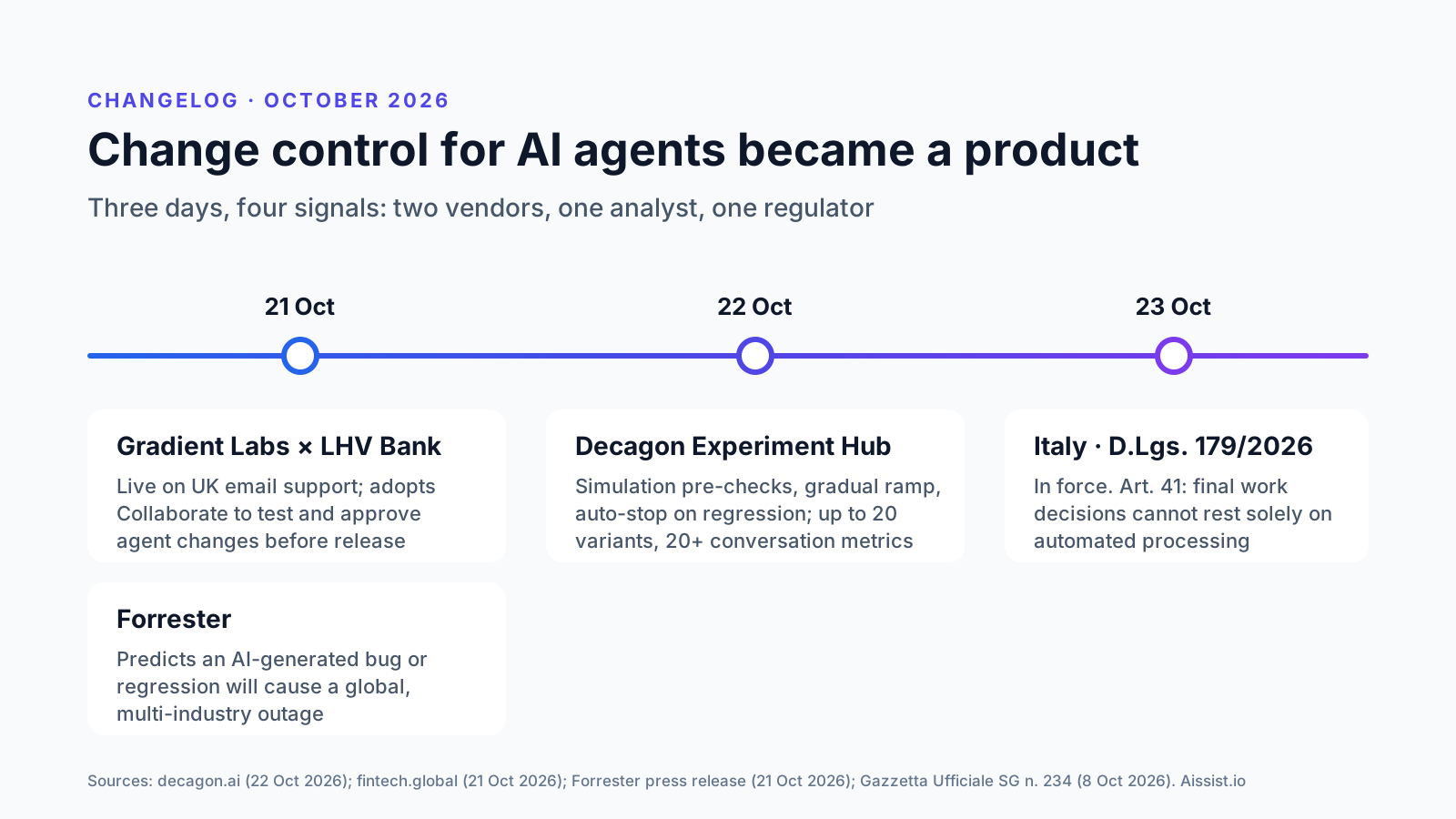
On 21 and 22 October 2026, two AI agent vendors made release discipline a product and an analyst predicted the failure it prevents. On 23 October, a regulator set a standard for what human approval has to mean.
| Date (2026) | Event | Why it matters |
|---|---|---|
| 21 Oct | LHV Bank goes live with Gradient Labs for UK email support and adopts Collaborate, its change-control component | A bank now tests and approves agent changes before release |
| 21 Oct | Forrester predicts an AI-generated bug or regression will cause a global outage across multiple industries | The failure mode has an analyst's name on it |
| 22 Oct | Decagon launches Experiment Hub | Simulation, gradual ramp and auto-stop become product features |
| 23 Oct | Italy's D.Lgs. 179/2026 enters into force | Final employment decisions cannot rest solely on automated processing |
Decagon's Experiment Hub post describes experiment blocks inside its Agent Operating Procedures, variants checked against a golden test set in simulation, traffic that ramps gradually, and a test that stops automatically if a variant performs significantly worse. It supports up to 20 variants against a shared control and over 20 conversation-specific metrics.
"…gives our team the confidence to decide what to roll out." — Harsha Bhangdia, Senior Program Manager, Chime, quoted by Decagon
fintech.global reports that LHV staff across operations, product, engineering, risk and compliance prepare changes in controlled environments, test them against representative customer scenarios, and approve them before release, with records of what changed, who authorised it, and when. Neither vendor is selling a smarter model here. Both are selling the release process, which tells you where buyers now see the risk.
Why does AI agent change management matter if no code changes?
AI agent change management matters because the agent's behaviour changes without anyone deploying code. A rewritten help article, a tweaked instruction or a new refund action alters what customers experience as surely as a software release does — usually with less review.
Forrester's 2027 predictions put the problem plainly: AI-assisted development and patching will outstrip testing capacity, and a faulty AI-generated change will cause a global outage across multiple industries. The same release puts AI at 20% of all business technology spend in 2027. More spend means more changes; testing capacity does not grow on the same curve.
"…will introduce new complexities and potential points of failure." — Sharyn Leaver, Chief Research Officer, Forrester, on emerging technology, geopolitics and the growing use of AI
Customer service makes this sharper. The agent talks to customers directly, at volume, so a regression is not a bug report from one user — it is the same wrong answer given to everyone who asks. And because behaviour emerges from the interaction of knowledge, instructions, tools and model, the change that breaks something is often not the one that looked risky. A content team fixing a typo in a returns policy does not think of itself as shipping software. It is.
How should you test AI agent changes?
Test AI agent changes in proportion to what they can break and how quickly you can undo them. A knowledge edit needs a targeted regression check; a model swap needs the full suite plus shadow traffic. One process for everything either blocks the content team or waves through the model swap.
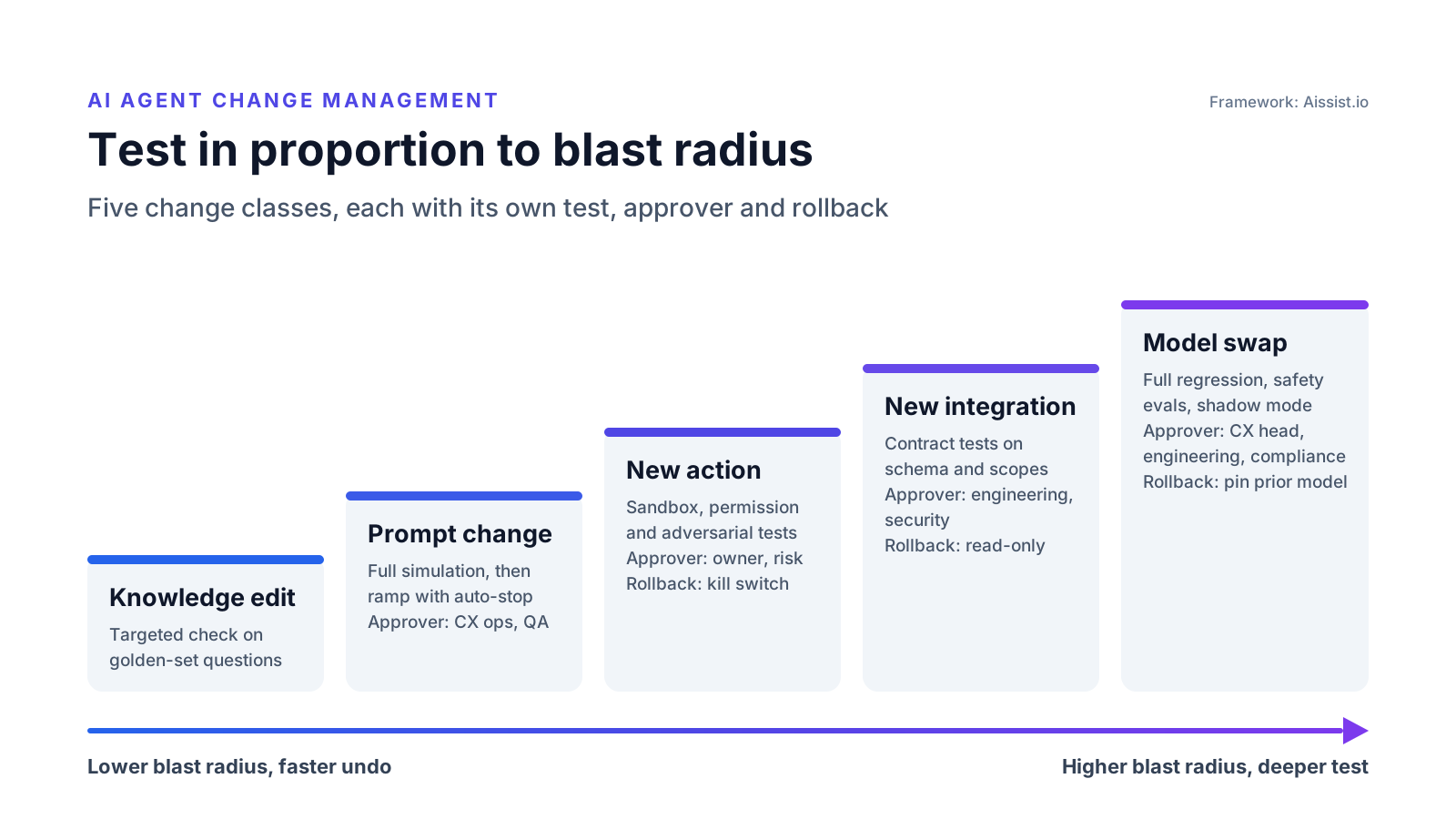
| Change type | Required test | Approver | Rollback mechanism | Evidence retained |
|---|---|---|---|---|
| Knowledge edit (article, policy text, macro) | Golden-set questions that touch the article, plus a contradiction check against other sources | Content owner in CX ops | Revert article version and re-index | Diff, test results, approver, timestamp |
| Prompt or procedure change (instructions, tone, workflow step) | Full golden-set simulation, then gradual ramp with auto-stop on regression | CX ops lead plus QA | Version pin back to the prior prompt or procedure | Variant metrics against control, ramp log |
| New action (refund, cancellation, address change) | Sandbox runs on test accounts, permission and limit tests, adversarial attempts | Process owner plus risk or compliance | Kill switch disables the action; agent hands off to a human | Action logs with parameters, permission matrix |
| New integration (CRM, billing, helpdesk) | Contract tests on schema, auth scopes and failure modes such as timeouts and empty responses | Engineering plus security or DPO | Disconnect, or drop to read-only | Scopes granted, security review, test run |
| Model swap (new version or provider) | Full regression across intents, safety and hallucination evals, latency and cost, then shadow mode | Head of CX, engineering and compliance | Pin previous model; router fallback | Side-by-side eval report, shadow comparison |
Two rules hold in every row. First, you set the pass threshold before the test runs, not after you see the numbers. Second, the rollback is tested, not assumed — an undo button nobody has pressed is a theory. The reliable AI principle applies: worst-case behaviour matters more than average accuracy.
Who should approve an AI agent change — and what counts as approval?
Approval counts only when a named person sees the evidence and has real authority to refuse the change. A manager clicking "approve" on a summary they cannot assess is a signature, not a control.
Italy has now written that standard into law for one domain. D.Lgs. 179/2026, in force since 23 October 2026, requires in Article 41 that employers using AI ensure final decisions on hiring, changing or ending employment are not taken solely on automated processing, and the worker's consent is no exception. Italian legal commentary reads it as reserving the decision to a natural person with effective, autonomous power, and extends it to performance evaluations and disciplinary measures.
That matters to CX directly when AI scores human agents. If an automated QA scorecard feeds a performance review in Italy, a person has to actually decide. The same logic transfers to agent releases: the approver in each table row should be able to say no without escalating, and should see test results, not a vendor's confidence.
"…not a faster human approving AI suggestions at every step." — Dimitri Masin, CEO, Gradient Labs, via fintech.global
Masin's point and Italy's are compatible. Humans should not approve every reply; they should approve every change to how replies get made. That is where judgement scales.
What does AI agent regression testing look like in customer service?
AI agent regression testing in customer service means replaying a fixed set of real conversations against every change and blocking release if agreed metrics fall. Here is a pre-release checklist a team can run this week:
- Inventory every path to change. List who can edit knowledge, instructions, actions, integrations and the model. Most teams find more editors than they expected.
- Classify each path into the five change classes above and name its owner.
- Build a golden set. Real past conversations for your top intents, known failures and policy edge cases, each with the expected outcome.
- Fix the regression metrics first. Resolution, escalation rate, policy violations, action errors and a satisfaction proxy, with thresholds written down.
- Version everything and rehearse a revert until it takes minutes.
- Ramp, don't flip. Start with a small slice of traffic and stop automatically on regression.
- Name approvers with authority to refuse and give them the evidence, not a summary.
- Keep the record — what changed, who approved, when, and the test results — and connect it to your incident reporting process.
Outcome numbers only mean something if releases cannot quietly move them. Aissist reports an 83% average resolution rate and 4.8/5.0 CSAT on its evaluable AI page; a single untested procedure change could shift either. Our own approach, described on the Evolve product page, applies changes as experiments, rolls back one that improves its target but hurts another metric, and queues changes touching policy, compliance, pricing or brand for human approval. The fully self-evolving loop is still in alpha, and we say so.
Change control should be graded by blast radius, and approval must be able to say no
The October announcements did not invent AI agent change management; they made it a buying criterion. A knowledge edit and a model swap carry different risks, so they deserve different tests, and a signature from someone who cannot refuse is not a control. Ask any vendor, including us, to fill in the change-class table for their platform: which test runs, who approves, how rollback works, and what evidence is kept. Gaps in that table are your outage. Fill yours in before a release fills it in for you.
Frequently asked questions
What is AI agent change management?
AI agent change management is the process of testing, approving, releasing and rolling back any change that alters an AI agent's behaviour, including knowledge edits, prompt changes, new actions, new integrations and model swaps.
How do you test AI agent changes before release?
Replay a golden set of real past conversations against the changed agent, compare agreed metrics with the current version, then ramp to a small slice of live traffic with automatic stop on regression.
What is a golden test set for an AI agent?
A golden test set is a fixed collection of real customer conversations, edge cases and known failures, each with an expected outcome, used to check that a change has not made the agent worse.
Does a knowledge base edit really need testing?
Yes, at a lighter level than a model swap. A rewritten article can contradict another source or change how the agent answers a common question, so check the questions that touch that article before publishing.
Who should approve changes to a customer service AI agent?
A named owner per change class: the content owner for knowledge, CX ops and QA for prompts, risk or compliance for new actions, and engineering plus compliance for model swaps in regulated teams.
Does Italy's AI decree apply to customer service AI?
Article 41 of D.Lgs. 179/2026 covers employment decisions, including performance evaluations, so it applies when AI scores human agents. It does not regulate customer-facing replies, but its "a person must actually decide" test is a sound release principle.