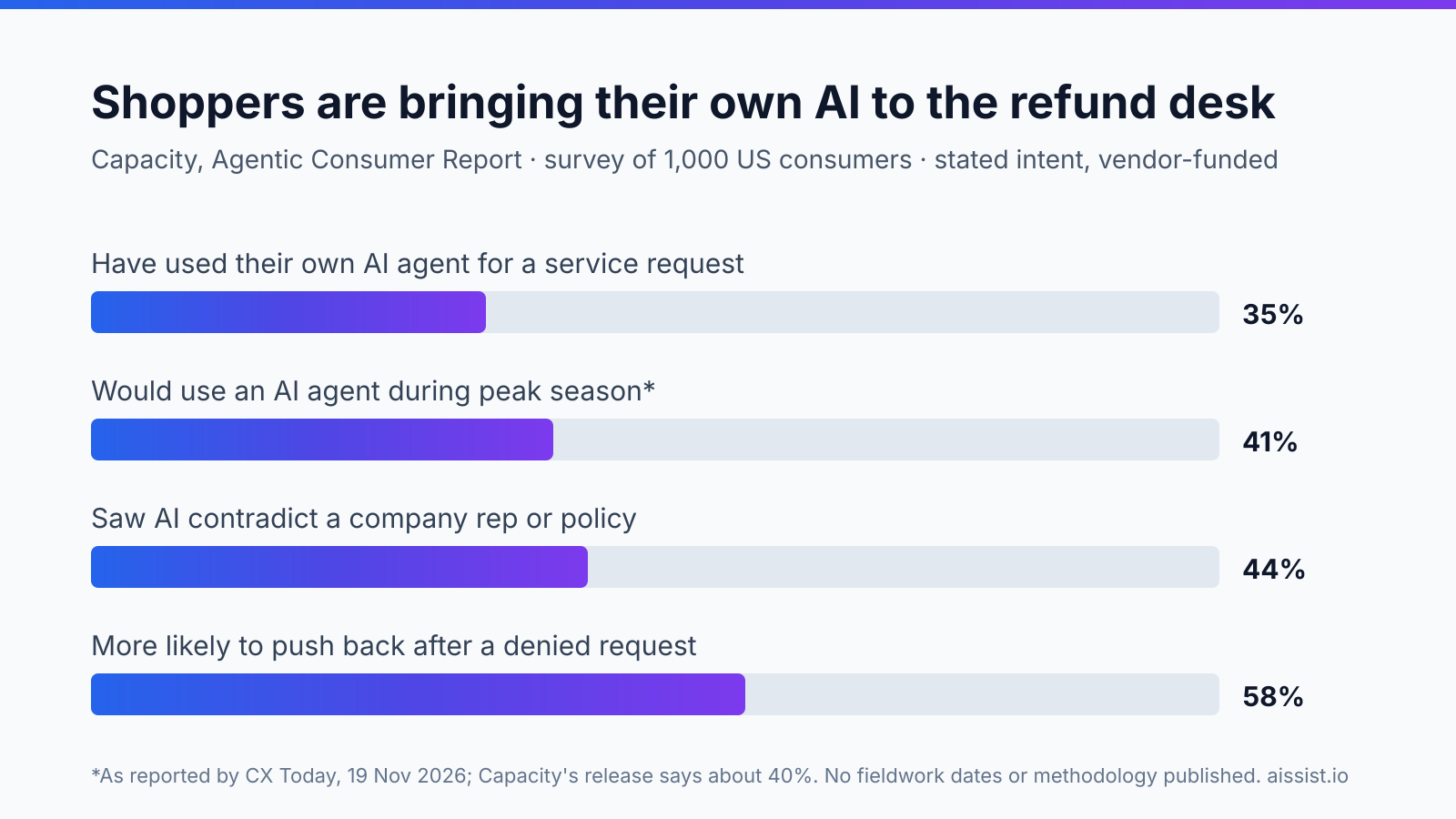
AI agent refunds and returns now have two sides. Capacity's Agentic Consumer Report, a survey of 1,000 US consumers, reported 19 November 2026, found 41% would use an AI agent during peak season and 58% say AI would make them likelier to push back after a denial. That is stated intent from a vendor-funded survey with no published fieldwork dates or methodology.
TL;DR: Six help desk AI agents can issue refunds, yet none documents what happens when the customer's own AI asks; Visa already holds cardholders responsible for their agents' purchases, so the fix is a written policy.
Methodology & sources
- Help desk capabilities from Macha's actions matrix (28 Sep 2026); Visa rule 4.1.23.10 (24 Oct 2026 edition) via Chargeflow.
- Checked 24 Nov 2026. Disclosure: this is Aissist's blog; Aissist sells AI agents that resolve requests, refunds included.
Can a customer use their own AI agent to request a refund?
Yes. Nothing stops a customer's AI agent from requesting a refund, and Visa's rules already hold cardholders responsible for their registered agents' purchases.
Visa's rule 4.1.23.10 requires agent providers to obtain "Cardholder acknowledgement that they are responsible for actions," hospitality.today reports.
Capacity's report page says 35% have already used their own AI agent for a service request, and 44% have seen AI contradict a company representative or policy. The agent arrives confident and sometimes wrong about your return window.
Your refund policy now has a second reader, and it reads faster than your team.
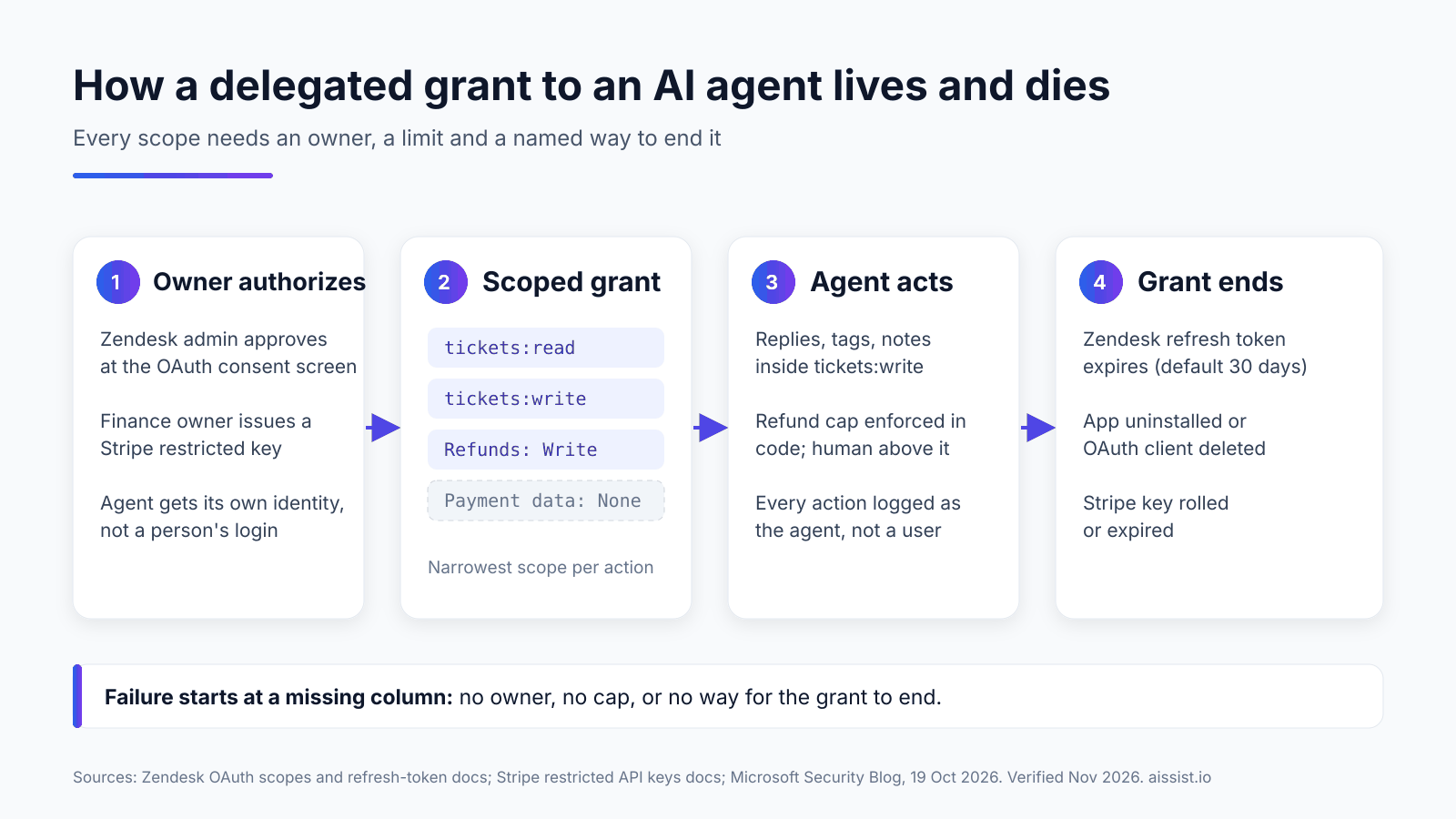
A deflection tool never faced this; it doesn't act. Once your AI can move money, "whose AI is asking?" becomes an operational control, the other half of delegated authorization.
Which help desk AI agents can refund — and what if an agent asks?
All six native help desk AI agents in Macha's matrix can refund in some form; none documents a request from the customer's own AI.
| AI agent | Refunds (Nov 2026) | Approval gate | Customer's own agent asks |
|---|---|---|---|
| Zendesk AI agents | Native, full refunds only | Runs as the connecting Shopify user | Not documented |
| Intercom Fin | Shopify refund action in a Procedure | "Loop in teammate" pauses for approval | Not documented |
| Gorgias AI Agent | Inside cancel or item-change only | Customer confirms irreversible actions | Not documented |
| Freshdesk Freddy | PayPal template; Shopify read-only | Chat confirmation, skipped on email | Not documented |
| HubSpot customer agent | Custom API action | None, match email, or verify email | Not documented |
| Front Autopilot | Custom Playbook step | Drafts when auto-send is off | Not documented |
Gorgias's customer confirmation and HubSpot's email verification both assume a person. They prove only that something with inbox access said yes.
Who is liable when an AI agent requests a refund?
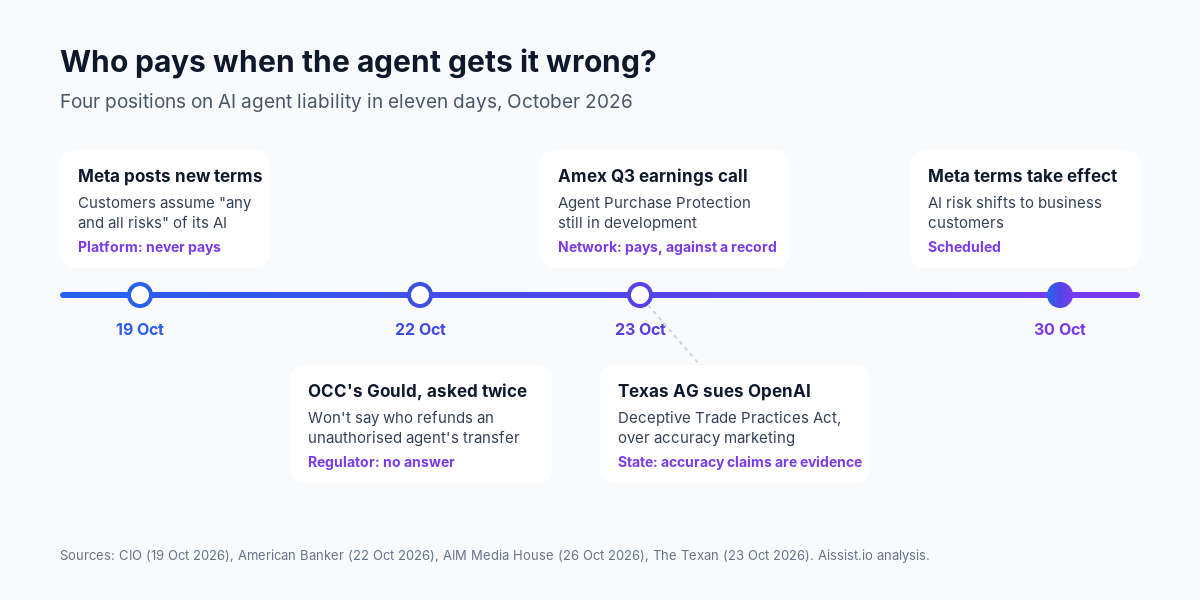
Nobody has settled it: Visa holds cardholders responsible for registered agents' purchases, but Chargeflow notes rule 4.1.23.10 sets no dispute procedure, so the merchant makes the call and wears a bad one. Citi disagrees with Visa:
"to the agent themselves, the company that is actually coming with the agent." — Abhinav Anand, Citi U.S. consumer cards, on agent liability, via hospitality.today
| Rule or protocol | What it means for an agent's refund request |
|---|---|
| Visa Core Rules 4.1.23.10 (Oct 2026) | Cardholder answers for a registered agent; no dispute procedure |
| Amex Agent Purchase Protection (announced Apr 2026) | Cardmember asks the merchant first; not yet live |
| ACP (Stripe, OpenAI, Meta) | Merchant pushes refunds to the agent platform as order events |
| UCP (Google, Shopify) | Refunds and returns are adjustments the merchant reports |
| EU Directive 2011/83/EU (2011) | 14-day withdrawal for online purchases, no reason required |
Both protocols carry refunds out to the agent, not requests in. The refund is left to your policy.
"Reg E's unauthorized transaction framework has a gap that no regulator has yet addressed." — Nilesh (Neal) Patel and co-authors, FBT Gibbons
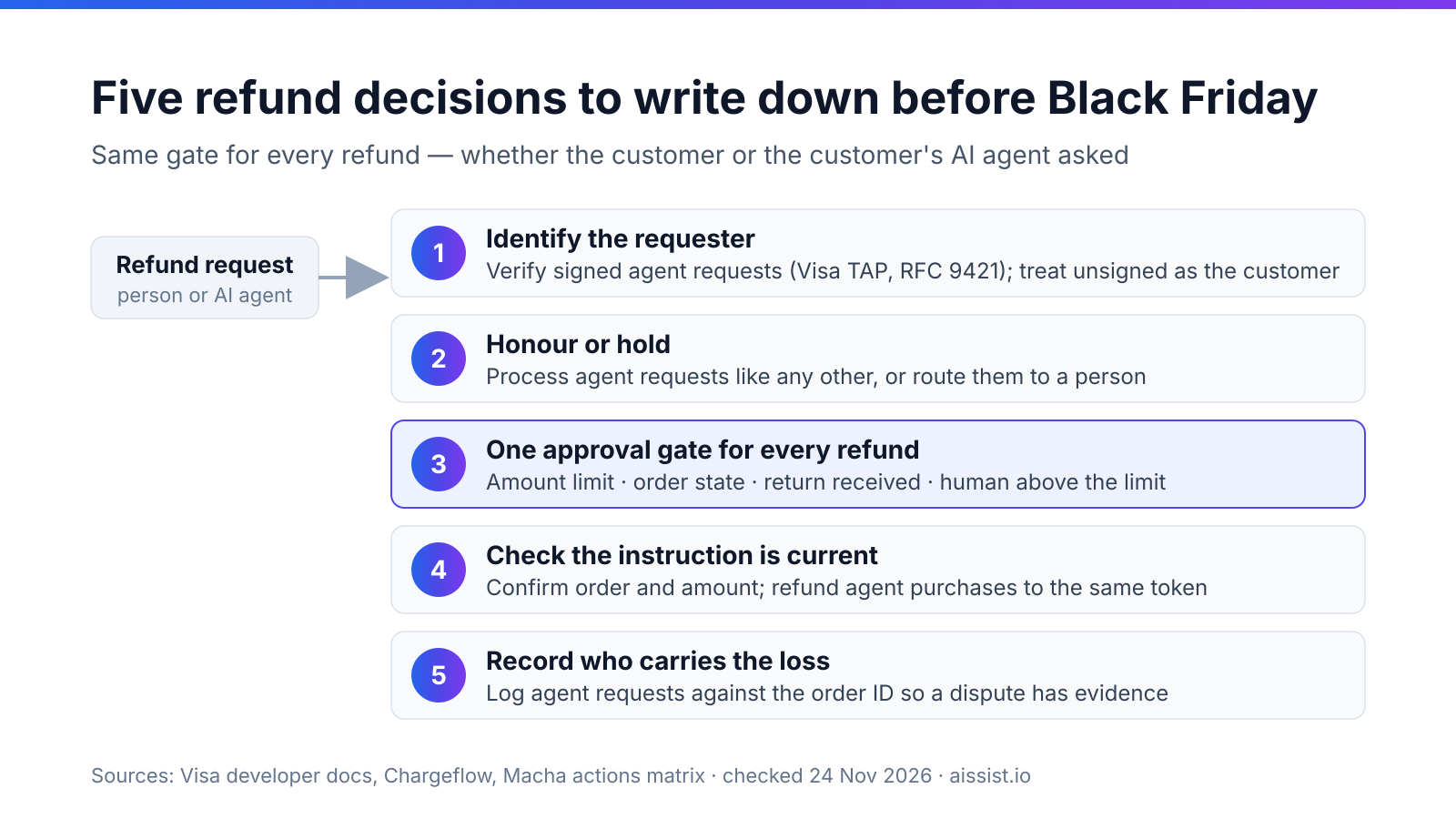
Five decisions to make before Black Friday
Each is one line of policy, not a product.
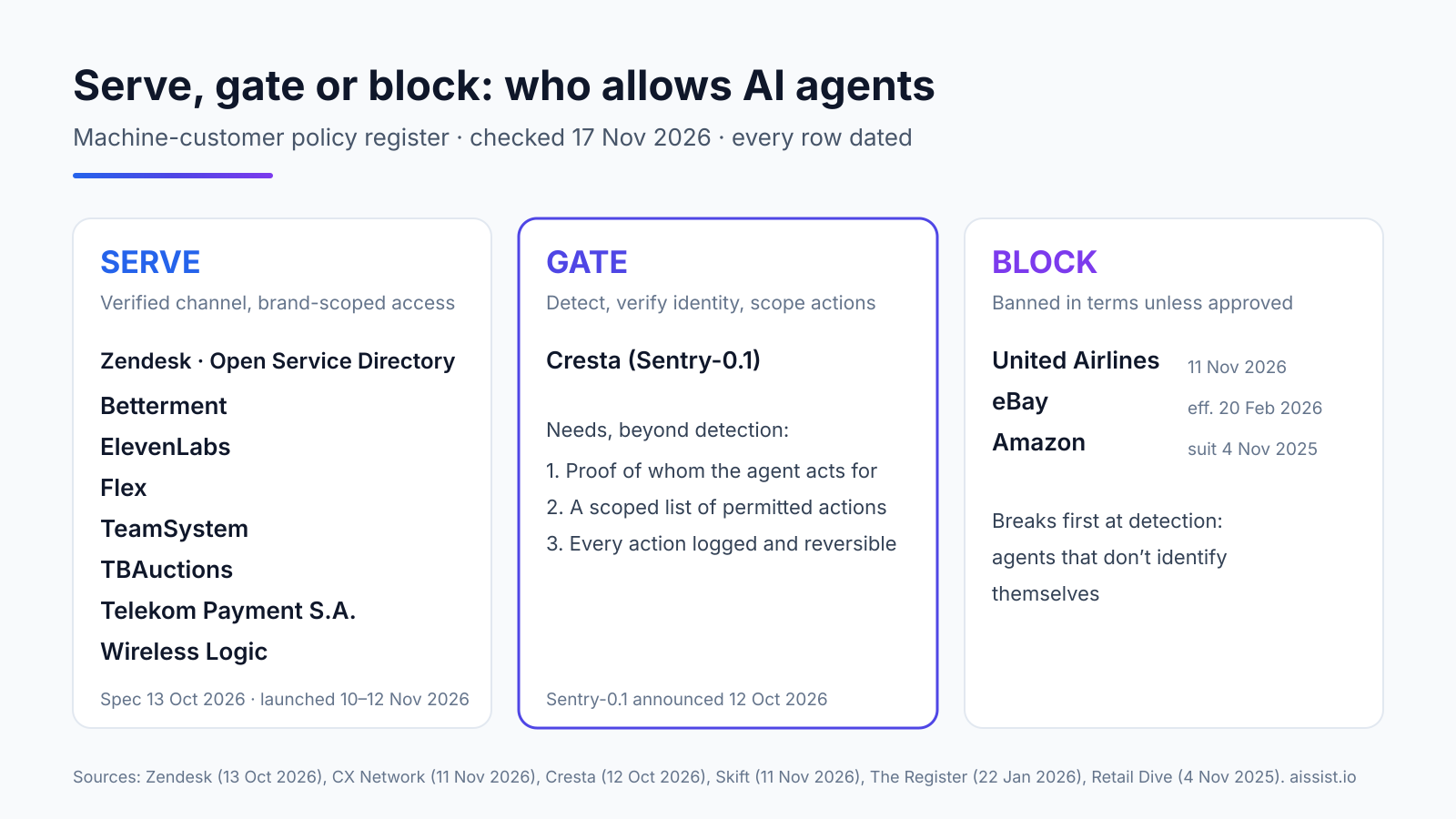
- Identify it. Visa's Trusted Agent Protocol has agents sign requests (RFC 9421) for merchants to verify; treat unsigned email as the customer.
- Honour or hold. Process an agent's request like any other, or route it to a person. Refusing a valid EU withdrawal because software sent it needs counsel's sign-off.
- Gate the money, not the messenger. One approval rule for every refund: amount limit, order state, return received.
- Check the instruction is current. Confirm order and amount; Chargeflow advises refunding agent purchases to the same token.
- Write down who carries the loss. Log agent requests against the order ID, so a dispute has evidence.
Aissist's reliable-AI page describes this shape: refunds checked against business-set limits, anything outside them escalated to a human with full context. Aissist reports 83% average resolution and 4.8/5.0 CSAT.
Whose AI is asking is a policy you can write this week
Help desk AI agents can refund. Who may ask is half-answered: the networks put the cardholder on the hook. The other half is yours. Write the five decisions down before Friday, put one gate in front of every refund, and plan for the error, not the argument.
Frequently asked questions
Should merchants refuse refund requests sent by a customer's AI agent?
Not by default. A request on a verifiable order should meet the same policy and approval gate as any other; refusing EU withdrawals sent by software is a legal risk.
How can a merchant tell a request came from an AI agent?
Verify signed requests where offered; Visa's Trusted Agent Protocol uses RFC 9421 signatures. Unsigned email and chat can't be reliably told apart.
Do ACP and UCP let an agent request a refund?
Their order documentation treats refunds as events the merchant reports to the agent platform. The request still arrives through your normal service channels.
What approval gate should sit in front of an AI-issued refund?
One rule regardless of requester: an amount limit, order and return checks, and human approval above the limit. Zendesk advises marking refund actions as agent-approved.
Changelog
- 24 Nov 2026 — Published; help desk actions, card-network rules and protocol docs checked.