AI Readiness Checklist for Customer Support: 10 Questions, One Score
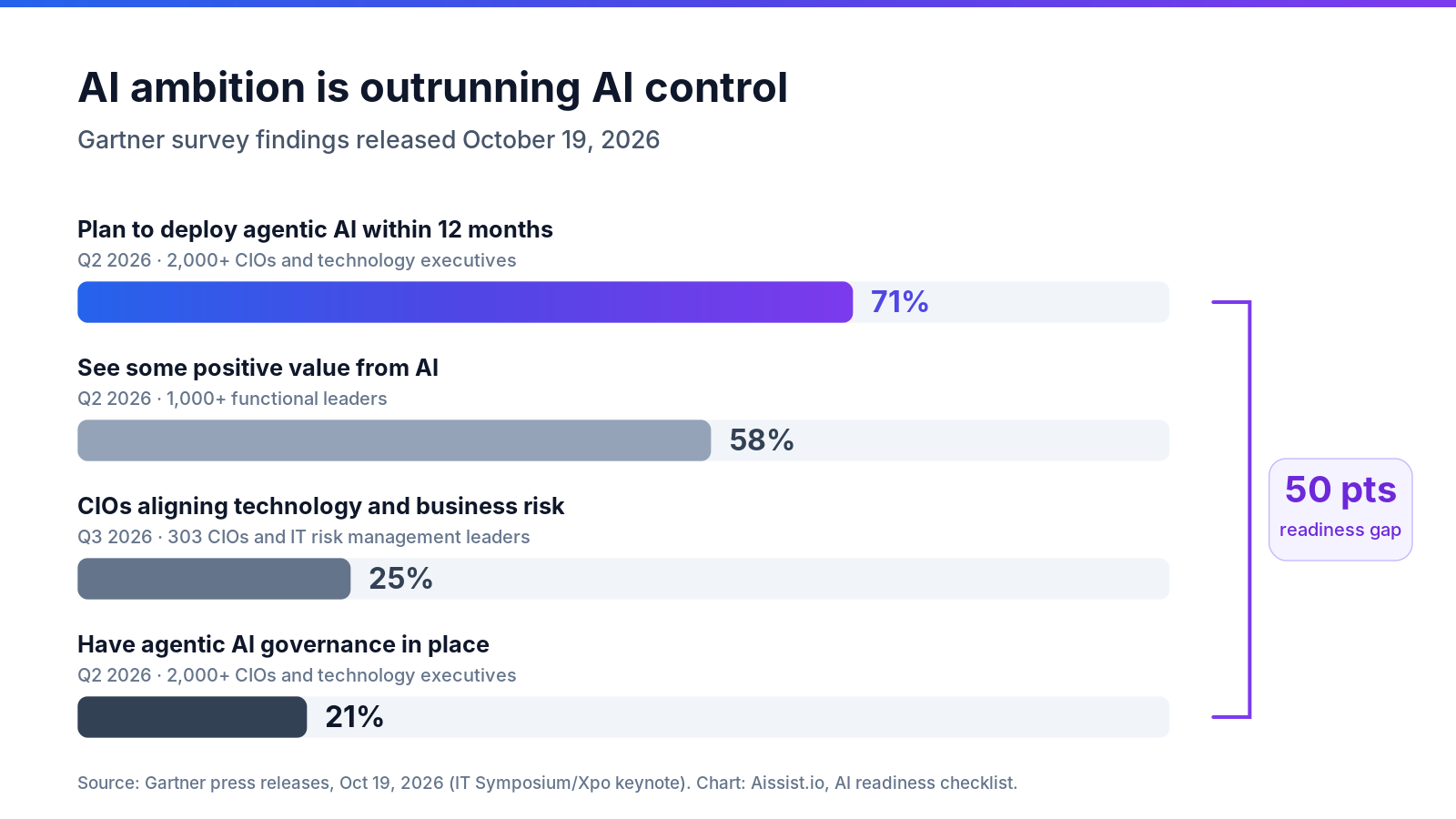
This AI readiness checklist scores a support team out of 100 in ten questions, then feeds the two numbers that matter into a resolution benchmark and an Erlang C staffing model. The urgency comes from Gartner's October 19, 2026 data: 71% of organizations plan to deploy agentic AI within 12 months, while 21% have governance in place.
TL;DR: Gartner's 50-point gap between agentic AI plans (71%) and governance (21%) is a readiness gap; for a support team, readiness means five artifacts — answers, handoffs, data access, an off switch, a baseline — and most cannot be bought.
Methodology & sources
- Survey data: two Gartner press releases dated October 19, 2026 (Q2 2026 survey of 2,000+ CIOs and technology executives; Q2 2026 survey of 1,000+ functional leaders; Q3 2026 survey of 303 CIOs and IT risk leaders; 2027 CIO Agenda survey of 2,002 CIOs, fielded May–July 2026).
- Benchmark bands come from Aissist's resolution benchmark tool, which the page describes as Aissist's own synthesis, not an audited dataset. Staffing figures are the default example in Aissist's Erlang C calculator.
- The 10-question rubric and its bands are an editorial heuristic, not a validated predictive model.
- All figures verified October 21, 2026. Disclosure: this is Aissist's blog, and Aissist sells AI agents for customer service and sales.
Why does a support team need an AI readiness checklist now?
A support team needs an AI readiness checklist now because ambition is outrunning control: Gartner reports that 71% of organizations expect to deploy agentic AI within 12 months, but only 21% have agentic AI governance capabilities, in a Q2 2026 survey of more than 2,000 CIOs and technology executives.
The rest of Gartner's October 19 data points the same way. A separate Q2 2026 survey found 58% of more than 1,000 functional leaders see "some positive value" from AI. A Q3 2026 survey of 303 CIOs and IT risk leaders found only 25% align technology and business risk. Gartner titled the keynote release plainly: AI risk is rising faster than AI value.
"The new CIO imperative is to align value with risk and align safety with governance." — Daryl Plummer, VP, Distinguished Analyst and Gartner Fellow, Gartner
Customer support is where that gap gets expensive first, because support AI talks to customers and touches orders, refunds and accounts. Gartner's 2027 CIO Agenda survey of 2,002 CIOs puts the odds of an AI use case succeeding at one in five, and finds just 13% have realized significant value.
Most checklists ranking for this query — Zendesk's, Forethought's, Lorikeet's — list good advice. A list tells you what to do. A score tells you whether to launch on Monday.
What are the 10 questions in the AI readiness checklist?
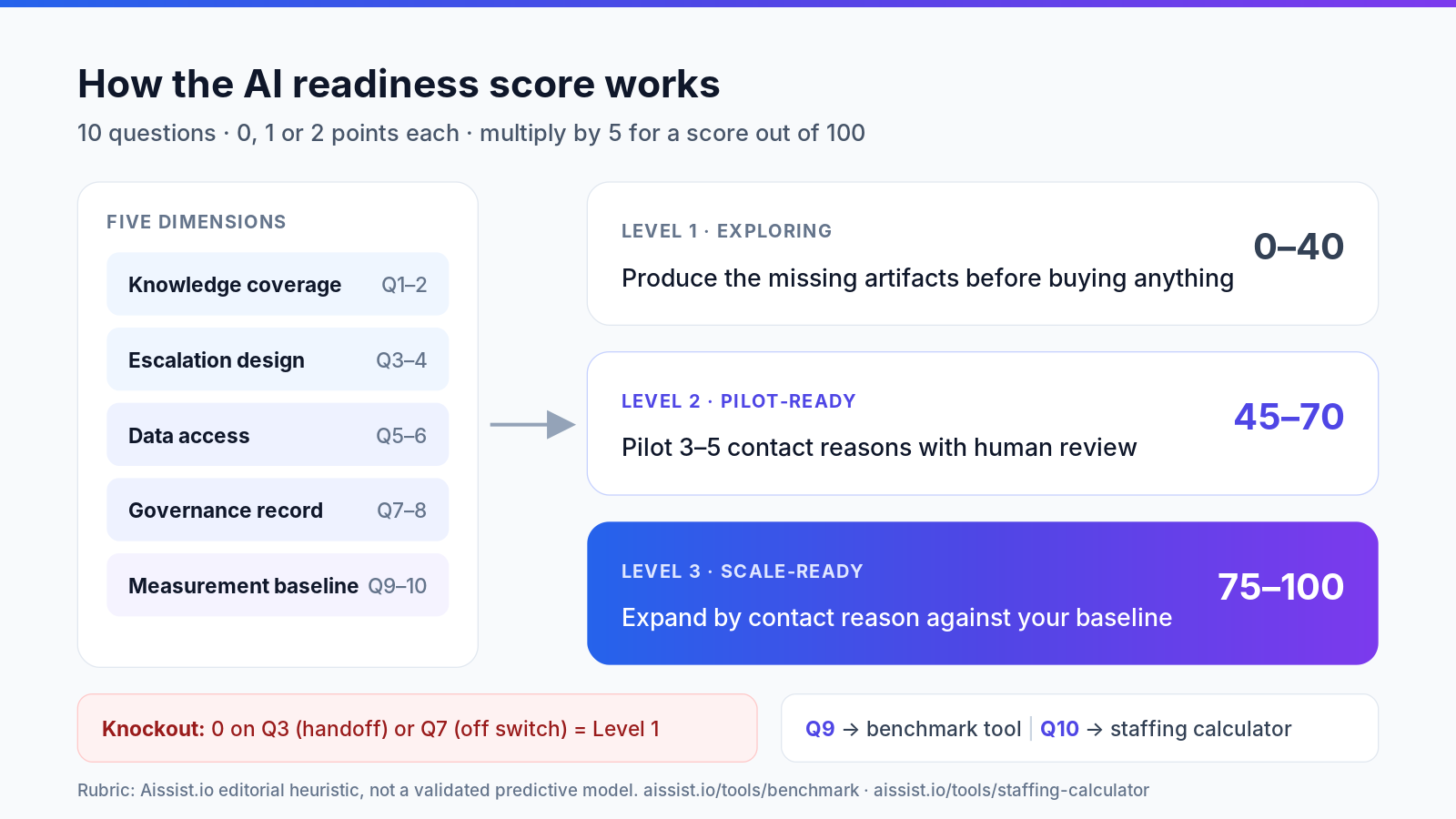
The AI readiness checklist asks ten questions across five dimensions — knowledge coverage, escalation design, data access, governance and measurement — and scores each 0, 1 or 2. Give yourself 2 only if the artifact exists in writing today. "We'd figure it out" scores 0.
| # | Question | Scores 2 if… |
|---|---|---|
| 1 | Do written answers exist for your top 20 contact reasons? | Current within 90 days, each with a named owner |
| 2 | Are policies written as rules, not prose? | Refunds, exceptions and limits are stated as thresholds |
| 3 | Is there a written AI-to-human handoff? | Triggers, context passed and target queue are documented |
| 4 | Does every escalation queue have an owner and staffed hours? | Named person, published hours, overflow plan |
| 5 | Can a system read order and account data through an API? | Read access works today; write access is scoped |
| 6 | Is ticket tagging consistent enough to rank contact reasons? | Top reasons come from data, not memory |
| 7 | Is there an owner who can switch the AI off, and has it been tested? | Named owner, permitted-action list with limits, tested off switch |
| 8 | Did you write a success metric and a stop rule before launch? | Both exist, signed off |
| 9 | Do you know your resolution rate and CSAT, defined? | Resolution measured separately from deflection |
| 10 | Do you know peak contacts per hour, handle time and shrinkage? | All three from the last 90 days |
Question 8 is the rarest 2. Gartner's CIO survey found only 31% of CIOs have guidelines for when a pilot should not reach production, and 17% have rules for abandoning low-value AI already live. A stop rule written after launch is called a post-mortem.
Two answers need a number, not a yes. For question 9, enter your resolution rate and CSAT in the AI resolution benchmark, which places you against an industry band. For question 10, enter your traffic in the staffing calculator.
How do you score it, and where does that put you on the maturity model?
Add the ten scores, multiply by five for a score out of 100, then read the result as a customer support AI maturity model: 0–40 is Level 1 (fix artifacts first), 45–70 is Level 2 (pilot narrowly), 75–100 is Level 3 (scale). One override applies: a 0 on question 3 or question 7 caps you at Level 1 whatever the total, because missing handoffs and missing off switches are where AI errors become customer harm.
| Score | Level | What to do next |
|---|---|---|
| 0–40 | 1 · Exploring | Produce the missing artifacts before buying anything |
| 45–70 | 2 · Pilot-ready | Launch on three to five contact reasons with human review |
| 75–100 | 3 · Scale-ready | Expand by contact reason, measured against your baseline |
The calculators turn the score into an operating number. Aissist's benchmark lists an ecommerce AI resolution band of 70–84% with a 76% median; a result below the band is a prompt to revisit questions 1 and 2 first. The staffing calculator's default example shows why resolution is not headcount: 28% AI resolution removes 13% of scheduled agents, because Erlang C staffing is nonlinear and the contacts left over take longer.
For comparison, Lorikeet's own yes/no scorecard reports a median of 54 out of 100 among the CX leaders who took it, per its readiness checklist. The middle of the curve is crowded, and that is the expensive place to start a big rollout.
Which AI readiness gaps can't you fix by buying software?
Two of the five gaps — escalation design and the measurement baseline — cannot be bought at all, and the other three can only be half-bought. A vendor can sell you the switch. It cannot sell you the person who decides to pull it.
| Gap | Artifact that closes it | Who produces it | Can a purchase close it? |
|---|---|---|---|
| Knowledge coverage | Top-20 answers and policy rules, with owners and review dates | Support ops and policy owners | Partly: tools draft from tickets; humans sign off policy |
| Escalation design | Handoff spec: triggers, context, queue, hours | Support lead | No |
| Data access | API access to order, account and billing records | Platform or engineering owner | Partly: connectors work only where an API exists |
| Governance record | Owner, action limits, off-switch test, stop rule | Exec sponsor and risk | Partly: vendors supply switches and logs, not owners |
| Measurement baseline | Resolution, CSAT, peak volume, handle time, shrinkage | Support ops or WFM | No: a dashboard after launch cannot recreate "before" |
"Volume is not value." — Alicia Mullery, VP Analyst, Gartner
The data-access row is the one buyers most often assume a connector will solve. Before Game Room Shop's AI could answer presales questions, its product catalog had to be searchable by name, SKU and variant against live Shopify data, and the team now trains the AI weekly. The published story reports a 60% resolution rate and a planned hire that never happened.
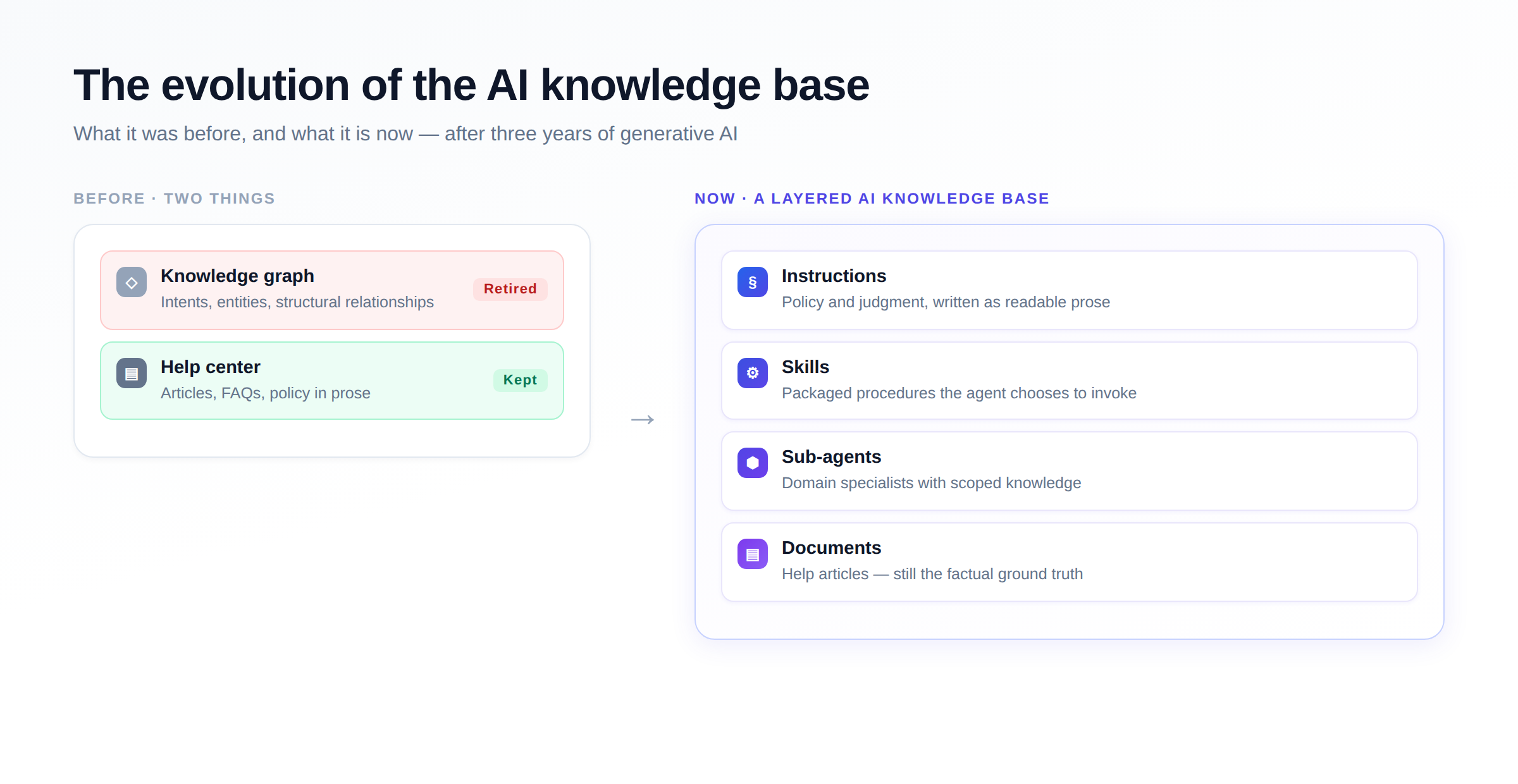
Knowledge is the row teams underrate. Aissist's guide to the modern AI knowledge base explains why policy written as rules now matters more than article count, and the governance control gap piece covers what a tested off switch looks like.
Is my support team ready for AI if we score low?
A low score means your support team is not ready to scale AI, but it is ready to start producing the artifacts — work that costs time and meetings, not licenses. Begin with questions 10 and 9, because a baseline is cheap now and impossible later.
Then write the handoff spec and name the off-switch owner, which lifts the knockout cap. The remaining gaps can close inside a narrow pilot: three contact reasons, human review on every escalation, and the stop rule from question 8 pinned somewhere awkward to ignore. Aissist's four-step build assumes those assets exist, which is the point.
The end state is a hybrid model, not a replacement, and planning for it is still rare: Gartner's CIO survey found only 4% of CIOs have explicit plans to redesign roles for a human-agent workforce. Holafly scaled sales and support threefold through peak season with AI on the baseline volume and humans on escalations.
"Not only our sales and support operations increased by 3X during peak season, the CSAT improved." — Jefersson Arana, Senior Manager of AI, Holafly
Skipping the order has a known ending; Aissist's breakdown of why AI projects fail starts with the missing success metric.
Readiness is a paper trail, not a purchase order
Gartner's 71%-versus-21% gap will not close by buying faster. For a support team, readiness is five artifacts: written answers, a handoff spec, working data access, a governance record with a named owner, and a baseline taken before launch. Score yourself honestly, fix any knockout first, and put your two numbers through the benchmark and the staffing calculator. If you land at Level 2, pilot narrowly. If you land at Level 1, the cheapest AI project available is a document.
Frequently asked questions
What is an AI readiness checklist for customer support?
An AI readiness checklist for customer support is a set of questions that tests whether a team has the knowledge, escalation paths, data access, governance and baseline metrics needed before deploying AI agents. This version scores ten questions out of 100.
How long does an AI readiness assessment take for a CX team?
Scoring the ten questions takes about 15 minutes if the answers are honest. Closing the gaps takes longer, and the time goes into writing handoffs, policy rules and a baseline rather than installing software.
What score means my support team is ready for AI?
A score of 75 or higher with no zero on the handoff or off-switch questions means a team is ready to scale. Scores from 45 to 70 support a narrow pilot with human review.
What is a customer support AI maturity model?
A customer support AI maturity model ranks how prepared a team is to run AI agents. This checklist uses three levels: Exploring (0–40), Pilot-ready (45–70) and Scale-ready (75–100), with a knockout rule for missing handoffs or off switches.
What is the difference between resolution and deflection?
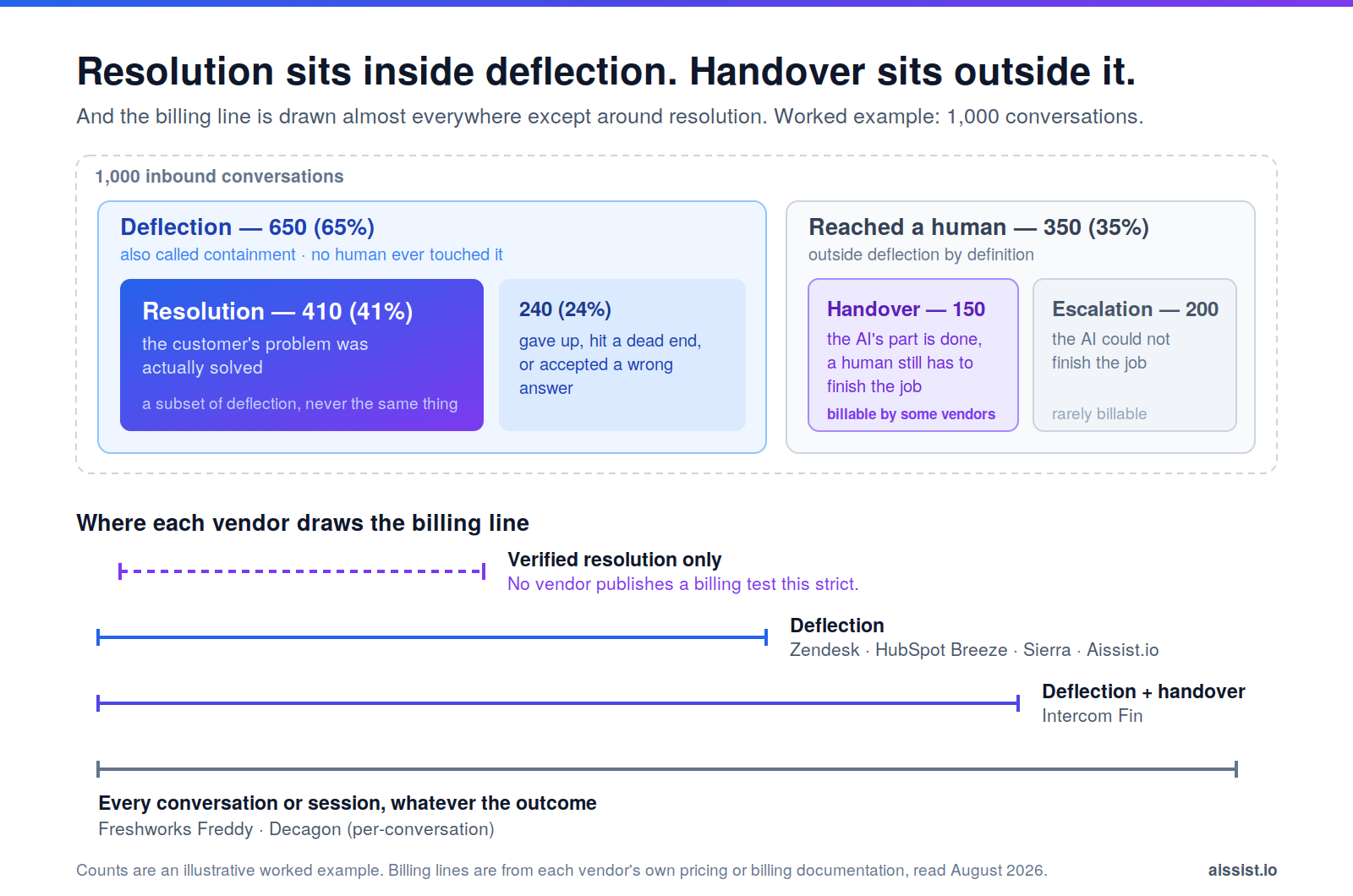
Resolution means the customer's issue was fully solved without a human. Deflection means the customer did not reach a human, whether or not the issue was solved. Measure resolution, because deflection counts unsolved issues as successes; see deflection vs. resolution rate.
Why does AI resolution not reduce headcount one-for-one?
The contacts AI leaves for humans are harder and take longer. In the default example of Aissist's Erlang C staffing calculator, 28% AI resolution removes 13% of scheduled agents.
Changelog
- Oct 21, 2026: Published, with Gartner survey data released October 19, 2026.