The 7 Best AI Governance and EU AI Act Compliance Tools in 2026
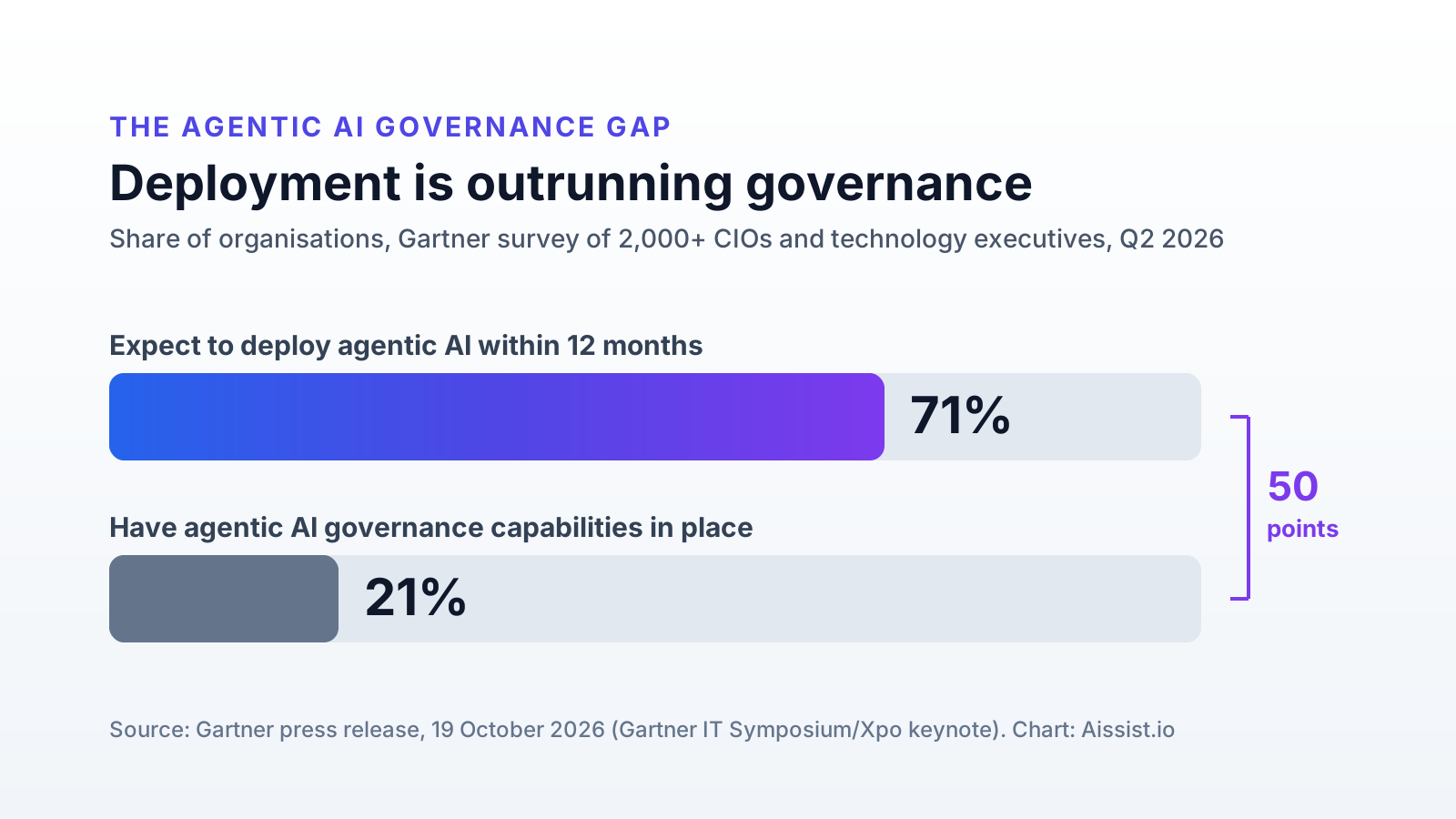
Gartner's survey of more than 2,000 CIOs and technology executives found that 71% of organisations expect to deploy agentic AI within 12 months, while only 21% have agentic AI governance in place (Gartner, 19 October 2026). The best AI governance tools close that gap on paper. This guide covers the part they can't close alone.
TL;DR: Credo AI, Trustible and Holistic AI are the strongest registers for AI you buy rather than build, but no register produces the disclosure, logs and escalation records a deployed agent must generate itself.
The shortlist
- Credo AI — best for registering third-party agents and vendors
- Trustible — best for regulated enterprises with deployer obligations
- Holistic AI — best for testing plus third-party vendor monitoring
- IBM watsonx.governance — best for large multi-cloud estates
- Modulos — best for building an evidence library behind Annex IV
- Asenion (formerly Fairly AI) — best for turning regulations into operational controls
- Kertos — best for European mid-market compliance bundles
Methodology & sources
- Vendor facts from each vendor's product, documentation and pricing pages; ratings from public G2 listings; Gartner placements as vendors state them. Legal text from the AI Act as amended by the Digital Omnibus.
- Five criteria: inventory depth, risk-tier mapping, evidence and Annex IV support, intake of third-party AI (weighted highest), and pricing transparency. All figures verified October 2026.
- Disclosure: this is Aissist's blog. Aissist sells customer-service AI agents, not governance software, so it isn't ranked. It sits on the other side of the audit, which is this article's angle.
What changed for EU AI Act compliance in October 2026?
Enforcement became real. On 14 October, Executive Vice-President Henna Virkkunen told the International AI Summit in Dublin that the Commission had taken its first AI Act enforcement actions: AI Office Requests for Information on security, external evaluation and how models are used (European Commission).
"The Commission has been loud and clear: AI must remain under human direction, oversight and control" — Henna Virkkunen, Executive Vice-President, European Commission
Gartner's fifty-point gap arrived five days later. That is a lot of agents running on trust. Penalty tiers come from Article 99 and Article 101; application dates from Article 113 as amended by the Digital Omnibus (Orrick).
| Date | What applies | Maximum fine |
|---|---|---|
| 2 Aug 2026 | Article 50 transparency, including telling people they are talking to AI | €15M or 3% of turnover |
| 2 Aug 2026 | Commission fining powers over general-purpose AI model providers (Art. 101) | €15M or 3% of turnover |
| 14 Oct 2026 | First AI Office Requests for Information announced | — |
| 2 Dec 2026 | New Article 5 prohibited practices | €35M or 7% of turnover |
| 2 Dec 2027 | Annex III high-risk obligations, deferred from August 2026 | €15M or 3% of turnover |
The best AI governance tools at a glance
The columns are obligations, not features. The fourth, which most roundups skip, asks whether a tool can take in an agent you bought.
| Tool | What it registers | AI Act risk-tier mapping | Covers a deployed third-party agent | Pricing model (Oct 2026) |
|---|---|---|---|---|
| Credo AI | Agents, models, apps, shadow AI, vendors | Risk classification and conformity assessments | Yes: vendor registry and vendor portal | No public price; demo |
| Trustible | Use cases, models, agents, vendors | Four tiers, including an Article 50 tier | Yes: vendor intake and questionnaires | No public price found |
| Holistic AI | Models, agents, datasets, endpoints | Prohibited / high-risk / low-to-minimal, plus role | Yes: third-party vendor monitoring | No public price found |
| IBM watsonx.governance | Use cases, models, factsheets | Applicability assessment per regulation | Partial: models built outside IBM | From $3,500/month (Basic) |
| Modulos | AI systems and agents, evidence | Prohibited / high-risk / transparency | Partial: vendor documentation as evidence | Bespoke, about $50K+/year |
| Asenion | Models, copilots, vendor AI, agents | Risk-tiered register | Partial: vendor AI in register | Discovery call |
| Kertos | AI use cases with a risk class | Risk tiers (unnamed) | Not documented | Quote only, three plans |
1. Credo AI — best for registering third-party agents and vendors
Credo AI is an AI governance platform that inventories every AI system an enterprise uses, including agents and vendor AI, and applies policy packs and evidence collection to each. Its product page lists an Agent Registry with agent cards and EU AI Act, NIST AI RMF and ISO 42001 policy packs.
- Strong at: vendors submit compliance evidence through a vendor portal; agents get their own registry.
- Watch for: no published pricing; 4.7 on G2, but from only 10 reviews.
"Features like AI Registry and Vendor Registry have allowed us to maintain control of all AI use cases" — Andrew Reiskind, Chief Data Officer, Mastercard, via Credo AI
Our take: the closest fit when your AI is mostly bought. Model builders may want deeper testing.
2. Trustible — best for regulated enterprises with deployer obligations
Trustible is an AI governance platform for regulated enterprises that captures every AI use case, model, agent and vendor at intake, scores its risk and triggers impact assessments. Its EU AI Act page says most enterprises hold deployer obligations for AI they buy, and maps systems to four tiers, one dedicated to Article 50.
- Strong at: intake records whether a system is built or bought; vendor questionnaires.
- Watch for: no reviews on G2 yet; no public price found.
Our take: the clearest framing of the deployer's problem here; not aimed at small teams.
3. Holistic AI — best for testing plus third-party vendor monitoring
Holistic AI is an enterprise AI governance platform that discovers, tests and enforces policy across an organisation's AI, keeping one live registry of models, agents, datasets and endpoints. It classifies systems as prohibited, high-risk or low-to-minimal risk and records the operator's role (Holistic AI).
- Strong at: red teaming alongside governance; a dedicated third-party vendor management use case.
- Watch for: no G2 reviews yet; Annex IV support not described on its AI Act pages.
Our take: strongest when in-house models need testing too. Overkill for a single vendor agent.
4. IBM watsonx.governance — best for large multi-cloud estates
IBM watsonx.governance is an enterprise platform for monitoring, controlling and documenting AI across its lifecycle, using factsheets and a governance console. It runs an applicability assessment to decide whether a use case falls under the AI Act, and can govern models built outside IBM.
- Strong at: the only published prices here, with Risk & Compliance Basic from $3,500 a month (indicative, one user) and a 14-day free trial (IBM pricing); 4.3 from 83 G2 reviews.
- Watch for: model-centric; vendor-questionnaire workflows not documented.
Our take: the safe pick for large estates; heavy for one bought agent.
5. Modulos — best for building an evidence library behind Annex IV
Modulos is a Swiss AI governance platform, which the company calls the first ISO 42001-certified one, that inventories AI systems and agents and files evidence against the AI Act, ISO 42001 and NIST AI RMF. Its documentation is unusually candid: writing the Annex IV technical file is the provider's job, the platform is the evidence library behind it, and there is no dedicated FRIA workflow.
- Strong at: honest scope; broad framework library.
- Watch for: bespoke pricing that Modulos itself puts at about $50,000 to several hundred thousand dollars a year (Modulos).
"We have selected Modulos platform because we need to demonstrate rigorous, auditable oversight of any AI systems that we use." — Gorazd Čibej, Director, Insurance Supervision Agency (Slovenia), via Modulos
Our take: right for supervised, Europe-first organisations. Wrong for a quick start.
6. Asenion (formerly Fairly AI) — best for turning regulations into controls
Asenion is an AI governance platform that converts legal, regulatory and internal requirements into operational controls, then assesses and monitors AI systems and agents against them. It formed when Fairly AI acquired Sweden's anch.AI in June 2025 (Asenion), and keeps one risk-tiered register of models, copilots, vendor AI and agents.
- Strong at: deep financial-services framework coverage, including OSFI E-23.
- Watch for: no G2 listing; AI Act depth not detailed on its homepage.
Our take: worth a call for banks and insurers. Thin public detail for everyone else.
7. Kertos — best for European mid-market compliance bundles
Kertos is a German compliance automation platform that combines software with certified experts across ISO 27001, GDPR, NIS2, ISO 42001 and the AI Act. Its AI inventory records every use case and assigns it a risk class.
- Strong at: one platform for security, privacy and AI; 4.8 from 65 G2 reviews.
- Watch for: quote-only plans; intake of purchased AI agents not documented.
Our take: practical for a mid-sized firm already doing ISO 27001; not built for large model estates.
What should the AI Act record for a customer-service agent contain?
Four things, and the agent generates most of them. A register can point to each one; it cannot create the evidence.
| Record element | Legal hook | Produced by |
|---|---|---|
| AI disclosure at first interaction | Article 50(1) and 50(5), from 2 Aug 2026 | The agent, logged per conversation |
| Interaction and action logs | Article 26(6): at least six months, if high-risk | The agent platform |
| Human oversight owner | Article 26(2): competence, training and authority, if high-risk | Your team, named in the register |
| Escalation path with context | The oversight duty in practice | The agent's handoff |
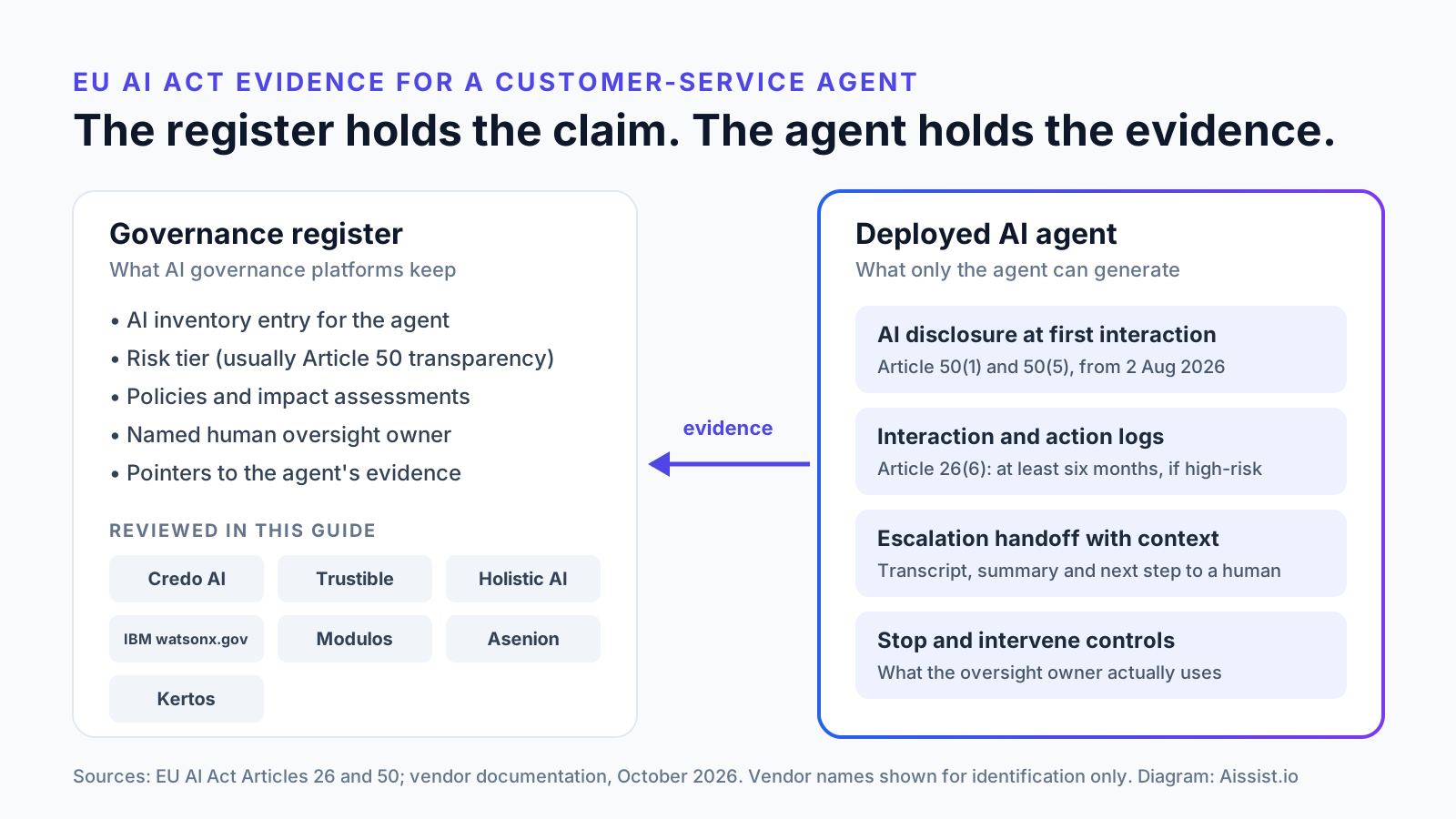
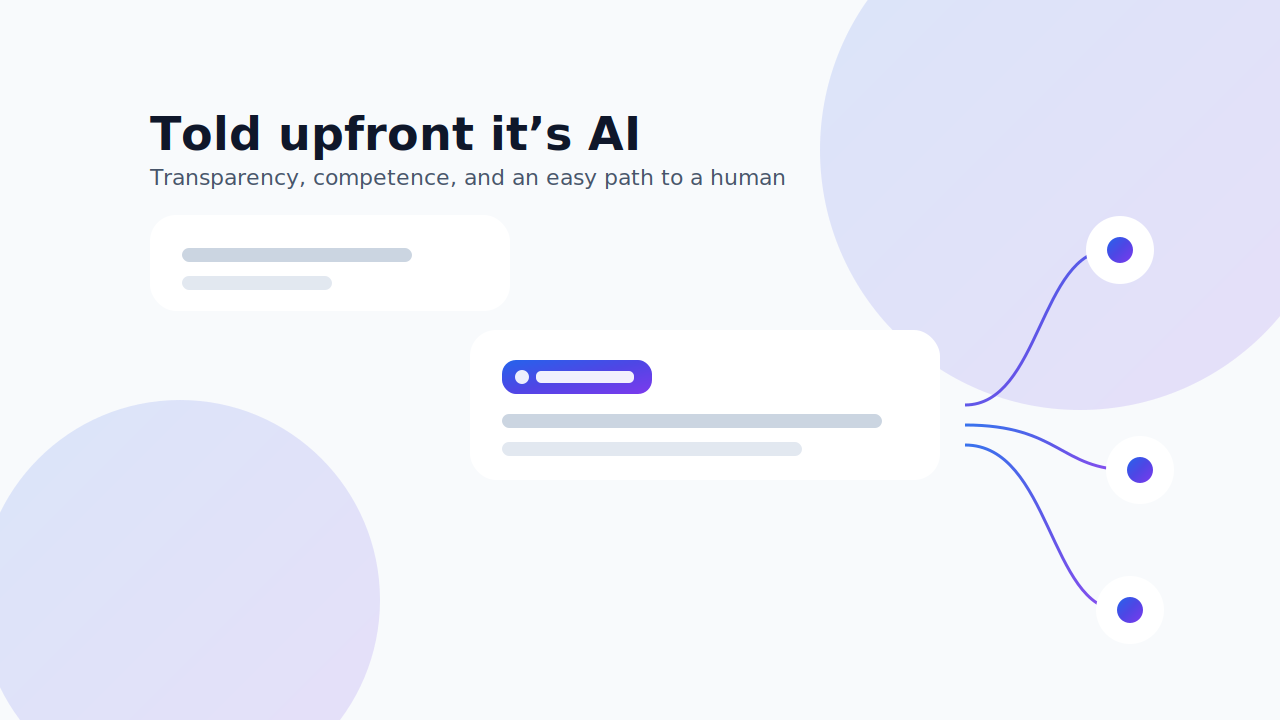
Most customer-service agents sit in the transparency tier, not high-risk, so Article 50 is today's binding duty, and it binds the provider: for a bought agent, the vendor. Building the rest as an Annex-IV-style record is optional before December 2027, and cheap; our disclosure research covers doing the first row without losing conversions.
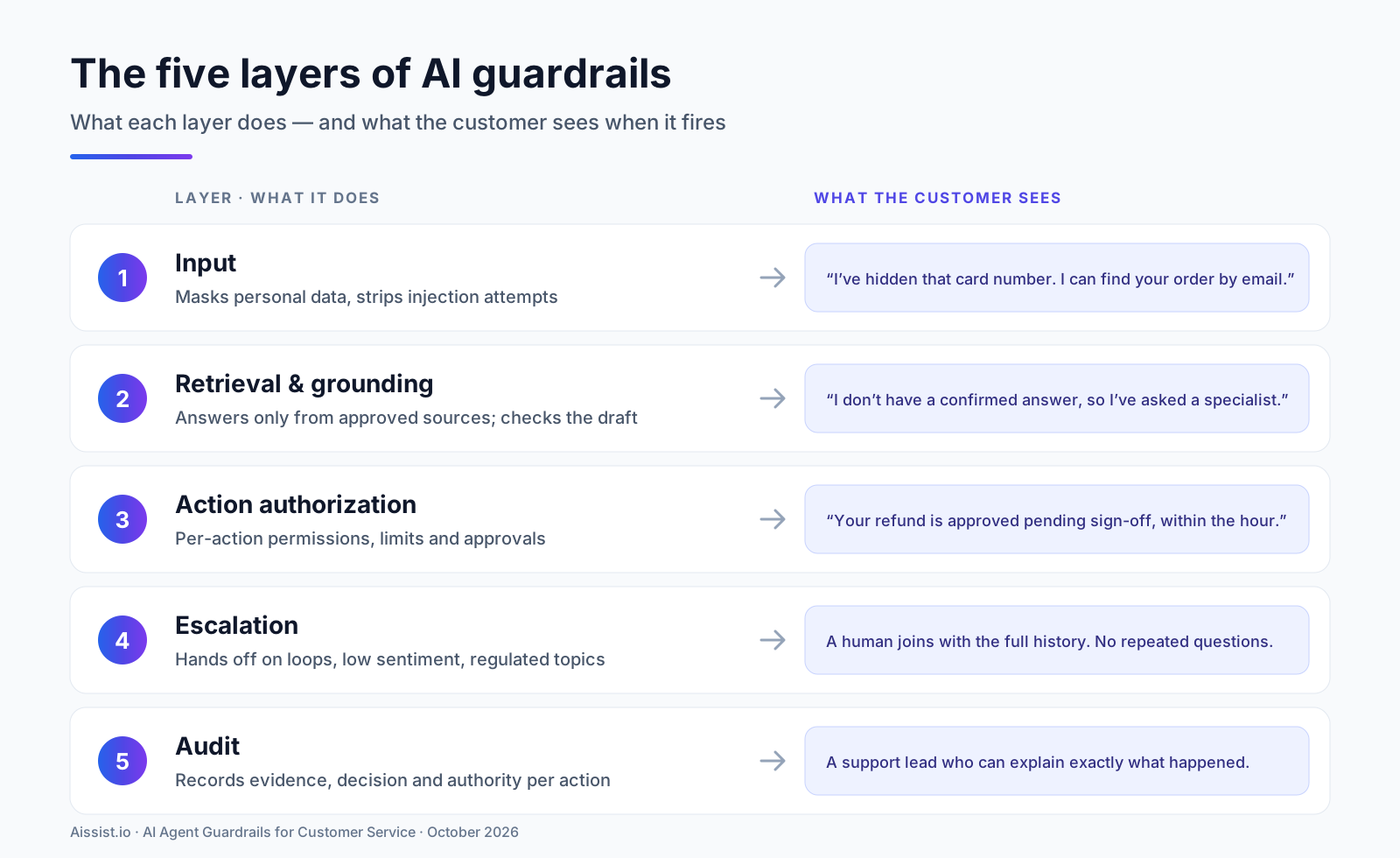
From the vendor side of the audit, escalation is where records usually break. In the Weltrade deployment, unresolved cases reach backend teams as structured tickets with a summary and next steps — the artefact an auditor asks for. Aissist audits every AI-handled conversation and provides logs for compliance review (Aissist security); our five guardrail layers map to the same rows.
The register holds the claim; the agent holds the evidence
Pick the register by how well it takes in AI you bought, then demand the evidence from the agent vendor.
- If most of your AI is purchased, choose Credo AI or Trustible, because both treat vendor intake as a core workflow.
- If you also build models, choose Holistic AI or IBM watsonx.governance, because testing and monitoring are built in.
- If you are a European mid-market team certifying ISO 27001, choose Kertos, because one audit stack beats two.
- If your agent vendor can't export disclosure logs, transcripts and escalation records, fix that first, because no register can invent them.
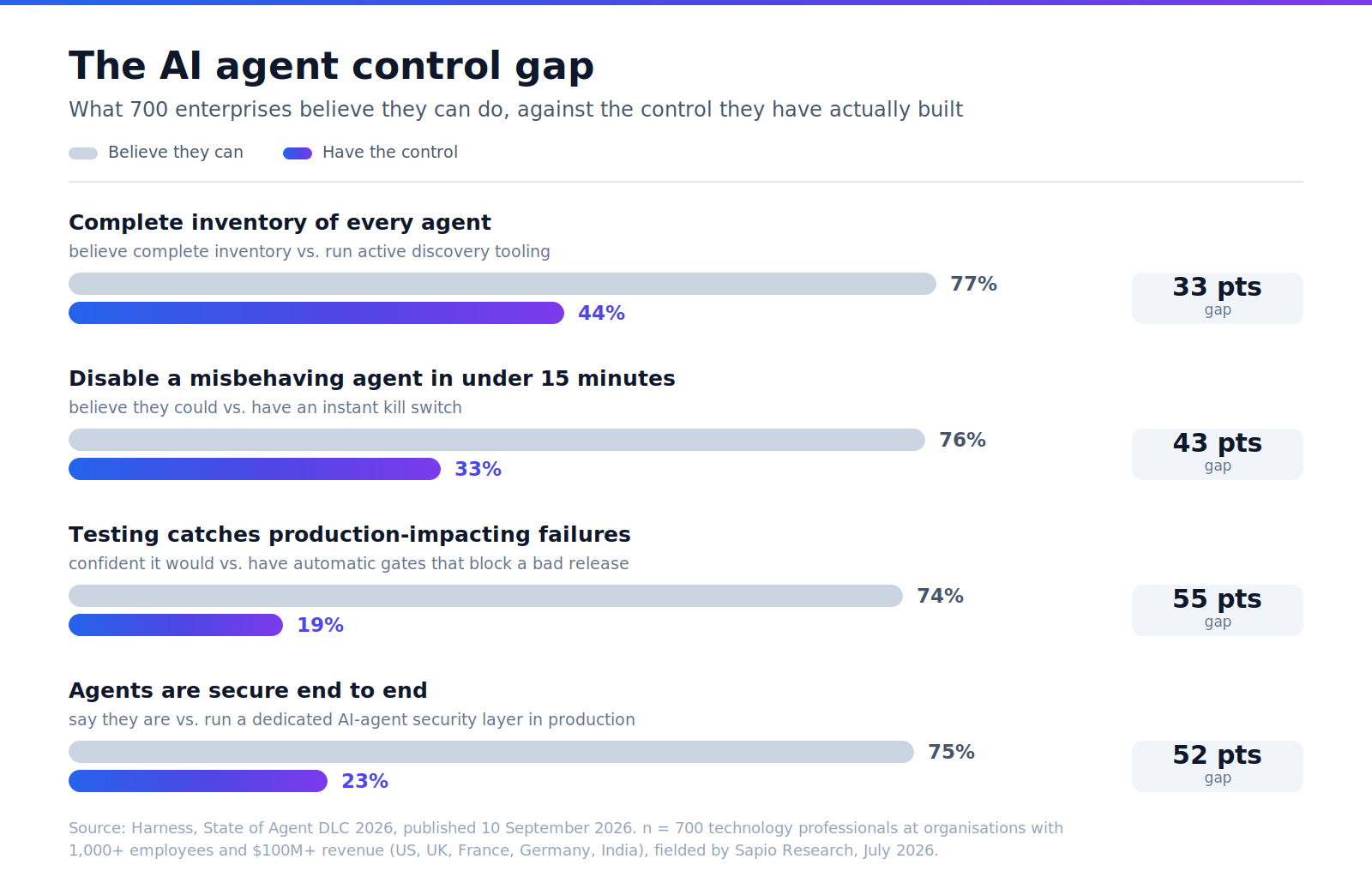
Our control-gap analysis and Reliable AI framework go deeper on the agent side.
Need the agent side of the audit covered? Aissist logs every AI-handled conversation and hands off escalations with full context. See how Reliable AI works →
Frequently asked questions
When did EU AI Act enforcement start?
The Commission's power to fine general-purpose model providers applied from 2 August 2026, alongside Article 50 transparency. The first AI Office Requests for Information were announced on 14 October 2026.
Is a customer service chatbot high-risk under the EU AI Act?
Usually not. Most customer-service agents fall under Article 50 transparency, which applies from 2 August 2026. Annex III high-risk duties, now deferred to 2 December 2027, apply only to listed uses such as creditworthiness assessment.
What are the EU AI Act penalties?
Prohibited practices carry fines up to €35 million or 7% of worldwide turnover. Most other breaches, including Article 50 transparency, carry up to €15 million or 3%. General-purpose model providers face up to €15 million or 3% under Article 101.
What is AI agent governance?
AI agent governance is the set of controls that keeps autonomous agents inventoried, policy-bound, monitored and stoppable. It spans a register, runtime guardrails, logging, human oversight and evaluation, as our Evaluable AI page explains.
Does an AI governance platform replace logging inside the AI agent?
No. A governance platform stores the register, assessments and pointers to evidence. Disclosure messages, transcripts, actions and escalation handoffs are generated by the agent, so the agent vendor must log and export them.
Changelog
- 21 October 2026 — First published. Reflects the 14 October enforcement announcement and Gartner's 19 October survey.