Last updated October 31, 2026.
The best ecommerce fraud prevention tools in 2026 are Bureau, Fingerprint, Forter, NoFraud (now Wyllo), Riskified, SEON, Sift and Signifyd. All eight are scored on chargebacks stopped; few are judged on the good customers they block.
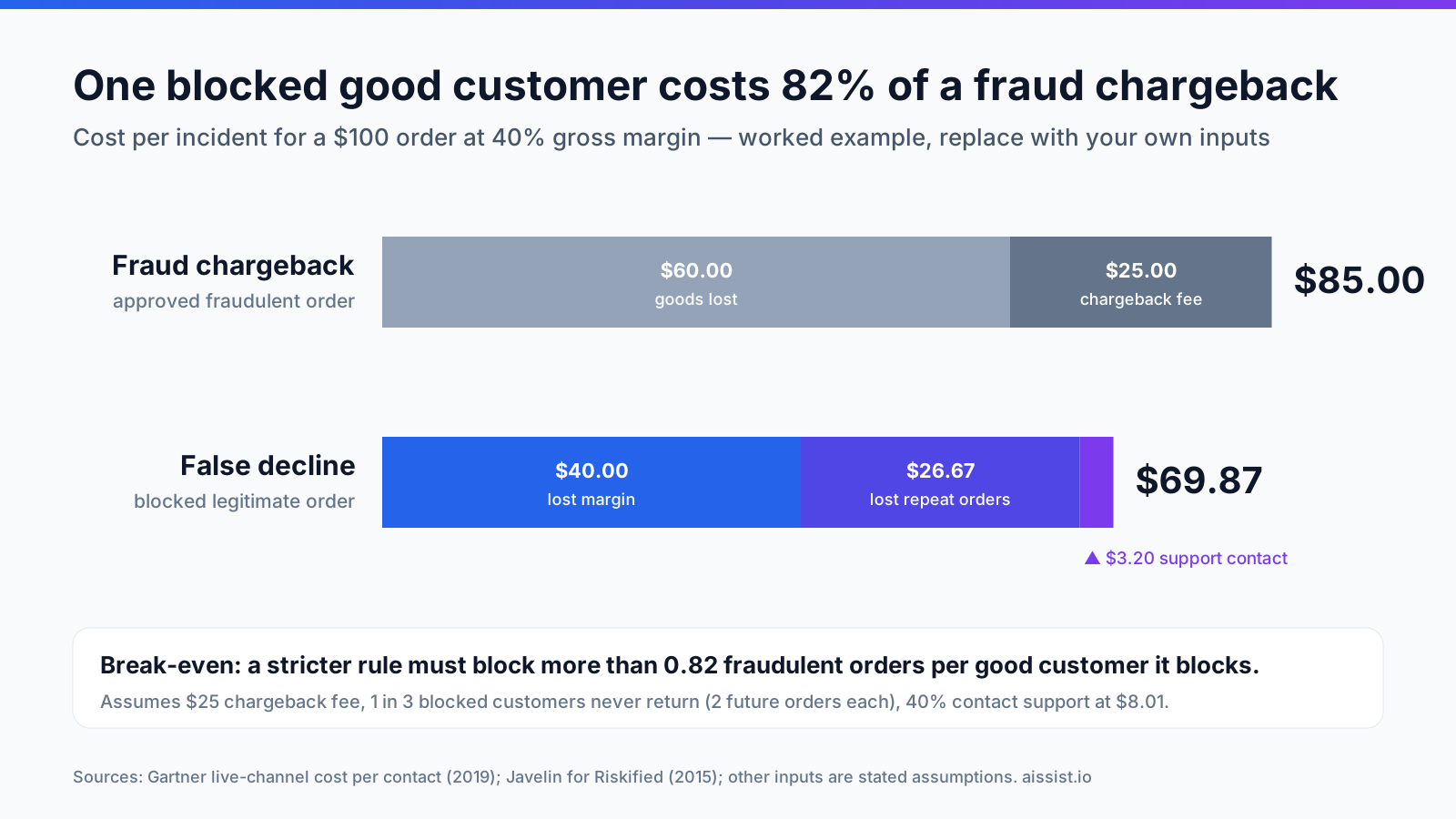
TL;DR: With Gartner's $8.01 cost per live contact and stated margin assumptions, one false decline costs about $70 against $85 for the fraud chargeback it prevents, and only the chargeback shows up in fraud reports.
- Bureau — best for identity-heavy flows in India and Southeast Asia
- Fingerprint — best as a device-identity signal under your own rules
- Forter — best for large merchants who want one decision
- NoFraud (now Wyllo) — best for small Shopify stores
- Riskified — best for second chances on borderline orders
- SEON — best for teams that write their own rules
- Sift — best for fraud that spans accounts, not just checkouts
- Signifyd — best for full liability shift at checkout
Methodology & sources
- Features, guarantees, prices and G2 ratings read from primary pages on 26 Oct 2026. Listed alphabetically, not ranked.
- Every limitation or criticism of a named vendor links to the page it comes from, re-checked on 31 Oct 2026; where a page is silent, the text says which page was checked.
- "Claims" means vendor-stated; "case study" means a named customer result. None are audited.
- Industry figures: Merchant Risk Council 2025 Global eCommerce Payments & Fraud Report; Gartner (2019); Javelin for Riskified (2015). The cost model's other inputs are stated assumptions.
- Disclosure: this is Aissist's blog. Aissist sells AI support agents, not fraud screening; no vendor paid for placement.
How do the 8 fraud prevention tools compare?
Four of the eight return an approve-or-decline decision and can back it with chargeback coverage; the other four return scores or signals your team turns into decisions. That split decides who owns a wrong call.
| Tool | Decision model | Pre-auth or post-auth | Guarantee or advisory | Pricing model (Oct 2026) | Published false-decline posture |
|---|---|---|---|---|---|
| Bureau | Risk score and bands; you set actions | Onboarding to payments, refunds | Advisory | Not on bureau.id | None on its ecommerce page |
| Fingerprint | Device ID and signals only | Any page (signal layer) | Advisory | Free to 1,000 calls; $99/mo for 20K | Case study: 6% fewer false positives |
| Forter | Approve/decline, network AI | Both | Optional chargeback coverage | AWS Marketplace: $120K/yr under 1M decisions | Claims 42% fewer false declines on average |
| NoFraud (Wyllo) | Pass/review/fail, automation plus analysts | Both, incl. pre-gateway | Guarantee (optional plan) | 1–1.5% of revenue, $250–$450/mo minimum | None on its Shopify listing |
| Riskified | Approve/decline, ML plus verification flow | Both | Guarantee | AWS Marketplace: $60K/yr; else custom | Case study: ~95% authorization rate |
| SEON | Score; your rules plus ML | Signup to payment | Advisory | Starter $699/mo (2,500 checks) | None on its pricing page |
| Sift | 0–100 score plus workflows | Signup to payment | Advisory | Not on sift.com | Case study: block rate 2.2% vs 3.1% |
| Signifyd | Approve/decline, ML plus network | Pre-auth | Guarantee | % of approved order value | Claims up to 98% approval |
Pricing and false-decline cells were re-checked against the linked pages on 31 Oct 2026.
A guarantee changes the incentive: a vendor paying your chargebacks has reason to decline the orders it is unsure of, and those declines cost you, not it. Signifyd's pricing partly offsets this by charging only on approved orders.
"The bump in authorization rates was immediate after deploying Riskified, taking us to about 95%." — Peter Clarke, CTO, Lorna Jane, Riskified
What does a false decline actually cost compared with a chargeback?
On the assumptions below, one false decline costs about $70 and one fraud chargeback about $85, so blocking a good customer is roughly 82% as expensive as letting a fraudster through. The Merchant Risk Council reports merchants reject 5.0% of orders on average, and about six in ten put their "customer insult" rate at 2–10%.
| Input (replace with yours) | Value | Basis |
|---|---|---|
| Orders per month / average order | 10,000 / $100 | Assumption |
| Gross margin | 40% | Assumption |
| Rejected orders | 5.0% = 500 | MRC 2025 average |
| Share of rejections that were good customers | 10% = 50 | Top of MRC's common band |
| Chargeback fee | $25 | Assumption; check your acquirer |
| Cost of one fraud chargeback | $60 goods + $25 fee = $85 | |
| Lost margin on the blocked order | $40 | |
| Lost repeat orders: a third stop buying, 2 future orders each | $26.67 | Javelin found 66% of declined shoppers cut back or stopped (2015) |
| Support: 40% contact you at $8.01 each | $3.20 | Gartner live-channel average (2019) |
| Cost of one false decline | $69.87 |
Tightening a fraud rule pays only if it blocks more than about 0.82 fraudulent orders for every good customer it also blocks. Few merchants run this check, because chargebacks arrive as an itemised bill and false declines arrive as silence, plus 20 tickets.
Which support contacts does each fraud decision create?
Every fraud outcome except a correct decline generates a customer contact, and the false decline generates the angriest one. No fraud vendor's ROI page prices that tail.
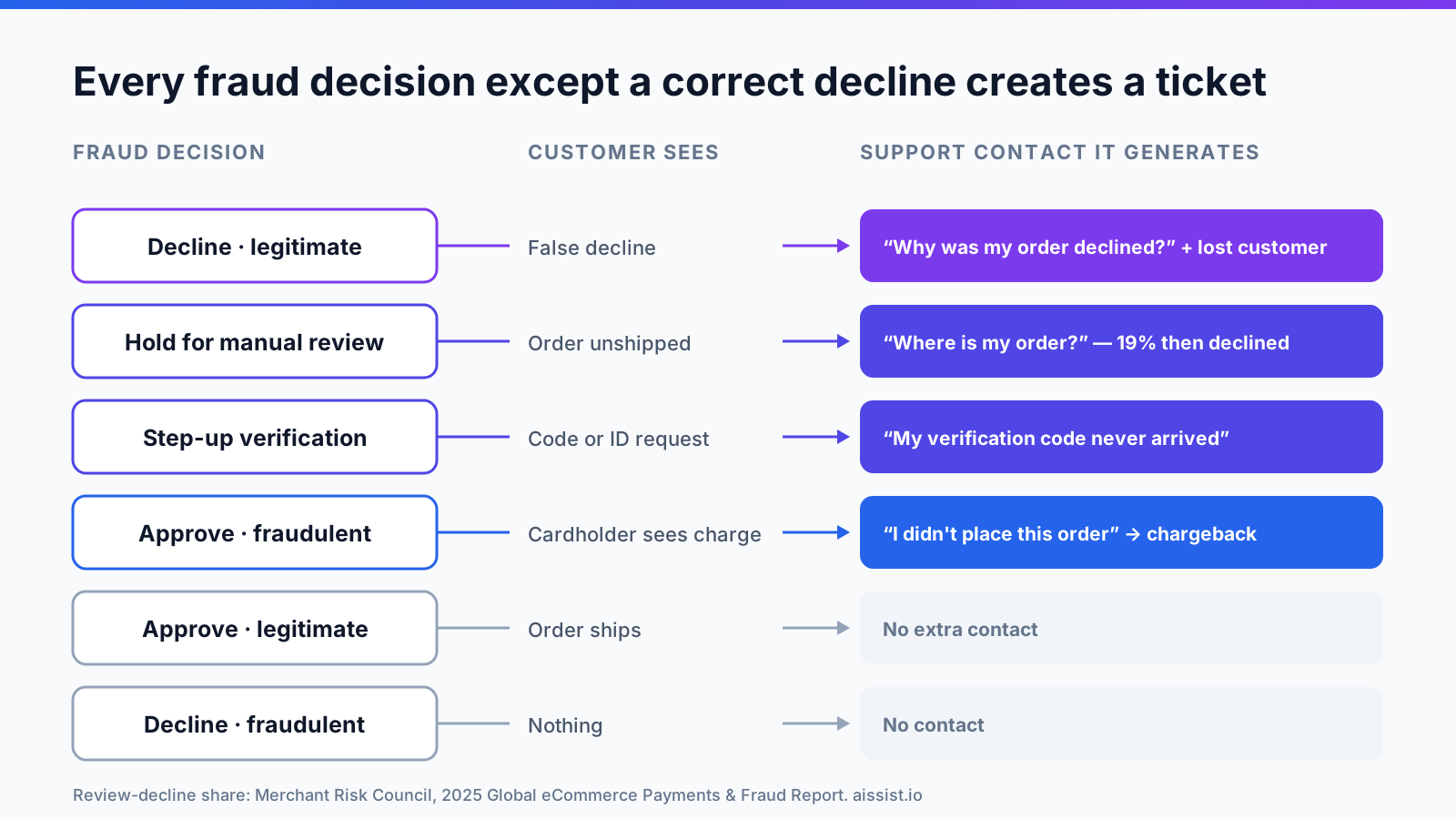
| Decision outcome | What the customer sees | Support contact it generates |
|---|---|---|
| Approve, legitimate | Order ships | None beyond normal order-status |
| Decline, legitimate (false decline) | "Payment declined," card works elsewhere | "Why was my order declined?" plus a lost customer |
| Hold for manual review | Order sits unshipped | "Where is my order?"; MRC finds about 19% of reviewed orders are declined |
| Step-up verification | Code or ID request | "My verification code never arrived" |
| Approve, fraudulent | Real cardholder sees a charge | "I didn't place this order," then a chargeback |
| Decline, fraudulent | Nothing | None |
These contacts are hard to automate because the agent cannot explain the fraud rule; it can confirm status, offer another payment route and escalate with context.
Payphone, a payments platform and Aissist customer, saw this pattern: one "failed payment" message traced to more than ten causes. Its AI agents separate failed-payment troubleshooting from a dedicated dispute and chargeback agent, and hand security cases to people with a summary attached. Regulated retailer Grab A Gun routes edge cases to human review by rule, and Weltrade hands unresolved cases over as structured tickets.
"We scaled customer support efficiently without sacrificing speed or consistency across channels." — Paul Brito, Customer Service Manager, Payphone
The 8 ecommerce fraud prevention tools, reviewed
1. Bureau — best for identity-heavy flows in India and Southeast Asia
Bureau is a risk decisioning platform that combines device, identity and transaction signals through SDKs and an API. Cost: not published; its ecommerce page offers a demo booking instead (checked 31 Oct 2026).
- Pros: covers refunds, payouts and promo abuse, not only checkout.
- Cons: its case studies page lists seven studies without naming the customers (checked 31 Oct 2026), so results are hard to check with a reference.
- Take: shortlist it for multi-step onboarding in Asia; the named testimonials on its homepage come from companies such as Aditya Birla Capital, Rapido and Spice Money.
2. Fingerprint — best as a device-identity signal
Fingerprint is a device-intelligence service that gives each visitor a persistent ID and risk signals via a JavaScript agent, mobile SDKs and a Server API. G2: 4.7 (454) · Cost: free to 1,000 calls, then $99/month.
- Pros: cheap to start; catches returning fraudsters across accounts.
- Cons: returns visitor IDs and signals such as a Suspect Score, per its pricing page (checked 31 Oct 2026), not an approve-or-decline decision; you still need rules or a platform above it.
- Take: not a fraud tool on its own; an input that makes the others sharper.
"Fingerprint allowed us to accurately catch fraud where our previous solution was failing." — Drayton Williams, Director of Fraud Prevention, FlightHub, Fingerprint
3. Forter — best for large merchants who want one decision
Forter is a network-based fraud platform that returns approve or decline for every transaction, deployed by JavaScript snippet plus Order and Claims APIs. G2: 4.5 (29) · Cost: $120,000 a year for under 1M decisions on AWS Marketplace, otherwise custom (checked 31 Oct 2026).
- Pros: claims 42% fewer false declines on average; pre- and post-auth flows.
- Cons: that entry list price is sized for enterprise volume; the one PeerSpot review (November 2020) asks for a reason or risk score with each accept or reject decision (checked 31 Oct 2026).
- Take: if your team must explain declines to customers, ask how much decision reasoning Forter returns.
4. NoFraud (now Wyllo) — best for small Shopify stores
NoFraud, renamed Wyllo in March 2026, combines automated screening, analyst review and an optional guarantee via Shopify app or API. G2: 4.7 (269) · Cost: 1–1.5% of revenue, $250–$450 monthly minimum (Shopify App Store listing, checked 31 Oct 2026).
- Pros: the only guaranteed option here with published monthly plans; free screening to 100 orders a month.
- Cons: the listed guarantee plans apply under $50K a month in revenue; above that, the listing says to contact it for custom pricing (checked 31 Oct 2026).
- Take: outgrown once volume makes a percentage of revenue expensive.
5. Riskified — best for second chances on borderline orders
Riskified is a machine-learning chargeback guarantee service that approves or declines orders and runs verification flows for borderline ones. G2: 4.4 (240) · Cost: $60,000 a year on AWS Marketplace, or a custom quote by private offer (checked 31 Oct 2026).
- Pros: Recover verifies uncertain shoppers instead of declining them; pre- and post-auth.
- Cons: on AWS Marketplace, which republishes its G2 reviews, two 2026 reviewers say it can be hard to tell why an order was declined or blocked (checked 31 Oct 2026).
- Take: budget for the verification-code tickets a step-up flow like Recover can create.
6. SEON — best for teams that write their own rules
SEON is a fraud and AML platform that scores users on 1,100+ signals and runs custom rules plus machine learning via API. G2: 4.6 (395) · Cost: Starter $699/month.
- Pros: transparent scoring; covers signup and login as well as payment.
- Cons: no chargeback guarantee appears on its pricing page; on AWS Marketplace, which carries its G2 and PeerSpot reviews, an October 2026 reviewer calls reporting "really very difficult to create and extract" (both checked 31 Oct 2026).
- Take: needs an analyst who will own false-decline tuning.
7. Sift — best for fraud that spans accounts
Sift is a fraud decisioning platform that scores payment fraud, account takeover and abuse 0–100 and routes them through no-code workflows. G2: 4.6 (618) · Cost: not published.
- Pros: the most-reviewed tool here; in a case study, Paula's Choice blocked 2.2% of orders against 3.1% under its old rules.
- Cons: neither a chargeback guarantee nor a price appears on sift.com, which offers a demo instead (checked 31 Oct 2026).
- Take: overbuilt for a store whose only fraud is card testing.
8. Signifyd — best for full liability shift at checkout
Signifyd is a guaranteed fraud protection service that approves or declines orders pre-authorization via plugins for Shopify, Magento, Salesforce Commerce Cloud and BigCommerce. G2: 4.6 (347) · Cost: percentage of approved orders.
- Pros: can shift full chargeback liability; claims up to 98% approval.
- Cons: on its Shopify App Store listing, 18 of 92 ratings are one or two stars, and several of those reviewers cite fees and unanswered support requests; pricing is a custom quote (both checked 31 Oct 2026).
- Take: expensive for low-margin, high-volume catalogues.
How should you choose an ecommerce fraud prevention tool?
Choose by who should own a wrong decision, then by price.
- If you sell on Shopify under $50K a month, choose NoFraud, because its guarantee and price are both published.
- If chargebacks threaten your processor relationship, choose Signifyd or Riskified, because a guarantee moves the liability off your books.
- If you have a fraud analyst, choose SEON or Sift, because you keep control of the false-decline trade-off.
- If fraud starts at signup or login, choose Sift, SEON or Bureau, because checkout-only tools never see it.
- If you already have rules, add Fingerprint, because a stable device ID sharpens them for $99 a month.
The best fraud tool is the one whose declines your support team never has to explain
Every tool here stops fraud; the difference is who pays for the mistakes. Run the break-even with your own margin before signing, ask each vendor for its false-decline rate in writing, and tag declined-order tickets so the support tail has a number. For the payment layer upstream, see the payment orchestration roundup; for the support side, the fintech benchmark and our guide to AI agents for ecommerce.
Frequently asked questions
What is ecommerce fraud prevention?
Ecommerce fraud prevention is the screening of online orders and accounts for stolen cards, account takeover and abuse before goods ship. Tools either return an approve/decline decision, often with a chargeback guarantee, or a risk score your team acts on.
What is a false decline?
A false decline is a legitimate order rejected as suspected fraud. The Merchant Risk Council found 14% of merchants report false-positive rates above 10% in 2025.
Is a chargeback guarantee worth it?
A chargeback guarantee is worth it when chargeback ratios threaten your processor account. It costs a percentage of approved order value and does not cover good orders the vendor declines.
Which fraud prevention tools publish their pricing?
NoFraud, SEON and Fingerprint publish prices: NoFraud 1–1.5% of revenue, SEON from $699 a month and Fingerprint from $99 a month. Forter and Riskified list annual contracts on AWS Marketplace ($120,000 and $60,000 a year, checked 31 Oct 2026); Signifyd, Sift and Bureau quote individually.
Can an AI support agent handle declined-payment tickets?
An AI support agent can confirm order status and suggest another payment method, but should not reveal fraud rules. Disputes, suspected account takeover and verification failures belong with a human, handed over with context.
How is fraud prevention different from chargeback management?
Fraud prevention screens orders before or at authorization; chargeback management fights disputes after the cardholder's bank files them. Several vendors sell both.
Changelog
- 31 Oct 2026 — Adverse vendor claims sourced or removed: each limitation now links to the page it comes from, checked on this date. Removed unverifiable G2 and Capterra reviewer complaints and Bureau's company-level remarks; added AWS Marketplace list prices for Forter and Riskified; NoFraud pricing now cites its Shopify App Store listing.
- Oct 2026 — First published. NoFraud listed under its 2026 name, Wyllo.