AI Agents for Ecommerce Support: WISMO, Returns, Refunds and the Four Actions Worth Automating First
Compiled by Nadia Yun. Published October 8, 2026 · Last updated October 8, 2026.
AI agents for ecommerce get sold as storefront features, but the contact volume lives after the purchase. Rank every support task by contact volume times reversibility, and the boring tickets win.
TL;DR: Automate the high-volume, undoable work first — WISMO and policy-bound returns — and gate refunds and address changes, because Shopify says a refund can't be reversed and a shipped parcel can't be re-addressed by editing the order.
Methodology & sources
- Aissist.io e-commerce benchmark: 15 deployments, sources re-checked 24 August 2026; GameRoomShop customer story, published January 2026.
- Third-party data: NRF 2025 returns release, Loop's CurrentBody case study, Sierra's OluKai story, USPS and Shopify help pages, Gorgias docs, TechCrunch.
- All figures read 8 October 2026. Disclosure: this is Aissist's blog, and Aissist sells AI agents that resolve e-commerce support.
What do AI agents for ecommerce support actually do?
An AI agent for ecommerce support is software that reads the customer's request, looks up the order in the store's real systems, and completes the task — tracking a parcel, starting a return, issuing a refund — inside the helpdesk the team already uses, handing off to a human when policy or risk requires it. The difference from a chatbot is the last step: a chatbot answers, an agent acts.
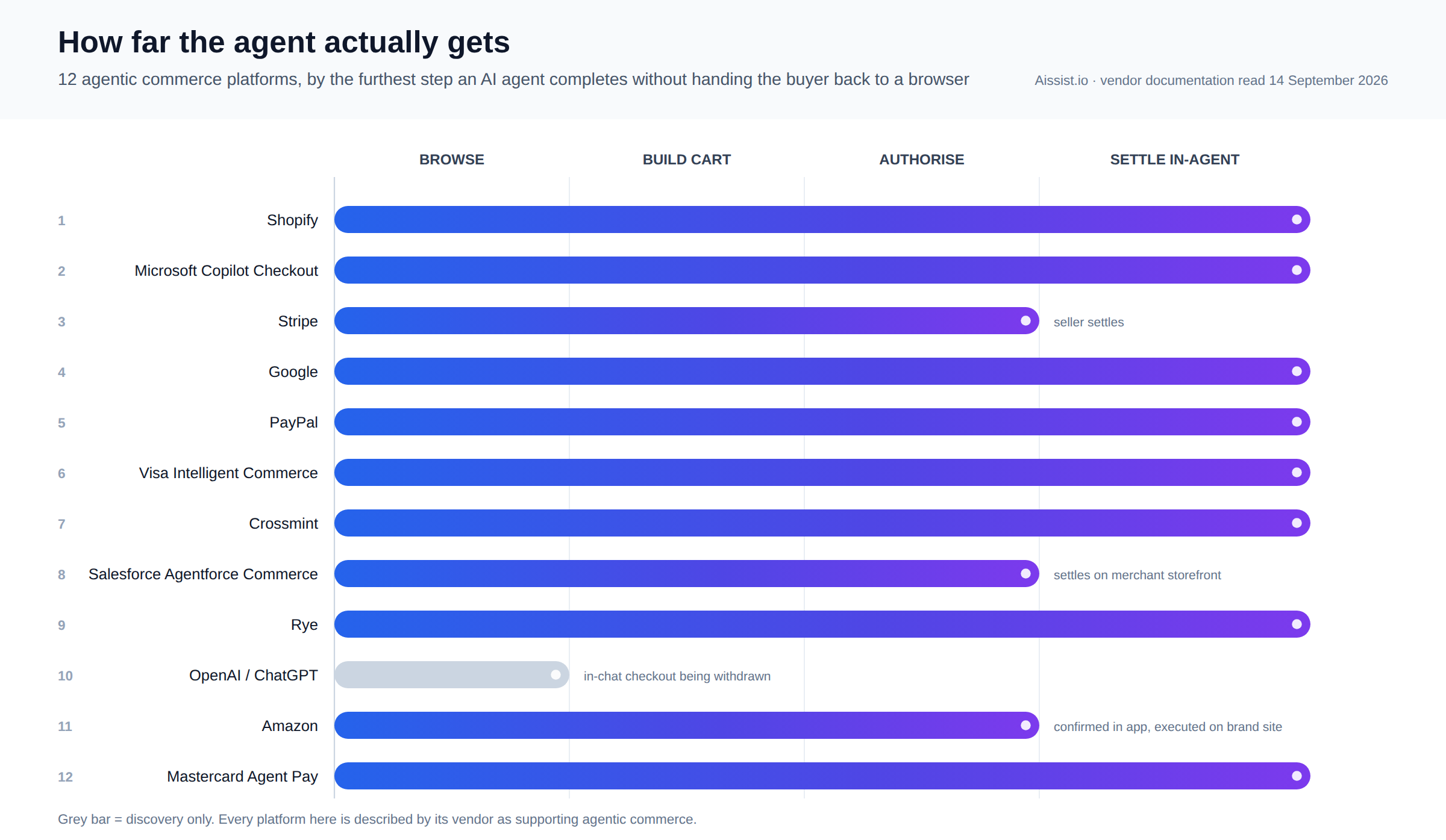
Most pages ranking for this topic describe a different animal: the AI shopping agent that recommends, upsells and converts. That market is real. On 5 October 2026, TechCrunch reported that TikTok launched a conversational Shopping Assistant with one-click in-app checkout, built with partners including Shopify and Stripe. Agentic checkout is coming whether your support team is ready or not.
But every order an agent sells becomes an order someone asks about. The work that fills a support queue is post-purchase and unglamorous.
"75% of the requests are common issues like missing orders or return requests." — John Elkins, Aloha Experience Team supervisor, OluKai, Sierra customer story
That is the real job description. The storefront agent gets the launch post; the post-purchase agent gets the tickets.
Which ecommerce support tasks can an AI agent handle?
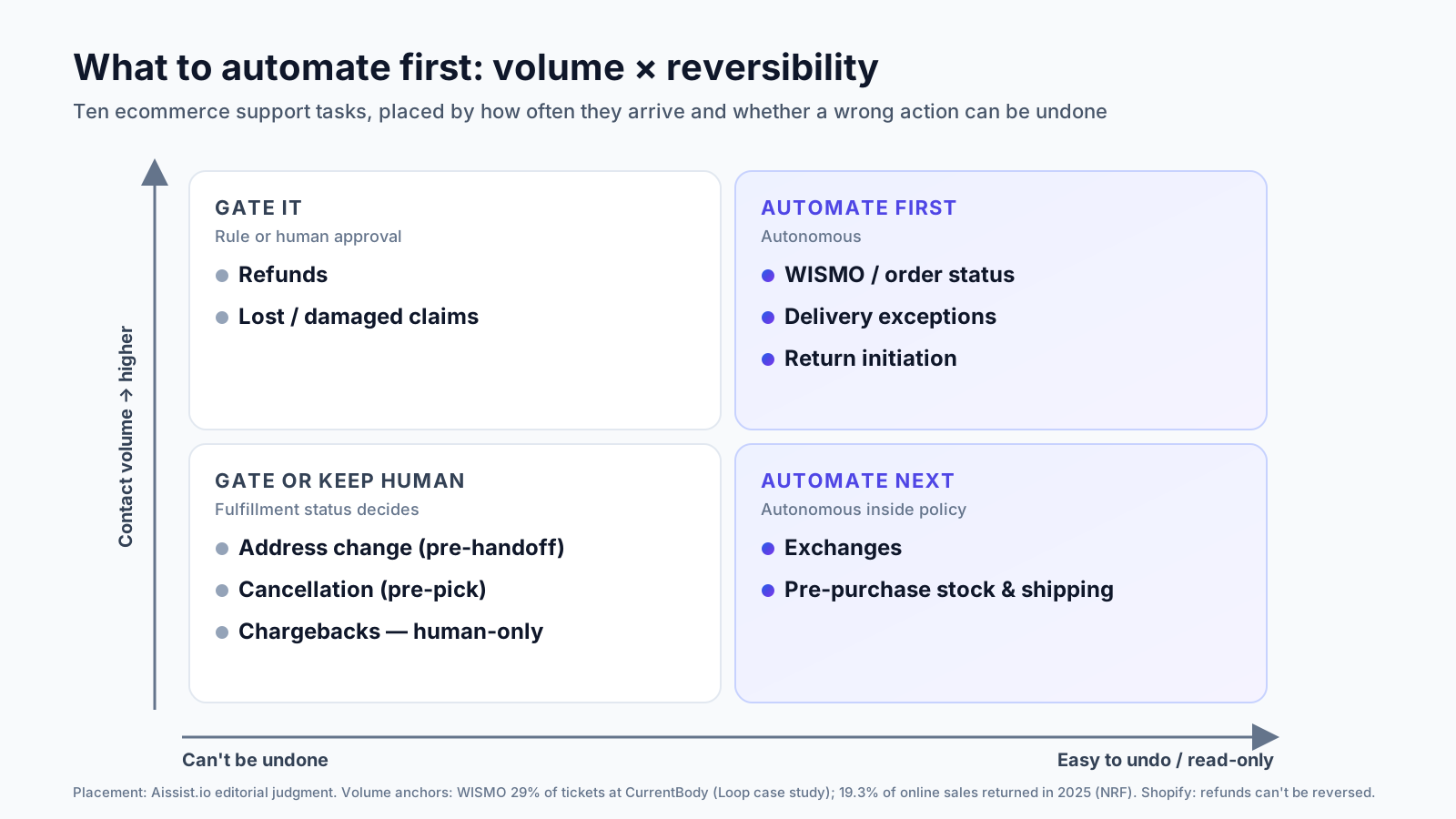
An AI agent can take on ten common ecommerce support tasks, but only five should run fully autonomously; four need a gate, and one belongs to humans. "Gated" means the agent gathers the facts, checks policy and order state, then executes only inside a rule — a value limit, a fulfillment status — or after a human approves.
- Order status and tracking (WISMO) — Autonomous. Read-only: nothing to undo.
- Delivery exceptions (delayed, stuck in transit) — Autonomous. The carrier scan is the answer.
- Pre-purchase stock, price and shipping questions — Autonomous. Live catalog reads.
- Return initiation and label — Autonomous, inside the written return policy.
- Exchanges (size or colour swap) — Autonomous when stock is confirmed and the policy allows it.
- Refunds — Gated. Money leaves and doesn't come back.
- Order cancellation — Gated. Safe only before the warehouse picks it.
- Shipping address change — Gated. Safe only before carrier handoff.
- Lost or damaged package claims — Gated. Evidence and claim value decide.
- Chargebacks and fraud disputes — Human-only. These are legal and financial judgments.
The tags are not about how hard each task is for a model. A refund is technically easier than diagnosing a stuck parcel. The tags are about what happens when the agent is wrong.
Which four actions should you automate first?
Automate WISMO first and returns second, because both are high-volume and recoverable; gate refunds and address changes, because a mistake in either can't be taken back. The ordering rule is contact volume multiplied by reversibility — not how impressive the demo looks.
| Contact type | Volume signal | Reversible if wrong? | System of record the action reaches | Verdict |
|---|---|---|---|---|
| WISMO / order status | 29% of tickets at CurrentBody before proactive tracking | Yes — read-only | Shopify order + carrier tracking | Autonomous |
| Return request | 19.3% of online sales returned in 2025 (NRF) | Yes, until the refund posts | Returns app + Shopify | Autonomous inside policy |
| Refund | Follows returns | No — Shopify: can't cancel or reverse | Shopify payments / gateway | Gated |
| Address change | Not published | Only before fulfillment | Shopify + WMS/3PL + carrier | Gated by fulfillment status |
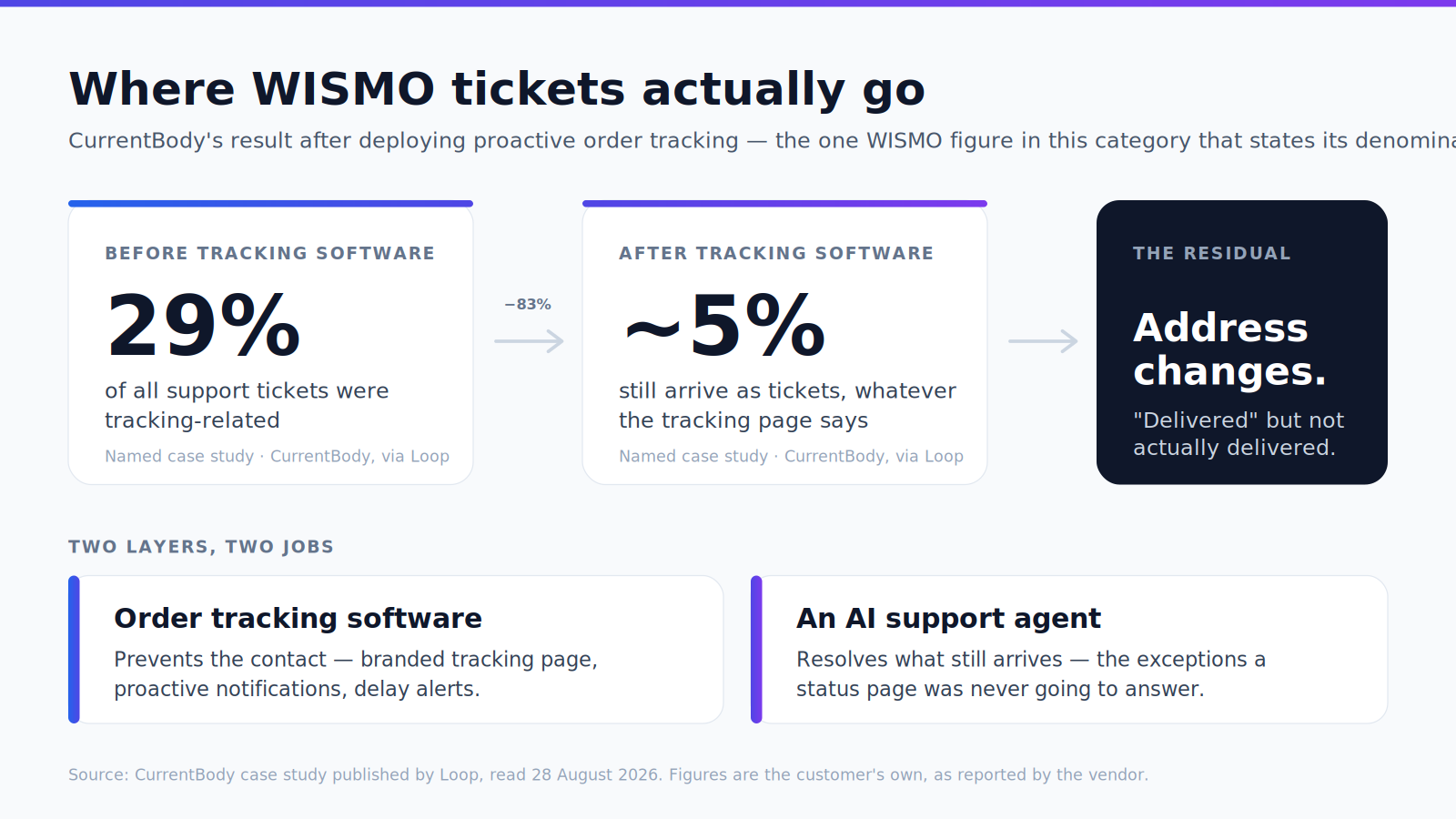
WISMO is the volume. Loop's CurrentBody case study puts tracking questions at 29% of tickets before proactive notifications, falling to about 5% after.
"29% of our customer support tickets were related to customers writing in asking us where their order was." — Andrew Showman, Co-founder and CTO, CurrentBody, Loop case study
Returns are already policy. The NRF expected $849.9 billion in 2025 returns, and 71% of consumers said a poor returns experience makes them less likely to shop again. The rules are written down; the agent just applies them, every time, at 3am.
"Returns are no longer the end point of a transaction." — Katherine Cullen, Vice President of Industry and Consumer Insights, NRF
Refunds are irreversible. Shopify's help center states that a refund can't be cancelled or reversed once it is initiated from the admin. Aissist's reliable AI page uses "a refund approved against policy" as its example of a costly error. Gate it on amount and policy match.
Address changes expire. Redo's Shopify editing guide notes that editing the address in the admin does not reroute a parcel the carrier already has. After handoff it becomes a logistics problem with a fee attached.
What does AI agent integration need to reach?
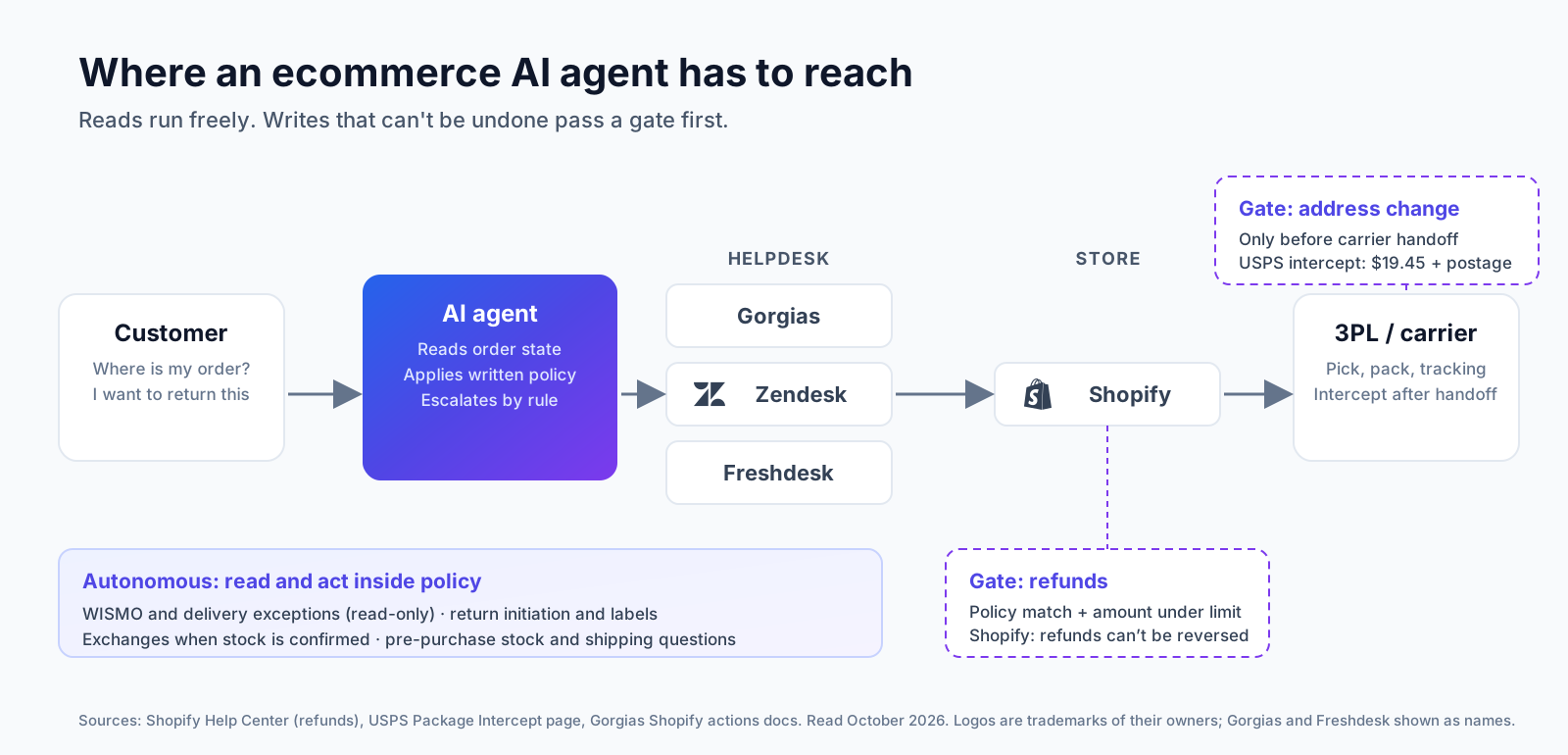
AI agent integration for ecommerce support has to reach three layers: the helpdesk where the ticket lives, the store platform that owns the order, and the warehouse or carrier that owns the parcel. An agent that only reads the help center can answer questions about returns. It cannot start one.
| Platform | What the agent reads | What it can write (Oct 2026) | Watch-out |
|---|---|---|---|
| Shopify | Orders, fulfillment status, customer | Refunds, cancellations, order edits | Refunds can't be reversed |
| Gorgias | Ticket + Shopify sidebar | Refund, cancel, edit order, edit shipping address (Gorgias docs) | Orders paid with more than one method can't be refunded from Gorgias |
| Zendesk | Ticket + Shopify via marketplace app | Refund, cancel and restock (Shopify by helphouse.io) | Shopify actions come from a third-party app |
| Freshdesk | Recent orders (Freshworks Shopify app) | Write actions not documented on the listing | Plan for an API connector |
| 3PL / WMS + carrier | Pick, pack and tracking status | Hold, address change, intercept | Window closes at carrier handoff |
The Gorgias row matters most for Shopify brands: the actions a human agent clicks in the sidebar are the actions an AI agent needs. Aissist.io connects to Gorgias, Zendesk and Freshdesk and writes back to connected systems such as Shopify and shipping tools.
AI agents for logistics sit on the same rule, one layer down. The fulfillment status in the WMS is what tells the agent whether an address change is a free edit or a paid intercept. USPS charges a $19.45 Package Intercept fee plus postage and states the service is not guaranteed. An agent that checks pick status before promising anything turns a gated action into a safe one.
What does this look like in a real store?
GameRoomShop, a Shopify retailer with thousands of products and variants, has an AI agent fully resolving about 60% of all inbound conversations without a human, according to Aissist's customer story. The denominator is every inbound conversation, presales included — not a hand-picked queue.
The agent handles live stock checks, pricing, shipping timelines and order status lookups by order number, reading Shopify in real time. Humans keep edge cases, custom configurations and high-value relationships, and the team retrains the agent weekly. The owner's summary is the most honest line in the case study:
"It's not magic, weird edge cases still need humans." — Owner, GameRoomShop, Aissist customer story
The wider numbers set the ceiling. Aissist's ecommerce benchmark puts full agentic resolution at 75–80%, with Edel Optics at 79% (up from 25%), while deflection-first bots cluster at 25–55%. The same benchmark prices an AI resolution at about $0.50–$2.00 against $6–$13 for a human-handled ticket.
Read those together: 60% is a strong start, and the gap to 80% is mostly the gated work. The agent doesn't close it by getting braver. It closes it by getting the policy rules and fulfillment data it needs to gate safely.
Automate what you can undo; gate what you can't
The storefront agent and the post-purchase agent are two different products, and the second one carries the volume. If the agent can only read orders and tracking, launch it on WISMO and delivery exceptions, because nothing it does there needs undoing. If your return policy is written and your returns app is connected, add returns next, because the rules already exist. If the agent can't see fulfillment status or apply an amount limit, keep refunds and address changes with humans, because neither can be taken back. Measure resolution, not deflection, so the number means a finished task. For the tools on either side of the agent, see our guides to order tracking and WISMO software, shipping protection apps and agentic commerce platforms.
See what your queue would automate. Aissist.io reads your last month of tickets and shows which run autonomously and which need a gate. Book a demo →
Frequently asked questions
What are AI agents for ecommerce?
AI agents for ecommerce are AI systems that complete customer tasks inside a store's own systems — tracking orders, starting returns, issuing gated refunds — rather than only answering questions. They work through the helpdesk and the store platform, and escalate to humans by rule.
Is an AI shopping agent the same as a support agent?
No. An AI shopping agent works before the purchase, recommending products and completing agentic checkout, as TikTok's October 2026 Shopping Assistant does. A support agent works after it, on order status, returns, refunds and delivery problems.
Can an AI agent issue refunds safely?
Yes, with a gate. Because Shopify says a refund can't be reversed once issued, the agent should verify the order, check the return policy and amount, and refund automatically only under a set limit, routing larger or unusual cases to a human.
How much of ecommerce support is WISMO?
It varies by brand and carrier, and few brands publish it. CurrentBody reported WISMO at 29% of its support tickets before proactive tracking, falling to about 5% afterwards, per Loop's case study.
What do AI agents for logistics do?
AI agents for logistics read warehouse and carrier status to answer delivery questions and decide when changes are still possible. They can hold an order or edit an address before carrier handoff; afterwards, changes need a carrier intercept, which USPS prices at $19.45 plus postage.
Does agentic checkout increase support volume?
More orders from any channel mean more post-purchase questions, and an order placed through an AI agent still needs tracking, returns and refunds. Agentic checkout moves the sale; the support queue still lands with the merchant.