The 7 Best Payment Orchestration Platforms in 2026, Judged by the Tickets They Prevent
The best payment orchestration platforms in 2026 are Corefy, Gr4vy, Payrails, Primer, Rebilly, Solidgate and Spreedly. All seven route and retry payments; they differ in how a retry looks to the customer, which decides whether support hears about it.
TL;DR: A retry that succeeds in the same checkout session is invisible to the customer; a retry that runs days later without notice becomes a "why was I charged?" ticket — and Forrester data cited by CSG shows 53% of US online adults called a company about billing or payments last year.
Methodology & sources
- Features, connection counts and prices read from each vendor's own product, docs and pricing pages, 21 October 2026. All performance figures are vendor-claimed unless stated otherwise.
- Ratings from G2 review pages, read October 2026. Card-network retry rules from Visa's published rules and processor documentation.
- Platforms are listed alphabetically; each is "best for" a different job, so a numbered rank would be invented precision.
- Disclosure: this is Aissist's blog. Aissist sells an AI agent that resolves customer support tickets — it is not a payment orchestration platform and none of these vendors paid for inclusion.
What are the best payment orchestration platforms in 2026?
Seven platforms publish enough about routing, recovery and pricing to compare: Corefy, Gr4vy, Payrails, Primer, Rebilly, Solidgate and Spreedly. A payment orchestration layer sits between your checkout and your payment service providers (PSPs), deciding which processor gets each transaction and what happens when one says no.
| Platform | Best for | Published connections | Retry timing | Pricing model (Oct 2026) | G2 (Oct 2026) |
|---|---|---|---|---|---|
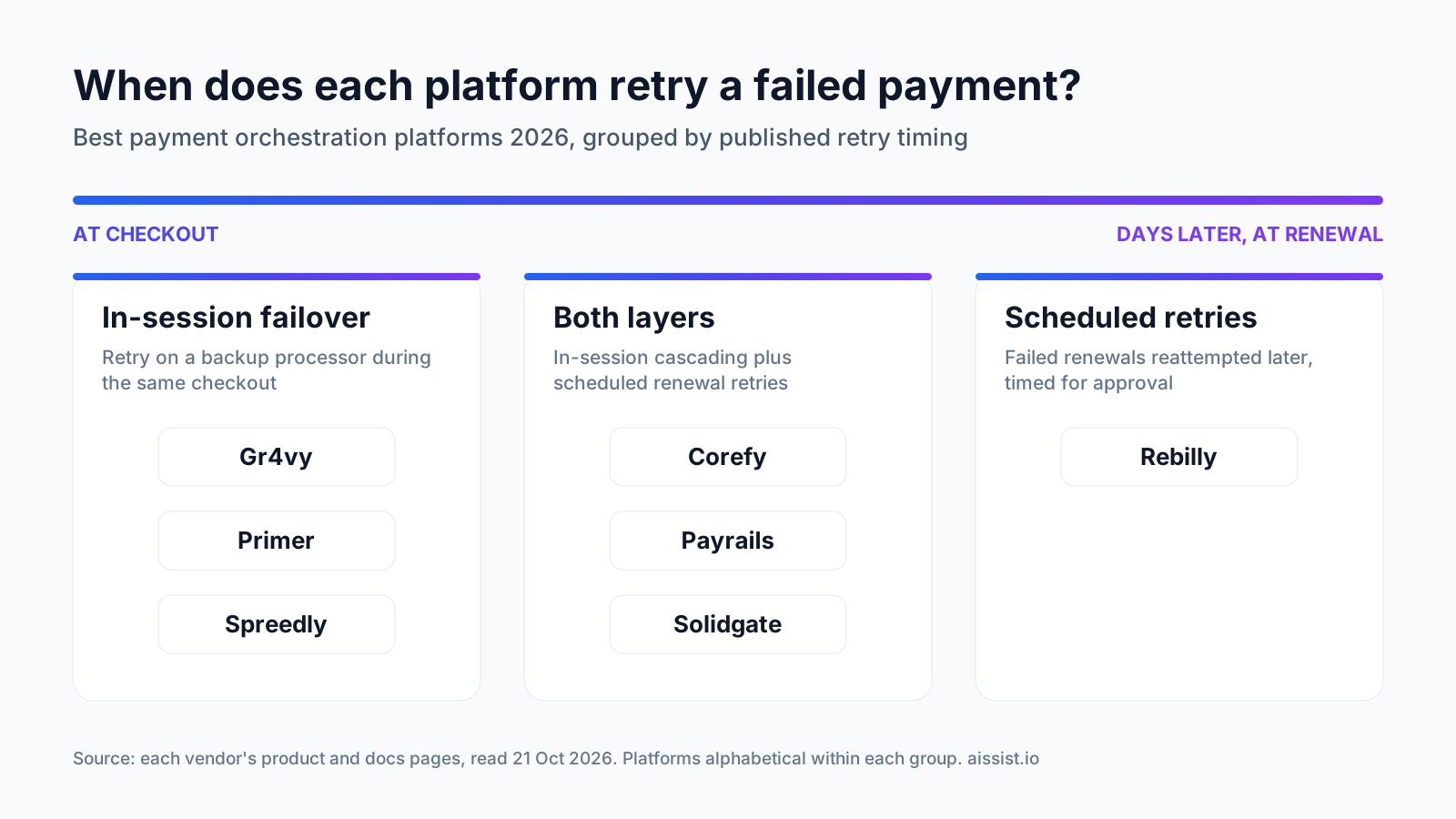
| Corefy | PSPs and white-label payment platforms | 650+ connectors | In-session cascading; renewal retries | Monthly fee + per successful txn above included volume (€0.02–€0.06 overage) | 4.7 (5 reviews) |
| Gr4vy | Enterprises wanting a dedicated cloud instance | 400+ payment methods | In-session failover | From $248/month, no per-transaction fees | 5.0 (1 review) |
| Payrails | Global platforms and marketplaces | 100+ integrations | Response-code retries; timed renewal retries | Not published | No reviews yet |
| Primer | Checkout recovery without code | 100+ providers | In-session fallback | Not published | Not verified |
| Rebilly | SMB subscription businesses | 214 gateways | Scheduled intelligent retry | $15–$125/month + 1% revenue fee | 4.5 (1 review) |
| Solidgate | Subscription apps needing both layers | 100+ acquirers, PSPs, APMs | In-session cascading + scheduled smart retries | Volume-based, quote only | 4.8 (12 reviews) |
| Spreedly | PSP independence via a neutral vault | 150+ gateways | Real-time retry on backup gateway | Vault from $750/month; optimization quote only | 4.4 (35 reviews) |
Only Spreedly's G2 score rests on more than a dozen reviews, so treat these ratings as a sign of review volume, not recovery performance.
Which retry strategy creates the "where is my refund" ticket?
Scheduled retries without customer notice create tickets; in-session failover and notified retries prevent them. According to Checkout.com, soft declines — temporary failures worth retrying — make up 80% to 90% of all declines, so retries fire constantly.
| Retry strategy | What the customer experiences | Support contact it generates |
|---|---|---|
| In-session failover to a second PSP after a soft decline | One checkout, one success screen | Prevents "my payment failed" |
| Failover that re-runs 3DS | A second bank challenge in the same purchase | Creates "is this fraud?" |
| Retry after a processor timeout, not a decline | Possible duplicate authorization if the first one actually cleared | Creates "I was charged twice" |
| Scheduled renewal retry, no notice | Silent failure, then a charge days later or an access cutoff | Creates "why was I charged today?" and "why is my account locked?" |
| Scheduled retry with decline and card-expiry emails | Knows what happened and what to fix | Prevents both of the above |
| Retrying a hard decline | Repeated declines from the bank's app | Creates "stop charging my card" — and network fees |
| Refund issued with no status event to support | Waits, then asks | Creates "where is my refund?" |
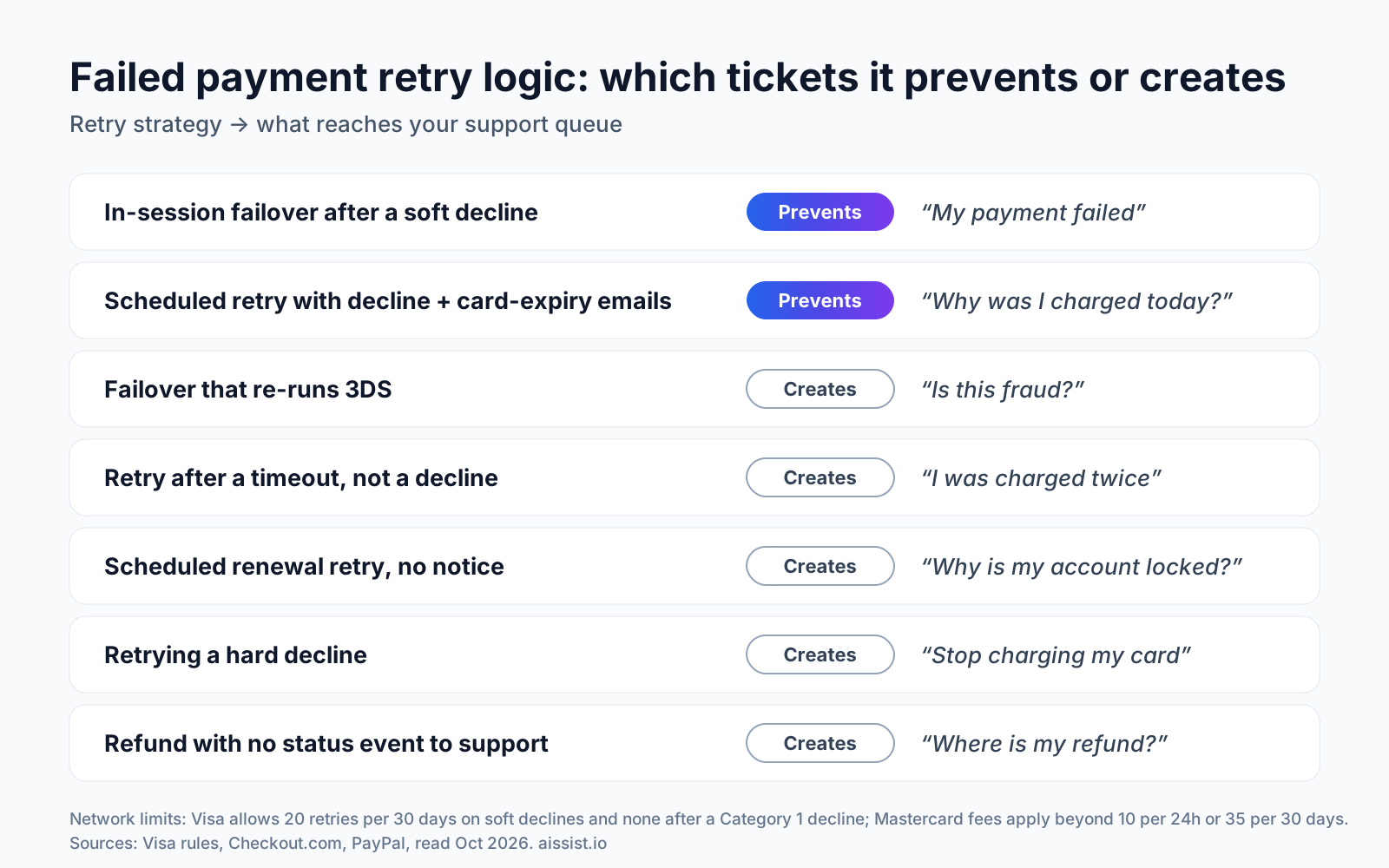
The last row is the quiet one. Whether support can see a refund's state depends on whether the platform emits a refund event and someone wires it into the help desk — the same visibility problem behind most ecommerce refund tickets.
Card networks also cap retries. Visa allows up to 20 retries in 30 days on soft declines, according to Checkout.com, and Visa's rules forbid any reattempt after a Category 1 "issuer will never approve" code. PayPal reports that Mastercard charges $0.50 per retry beyond 10 in 24 hours or 35 in 30 days in the US. Aggressive retry logic is billed twice: once by the network, once by your support queue.
"Billing is the brand's truth serum." — Keith Wilson, Executive Director of Product Management for Customer Experience, CSG
How do the seven platforms compare on tickets prevented vs. tickets created?
Platforms built for checkout prevent the most tickets at the moment of purchase; platforms built for subscriptions prevent the most at renewal. No platform covers every row above, and the gap is where your support load lives.
| Platform | Tickets prevented (published features) | Ticket risk left to cover |
|---|---|---|
| Corefy | Cascading retries "without customer re-entry"; webhooks at every status change | Renewal retry timing unpublished |
| Gr4vy | Real-time failover; refund and decline webhooks; batch or real-time card updater | No webhook for chargebacks or disputes |
| Payrails | Retries keyed to issuer response codes; network tokens; chargeback handling including customer communication | Can trigger 3DS on retry — warn customers a second check may appear |
| Primer | Backup-processor fallback that reuses 3DS data, so no second challenge | No scheduled or dunning retries published |
| Rebilly | Emails on declined renewals, card expiry at 14, 7 and 1 days, refunds and disputes | Failover documented for gateway outages, not declines |
| Solidgate | Cascading plus smart retries (four in four weeks by default); Ethoca/Verifi alerts that open a refund window | Customer dunning emails not documented |
| Spreedly | Real-time retry on up to two backup gateways; account updater | Retry is a paid add-on; dispute events not found in public docs |
Which payment orchestration platform fits your business?
Pick by where your failed payments happen: at checkout, at renewal, or across a network of providers you resell.
1. Corefy — best for PSPs and white-label payment platforms. Corefy is a payment orchestration platform with 650+ connectors, a hosted payment page and a white-label portal for merchants. It charges a monthly fee plus a per-transaction rate above included volume, counting only successful transactions, per Corefy's pricing page. Pros: breadth of connectors; cascading without re-entry. Cons: infrastructure fees not shown as numbers; recurring retry schedule undocumented. Skip it if you are a single merchant with two processors.
2. Gr4vy — best for enterprises wanting a dedicated cloud instance. Gr4vy runs each merchant on its own cloud instance with a no-code workflow engine, from $248/month with no per-transaction fees, per Gr4vy's pricing page. Pros: predictable flat pricing; real-time failover across PSPs. Cons: a single G2 review; chargebacks readable only via API. Skip it if you need dunning.
3. Payrails — best for global platforms and marketplaces. Payrails is a payment operating system with 100+ integrations, ML-assisted routing and retry strategies configured per issuer response code. In its inDrive case study, Payrails reports an 11% card approval-rate increase. Pros: response-code retry rules; built-in chargeback workflows. Cons: no public pricing; no G2 reviews yet. Skip it if you want self-serve onboarding.
4. Primer — best for checkout recovery without code. Primer is a payment orchestration platform whose Fallbacks product resends a rejected payment to a backup processor during authorization. Primer claims an average 38% recovery with fallbacks on its Fallbacks page. Pros: 3DS data carried to the fallback; no-code workflows. Cons: no published pricing; no scheduled renewal retries documented. Skip it if most failures are subscription renewals.
"We recovered over $7 million in revenue over six months using Primer Fallbacks." — Greg Rikkhachai, Former Head of Payments, Banxa, via Primer
5. Rebilly — best for SMB subscription businesses. Rebilly combines orchestration across 214 gateways with subscription billing, at $15/month (Basic) or $125/month (Pro) plus a 1% revenue fee; Rebilly's pricing page says it charges only for invoices marked as paid. Pros: the most complete customer-notification triggers here; published pricing. Cons: decline cascading undocumented; one G2 review. Skip it at high volume, where a revenue fee outgrows a flat platform fee even after volume discounts.
6. Solidgate — best for subscription apps needing both layers. Solidgate pairs in-session cascading with scheduled smart retries capped at 14 attempts, per Solidgate's docs. Pros: both retry layers in one product; chargeback alerts before disputes are filed. Cons: quote-only pricing; customer emails undocumented. Skip it if you sell one-time purchases only.
7. Spreedly — best for PSP independence. Spreedly is a payments orchestration platform built around a neutral card vault, with 150+ gateway connections and an optional Recover add-on that retries soft declines on backup gateways in real time, per Spreedly's docs. Pros: the deepest review base (35 on G2); tokens portable across processors. Cons: recovery costs extra; optimization pricing is quote only. Skip it if you will only ever use one PSP.
"Being able to change providers whenever you want is really important because the market is always changing in LATAM." — Mathias Fonseca, Payments Lead, PedidosYa, via Spreedly
Where does orchestration stop and resolution start?
Orchestration decides which rail a payment takes; it does not answer the customer who asks what happened. Even perfect routing leaves declines, refunds in flight and disputes. In a June 2026 PYMNTS study with Spreedly, 52% of firms with three or four orchestration capabilities said payment issues still drive at least 5% of customer complaints.
Payphone, a payments app, found that a single "payment failed" message can have more than ten underlying causes. Its Aissist deployment routes those conversations to dedicated sub-agents for transaction status, verification and disputes, and escalations reach humans with the transaction ID and error already extracted. WelTrade automated 90% of its Tier 1 service the same way. Our fintech customer service benchmark compares these deployments with other fintech support teams.
If your failed payments start at an AI agent's checkout rather than a human's, see our guide to agentic commerce platforms — a different problem with different vendors.
The best platform is the one whose retries your customers never notice
Choose the payment routing platform whose failed payment retry logic matches where your declines happen, then wire its events into support. Checkout-heavy businesses get the most from in-session failover (Primer, Gr4vy, Spreedly, Corefy). Subscription businesses need scheduled retries that tell the customer first (Rebilly, Solidgate, Payrails). Authorization rate is half the scorecard; the other half is how many people write in asking where their money went — a number no vendor homepage publishes.
Frequently asked questions
What is a payment orchestration layer?
A payment orchestration layer is software that connects a business to multiple payment processors through one integration, then routes, retries and reports on every transaction. It replaces hard-coding a single PSP.
What is the difference between payment cascading and smart retries?
Cascading resends a declined payment to another processor within the same checkout session. Smart retries reattempt a failed recurring payment later, timed to when approval is more likely.
How many times can you retry a declined card payment?
Visa permits up to 20 retries in 30 days on soft declines and none after a Category 1 hard decline. Mastercard fees apply beyond 10 retries in 24 hours or 35 in 30 days, according to PayPal.
Is a payment orchestration platform the same as a payment gateway?
No. A gateway connects you to one processor; an orchestration platform sits above several gateways and decides which one handles each payment.
Do you need payment orchestration with only one processor?
Usually not. Orchestration pays off once you run two or more processors or sell across regions where local acquiring raises approval rates.
Does payment orchestration reduce customer support tickets?
It reduces tickets from failed checkouts when retries happen in-session. Renewal failures, refunds and disputes still generate contacts unless the platform's events reach the customer and your support team.