Proactive Customer Service: the Four Contacts Worth Getting Ahead Of, and the Two That Backfire
Proactive customer service works when you tell a customer about a problem they can fix before they notice it. Here are the four contacts that pass that test, the two that fail it, and the volume maths behind both.
Compiled by Lucía Díaz. Published October 13, 2026 · Last updated October 13, 2026.
TL;DR: Pre-empt a contact only when the trigger is unambiguous, the customer can act on the message, and the outcome is reversible — because, per Gartner, 66% of B2C customers contact support after a proactive message anyway.
Methodology & sources
- Proactive-outreach behaviour: Gartner survey of 4,800+ customers, November–December 2021, published April 2022.
- Churn-outreach backfire: Ascarza, Iyengar and Schleicher field experiment, 65,000 wireless customers.
- Contact mix and payments: DigitalGenius WISMO data (March 2023), Stripe Billing docs and resources, Recurly.
- First-party: Aissist's published Payphone case study and fintech benchmark. The volume model is ours; its assumptions are stated where it appears.
- All figures verified October 2026. Disclosure: this is Aissist's blog, and Aissist sells AI agents for service and sales.
What is proactive customer service?
Proactive customer service is contacting a customer about a specific event in their account — a failed payment, a late order, an outage — before they contact you, with a message they can act on. It differs from marketing outreach in one way that matters: the trigger is something that happened to this customer, not a campaign calendar or a sales target.
That definition is narrower than the one most pages use, on purpose. The glossary entries ranking for this term describe an attitude ("anticipate needs"), and Lorikeet's glossary lists post-onboarding check-ins and churn signals alongside shipping delays and outages. Those are four very different bets, and only two of them reliably pay.
The reason is the follow-up contact. Gartner's survey of more than 4,800 customers found that 66% of B2C and 82% of B2B customers contact the company after receiving proactive outreach, and that 10% of B2C and 24% of B2B customers did so only to check the message wasn't a scam. A proactive message is not a contact avoided. It is a contact you scheduled.
"Proactive outreach that raises unanswered questions erodes the benefits for customers." — Eric Keller, Senior Research Director, Gartner Customer Service & Support
Done well, it still pays: the same Gartner research ties receiving proactive service to a 9% increase in a customer's value enhancement score. The question is which messages earn that, and which only generate tickets. (The broader posture argument lives in our proactive AI vs reactive AI piece; this one is the rule.)
Which contacts are worth getting ahead of?
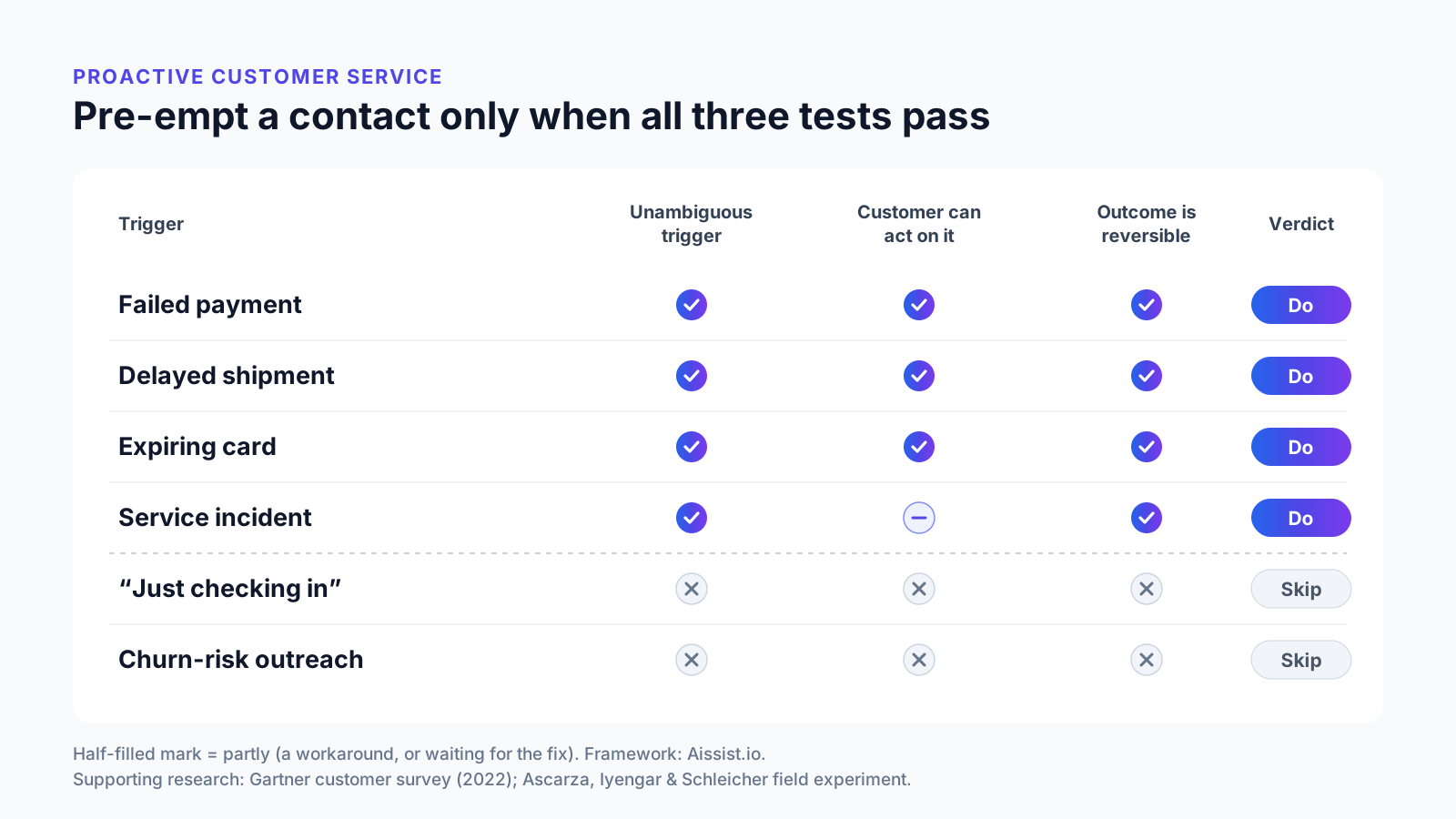
A contact is worth pre-empting when three tests pass: the trigger is unambiguous, the customer can act on the message, and the outcome is reversible. Fail any one and the message tends to create inbound volume rather than remove it.
| Trigger | How you detect it | Can the customer act on it? | Reversible? | Effect on inbound volume | Verdict |
|---|---|---|---|---|---|
| Failed payment | Processor decline event (e.g. Stripe's invoice.payment_failed) | Yes — update card, retry | Yes — access restored on payment | Small; the payoff is recovered revenue | Do |
| Delayed shipment | Carrier scan misses the promised date | Yes — wait, reroute, or refund | Yes | Removes most "where is my order" contacts, if the message carries a new date | Do |
| Expiring card | Expiry date on file, 30–60 days out | Yes — update before it fails | Yes | Neutral now; prevents a failure later | Do |
| Service incident | Monitoring alert or status page | Partly — workaround or wait | Yes, once fixed | Removes duplicate "is it down?" contacts | Do |
| "Just checking in" | A calendar, not an event | Nothing to act on | — | Adds contacts | Skip |
| Churn-risk outreach | A model score | Rarely; may dispute the premise | No — can prompt the exit it predicts | Adds contacts; can raise churn | Skip |
Turned into rules:
- Message every failed payment within minutes, with a one-tap fix.
- Flag a late order before the promised date passes, with the new date and options.
- Warn about an expiring card 30–60 days ahead, the window Stripe's expired-card guide suggests flagging.
- Tell affected customers about an incident first, with a status link. Gartner found customers alerted to urgent issues reported better effort scores than those who found out themselves.
- Don't send "just checking in" messages. A check-in is a ticket you mailed to yourself.
- Don't contact customers because a churn model scored them.
Why do check-in nudges and churn-risk outreach backfire?
Both fail the "can act" test: the customer receives a message with no specific problem in it, so the only available action is to reply, or to reconsider the relationship. They are also the two use cases vendors demo most, because they look like growth.
The check-in nudge is the simple case. With no event behind it, the baseline contact rate is roughly zero, so every reply is net-new volume. Gartner's finding that outreach "raises unanswered questions" describes it exactly: "Is something wrong with my account?" is a question the message created.
Churn-risk outreach is worse, because it can cause the churn. In a field experiment with 65,000 customers of a South American wireless carrier, researchers Eva Ascarza, Raghuram Iyengar and Martin Schleicher proactively recommended better-fitting plans to one group. Churn in the first three months was 10% among customers who got the recommendation, against 6% among those left alone. One plausible reading: the recommendation prompted customers to rethink what they were paying, and some did so by leaving.
"Companies are spending heavily on proactive retention campaigns to keep their customers with them for longer." — Eva Ascarza, then Assistant Professor of Marketing, Columbia Business School
The study also found the damage concentrated among customers with volatile, declining usage — exactly who a churn model flags. Telling a customer your model thinks they're about to leave is a strange way to ask them to stay. Use the score to fix the cause instead: route the account to a human, fix the billing error, close the open ticket.
How much volume does proactive customer service actually remove?
The same trigger can remove 5% or 70% of its contacts, depending on whether the message lets the customer act. A worked example on a 10,000-contact month shows the spread.
Start with "where is my order." DigitalGenius data from March 2023 put WISMO at 21% of contacts on average across its ecommerce customers, so a 10,000-contact month carries about 2,100. Assume — our assumption — those come from 3,000 customers with a late order, 70% of whom write in when nobody tells them anything.
| Scenario (Aissist illustrative model) | Messages sent | Contacts that month | Change vs silence |
|---|---|---|---|
| Silence | 0 | 2,100 | — |
| Vague delay notice, 66% follow up (Gartner's B2C rate) | 3,000 | 1,980 | −120 |
| Actionable notice: new date, tracking, refund-or-wait choice; 20% follow up (assumed) | 3,000 | 600 | −1,500 |
| Check-in nudge to 5,000 healthy customers; 5% reply (assumed) | 5,000 | +250 new | +250 |
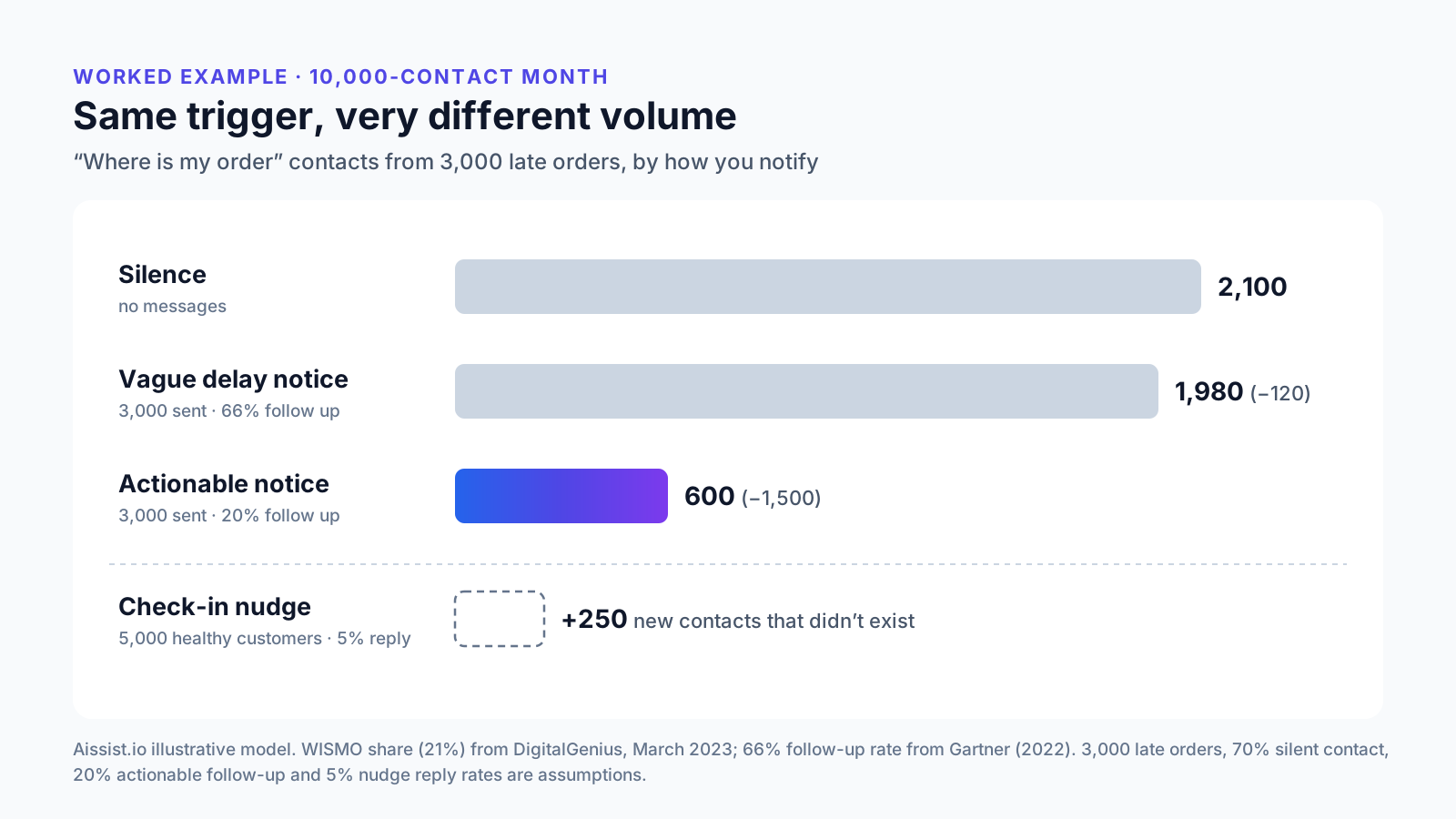
The vague notice sends 3,000 messages to save 120 contacts. The actionable one saves 1,500, and the check-in nudge quietly adds 250 to the queue. Your follow-up rates will differ, so measure them: hold back a random 10% of each trigger and compare contact rates between notified and silent groups. Proactive service is the one part of support where you choose the contact rate, so it is worth knowing what you chose.
How should failed payment recovery and dunning management work?
Failed payment recovery should combine automatic retries for soft declines with an immediate, actionable message for hard declines, and the message should land somewhere that can resolve the reply. Dunning management is the name for that sequence of retries and reminders.
The stakes are large. Recurly projected that involuntary churn would cost subscription businesses $129 billion in 2025, and Stripe's expired-card guide, citing a 2023 PYMNTS study, says 50% of subscriber churn stems from failed payments.
"Subscriber churn is the enemy of every brand we speak to." — Jonas Flodh, CPO, Recurly
Retries handle part of it. Stripe's Smart Retries documentation recommends 8 tries within 2 weeks by default, but a hard decline — a lost, stolen or closed card — can't be retried until the customer adds a new payment method. That is the proactive message, and it passes all three tests.
The catch is the reply. Customers answer dunning messages with "I already updated it," "can I switch to annual?" or "why was I charged twice?" That is service and sales in one thread. Aissist's Payphone case study lists failed-payment troubleshooting and transaction-status checks among the workflows the AI resolves, at a 70% resolution rate in that published deployment; our fintech benchmark puts the median across seven named fintech deployments at 75%. If replies instead land in a human queue, the outreach has moved the cost, not removed it. This is why we think of proactive outreach as an AI that completes tasks problem — and why AgentMesh™ runs sales and service on one layer, with proactive escalation to a human when the case needs one. Aissist's escalation guide reports an 83% average resolution rate across its deployments, a vendor-claimed figure.
Proactive service is a filter, not a posture
Proactive customer service earns its reputation on four triggers — failed payments, late orders, expiring cards and incidents — where the customer can act and the damage is reversible. It loses it on check-ins and churn-score outreach, which add volume and, in Ascarza's experiment, raised churn from 6% to 10%. Start with the failed-payment and delay messages, measure each against a holdout group, and send nothing you couldn't resolve the reply to.
Outreach is only as good as the reply handling. See how AgentMesh™ resolves service and sales in one thread. Get a free demo →
Frequently asked questions
What is an example of proactive customer service?
A message telling a customer their payment failed, with a one-tap link to update the card, sent before service is interrupted. Other good examples are a late-order notice carrying the new delivery date, and an outage alert with a status link.
Is proactive customer service the same as proactive outreach in marketing?
No. Proactive customer service is triggered by a specific event in the customer's account and helps them fix it. Marketing outreach is triggered by a campaign or sales goal, which is why it rarely reduces support contacts.
What is dunning management?
Dunning management is the sequence of automatic payment retries and customer reminders used to recover failed recurring payments. Stripe's documentation recommends 8 retries within 2 weeks by default; hard declines need the customer to add a new payment method.
Does proactive customer service reduce ticket volume?
Only when the message answers the customer's next question. Gartner found two-thirds of customers contact support after proactive outreach, so a vague notice can remove almost nothing while an actionable one removes most of the contacts.
How do you measure proactive customer service?
Hold back a random share of customers for each trigger, such as 10%, and compare contact rate, resolution and churn between the notified and silent groups. Without a holdout, you can't tell whether outreach removed contacts or created them.
Can AI agents handle proactive outreach and the replies?
Yes, if the same AI agent that sends the message can resolve the reply, such as checking a transaction or changing a plan. Aissist reports an 83% average resolution rate across deployments, a vendor-claimed figure.