PCI DSS customer service AI questions stall security reviews because most vendor pages answer with a badge. This one answers with v4.0.1 requirement numbers.
TL;DR: An AI agent is only as compliant as its environment; under PCI DSS v4.0.1, the safest design keeps card numbers and security codes out of the AI entirely and documents that scope yearly (Requirement 12.5.2).
Methodology & sources
- Standard: PCI DSS v4.0.1 (June 2024).
- Guidance: PCI SSC AI principles (Sep 2025) and Security Considerations for AI Systems (Sep–Oct 2026, non-mandatory).
- Checked 20 Nov 2026. Disclosure: this is Aissist's blog; Aissist sells AI agents for customer service.
Is AI customer service PCI DSS compliant?
AI customer service is PCI DSS compliant only when the environment it runs in is assessed as compliant; the product alone cannot be. PCI DSS applies to entities and their system components, not software categories. "Meets all 12 requirements" means little without a version, requirement numbers and an assessor.
The Council's September 2026 announcement says that for scoping, AI "should be considered no different from any other form of technology." There is no AI loophole, and no new AI rulebook either.
"There is an obligation for all parties to ensure the technology is used responsibly." — Gina Gobeyn, Executive Director, PCI Security Standards Council
So the useful question is narrower: does this AI agent ever see, store or transmit account data?
Which PCI DSS v4.0.1 requirements apply to an AI support agent?
The requirements that bite are in Requirement 3 (stored data), 4 (transmission) and 12 (scope and service providers). The Council's AI principles post says Requirements 3 and 4 apply equally to AI-based systems.
| Requirement (v4.0.1) | What it demands | How an AI layer satisfies it | In scope or descoped |
|---|---|---|---|
| 3.3.1 | Sensitive authentication data not stored after authorization, even if encrypted | Security codes never reach prompts, transcripts or logs | Descoped if none arrives |
| 3.4.1 | PAN masked when displayed; BIN and last four at most | Replies and agent views show masked numbers only | Descoped if PAN never arrives |
| 3.5.1 | PAN unreadable anywhere stored | No raw PAN in transcripts, vector stores or analytics | Descoped if PAN never arrives |
| 4.2.1 | Strong cryptography for PAN in transmission | Applies to any model or tool call carrying PAN | In scope if PAN crosses the wire |
| 12.5.2 | Scope documented and confirmed every 12 months | The AI system appears in the data-flow diagram | Always applies |
| 12.8.1, 12.8.5 | List of service providers sharing account data; who manages which requirement | AI vendor listed with a responsibility split | Applies if the vendor receives account data |
Requirement 3.3.1 cannot be met by encrypting security codes, only by not keeping them. An AI that never receives them has nothing to prove.
Does the AI layer enter the cardholder data environment?
An AI layer enters the cardholder data environment when it can read account data, and tokens count if it can also detokenize them. The Council's 2026 supplement, as reported by Help Net Security, treats tokenized data plus a detokenize tool as readable data.
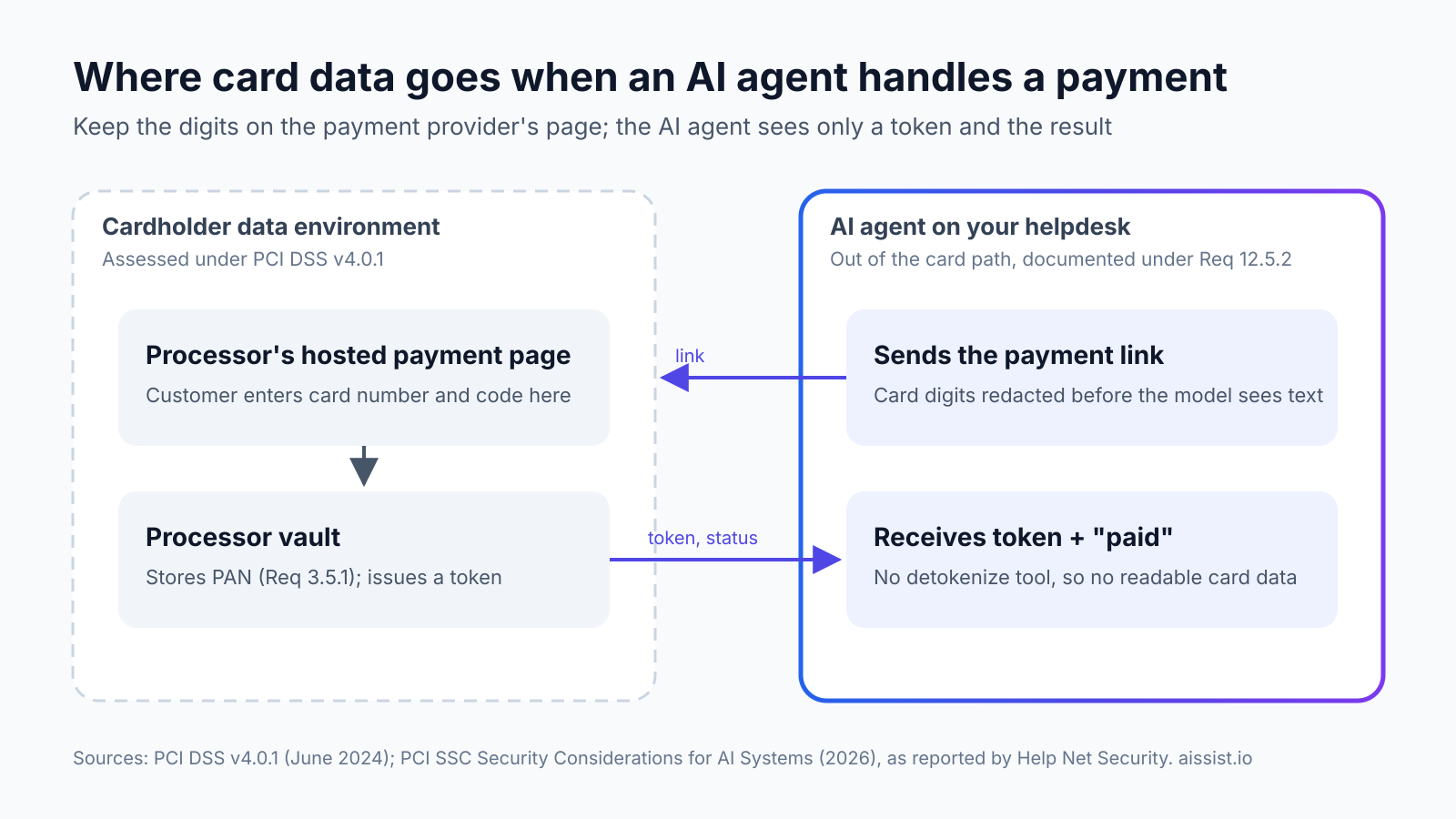
An AI layer on your existing helpdesk adds no new card path; it inherits whatever reaches the desk. Redact card data at the desk, send payments to your processor's hosted payment page, and the AI handles tokens and payment status only. Aissist's reliable AI design is built on that rule: card details never enter the context, so they cannot leak.
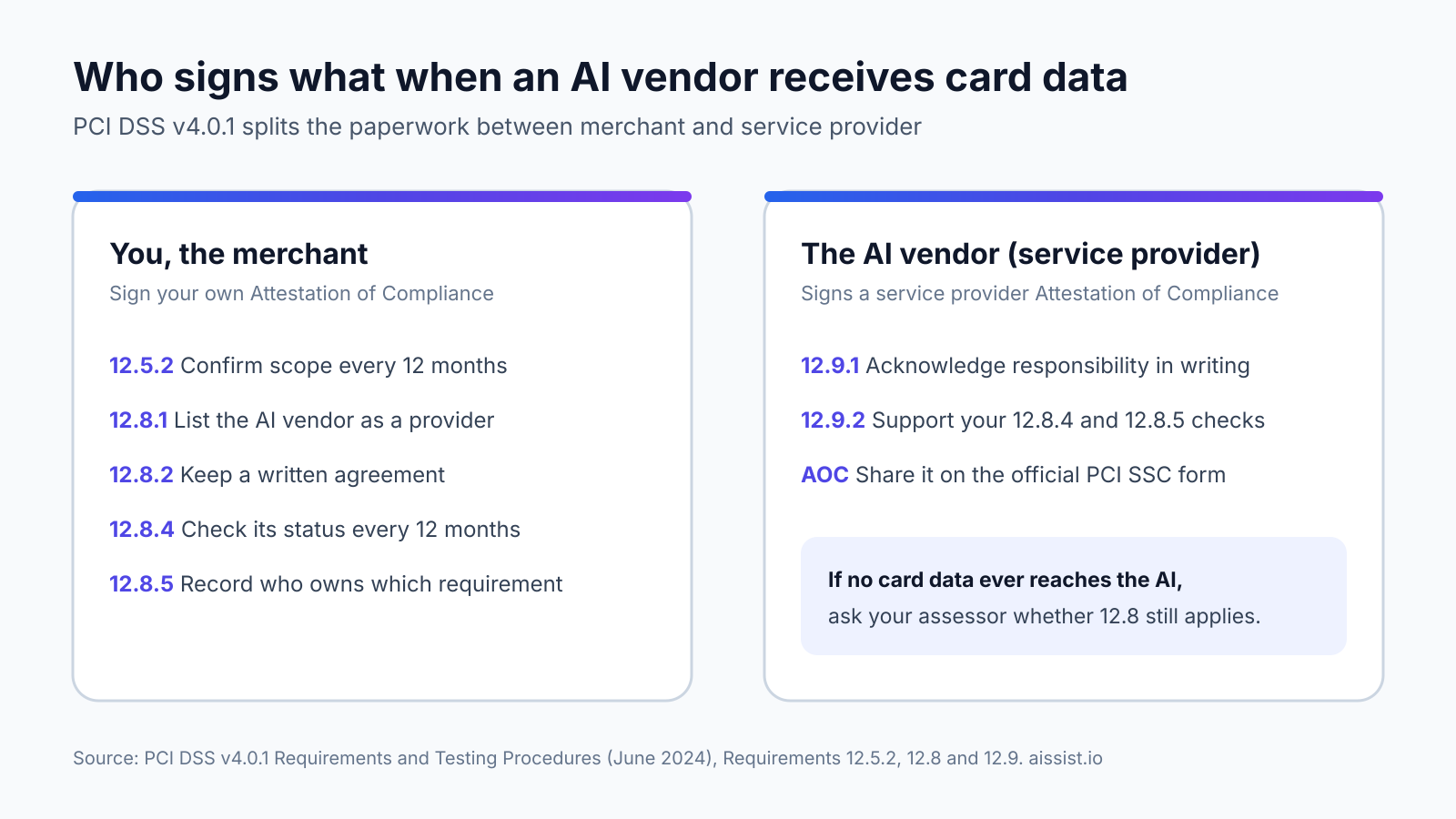
Then the paperwork most pages skip. You, the merchant, sign your own attestation. A vendor that receives account data is a third-party service provider, with duties on both sides of Requirement 12.8 and 12.9 (below). Check that its attestation covers the AI service you are buying, not just its hosting.
What should you ask before an AI agent touches card data?
Ask six questions, and accept only evidence, not adjectives:
- Which PCI DSS version and requirement numbers back your answer? Expect v4.0.1.
- Can card numbers or security codes reach the model, transcripts, logs or training data?
- Where does redaction happen, and does it run independently of the AI, as the Council's 2026 guidance recommends?
- Can the agent call any tool that detokenizes or decrypts payment data?
- Which card-related actions need explicit human approval? The 2026 guidance recommends it for any agent action on cleartext card data.
- If you receive account data, where are your service provider attestation and your 12.9.1 acknowledgment?
"There should always be a human who is involved and responsible…" — Andrew Jamieson, VP, Distinguished Standards Architect, PCI Security Standards Council
Aissist's 20-question AI agent security review scores Aissist's own security page against it, gaps included.
The compliant AI agent is the one that never sees the card
Compliance belongs to your assessed environment, so the vendor that answers "yes" fastest is rarely the safest. Keep account data out of the AI's reach, document it under 12.5.2, and collect an attestation only if data crosses over. For adjacent risk, see AI agent liability in customer service.
Frequently asked questions
Does ISO 27001 certification make an AI vendor PCI DSS compliant?
No. ISO 27001 certifies a security management system; PCI DSS compliance is shown by a Report on Compliance or self-assessment plus an official Attestation of Compliance.
Who fines a company for PCI DSS non-compliance?
Not the PCI Security Standards Council. PCI DSS v4.0.1 leaves compliance programs to payment brands and acquirers, so any fine figure should cite the brand or acquirer that set it.
Can an AI agent take a card payment in chat?
Yes, by handing off. The agent sends your processor's hosted payment page or link; the customer enters the card there, and the agent gets back a token and the result.
Is PCI DSS 4.0 still valid in 2026?
No. PCI DSS v4.0 was retired on 31 December 2024; v4.0.1, published June 2024, is the version assessments use now.