The 6 Best SaaS Review Sites in 2026
The best SaaS review sites in 2026 are G2, Capterra, TrustRadius, Gartner Peer Insights, Trustpilot and PeerSpot. For a software vendor the choice is not really about which site is best — it is about which review threshold you can realistically clear, because a listing does nothing until it does. This guide compares all six on published listing cost, verification strictness and the exact number of reviews each one needs before your product appears, ranks, or earns a badge.
Reviewed by Alex Gomez, Sr. Analyst. Disclosure: this guide is published by Aissist.io. We build agentic AI for customer service and sales — we are not a software review site, and we hold no affiliate or referral relationship with any platform listed here. Prices, review thresholds and eligibility rules were read from live vendor documentation on 20–21 August 2026.
TL;DR: Six software review sites are worth a SaaS vendor's time in 2026. Each one does a different job.
- Widest reach and category coverage: G2
- Most SMB click volume: Capterra
- Best independent mid-market depth: TrustRadius
- Best free enterprise listing: Gartner Peer Insights
- Best Google-visible star rating: Trustpilot
- Best cloud-marketplace reach: PeerSpot
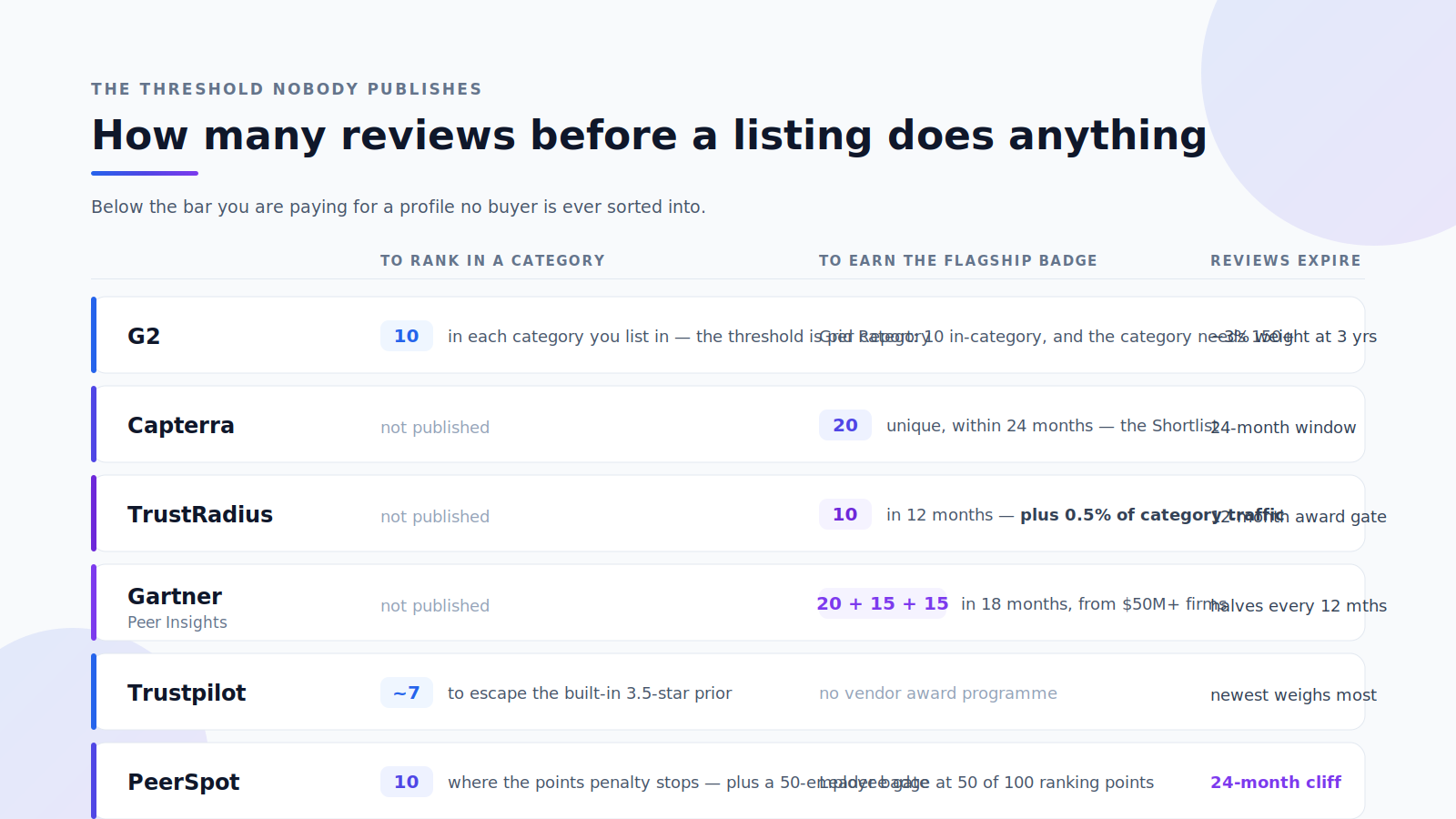
The trap in this category is treating a listing as a channel. It is not a channel until it clears a review threshold — G2 needs 10 reviews in a category before your product appears on the Grid at all, Capterra needs 20 in 24 months for the Shortlist, and Gartner Peer Insights needs 20 plus 15 capability ratings plus 15 support ratings inside an 18-month window. Below those numbers you are paying for a profile nobody sorts you into.
How we compared these SaaS review sites
We scored each platform out of 5 on six criteria for a maximum of 30, and excluded anything under 65%. Prices, review counts and eligibility rules were read from live vendor documentation on 20–21 August 2026. Where a platform publishes no figure, this article says "not published" rather than repeating a number from a third-party guide — several widely circulated figures in this category turn out to have no official source.
- Review threshold to matter — how many reviews before the listing appears, ranks, and earns a badge.
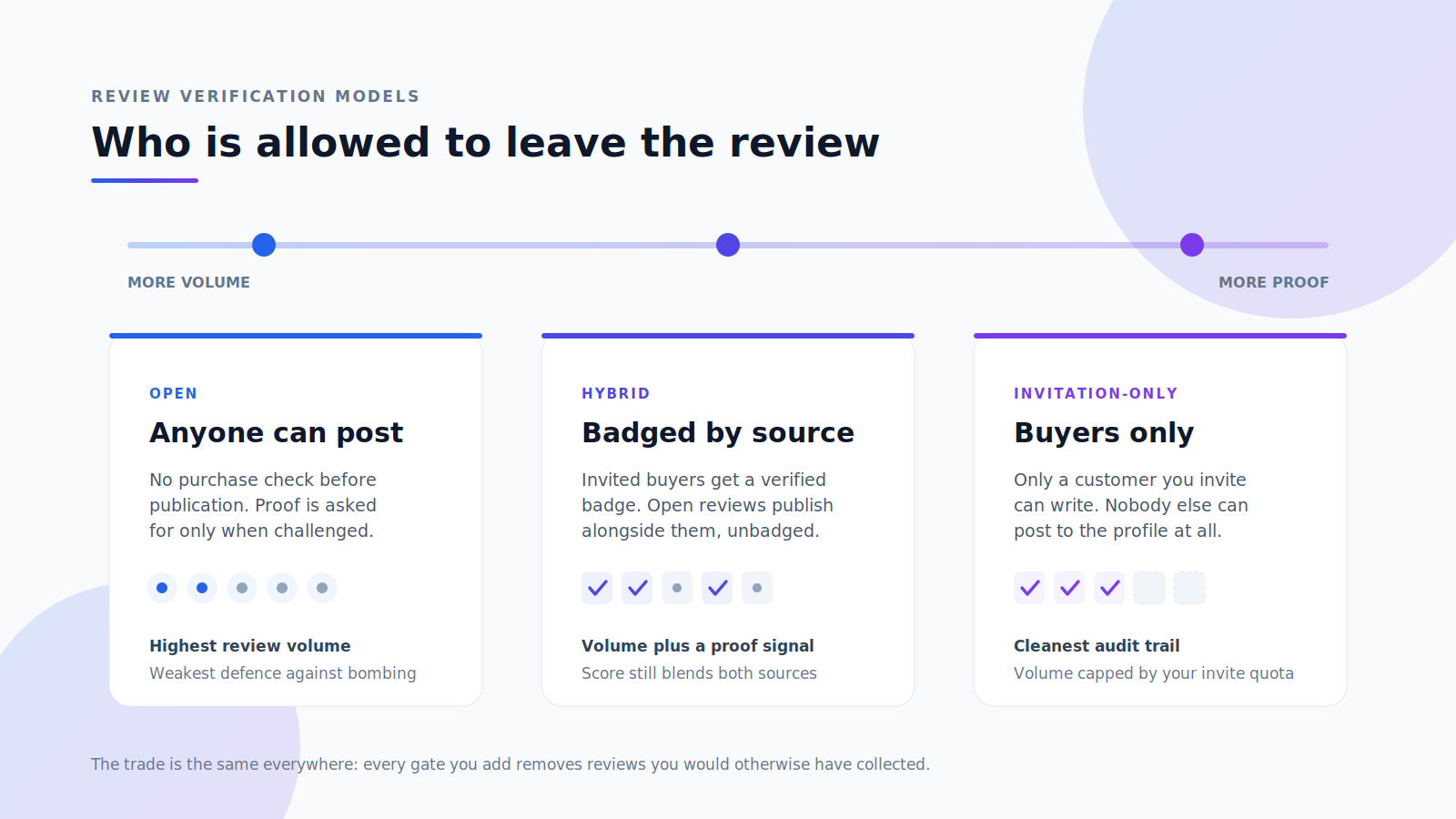
- Verification strictness — work email, LinkedIn, employer matching, human moderation, and whether incentives and AI-written reviews are permitted.
- Price transparency — whether a vendor can budget without a sales call.
- Buyer reach and audience fit — annual buyers, and SMB versus enterprise skew.
- Recency economics — how fast reviews decay, which sets your ongoing collection cost.
- Independence — after February 2026 this is a real variable, not a philosophical one.
One counterweight worth holding in mind: Wynter's January 2026 survey of 101 mid-market SaaS CMOs found 84% now use AI assistants for vendor discovery and 68% start there before a search engine. Review sites are no longer the first stop for everyone.
Bias disclosure, plainly: this is Aissist.io's blog. We build agentic AI for customer service and sales, we are not a software review site, and we hold no affiliate or referral relationship with any platform below. G2 ranks first here on the rubric, and we have no commercial reason to want that.
Two numbers set the stakes. Wynter's survey of 100 B2B SaaS marketing executives found 81% check third-party reviews during self-education, scoring review sites 4.74 out of 5 on influence — second only to word of mouth. And Capterra's 2025 Tech Trends survey of 3,500 buyers across nine countries found 70% of successful software buyers are more likely to trust review and comparison sites than vendor sites when gauging customer satisfaction. The window to be found is narrow: 6sense's 2025 B2B Buyer Experience Report, surveying nearly 4,000 buyers, found buying groups fill about 3.6 shortlist spots on day one — and 95% of the time the eventual winner was already on that day-one list.
One ownership fact that changes the shortlist
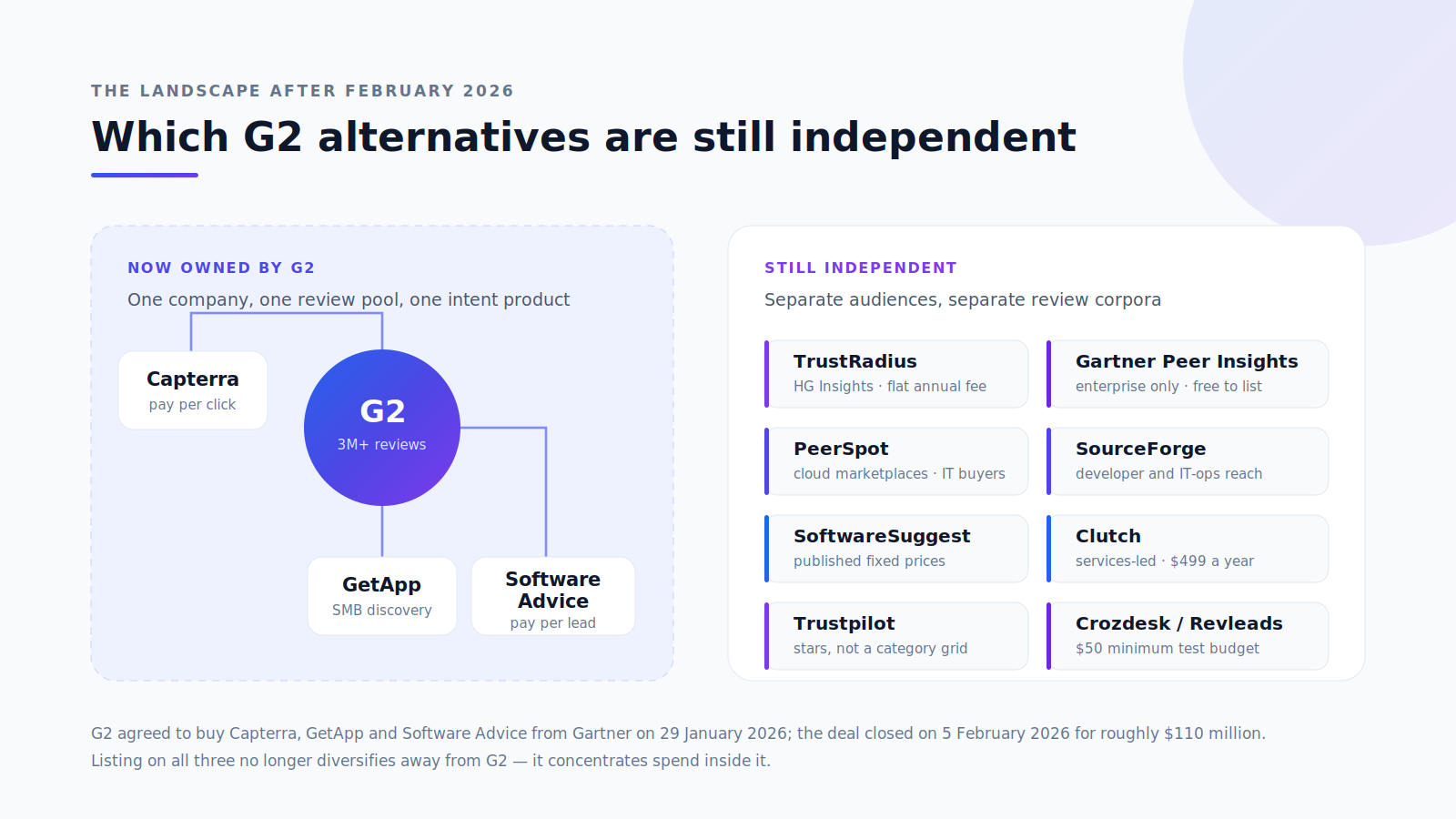
G2 acquired Capterra, GetApp and Software Advice from Gartner in February 2026, for roughly $110 million. Godard Abel, G2's co-founder and CEO, called it "a transformational moment for G2, and, more importantly, the global B2B software industry." The practical consequence for a vendor: listing on G2, Capterra, GetApp and Software Advice is one company and one shared review pool, not four channels. We cover the fallout in detail in our guide to the best G2 alternatives.
The 6 SaaS review sites at a glance
| Platform | Best for | Owner | Verification | Vendor billing model | Entry price | Incentives |
|---|---|---|---|---|---|---|
| G2 | Widest reach and category coverage | Independent | Business email, LinkedIn, or a personal email G2 can validate | Tiers + intent add-on | $299/mo, or $2,999 first year (yr 2: $6,000) | Allowed, capped at $100, labelled |
| Capterra | SMB click volume | G2 | 30+ human moderators, 20+ checks per review | Pay per click | Not published | Allowed, "nominal value", icon-disclosed |
| TrustRadius | Independent mid-market depth | HG Insights | LinkedIn or work email only, depth-vetted | Flat annual fee per product | From $30,000/product/year | Allowed, no cap published, labelled |
| Gartner Peer Insights | Free enterprise listing | Gartner | Corporate email matching employer + confirmed profile | Free | $0 | Allowed, $25 nominal, $10,000/market/yr vendor cap |
| Trustpilot | A Google-visible star rating | Independent (LSE: TRST) | Open — anyone can post | Per domain, 12-month term | $99/mo (under $5M rev), else $319 | Banned outright |
| PeerSpot | Cloud-marketplace reach | Independent | LinkedIn or company email, 100% human moderated | Quote only | Not published | Allowed, disclosed per review |
Who each one is built for
| Platform | Audience | Scale (vendor-published) | Approval turnaround | Standout capability | Hardest constraint |
|---|---|---|---|---|---|
| G2 | SMB through enterprise, global | 3M+ reviews, 200,000+ products, 2,000+ categories, 100M+ buyers | Up to 3 business days | Buyer Intent across four properties since June 2026 | Grid position weights Market Presence alongside Satisfaction, and G2 does not publish the ratio |
| Capterra | SMB, strong international footprint | 2.5M+ reviews; buyer reach no longer published as a figure | Not published | Highest SMB discovery volume in the category | No vendor pricing published anywhere |
| TrustRadius | Mid-market and enterprise, US-centric | 12M annual buyers, 400+ word average review | 2–3 days | Long-form practitioner reviews and downstream intent | Top Rated needs 0.5% of category traffic — reviews alone won't buy it |
| Gartner Peer Insights | Enterprise only — reviewers must be at $50M+ revenue firms | 880,000+ ratings, 840+ markets, 28,600+ vendors | 3–10 business days | Feeds Voice of the Customer and sits beside Magic Quadrant | Sells no intent data — reputation, not pipeline |
| Trustpilot | B2C-first; B2B as a trust layer | 361M active reviews as of Dec 2025 | Up to 2 hours | Google Seller Ratings partner; widgets emit review schema | No software taxonomy, no category grids, no alternatives pages |
| PeerSpot | Enterprise IT, infrastructure, security | 86,000+ in-depth reviews | Up to 3 business days | Supplies reviews inside Google Cloud and AWS Marketplace | Vendor gate: 50+ employees and 10+ enterprise customers |
How many reviews before a listing does anything
This is the table nobody publishes, and it is the one that should drive your sequencing. Everything below comes from each platform's own live documentation: G2, Capterra, TrustRadius, Gartner Peer Insights, Trustpilot and PeerSpot.
| Platform | To appear / be scored | To rank in a category | To earn the flagship badge | Recency rule |
|---|---|---|---|---|
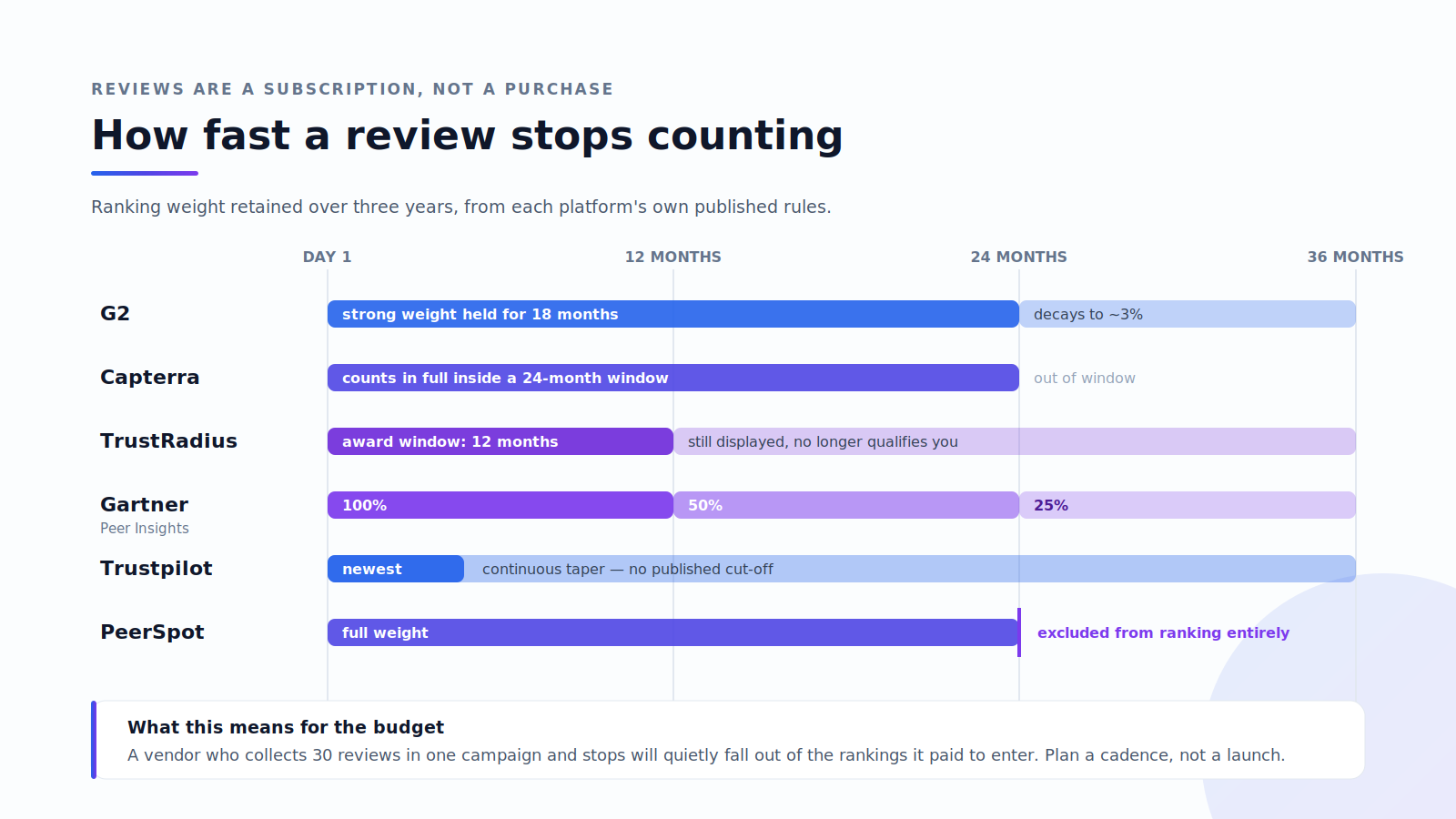
| G2 | Not published | 10 reviews in that category — reviews don't travel between categories | Grid Report: product needs 10 in-category reviews; the category needs 6 products with 10+ and 150+ reviews overall. Users Love Us: 20 reviews at 4.0+ | Gradual decay for 90 days, strong weight held 18 months, then accelerating to ~3% of original weight at ~3 years |
| Capterra | Not published | Not published | Shortlist: 20 unique reviews published within 24 months. Feature-level "Best" distinctions need 4.0+ from 10 reviews in two years | 24-month window; ratings normalised for recency and volume |
| TrustRadius | Not published | Not published as a number | Top Rated: 10+ new or updated reviews in 12 months, plus ≥0.5% of category traffic, plus 4 stars / trScore 7.5+. Buyer's Choice: 10 reviews + 75% reviewer selection | Newer weighted more heavily; no interval published. Award gate is 12 months |
| Gartner Peer Insights | Not published | Not published | Voice of the Customer: 20+ eligible reviews in an 18-month window, plus 15+ Capabilities ratings and 15+ Support/Delivery ratings. Reviewers must be at $50M+ revenue companies. Report capped at 25 vendors | Star rating halves yearly — 100% / 50% / 25% at 0–12, 12–24, 24–36 months. VoC separately weights the window's first 6 months at 50% |
| Trustpilot | Effectively 1. A Bayesian prior of "7 reviews worth 3.5 stars" is baked into every TrustScore | Not published | No category-badge programme comparable to the B2B platforms | Newest review carries the most weight; no cut-off published |
| PeerSpot | Vendor gate first: 50+ employees and 10+ enterprise customers | No floor, but a penalty: ⅓ fewer rating points at 5–9 reviews, ⅔ fewer below 5 — so 10 is where the penalty stops | Leader badge at 50 of 100 ranking points. Tech Leader Awards need a category with 5 products at 8+ reviews in 12 months | Hard cliff: reviews older than 24 months are excluded from the ranking algorithm entirely |
Three things fall out of that table.
Ten is the magic number almost everywhere. G2, TrustRadius and PeerSpot all converge on roughly ten reviews as the point where a listing stops being decorative. Capterra doubles it to twenty; Gartner effectively triples it once you count the sub-ratings.
Reviews are a subscription, not a purchase. G2 reviews fall to about 3% of their original weight after three years. PeerSpot deletes them from ranking at 24 months. Gartner halves them annually. A vendor that collects 30 reviews in one campaign and stops will quietly disappear from the rankings it paid to enter.
The recency preference is real on the buyer side too, though the best granular evidence is old and worth flagging as such: fieldwork by OnTarget Consulting and Research in 2017, surveying 548 business professionals, found 65.7% rated reviews under three months old as very valuable against 11.2% for reviews over a year old.
The 6 best SaaS review sites, reviewed
1. G2 — best for widest reach and category coverage
G2 is a B2B software review marketplace and buyer-intent platform where verified users rate business software across 2,000-plus categories, and where vendors buy profiles, category placement and account-level intent signals.
Verification: Business email, LinkedIn, or a personal email address "as long as G2 is able to validate your reviewer identity" — a looser gate than TrustRadius's work-email-only rule. Every review is human-moderated before publication, and resellers are labelled Business Partner and excluded from scoring. Generative-AI drafting is permitted only for reviewers who are LinkedIn Verified, on a seller-provided list, or submitting in-app; unverified reviewers may not use it. Incentives are allowed and capped at $100 per review, labelled "Incentivized". · Threshold: 10 in-category reviews to appear on a Grid. · Turnaround: up to 3 business days.
Scale: 3 million-plus reviews, 200,000-plus products, 175,000-plus vendors, 100 million-plus buyers (vendor-published).
Cost: Free tier at $0 with three users. Starter $299/month, or $2,999 for the first year — rising to roughly $6,000 in year two, which is the step most budgets miss. Professional and Enterprise are quote only, and Buyer Intent is an add-on restricted to those two tiers. As a reported figure, procurement platform Vendr puts the median annual contract value around $28,000.
Pros:
- The largest review corpus in the category, and since February 2026 ownership of the second-largest as well.
- Publishes an itemised entry price, which Capterra, GetApp, Software Advice and Gartner Peer Insights do not do at any level.
- The only platform here selling intent signals aggregated across four discovery sites.
Cons:
- Market Presence — half the Grid's horizontal axis — is scored partly on PPC spend, web traffic and employee headcount from third-party data, so a better-funded vendor can outrank a better-liked one.
- The 10-review threshold is stated per "corresponding category," so a product listed in four categories has to clear the bar in each one rather than once overall.
- The personal-email path and conditional allowance of AI-drafted reviews make it the loosest verification of the five B2B platforms here, and G2's own pages disagree on its buyer reach — 100 million in the 2025 Year in Review against 200 million on its about page.
Our take: G2 is the default and deserves to be — the corpus, the taxonomy and the intent product are all category-leading. Do not treat it as a complete strategy if your buyers are enterprise IT, or if you cannot sustain the review velocity Market Presence rewards.
On "pay-to-play", precisely. G2 states that a paid profile buys no ranking advantage: free and upgraded profiles "are scored the same and will remain eligible and included in Quarterly Market Reports and annual Best Software Awards" (G2, 29 April 2025). Two things are nonetheless true and worth planning around. First, G2's published scoring methodology folds a vendor's own external marketing footprint into Market Presence — Moz domain authority, estimated search volume, and SimilarWeb metrics including PPC spend, each carrying "Low" importance among roughly a dozen signals — so a bigger marketing budget nudges the axis, even though none of that money goes to G2. Second, since the Summer 2025 report only vendors on a paid plan may publicly display or download G2 badges (G2 seller documentation). Payment buys the right to advertise the accolade, not the accolade itself. We have seen no regulator action, litigation or newsroom investigation alleging otherwise.
2. Capterra — best for SMB click volume
Capterra is a software discovery directory and pay-per-click marketplace where small and mid-sized business buyers compare products by category and reviews, and where vendors bid for sponsored placement.
Verification: The most specific moderation mechanics published by anyone here — 30-plus human moderators applying 20-plus checks per review, identity confirmed through manual checks and enrichment, plus generative-AI and plagiarism detection. Suspicious reviews trigger a demand for further evidence of use. Incentives are permitted at "nominal value, as defined by applicable law" — no dollar figure is published — and disclosed via a Reviewer Source icon. · Threshold: 20 unique reviews in 24 months for the Shortlist. · Turnaround: not published.
Scale: 2.5 million-plus reviews (vendor-published). Capterra's vendor page no longer publishes an annual buyer count, referring only to "millions of in-market software buyers." Owner: G2, since 5 February 2026.
Cost: Free listing plus pay-per-click sponsored profiles. No pricing page exists — capterra.com/vendors/pricing returns a 404, and the official PPC service description states no minimum bid and no minimum spend.
Pros:
- The highest SMB discovery volume of the six, on a review corpus second only to G2's.
- One review collection effort propagates free across Capterra, GetApp and Software Advice.
- The Shortlist is among the most gettable flagship badges here — 20 reviews over two years is a lower bar than Gartner's 20-plus-15-plus-15 inside 18 months. Check the current methodology before planning around it: Capterra's international pages add a further minimum of 10 reviews in the last year.
Cons:
- Zero published vendor pricing, no bid minimum and no rate card, so budgeting requires a sales call.
- Incentivised reviews are standard practice and there is no work-email or LinkedIn requirement, so verification rests on moderator judgment.
- Its own former parent now routes enterprise buyers away from it, confirming the SMB ceiling as published policy.
Our take: If you sell to SMBs, Capterra still carries volume nothing independent matches, and the Shortlist is a realistic first badge. Do not buy it as a hedge against G2 — since February 2026 that is the same invoice to the same company.
3. TrustRadius — best for independent mid-market depth
TrustRadius is an independent B2B technology review platform, owned by HG Insights, that publishes long-form vetted reviews from verified enterprise and mid-market practitioners and sells vendors a flat-fee customer-voice programme plus downstream intent data.
Verification: Registration via LinkedIn or work email only — no personal-email path. Reviews are vetted for authenticity, depth and detail, with thin submissions returned for more; the average review runs 400-plus words. Incentives are permitted with no published cap, and incentivised reviews are labelled as such. · Threshold: Top Rated needs 10-plus new or updated reviews in 12 months plus at least 0.5% of category traffic plus a trScore of 7.5. · Turnaround: 2–3 days.
Scale: 12 million annual technology buyers, with an average review length above 400 words (vendor-published). Total review count is not published anywhere.
Cost: On 5 August 2026 HG Insights rebranded the vendor product as HG Customer Voice, and the launch announcement puts pricing at from $30,000 per product per year — one of only four published prices among the six. Note the billing unit: per product, so a three-product portfolio is $90,000 at list.
Pros:
- The strictest verification of the three non-Gartner B2B platforms, producing 400-plus word reviews that read as practitioner accounts rather than survey responses.
- Genuinely independent of G2 after February 2026, which is the entire argument if diversification is the goal.
- A published starting price of $30,000 per product per year, which makes budgeting a spreadsheet exercise rather than a negotiation.
Cons:
- Top Rated cannot be bought with reviews alone — the 0.5% category-traffic gate means a small vendor can hit every review target and still miss the badge.
- Total review count is not published, so you cannot size the corpus against G2's 3 million before committing $30,000.
- 12 million annual buyers is a fraction of G2's stated reach, at ten times G2's published entry price.
Our take: If you sell to mid-market or enterprise buyers and want a review presence G2 does not own, TrustRadius is the answer. Do not buy it as a volume play — you are paying for depth and independence.
4. Gartner Peer Insights — best free enterprise listing
Gartner Peer Insights is a free, Gartner-moderated enterprise IT review platform where verified technology decision-makers rate software, feeding Voice of the Customer reports that sit alongside Magic Quadrant research.
Verification: The strictest here. A reviewer must supply a corporate email matching their stated employer and hold a confirmed Gartner or LinkedIn profile, then pass human moderation. Incentives are capped at $25 per gift card, with vendor self-funding limited to $10,000 per market per year and a Gartner-funded $1,250 starter pool for new vendors. · Threshold: Voice of the Customer needs 20-plus eligible reviews in an 18-month window, plus 15-plus Capabilities ratings and 15-plus Support/Delivery ratings, from reviewers at companies above $50 million revenue. · Turnaround: 3–10 business days — though official Gartner pages disagree, with one stating 3 business days.
Scale: 880,000-plus ratings across 840-plus markets and 28,600-plus vendors (vendor-published; a second Gartner page states 760,000-plus, and the two contradict each other).
Cost: Free. No listing fee, no pay-per-click, no pay-per-lead, unlimited portal users, plus a free Gartner-run review sourcing service.
Pros:
- Genuinely free to list, with unlimited portal users, free review sourcing and $1,250 in starter incentive funding.
- Strictest verification of the six — employer-matched corporate email plus a confirmed profile plus human moderation.
- Reviews feed Voice of the Customer and surface inside interactive Magic Quadrants, an analyst adjacency no other platform offers.
Cons:
- Sells no buyer-intent data at all. You get reputation, not pipeline.
- The hardest badge threshold here: 20 reviews plus 15 plus 15 inside 18 months, all from $50 million-plus companies, with the report capped at 25 vendors.
- Excludes SMB by rule, and two live Gartner pages give contradictory totals for its own review corpus — 880,000-plus on one, 760,000-plus on another.
Our take: If you sell to enterprises there is no argument against listing — it costs nothing and the analyst adjacency is unique. Do not expect leads; treat it as the credibility asset a procurement committee checks.
5. Trustpilot — best for a Google-visible star rating
Trustpilot is an open consumer review platform where any customer can review any business by domain, used by SaaS vendors mainly for Google-visible star ratings and on-site trust widgets rather than category discovery.
Verification: The loosest here, with one striking exception. Anyone can post without proof of purchase, and automated systems assess submissions after the fact — Trustpilot reports 7.8 million reviews detected as fake and removed in 2025, and its most recent formal Trust Report (published 29 May 2025, covering 2024) puts the removal rate at 7.4% of everything submitted that year, up from 6.1% in 2023, with 90% caught automatically before publication. Read that as a detected-and-removed rate, not an estimate of how many fakes remain live. But Trustpilot bans incentivised reviews outright, the only platform of the six to do so: reviewers are ineligible if they were offered "discounts, promo codes, prize draw entries, refunds, freebies, or any other benefit." · Threshold: effectively one — a Bayesian prior worth "7 reviews at 3.5 stars" is baked into every TrustScore, so a single 5-star review displays as roughly 3.7. · Turnaround: up to 2 hours, by far the fastest here.
Scale: 361 million active reviews as of December 2025 (vendor-published).
Cost: Published, on a 12-month commitment. Free at $0. Starter from $99/month per domain with 100 invitations — but Starter is restricted to new small-business customers under $5 million revenue, so most mid-market SaaS companies start at Plus. Plus from $319. Premium from $799, with unlimited domains permitted but each domain priced separately. Enterprise is quoted.
Pros:
- The only platform here that bans incentives entirely, which makes its corpus harder to manufacture than any of the B2B sites.
- Published pricing from $0 to $799 a month with exact feature counts per tier, above which Enterprise is quoted.
- Two-hour publication and a Google Seller Ratings partnership — the fastest path to visible stars on ads and in search.
Cons:
- No software category taxonomy, no comparison grids and no alternatives pages, so it captures none of the category-level discovery traffic G2 monetises.
- No proof-of-purchase gate at all, which in our judgement makes a Trustpilot rating weaker evidence in a software evaluation than a work-email-verified review on G2 or PeerSpot.
- Per-domain pricing on a mandatory annual term multiplies for multi-product vendors, and there is no buyer-intent product at all.
Our take: Trustpilot does exactly one job for a SaaS company — stars next to your brand in Google results and on your pricing page — and does it faster and more cleanly than anyone. Do not buy it for discovery. If Trustpilot's own pricing is what brought you here, we compare the cheaper routes in the best Trustpilot alternatives.
6. PeerSpot — best for cloud-marketplace reach
PeerSpot is an enterprise technology review platform that publishes long-form validated reviews from verified IT practitioners and distributes them into cloud marketplaces, serving infrastructure, security and enterprise software buyers.
Verification: LinkedIn or company-email registration is required, and every post is human-moderated before publication. Some reviews come from paid interviews, and PeerSpot discloses per review how each was obtained — a level of provenance transparency nobody else here matches. · Threshold: a vendor gate before any review threshold — 50-plus employees and 10-plus enterprise customers, where enterprise means 1,000-plus employees or $250 million-plus revenue. Then a graduated penalty rather than a floor: rating points are cut by a third at 5–9 reviews and by two thirds below 5. · Turnaround: up to 3 business days.
Scale: 86,000-plus in-depth reviews (vendor-published; two official pages state community size as 864,000 and 910,000 professionals, and contradict each other).
Cost: Not published. Review Capture, PeerContent, peerspot.ai and Sponsored Comparisons are all quote only. PeerSpot states it accepts no banner advertising and has "no pay to play."
Pros:
- Supplies the reviews inside Google Cloud Marketplace and AWS Marketplace — PeerSpot describes itself as the sole provider for Google Cloud, though AWS's own documentation notes it displays external reviews from G2 as well.
- 100% human moderation with per-review disclosure of how each review was obtained.
- Publishes its full 100-point ranking formula — Average Rating 25, Product Comparisons 25, Product Views 25, Review Count 15, Words Per Review 10 — so you can see exactly what moves the number, which no other platform here discloses.
Cons:
- The hardest entry barrier of the six: under 50 employees or 10 enterprise customers and you cannot list at all.
- The harshest recency rule in the category — reviews older than 24 months are excluded from ranking entirely, with no taper. It is a cliff, not a decay curve.
- No published pricing at any tier, and two official pages that disagree about its own community size.
Our take: If you sell infrastructure or security and transact through AWS or Google Cloud Marketplace, PeerSpot's marketplace position is worth more than its review count. Do not approach it as an early-stage vendor — you will not clear the gate.
Who didn't make the six, and why
Being excluded is not the same as being worthless. Five near-misses and the honest reason each one fell short:
SoftwareReviews (Info-Tech) runs the most interesting scoring artefact in the category — an Emotional Footprint built from relationship data points that no competitor measures, though Info-Tech's own pages put the count at 25 in one place and 27 in another. It missed the six because it publishes no pricing anywhere, no site-wide review total, and no numeric award threshold, and because its incentivised reviews carry a gift-card disclosure on every one.
Software Advice and GetApp are genuinely useful — Software Advice sells human-qualified BANT leads rather than clicks, which is a different purchase from anything else here. Both are excluded as separate entries because they are G2-owned and share Capterra's review pool. Listing on all three is one asset sold three times.
SourceForge reaches an audience the B2B directories miss entirely, with 20 million-plus monthly visitors skewed to developers and IT ops. It publishes no review-verification methodology at all and no prices across any of its named tiers, and its download-driven traffic overstates purchase intent.
Product Hunt is free to launch and reaches roughly 800,000 subscribers across its newsletters, but reviews carry no verification badge of any kind and the value is a one-day leaderboard spike rather than an evergreen listing. Worth doing; not a review site.
SaaSworthy, Tekpon, Crozdesk and SpotSaaS all publish some pricing and all list tens of thousands of products, but review-to-listing ratios are thin enough that most profiles carry no meaningful social proof. Tekpon is the exception on transparency — a full published rate card from $249 one-time to $12,000 a year — but placement there is explicitly purchasable, which is precisely what limits what a badge from it is worth.
What a review-site programme actually costs
Take a mid-market B2B SaaS company with one product, two categories, and a $40,000 annual budget for software discovery. Here is what that buys, using prices published as of 21 August 2026 — and, more usefully, the review effort each option demands.
| Platform | Published annual cost | Reviews needed to matter | Ongoing collection load |
|---|---|---|---|
| Gartner Peer Insights | $0 | 20 + 15 + 15 in 18 months, from $50M+ companies | High — star weight halves every 12 months |
| Trustpilot | $3,828–$9,588 (Starter is gated to firms under $5M) | ~7 to escape the Bayesian prior | Low — but newest review dominates the score |
| G2 | $2,999 first year (Starter) | 10 per category — so 20 for two categories | Medium — strong weight for 18 months |
| Capterra | Not published | 20 in 24 months for the Shortlist | Low-to-medium — 24-month window, plus a possible 10-in-12-months floor |
| TrustRadius | From $30,000 per product | 10+ in 12 months, plus 0.5% category traffic | High — annual re-qualification |
| PeerSpot | Not published | 10 to escape the points penalty | Highest — reviews expire at 24 months |
Two of six publish nothing at all, which is the structural fact about this market: you cannot build a channel-mix spreadsheet from public information.
The costs that don't appear on any rate card:
- Review sourcing is the real budget line. Gartner funds $1,250 of starter incentives and G2's Enterprise tier includes a $1,000 gift-card credit, but on most platforms the incentive spend and the campaign labour are yours.
- Incentive rules differ and are legally consequential. Gartner caps gift cards at $25 to stay inside the FTC's nominal-value guidance and bans them for government employees. G2 caps at $100. Trustpilot bans them outright. Running one campaign across all three with the same offer will breach at least one policy.
- Category multiplication. G2's threshold is 10 reviews in the corresponding category, so a product listed in four categories has four bars to clear, not one.
- Multi-product multiplication. TrustRadius bills per product per year. Trustpilot bills per domain.
- The renewal cliff. PeerSpot drops reviews from ranking at 24 months with no taper. Budget for a permanent collection cadence, not a launch campaign.
How to choose the right SaaS review sites
If you sell to enterprises, then list on Gartner Peer Insights first, because it costs nothing, applies the strictest verification in the category, and feeds research that procurement committees already read.
If you sell to SMBs, then Capterra carries the volume and one of the most gettable badges, because 20 reviews over 24 months is a lower bar than Gartner's or TrustRadius's flagship thresholds.
If you want a presence G2 does not own, then it is TrustRadius, Gartner Peer Insights or PeerSpot, because Capterra, GetApp and Software Advice all became G2 properties in February 2026.
If you sell infrastructure or security through AWS or Google Cloud Marketplace, then PeerSpot earns a place, because it supplies the review content inside both marketplaces, where your buyers are already transacting.
If you can only fund one collection campaign this quarter, then spend it on G2 in your single most important category, because 10 in-category reviews is the cheapest threshold that unlocks a ranked position anywhere.
If your budget must be approved before a sales call, then start with Gartner Peer Insights, Trustpilot, G2 or TrustRadius, because they are the four of the six that publish a number you can put in a spreadsheet — Capterra and PeerSpot publish nothing at all.
If you have under 50 employees, then skip PeerSpot and think hard about TrustRadius, because PeerSpot's gate will reject you outright and a five-figure annual commitment is hard to justify below a certain deal size.
Frequently asked questions
What are the best SaaS review sites?
The best SaaS review sites in 2026 are G2 for reach and category coverage, Capterra for SMB click volume, TrustRadius for independent mid-market depth, Gartner Peer Insights for a free enterprise listing, Trustpilot for Google-visible star ratings, and PeerSpot for cloud-marketplace distribution. Which matters most depends on whether your buyers are SMB, mid-market or enterprise IT.
How many reviews do you need on G2?
You need 10 reviews in a specific category for a product to appear on that category's Grid, and reviews do not carry over between categories. For a quarterly Grid Report the category itself must contain at least 6 products with 10+ reviews and 150+ reviews overall. The Users Love Us badge requires 20 reviews averaging 4.0 stars or higher.
Which software review site is free for vendors?
Gartner Peer Insights is genuinely free — no listing fee, no pay-per-click, no pay-per-lead, unlimited portal users, a free Gartner-run review sourcing service and $1,250 in Gartner-funded starter incentives. The trade-off is that it sells no buyer-intent data, so it produces credibility rather than pipeline, and its reviewers must work at companies above $50 million in revenue.
Are G2 and Capterra the same company?
Since February 2026, yes. G2 acquired Capterra, GetApp and Software Advice from Gartner for approximately $110 million, and those three have long shared a single review pool. Listing on all four is one company and one review corpus, not four independent channels.
Do reviews expire on software review sites?
Effectively, yes — every platform discounts older reviews, but the mechanics differ sharply. PeerSpot excludes reviews older than 24 months from ranking entirely. Gartner Peer Insights halves the weight each year, from 100% to 50% to 25%. G2 decays to roughly 3% of original weight after about three years. Capterra uses a 24-month window. Review collection is a subscription, not a purchase. And what those reviews say is downstream of your support operation — our 2026 AI customer service benchmark covers what resolution rates and CSAT look like across sectors.
Can you pay for reviews on G2 or Capterra?
You cannot pay for a positive review anywhere, but incentives are permitted and the caps differ. G2 limits incentives to $100 per review and labels them "Incentivized". Gartner Peer Insights caps gift cards at $25, limits vendor funding to $10,000 per market per year, and bans them for government employees. Capterra permits "nominal value" with no published figure. Trustpilot bans incentivised reviews outright.
Which review site do enterprise software buyers use?
Gartner Peer Insights is the most enterprise-restricted by design — Voice of the Customer counts only reviewers at companies above $50 million in revenue. TrustRadius and PeerSpot also skew mid-market and enterprise, with longer, more technical reviews. Capterra, GetApp and Software Advice are SMB-weighted, and Gartner's own vendor page now routes small businesses to G2 Digital Markets.
Is Trustpilot worth it for a B2B SaaS company?
For one specific job, yes: Trustpilot is a Google Seller Ratings partner and its widgets emit review schema, so it is the fastest route to star ratings beside your brand in search and on ads, with reviews publishing in about two hours. It is worth much less for discovery — Trustpilot has no software category taxonomy, no comparison grids and no alternatives pages, so it captures none of the category-level traffic G2 monetises.
Changelog
- August 2026 — First publication. Prices, review thresholds and eligibility rules read from live vendor documentation 20–21 August 2026. Reflects G2's acquisition of Capterra, GetApp and Software Advice (closed 5 February 2026) and HG Insights' August 2026 rebrand of the TrustRadius vendor product to HG Customer Voice. Next scheduled review: January 2027.