Sierra AI Pricing Explained (2026): What Outcome-Based Pricing Actually Bills You For
Compiled by Lifan Xu. Published October 5, 2026.
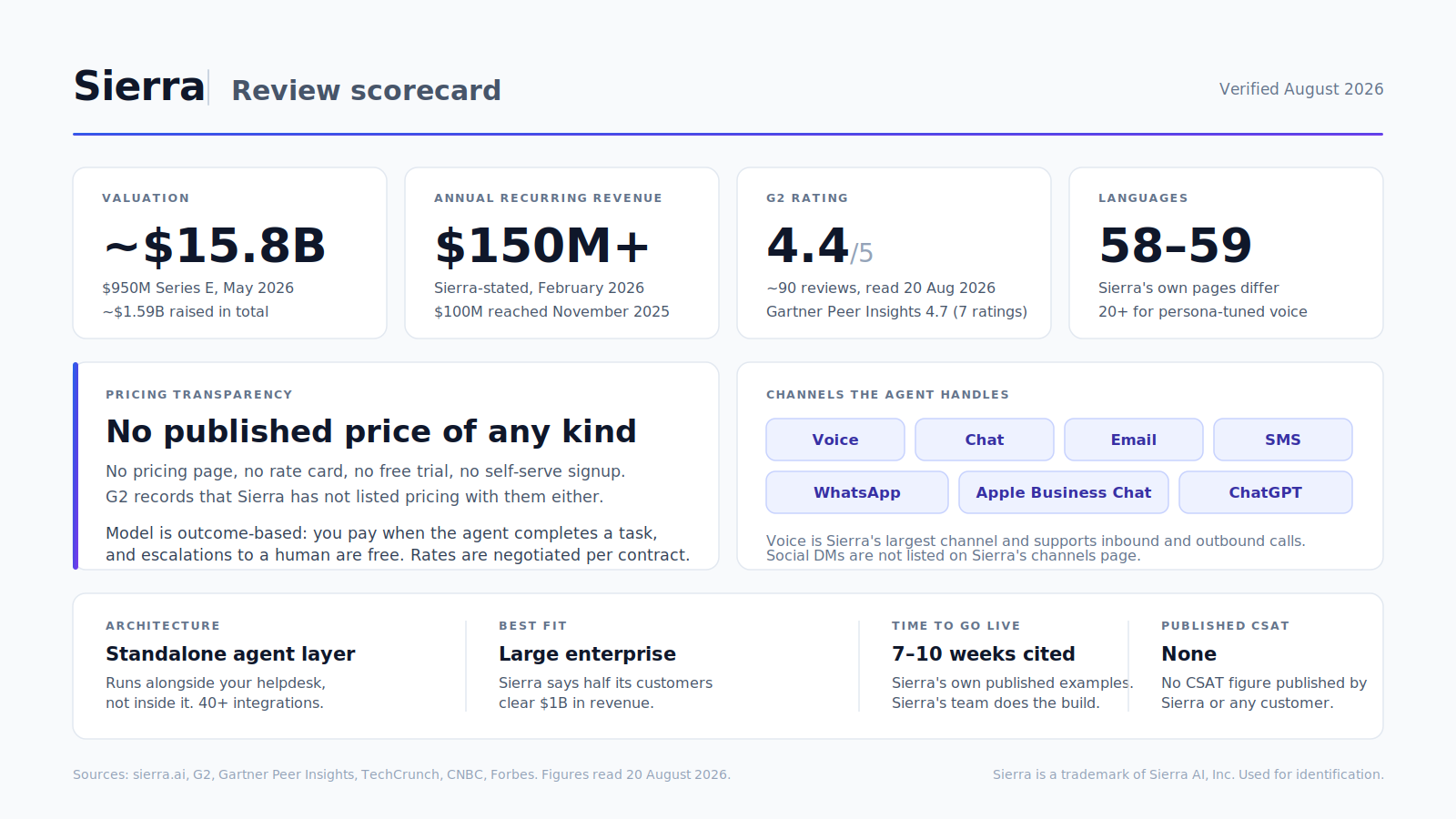
Sierra AI pricing is not published anywhere — no rate card, no calculator, no pricing page. What Sierra does publish is its model: you pay a pre-negotiated rate when the AI agent resolves a case, and nothing when it escalates to a person.
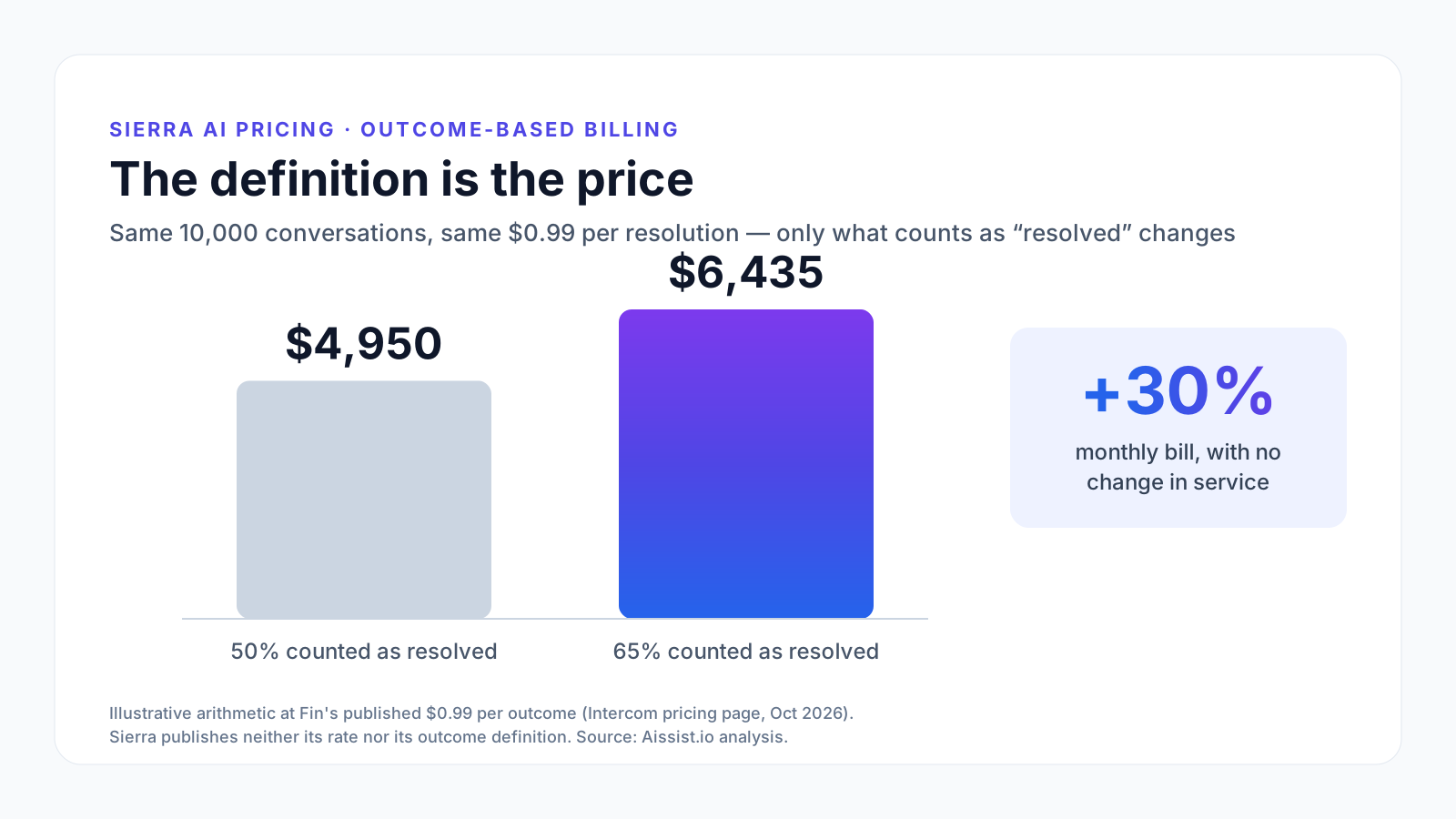
TL;DR: Sierra charges per outcome but publishes neither the rate nor the scoring rule, and the scoring rule moves the bill as much as the rate: at Fin's published $0.99, a 15-point shift in what counts as resolved adds 30%.
Methodology & sources
- Sierra's model: Sierra's outcome-based pricing post (Dec 2024) and CEO Bret Taylor's interviews.
- Billing rules and rates: Intercom, Zendesk, Salesforce, Decagon and Aissist.io documentation and pricing pages.
- Reported Sierra contract figures come from competitors' pages, named as such; none comes from Sierra.
- Worked examples assume a 60% resolution rate for every vendor so only the billing model differs.
- All figures verified October 2026. Disclosure: this is Aissist's blog, and Aissist sells AI agents priced per resolution.
Is Sierra AI pricing published, and what does it cost?
Sierra publishes no price for its AI agents; every contract is quoted through enterprise sales, and the per-outcome rate is negotiated per customer. What circulates online is estimates, and nearly all of it comes from companies that sell against Sierra.
The most-cited numbers come from Fin, Intercom's AI agent. Fin's Sierra pricing page (June 2026) estimates $150,000 to $750,000 a year in platform licensing plus $50,000 to $200,000 in implementation, attributed to unnamed "procurement data platforms." eesel AI's Sierra pricing guide (May 2026) gives no dollar figures at all, and Lorikeet's comparison (February 2026) says services can equal or exceed first-year licensing. Treat all three as competitor claims, because that is what they are.
What is verifiable is scale, not price. Salesforce Ben reported in August 2026 that Sierra reached $100 million in ARR in seven quarters. That is a vendor selling large contracts to large companies. "Contact sales" is not a price, but it is a strong hint about the size of one.
For the full product picture, see our Sierra AI review and the Aissist vs. Sierra comparison.
What does outcome-based pricing actually bill you for?
Outcome-based pricing bills a fixed, pre-negotiated rate each time the AI agent achieves an agreed result — usually a resolved conversation — and charges nothing when the case goes to a human. Sierra's own post lists resolved conversations, saved cancellations, upsells and answered questions as billable outcomes.
Bret Taylor, Sierra's co-founder and CEO, describes the support case plainly:
"For a customer service context, that means if the AI agent resolves the case, no human intervention, there's a pre-negotiated rate for that. If we do have to escalate to a person, that's free." — Bret Taylor, CEO, Sierra, on Cheeky Pint (March 2026)
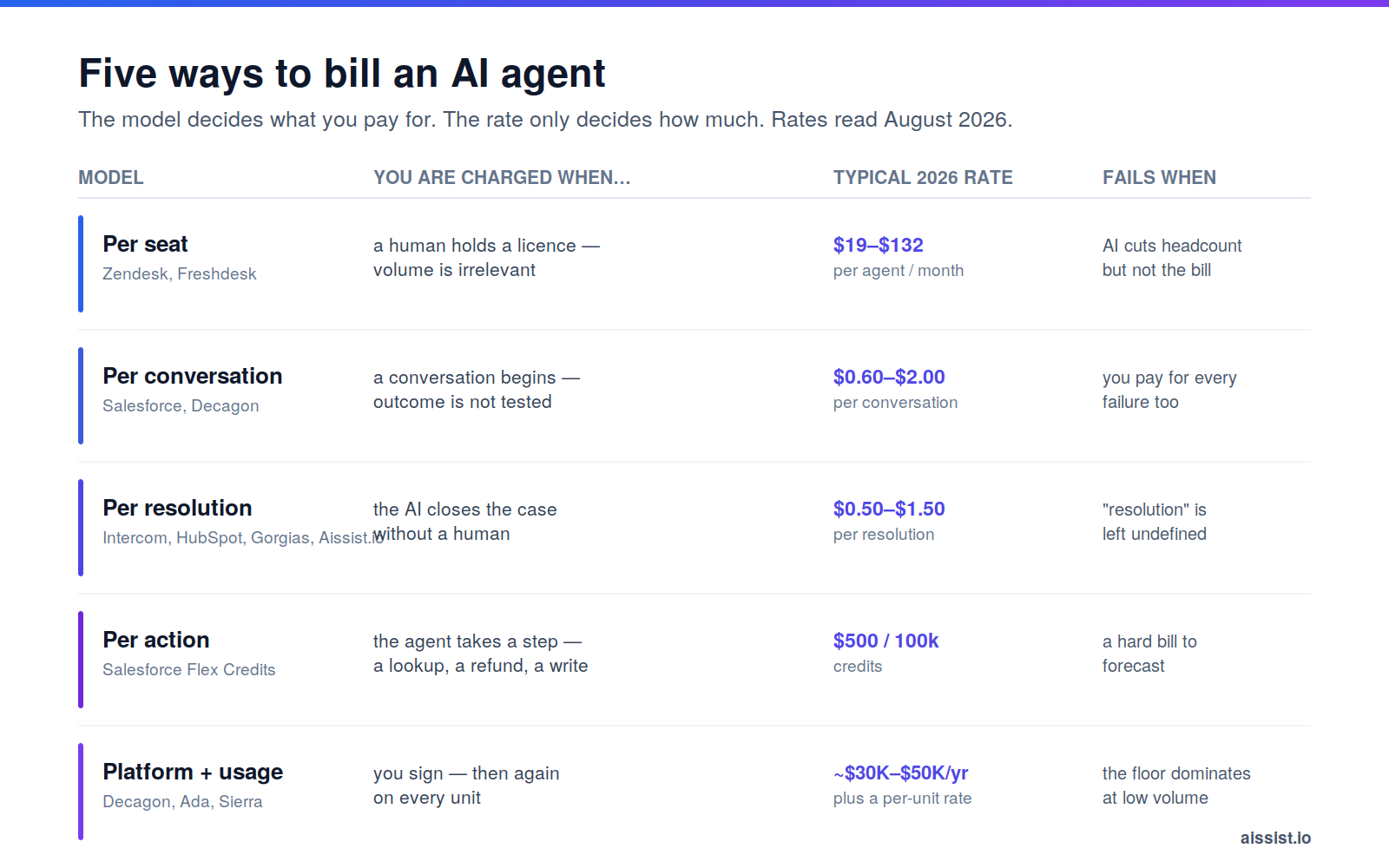
It is easiest to understand next to the other four models. Seat based pricing charges per human licence, like Intercom's $29–$132 per seat per month on its pricing page. Usage based pricing charges per unit consumed: Salesforce Agentforce bills $0.10 per action or $2 per conversation, per Salesforce's help article, and its pricing page adds $2 per Help Agent resolution. A flat platform fee charges the same every month — DigitalOcean launched Agent Droplets on 1 October 2026 at $50 or $200 a month.
Outcome-based pricing is the only one of the five where the billable unit is a judgement rather than a count. A seat, an action and a conversation can be counted. A resolution has to be decided. The question that matters is who does the deciding. Our guide to AI agent pricing models compares all five in depth.
Who decides what counts as a resolution?
In most per-resolution contracts the vendor decides what counts as a resolution — the same party that gets paid for each one. Sierra's post makes a promise:
"We provide clear, agreed-upon criteria for each outcome upfront, ensuring transparency and predictability in your billing." — Elliot Greenwald, Sierra blog (December 2024)
The criteria live in each contract, not in public. The vendors that do publish their rules show why that matters.
Intercom's Fin outcomes article bills an "assumed resolution" when the customer exits without asking for more help. Zendesk's resolution tiers article has an LLM read the transcript after the conversation closes — 72 hours for email, 2 hours for messaging — and decide. Neither is dishonest; both are published. But a customer who gives up and leaves looks a lot like a customer who got an answer.
Decagon, which defaults to per-conversation pricing, puts the problem in one line:
"If a frustrated customer stops responding, does that count as "resolved"? If the agent provides a trivial answer, should it cost the same as a major technical fix?" — Bihan Jiang, Director of Product, Decagon (December 2024)
| Vendor | Billing unit (Oct 2026) | Published rate | Who scores the unit | Reopened ticket | Escalated to human | Minimum commitment |
|---|---|---|---|---|---|---|
| Sierra | Per outcome; per conversation for routing | Not published | Criteria agreed per contract; method not published | Not published | "In most cases" no charge | Not published |
| Intercom Fin | Per outcome | From $0.99 | Intercom's published rules; assumed resolutions count | Deducted if customer returns to same conversation | Not billed if customer asks; Procedure handoffs billed | None stated |
| Zendesk AI agents | Per verified resolution | Not published | Zendesk's LLM after a 72h / 2h window | Not billed inside the window; after it, not published | Not billed | Requires Zendesk Suite |
| Decagon | Per conversation (default) or per resolution | Not published | Per conversation: no judgement needed | Not published | Billed per conversation; free per resolution | Not published |
| Salesforce Agentforce | Per action, per conversation, or per Help Agent resolution | $0.10 / action; $2 / conversation; $2 / Help Agent resolution | Count of actions or conversations | New actions billed | Actions already taken billed | $500 per 100,000-credit pack |
| Aissist.io | Per interaction, capped per resolution | $0.09 / interaction, cap $0.25–$0.60 | Aissist's published definition | Not published | Not charged | None; no contract |
A per-resolution price with a published definition is a fair deal. A per-resolution price with a private definition is a seat licence with extra steps.
What would 1,000, 10,000 or 50,000 contacts a month cost?
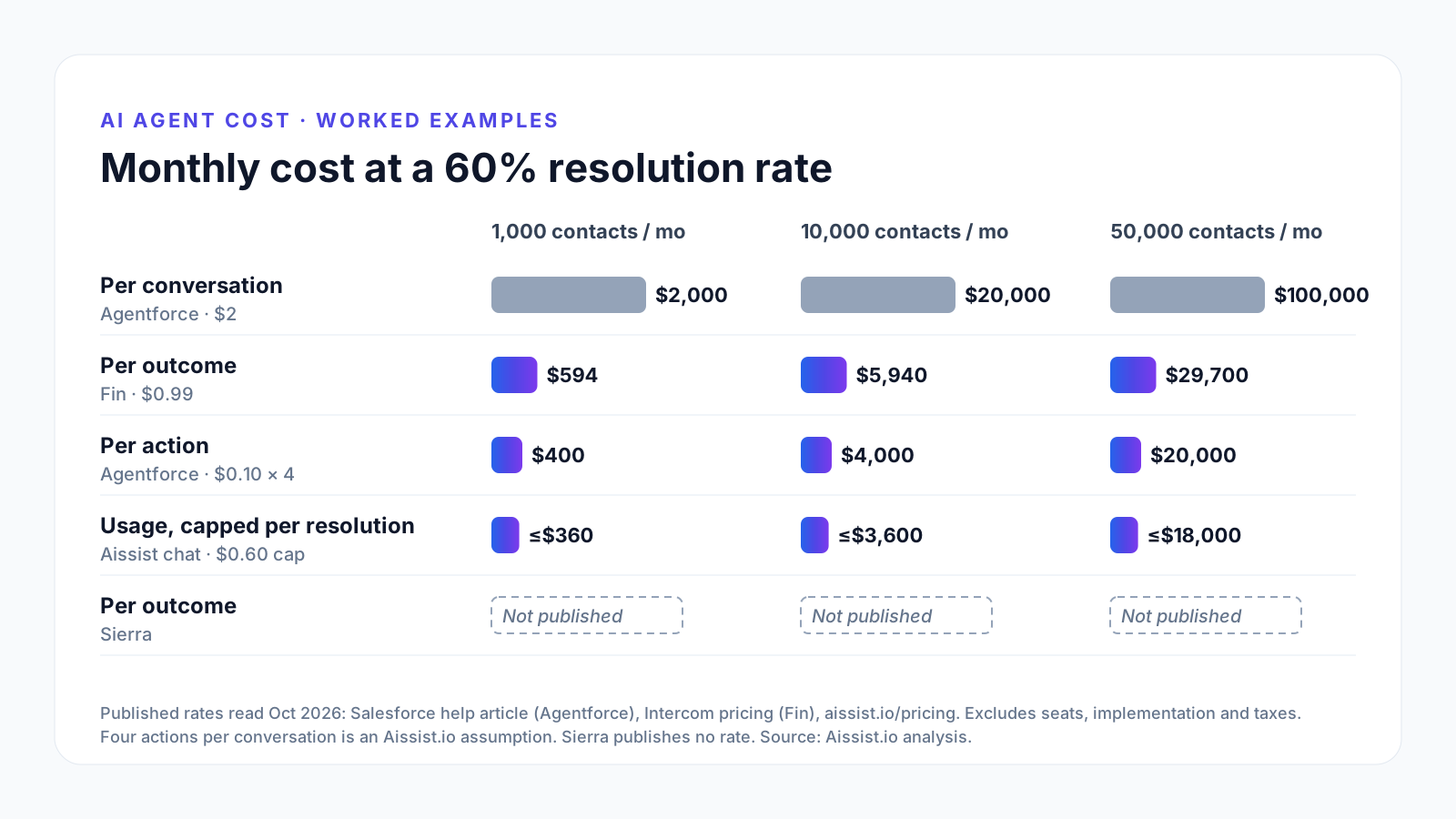
At a 60% resolution rate and 10,000 monthly contacts, published pricing ranges from about $3,600 to $20,000 a month, while Sierra cannot be calculated because no rate is public. The table holds the resolution rate fixed so the only variable is the billing model.
| Model (published rate, Oct 2026) | 1,000 contacts | 10,000 contacts | 50,000 contacts |
|---|---|---|---|
| Per conversation — Agentforce, $2 | $2,000 | $20,000 | $100,000 |
| Per outcome — Fin, $0.99 | $594 | $5,940 | $29,700 |
| Per action — Agentforce, $0.10 × 4 actions | $400 | $4,000 | $20,000 |
| Usage capped per resolution — Aissist chat, $0.60 cap | ≤$360 | ≤$3,600 | ≤$18,000 |
| Per outcome — Sierra | Not published | Not published | Not published |
Figures exclude helpdesk seats, implementation and taxes; the four-actions-per-conversation figure is our assumption, not Salesforce's.
Two things the table hides. First, a platform floor changes the arithmetic at low volume: at the low end of Fin's Sierra licensing estimate, $150,000 a year, a team handling 1,000 contacts a month would pay $12.50 per contact before a single outcome fee. Second, the definition is a price. At $0.99 and 10,000 contacts, counting 50% of conversations as resolved bills $4,950; counting 65% bills $6,435. Same customers, same answers, 30% more.
We ran the same audit on our own pricing page while writing this. It defines a resolution — no escalation, at least one genuine inquiry, chitchat excluded — but says nothing about a customer who comes back two days later. That gap is now on our list. To convert any quote into effective cost per resolution, try the price comparison tool.
What should you ask Sierra before you sign?
Ask for the outcome definition in writing, with the scoring method, the evaluation window and the reopen rule, before you negotiate the rate. The rate is the number everyone discusses. The definition is the number that compounds.
Put these seven questions in the RFP:
- What exactly is a billable outcome? Ask for the written definition, per outcome type.
- Who scores it, and how? Rules, an LLM, customer confirmation, or a mix.
- What happens if the customer returns? Name the window and whether the fee is refunded.
- Is an abandoned conversation billable? This is the assumed-resolution question.
- Which escalations are free? Sierra says "in most cases"; ask for the exceptions.
- Can we audit and dispute? You want transcript-level access to every billed outcome.
- What is the floor? Platform fees, minimums and services, each priced separately.
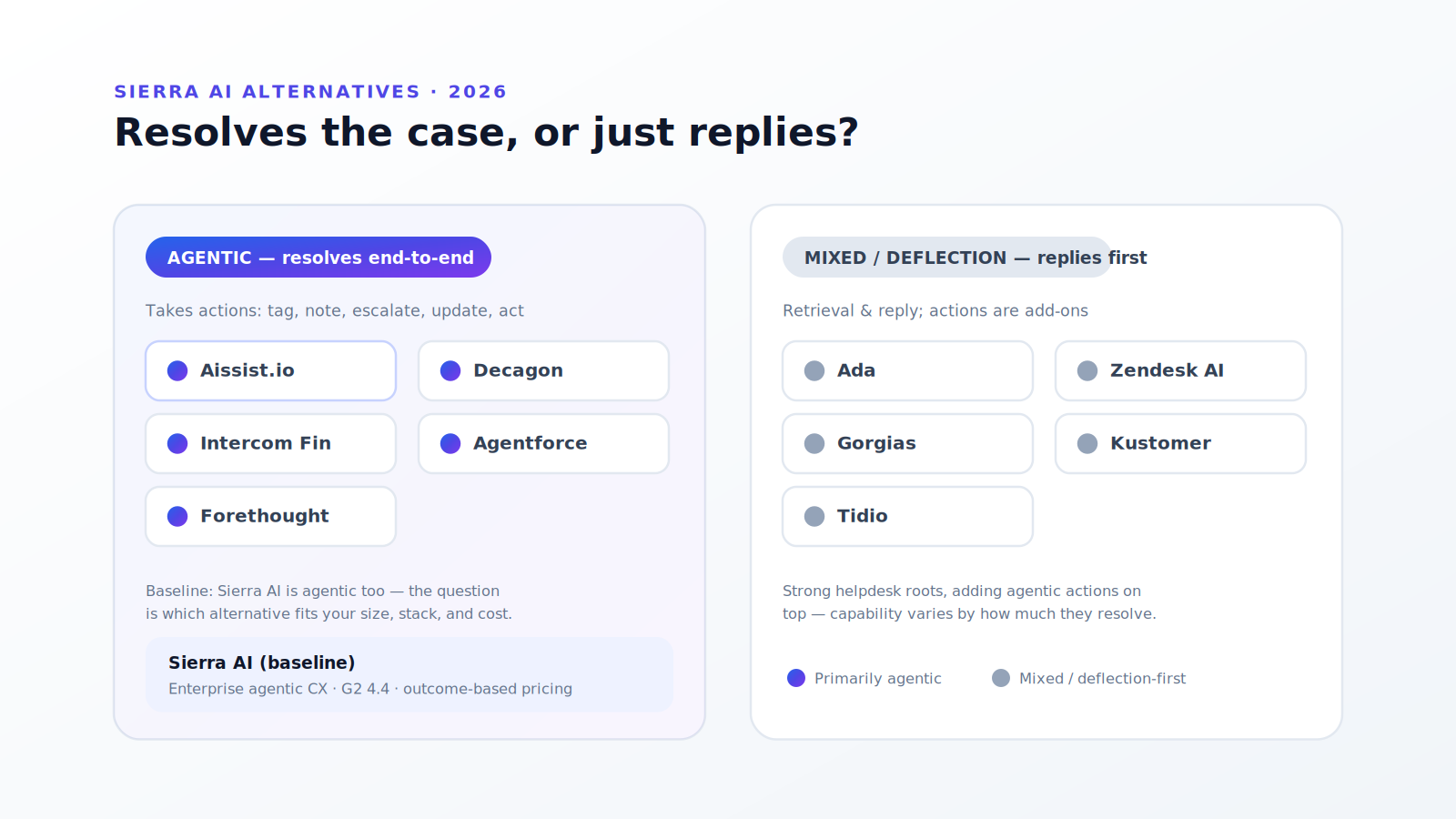
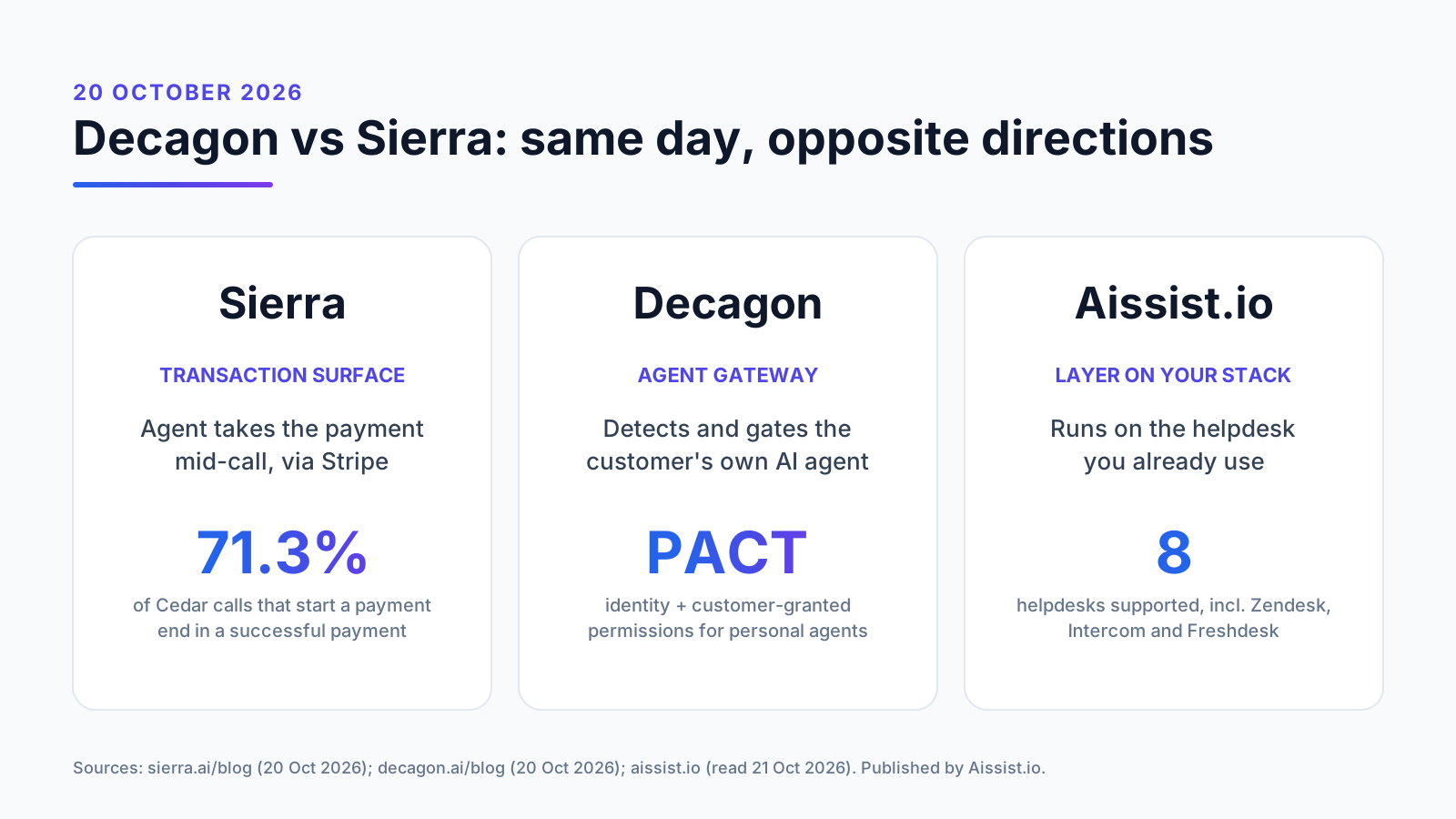
Lorikeet's pricing write-up says customers hold a veto on what counts as a resolution. Whether or not you buy from them, that is the right clause to ask everyone for. For shortlist options, see our Sierra AI alternatives and the three-way Decagon vs. Sierra vs. Aissist comparison; for published rates across 18 vendors, see the AI agent pricing benchmark.
Outcome-based pricing is only as honest as its definition
Sierra pioneered a genuinely better idea: pay for work done, not seats filled. But "pay per resolution" describes a contract shape, not a price. Until the definition, the scorer and the reopen rule are on paper, the per-outcome rate cannot be compared with anything.
Buy outcome-based pricing the way you would buy any commission plan. Read the definition first, model the bill at two or three resolution rates, and insist on the right to audit every billed outcome. The vendors worth trusting will hand over the arithmetic without being asked twice.
Want a per-resolution price with the definition in writing? Aissist publishes its rate, its resolution rule and its cap. See Aissist pricing →
Frequently asked questions
Does Sierra AI publish its pricing?
No. Sierra publishes its outcome-based pricing model but no rate card, pricing page, free trial or self-serve plan. Every contract is quoted through enterprise sales.
How much does Sierra AI cost per year?
Sierra does not say. Fin, a competitor, estimates $150,000 to $750,000 a year in licensing plus $50,000 to $200,000 for implementation, citing unnamed procurement sources. Treat it as a competitor estimate, not a quote.
What is outcome-based pricing for AI agents?
Outcome-based pricing charges a fixed fee each time an AI agent achieves an agreed result, such as a resolved conversation or a saved cancellation, and nothing when a case is escalated to a human.
Is outcome-based pricing cheaper than per-conversation pricing?
Often, because unresolved conversations cost nothing. At a 60% resolution rate, Fin's $0.99 per outcome costs about 30% of Agentforce's $2 per conversation; a higher rate or a looser definition narrows the gap.
Does Sierra charge for escalations to a human agent?
Sierra says that when a case needs escalating, "in most cases, there's no charge." It does not publish which cases are exceptions, so ask for them in writing.
What is the difference between usage based and seat based pricing?
Seat based pricing charges per human user each month, regardless of volume. Usage based pricing charges per unit of work — a conversation, an action or an interaction — so the bill follows volume rather than headcount.