Checked 17 Nov 2026 · every figure links to its primary source.
An AI customer service SLA should bind only what you can measure yourself. At 99.9% uptime that means about 43 minutes of downtime a month, plus latency per channel, error limits by severity and an exit with a date on it.
TL;DR: Only 17% of AI vendor contracts warrant the product works as documented, per Stanford CodeX, so contract only for what you can measure yourself: uptime, latency, error rate by severity, and a dated exit.
Methodology & sources
- Primary pages read this run: Maven AGI's AI SLA glossary (updated 5 Mar 2026), My AskAI's SLA guide (updated 5 Nov 2026), the AWS Compute SLA, the Stanford CodeX contract analysis (TermScout data, Mar 2025) and τ-bench.
- Severity thresholds are the contractual targets Aissist publishes on its AI Agent Reliability Benchmark 2026: signed limits, not observed averages.
- Downtime and ticket figures are our arithmetic on a 30-day month (43,200 minutes).
- Disclosure: this is Aissist's blog, and Aissist sells AI agents for customer service. Aissist publishes error thresholds but no uptime figure or service-credit schedule on its pricing page. Hold us to the same checklist.
What should an AI customer service SLA cover?
An AI customer service SLA is a contract setting measurable minimums for an AI agent's availability, response speed and error rate, with remedies when missed.
Most of the ranking definitions stop at uptime and latency. Those matter, but they describe a web service. An AI agent can be up, fast and wrong, and wrong is the expensive failure. So a complete SLA covers four things the buyer can check without asking the vendor's permission:
- Uptime: the share of the month the agent answers at all.
- Latency: how long a customer waits for each reply, per channel.
- Defect rate by severity: how often the agent makes an error, graded by business impact.
- Exit: a dated point where you can leave if the numbers miss.
Maven AGI's glossary gives the usual baselines: 99.9%+ uptime, replies under 2–5 seconds for chat and under 500ms for voice. It also lists resolution rate and accuracy as SLA metrics. The trouble is the definitions. Whoever defines "resolved" and "accurate" controls whether the SLA was met.
The test for every clause is simple: could your own team compute the number from logs you hold? If not, it is a promise, not a service level. Our evaluable AI guide makes the same argument for the product itself.
How much downtime does each uptime percentage allow?
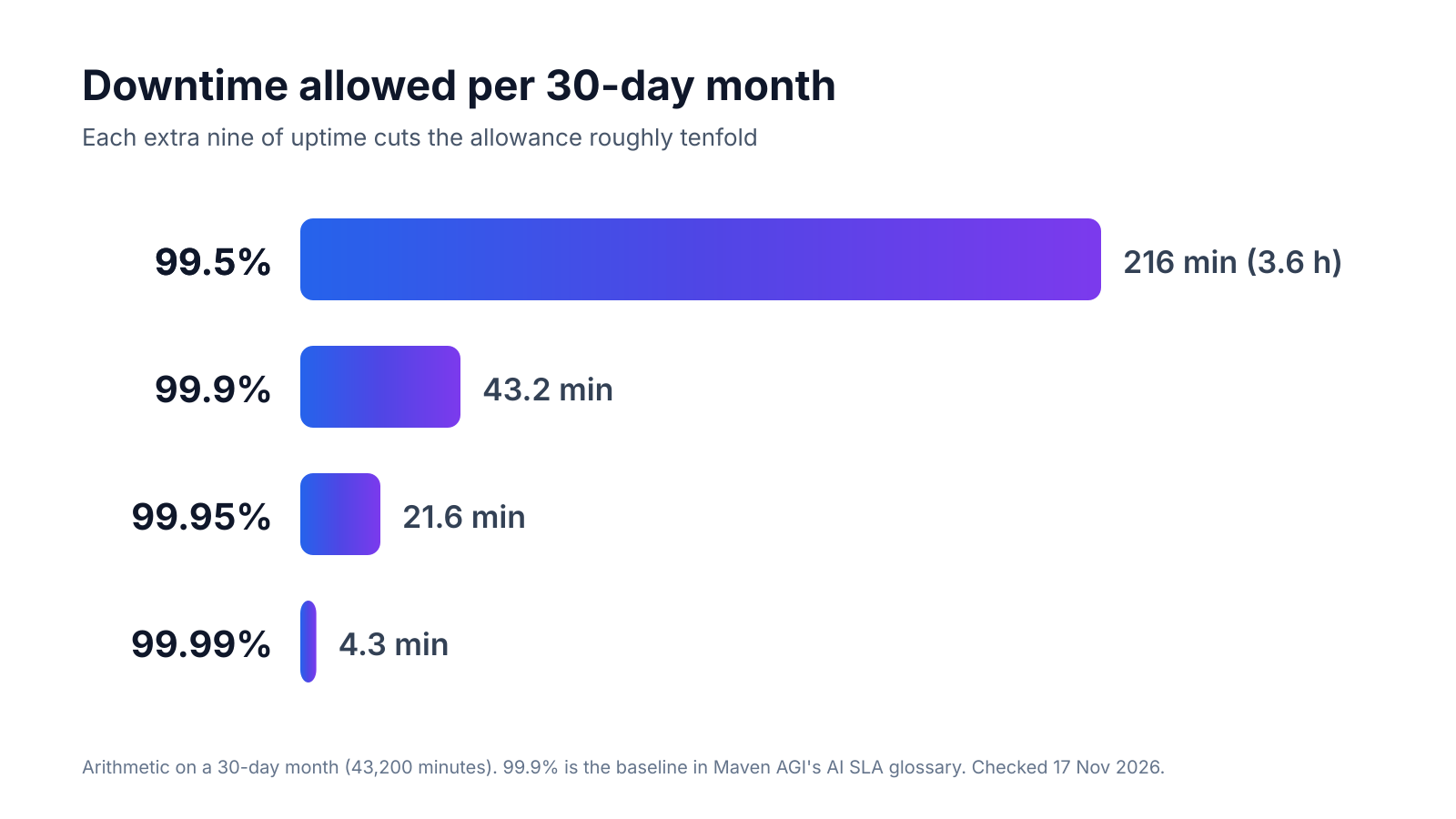
At 99.9% uptime, an AI agent can be down about 43 minutes in a 30-day month; at 99.99%, about 4 minutes. Each extra nine cuts the allowance by roughly ten.
| Uptime | Downtime per 30-day month | Tickets hit at 10,000/month* |
|---|---|---|
| 99.5% | 216 minutes (3.6 hours) | ~50 |
| 99.9% | 43.2 minutes | ~10 |
| 99.95% | 21.6 minutes | ~5 |
| 99.99% | 4.3 minutes | ~1 |
*Assumes tickets arrive evenly. They don't: outages have a gift for landing on launch day.
For what uptime to require from an AI vendor, 99.9% is the sensible floor for customer-facing chat and voice. It matches Maven's baseline and leaves room for scheduled model updates. Ask for 99.95% only if the agent is your only front door at night.
The percentage is half the clause. The other half is the credit. The AWS Compute SLA is a useful template: 10% back below 99.99% region uptime, 30% below 99.0%, and 100% below 95.0%. Credits rarely cover the cost of an outage, but a vendor that pays for downtime prices it in.
"100% is probably never the right reliability target" — Marc Alvidrez, author of "Embracing Risk," Site Reliability Engineering (Google)
That cuts both ways. A vendor promising 100% is not offering a measurement.
Why isn't a guaranteed resolution rate enough?
A guaranteed resolution rate protects little when the vendor defines "resolved," because the easiest way to hit the number is to make reaching a human harder. The metric then rises while customers fail.
My AskAI's SLA guide makes this point well. Its fix is an agreed definition of resolved, a test on your own tickets, and a review point. That is correct and incomplete: a definition you agreed to is still graded by the vendor's system unless you can see every conversation.
"That guarantee protects you less than it looks like it does." — Mike Heap, co-founder, My AskAI
The contract data agrees. The Stanford CodeX analysis of TermScout data found only 17% of AI vendor contracts warrant compliance with documentation, against 42% of SaaS contracts. Most AI vendors will not even promise the product does what the manual says.
"A significant oversight in AI vendor agreements is the scarcity of performance warranties." — Olga Mack, CodeX Affiliate, Stanford Law School
Aissist reports an 83% average resolution rate and 4.8/5.0 CSAT across its projects. Those are vendor-reported numbers, which is exactly why this article doesn't ask you to contract on them. Track resolution in your own helpdesk and use it to decide renewal; keep the SLA for numbers no one can redefine.
How should an SLA grade AI errors by severity?
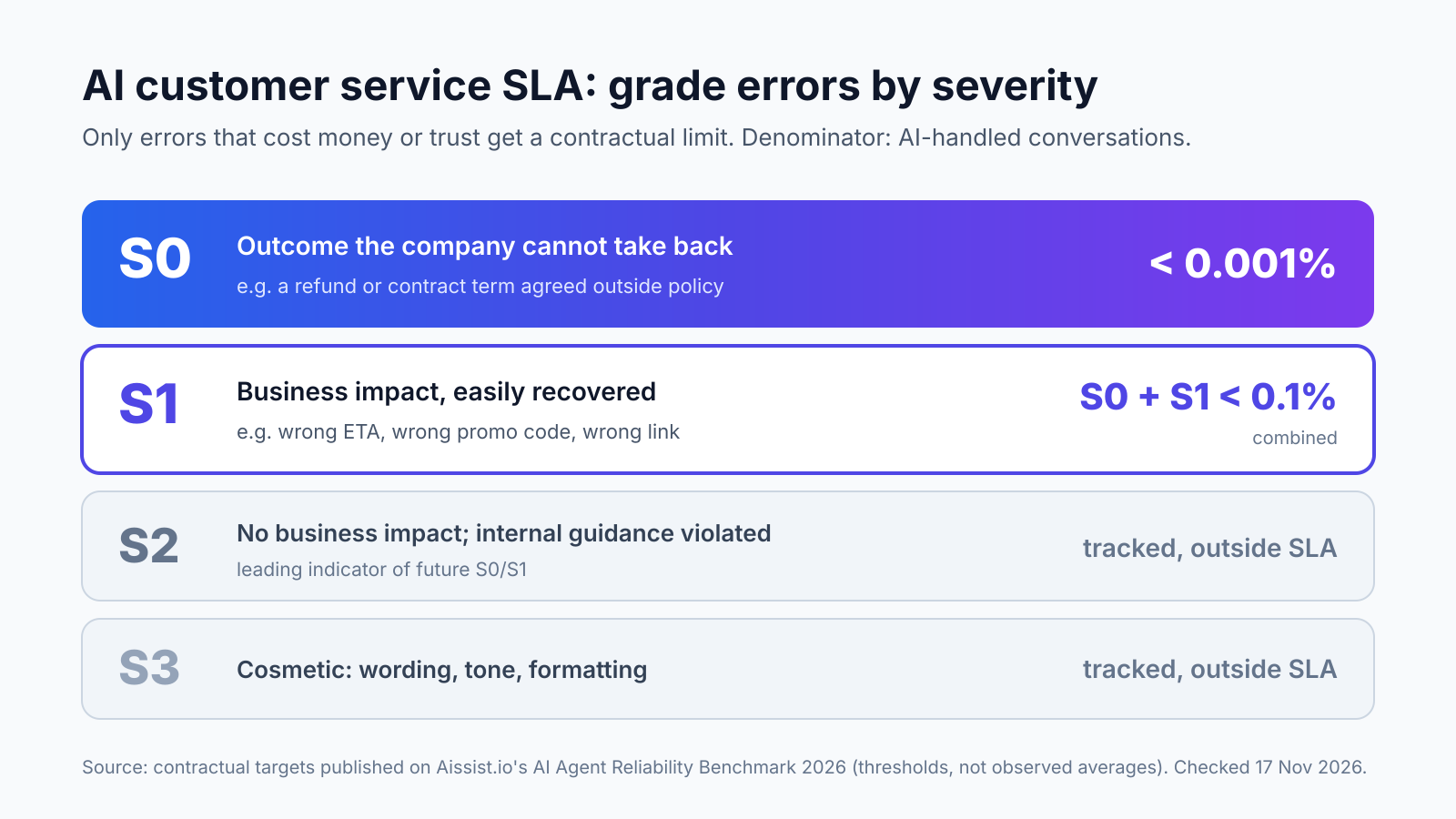
An SLA should grade AI errors by business impact, count them per conversation, and put contractual limits only on errors that cost money or trust. A blended "accuracy rate" hides a refund promised in error inside a thousand typos.
Aissist's published scale has four levels. The definitions and targets below are the ones on its reliability benchmark; the Remedy and Who-declares-it columns are what we recommend any buyer write in.
| Severity | Definition | Target | Remedy | Who declares it |
|---|---|---|---|---|
| S0 | Changes a business outcome the company cannot simply take back (e.g. an out-of-policy refund) | < 0.001% of AI-handled conversations | Incident report within agreed hours; root-cause fix; credit or exit right if breached | Buyer, from the transcript |
| S1 | Business impact, but the customer or the business recovers easily (e.g. wrong ETA, wrong link) | S0 + S1 combined < 0.1% | Monthly credit if breached two months running | Buyer, vendor may contest within a set window |
| S2 | No business impact; internal guidance violated (e.g. skipped verification) | Tracked, outside SLA | Reported monthly as a leading indicator | Vendor audit, buyer-sampled |
| S3 | Cosmetic: wording, tone, formatting | Tracked, outside SLA | Fixed in normal releases | Vendor audit |
Two details make the table enforceable. The denominator is conversations, not messages, because a message count inflates volume and flatters the rate. And the buyer declares S0 and S1, since a rate graded by the model that produced the output is a self-graded exam.
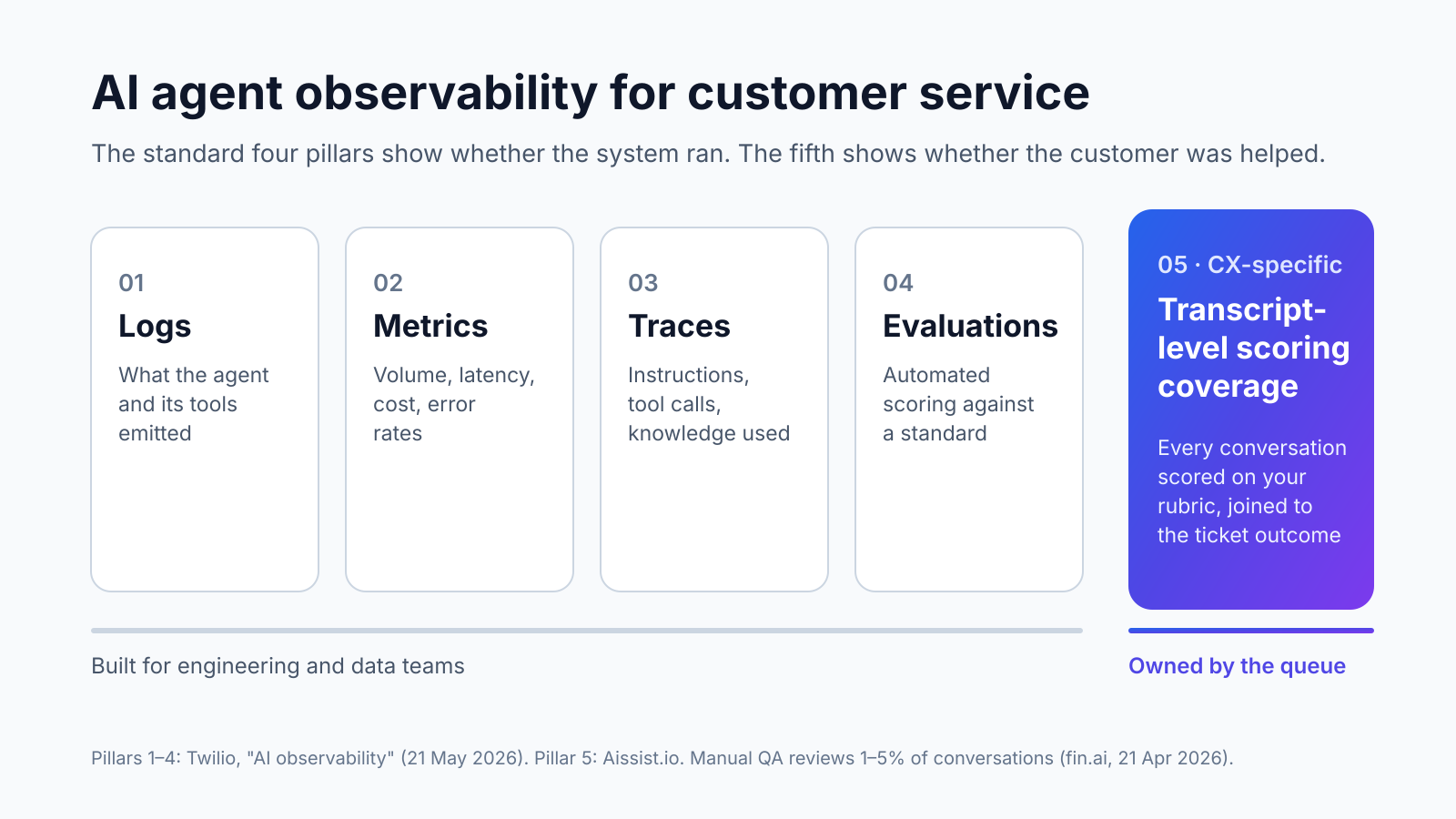
Repeatability is why this matters. The τ-bench study found leading agents "are quite inconsistent (pass^8 <25% in retail)" when given the same task eight times. Severity limits put a ceiling on that inconsistency. For the grading machinery, see AI agent observability.
What are the seven clauses to put in the contract?
Put seven clauses in an AI support vendor SLA: uptime, latency, severity limits, a resolution definition, incident notice, data access and a dated exit. Each is measurable on data you hold.
- Uptime with credits. 99.9% monthly minimum, tiered credits on the AWS pattern, claim window of at least 30 days.
- Latency per channel. A p95 (95th-percentile) reply time for chat and a separate, tighter one for voice. Maven's under-500ms voice figure is the benchmark to negotiate from.
- Severity limits. S0 and S0+S1 thresholds, conversation denominator, buyer declares severity.
- A resolution definition you write. Escalations and repeat contacts within a set window are not resolutions and are not billed as resolutions.
- Incident notice in hours. A stated notification window for S0 errors and outages, plus a written post-incident report. Our incident reporting guide has a template.
- Data access. Full transcript, action-log and configuration export on demand, so every number above can be recomputed.
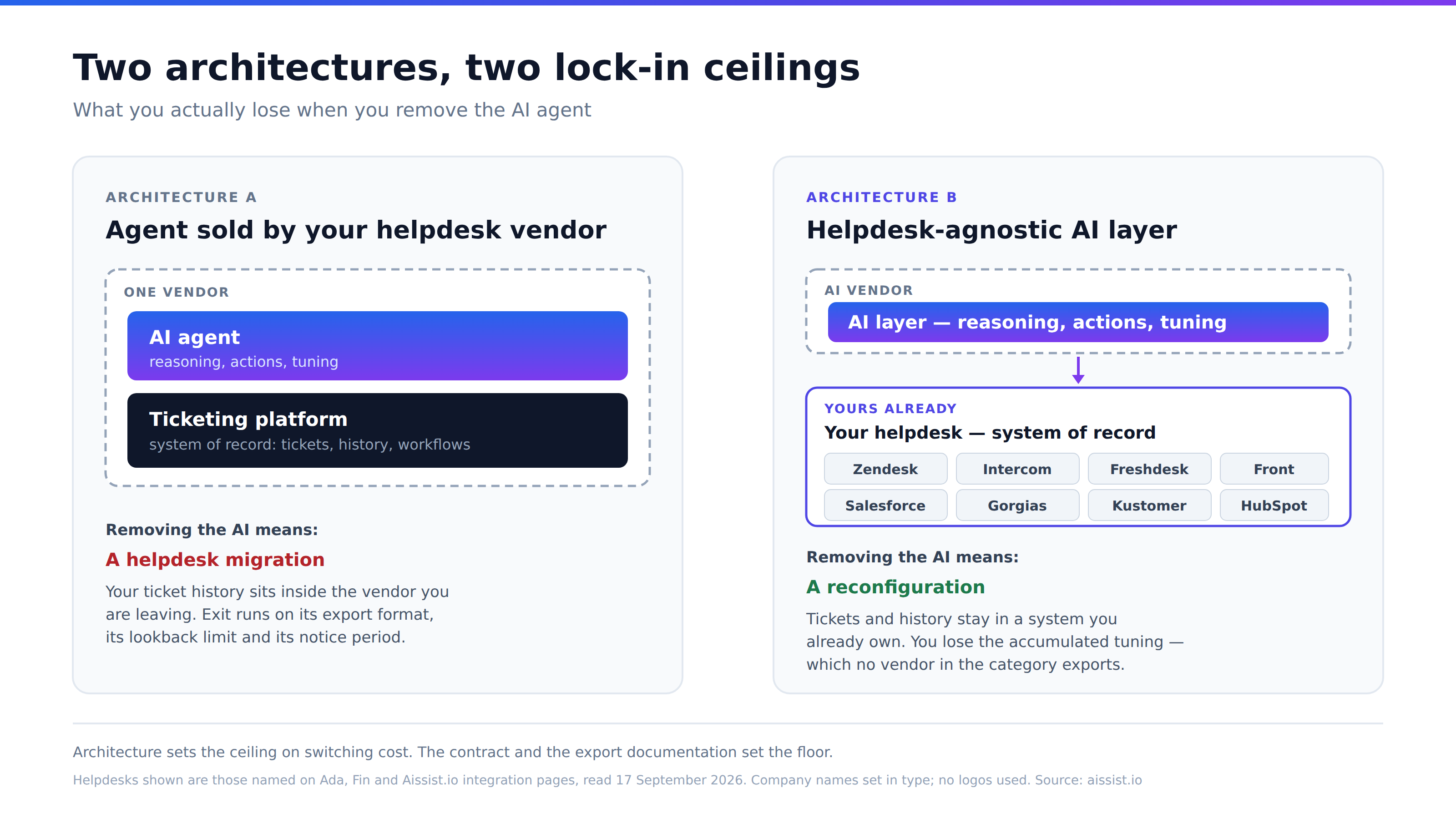
- The exit clause. A named date, such as day 90, when you can terminate without penalty if clauses 1–3 missed in any two months, with export delivered within a set number of days. Without a date, an exit clause is a mood. See vendor lock-in.
Each clause maps to questions in our AI agent RFP question bank, so you can ask before you sign.
The SLA that binds is the one you can measure yourself
An AI customer service SLA has two kinds of terms: ones you can check and ones you have to believe. Uptime, latency, severity-graded defect rates and a dated exit are the first kind. A resolution guarantee the vendor grades is the second kind, however large the number.
So negotiate the checkable terms hard, keep your own resolution tracking for renewal, and insist on the data export that makes every number recomputable. If a vendor won't sign the S0 line, you have learned what you needed to. For how reliability gets engineered rather than promised, see reliable AI.
Frequently asked questions
What uptime should I require from an AI vendor?
Require at least 99.9% monthly uptime for a customer-facing AI agent, which allows about 43 minutes of downtime in a 30-day month. Ask for 99.95% if the AI is your only after-hours channel.
What latency should an AI voice agent SLA specify?
Specify a 95th-percentile reply time per channel. Maven AGI's glossary lists under 500ms for voice and under 2–5 seconds for chat as standard; voice needs the tighter target because callers hear silence.
Should an AI customer service SLA include financial penalties?
Yes, as tiered service credits tied to measurable terms such as uptime and S0 error limits. Credits rarely cover losses, so pair them with a termination right that triggers after repeated misses.
What is an S0 error in an AI agent SLA?
An S0 error changes a business outcome that cannot be taken back, such as an out-of-policy refund or contract term. It warrants the tightest limit and an incident report.
Is there an AI support SLA template I can use?
Use the seven clauses above as the template: uptime with credits, latency per channel, severity limits, a buyer-written resolution definition, incident notice, data access and a dated exit clause.
Should I put a resolution rate guarantee in the contract?
Only with a definition you write and data you can audit. Otherwise the vendor grades its own exam; track resolution yourself and use it at renewal.