Most AI agent observability tooling is built for the engineer who reads a span, not the support manager who reads a transcript. G2's AI Agent Observability category lists 55 products and names "engineering and data teams" as the audience; this guide covers AI agent observability for customer service from the queue owner's side.
TL;DR: Customer service failures that cost CSAT pass every log check, and human QA sees only 1–5% of conversations (fin.ai), so AI agent observability must score every transcript and join it to the ticket's outcome.
Methodology & sources
- Category data: G2's AI Agent Observability (55 products) and Contact Center AI Observability (13 products) pages, and G2's May 2026 new-categories announcement.
- Definitions and frameworks: Twilio (published 21 May 2026), fin.ai (21 April 2026), Decagon's glossary, Sierra's blog.
- Metric formulas and ranges: Aissist's KPI, containment-rate and benchmark pages, which synthesise published third-party sources. Coverage figures for manual QA are as stated by fin.ai and The Next Web, neither of which names an underlying study.
- All figures verified 2 November 2026. Disclosure: this is Aissist's blog. Aissist sells AI agents for customer service and Agent Insight, a QA scorecard product.
What is AI agent observability?
AI agent observability in customer service is the practice of scoring every AI conversation against its ticket outcome so that failures surface before customers complain.
Observability differs from QA in scope: QA grades a sample of conversations, while observability scores every conversation and explains why outcomes changed.
Generic definitions stop one step short. Twilio's AI observability guide, the current top result, describes AI observability as monitoring AI models and agents in production, organised into four components: logs, metrics, traces and evaluations. That is correct, and incomplete for a support team. A trace shows which tool the agent called. It does not show that the customer came back two days later with the same refund question, because that outcome lives in the helpdesk, not the model log.
The sampling gap is why this matters now. fin.ai's monitoring guide puts human QA coverage at 1–5% of conversations, and The Next Web's coverage of Solidroad's Series A describes 1–3% as the industry norm. Judging an AI agent on a 2% sample is like reviewing a novel from its back cover.
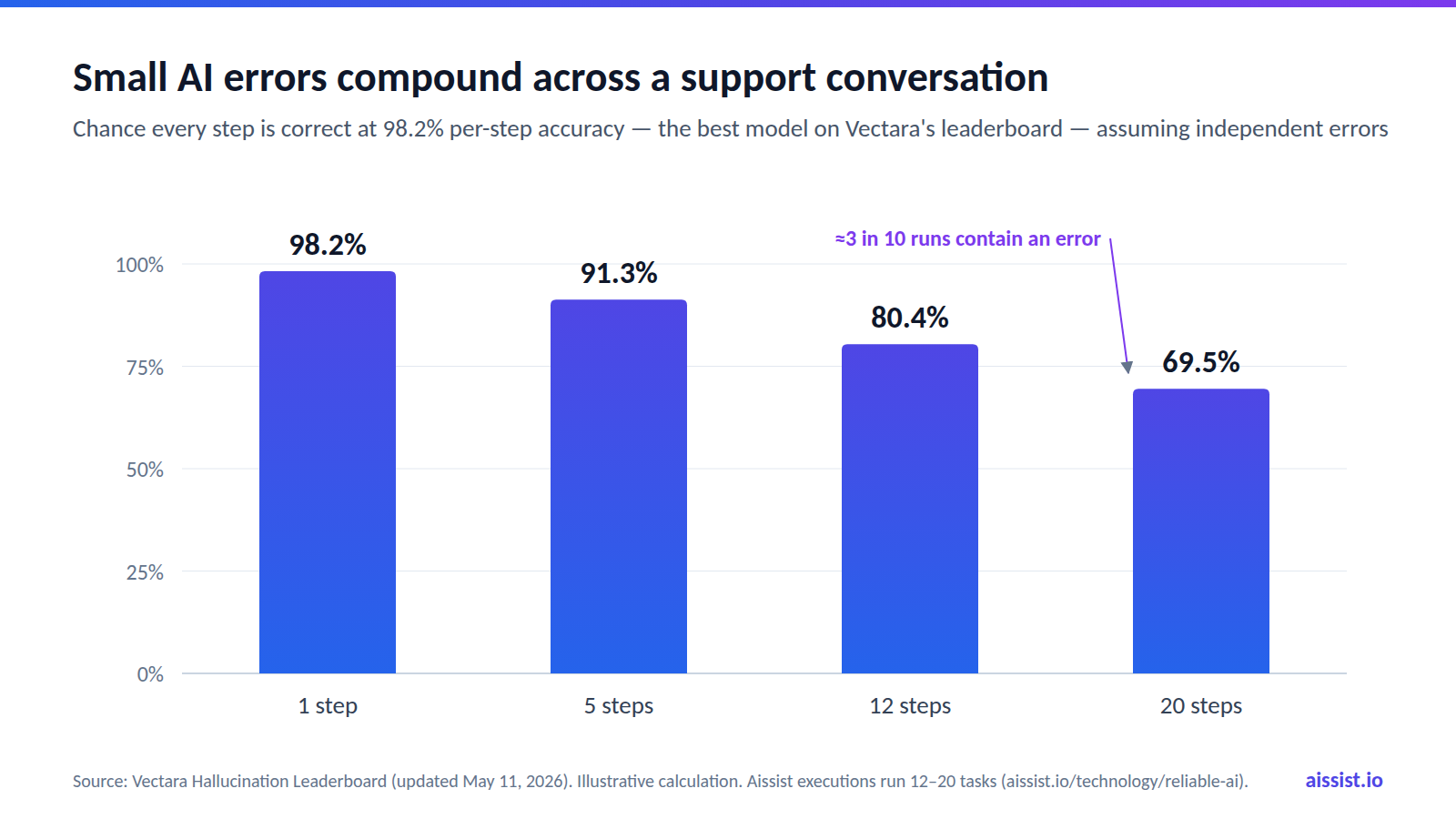
An AI agent compounds the problem. It answers thousands of conversations with the same instructions, so a single bad policy article becomes thousands of bad answers before anyone opens the sample.
Why do generic AI agent monitoring tools miss customer service failures?
Generic AI agent monitoring tools miss customer service failures because they watch system health, and the failures that cost CSAT pass every system check. G2 introduced its AI Agent Observability category in May 2026; the leaders on its Grid, including LangSmith, Braintrust and Arize AX, are built for people who debug prompts. G2 runs a separate Contact Center AI Observability category, with 13 products, whose inclusion criteria require automation metrics such as containment and escalation trends.
Decagon's glossary calls the core problem silent agent drift: gradual degradation in an agent that still passes every uptime, latency and error-rate check. The entry cites an April 2026 AgentMarketCap estimate of a 15–30% silent regression rate for under-monitored production agents. A green dashboard and an agent quietly misquoting the refund policy are fully compatible.
"But that same adaptability makes them harder to evaluate." — Colin VanLang and Darshdeep Hora, Sierra, on agent monitoring
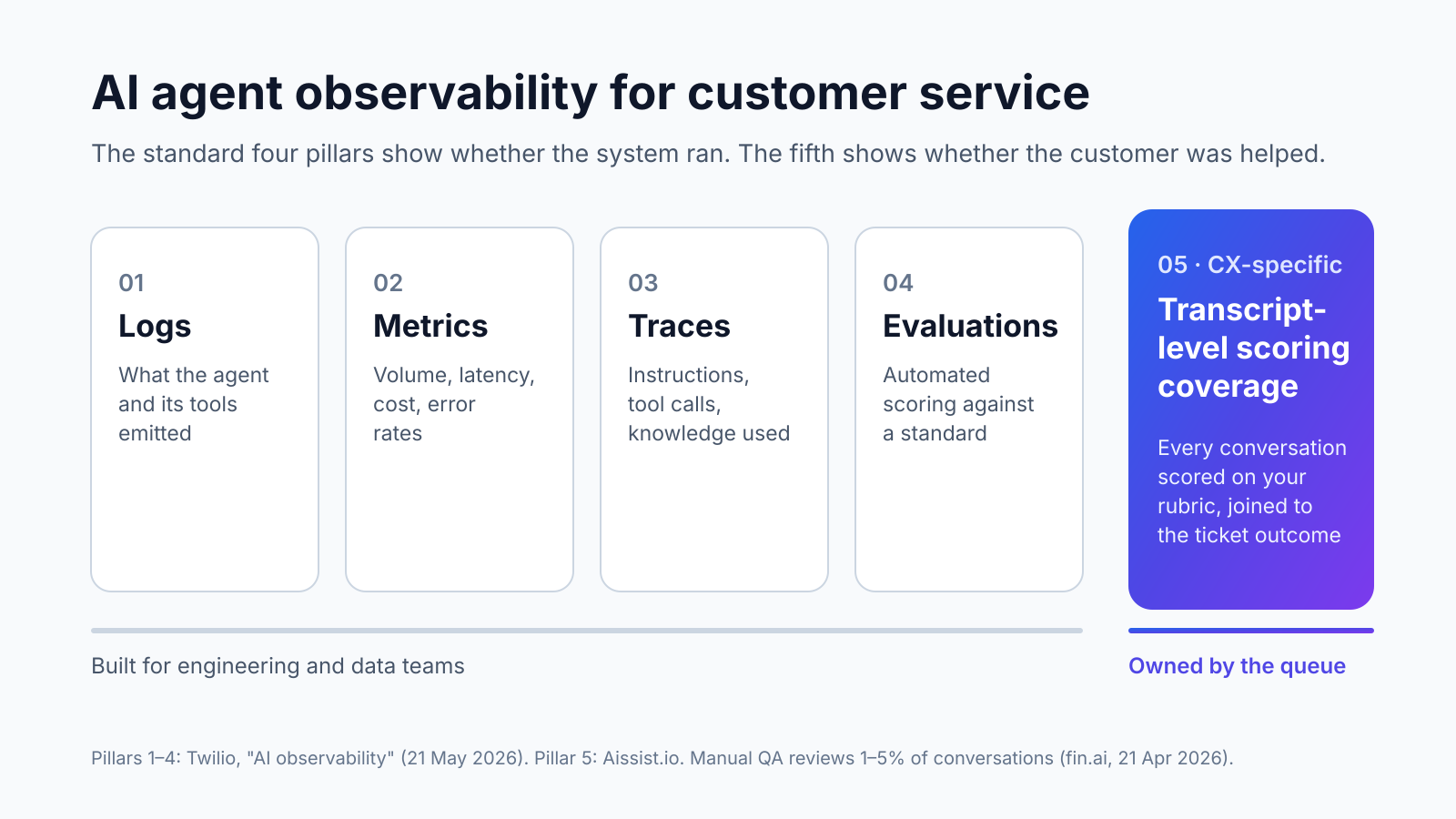
The fix is a fifth pillar on top of the standard four:
- Logs — what the agent and its tools emitted.
- Metrics — volume, latency, cost and error rates.
- Traces — each step behind a reply: instructions, tool calls, knowledge lookups.
- Evaluations — automated scoring of outputs against a standard.
- Transcript-level scoring coverage — the share of real customer conversations scored against your own QA rubric and joined to the ticket's outcome.
The first four tell you whether the system ran. The fifth tells you whether the customer got helped.
Which AI agent observability metrics should a support team track?
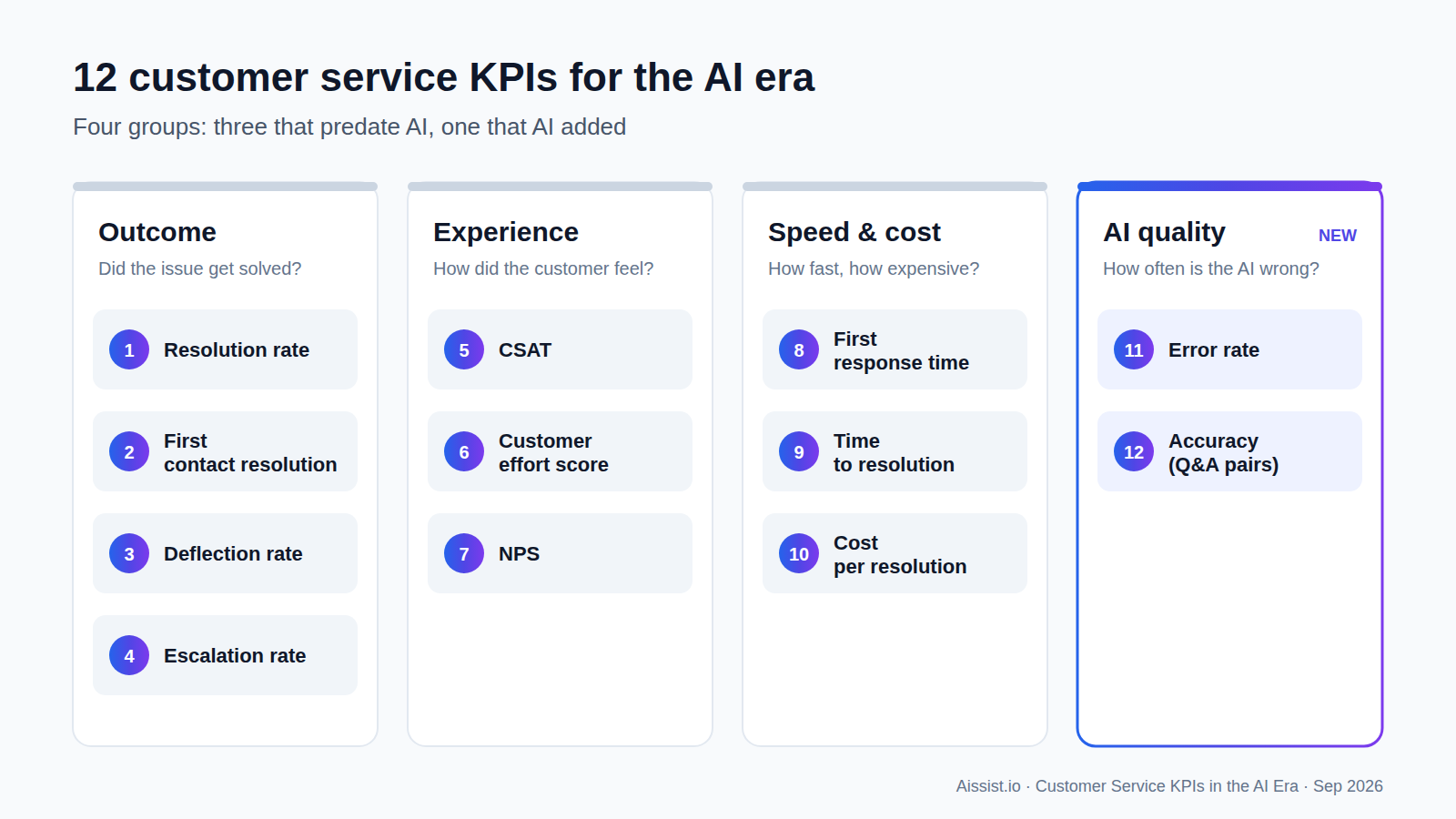
A support team should track six metrics for its AI agent: resolution rate, containment rate, repeat-contact rate, escalation rate, AI CSAT and scoring coverage. Each needs a written formula, because every one can improve without a single extra customer being helped. Formulas and ranges come from Aissist's customer service KPI guide and containment rate analysis unless noted.
| Metric | Formula | What it tells you | Healthy range | Common way it gets gamed |
|---|---|---|---|---|
| Resolution rate | Requests completed with no re-contact in 7 days ÷ conversations that entered the AI | Whether customers were actually helped | 40–84% by industry (Aissist 2026 benchmark, a synthesis of 40+ published sources) | Dividing by "eligible" conversations only |
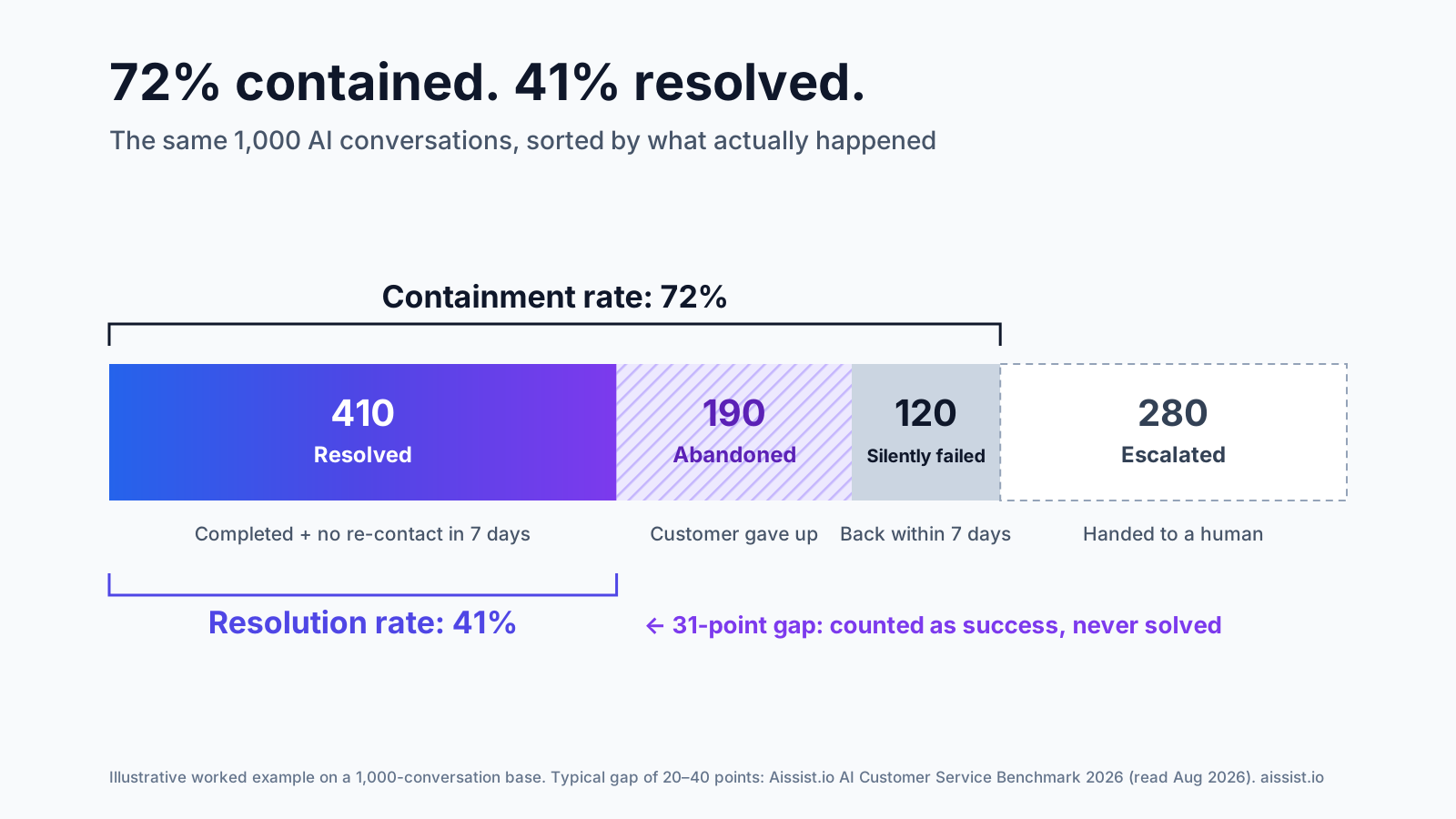
| Containment rate | Conversations ended without a human handoff ÷ conversations that entered the AI | Whether the AI kept the conversation, not whether it solved it | Typically 20–40 points above resolution rate | Hiding the handoff option or auto-closing idle chats |
| Repeat-contact rate | Same customer, same intent, back within 7 days on any channel ÷ AI-closed conversations | Silent failures that containment logs as success | No cross-vendor benchmark; track your own trend | Matching repeats on one channel only |
| Escalation rate | Conversations handed off or flagged ÷ AI-handled conversations | Where the agent's limits sit | No numeric benchmark; read it beside resolution | Penalising escalations until the agent stops making the right ones |
| AI CSAT | 4–5 ratings ÷ all ratings on AI-handled conversations | How the experience felt | 80%+ is good; AI typically runs 5–10 points below human | Surveying only contained conversations |
| Scoring coverage | Conversations auto-scored against your rubric ÷ all conversations | How much of the queue you can see | Manual QA reaches 1–5% (fin.ai); automated scoring should reach 100% | A rubric that only checks the greeting |
Averages hide the damage. Aissist's self-evolve explainer offers an illustration: an 80% overall resolution rate can conceal a refund-exception category at 35% while order status runs at 95%. Segment every metric by intent, channel and language, or the average will tell you a comforting story.
How do you detect agent drift before it shows up in logs?
Agent drift shows up first in transcripts and customer behaviour, as falling scores in one intent, rising repeat contacts and slipping CSAT, and only later, if ever, in logs. Decagon's glossary recommends scoring live conversations daily, replaying a fixed test set on a schedule and tracking how often humans override the AI by topic. For a support manager, that becomes a weekly conversation trace review.
Each week, pull these conversations and their traces:
- The 20 lowest-scoring conversations in each high-volume intent.
- Every conversation followed by a repeat contact within 7 days.
- Escalations where the agent sounded confident right before handing off.
- New or rising intents the rubric has not seen before.
- Anything touching refunds, cancellations or regulated disclosures.
"The real power of Agent Traces is that they answer why." — Sachi Shah, Sierra, "Agent Traces"
The why is where transcript and trace meet. The score says the refund answer was wrong; the trace shows the agent pulled last quarter's policy article. Together they form the support AI audit trail: what the customer asked, what the agent decided, and what happened next.
That join is also how an evaluation score connects to the ticket's real outcome. Store the score on the ticket, then compare it with the reopen, repeat-contact and CSAT fields on the same record. If high scores do not predict good outcomes, the rubric is measuring politeness, not resolution. Aissist's Agent Insight scores every AI and human conversation on a rubric the customer defines and feeds the results into Pulse™.
How mature is your AI agent observability?
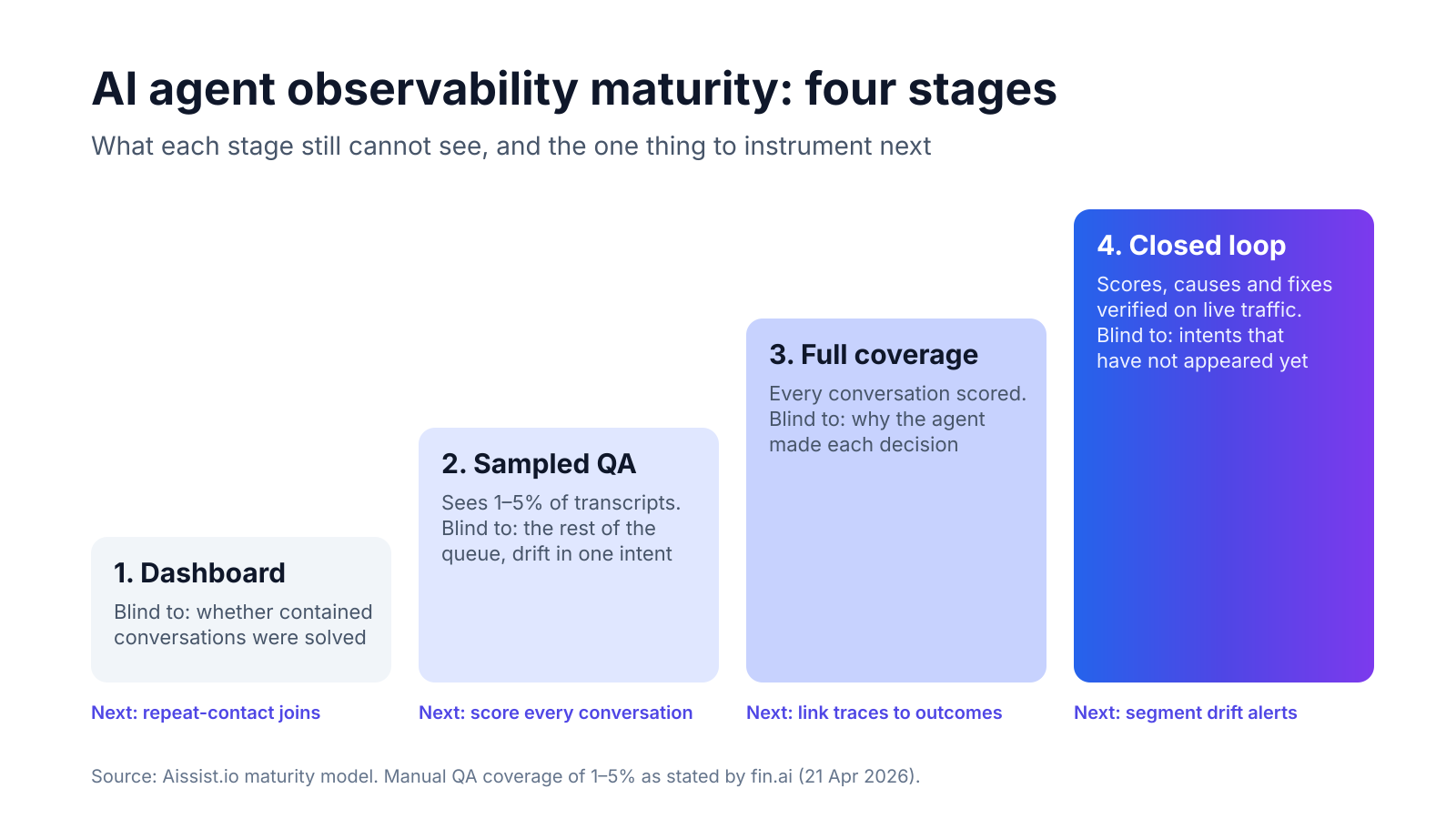
Most support teams sit at stage one or two of four: they can see containment and a small sample of transcripts, but not why outcomes change. Find your stage below, then instrument the column on the right.
| Stage | What you can see | What you cannot see | What to instrument next |
|---|---|---|---|
| 1. Dashboard | Volume, containment, average CSAT | Whether contained conversations were solved | Repeat-contact joins to the ticket |
| 2. Sampled QA | 1–5% of transcripts, scored by humans | The rest of the queue, and drift inside one intent | Automated scoring of every conversation |
| 3. Full-coverage scoring | Every conversation scored against your rubric | Why the agent made each decision | Traces linked to scores and ticket outcomes |
| 4. Closed loop | Scores, causes and fixes verified on live traffic | Intents that have not appeared yet | Segment-level drift alerts and new-intent detection |
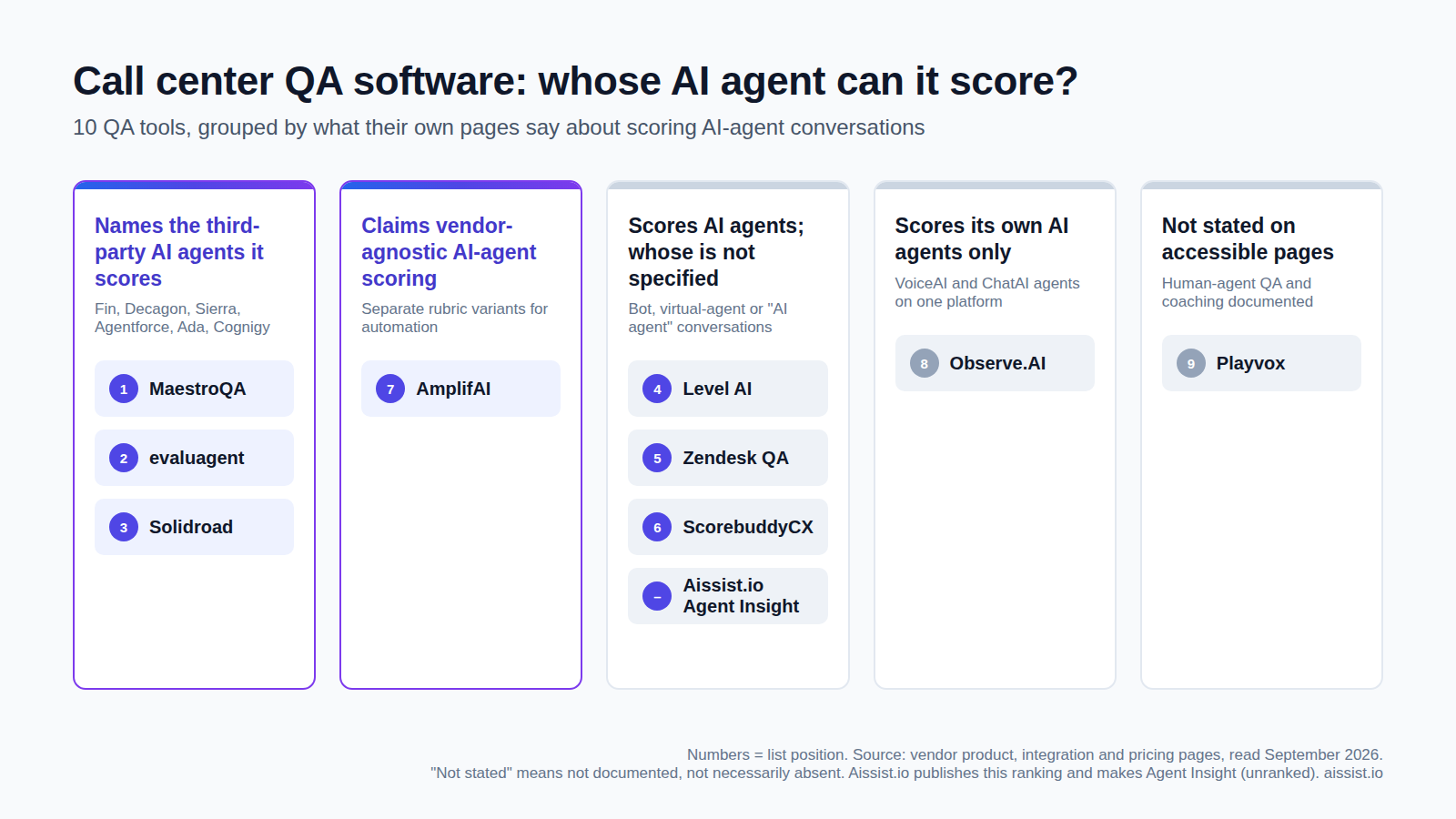
Moving up a stage should not mean adopting an engineering platform your team cannot run. A call center QA platform can carry a team to stage two; stage three needs scoring built for AI-handled transcripts.
"With the previous vendor, at least half my week was dedicated to maintaining their system." — Ian Riggins, Senior Operations Manager, Duolingo, quoted by Decagon
Upkeep is the hidden cost. If the person who owns the queue cannot change the rubric without filing a request with engineering, the tool ends up watched by the wrong person.
Observability belongs to whoever owns the queue
AI agent observability for customer service is a support discipline that borrows engineering tools, not the other way round. Logs, metrics, traces and evaluations keep the system running; transcript-level scoring joined to ticket outcomes shows whether customers were helped. Write formulas for the six metrics, segment them by intent and run the weekly trace review. Then find your stage in the maturity table and instrument the next one. The aim is simple: the support manager hears about a failing agent from the dashboard, not from a customer.
See every conversation, not a 2% sample. Agent Insight scores AI and human agents on your own QA rubric. See how Agent Insight works →
Frequently asked questions
What is AI agent observability?
AI agent observability is the ability to see what a deployed AI agent did, why it did it, and whether the result was right. In customer service, that means scoring conversations and linking them to ticket outcomes such as repeat contacts and CSAT.
How is AI monitoring different from QA?
AI monitoring tracks every conversation continuously against system and outcome metrics, while traditional QA has humans grade a small sample, 1–5% of conversations according to fin.ai. Automated QA scoring is now one input into monitoring rather than a separate activity.
What is the most important metric for an AI support agent?
Resolution rate, measured as requests completed with no re-contact within 7 days, is the most important single metric. Read it beside repeat-contact rate and AI CSAT, because containment can rise while customers are failed.
How often should AI agent performance be monitored?
Automated scoring and alerts should run continuously, with daily segment checks on high-volume intents. A person should review a targeted sample of traces weekly and re-check results after every prompt, policy or model change.
What tools do you need for AI agent observability?
You need conversation-level scoring against your own rubric, traces showing tool calls and knowledge used, a join between scores and helpdesk ticket outcomes, and drift alerts by intent. Engineering platforms cover traces; support-specific tools cover scoring and outcomes.