AI vs BPO Customer Support: What Your Contract Costs When Tier One Goes Away
AI vs BPO customer support is usually argued per ticket, but BPO contracts are written per hour and per seat. This page prices outsourcing the way the contract does, then converts it to cost per resolved ticket with every assumption on show.
TL;DR: At Outsource Accelerator's nearshore rates, an AI layer over your existing team resolves 10,000 tickets a month for about $1.08 each versus $3.41 for BPO alone — unless a 10-seat minimum keeps you paying for idle agents.
Methodology & sources
- BPO hourly rates: Outsource Accelerator, HiveDesk and Wisemonk 2026 pricing guides. All three are written by or for outsourcing providers, so treat them as list-price ranges, not audits.
- Handle time: Gladly's published CX benchmarks. Utilization and occupancy: Call Centre Helper.
- AI prices: vendor pricing pages (Aissist, Intercom, Zendesk, Salesforce). Forecast: Gartner, January 2026.
- Every assumption sits in the conversion table, so you can re-run it with your own numbers.
- All figures verified October 2026. Disclosure: this is Aissist's blog, and Aissist sells the AI layer in the third column.
How much does outsourced customer service cost per hour?
Outsourced customer service costs $28–$45 per productive agent hour onshore in the US, $14–$25 nearshore and $8–$16 offshore, according to Outsource Accelerator's 2026 US call center pricing guide. That hourly rate, not a per-ticket price, is the unit most BPO contracts bill.
Other 2026 guides land in the same bands, except at the top of the US range:
| Geography | Outsource Accelerator ($/productive hr) | HiveDesk, all-in ($/hr) | Wisemonk, vendor-billed ($/hr) |
|---|---|---|---|
| US onshore | $28–$45 | $40–$80 | — |
| Nearshore (Mexico) | $14–$25 (region) | $15–$25 | $13–$23 |
| Nearshore (Colombia) | — | $12–$22 | — |
| Offshore (Philippines) | $8–$16 (region) | $10–$18 | $8–$14 |
| Offshore (India) | — | $8–$15 | $6–$12 |
Sources: Outsource Accelerator, HiveDesk BPO pricing guide, Wisemonk.
For scale, the US Bureau of Labor Statistics puts the median customer service representative wage at $21.53 an hour in May 2025, before benefits, management or margin. HiveDesk says providers bundle a 20–40% margin into the rate, which explains most of the gap.
That is why nearshore support pricing and offshore quotes rarely compare cleanly: the definition of "productive hour" matters more than the headline rate. Outsource Accelerator notes that paid and productive hours can differ by 15–30%, so two quotes at $18 can be two different prices. Get the definition in writing before you compare anything.
How do you convert a BPO hourly rate into cost per ticket?
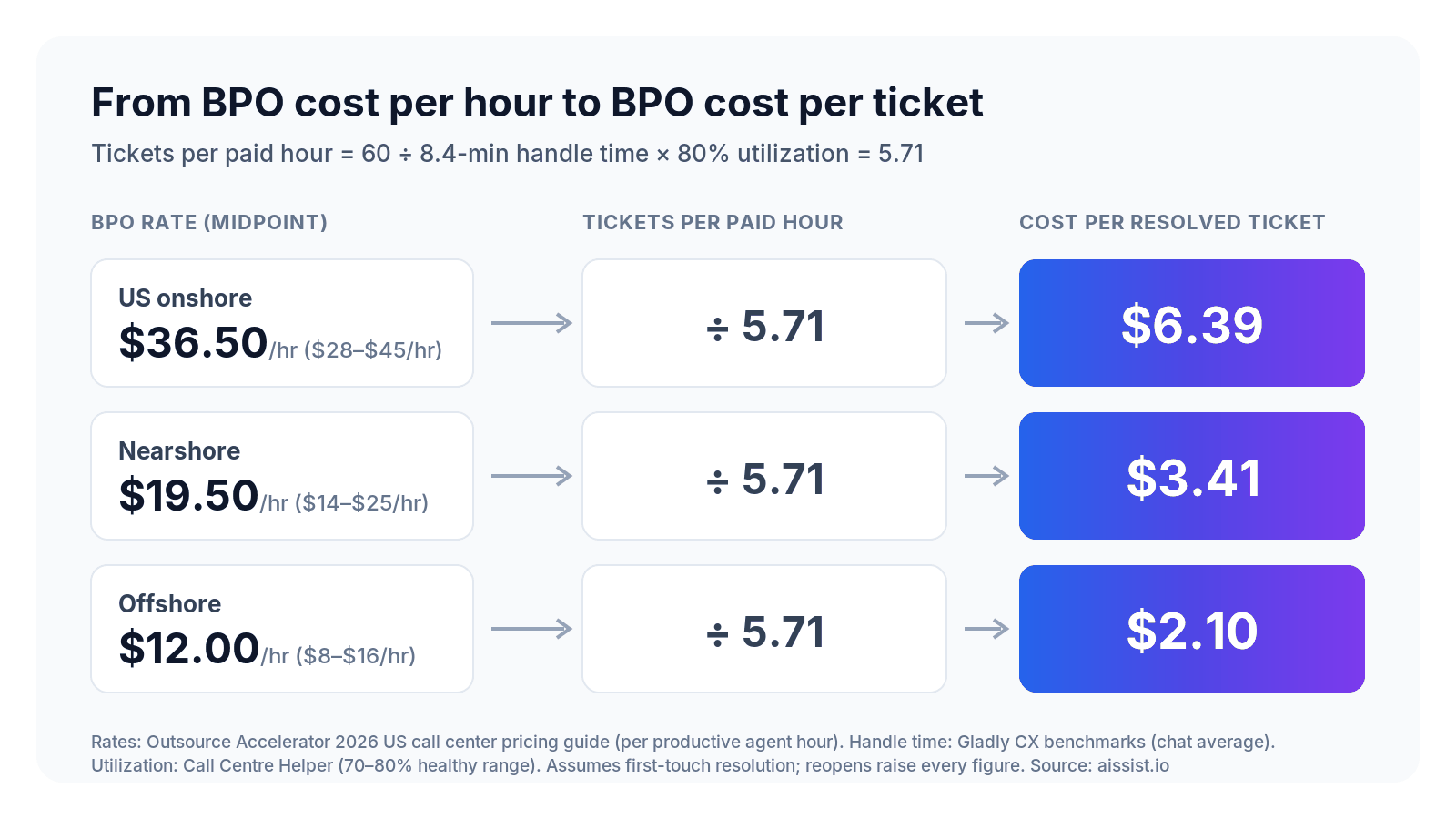
Cost per resolved ticket equals the hourly rate divided by the tickets an agent resolves in a paid hour, which is 60 ÷ handle time × utilization. At an 8.4-minute handle time and 80% utilization, one agent resolves 5.71 tickets per paid hour, so a $19.50 nearshore hour becomes $3.41 per ticket.
Both inputs are sourced and adjustable. Gladly's CX benchmarks report an average chat handle time of 8.4 minutes and 5.5 for email. Call Centre Helper recommends 70–80% chat utilization, and separately warns against letting occupancy pass 85%. We used the top of the healthy range, which flatters the BPO.
| Tier (midpoint rate) | Tickets per paid hour | Cost per resolved ticket | Range across the band |
|---|---|---|---|
| US onshore ($36.50) | 5.71 | $6.39 | $4.90–$7.88 |
| Nearshore ($19.50) | 5.71 | $3.41 | $2.45–$4.38 |
| Offshore ($12.00) | 5.71 | $2.10 | $1.40–$2.80 |
Assumptions: 8.4-minute handle time, 80% utilization, every human-handled ticket resolved on first touch. Reopens would raise every number.
The output checks out against per-ticket pricing that exists in the wild. Helpware's 2026 cost guide quotes per-resolution BPO deals at $1–$7, averaging near $4. A per-ticket number with no handle time behind it is a guess wearing a dollar sign. Change any input in the staffing calculator and the whole table moves with it.
AI vs BPO customer support: what do 10,000 tickets a month cost?
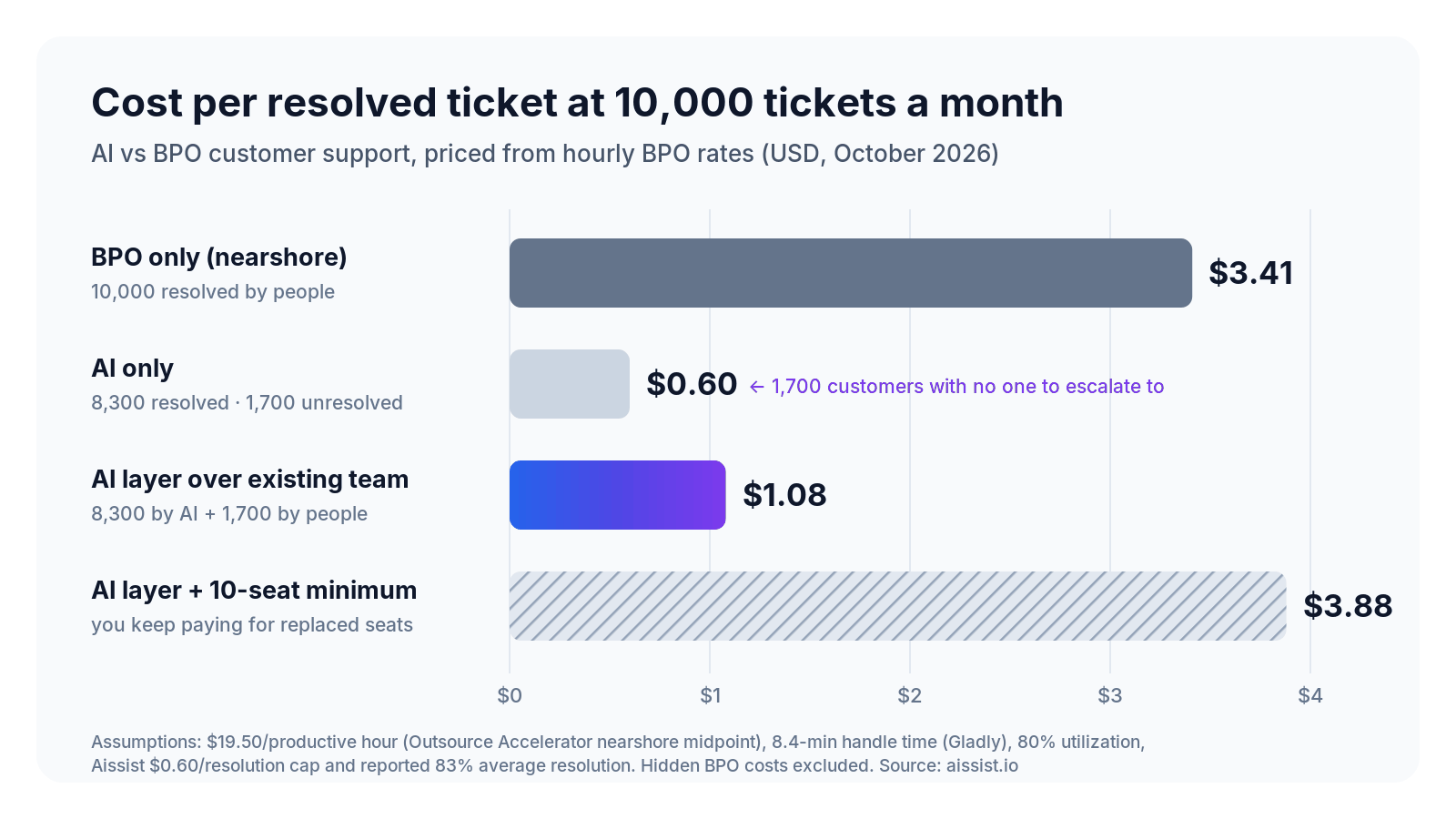
At 10,000 tickets a month, nearshore BPO costs about $34,125 ($3.41 per resolved ticket), AI alone costs $4,980 but leaves 1,700 tickets unresolved, and an AI layer over the existing team costs $10,781 ($1.08 per resolved ticket). The third column is the only one that resolves every ticket for less.
| 10,000 tickets/month | BPO only (nearshore) | AI only | AI layer over existing team |
|---|---|---|---|
| Tickets resolved by AI | 0 | 8,300 | 8,300 |
| Tickets resolved by people | 10,000 (1,750 hrs, ~10 seats) | 0 | 1,700 (298 hrs, ~1.7 seats) |
| Unresolved | 0 | 1,700 | 0 |
| Monthly cost | $34,125 | $4,980 | $10,781 |
| Cost per resolved ticket | $3.41 | $0.60 | $1.08 |
AI columns use Aissist's published cap of $0.60 per resolution from its pricing page and its reported 83% average resolution rate. Human work priced at $19.50 per productive hour.
AI-only looks cheapest until you count the 1,700 customers a month with nobody to escalate to. List prices elsewhere run higher: Intercom's pricing page shows Fin from $0.99 per outcome, Zendesk charges $1.50 per committed automated resolution beyond plan allowances, and Salesforce lists Agentforce at $2 per conversation. Run those through the price comparison tool and the middle column narrows fast.
Now argue against ourselves. Gartner forecasts that GenAI cost per resolution will exceed $3 by 2030. At $3, the AI layer costs $3.07 per ticket: still under nearshore BPO, but above offshore BPO's $2.10.
"Full automation will be prohibitively expensive for most organizations" — Patrick Quinlan, Senior Director Analyst, Gartner
What hidden costs sit outside the BPO hourly rate?
BPO hidden costs are the ones the hourly rate never shows: setup fees, per-agent training, turnover, ramp time, thin QA coverage and seat minimums. The biggest is the minimum. Under a 10-seat floor, the AI layer in our model costs $3.88 per ticket, more than BPO alone, because you keep paying for agents the AI replaced.
| Hidden cost | Typical figure | Source |
|---|---|---|
| Seat minimum and term | 10–20 agents, 6–12 month contracts | HiveDesk |
| Setup fees, mid-market | $5,000–$25,000 | Helpware |
| Training per new agent | $500–$2,000 | HiveDesk |
| Agent turnover | 30–40% a year | SQM Group |
| Time to average performance | Six months or more | SQM Group |
| Manual QA coverage | 1–2% of interactions | SQM Group |
| After-hours premium | 15–50% | HiveDesk |
Turnover compounds the rest. On a 10-seat account with 35% attrition, roughly three or four agents leave each year, and each replacement brings a training fee and months below full speed. SQM Group estimates replacing one average agent costs $20,800 in an in-house center; with a BPO, some of that lands in your rate and the rest in your CSAT.
None of these appear in the 10,000-ticket table, which makes BPO's $3.41 a floor, not an estimate.
"So we perceive AI as enhancing the job that our human employees do, but absolutely not replacing them." — Daniel Julien, CEO, Teleperformance, to CNBC
Why does an AI layer beat both BPO and AI-only?
An AI layer wins because it prices the easy majority of tickets per resolution and keeps people on the hard minority, so you stop buying hours for work a machine does and stop abandoning customers a machine can't help. It also runs inside the helpdesk you already use, so there is no migration to fund. That reframes customer support outsourcing vs AI from a switch into a staffing decision.
The BPO industry itself is moving this way. TaskUs added agentic AI partners in 2025 and framed the result as a blend, not a replacement.
"This hybrid model is the future of customer support." — Bryce Maddock, CEO, TaskUs, press release via Nasdaq
Holafly, an eSIM provider and Aissist customer, is the shape in practice. During peak travel season, AI took the high-volume baseline while its people handled edge cases, escalations and relationships, according to the Holafly customer story.
"Not only our sales and support operations increased by 3X during peak season, the CSAT improved." — Jefersson Arana, Senior Manager of AI, Holafly
The practical rule: if your contract is above its seat minimum, layer AI on top and shrink seats at renewal. If you sit at the floor, negotiate the floor first, because the AI saving will otherwise go to your vendor.
The contract term, not the AI price, decides what you save
The cheapest resolved ticket in 2026 comes from AI on the routine majority and people on the rest. BPO alone overpays for easy tickets; AI alone leaves the hard ones unanswered. The arithmetic is simple enough to re-run: hourly rate, handle time, utilization, resolution rate.
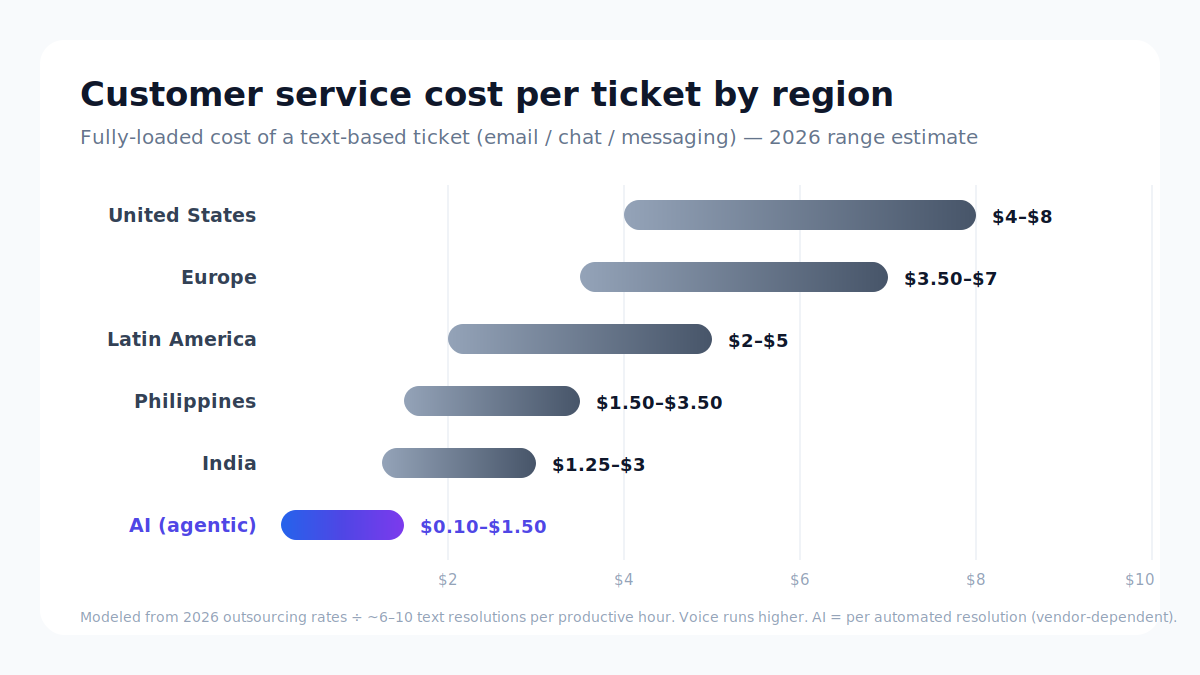
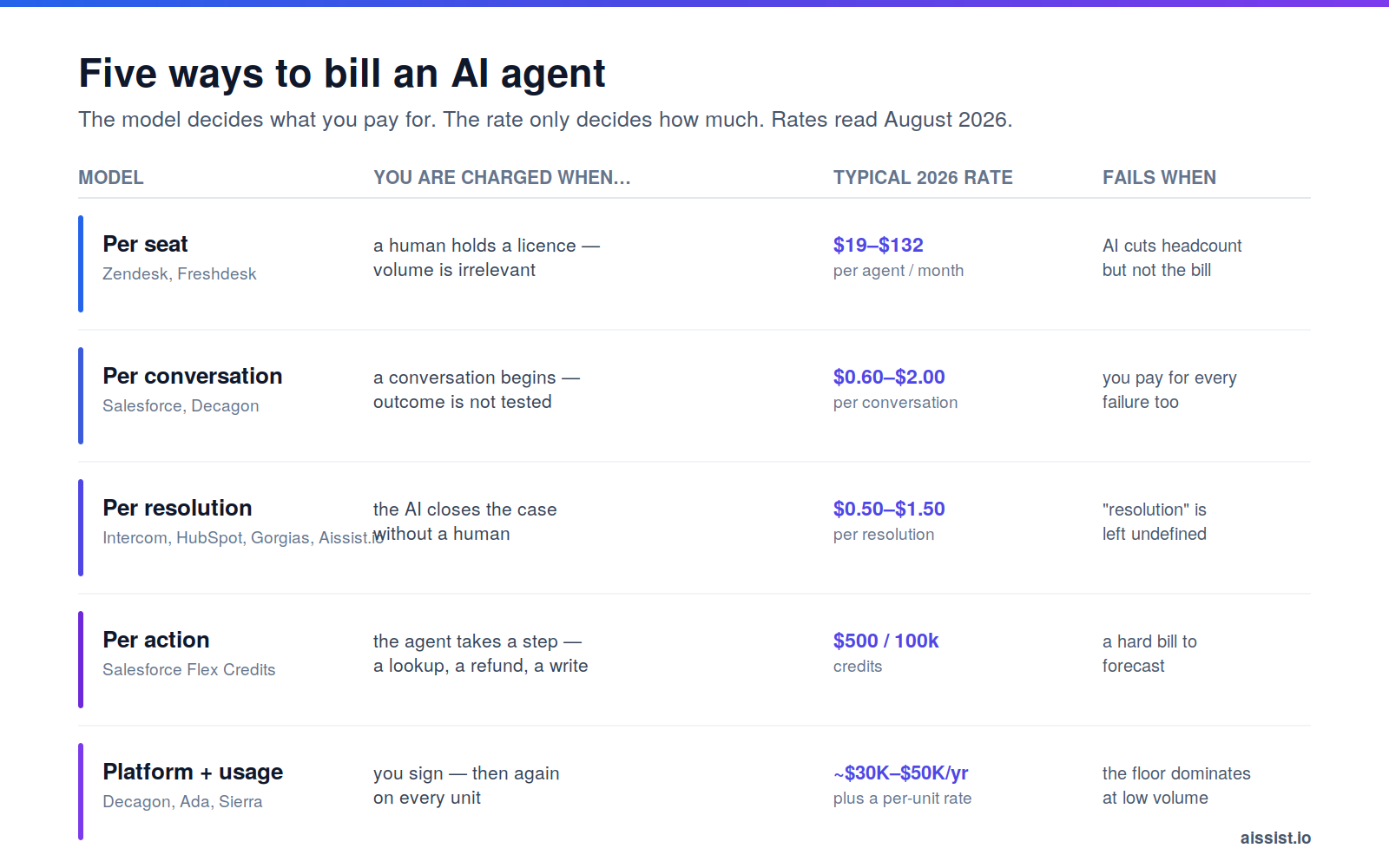
Before you sign or renew, ask three things: what counts as a productive hour, what the seat minimum is, and whether seats can step down as AI absorbs volume. For channel-level benchmarks, see customer service cost per ticket by region and the AI agent pricing benchmark.
Price the third column on your own volume. Aissist.io runs an agentic AI layer on top of the helpdesk and team you already have, at $0.20–$0.60 per resolution by channel. Compare AI pricing models →
Frequently asked questions
Can AI fully replace a BPO?
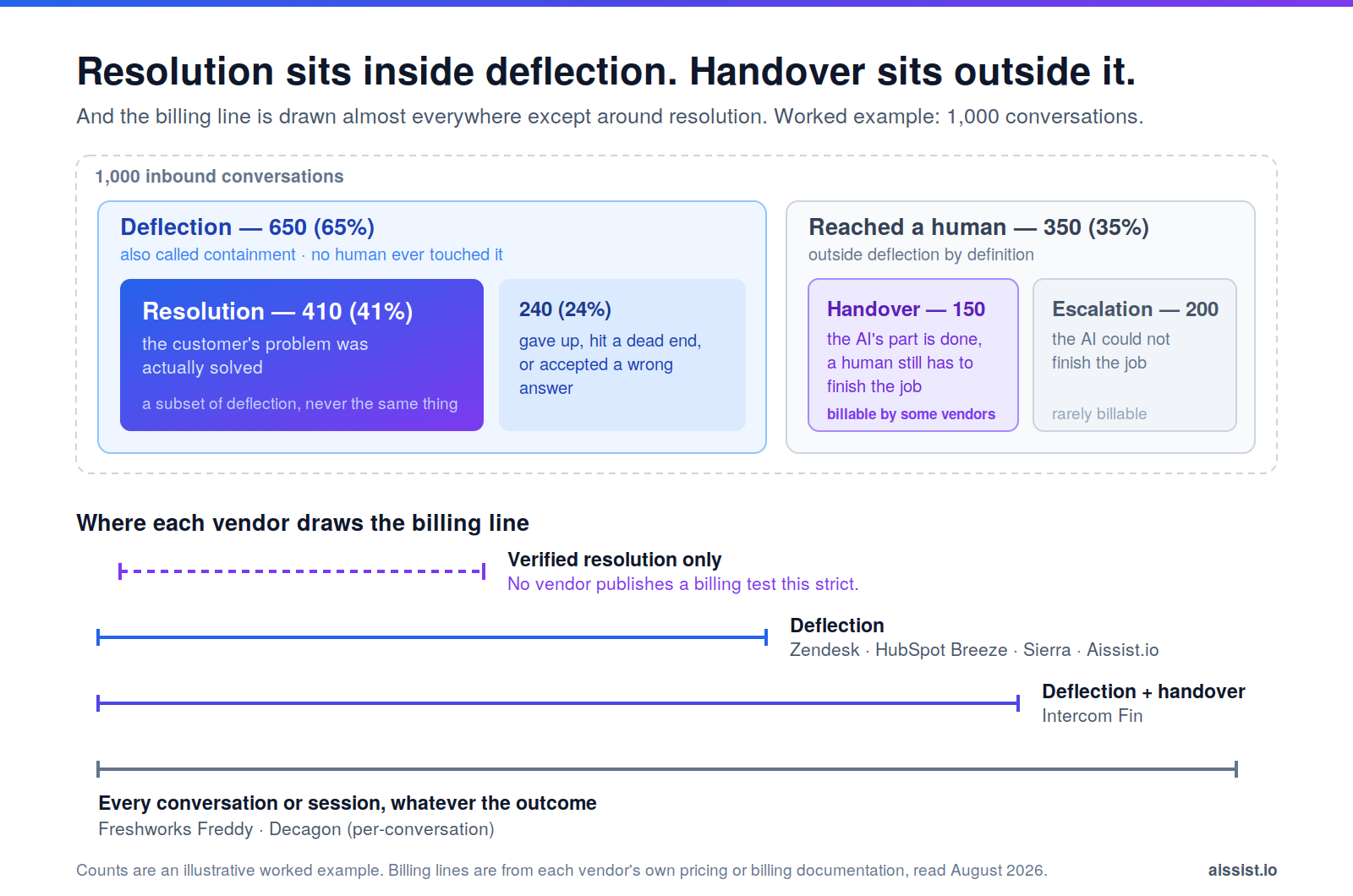
Rarely. Even at Aissist's reported 83% average resolution rate, 17 of every 100 tickets still need a person, and Gartner expects regulation to push more customers toward humans. AI replaces most tier-one hours, not the whole team.
Where does BPO still win?
Offshore BPO wins on cost if AI resolution prices climb toward Gartner's forecast of $3 by 2030, since our model puts offshore human tickets near $2.10. BPO also wins for complex voice work, regulated tasks and 24/7 coverage you can't staff yourself.
How much does nearshore customer support cost?
Nearshore support costs $14–$25 per productive agent hour, per Outsource Accelerator, with Mexico at $15–$25 and Colombia at $12–$22 in HiveDesk's 2026 guide. That works out to roughly $2.45–$4.38 per ticket at an 8.4-minute handle time.
What is a good BPO cost per ticket?
A competitive BPO cost per ticket is $1.40–$2.80 offshore and $2.45–$4.38 nearshore, using sourced 2026 hourly rates, an 8.4-minute handle time and 80% utilization. Anything quoted without a handle-time assumption can't be compared.
How do I calculate AI vs BPO savings for my team?
Multiply your monthly tickets by the AI resolution rate and per-resolution price, then price the remaining tickets at your BPO's hourly rate using your handle time. The AI service cost benchmark lists AI rates to plug in.
Does AI reduce BPO seat counts immediately?
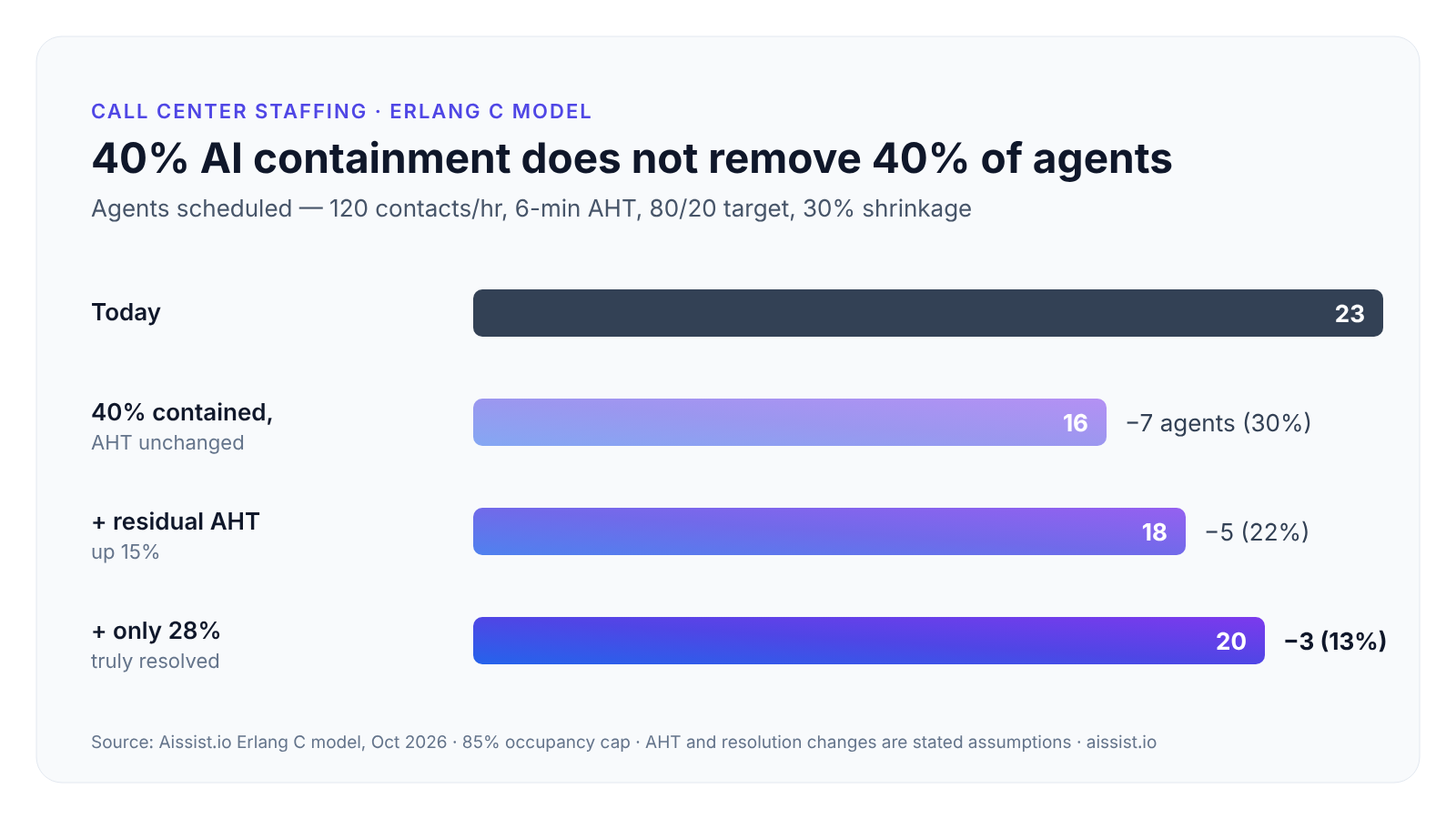
Only if your contract lets seats step down. With 10–20 seat minimums and 6–12 month terms common, per HiveDesk, savings often arrive at renewal, so model the contract calendar alongside the AI rollout. The call center staffing guide shows the seat math.