Compiled by Lucía Díaz. Published November 2, 2026 · Last updated November 2, 2026 · Pricing checked November 2, 2026.
TL;DR: Only 25% of cardholders contact the merchant before disputing, and merchants resolve about 75% of those who do, per Javelin's 2026 white paper for Mastercard — so the best chargeback management software is the one that can use your support history.
- Best for Shopify and DTC brands that want hands-off recovery: Chargeflow
- Best for enterprise merchants across several processors: Justt
- Best for a managed service spanning merchants, acquirers and issuers: Chargebacks911 / Fi911
- Best for small Shopify stores watching every dollar: Disputifier
- Best for banks and credit unions working disputes from the issuer side: Quavo
How we compared these tools
We scored each tool on five criteria: which side of the dispute it serves, how it bills, whether it publishes rates, whether it pulls evidence from a helpdesk, and independent ratings.
Methodology & sources
- Every price from the vendor's own pricing page or app listing, read 2 Nov 2026; "quote only" where none is published.
- G2 ratings from G2's new Chargeback Management category, read 2 Nov 2026.
- Javelin Strategy & Research, 2026 Chargebacks white paper for Mastercard.
- Visa CE 3.0 merchant guide and Regulation E (12 CFR 1005.11).
- Disclosure: this is Aissist's blog. Aissist sells AI agents for customer support, not chargeback software, so it is not ranked here — but the support-load section below is exactly our territory, and we'll say so when we get there.
Which chargeback management software fits which job?
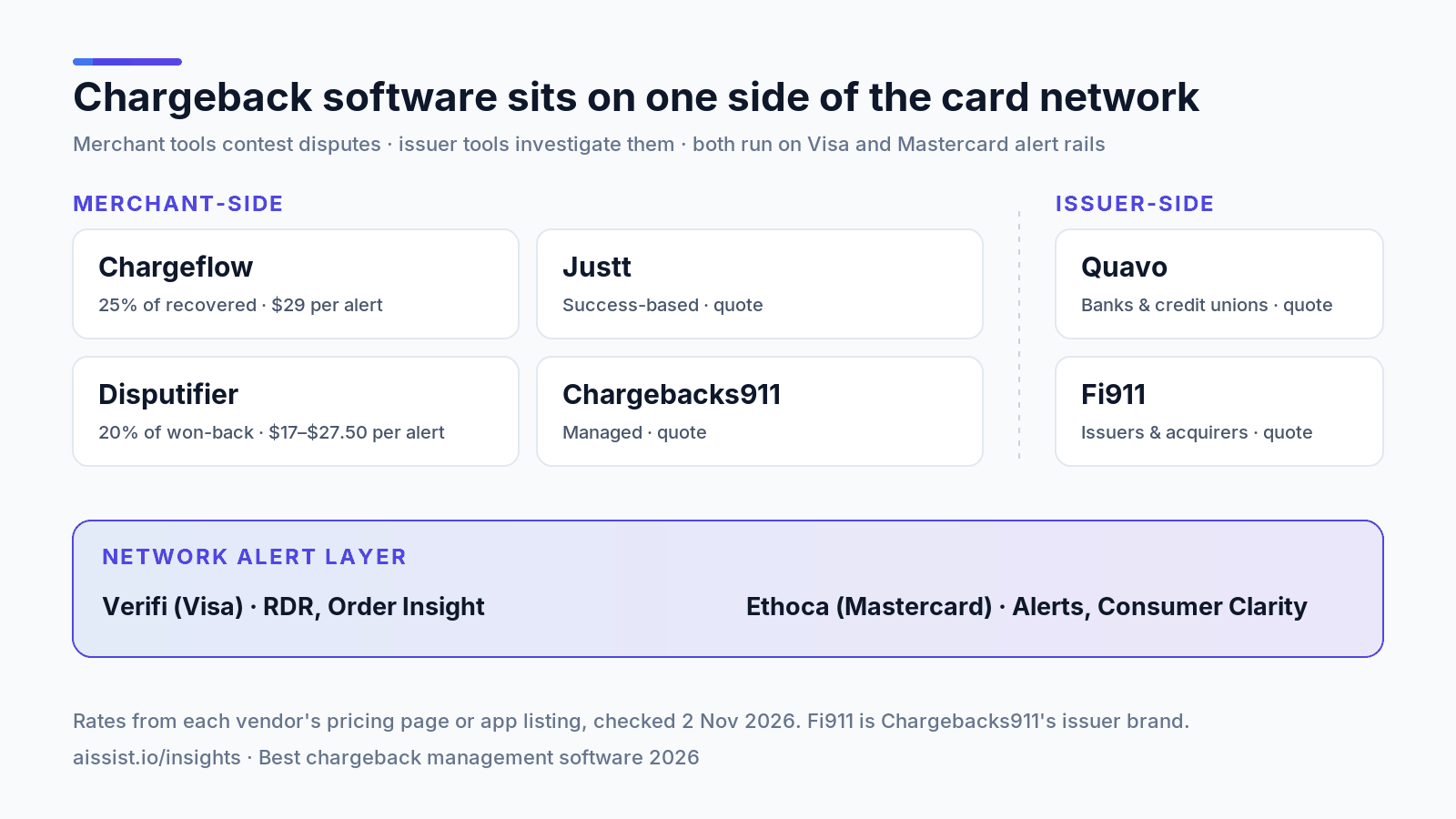
Chargeback tools split by which side of the card network they sit on: merchant-side tools contest disputes filed against a business, while issuer-side tools help banks investigate disputes their own cardholders file. Mixing the two is the most common error in ranking pages; a credit union cannot buy Disputifier, and a Shopify store has no use for Quavo.
A third layer sits underneath both: the card networks' own alert programmes, Verifi (Visa) and Ethoca (Mastercard), which most merchant tools resell. Chargeback tools also sit downstream of fraud prevention tools, which block bad transactions before authorisation.
| Vendor | Side | Billing model | Published rate (checked 2 Nov 2026) | Pulls evidence from a helpdesk? | G2 rating (Nov 2026) |
|---|---|---|---|---|---|
| Chargeflow | Merchant | Success fee + per-alert + per-scan | 25% of recovered chargebacks; $29 per deflected chargeback (Alerts); $0.10 per scanned transaction (Prevent) | Yes — Gorgias, Zendesk, Gmail | 4.7 (277) |
| Justt | Merchant | Success-based | Quote only | None named | 4.4 (13) |
| Chargebacks911 / Fi911 | Merchant, acquirer, issuer | Managed service | Quote only | None named | 4.4 (21) |
| Disputifier | Merchant | Success fee + per-alert | 20% of won-back revenue; $17–$27.50 per alert | None named | Shopify 4.6 (137) |
| Quavo | Issuer | Enterprise licence | Quote only | n/a (issuer case work) | — |
| Verifi / Ethoca | Network layer | Per alert / per case | Quote only (resold via processors and tools above) | n/a | — |
The 5 chargeback tools, reviewed
Four tools serve merchants and one serves issuers; only one publishes a helpdesk evidence pull.
1. Chargeflow — best for Shopify and DTC brands that want hands-off recovery
Chargeflow is a merchant-side chargeback platform that automates representment, resells Visa and Mastercard alerts, and bills mostly on success. Key facts: 25% of recovered chargebacks, dispute fee excluded; G2 4.7 from 277 reviews.
- Pros: the only tool here whose Gorgias integration pulls order-linked tickets and chat transcripts into representments; you pay nothing on lost cases.
- Cons: 25% is the highest published success fee in this list; Connect and Enterprise tiers are quote only. Our take: the default for Shopify brands. Skip it if your win volume makes a flat-fee managed service cheaper.
2. Justt — best for enterprise merchants across several processors
Justt is an AI chargeback platform for enterprise merchants that builds case-specific responses and decides which disputes are worth fighting. Key facts: success-based, quote only; integrates with Adyen, Nuvei, Ethoca and Verifi, per its G2 profile; G2 4.4 from 13 reviews.
- Pros: ROI-based fight-or-accept decisions; strong in travel, gaming and financial services.
- Cons: no published rates; no helpdesk integration named. Our take: built for multi-PSP enterprises. Not for a single Shopify store.
3. Chargebacks911 / Fi911 — best for a managed service spanning merchants, acquirers and issuers
Chargebacks911 is a managed dispute service whose Unified Dispute Management System serves merchants, while sister brand Fi911 serves issuers and acquirers. Key facts: quote only; G2 4.4 from 21 reviews.
- Pros: covers both sides of the network; full outsourcing.
- Cons: no published rates; service model means less self-serve control. Our take: for teams that want disputes off their plate entirely. Not for teams that want to own the workflow.
4. Disputifier — best for small Shopify stores watching every dollar
Disputifier is a Shopify chargeback app that fights disputes on a success fee and resells pre-dispute alerts. Key facts: 20% of won-back revenue; alerts $17–$27.50 each; Shopify rating 4.6 from 137 reviews.
- Pros: lowest published success fee here; 7-day trial.
- Cons: Shopify-centric; no helpdesk evidence pull named. Our take: the budget pick. Outgrown once you run several processors.
5. Quavo — best for banks and credit unions working disputes from the issuer side
Quavo is issuer-side dispute software for financial institutions; on 7 April 2026 it launched Aria, an AI tool that handles intake, investigation and resolution inside its QFD platform. Key facts: quote only; customers include USAA and Apple Federal Credit Union.
"We've been building and refining our models using insights from millions of disputes." — David Chmielewski, Co-founder and Chief Product Officer, Quavo, MyChesCo
- Pros: applies regulatory rules to case data; automates back-office case work.
- Cons: enterprise-only; not a merchant tool. Our take: the issuer-side reference point; see our guide to AI agents for banking for the cardholder-facing side. Merchants should skip it.
Why is a chargeback a support problem before it is a finance problem?
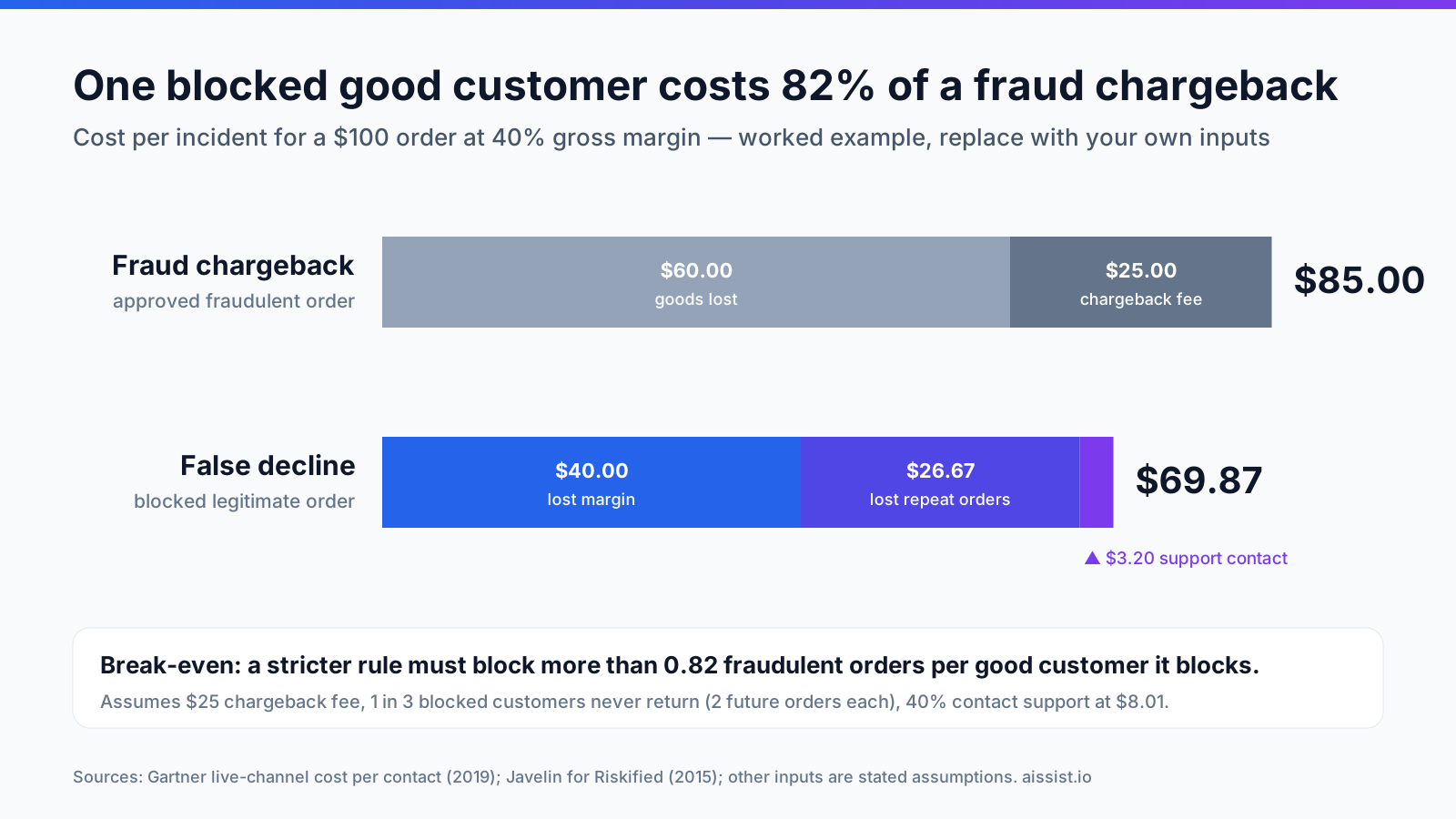
A pending dispute generates customer contacts on both sides of the card network, and the transcripts from those contacts are often your best evidence. The Javelin white paper puts merchant costs at $46 in third-party fees plus $82 in internal costs per chargeback, and estimates that chargeback volume could fall 50–60% if every consumer contacted the merchant first.
"Only 25% of consumers reach out to merchants to resolve a dispute before contacting their card issuer." — Don Apgar, author, 2026 Chargebacks white paper, Javelin Strategy & Research for Mastercard
The contacts a single dispute creates:
- "I don't recognise this charge." The cheapest moment to resolve it — and the one 75% of cardholders skip.
- "Where is my refund?" Repeat status contacts while the case is pending, often to both merchant and bank.
- "Why did my balance change?" For debit cards, Regulation E requires an issuer taking up to 45 days to provisionally credit within 10 business days — and explain it.
- "Why was my credit taken back?" If the issuer finds no error, it reverses that credit after notifying the cardholder.
- Refund-and-chargeback collisions. A customer refunded by support who also disputed creates a double-credit case nobody owns.
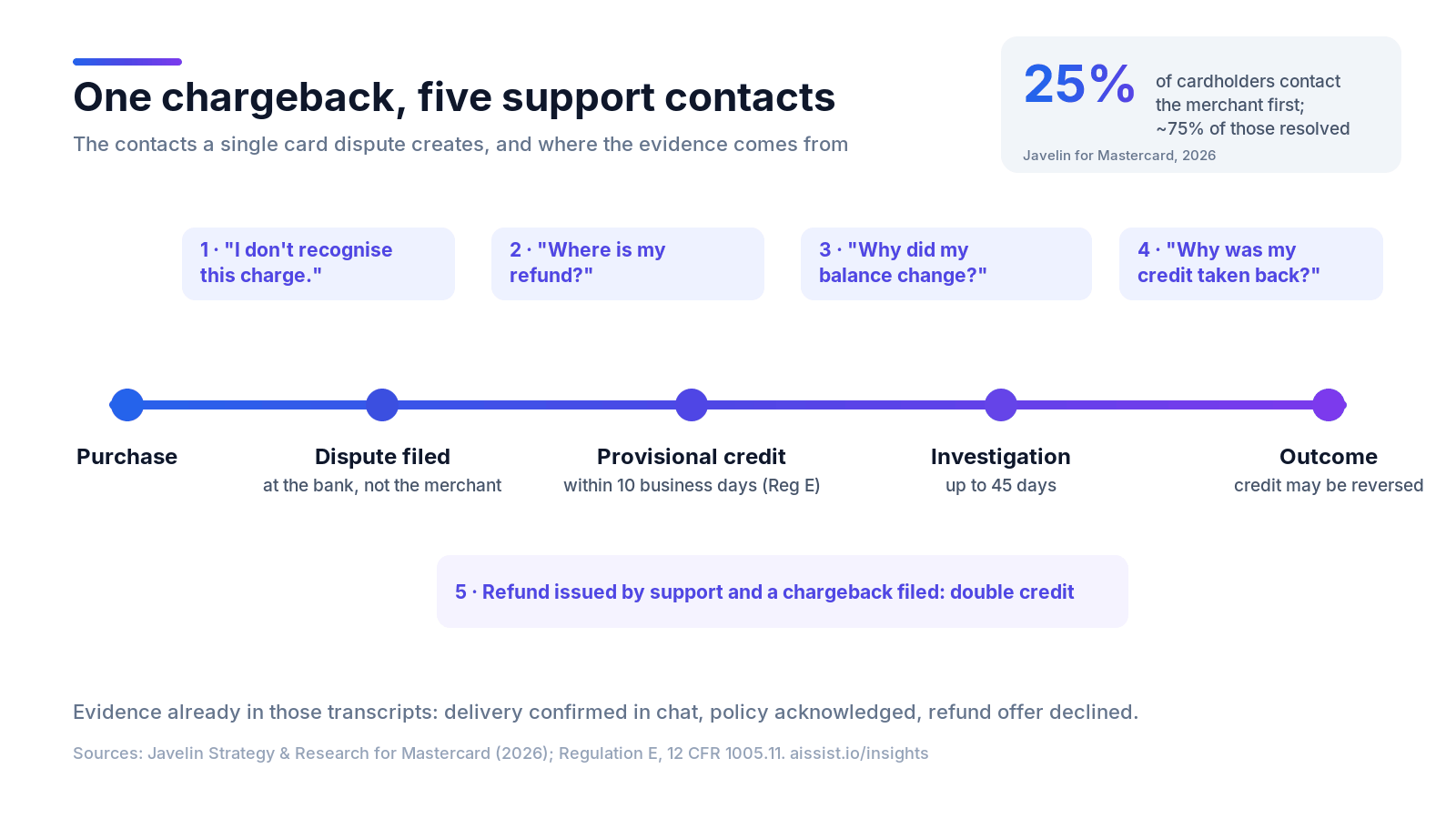
Those transcripts carry evidence: a delivery confirmation shared in chat, a cancellation policy acknowledged, a refund offer declined. Visa's CE 3.0 rules already reward prior-relationship data — two undisputed transactions 120 to 365 days old with matching identifiers. Support history is the same idea in conversational form. Yet G2's own category criteria list processors, e-commerce platforms and order systems as integrations, and never mention a helpdesk.
Capital is arriving here too: Casap raised a $56M Series B on 28 October 2026 to automate issuer disputes, Value Add VC reported.
This is where Aissist works, and our fintech benchmark is explicit that chargebacks themselves should route to humans. In its Payphone deployment, transaction-status and failed-payment questions are automated, while dispute cases route to a specialist sub-agent and escalate with transaction IDs already extracted.
"We scaled customer support efficiently without sacrificing speed or consistency across channels." — Paul Brito, Customer Service Manager, Payphone, Aissist customer story
What do chargeback tools actually cost?
On published rates, success-fee tools cost 20–25% of what they recover, and alerts cost $17–$29 per dispute prevented. Take a merchant with 100 disputes a month averaging $80, winning half.
| Tool (rates checked 2 Nov 2026) | How the bill is built | Monthly cost |
|---|---|---|
| Chargeflow Automation | 25% × $4,000 recovered | $1,000 |
| Disputifier | 20% × $4,000 recovered | $800 |
| Disputifier alerts, 30 disputes stopped | 30 × $17–$27.50 | $510–$825 |
| Chargeflow Alerts, 30 disputes stopped | 30 × $29 | $870 |
The arithmetic hides one thing: every alert refunds the customer, so a $29 alert on an $80 order costs $109. Alerts make sense when a chargeback would cost more — Javelin's $128 per chargeback in fees and internal time suggests it usually would.
How to choose chargeback management software
- If you sell on Shopify and run Gorgias or Zendesk, choose Chargeflow, because it is the only tool here that publishes a helpdesk evidence pull.
- If you process across several PSPs at enterprise volume, choose Justt, because its fight-or-accept decisions matter most at scale.
- If your problem is ratio thresholds rather than lost revenue, add Chargeflow or Disputifier alerts, because resolved alerts do not count toward Visa or Mastercard dispute rates, per Stripe's documentation.
- If you are a bank or credit union, shortlist Quavo or Fi911, because merchant tools do not touch Regulation E workflows.
The best chargeback tool starts in the support queue
Chargeback management software is judged on win rates, but the cheapest disputes are the ones that never get filed and the strongest evidence is a conversation you already have. Pick a representment tool on its billing model and side of the network — then check whether it can read your helpdesk. If it can't, your support team is holding evidence nobody submits.
Support is where disputes start. Aissist resolves the status, refund and "I don't recognise this charge" contacts on the helpdesk you already run, and hands chargebacks to your team with the transcript attached. See the fintech benchmark →
Frequently asked questions
What is chargeback management software?
Chargeback management software helps merchants track, contest and prevent card disputes: it maps each case to its reason code and deadline, assembles evidence and submits representments, per G2's category definition.
What is the difference between dispute management and chargeback management software?
Dispute management software usually means issuer-side tools for banks investigating cardholder claims, such as Quavo; chargeback management software usually means merchant-side tools that contest those claims, such as Chargeflow.
Is Midigator still an independent company?
No. Equifax agreed to acquire Midigator and pairs it with Kount, its existing anti-fraud network, according to FinTech Futures. Ranking pages that list it as standalone are out of date.
Can support chat transcripts be used as chargeback evidence?
Yes. Order-linked tickets and chat transcripts can be included in a representment; Chargeflow, for example, pulls them from Gorgias automatically, per its integration page.
How much does chargeback management software cost?
Published rates run from 20% (Disputifier) to 25% (Chargeflow) of recovered revenue, or $17–$29 per prevented dispute for alerts; Justt, Chargebacks911 and Quavo are quote only.
Changelog
- 2 Nov 2026 — First published. Rates, ratings and integrations checked against live vendor pages.