The 7 Best Returns Management Software Platforms for 2026
Compiled by Alex Gomez, Sr. Analyst. All pricing, notification templates, helpdesk integration docs and G2 ratings were read from primary sources on 19 October 2026. Disclosure: this guide is published by Aissist.io, which sells an agentic AI layer for customer service and sales. None of the seven vendors on this page is an Aissist.io product, and we hold no affiliate, referral or paid-placement relationship with any of them.
TL;DR: The best returns management software removes the "where is my refund" ticket rather than relocating it — and on published evidence only ReturnGO passes both of our tests, while Narvar posts the strongest refund-ticket case study (a 37% drop at Seasalt).
Best for, at a glance
- ReturnGO — best for removing refund tickets end to end
- Narvar — best for enterprise retailers on Salesforce or Kustomer
- Happy Returns — best for box-free, in-person returns
- AfterShip Returns — best for multi-platform stores on a budget
- Loop Returns — best for exchange-led Shopify brands
- Perform.AI (formerly Parcel Perform) — best for tracking-led enterprise programs
- Redo — best for free returns on Shopify
How did we compare returns management software?
We ranked each platform on one question: when a customer returns something, does the follow-up ticket disappear, or does it just move? Every platform here automates the label. The difference is what happens to the question that follows it.
We applied two tests:
- The customer test. Does the shopper get a refund or return-status update without asking?
- The agent test. If they ask anyway, can the agent see the return — and act on it — inside the helpdesk?
Pass both and the ticket is removed. Fail the customer test and the question still arrives — relocated to an agent, answered faster but still answered by a person. This is the deflection-versus-resolution distinction applied to returns: a return started in a portal that still generates an email has not been automated. It has been moved down the hall.
Methodology & sources
- Pricing, notification templates and helpdesk docs read from each vendor's own pages and Shopify App Store listings, October 19, 2026.
- Ratings read from G2, October 2026; review counts in brackets.
- Ticket-reduction figures come from vendor-published case studies and are labelled as such.
- Excluded: Returnly, which Loop reports shut down on October 1, 2023.
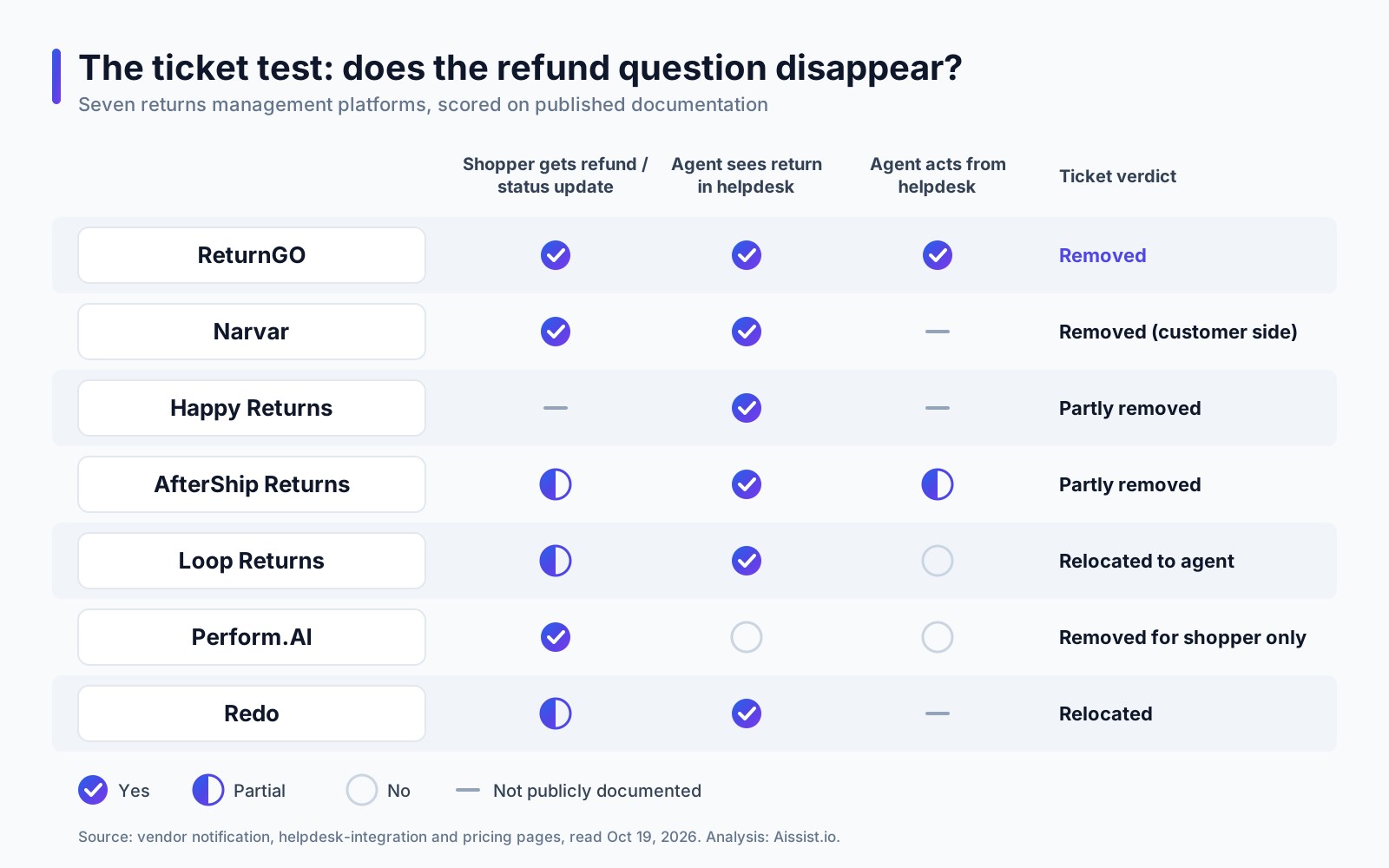
The 7 returns management platforms at a glance
ReturnGO is the only platform whose published documentation passes both tests; Narvar and Perform.AI pass the customer test, and the rest leave the refund question to an agent.
| Platform | Pricing model | Entry price (Oct 2026) | G2 (Oct 2026) | Ticket verdict |
|---|---|---|---|---|
| ReturnGO | Monthly plan + per-return overage | $147/mo | 4.8 (92) | Removed |
| Narvar | Custom quote | Quote only | 4.2 (196) | Removed (customer side) |
| Happy Returns | Monthly plan + shipping | $500/mo | 4.8 (11) | Partly removed |
| AfterShip Returns | Monthly plan + per-return overage | $16/mo | 4.3 (12) | Partly removed |
| Loop Returns | Free tier + monthly plans + outcome fees | $0 | 4.7 (63) | Relocated to agent |
| Perform.AI | Custom quote | Quote only | 4.7 (41) | Removed for shopper only |
| Redo | Free returns; paid add-ons | $0 | No reviews yet | Relocated |
The second table shows why each verdict landed where it did.
| Platform | Refund/status update to shopper | Agent sees the return in | Agent can act from helpdesk |
|---|---|---|---|
| ReturnGO | Yes — "Refund Issued" email or SMS | Gorgias, Zendesk, Freshdesk | Yes — approve, reject, receive, release (Gorgias) |
| Narvar | Yes — real-time return tracking | Gorgias, Zendesk, Salesforce Service Cloud, Kustomer | Not publicly documented |
| Happy Returns | Not documented | Gorgias | Not publicly documented |
| AfterShip Returns | Partial — 14 status emails; tracking page shows shipment only | Gorgias, Zendesk, Gladly, Kustomer (Premium) | Approve or reject only (Gorgias) |
| Loop Returns | Partial — status page for box-and-ship returns | Gorgias, Zendesk, Gladly | No — links into Loop |
| Perform.AI | Yes — alert when the refund is on its way | No helpdesk named | No |
| Redo | Store-credit email documented | Gorgias, Gladly | Not publicly documented |
Which returns platforms actually remove the refund ticket?
Ranked by how much of the follow-up ticket each platform's published evidence removes, ReturnGO leads, Narvar and Happy Returns follow, and Redo trails only for lack of documentation.
1. ReturnGO — best for removing refund tickets end to end
ReturnGO is a multi-platform ecommerce returns management tool covering returns, exchanges and warranties across Shopify, Magento, BigCommerce, Salesforce Commerce Cloud and others. On ReturnGO's pricing page, Premium starts at $147 a month; the Shopify listing includes 110 returns, then $1.25 per return.
- Pro: its Gorgias widget lets agents approve, reject and mark items received without leaving the ticket.
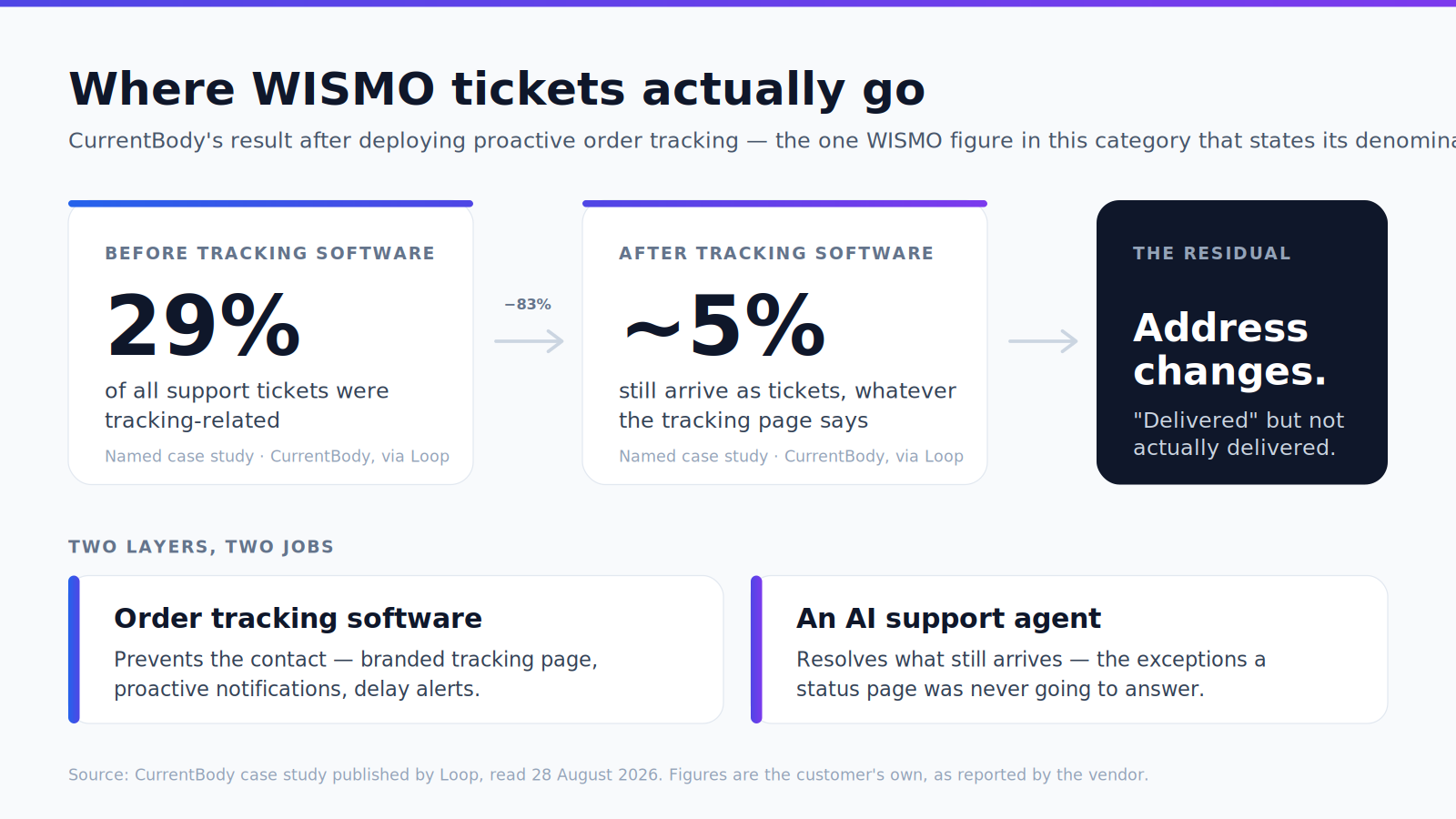
- Pro: in a published case study, CurrentBody's "where is my refund" tickets fell 63%.
- Con: custom notification emails are a paid add-on below Enterprise.
- Con: no Gladly, Kustomer or Intercom integration listed.
Customers were frustrated with "the lack of transparency and the long wait times for refunds." — Jadwiga Imiela, Returns Manager, CurrentBody
Our take: the strongest ticket story here; skip it if your helpdesk is Gladly or Kustomer.
2. Narvar — best for enterprise retailers on Salesforce or Kustomer
Narvar Shield is reverse logistics software for enterprise retailers, handling returns, exchanges and fraud rules across Salesforce Commerce Cloud, SAP, Shopify and Oracle. Pricing is quote only.
- Pro: in a case study, Seasalt Cornwall's "where is my refund" enquiries fell 37%, from 4.6% to 2.5% of customers returning.
- Pro: the broadest helpdesk list here, including Salesforce Service Cloud and Kustomer.
- Con: no published price.
- Con: the lowest G2 score of the seven, 4.2.
Our take: built for complex retail stacks; overkill for a Shopify brand under 1,000 returns a month.
3. Happy Returns — best for box-free, in-person returns
Happy Returns, a UPS company, pairs returns software with 10,000 Return Bar drop-off locations where shoppers return items without a box or label. The Shopify listing shows a $500-a-month plan, plus shipping.
- Pro: Happy Returns says merchants see 80% fewer returns-related service contacts (vendor-claimed).
- Pro: in-person drop-off removes the box-and-label step shoppers most often ask about.
- Con: shopper refund notifications are not publicly documented.
- Con: the only verified helpdesk integration is Gorgias.
Our take: the best fix for return friction; pair it with something that answers the refund question.
4. AfterShip Returns — best for multi-platform stores on a budget
AfterShip Returns is RMA software for brands selling across Shopify, Magento, BigCommerce, WooCommerce and Amazon. AfterShip's pricing page starts Essentials at $16 a month for 240 returns a year, then $0.50 each.
- Pro: integrates with four helpdesks, including Kustomer.
- Pro: Pelagic Gear reported a 12% drop in return contact tickets (case study).
- Con: helpdesk integrations need Premium, from $99 a month.
- Con: the return tracking page shows shipment status, not refund status.
"This exchange feature took every problem away." — Nikolas Callas, Director of Operations, Marc Nolan
Our take: good value across platforms; on Essentials, the helpdesk shows agents nothing.
5. Loop Returns — best for exchange-led Shopify brands
Loop is a Shopify-first returns and exchanges platform built around Instant Exchange, store credit and Bonus Credit. Loop's pricing page lists a free Core plan, Essential from $155 a month and Advanced from $340.
- Pro: the free tier includes labels and Return Bar drop-off.
- Pro: Gorgias agents see refund and shipping status on the customer profile.
- Con: agents view returns in the helpdesk but act in Loop.
- Con: outcome fees are not published.
"We have seen a massive increase in our CSAT scores since implementing Loop." — Alexandria Collis, Senior Director of Operations, Princess Polly
Our take: the exchange engine to beat; not the tool to buy for ticket removal alone.
6. Perform.AI — best for tracking-led enterprise programs
Perform.AI, formerly Parcel Perform, is a delivery-tracking platform with a returns module covering eligibility rules, drop-off booking and exchanges. Pricing is quote only.
- Pro: alerts shoppers when the refund is on its way.
- Pro: returns start from the same tracking page shoppers already use.
- Con: no helpdesk integration named.
- Con: returns are a module, not the core product.
Our take: strong if you already track with it; a poor first purchase for returns alone.
7. Redo — best for free returns on Shopify
Redo is a Shopify post-purchase platform whose returns module is free on Redo's pricing page, with paid checkout coverage, email and support add-ons.
- Pro: $0 for returns.
- Pro: 4.9 from 809 reviews on the Shopify App Store.
- Con: no G2 reviews and no published ticket data.
- Con: cash-refund notifications are not publicly documented.
Our take: unbeatable on price; check the refund-notification flow before peak. Redo also sells a support AI agent at $0.99 per resolution, which competes with Aissist.
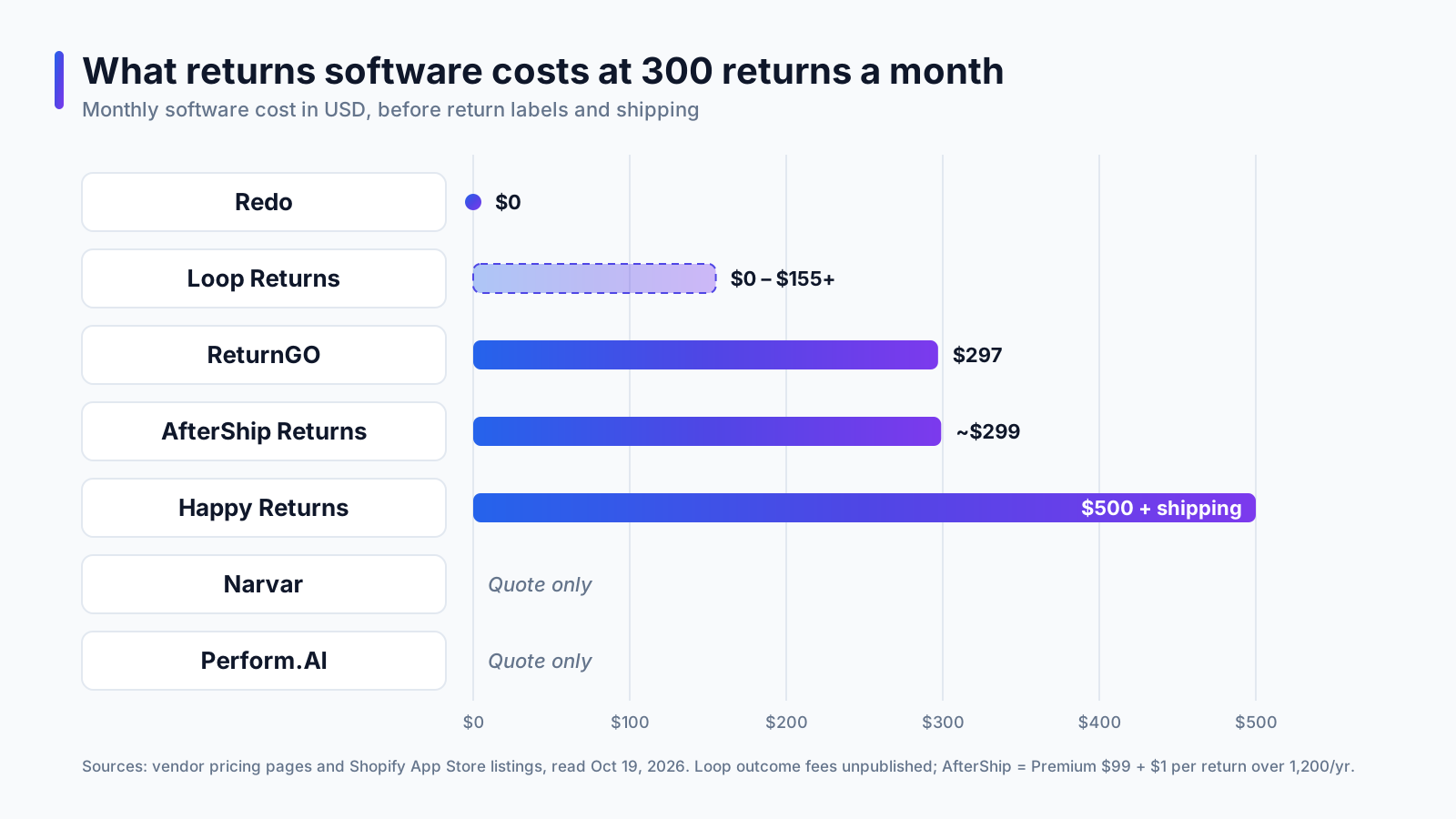
What does returns management software cost at 300 returns a month?
At 300 returns a month, published prices run from $0 at Redo and Loop Core to $500 at Happy Returns — before labels and shipping.
| Platform | Monthly software cost at 300 returns (Oct 2026) | How we got it |
|---|---|---|
| Redo | $0 | Returns module free |
| Loop Returns | $0–$155+ | Core free; Essential from $155; outcome fees unpublished |
| ReturnGO | $297 | Pro includes 300 returns |
| AfterShip Returns | ~$299 | Premium $99 + 2,400 extra returns/yr at $1 |
| Happy Returns | $500 + shipping | Shopify plan |
| Narvar, Perform.AI | Quote only | — |
The bigger number is peak volume. The NRF expects 17% of holiday sales to come back, within a projected $849.9 billion in 2025 returns (NRF research with Happy Returns). At Seasalt's rates, 3,000 January returns mean 138 refund-status contacts before Narvar and 75 after. Our BFCM playbook prices what each of those costs at peak.
How should you choose a returns platform?
Choose on the ticket test first, then the exchange engine.
- If refund tickets flood your January inbox, choose ReturnGO, because it updates shoppers and lets agents act in Gorgias.
- If you run Salesforce Service Cloud or Kustomer, choose Narvar, because it lists both.
- If returns friction hurts repeat purchases, choose Happy Returns, because box-free drop-off removes the hardest step.
- If exchanges matter more than tickets, choose Loop, because that is what it is built to win.
- If you sell on more than Shopify on a budget, choose AfterShip Premium, because helpdesk access starts there.
Shipping protection handles the order that never arrives; this category handles the one that comes back.
Return policy automation is half the job
Return policy automation removes the label request; only the refund update removes the follow-up. ReturnGO, Narvar and Perform.AI publish shopper-facing refund or return-status updates; the rest automate the warehouse and leave the question to your team. Whatever remains lands in the helpdesk, where an AI agent for ecommerce can read the return status and answer it — the step the ecommerce benchmark tracks. Buy the platform that removes the most tickets. Automate the rest.
The refund ships; the question still lands with you. Aissist.io resolves the "where is my refund" follow-ups end to end on the helpdesk you already run, reading return status from your returns platform. See the ecommerce benchmark →
Frequently asked questions
What is returns management software?
Returns management software automates the post-purchase return: a self-service portal, policy rules, labels, exchanges and refunds. The better tools also notify shoppers about refund status and sync return data into the helpdesk.
What is the difference between RMA software and reverse logistics software?
RMA software authorizes and tracks individual returns. Reverse logistics software also moves the goods: carrier booking, drop-off networks and warehouse processing. Narvar, Happy Returns and Perform.AI cover both.
Is Returnly still available?
No. Loop reports Returnly shut down on October 1, 2023, and Loop became its preferred migration partner.
Which returns platform integrates with Zendesk?
ReturnGO, Narvar, AfterShip Returns (Premium) and Loop list Zendesk integrations. Documented in-helpdesk actions, such as approving a return, exist only for Gorgias, at ReturnGO and AfterShip.
Does returns software reduce support tickets?
Vendor case studies say yes: CurrentBody cut refund tickets 63% with ReturnGO, and Seasalt cut "where is my refund" enquiries 37% with Narvar. The reduction depends on shopper refund notifications.
Changelog
- Oct 19, 2026 — First published. Returnly excluded (shut down 2023); Parcel Perform listed under its new name, Perform.AI.