Compiled by Lucía Díaz. Published November 2, 2026 · Last updated November 13, 2026 · Rates checked November 13, 2026.
The best KYC providers for fintech, eSIM and travel brands in 2026 are Sumsub, Veriff, Didit, Persona, iDenfy, Shufti and Trulioo, with Jumio and Entrust (Onfido) as enterprise benchmarks. We ranked them on a column no vendor ranking covers: what your support team can do when a check fails.
TL;DR: Match rates are close across serious KYC vendors; the real cost difference is whether a failed check reaches support with a reason code, a retry path and a review button, because each missing piece becomes a ticket.
- Sumsub — best for separating fixable rejections from final ones
- Veriff — best for granular resubmission codes agents can quote
- Didit — best for the lowest published per-check price
- Persona — best for running ID review inside Zendesk
- iDenfy — best for paying only for approved verifications
- Shufti — best for a free-forever test tier and wide country reach
- Trulioo — best for database-first checks where documents are impractical
How we compared these KYC providers
- Six criteria: document coverage, liveness, reason codes exposed to your systems, retry without restarting, manual review inside your helpdesk, and published price.
- Sources: each vendor's own pricing page, developer docs and help center, read this run. Where we couldn't find something documented, the table says so rather than guessing.
- Excluded: vendors shipping a conversational onboarding agent for end users. None of the seven do; the AI launches we found (Sumsub's Summy, Shufti's Copilot, Persona Assistant) are back-office tools for compliance teams.
- Disclosure: this is Aissist's blog. Aissist sells AI agents that resolve customer support tickets, including verification tickets. We don't sell KYC, and no vendor paid for placement.
What is a KYC provider, and why do failed checks matter more than match rates?
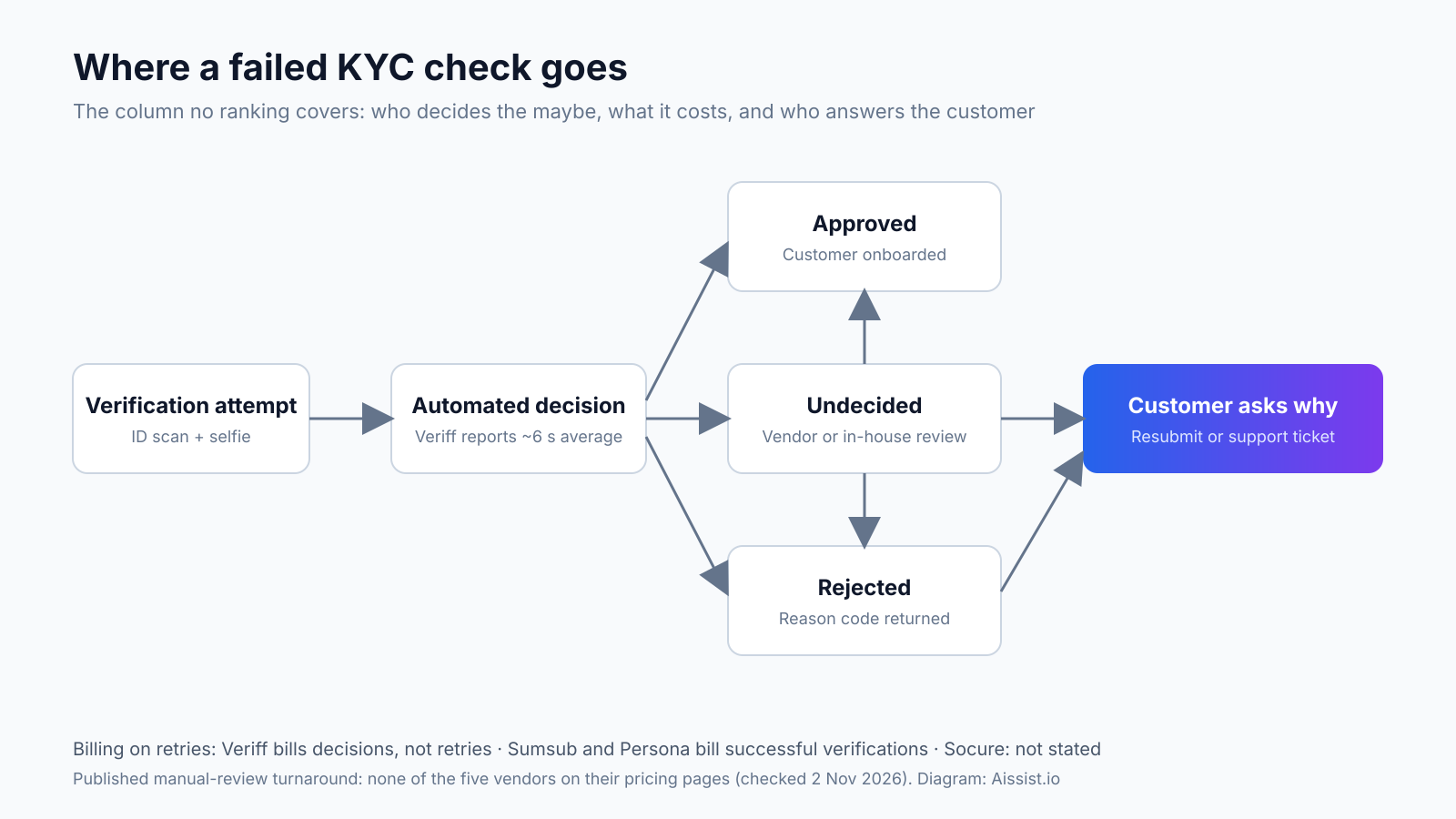
A KYC provider checks a customer's ID document, face and watchlist status, then returns an approve, decline or review decision. That decision is where every ranking stops and where your support queue starts: a decline the customer doesn't understand comes back as a ticket.
Vendors agree on why fixable failures matter. Didit's help center says most declines can be fixed with a resubmission rather than a final no. Veriff's developer docs strongly advise telling the end-user why verification failed and how to fix it. Both are describing the same gap: a decision engine that can't explain itself to the customer.
"The more types of ID cards, passports, residence proof, and other documents we are able to deal with, the higher the pass rates our global clients reach." — Vyacheslav Zholudev, co-founder and CTO, Sumsub
Coverage raises pass rates. It doesn't help the people who still fail. A KYC vendor sells the decision; nobody sells the explanation.
Which three tickets does a failed KYC check create?
A failed check creates three tickets: "why was I rejected?", "can I try again?" and "why am I still in review?" Each maps to one support column in the table below.
| Ticket the customer sends | What support needs from the KYC vendor | Table column |
|---|---|---|
| "Why was I rejected?" | A machine-readable reason, delivered by webhook or API | Reason codes exposed |
| "Can I try again?" | A retry that reopens only the failed step | Retry without restart |
| "Why am I still in review?" | A way to see and finish the review from the ticket | Manual review in your helpdesk |
The volume is your own arithmetic: monthly verifications × failure rate × share of failed users who contact you. At 20,000 sign-ups a month, a 5% failure rate is 1,000 failed checks; if four in ten write in, that is 400 tickets a month, before anyone asks twice. Use your numbers, not these.
How do the best KYC providers compare on support-readiness?
Sumsub, Veriff and Didit return reason codes and support step-level retries; only Persona documents a native Zendesk integration for review. Pricing checked 13 Nov 2026 on each vendor's pricing page, USD.
| Provider | Document coverage | Liveness | Reason codes exposed to support? | Retry without restart? | Manual review inside your helpdesk? | Published price per check (Nov 2026) |
|---|---|---|---|---|---|---|
| Sumsub | 14,000+ docs, 220+ countries | Passive and active | Yes — reject labels plus RETRY/FINAL type | Yes, on RETRY | No native app found | $1.35 ($149/mo minimum) |
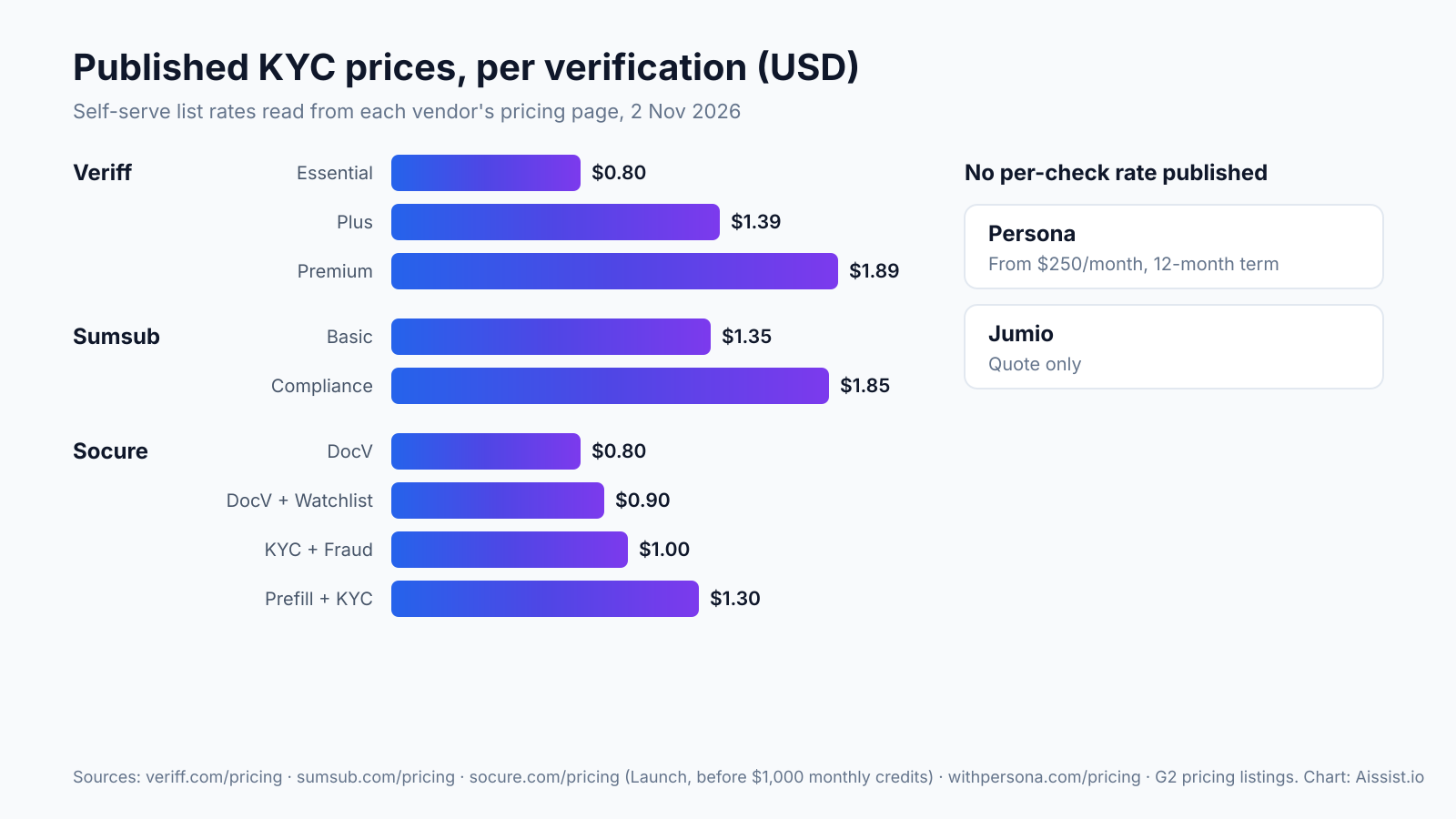
| Veriff | 12,500+ docs, 230+ countries | Yes | Yes — numeric reason codes | Yes — same session URL, 10-attempt cap | No native app found | $0.80 ($49/mo minimum) |
| Didit | 14,000+ docs, 220+ countries | Passive ($0.10) or active ($0.15) | Yes — per-check warnings | Yes — only flagged steps | No native app found | $0.33 full KYC bundle |
| Persona | Not stated as a count | Selfie liveness checks | Yes — check-level failure reasons | Yes — multiple attempts per inquiry | Yes — Zendesk integration, plan-gated | From $250/mo, 12-month term; no per-check rate |
| iDenfy | 16,000+ docs, 200+ countries | 3D liveness, iBeta tested | Yes — fraud and mismatch tags | Partly — clear tags in dashboard, else new session | No native app found | Quote only |
| Shufti | 10,000+ docs, 240+ countries | Yes | Yes — declined codes per service | Not documented | No native app found | From $1.50; 10 free/mo |
| Trulioo | 14,000+ docs, 195 countries | iBeta-certified | Yes — DocV result subindicators | Not documented | No native app found | Quote only |
| Jumio (benchmark) | 5,000+ docs, 200+ countries | Yes | Yes — usability reject codes | In-SDK capture retries | Via third-party SnapCall app | Quote only |
| Entrust / Onfido (benchmark) | 2,500+ docs, 195+ countries | Yes | Not verified this run | Not verified this run | No native app found | Quote only |
"No native app found" means no first-party helpdesk app in the vendor's docs; webhooks into your helpdesk work everywhere.
"We want to automate everything, and Persona is making that possible." — Giovanna de Luca, Head of CX innovation & projects, Vestiaire Collective, Persona case study
The seven providers, one at a time
1. Sumsub — best for separating fixable rejections from final ones
Sumsub is a verification platform covering KYC, KYB and AML, deployed by SDK or API. Its review API marks each rejection RETRY or FINAL and adds a comment that must not be shown to the applicant.
- Pros: the RETRY/FINAL split is exactly what an agent needs; rejected applicants can be routed to manual review by label.
- Cons: $149 monthly minimum; review happens in Sumsub's dashboard, not your helpdesk.
- Our take: the strongest support data model here. Skip it if you need sub-$1 checks.
2. Veriff — best for granular resubmission codes agents can quote
Veriff is an identity verification platform that returns approved, declined or resubmission_requested decisions. Its docs list codes like 207 (document expired) and 216 (glare), and resubmissions reuse the same session URL.
- Pros: $0.80 entry rate on the pricing page; codes map cleanly to customer-facing explanations.
- Cons: declined sessions need a new session; the 10th failed resubmission becomes a decline.
- Our take: the easiest codes to turn into macros. Not for teams that need review inside Zendesk.
3. Didit — best for the lowest published per-check price
Didit is a modular identity platform that bills per check. Its pricing page lists a $0.33 full KYC bundle, and its resubmission flow asks the user to redo only the steps that failed.
- Pros: published per-module prices; $10 of free credit each month.
- Cons: the overall "Declined" status never says why, so you must read warnings per check; review lives in Didit's console.
- Our take: the price leader with a good retry model. Not for buyers who want an established enterprise vendor.
4. Persona — best for running ID review inside Zendesk
Persona is a configurable identity platform built around inquiries and workflows. Its Zendesk integration creates and updates tickets from workflows, and Vestiaire Collective's agents trigger checks with a Zendesk macro.
- Pros: the only native helpdesk path we found; check-level failure reasons.
- Cons: no per-check price published, 12-month term on Essential; the Zendesk integration is limited or unavailable on lower plans.
- Our take: the pick if review must happen in the ticket. Not for teams that want month-to-month pricing.
5. iDenfy — best for paying only for approved verifications
iDenfy is a KYC, KYB and AML provider with in-house human review. Its docs return fraud and mismatch tags; removing a tag in the dashboard re-evaluates the status automatically.
- Pros: pay-for-approved pricing model; 16,000+ document types.
- Cons: pricing is form-gated; outside dashboard fixes, the user starts a new session.
- Our take: good economics for high failure rates. Not for buyers comparing published prices.
6. Shufti — best for a free-forever test tier and wide country reach
Shufti is an AI identity verification and compliance provider covering 240+ countries. Its declined callback carries a readable reason plus codes such as SPDR07.
- Pros: 10 free verifications a month, forever; per-service decline codes.
- Cons: no documented step-level retry; Essentials starts at $1.50, above Veriff and Didit.
- Our take: easy to trial. Not the cheapest at volume.
"Teams should get the speed of AI without giving up control of their verification." — Farryam Asif, CTO, Shufti
7. Trulioo — best for database-first checks where documents are impractical
Trulioo is a global identity platform that pairs data-source verification with document checks across 195 countries. Its KYC Document API returns results with coded subindicators.
- Pros: data-matching where uploads aren't practical; 14,000+ document types.
- Cons: quote-only pricing; retry behaviour not documented publicly.
- Our take: right for wide cross-border coverage. Not for a fast self-serve start.
How should fintech, eSIM and travel brands choose a KYC API provider?
Choose on support-readiness first and price second, because a cheap check that generates tickets isn't cheap.
- If most failures are blurry photos or expired IDs, choose Sumsub, Veriff or Didit, because step-level retry closes the ticket without a restart.
- If compliance insists review happens in the ticket, choose Persona, because it's the only native helpdesk integration we found.
- If you sell eSIMs or travel products to many nationalities, weight document and country coverage, because an unsupported document is a failure no retry fixes.
- If budget leads, start with Didit or Veriff, then price the tickets your failure rate creates.
Our research turned up a detail no ranking mentions: Veriff caps resubmissions at ten, then declines with code 539. Your agents should be able to explain that before the customer asks. Benchmarks for the support side live in our fintech resolution and cost benchmark and eSIM customer service benchmark; related roundups cover eSIM platforms, payment orchestration and fraud prevention tools.
The cheapest KYC check is the one your support team can explain
Pick the vendor whose failed checks arrive with a reason, a retry path and a review state your agents can see. Sumsub and Veriff have the cleanest reason models, Didit the lowest price, Persona the only native helpdesk path. Whatever you choose, wire its webhook into your helpdesk on day one, so "why was I rejected?" gets an answer instead of a guess.
Frequently asked questions
What are the best KYC providers in 2026?
Sumsub, Veriff, Didit, Persona, iDenfy, Shufti and Trulioo are strong choices, with Jumio and Entrust (Onfido) as enterprise options. Choose on how failed checks reach support, not on match rates alone.
Which KYC provider is cheapest?
Didit publishes the lowest rate we found: $0.33 for a full KYC bundle. Veriff's Essential plan is $0.80 per verification with a $49 monthly minimum, per its pricing page in November 2026.
Do eSIM providers need KYC?
It depends on the market. Some countries require identity checks for SIM registration, so eSIM sellers should check each destination's rules and choose a provider covering those countries' documents.
What does "resubmission requested" mean in KYC?
It means the check couldn't finish, usually from a fixable issue like glare or a cropped document, and the user can try again. In Veriff's flow, they reuse the same session link.
Can support agents see why a KYC check failed?
Yes, if you pass the vendor's reason codes into your helpdesk. Sumsub, Veriff, Didit, iDenfy and Shufti all return machine-readable reasons; Persona adds a native Zendesk integration.
Changelog
- 13 Nov 2026 — Rewritten around what support teams need after a failed check; expanded to seven providers (added Didit, iDenfy, Shufti, Trulioo; Socure removed), with Jumio and Entrust as benchmark rows. Prices and docs rechecked.
- 2 Nov 2026 — First published. All rates read from vendor pricing pages.