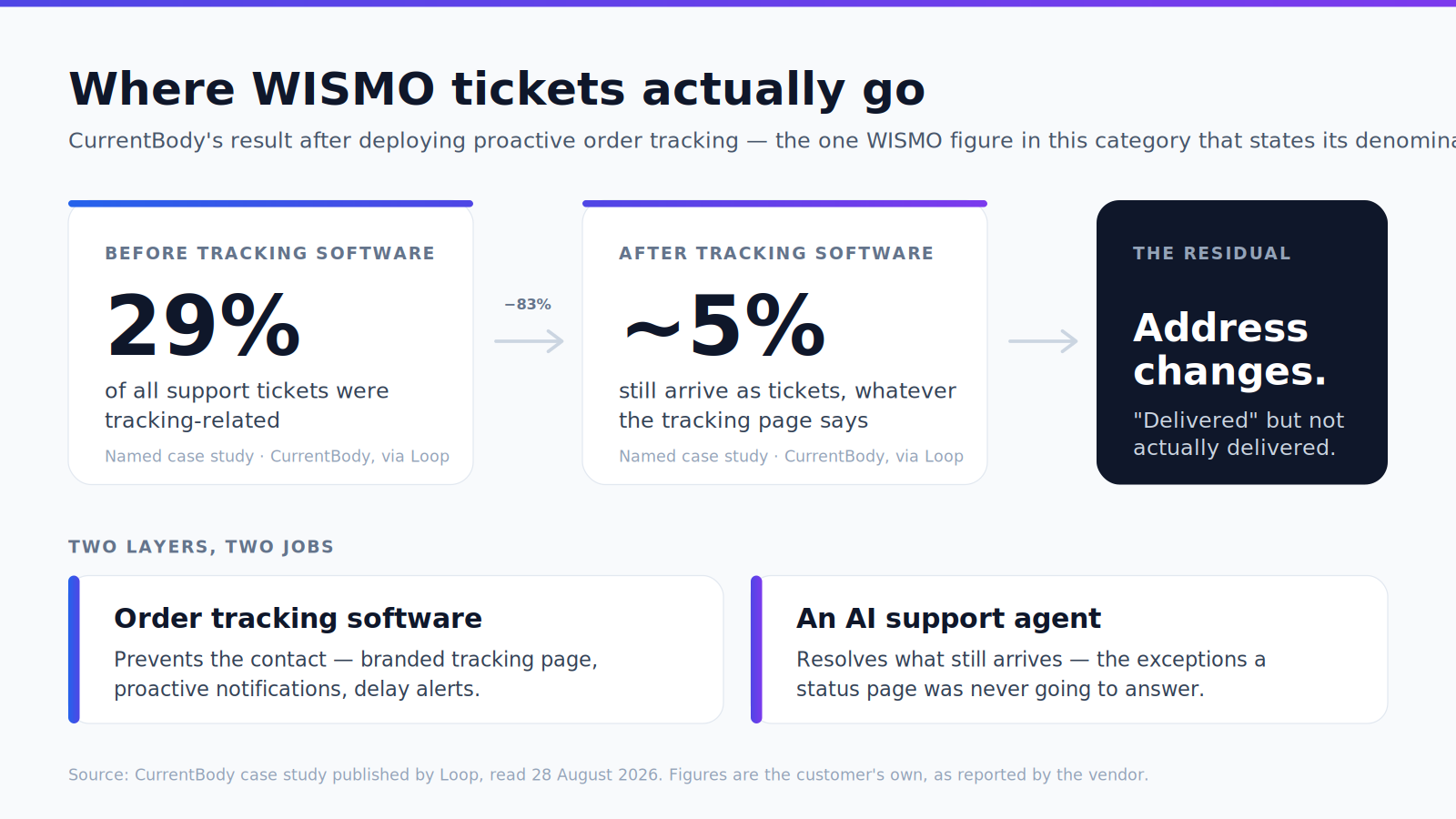
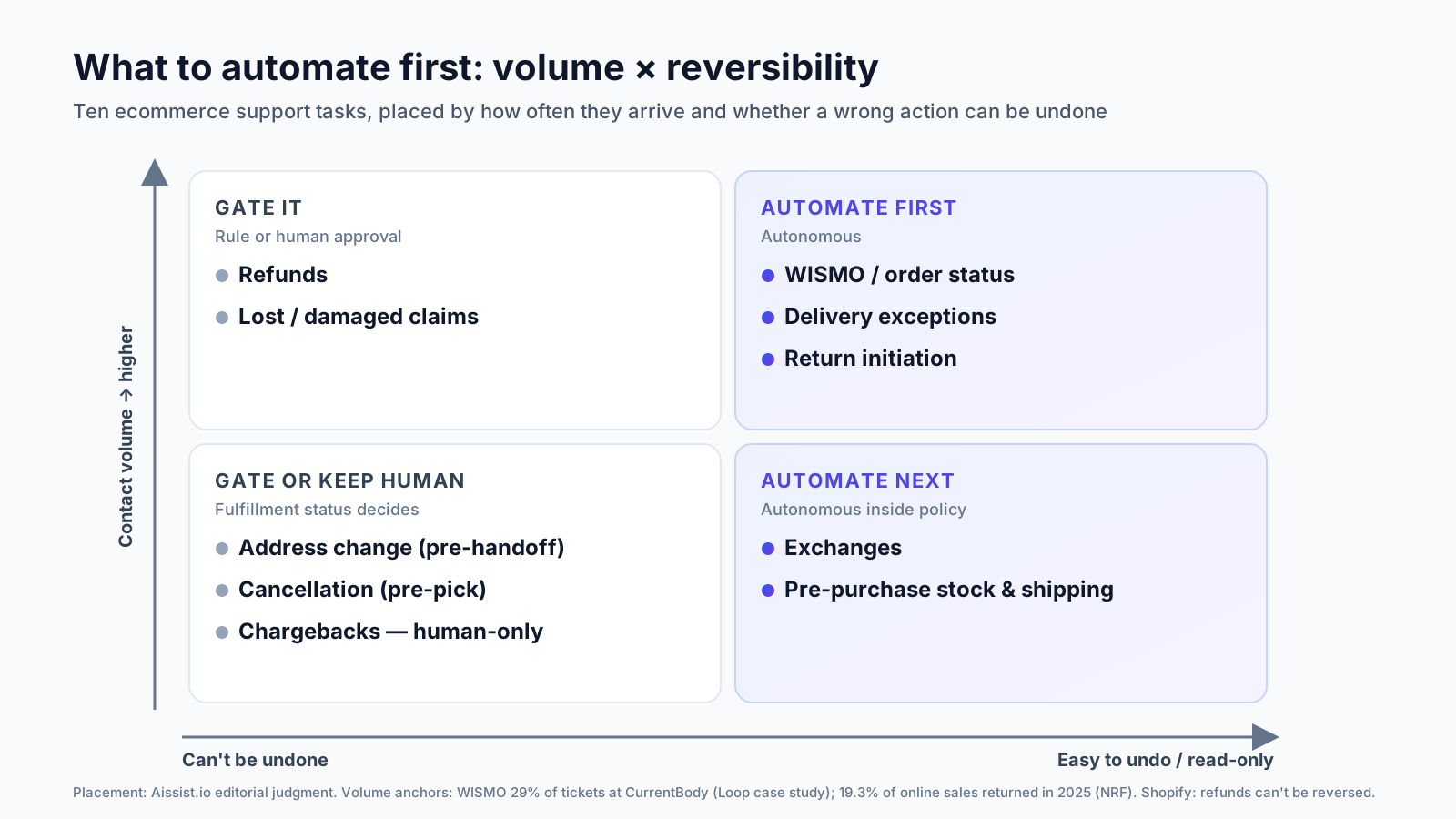
Most order management software reviews stop at inventory sync and channel counts. This one adds what an AI support agent can read from each system — because WISMO is 18% of incoming e-commerce requests, per Gorgias's 2023 data.
By Nadia Yun, Head of Marketing · Published 26 October 2026 · Last updated 31 October 2026
TL;DR: Pick the order management system that pushes shipment-level events — split shipments, carrier exceptions, return state — because every gap in that data becomes a "where is my order" ticket.
- ShipBob — best if you outsource fulfilment
- Fluent Commerce — best for enterprise distributed order management
- Cin7 — best for SMB product brands that want published pricing
- Brightpearl — best for mid-market retail-plus-wholesale
- Veeqo — best free option for Amazon-heavy sellers
- Linnworks — best for high-volume marketplace sellers with heavy returns
- Extensiv Order Manager — best for multi-warehouse networks
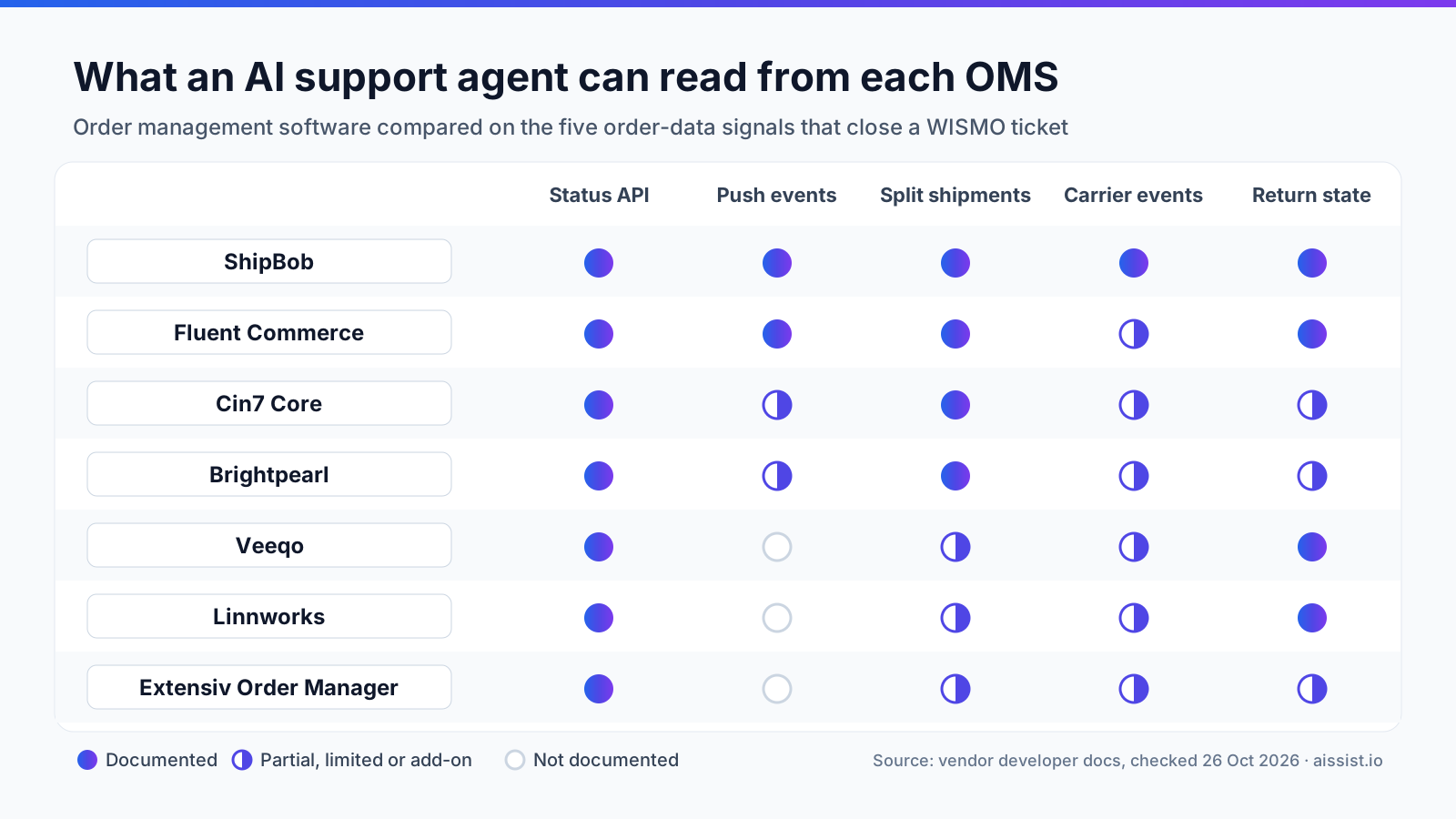
How we compared these order management systems
We scored each order management system on five criteria: support-readable order data (which sets the order), channel coverage, fulfilment model, pricing transparency and independent reviews.
Methodology & sources
- Order data from each vendor's developer docs; pricing from its own pricing page; ratings from g2.com. All checked 26 Oct 2026.
- Not listed: Shopify's native order admin (see FAQ) and manufacturing-first tools like Katana.
- Scope: the back-office system of record. Customer-facing tracking pages are in our order tracking and WISMO software roundup.
- Disclosure: this is Aissist's blog. Aissist sells AI support agents that read OMS data; it is not an OMS and is not ranked here.
The 7 order management systems at a glance
| Platform | Best for | Entry price (Oct 2026) | Billing unit | Push events to a support agent | G2 (n), Oct 2026 |
|---|---|---|---|---|---|
| ShipBob | Outsourced fulfilment | Software free; fulfilment quote only | Per fulfilment service | Yes — shipment, exception and return events | 3.7 (122) |
| Fluent Commerce | Enterprise distributed OM | Quote only | Order volume | Yes — configurable status-change webhooks | 4.9 (14) |
| Cin7 Core | SMB product brands | $349/month | Monthly tiers | Yes — with Automation module | 4.3 (352) |
| Brightpearl | Mid-market retail + wholesale | Quote only | Custom, unlimited users | Webhooks documented; goods-out notes are the example | 4.4 (102) |
| Veeqo | Free, Amazon-heavy | $0 (Shipping plan) | Label commission | None in its API docs — poll the API | 4.5 (47) |
| Linnworks | High-volume marketplaces | Quote only | Monthly order volume | None in its API reference — poll the API | 4.3 (118) |
| Extensiv Order Manager | Multi-warehouse networks | Quote only | Not published | Webhook docs cover inbound channel events | 4.4 (67) |
What each OMS lets a support agent read
| Platform | Best-fit team | Channels | Split shipments | Return state via API | Carrier events |
|---|---|---|---|---|---|
| ShipBob | DTC to mid-market | Shopify, BigCommerce, WooCommerce, Amazon, eBay, Walmart | Shipments array | Yes, with webhooks | Tracking-updated webhook |
| Fluent Commerce | Enterprise | Adobe Commerce, Salesforce Commerce Cloud, Amazon, eBay | Fulfilments per order | Yes | Tracking label |
| Cin7 Core | SMB | All six* | Multiple fulfilments | Credit notes | Tracking number |
| Brightpearl | Mid-market | All six | Multiple goods-out notes | Sales credits | Tracking reference |
| Veeqo | SMB | All six | Allocations per order | Yes | Yes, Veeqo-bought labels only |
| Linnworks | SMB to mid-market | All six | Split into separately shipped orders | Full RMA | Tracking number |
| Extensiv Order Manager | Multi-node brands | All six | Split into separate orders | RMA module; ask about API access | Tracking number |
*All six: Shopify, Amazon, eBay, BigCommerce, WooCommerce and Magento, per each vendor's integrations page.
Which order data model lets an AI agent close a WISMO ticket?
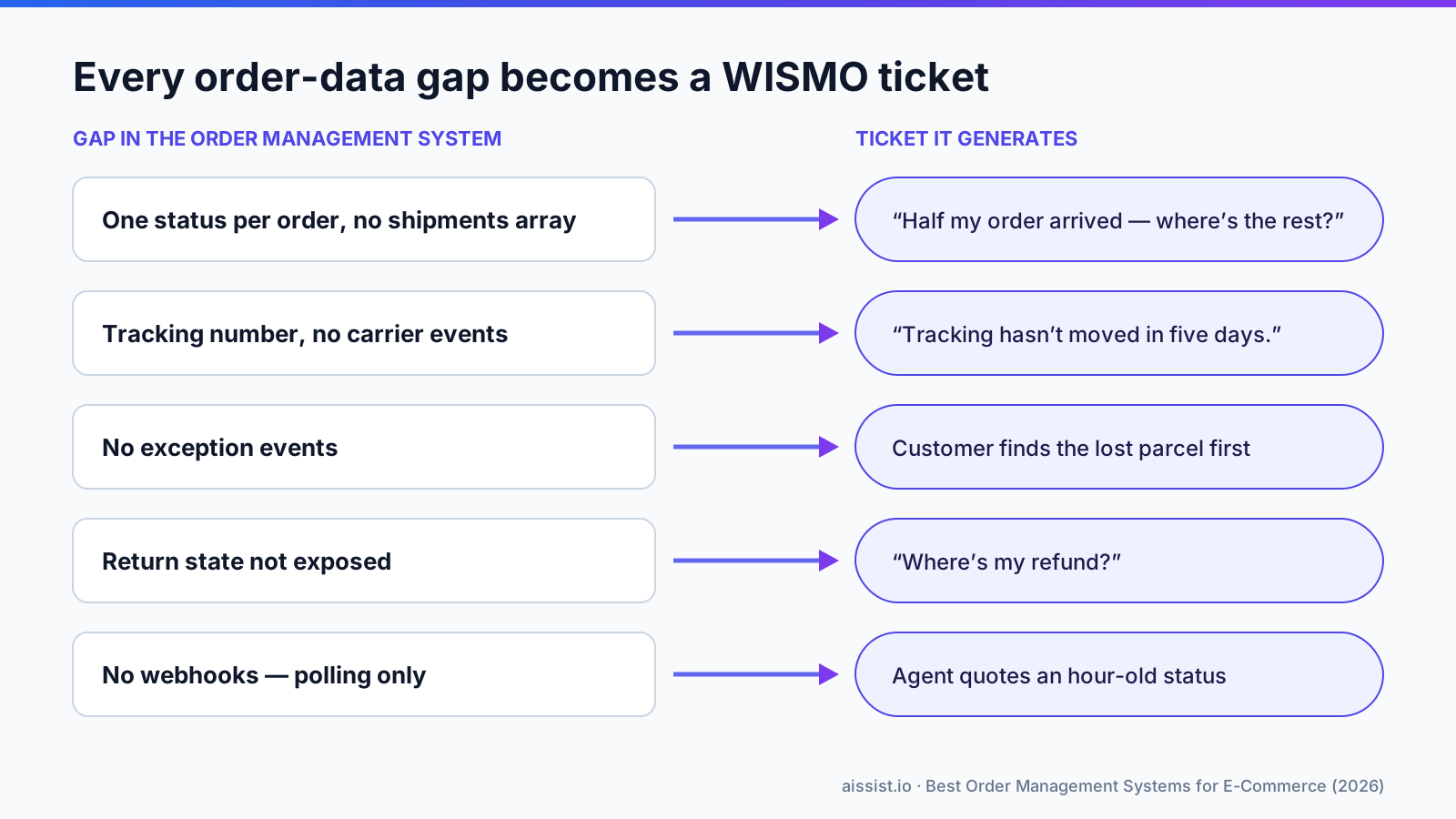
An agent can resolve "where is my order" without a human only when the OMS exposes four things: a shipments array per order, carrier events, return state, and webhooks that push changes instead of waiting to be asked. Missing any one of them produces a predictable contact.
| Order-data gap | The ticket it generates |
|---|---|
| One status per order, no shipments array | "Half my order arrived — where's the rest?" |
| Tracking number, no carrier events | "Tracking hasn't moved in five days." |
| No exception events | The customer discovers the lost parcel before you do. |
| Return state not exposed | "You received my return. Where's my refund?" |
| No webhooks (polling only) | The agent quotes a status that changed an hour ago. |
The vendors have noticed. Fluent Commerce launched an order management MCP server in November 2025 that it calls optimized for WISMO use cases, and ShipBob's Summer 2026 release added one over orders and shipments. An OMS is now expected to answer questions, not just store answers.
Game Room Shop shows the floor. In a published Aissist case study, an agent reading Shopify order status by order number resolves 60% of conversations without a human. Richer shipment data raises the ceiling.
1. ShipBob — best if you outsource fulfilment
ShipBob is a fulfilment network whose free merchant platform manages orders, inventory and returns across its warehouses.
Key facts: ShipBob's pricing page says the software is free for all customers; fulfilment is quoted. Its webhooks include tracking updated, shipment exception and return completed, and its tracking guide gives each split shipment its own tracking.
- Pro: the richest push-event set on this list.
- Pro: an MCP server over orders and shipments.
- Con: running your own warehouse means ShipBob's separately quoted WMS, offered for US-based warehouses, per its pricing page (checked 31 Oct 2026).
- Con: rated 3.7 on G2, the lowest here (read 26 Oct 2026).
Our take: the most agent-ready data model reviewed. Skip it if you run your own warehouse outside the US.
2. Fluent Commerce — best for enterprise distributed order management
Fluent Commerce is a cloud order management system that routes orders across stores, warehouses and marketplaces for large multi-region retailers.
Key facts: Fluent's docs link each order to zero or more fulfilments, and return orders run from CREATED to COMPLETE. Pricing is quote only, by order volume (checked 31 Oct 2026).
- Pro: GraphQL API plus configurable status-change webhooks.
- Pro: an MCP server built for order-status queries.
- Con: Fluent's connector docs name Salesforce, commercetools and Adobe connectors, not Shopify, BigCommerce or WooCommerce (checked 31 Oct 2026); other platforms go through its Fluent Connect framework.
- Con: 14 G2 reviews is a thin sample, even at 4.9 (read 26 Oct 2026).
Our take: built for retailers with dozens of fulfilment nodes, and priced by order volume on request.
3. Cin7 — best for SMB product brands that want published pricing
Cin7 Core is an inventory and order management system for small and growing product businesses selling wholesale and online.
Key facts: Cin7's pricing page lists Core Standard at $349 a month for 5 users and 6,000 sale orders a year; Cin7 Omni is quote only. Backordered and tracking-number-changed webhooks exist only with the Automation module.
- Pro: the only paid OMS here with a published price.
- Pro: a backorder event, which pre-empts "why hasn't it shipped?"
- Con: push events cost an add-on, and the pricing page lists Advanced Automations without a price (checked 31 Oct 2026).
- Con: Cin7 Omni, the larger edition, is quote only on the same page (checked 31 Oct 2026).
Our take: the default for an SMB that wants the bill in advance. Larger operations move to the quote-only Omni edition.
4. Brightpearl — best for mid-market retail-plus-wholesale
Brightpearl, part of Sage, is a retail operating system combining order management, inventory and accounting for multichannel merchants and wholesalers.
Key facts: Brightpearl's API returns multiple goods-out notes for a part-fulfilled order, each flagged picked, packed or shipped. Pricing is quote only, with unlimited users (checked 31 Oct 2026).
"Brightpearl has saved us time, helped us align departments and brought people together." — Mark Nicholls, Co-Founder and Director, The Little Green Sheep
- Pro: split shipments are first-class.
- Pro: unlimited users at no extra cost.
- Con: the webhook docs use goods-out notes as the example and list no order events on that page (checked 31 Oct 2026); ask which order events fire.
- Con: returns are recorded as sales credits linked to the original sales order, per Loop's Brightpearl guide (checked 31 Oct 2026), so return state means reading credits.
Our take: strong for a merchant also running wholesale. Pricing is a bespoke quote, so get one before assuming it fits a small DTC budget.
5. Veeqo — best free option for Amazon-heavy sellers
Veeqo, an Amazon company, is a shipping, inventory and order management platform for small multichannel sellers.
Key facts: Veeqo's pricing page lists a free Shipping plan with unlimited orders, funded by label commission, and an Inventory plan from $19 a month. Its tracking-events endpoint returns carrier events for labels bought in Veeqo.
"It saves us so much time." — Howard Beale, Managing Director, MirrorDeco
- Pro: carrier events and return status via API.
- Pro: free is hard to undercut.
- Con: its API docs have no webhooks section (checked 31 Oct 2026), so an agent must poll.
- Con: tracking events are documented only for labels bought in Veeqo, per the tracking-events endpoint (checked 31 Oct 2026).
Our take: the obvious start for a small seller. Test tracking if you buy labels elsewhere.
6. Linnworks — best for high-volume marketplace sellers with heavy returns
Linnworks is a multichannel order and inventory management platform for growing marketplace and storefront sellers.
Key facts: Linnworks prices on monthly order volume, not revenue, plus a one-off onboarding fee. Its API includes full RMA operations.
"The cannot fulfill settings and packing insights have been game changers for us." — Flo Broughton, Founder, Choc on Choc
- Pro: the deepest returns model reviewed.
- Pro: pricing doesn't scale with revenue.
- Con: its API reference lists no webhooks section (checked 31 Oct 2026).
- Con: pricing is quote only, and the pricing page gives no amount for the one-off onboarding fee (checked 31 Oct 2026).
Our take: ideal when returns drive your ticket queue. Weaker when "it shipped five minutes ago" matters.
7. Extensiv Order Manager — best for multi-warehouse networks
Extensiv Order Manager, formerly Skubana, is an order management system for multichannel brands fulfilling from more than one node.
Key facts: Extensiv's product page describes splitting one order across warehouses and publishes no prices. Its documented webhooks are inbound from channels; outbound webhooks belong to its separate 3PL Warehouse Manager.
- Pro: routes one order across several warehouses.
- Pro: an RMA module with receive and write-off actions.
- Con: its webhook help articles cover sales-channel webhooks such as Shopify and BigCommerce; none describes an outbound order-status webhook (checked 31 Oct 2026).
- Con: the product page publishes no prices and points to a demo request (checked 31 Oct 2026).
Our take: fits a brand juggling 3PLs. Ask sales how a support agent gets status pushed.
How to choose order management software for your support team
Choose by your fulfilment model first, then check the event column.
- If you outsource fulfilment, choose ShipBob, because the event data comes with the warehouse.
- If you need a predictable bill, choose Cin7 Core, because it publishes its tiers — budget for Automation.
- If returns dominate your queue, choose Linnworks, because RMA state is readable end to end.
- If you're small and on Amazon, choose Veeqo, because free beats every quote.
Before signing, ask: "Show me the webhook that fires when a shipment hits an exception." The answer predicts next quarter's ticket volume.
The OMS stores the answer; something has to give it. See how AI agents for e-commerce resolve order-status tickets on your helpdesk. Get a free demo →
The best OMS is the one that tells your agent first
Order management software decides how many WISMO tickets your support team can close without a human. Channel coverage gets a system shortlisted; shipment-level events decide whether an agent answers "where's the rest of my order?" or escalates it. Pair it with returns management software and shipping protection, and check resolution figures against our e-commerce AI customer service benchmark.
Frequently asked questions
What is an order management system?
An order management system (OMS) captures orders from every sales channel, allocates stock, routes fulfilment and tracks each order through shipping and returns. It is the system of record a support agent reads.
What is the difference between an OMS, a WMS and an ERP?
An OMS manages the order across channels; a warehouse management system (WMS) manages picking and storage inside a warehouse; an ERP adds accounting and purchasing.
Do I need an OMS if I sell only on Shopify?
Often not. Shopify's GraphQL Admin API already exposes per-order fulfilments, tracking events, return status and webhooks such as ORDERS_PARTIALLY_FULFILLED. An OMS earns its cost once you add marketplaces, wholesale or a second warehouse.
How much does order management software cost?
Published prices run from free (Veeqo's Shipping plan, ShipBob's software) to $349 a month for Cin7 Core Standard, per October 2026 pricing pages. The rest quote on request.
Which order management systems support multiple warehouses?
Fluent Commerce, Extensiv Order Manager and ShipBob all split a single order across fulfilment locations. Cin7 Core and Brightpearl document multiple fulfilments per order.
What about manufacturers?
Consider Katana, whose API exposes partially delivered orders and sales-order webhooks; its pricing page starts free up to 30 SKUs.
Changelog
- Oct 31, 2026 — Adverse vendor claims sourced or removed: dated links added to every con and table limitation; claims about ShipBob, Fluent Commerce, Cin7, Brightpearl and Linnworks that vendor pages did not support were rewritten to what those pages show.
- Oct 26, 2026 — First published. Pricing, G2 ratings and API capabilities verified for seven vendors.