Best RCS Business Messaging Providers in 2026: Coverage, Verification and Pricing Compared
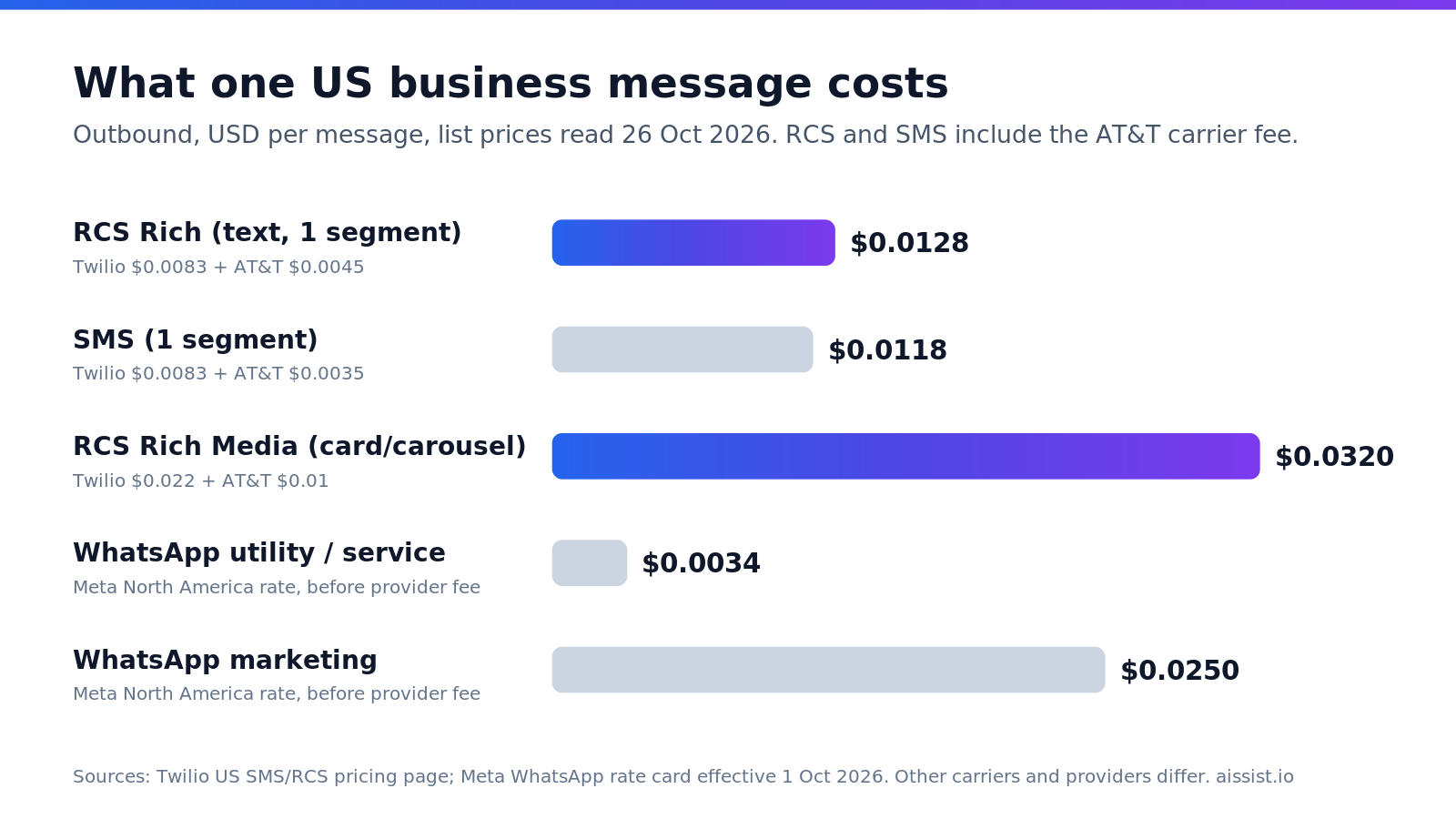
RCS business messaging puts a verified logo, rich cards and reply buttons into the phone's default messaging app, and in the US a one-segment RCS text costs $0.0128 with the AT&T fee on Twilio's US price list, against $0.0118 for an SMS.
TL;DR: RCS is priced like SMS until you add media, so pick the provider that publishes carrier fees and fallback billing; only Twilio and Telnyx list full US RCS prices, and only Vonage and Bird say how fallback is billed.
Methodology & sources
- Billing rules: Google's RCS for Business billing FAQ and US billing model.
- Provider facts: each provider's own pricing, product, docs and help pages, all read 26 Oct 2026. "Quote only" means no public price.
- Clickatell was dropped: its live pages did not confirm an RCS product. Wati and Gupshup are listed as BSPs only.
- Disclosure: this is Aissist's blog. Aissist sells AI agents that resolve conversations on top of a messaging provider; it does not sell message transport, and no provider here paid for placement.
How is RCS business messaging priced in 2026?
RCS is billed per delivered message, by message type, at rates the carriers set; providers add their own fee on top. Google's US billing model, live since 15 July 2025, has two business-sent types: a Rich message (text, suggested replies, dial and open-URL buttons) billed per 160-byte segment, and a Rich Media message (any card, carousel, file or other action) billed as one flat event.
Outside the US, Google's standard model uses non-conversational messages plus 24-hour conversations: if a user replies within 24 hours, the exchange bills as one conversation instead of message by message. Charges are recorded at delivery, not send, and Google states that carriers decide whether user replies are charged.
The practical consequence: a plain RCS text is SMS-priced, and the rich card is where the money goes. A Sinch support article adds a trap worth knowing: the billing category is chosen when the agent is created, and changing it later can mean un-launching the agent. Choose the billing category with the same care as the logo.
What does the RCS verification process actually require?
Every sender needs brand verification plus launch approval from Google, each carrier, or both, before it can message real users. Google's brand verification page requires a named brand representative, not a distribution list, to confirm the agent and the sender's right to run it.
The launch request declares one use case (OTP, transactional, promotional or multi-use) and supplies a message-by-message transcript or preview video, STOP handling, a working website, and live privacy and terms links. Bandwidth's registration checklist shows the asset specs: a 224×224 px logo, a 1440×448 px banner and a 40-character display name.
Timelines vary more than prices. Google says Google-managed launches take 1–3 business days, but carrier-managed networks set their own pace, and some demand a direct contract. Twilio's onboarding docs tell customers to allow four to six weeks or longer; Wati's help centre quotes 6–8 business days. In the US, The Campaign Registry now runs RCS campaign vetting, describing it as the RCS equivalent of 10DLC.
"…streamlining the lengthy and cumbersome brand registration process" — Kunal Puri, Founder, Smobi, on Vonage, Vonage customer story
Where does RCS reach, and what happens when it doesn't?
RCS reaches Android users on enabled carriers and iPhone users on iOS 18.1 or later where the carrier has switched it on; everyone else needs SMS fallback. Twilio notes that iOS 18.1 added business RCS, and the longest published country lists run to 23 at Twilio, 25 at Sinch and 27 at Infobip.
Fallback is the line item most providers leave blank. Vonage charges nothing extra for failover and bills the channel that actually delivered; Bird's docs say fallback messages pay the SMS rate. Everyone else offers fallback without publishing how it bills, which is fine until the invoice arrives.
The reason to tolerate any of this is engagement. Fresha's RCS appointment messages reached a 41.3% read rate and 99.2% delivery, according to a Twilio-published release.
"When messages come from a verified, recognisable Fresha brand, people engage more because they know it's genuine." — Jeremy Miller, Head of Product, Fresha, Twilio press release
How do RCS messaging providers compare?
Only two of nine RCS messaging providers publish a complete US price, so the comparison turns on disclosure as much as cost. Each row reflects the provider's own pages.
| Provider | Carrier coverage | Verified-sender process | Per-message pricing (Oct 2026) | Rich-card tiers | SMS-fallback billing |
|---|---|---|---|---|---|
| Bird | US: AT&T, T-Mobile, Verizon live; Brazil live | Verify sender, add payment method | From $0.005/msg + carrier fees (docs); pricing page says custom quote | One rate | Billed at SMS rate |
| Esendex | Not listed | Google accredited partner onboarding | Quote only | Basic / Single / Conversational | Not published |
| Gupshup | ~50 operators for RichOTP | Business verified before sending | Not published | Cards, carousels | Not published |
| Infobip | 27 countries | Business ID (EIN, UK CRN) | Quote only | Basic = Rich, Single = Rich Media | Not published |
| Prelude | 230+ countries, all channels | Not described | €0.032/verification + messages at cost | OTP-focused | Not published |
| Sinch | 25 countries | Google- or carrier-managed | $0.0078 Rich, $0.0188 Rich Media, international; domestic quote | Rich / Rich Media | Not published |
| Telnyx | 8 US carriers | Brand verified before agent | $0.0065/segment Rich, $0.016 Rich Media + carrier | Rich / Rich Media | Not published |
| Twilio | 23 countries | Per-country registration, 4–6+ weeks | $0.0083/segment Rich, $0.022 Rich Media + carrier | Rich / Rich Media | Not published |
| Vonage | UK, Germany + 10+ more | Account manager; managed accounts | Quote only; some markets add a Sender ID minimum | Basic / Rich / Rich Media | No extra charge |
The best RCS business messaging providers
Listed alphabetically; this is not a ranking.
- Bird — best for SMS-fallback cost certainty. Bird is a CPaaS provider whose RCS docs list all three big US carriers live and bill fallback at SMS rates. Its pricing page still calls RCS a private beta, so get the rate in writing.
- Esendex — best for UK teams wanting a managed onboarding. Esendex is a UK messaging provider and Google accredited partner; pricing is quote only.
- Gupshup — best for RCS OTP at near-SMS cost. Gupshup is a BSP whose RCS ebook says RichOTP runs on almost 50 operators for nearly the price of an SMS; listed as a BSP only.
- Infobip — best for wide country coverage under one contract. Infobip is a CPaaS provider listing 27 RCS countries; pricing is quote only.
- Prelude — best for verification codes routed across channels. Prelude sells verifications, not messages, at €0.032 each plus message costs at cost, per its pricing page.
- Sinch — best for retail marketing proof. Sinch is a CPaaS provider with 25 RCS countries and a published international rate card.
"Our RCS campaign click-through rate is three times higher than our classic SMS campaigns." — Caroline Dauce, Leader CRM, Chronodrive, Sinch customer story
- Telnyx — best for the lowest fully published US rate. Telnyx is a carrier-grade CPaaS provider whose pricing page lists every US RCS fee, including T-Mobile's $0.001 per MB over 5 MB.
- Twilio — best for developers already on Twilio SMS. Twilio publishes US RCS and carrier fees on one pricing page, but warns US onboarding fees apply.
- Vonage — best for predictable failover. Vonage is a CPaaS provider whose Messages API fails over to SMS natively at no extra charge; pricing is quote only.
Wati, a WhatsApp-first BSP, runs RCS in beta; treat it as a BSP option, not an RCS specialist.
What do 20,000 RCS messages a month cost?
Sending 10,000 Rich texts and 10,000 Rich Media cards a month to AT&T customers in the US costs $448 at Twilio and $370 at Telnyx, at list price. Both add the same AT&T passthrough fees: $0.0045 per Rich segment and $0.01 per Rich Media message.
| Line item (US, AT&T recipients) | Twilio (Oct 2026) | Telnyx (Oct 2026) |
|---|---|---|
| 10,000 Rich texts, one segment | $128 | $110 |
| 10,000 Rich Media cards | $320 | $260 |
| Monthly total, before onboarding fees | $448 | $370 |
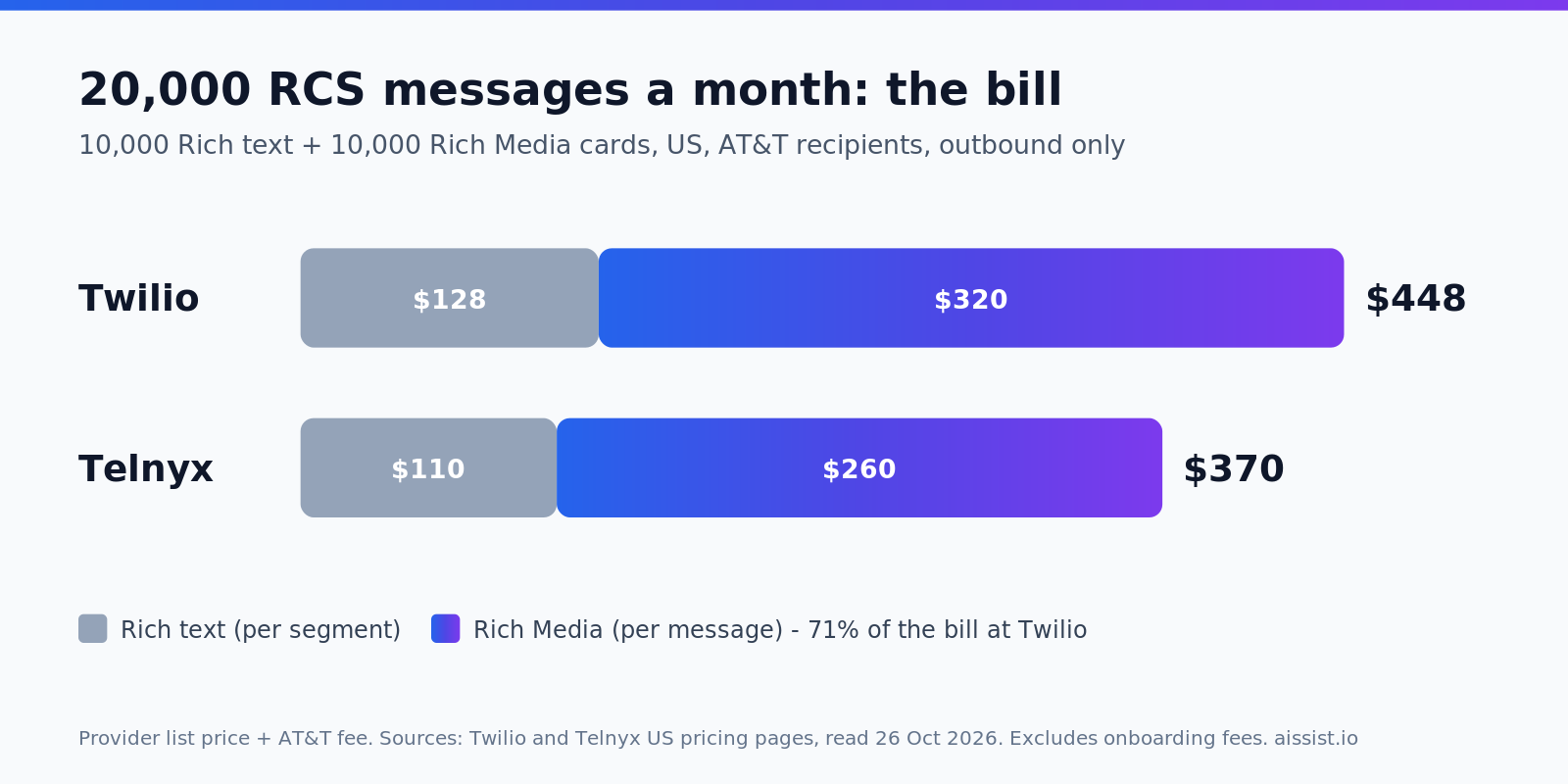
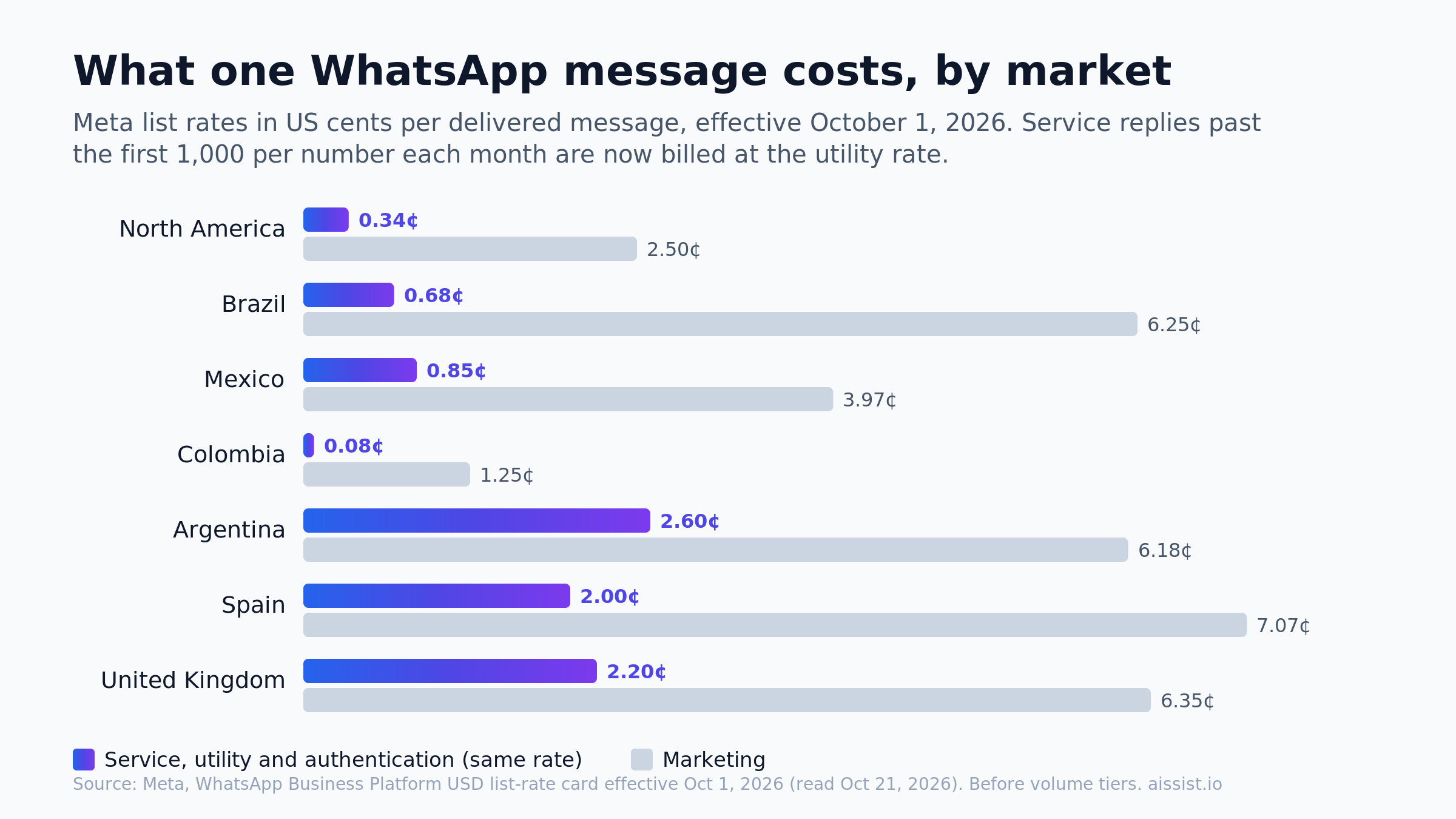
Rich Media is 71% of the Twilio bill. The same 10,000 texts sent as SMS would cost $118 at Twilio, so the text half is nearly a wash. For contrast, Meta's WhatsApp rate card charges $0.0034 per North America utility message and $0.025 per marketing message, before provider fees, as our WhatsApp Business API pricing guide details.
The message is the cheap part; answering the replies is not. Holafly, an eSIM brand, scaled sales and support with Aissist agents; Aissist reports an 83% average resolution rate and 4.8/5.0 CSAT across deployments. eSIM teams can compare figures in our eSIM customer service benchmark.
"Not only our sales and support operations increased by 3X during peak season, the CSAT improved." — Jefersson Arana, Senior Manager of AI, Holafly, Aissist customer story
Price the carrier fee and the fallback, not the headline rate
The cheapest RCS provider is the one whose full bill you can predict. Use these rules:
- If you send US volume and want list prices, choose Telnyx or Twilio, because they publish carrier fees.
- If many recipients lack RCS, choose Vonage or Bird, because they publish fallback billing.
- If you need many countries under one contract, request quotes from Infobip, Sinch and Vonage.
- If you mostly send codes, ask Prelude and Gupshup for an all-in price per code.
Whichever you pick, the transport only delivers the message; Aissist connects to the gateway you already run to automate the replies, in any language.
Frequently asked questions
Is RCS cheaper than WhatsApp for business messaging?
Usually not per message: in the US, Meta's WhatsApp rates of $0.0034 for utility and $0.025 for marketing undercut Twilio's RCS Rich text at $0.0128 and Rich Media at $0.032 with AT&T fees, before provider fees. RCS wins on reach, landing in the default messaging app.
How long does RCS verification take?
Google says Google-managed launches take 1–3 business days, but carrier-managed launches vary. Twilio tells customers to allow four to six weeks or longer.
Does RCS business messaging work on iPhone?
Yes, on iOS 18.1 or later, where the user's carrier has enabled business RCS. Other iPhones receive SMS fallback if the provider is configured for it.
Are user replies to RCS messages billed?
Sometimes. Google's billing FAQ says carriers decide whether user-sent messages are charged, and Twilio's US list price charges inbound Rich messages at $0.0083 per segment.
What is the difference between Rich and Rich Media RCS messages?
In the US, a Rich message is text with simple buttons, billed per 160-byte segment. A Rich Media message contains a card, carousel, file or other action and bills as one flat-rate message.
Changelog
- Oct 26, 2026 — Published. All pricing and coverage checked October 26, 2026.