WhatsApp Business API Pricing in 2026: Meta's Rates, Provider Fees, and the End of Free Support
WhatsApp Business API pricing has two layers: Meta's per-message rate, which is identical through every provider, and the provider's own fee on top. Since October 1, 2026, the first layer reaches customer-support replies too.
TL;DR: Meta's October 2026 rate card charges service replies past 1,000 per number at the utility rate ($0.0068 in Brazil), so a provider's billing unit now moves a support budget more than its template markup does.
Methodology & sources
- Meta rates: Meta's USD list-rate card effective October 1, 2026, linked from Meta's WhatsApp pricing documentation. All rates are USD per delivered message, before volume tiers.
- Provider fees: each provider's own pricing page, help center or product page. Where a fee is not published, it is marked "not published."
- Quotes: named customers in vendor-published case studies.
- All figures verified October 21, 2026.
- Disclosure: this is Aissist's blog. Aissist sells AI agents that resolve support conversations on top of a WhatsApp provider; it does not sell message transport, and it integrates with Wati, one of the providers below.
How does WhatsApp Business API pricing work in 2026?
WhatsApp Business API pricing is per delivered message, set by Meta, in four categories: marketing, utility, authentication and service. Meta's pricing documentation says conversation-based pricing was replaced on July 1, 2025, and that businesses pay only when a message is delivered. Customers never pay to message a business.
The categories split by who starts the exchange. Marketing, utility and authentication are templates — pre-approved messages a business can send at any time. Service messages are free-form replies, allowed only inside the 24-hour customer service window that opens each time a customer writes in.
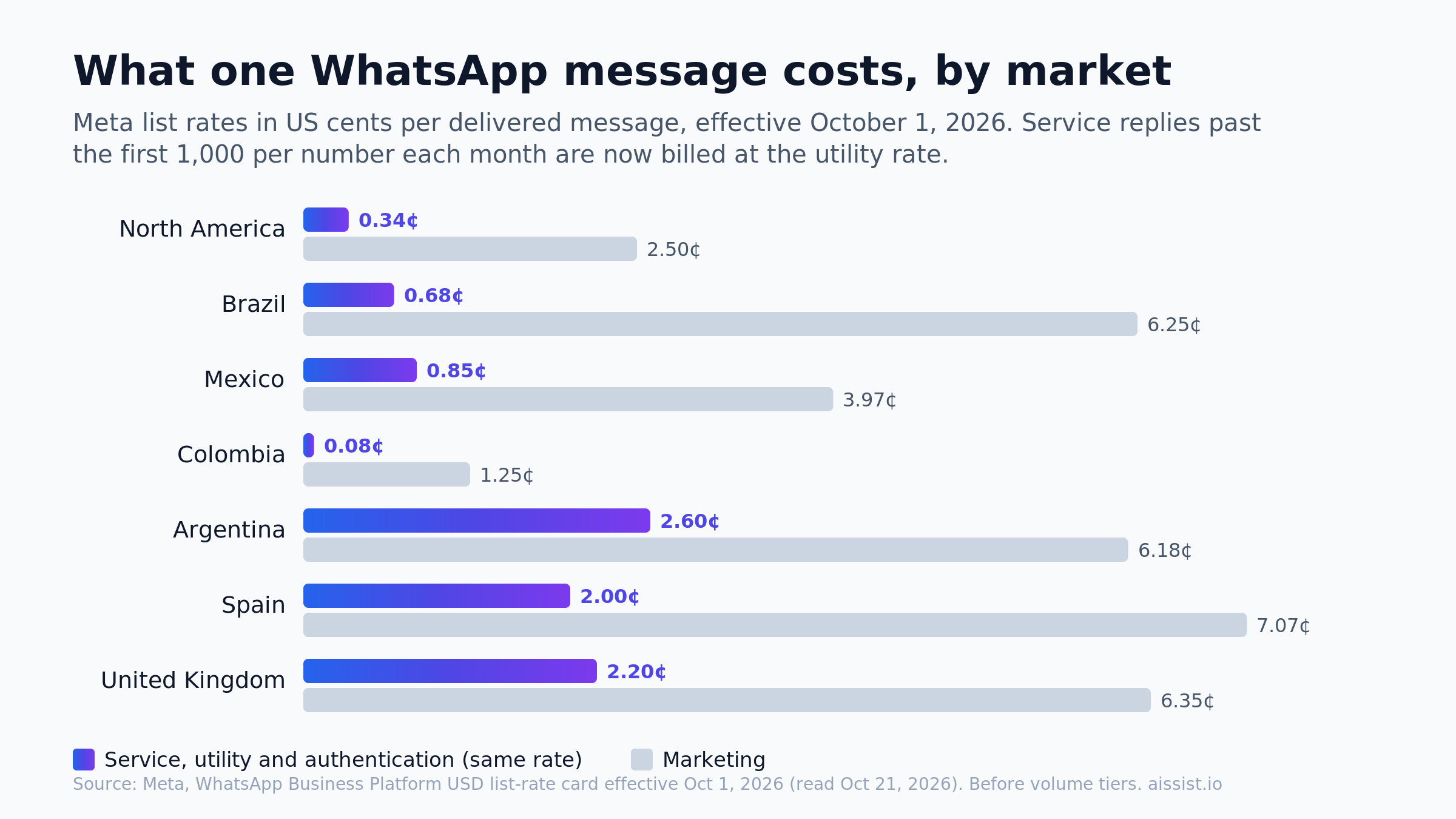
Rates vary by the recipient's country code, not your location. In Meta's October 2026 rate card, utility, authentication and service share one price in every market listed below; marketing costs two to fifteen times more.
| Market | Marketing (USD, Oct 2026) | Utility, authentication and service (USD, Oct 2026) |
|---|---|---|
| North America | $0.0250 | $0.0034 |
| Brazil | $0.0625 | $0.0068 |
| Mexico | $0.0397 | $0.0085 |
| Colombia | $0.0125 | $0.0008 |
| Argentina | $0.0618 | $0.0260 |
| Spain | $0.0707 | $0.0200 |
| United Kingdom | $0.0635 | $0.0220 |
Two discounts sit on top. Utility and authentication earn lower rates through monthly volume tiers, and a customer who arrives from a Click-to-WhatsApp ad opens a free entry point window of up to seven days, during which Meta charges nothing for most messages. Every provider gets the same Meta rate. Nobody has a secret Meta discount, whatever the sales deck implies.
Why did WhatsApp support stop being free on October 1, 2026?
From October 1, 2026, Meta gives each business phone number 1,000 free service messages a month and charges every reply after that at the market's utility rate. Meta's pricing documentation also ends the free status of utility templates sent inside an open customer service window, which had been free since July 2025. Unused free messages do not roll over.
Service messages had been free since November 2024, so most support teams never budgeted for them. That gap is now the biggest line item for anyone running support on WhatsApp. Marketing teams send fewer, pricier messages; support teams send thousands of cheap ones, and thousands of cheap things add up.
The allowance is small. A team averaging four replies per conversation exhausts 1,000 free messages in about 250 conversations — roughly a busy morning. One wording detail is worth checking with your provider: Meta counts the allowance per business phone number, while Wati's help center describes it per WhatsApp Business Account. Meta's page is the source of truth.
WhatsApp is still worth the bill for most support teams, because customers already live there.
"We only invested once in the WhatsApp channel, but could then use it in different departments, which increased our ROI." — Sebastian Obst, Team Lead Customer Service, mobilezone, Sinch customer story
Cloud API, on-premise, BSP or reseller: what are you actually buying?
In 2026 every provider sells the same Meta-hosted Cloud API; the On-Premises API stopped delivering messages when its final client expired on October 23, 2025, according to Meta's sunset notice. A pricing page that still offers "on-premise hosting" is describing a product that no longer exists.
What differs is the commercial wrapper. A Business Solution Provider (BSP) holds a direct Meta partnership and onboards your WhatsApp account itself. A reseller or software platform sells access through a partner's connection, usually bundled with an inbox, chatbot builder or campaign tool. Neither status changes Meta's rate. It changes who you call when a template is rejected, and how the provider meters your usage.
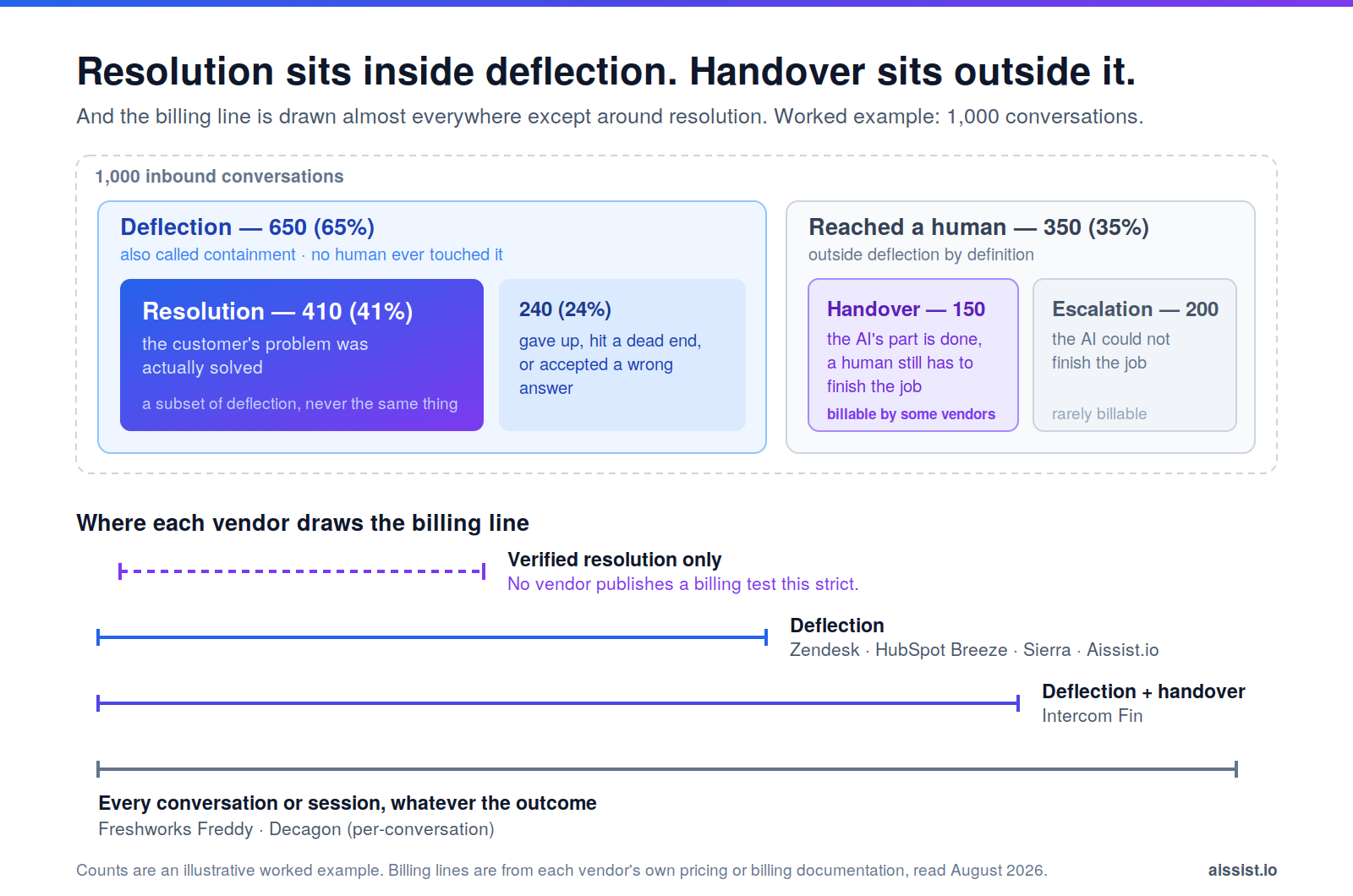
That metering is the real buying decision. Providers charge in three ways: a fee per message (some count inbound messages, some don't), a flat licence per phone number, or a monthly software plan with message credits on top. The billing unit you pick quietly decides whether a busy support month costs you a little extra or a lot.
A BSP sells transport: it gets the message to the phone. Resolving what the customer asked is a separate job, done by people or by AI agents connected to the stack you already run.
"Conversations and Answers helped us deliver a seamless customer experience over WhatsApp" — Abdullah Khan, Customer Service Team Lead, Edenred UAE, Infobip customer story
What do WhatsApp Business API providers charge on top of Meta?
WhatsApp Business API providers add between $0.0001 and $0.005 per message, a flat €49–€500 licence per number, or a $49–$299 monthly plan, on top of Meta's rates. Four of the eight publish a per-message fee; Infobip, Sinch and Wati's per-message rates sit behind a sales call or a login.
| Provider | Meta status (per provider) | Hosting | Billing unit | Template category pricing | Fee over Meta rates (Oct 2026) |
|---|---|---|---|---|---|
| 360dialog | Official Meta Solution Partner | Cloud API | Licence per number/month | Meta fees billed separately | €49 / €99 / €500 per number/month |
| Twilio | Not stated on pricing page | Cloud API | Per message, inbound and outbound | Meta template fees passed through | $0.005 per message |
| Infobip | Premier Meta Partner, BSP | Cloud API | Per message | By Meta category | Not published |
| Gupshup | Meta Business Partner | Cloud API | Per message; inbound session messages included | Meta fees "billed at actuals" | $0.001 per message |
| Sinch | Meta Premier Partner, BSP | Cloud API | Per message | Meta rate changes flow through | Not published |
| Bird | Not stated on pricing page | Cloud API | Per outbound message | By Meta category | $0.005 per outbound message (US) |
| Vonage | BSP (2023 press release) | Cloud API | Per delivered message | By Meta category | From €0.0001 per message |
| Wati | Meta Business Partner | Cloud API | Monthly plan plus message credits | By Meta category | $49 / $99 / $299 per month; message rates after login |
Sources, provider by provider:
- 360dialog — pricing page
- Twilio — WhatsApp pricing
- Infobip — WhatsApp page
- Gupshup — pricing page
- Sinch — WhatsApp page
- Bird — WhatsApp pricing; inbound is free, deposit plans $15–$500 a month
- Vonage — WhatsApp pricing
- Wati — help center; Aissist connects to Wati
What does WhatsApp cost at 20,000 support conversations a month?
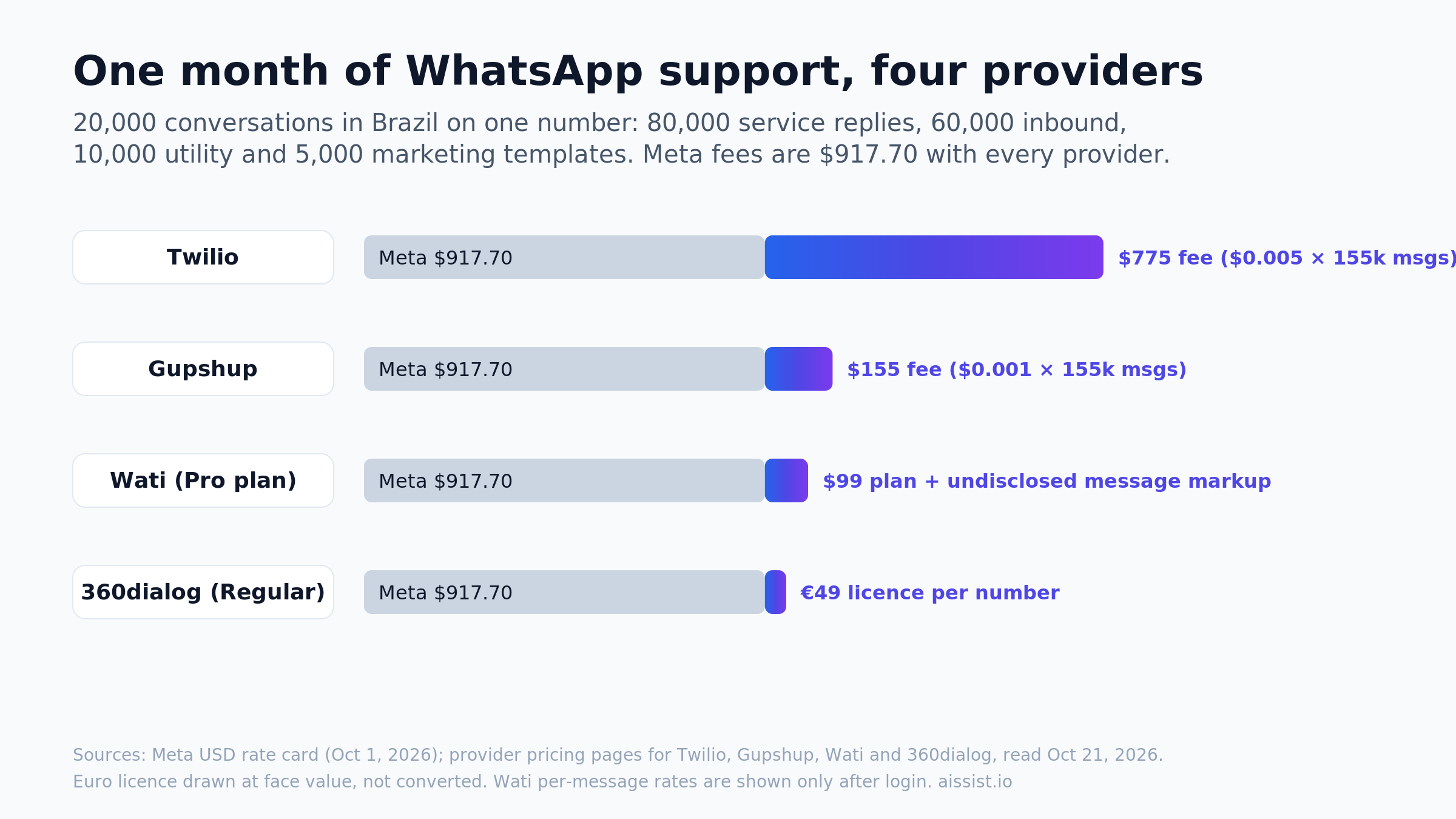
A Brazilian fintech running 20,000 WhatsApp support conversations a month on one number pays Meta $917.70 under the October 2026 rates, plus between €49 and $775 to its provider. Before October 1, those service replies would have cost nothing.
Assumptions: four business replies and three customer messages per conversation; Brazil list rates; no volume tiers.
| Line item | Calculation | Monthly cost (USD) |
|---|---|---|
| Meta: service replies | (80,000 − 1,000 free) × $0.0068 | $537.20 |
| Meta: utility templates | 10,000 × $0.0068 | $68.00 |
| Meta: marketing | 5,000 × $0.0625 | $312.50 |
| Meta subtotal (every provider) | $917.70 | |
| Twilio fee | 155,000 messages in and out × $0.005 | $775.00 |
| Gupshup fee | 155,000 messages × $0.001 | $155.00 |
| 360dialog licence | 1 number, Regular plan | €49 |
| Wati Pro plan | Plan only; message markup not public | $99.00 |
The comparison flips with the workload. Per-message fees punish chatty support threads, because every inbound "thanks!" is metered; flat licences punish teams spread across many numbers.
The cheapest reply is the one you never send. A conversation resolved in four messages costs less than one passed between three agents in nine, and since October Meta bills every extra reply. Aissist reports an 83% average resolution rate and 4.8/5.0 CSAT for its AI agents; whatever tool you use, count replies per resolution. Our eSIM customer service benchmark shows where travel brands' replies go wrong.
"Not only our sales and support operations increased by 3X during peak season, the CSAT improved." — Jefersson Arana, Senior Manager of AI, Holafly, Aissist customer story
The meter now runs on every reply, so price the provider by how you support
The provider choice comes down to three rules:
- If your WhatsApp traffic is mostly support replies, choose a flat licence or a low per-message fee, because inbound messages multiply per-message costs.
- If you send campaigns more than you answer questions, compare marketing rates and volume plans, because Meta's marketing rate dominates the bill.
- If you need a shared inbox and campaign tools in one place, a plan like Wati's can beat raw API pricing, because the software is bundled.
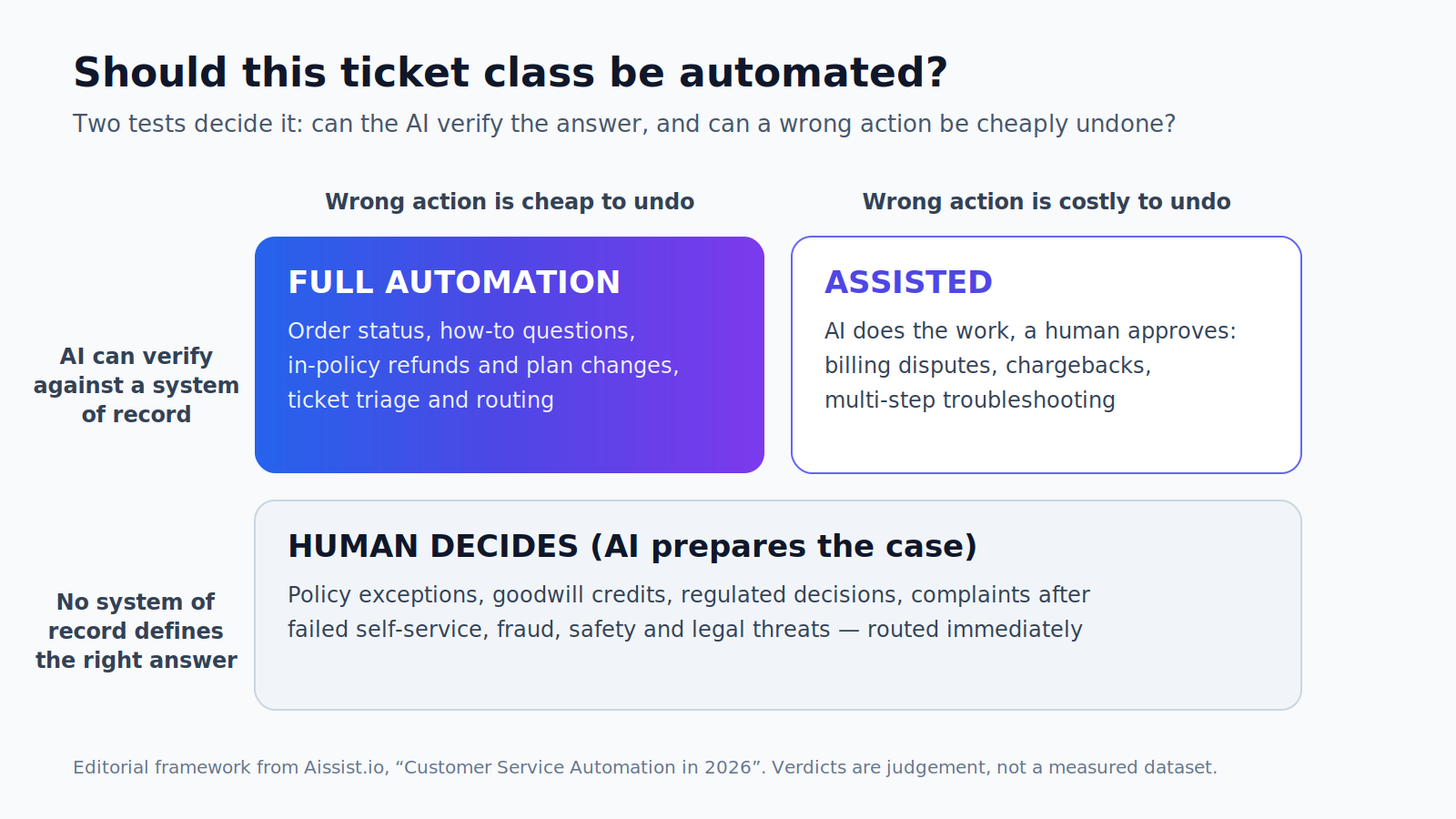
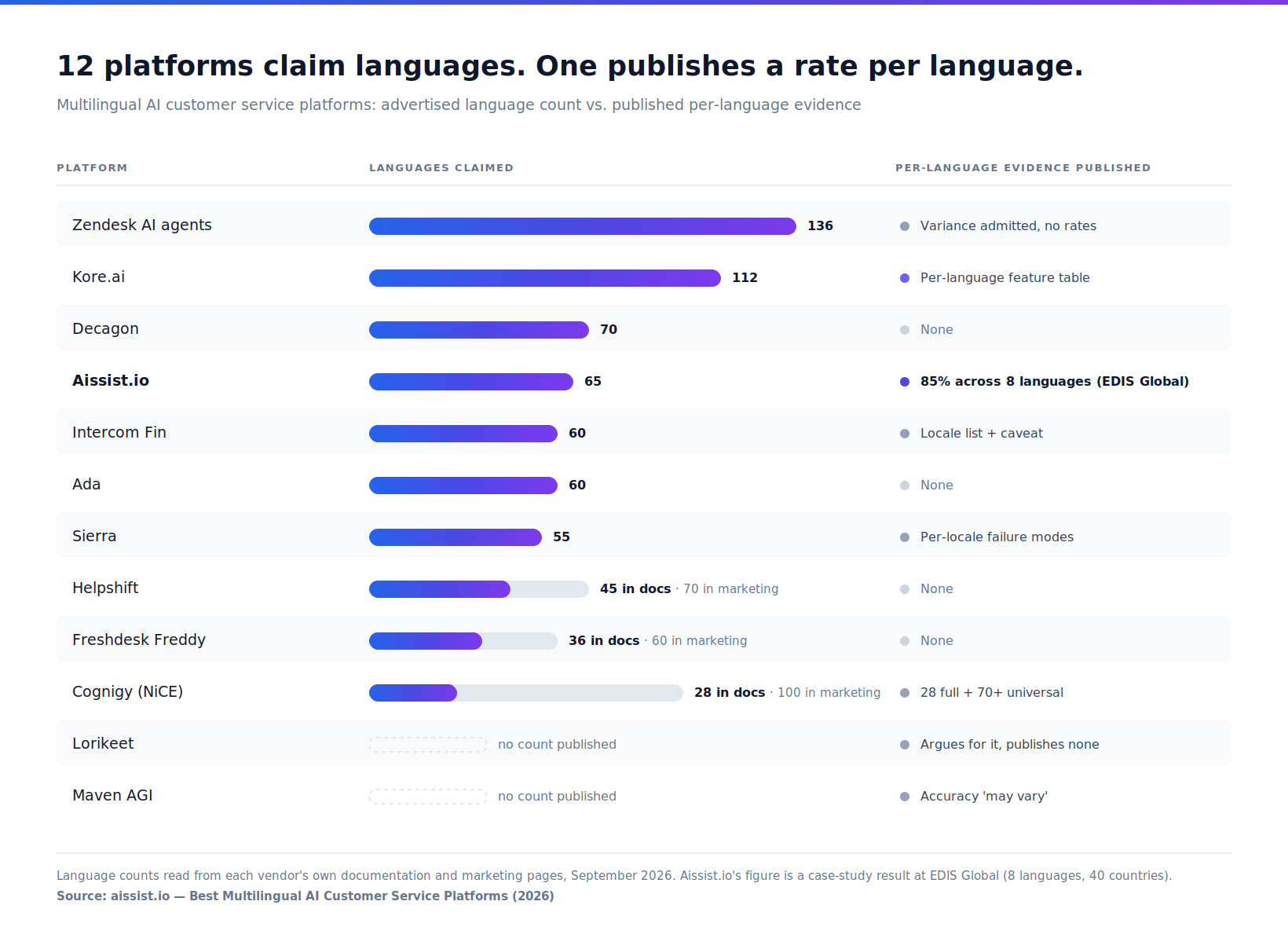
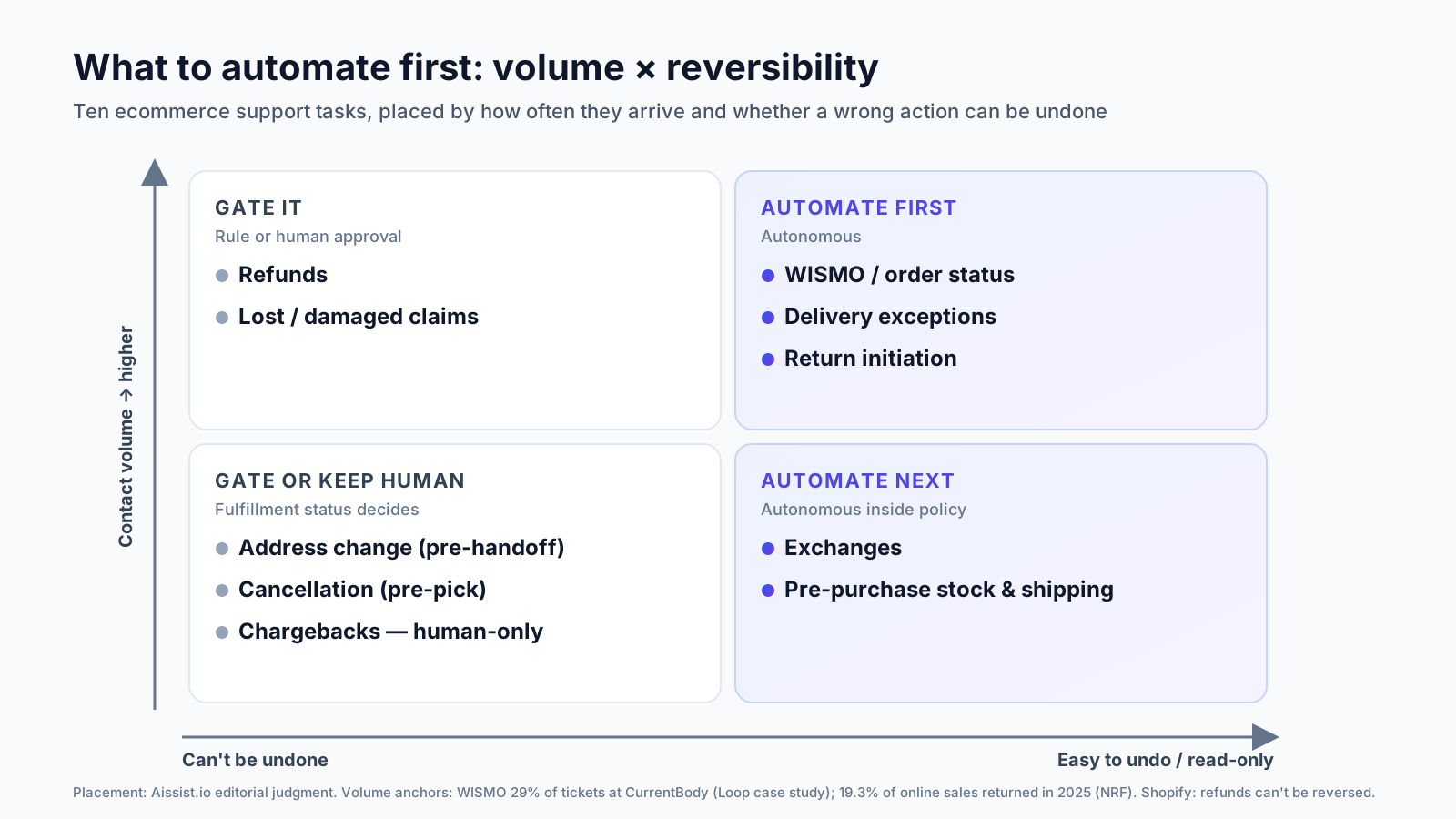
Then shrink the message count itself: automate the repetitive conversations and support every language your customers write in, so each resolution needs fewer replies.
Frequently asked questions
Does WhatsApp charge per message or per conversation?
WhatsApp charges per delivered message. Meta replaced conversation-based pricing with per-message pricing on July 1, 2025, and rates depend on the message category and the recipient's country.
Are WhatsApp service messages free in 2026?
Only the first 1,000 per business phone number each month. From October 1, 2026, Meta charges further service replies at the market's utility rate, for example $0.0034 in North America and $0.0068 in Brazil.
Is the WhatsApp Cloud API free?
Access is free from Meta, but messages are not. You pay Meta's per-message rates, plus any provider fee if you connect through a BSP or software platform rather than directly.
Do all providers pay the same Meta rates?
Yes. Meta's rates are the same through every provider; the differences come from each provider's own fee, licence or plan and from Meta's volume tiers.
Can I still use the WhatsApp On-Premises API?
No. The final On-Premises API client expired on October 23, 2025, and numbers still registered to it no longer deliver messages. Every provider now uses Meta's Cloud API.
Which WhatsApp provider is cheapest for ecommerce support?
For reply-heavy support, a flat per-number licence or a sub-cent per-message fee usually wins. Model your inbound volume first; for ecommerce workflows, see where AI agents start.