Every vendor page checked 20 Nov 2026.
- Amdocs connectX: best full SaaS stack from a tier-1 vendor
- Qvantel Flex Suite (with Optiva): best for MVNEs hosting many brands
- LotusFlare DNO Cloud: best for eSIM-first digital brands
- Totogi: best when you only need charging
- Telgoo5: best for small and mid-size MVNOs
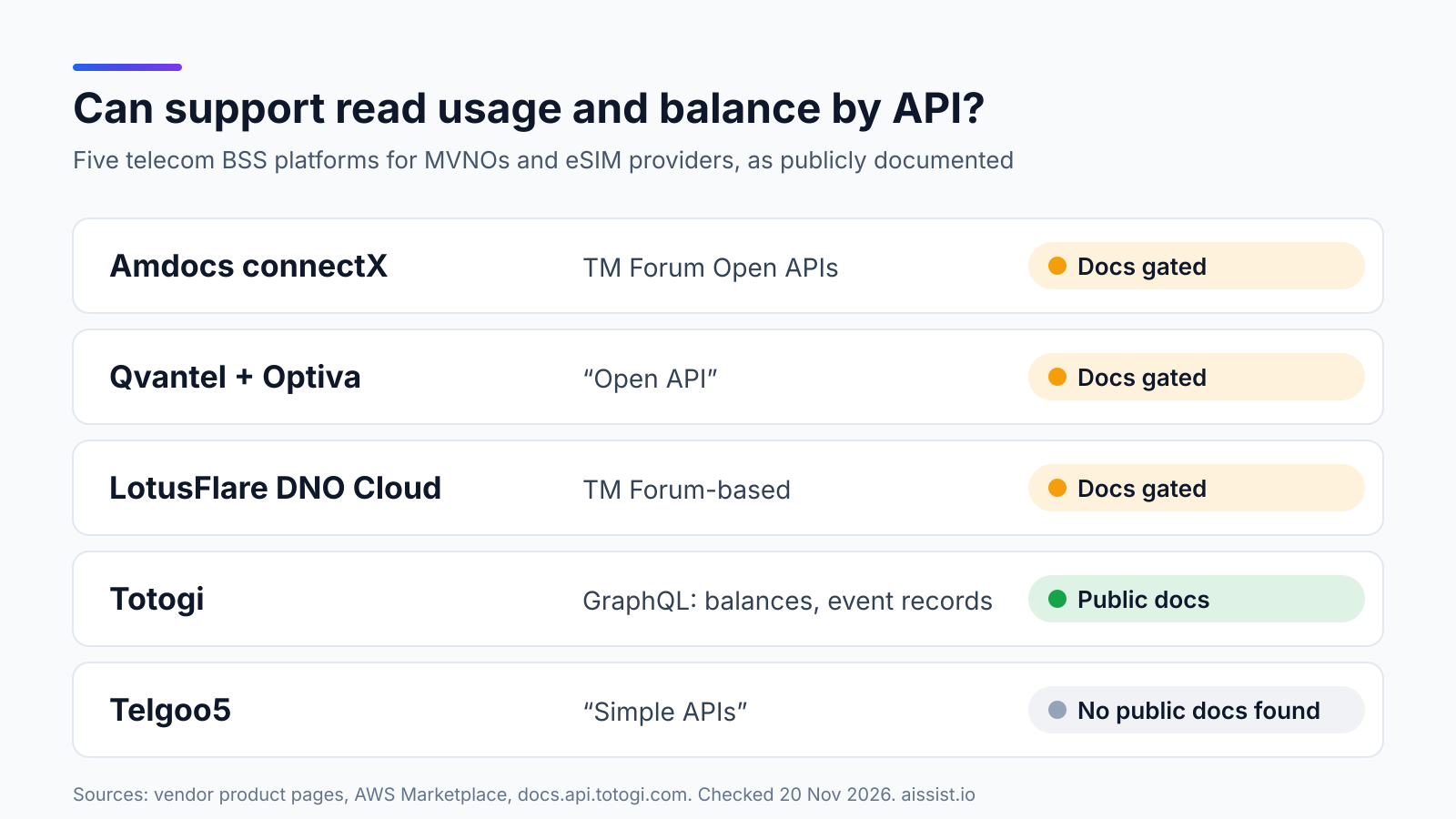
TL;DR: All five platforms say they rate in real time. Only Totogi publishes a public API reference for reading balances and usage records, and that API is what lets a support agent answer "why did my data stop" without logging into the back office.
How we compared these telecom BSS platforms
We read vendor pages, marketplace listings and press releases, checking six things: real-time rating, eSIM orchestration, data-pack rating, multi-IMSI, roaming settlement, and whether usage, balance and top-up state is readable by API. "Not stated" means no public claim, not a missing feature. We skip ratings: G2's new Telecom Operations category has 21 products, and Amdocs has one review there.
Disclosure: this is Aissist's blog. We sell AI support agents, not BSS, and none of these vendors sells an AI support agent.
What is a telecom BSS platform?
A telecom BSS platform is the software that sells, rates, charges and bills a mobile service: catalog, orders, balances, invoices and payments. It creates most of an MVNO's support tickets and answers none of them.
The 5 platforms at a glance
| Platform | Real-time rating | eSIM orchestration | Multi-IMSI | Usage/balance API | Price (Nov 2026) |
|---|---|---|---|---|---|
| Amdocs connectX | Stated | Stated (MVNO&GO) | Not stated | TM Forum Open APIs, docs gated | Setup fee + per subscriber; no figure |
| Qvantel + Optiva | Stated | Not stated | Not stated | "Open API," docs gated | Quote only |
| LotusFlare DNO Cloud | Stated (converged) | Stated | Not stated | TM Forum-based, docs gated | Quote only |
| Totogi | Stated | Not offered | Not offered | Public GraphQL docs | Free to 500M transactions/mo |
| Telgoo5 | Stated (≤250 ms) | Stated | Stated | "Simple APIs," no public docs found | Quote only |
No vendor publicly states MVNO roaming settlement, so that column is dropped.
1. Amdocs connectX — best for a full SaaS stack from a tier-1 vendor
Amdocs connectX is a pre-integrated SaaS BSS for MVNOs and digital brands, covering customer management, commerce and real-time charging. Amdocs lists a minimal setup fee plus per-subscriber pricing; its MVNO&GO bundle adds eSIM management. Users include AT&T and Consumer Cellular.
- Pros: tier-1 depth; TM Forum APIs
- Cons: no published price; data-pass rating not stated
"…relying on a robust platform to manage the complexity behind the scenes." — Daniel Barsoum, CEO, Qué tal Móvil, via Amdocs
Our take: safe for a funded launch. Skip it if you need pricing before the first call.
2. Qvantel Flex Suite — best for MVNEs hosting many brands
Qvantel Flex Suite is a convergent BSS suite that MVNEs resell to their MVNOs, now including the Optiva Charging Engine. Qvantel completed its acquisition of Optiva on 31 December 2025. When we checked, optiva.com's MVNO Hubs page redirected to Qvantel. Competing roundups still list Optiva as standalone.
- Pros: proven charging engine; multi-brand MVNE model
- Cons: roadmap still merging; eSIM not stated
Our take: strong for an MVNE. Skip it if you want a settled roadmap.
3. LotusFlare DNO Cloud — best for eSIM-first digital brands
LotusFlare DNO Cloud is a cloud-native digital BSS covering catalog, orders, converged charging, billing and eSIM orchestration. It runs MTN South Africa's app-only brand Pi, and LotusFlare owns Nomad, a travel eSIM store, so it sells data passes itself.
- Pros: eSIM is built in; it runs its own data-pack business
- Cons: pricing not published; API docs not public
Our take: the closest fit for travel eSIM. Skip it for voice-heavy postpaid.
4. Totogi — best when you only need charging
Totogi Charging-as-a-Service is a multi-tenant, real-time charging engine sold as SaaS on AWS, with a plan-design tool for building data packs. Its AWS Marketplace listing is free up to 500 million transactions a month, private pricing above. Its public API reference exposes balance and event-record queries; we found no top-up query.
"Totogi's SaaS-based charging platform has transformed how we operate our wholesale business." — Chris Bradley, Head of Digital Architecture, 2degrees, via TelecomTV
- Pros: published price; open balance API
- Cons: charging only, so you bring your own CRM and eSIM
Our take: ideal under an existing stack. Skip it if you want one vendor for everything.
5. Telgoo5 — best for small and mid-size MVNOs
Telgoo5 is a cloud-native BSS and online charging system for MVNOs, covering billing, CDRs, payments and CRM. Telgoo5 claims 75+ MVNOs, 12M+ subscribers and OCS responses of 250 ms or less. Its MVNO Index profile lists eSIM, iSIM and multi-IMSI.
- Pros: built for MVNOs; multi-IMSI stated
- Cons: no public API docs; no published price
Our take: practical if you want one throat to choke. Skip it if support needs documented APIs.
How to choose an MVNO billing platform
- If you sell travel eSIM, choose LotusFlare, because orchestration and data passes are native.
- If you host several brands, choose Qvantel or Totogi, because each brand gets a tenant.
- If support will be automated, demand usage, balance and top-up API docs before signing.
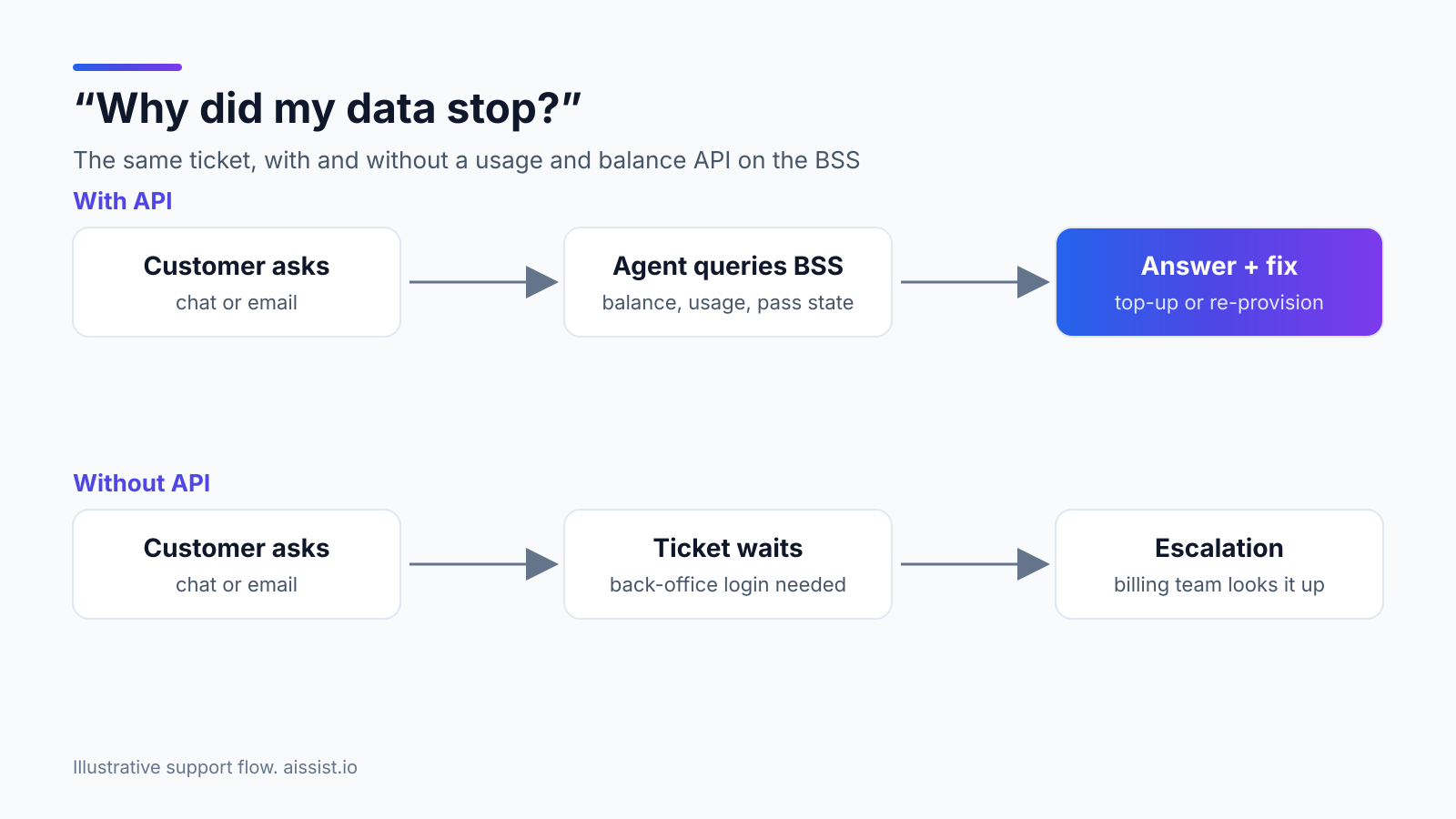
The API is the feature, not the rating speed
Real-time rating is table stakes; the difference is whether that data leaves the building. Get the balance-API docs first, then compare the eSIM platforms and eSIM support benchmarks that sit on top.
Frequently asked questions
What's the difference between a BSS and an OCS?
An OCS rates and charges usage in real time. A BSS also covers catalog, orders, billing, payments and customer records.
Is telecom BSS different from subscription billing software?
Yes. Telecom BSS rates network usage like data, minutes and roaming. Tools like Chargebee bill plans. See our subscription billing comparison.
What is a BSS for an MVNE?
A multi-tenant BSS one enabler runs for many MVNO brands, each controlling its own plans and pricing.
Changelog
- 20 Nov 2026 — Published; Optiva listed under Qvantel.